
Forklift Operator Skills: Complete Career Guide to Training, Certification, and Job Duties
Master forklift operator skills with our complete guide. Covers training, certification, job duties, and salary data. ✅ Real tips for US workers.

Forklift operator skills are the foundation of a stable, well-paying career in warehousing, logistics, manufacturing, and construction. Whether you are considering entering the trade for the first time or you are an experienced worker looking to sharpen your resume, understanding what employers expect from a qualified forklift operator is essential.
From safe load handling and pre-shift inspections to mastering electric forklift controls and stand up forklift techniques, the skill set required is broader than many job seekers assume. The demand for certified operators continues to grow as e-commerce and supply chain expansion push warehouses to hire qualified staff at record rates.
The certification of forklift operators is governed primarily by OSHA standard 29 CFR 1910.178(l), which requires that every powered industrial truck operator receive formal classroom instruction, hands-on training, and an employer-conducted evaluation before operating any equipment independently. This is not optional: OSHA inspectors can issue citations and substantial fines when operators work without documented certification. Understanding the regulatory framework helps you approach forklift training with the seriousness it deserves and ensures you will never be caught off-guard during a worksite audit.
Beyond regulatory compliance, strong forklift operator skills translate directly into job security and earning potential. Certified operators in the United States earn an average of $19 to $24 per hour, with experienced specialists running reach trucks, order pickers, or rough-terrain forklifts commanding even higher rates. Employers who invest in forklift training for their workforce see measurable reductions in product damage, workplace injuries, and equipment repair costs, which is why companies prioritize candidates with verifiable credentials when filling open positions.
The market for forklifts themselves is also worth understanding. Whether your employer relies on a forklift rental arrangement, owns a fleet outright, or is evaluating a forklift for sale to expand capacity, the type and condition of equipment you will operate directly affects the skills you need. Electric forklift models are increasingly common in indoor facilities because they produce zero emissions and require less maintenance, but they demand an understanding of battery care and charging cycles that differs significantly from internal combustion units.
Stand up forklift models, reach trucks, and pallet jacks are staples in high-density racking environments where narrow aisles make sit-down counterbalance units impractical. Learning to operate multiple forklift classes not only makes you more versatile but also allows you to command higher wages, take on lead operator roles, and transition more easily between industries. Many training programs now offer multi-equipment certifications in a single course sequence, maximizing your return on the time and money invested in forklift training.
This guide walks you through every dimension of forklift operator skills: the core competencies OSHA requires, the practical techniques that separate average operators from top performers, the career trajectory and salary data you can use to plan your next move, and the study resources that will help you pass your certification exam with confidence.
We have also embedded free practice quizzes throughout this page so you can test your knowledge as you read. Understanding forklift operator skills at this level of depth is the single most effective step you can take toward a long and rewarding career operating powered industrial trucks.
Forklift Operator Career by the Numbers

Core Skills Every Forklift Operator Must Have
Understanding load capacity, center of gravity, and tilt control is the most critical technical skill. Operators must calculate load weight against the data plate rating and never exceed the rated capacity, even briefly. Improper load handling accounts for the majority of forklift tip-over incidents.
OSHA requires a documented pre-shift inspection before every shift. Operators must check brakes, steering, lights, forks, hydraulic fluid levels, battery charge or fuel level, horn, and safety devices. Defective equipment must be tagged out and removed from service immediately until repaired.
Operators must constantly monitor their travel path, overhead clearances, and pedestrian zones. This includes slowing at intersections, honking at blind corners, maintaining safe following distances, and never allowing riders on equipment not designed for passengers.
Proficiency with lift, tilt, and side-shift controls allows operators to position loads precisely and safely. Understanding how hydraulic systems respond under different load weights and temperatures prevents costly mistakes such as sudden load drops or mast instability during travel.
Top operators maintain accurate inspection logs, communicate clearly with supervisors about equipment defects, and understand warehouse management system (WMS) basics. Clear verbal and written communication reduces errors, speeds up order fulfillment, and supports compliance during OSHA audits.
The forklift training and certification process in the United States follows a structured path defined by OSHA, but employers have significant flexibility in how they implement it. Training must cover formal instruction — which can be delivered in a classroom, online, or through video — as well as hands-on practical training with the specific type of equipment the operator will use.
An evaluation conducted by a qualified trainer must document that the operator can safely perform all required tasks before they begin working independently. Online components have become increasingly popular because they allow trainees to complete the classroom portion at their own pace before arriving on-site for the practical segment.
OSHA does not issue or recognize a universal forklift license or certification card. Instead, the employer is responsible for maintaining documentation of each operator's training, including what topics were covered, when the training took place, and who conducted the evaluation.
This means that a forklift certification completed at one employer may not automatically transfer to a new employer — you may need to be re-evaluated on the specific equipment and conditions at the new worksite. Understanding this distinction is important when you are job searching: a certificate from a third-party training provider demonstrates baseline knowledge, but expect your new employer to conduct a site-specific evaluation before you operate independently.
Third-party training providers offer a practical advantage: their certificates are widely recognized, often last three years, and can be referenced on a resume as tangible evidence of your qualifications. Programs typically run four to eight hours and cover OSHA regulations, equipment inspection, load handling theory, and supervised practical driving. Costs range from $50 to $200 depending on location, program depth, and whether the course includes multiple equipment classes. Many community colleges, vocational schools, and large forklift rental companies offer on-site or mobile training programs that come directly to your employer's facility.
Recertification is required every three years under OSHA guidelines, or sooner if an operator is observed operating unsafely, is involved in a near-miss or accident, or returns to work after an extended absence. Employers who let recertification lapse face OSHA citations and, more importantly, expose themselves and their employees to significant injury risk. If you track your own recertification dates and proactively remind your supervisor when renewal is approaching, you demonstrate the kind of professionalism that leads to advancement opportunities and long-term job security.
Different equipment classes require separate training and evaluation. The seven OSHA classes of powered industrial trucks include Class I electric counterbalanced rider trucks, Class II narrow-aisle trucks such as reach trucks and order pickers, Class III electric hand trucks and pallet jacks, Class IV internal combustion cushion-tire trucks, Class V internal combustion pneumatic-tire trucks, Class VI electric and internal combustion tow tractors, and Class VII rough-terrain forklift trucks.
Each class has distinct operating characteristics, and operators who earn certification across multiple classes significantly increase their market value. Many experienced operators eventually certify on three or four classes, making them highly sought-after in regional job markets.
Forklift training programs increasingly incorporate simulation technology, which allows trainees to practice emergency scenarios — tip-overs, pedestrian conflicts, load drops — without any physical risk. While simulation cannot fully replace real equipment time, research shows that simulation-trained operators demonstrate better hazard recognition and faster reaction times in their first weeks on the job.
If your training program offers a simulation component, take full advantage of it. Those hours in a virtual cab translate directly into safer, more confident real-world operation. For workers on the certification of forklift journey, combining online coursework, simulation, and hands-on evaluation is the gold standard preparation approach available today.
Once certified, the smartest thing any operator can do is keep learning. Attend every safety meeting, ask experienced colleagues about edge cases they have encountered, and read OSHA guidance updates when they are published. The operators who build the strongest careers are those who treat certification not as a finish line but as a starting point for ongoing professional development. From there, pursuing lead operator, trainer, or fleet supervisor roles becomes a natural progression that can significantly increase both your income and your job satisfaction.
Forklift Types: Electric, Stand Up, and Rental Options
Electric forklift models have become the industry standard for indoor warehouse operations across the United States. They produce zero exhaust emissions, operate significantly more quietly than internal combustion units, and require far less maintenance because they have fewer moving engine components. Modern electric forklifts offer lift capacities from 3,000 to 12,000 pounds and can run a full eight-hour shift on a single battery charge when properly maintained and driven efficiently.
Battery management is the most critical skill specific to electric forklift operation. Operators must understand opportunity charging versus full charge cycles, electrolyte level maintenance on flooded lead-acid batteries, and proper watering procedures. Lithium-ion battery systems are now entering the market and largely eliminate watering requirements, but they carry higher upfront costs. Regardless of battery type, operators who understand how charging habits affect battery lifespan will be valued by employers who track total cost of ownership on their equipment fleets.

Pros and Cons of a Forklift Operator Career
- +Strong, consistent demand across warehousing, manufacturing, construction, and retail distribution industries
- +Entry-level certification is achievable in as little as one day of training and evaluation
- +Median hourly wages of $19 to $24 per hour with overtime opportunities in peak seasons
- +Multi-class certification significantly increases earning potential and job portability across regions
- +Clear advancement path to lead operator, trainer, fleet supervisor, and warehouse manager roles
- +Physical activity on the job reduces sedentary health risks compared to desk-based careers
- −Physical demands — vibration, repetitive motion, and awkward postures — can cause musculoskeletal strain over time
- −OSHA certification does not transfer automatically between employers, requiring re-evaluation at each new worksite
- −Shift work is common, including nights, weekends, and holidays in 24/7 distribution center environments
- −High-stakes safety environment means that a single mistake can result in serious injury or property damage
- −Recertification every three years adds ongoing time and cost that operators must track independently
- −Automation and robotics are beginning to replace some repetitive pallet-moving tasks in highly automated facilities
Pros and Cons at a Glance
| Pros | Cons |
|---|---|
| Strong, consistent demand across warehousing, manufacturing, construction, and retail distribution industries | Physical demands — vibration, repetitive motion, and awkward postures — can cause musculoskeletal strain over time |
| Entry-level certification is achievable in as little as one day of training and evaluation | OSHA certification does not transfer automatically between employers, requiring re-evaluation at each new worksite |
| Multi-class certification significantly increases earning potential and job portability across regions | High-stakes safety environment means that a single mistake can result in serious injury or property damage |
| Clear advancement path to lead operator, trainer, fleet supervisor, and warehouse manager roles | Recertification every three years adds ongoing time and cost that operators must track independently |
| Physical activity on the job reduces sedentary health risks compared to desk-based careers | Automation and robotics are beginning to replace some repetitive pallet-moving tasks in highly automated facilities |
Daily Pre-Shift and Safety Checklist for Forklift Operators
- ✓Inspect forks for cracks, bends, or excessive wear before every shift and document findings on the inspection log.
- ✓Check hydraulic fluid level and inspect hoses for leaks, cracks, or signs of abrasion along the entire mast assembly.
- ✓Test all brakes — service brake, parking brake, and inching pedal — at low speed before entering the work area.
- ✓Verify that the horn, backup alarm, and all lights are functioning and audible from at least 20 feet away.
- ✓Confirm battery charge level or fuel level is sufficient for the planned shift without mid-shift interruption.
- ✓Inspect the overhead guard and load backrest extension for structural integrity and secure mounting.
- ✓Check tire condition and inflation pressure, looking for cuts, chunking, or abnormal wear patterns on pneumatic tires.
- ✓Review the data plate to confirm rated capacity for all attachments currently mounted on the truck.
- ✓Ensure all required safety labels and OSHA-required data plates are legible and securely attached to the equipment.
- ✓Report any defects to your supervisor immediately and tag the equipment out of service before the shift begins.
Operators certified on 3+ equipment classes earn 18–25% more on average
According to industry compensation surveys, forklift operators who hold certifications across multiple OSHA equipment classes — for example, Class I counterbalanced, Class II reach trucks, and Class III pallet jacks — earn significantly higher hourly wages than single-class operators. Employers value versatility because it reduces scheduling complexity, covers absences, and allows facilities to run leaner staffing models. Investing one to two additional training days to earn extra class certifications is one of the highest-return moves available in this career.
A career as a forklift operator offers a clear and achievable salary progression that rewards experience, additional certifications, and specialized equipment knowledge. Entry-level operators with a fresh certification of forklift typically start in the range of $16 to $18 per hour, which already places them above the federal minimum wage and comparable to many office support roles that require two or more years of college. Within the first two to three years, operators who build a clean safety record and demonstrate reliability can expect to reach $20 to $22 per hour at most large distribution centers and manufacturing plants.
Senior forklift operators who have mastered multiple equipment classes, including electric forklift and stand up forklift models, and who take on mentoring responsibilities for new hires, often earn $23 to $27 per hour or more in high-cost-of-living metro areas. Facilities in the Pacific Northwest, the San Francisco Bay Area, and the Northeast tend to pay at the top of this range, while rural Midwest and Southeast markets tend to cluster toward the median. Unionized environments, particularly in grocery distribution and automotive manufacturing, can push total compensation even higher through overtime provisions and shift differentials.
Beyond base wages, experienced operators frequently access profit-sharing programs, quarterly safety bonuses, and tuition reimbursement for additional certifications. Some employers offer a direct pathway from lead operator to warehouse supervisor — a salaried role that typically pays $55,000 to $75,000 annually — making forklift operation a genuine on-ramp to warehouse management rather than a ceiling position. The key to unlocking these opportunities is a combination of consistent safe performance, willingness to cross-train on new equipment, and proactive communication with supervisors about your career goals.
The forklifts industry is evolving rapidly, and operators who stay current with emerging equipment technology will find their skills in growing demand. Electric forklift adoption is accelerating as facilities move toward zero-emission indoor environments and as lithium-ion battery costs continue to fall. Operators who understand energy management, battery monitoring systems, and the performance differences between lead-acid and lithium-ion packs are positioned at the leading edge of the industry. Similarly, as automated guided vehicles (AGVs) and robotic systems are deployed alongside human operators, workers who can collaborate with automated equipment — monitoring, exception-handling, and coaching the systems — will become indispensable.
Geographic mobility is another career accelerator that forklift operators often underestimate. Because OSHA training requirements are nationally uniform and third-party certifications are broadly recognized, a certified operator can relocate to any state and be working within days of arrival. Major logistics hubs — Louisville, Memphis, Dallas-Fort Worth, Chicago, and the Inland Empire in Southern California — consistently show strong demand for experienced operators and often offer relocation incentives or sign-on bonuses during peak hiring periods. If you are willing to follow the work, salary gains of 15 to 25 percent from a strategic relocation are realistic.
Industry sectors also affect earning potential significantly. Operators in cold storage and frozen food distribution earn a premium — typically $1 to $3 per hour above ambient-temperature equivalents — to compensate for the challenging working conditions. Aerospace, automotive, and semiconductor manufacturing facilities, which handle high-value components requiring exceptional precision and zero damage tolerance, also pay above-market rates. If you have a background or interest in any of these industries, targeting forklift operator positions within them can substantially accelerate your total compensation growth compared to general warehousing environments.
For operators weighing whether to invest in training now or wait for an employer to pay for it, the math is clear. Even at the low end of the entry-level wage range, a newly certified operator recoups a $150 to $200 training investment within the first shift at the higher wage their certification unlocks.
The certification of forklift process pays for itself immediately, and the compounding effect of higher starting wages, faster advancement, and access to overtime — which in unionized facilities is calculated on the full hourly rate including all differentials — makes early investment the universally correct financial decision for anyone serious about this career path.

Many new operators assume that a forklift certification earned at one employer is valid everywhere. Under OSHA 29 CFR 1910.178(l), your new employer must evaluate you on their specific equipment and operating conditions before you work independently — even if you have years of certified experience. Always carry documentation of your prior training, but expect and cooperate with site-specific evaluations at every new employer. Refusing or skipping this step creates serious liability for both you and the company.
Preparing effectively for your forklift certification exam and practical evaluation requires a focused study strategy that covers both regulatory knowledge and equipment-specific techniques. The written or oral knowledge test that most training programs include assesses your understanding of OSHA regulations, load handling principles, stability triangles, inspection procedures, and hazard recognition. Many candidates underestimate the depth of this component and show up expecting a brief quiz, only to encounter detailed questions about data plate interpretation, maximum load capacity calculation at extended load centers, and specific prohibited practices under OSHA standards.
The stability triangle is one of the most frequently tested concepts on forklift certification exams. A counterbalanced forklift's stability depends on the triangle formed between the two front wheels and the single rear axle pivot point.
When a load is picked up, the center of gravity shifts forward; if it shifts beyond the front axle line, the rear wheels lift off the ground and a tip-over occurs. Understanding how load weight, load center distance, mast tilt angle, and travel speed all interact to affect stability is essential not only for passing your exam but for making safe decisions every single day on the job.
Ramp operations are another high-priority exam topic. OSHA requires that operators travel with the load on the uphill side when on a ramp — meaning you drive forward up a ramp when loaded and in reverse when descending. Traveling the wrong direction on a ramp with a load is one of the most common causes of serious tip-overs in warehouse environments.
Memorize this rule and the reasoning behind it: keeping the heavy load uphill maintains the center of gravity within the stability triangle. Practice questions on this topic frequently appear on certification exams in multiple formats, so familiarity with both the rule and its rationale is key.
Fuel and battery safety is another core exam category. For liquefied propane gas (LPG) forklifts, operators must know how to safely change cylinders — including shutting off the valve before disconnecting, checking for frost on fittings that indicates a leak, and storing tanks upright in designated outdoor areas.
For electric forklifts, the exam typically covers hydrogen gas venting requirements during charging, proper use of personal protective equipment when handling battery acid, and the prohibition against smoking or open flames in battery charging areas. Each of these topics has both a knowledge component for the written exam and a practical demonstration component for the hands-on evaluation.
Online practice tests are one of the most effective study tools available for forklift certification candidates. They expose you to the question formats and difficulty levels you will encounter on the actual exam, identify specific topic areas where you need additional review, and build the retrieval fluency that makes correct answers come quickly and confidently under test conditions.
Research on certification exam preparation consistently shows that candidates who complete five or more full-length practice tests before their evaluation achieve higher scores and require fewer retakes than those who rely on passive reading alone. The free practice quizzes linked throughout this page are designed specifically for this purpose.
Hands-on preparation is equally important. If your training program provides access to equipment before the formal evaluation, use every available minute of that time. Focus particularly on tasks that require fine motor control and spatial judgment: positioning forks precisely at load entry points, stacking a pallet in a racking slot at height, performing three-point turns in simulated narrow aisles, and demonstrating smooth, controlled stops at varying speeds.
Evaluators award points for smooth, deliberate control inputs, good visual scanning habits, and clear verbal communication of intended actions — not for speed. Rushing during the practical evaluation is the single most common reason candidates fail.
After passing your evaluation, request a copy of your training documentation and keep it in a personal file. While your employer is required to maintain records, having your own copy protects you if you change employers, if records are lost in a business transition, or if you need to verify your credentials during a job application process. Many experienced operators maintain a simple training portfolio that includes their original certification documents, any refresher training records, and notes from specialized equipment evaluations.
This habit takes minutes to maintain and has helped countless operators navigate career transitions smoothly. To deepen your preparation and review the full range of topics covered in the practical evaluation, exploring structured forklift operator skills resources can give you the edge you need to perform confidently on evaluation day.
Practical success as a forklift operator depends on habits that go well beyond the minimum standards required for certification. The operators who build the strongest safety records and the longest careers are those who develop disciplined pre-shift routines, actively scan their environments during operation, and communicate proactively rather than reactively. If you see a hazard — a wet floor, a damaged rack, a pedestrian working too close to travel lanes — speak up immediately. The small discomfort of raising a concern is always preferable to the consequence of an incident that could have been prevented.
Load handling technique improves dramatically with deliberate practice. One of the most valuable habits you can build is always confirming load weight and center distance against the data plate before picking up any unfamiliar load. This takes fifteen seconds and eliminates one of the most common root causes of capacity overloads.
Similarly, always tilt the mast back slightly and keep forks as low as safely possible during travel — this dramatically reduces the risk of tip-overs and improves your forward visibility. A load carried high during travel shifts the center of gravity upward and dramatically reduces stability, a physics reality that your certification exam will test and that your daily habits must reflect.
Communication with pedestrians and coworkers is a skill dimension that many training programs underemphasize. Making eye contact with pedestrians before proceeding through a crossing, using your horn at every blind corner even when you believe the area is clear, and calling out your intended direction when working in congested areas all reduce the probability of pedestrian-vehicle conflicts. In noisy warehouse environments where verbal communication is difficult, learning the standard hand signals used by your facility and confirming that spotters know those signals before a lift begins is essential for safe operation.
Fatigue management deserves serious attention, particularly for operators on extended shifts or rotating schedules. Forklift operating is a task that requires sustained concentration, and fatigue significantly degrades reaction time, spatial judgment, and hazard recognition — the exact skills that prevent accidents. Take scheduled breaks, stay hydrated, avoid operating immediately after consuming large meals, and report to your supervisor if you are feeling unwell or unusually tired. OSHA supports workers' right to remove themselves from unsafe conditions, and operating a forklift while severely fatigued qualifies as an unsafe condition.
Continuing education keeps your skills sharp and your knowledge current. OSHA updates its guidance documents periodically, and new equipment technology introduces operational considerations that were not covered in your original training. Follow industry publications, participate in safety committee meetings if your employer has them, and consider joining professional associations such as the Material Handling Industry (MHI) or attending regional warehousing and logistics trade shows where equipment manufacturers demonstrate new technologies. These investments in your professional development signal to employers that you take your career seriously and position you as a candidate for advancement when opportunities arise.
Mentoring newer operators is one of the most underrated career accelerators available to experienced workers. When you take the time to guide a new hire through inspection procedures, demonstrate proper ramp technique, or explain the reasoning behind a safety rule, you reinforce your own knowledge, build professional relationships, and demonstrate leadership capability to supervisors who are evaluating candidates for trainer or lead operator roles. Many facilities select their next wave of supervisors from operators who have shown mentoring initiative, making this a high-use career investment that costs nothing but time and patience.
Finally, keep your documentation in order. Maintain a personal training record that lists every certification, every recertification, every equipment class you have been evaluated on, and the contact information for trainers who can serve as professional references. The forklift operator job market rewards documentation and preparation, and workers who arrive at job interviews with organized credentials consistently outperform equally skilled candidates who cannot quickly verify their qualifications.
Build your career on a foundation of documented skill, consistent safe performance, and a genuine commitment to protecting yourself and everyone who works alongside you — and you will find that the forklift industry rewards that commitment generously and consistently over the long term.
Sample Forklift certification Practice Questions
Try these questions from our free Forklift certification practice tests. The correct answer and an explanation follow each question.
Can a new forklift operator trainee operate a forklift before completing training?
- A. No, trainees must complete all training before any operation
- B. Yes, but only if they have a driver's license
- C. Yes, with direct supervision by a qualified trainer
- D. Only in storage areas away from other workers
Answer: C. Yes, with direct supervision by a qualified trainer
OSHA allows trainees to operate a forklift during training only under the direct supervision of a qualified trainer.
Which of the following topics is required to be covered in forklift operator training related to the workplace?
- A. Company sales targets
- B. Surface conditions where the vehicle will be operated
- C. HR policies and vacation scheduling
- D. Customer service procedures
Answer: B. Surface conditions where the vehicle will be operated
OSHA requires training to address workplace-specific conditions including floor surfaces, ramps, and environmental hazards where the forklift will be used.
Who can serve as a qualified trainer for forklift operator training?
- A. Any employee who has operated a forklift for at least one week
- B. A person with the knowledge, training, and experience to train and evaluate operators
- C. Only a certified third-party training company
- D. The newest employee in the warehouse
Answer: B. A person with the knowledge, training, and experience to train and evaluate operators
OSHA requires trainers to have the knowledge, training, and experience necessary to effectively train operators and evaluate their performance.
Before starting a forklift shift, what must the operator complete first?
- A. A pre-operation inspection
- B. A lunch break
- C. A parking check only
- D. A fuel receipt
Answer: A. A pre-operation inspection
OSHA requires a daily pre-operation inspection before the forklift is used.
Forklift Questions and Answers
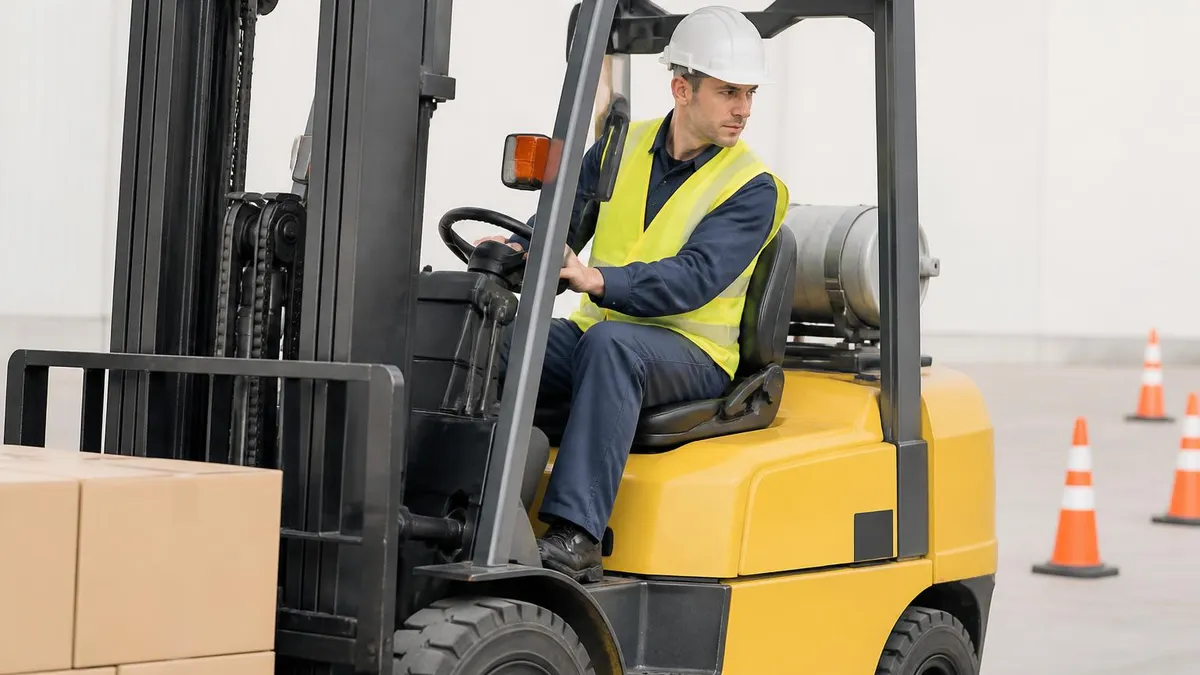
Forklift Rentals: Complete Guide to Pricing, Types, and Operator Requirements
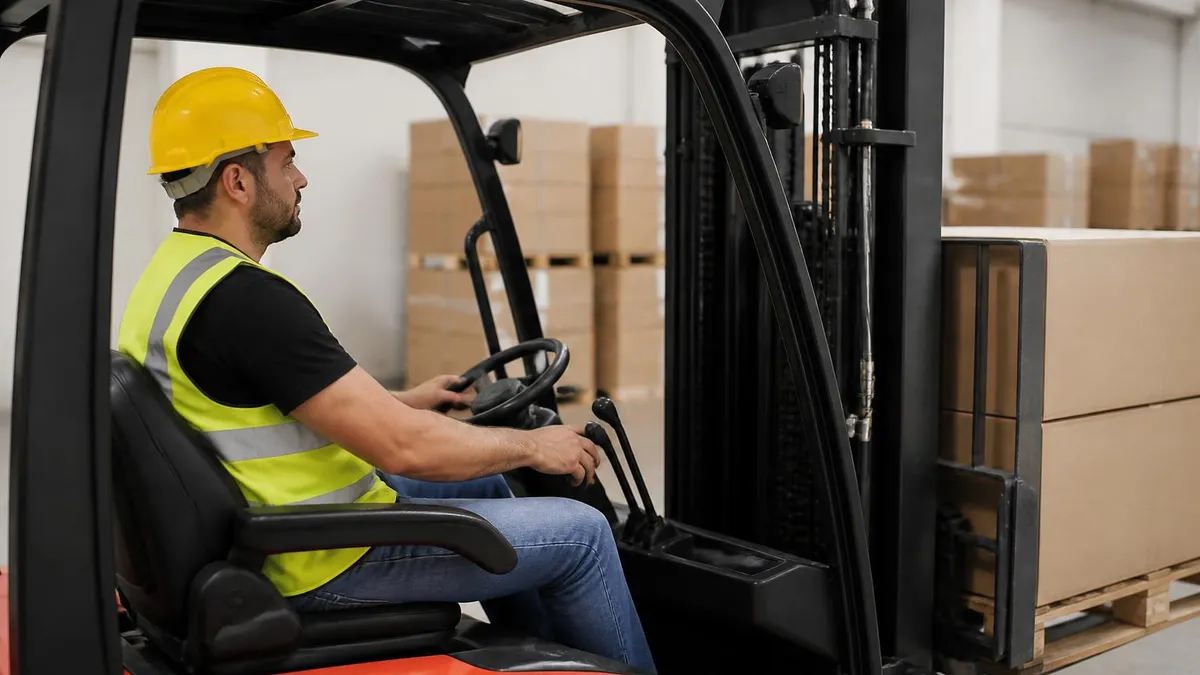
Forklift Hydraulic Fluid: Complete Guide to Types, Specifications, Change Intervals, and Troubleshooting for 2026
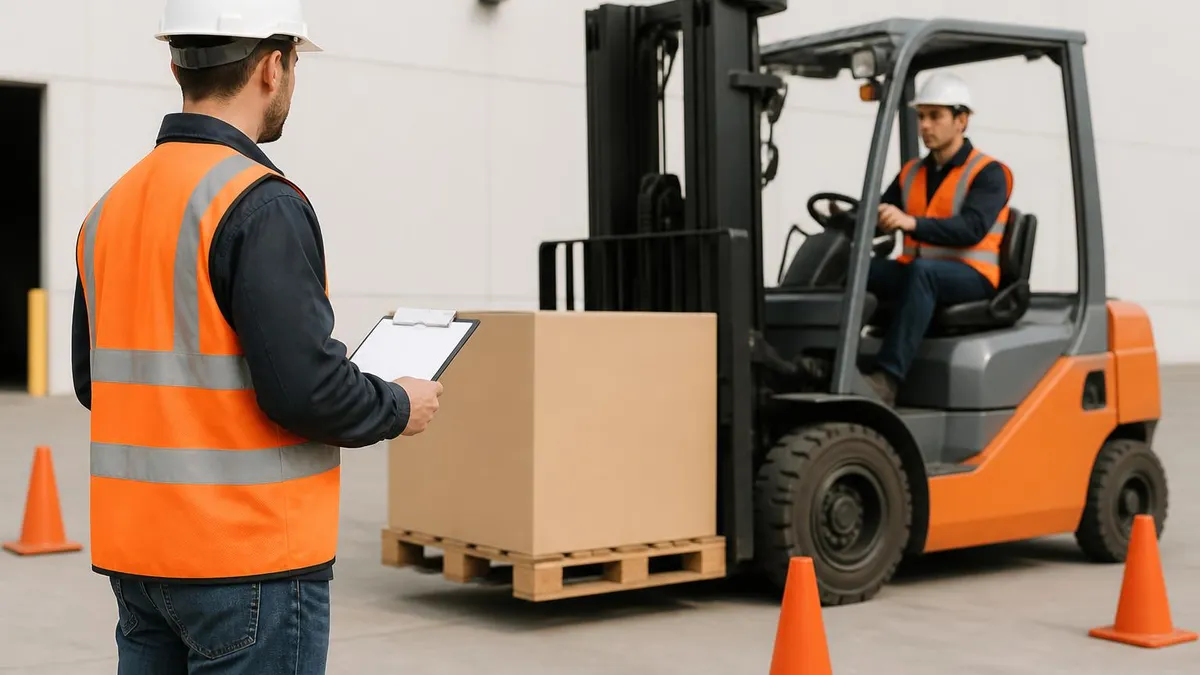
Forklift Parts and Maintenance: Complete Guide to Batteries, Chargers, and Replacement Components
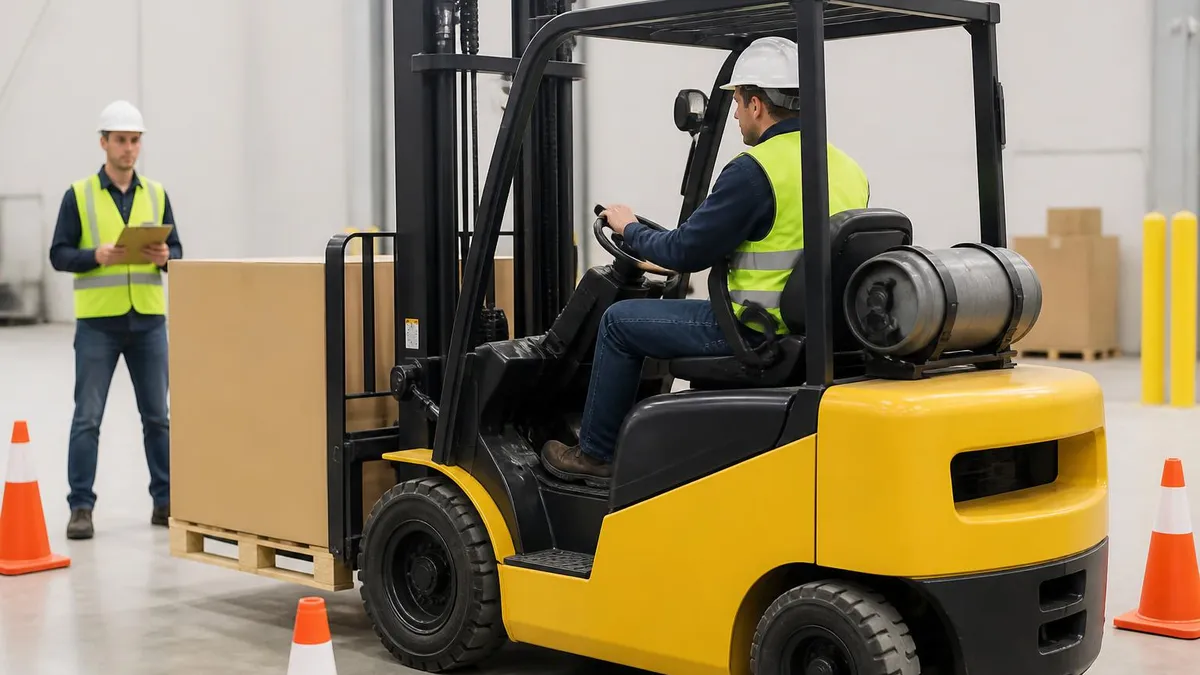
Big Forklift Guide: Heavy-Duty Lift Trucks, Capacity Classes, Rental Costs, and Operator Requirements
Forklift License Renewal: Complete Guide to Forklift License Expiry, OSHA Recertification, and Operator Requirements for 2026
About the Author

Certified Crane Operator & Skilled Trades Exam Specialist
Ferris State UniversityRobert Martinez is a Journeyman Ironworker, NCCCO-certified crane operator, and forklift trainer with a Bachelor of Science in Construction Technology from Ferris State University. He has 21 years of ironworking, rigging, and heavy equipment operation experience across high-rise and industrial construction sites. Robert prepares candidates for crane operator, rigger, forklift, and skilled trades certification examinations.