
Forklift Operator Jobs Atlanta: Certification, Pay, and How to Get Hired Fast
Find forklift operator jobs Atlanta with real salary data, certification steps, and hiring tips. ✅ Your complete 2026 October career guide.

Forklift rental demand across the Atlanta metro has surged alongside explosive warehouse and logistics growth, and with that surge comes a dramatic spike in forklift operator jobs Atlanta employers are scrambling to fill. The city's Hartsfield-Jackson airport corridor, the Fulton Industrial Boulevard hub, and the expanding flatlands of Gwinnett and Clayton counties now host hundreds of distribution centers ranging from regional grocery chains to global e-commerce giants. If you hold a valid certification of forklift operation, you are walking into one of the hottest hiring markets in the American South right now.
Understanding what separates a strong candidate from a marginal one starts with knowing how employers in metro Atlanta define readiness. Most large distribution companies — Amazon, Home Depot, Target, and UPS among them — require applicants to demonstrate hands-on competency on at least one class of forklifts before their first shift. That means sit-down counterbalanced trucks, electric forklift models, reach trucks, and stand up forklift variants all have separate proficiency requirements. Showing up with only classroom knowledge rarely satisfies a floor supervisor whose team is already behind on pallets.
The good news for job seekers is that forklift training in Atlanta is widely available, competitively priced, and frequently subsidized by workforce development programs through Georgia Quick Start and local technical colleges. Chattahoochee Technical College, Atlanta Technical College, and Gwinnett Technical College all offer OSHA-aligned operator curricula that range from a single eight-hour session to a week-long program covering multiple truck classes. Employers often reimburse tuition within 90 days of hire, so cost is rarely a permanent barrier.
Pay rates in Atlanta have climbed noticeably since 2022. Entry-level forklift operator roles — typically requiring certification and six months of verifiable experience — now advertise between $17 and $20 per hour on Indeed and ZipRecruiter. Operators who hold multi-class certification, can handle electric forklift and stand up forklift equipment, and have two or more years of experience routinely command $22 to $26 per hour. Supervisory and lead operator roles in larger DCs push past $30 per hour with benefits packages that include health insurance, 401(k) matching, and paid time off.
Certification of forklift operation is not a one-time achievement. OSHA standard 29 CFR 1910.178(l) mandates that employers formally evaluate every operator at least once every three years, and immediately following any accident, near-miss, or observed unsafe behavior. This recertification requirement creates a continuous professional development cycle that benefits workers willing to stay current. It also means employers value candidates who already understand compliance obligations, because the burden of documenting operator evaluations falls squarely on the employer — not the certifying school.
If you are exploring forklift operator jobs atlanta and wondering whether to pursue certification before or after applying, the answer is almost always before. Many Atlanta employers use applicant tracking systems that filter out résumés lacking the words "OSHA certified" or "certified forklift operator" in the skills section. Spending one to three days earning your certification before sending a single application dramatically increases your callback rate and often allows you to skip the employer's in-house onboarding training, accelerating your first paycheck timeline.
Atlanta's logistics sector shows no signs of slowing down. The city's inland port infrastructure, connected to the Port of Savannah by the Mason Mega Rail terminal, continues to attract new warehouse tenants every quarter. That sustained growth means forklift operators in the metro area enjoy unusual job security compared to workers in markets more exposed to economic cycles. Whether you're transitioning from construction, retail, or manufacturing, the combination of obtainable certification and strong employer demand makes forklift operation one of the most practical career pivots available to Atlanta workers in 2026.
Atlanta Forklift Job Market by the Numbers

Top Employers Hiring Forklift Operators in Atlanta
Amazon, Target, and Walmart operate massive fulfillment centers in Braselton, McDonough, and Douglasville. These facilities run 24/7 shifts and prioritize reach truck and electric forklift experience. Full-time benefits begin within 90 days at most locations.
Companies like XPO Logistics, Geodis, and Ryder operate Atlanta-area hubs serving auto parts, food service, and consumer goods. 3PL roles often expose operators to diverse cargo types and multiple forklift classes, accelerating skill development.
Caterpillar dealers, Sunbelt Rentals, and United Rentals need certified operators to manage heavy equipment inventory. These roles often involve rough-terrain forklifts and offer higher pay premiums for candidates already holding Class V or VI certifications.
Sysco, KeHE Distributors, and Coca-Cola UNITED maintain temperature-controlled Atlanta facilities. Cold-chain warehouses prize reliability and speed. Stand up forklift proficiency and reach truck experience are standard requirements for these competitive openings.
Automotive suppliers, packaging companies, and aerospace parts manufacturers in Carroll, Douglas, and Bartow counties offer stable, long-term forklift operator positions. Many provide on-site forklift training as part of new-hire onboarding, making them friendly entry points.
Earning your certification of forklift operation in Atlanta is a structured process governed by OSHA standard 29 CFR 1910.178(l), which applies to all powered industrial truck operators across every industry in the United States. The regulation specifies that certification must include three distinct components: formal instruction — meaning classroom or online coursework covering safety principles; practical training on the actual type of equipment the operator will use; and a formal evaluation where a qualified trainer observes the operator completing real tasks under workplace conditions. No single component alone satisfies the requirement.
Formal instruction covers a wide range of topics that go beyond simply driving the truck. Operators must demonstrate knowledge of pre-shift inspection procedures, load stability physics, travel rules for ramps and inclines, pedestrian safety protocols, fuel or battery handling depending on truck class, and emergency response procedures. Most reputable Atlanta training providers cover all of these domains in a single eight-hour session, supplemented by written assessments. Some programs offer a separate refresher module for operators who previously held certification but have lapsed beyond three years.
Practical training is where most new candidates feel the steepest learning curve. Maneuvering an electric forklift through a narrow warehouse aisle while maintaining load stability requires muscle memory that textbooks cannot fully develop. Atlanta-area training centers typically dedicate four to six hours of a single-day program to hands-on operation, including straight-line travel, turning, stacking, and retrieving loads from both floor level and improved racking. Candidates who arrive with zero prior experience often need to complete a second practice session before they are comfortable enough for formal evaluation.
The formal evaluation component requires a qualified trainer — typically a supervisor, safety manager, or certified third-party instructor — to observe the candidate performing actual job tasks in the actual or representative work environment. This is an important detail: a certification earned at a training center must technically be supplemented by a workplace-specific evaluation once the operator begins employment. Most large Atlanta employers conduct this workplace evaluation during the first week of work, making the initial certification more of a prerequisite for hire than a complete authorization to operate independently.
Certification costs in Atlanta range from $75 to $200 for single-class training through a third-party provider. Multi-class programs covering, for example, both sit-down counterbalanced trucks and stand up forklift equipment, typically run $250 to $400. Several Atlanta workforce development programs, including those funded through the Workforce Innovation and Opportunity Act (WIOA), will cover training costs entirely for eligible job seekers. Eligibility criteria include income thresholds, recent layoff status, and residency in participating counties, so it is worth contacting the Georgia Department of Labor before paying out of pocket.
Online certification programs deserve a careful word of caution. While some accredited providers offer legitimate hybrid programs where formal instruction is completed online and practical evaluation is arranged locally, fully online certifications that claim to satisfy the OSHA evaluation requirement without any hands-on component are not OSHA-compliant. Atlanta employers with strong safety cultures — especially those subject to third-party audits, like food manufacturers and pharmaceutical distributors — will reject these certificates. Invest in a program that includes documented hands-on evaluation to ensure your credential is recognized wherever you apply.
Once certified, keep your training records accessible. Employers are legally required to maintain documentation of each operator's training, but your own copy of the certificate and evaluation record is invaluable if you change jobs or if a question ever arises about your compliance status. A simple photo on your phone and a PDF copy in your email is sufficient. Renew every three years without waiting for an employer to prompt you, as self-managed recertification signals professionalism and initiative to hiring managers reviewing your application.
Forklift Training Options in Atlanta: Costs, Formats, and Best Fit
In-person forklift training remains the gold standard for new operators in Atlanta. Programs at Chattahoochee Technical College, Atlanta Technical College, and private providers like National Forklift Foundation–affiliated trainers combine classroom instruction with supervised equipment time. A typical single-day session runs eight hours and costs $75 to $150, with certificates issued the same day upon passing written and practical evaluations. Scheduling is flexible, with weekday and Saturday sessions available at multiple metro locations.
The hands-on component of in-person training is irreplaceable for candidates with limited prior experience. Instructors catch technique errors — like improper load centering or incorrect mast tilt during travel — that online courses simply cannot identify. Employers who perform their own safety audits, particularly in the food service and pharmaceutical sectors, specifically ask whether initial certification included observed practical evaluation. In-person programs provide documentation that satisfies this requirement without ambiguity, giving graduates a cleaner path through employer onboarding.

Is a Forklift Operator Career in Atlanta Right for You?
- +High demand market — thousands of active openings across Atlanta metro at any given time
- +Quick entry point — certification takes one to three days compared to months for many trade licenses
- +Strong wage growth — pay rates have risen 18% in Atlanta since 2022, outpacing inflation
- +Multiple shift options — most DCs offer first, second, and third shift with shift differentials
- +Clear advancement path — lead operator, trainer, and safety coordinator roles reward experienced operators
- +Employer-funded training available — Georgia Quick Start and WIOA programs reduce out-of-pocket costs to zero for eligible candidates
- −Physically demanding — long shifts on hard surfaces cause knee, back, and joint fatigue over time
- −Recertification required — OSHA mandates requalification every three years, adding ongoing compliance costs
- −Seasonal volatility — e-commerce peaks create hiring surges followed by slower hiring periods in Q1 and Q2
- −Equipment-specific skills — certification on one forklift class does not automatically qualify you for another
- −Noise and fume exposure — propane-powered forklifts in enclosed spaces create air quality and hearing risks
- −Safety culture dependency — operator risk varies enormously depending on employer safety investment and management practices
Pros and Cons at a Glance
| Pros | Cons |
|---|---|
| High demand market — thousands of active openings across Atlanta metro at any given time | Physically demanding — long shifts on hard surfaces cause knee, back, and joint fatigue over time |
| Quick entry point — certification takes one to three days compared to months for many trade licenses | Recertification required — OSHA mandates requalification every three years, adding ongoing compliance costs |
| Multiple shift options — most DCs offer first, second, and third shift with shift differentials | Equipment-specific skills — certification on one forklift class does not automatically qualify you for another |
| Clear advancement path — lead operator, trainer, and safety coordinator roles reward experienced operators | Noise and fume exposure — propane-powered forklifts in enclosed spaces create air quality and hearing risks |
| Employer-funded training available — Georgia Quick Start and WIOA programs reduce out-of-pocket costs to zero for eligible candidates | Safety culture dependency — operator risk varies enormously depending on employer safety investment and management practices |
Forklift Operator Job Application Checklist for Atlanta Candidates
- ✓Complete OSHA-aligned forklift training from a recognized Atlanta-area provider or accredited online hybrid program.
- ✓Obtain a signed, dated certificate documenting both your formal instruction hours and practical evaluation.
- ✓Update your résumé to include 'OSHA Certified Forklift Operator' in the skills section, listing all truck classes you are qualified on.
- ✓List all forklift types you have operated — sit-down, electric forklift, stand up forklift, reach truck — in a dedicated equipment section.
- ✓Request a reference letter or contact from your most recent supervisor who can verify hands-on experience hours.
- ✓Create profiles on Indeed, ZipRecruiter, and LinkedIn with location set to Atlanta metro and keyword alerts for 'forklift operator.'
- ✓Research each target employer's specific equipment fleet so you can speak knowledgeably about their truck models in interviews.
- ✓Prepare to pass a company-administered pre-employment practical evaluation — bring steel-toed boots and proper PPE.
- ✓Verify your eligibility for Georgia Quick Start or WIOA funding if you need to add a second truck class certification.
- ✓Schedule your three-year OSHA recertification in advance — do not wait for an employer to prompt you before your cycle expires.
Multi-Class Certification Can Boost Your Pay by $4–$6 Per Hour
Atlanta employers consistently pay a meaningful premium for operators who hold certification on two or more forklift classes. A candidate certified on both sit-down counterbalanced trucks and stand up forklift equipment is significantly more valuable to a DC manager than a single-class operator. If you can add reach truck certification — a one-day add-on at most Atlanta training centers — you become eligible for the highest-paying floor-level operator roles in the market.
Career advancement for forklift operators in Atlanta follows a well-worn path that rewards reliability, safety record, and willingness to cross-train on multiple equipment types. The first milestone is lead operator or team lead, a role that typically pays $2 to $4 per hour above base rate and involves mentoring junior operators, coordinating shift assignments, and serving as the first point of contact for floor-level safety incidents. Most Atlanta employers promote from within for this role after 12 to 24 months of clean safety record and demonstrated communication skills.
From lead operator, the next logical step is forklift trainer or safety coordinator. These positions require a much deeper command of OSHA regulation, documentation practices, and adult training methodology. Employers like Home Depot, Amazon, and Kroger typically require candidates for internal trainer roles to hold a Train-the-Trainer credential, which can be earned through National Safety Council programs or OSHA Education Center–affiliated providers. Internal trainers in large Atlanta DCs earn between $27 and $34 per hour, often with reduced physical labor and improved working conditions.
Operations supervisor is the ceiling that most floor-level forklift operators can realistically reach without a college degree. Atlanta DC supervisor roles manage teams of 15 to 40 operators across a shift, coordinating with procurement, inventory management, and transportation departments. Compensation ranges from $55,000 to $75,000 annually with full benefits, and many employers offer accelerated leadership development programs specifically designed to promote frontline operators into management. These programs typically run 12 to 18 months and include shadowing, classroom leadership instruction, and gradually expanding supervisory responsibilities.
For operators interested in equipment-focused advancement rather than people management, a path into forklift maintenance and repair is worth considering. Forklift technicians — sometimes called industrial truck mechanics — diagnose and repair hydraulic, electrical, and mechanical systems on the full range of forklifts, including electric forklift models and propane-powered machines. Technician salaries in Atlanta range from $24 to $38 per hour depending on certification level and brand specialization. Manufacturers like Toyota, Crown, and Raymond offer factory-authorized technician training programs that typically take six months to complete and result in strong employment prospects with authorized dealers.
The forklift rental and sales industry also creates career pathways for experienced operators. Forklift rental near me searches generate significant business for local dealers, who need knowledgeable sales representatives and fleet managers who understand the practical needs of warehouse customers. Experienced operators who can communicate fluently about load capacity, mast height, turning radius, and battery management time are exceptionally effective in these roles because they understand exactly what customers experience on the floor. Sales and fleet management roles typically offer base salaries plus commission, with total annual earnings between $55,000 and $90,000 for strong performers.
Entrepreneurial operators sometimes use their experience to start forklift training or inspection businesses. OSHA's operator training requirements guarantee a continuous market for qualified third-party trainers, and Atlanta's density of warehouses and distribution centers creates a large addressable client base. A solo trainer operating in the Atlanta metro can generate $80,000 to $120,000 annually by offering on-site certification programs to small and mid-sized employers who lack internal training capacity. This path requires strong insurance coverage, documented Train-the-Trainer credentials, and reliable marketing, but it represents one of the highest-earning outcomes for operators who combine technical excellence with business development skills.
Regardless of which advancement path you pursue, documenting every piece of training, certification, and performance review is essential. The forklift industry is documentation-heavy by regulatory design, and operators who maintain organized professional records — including training logs, equipment qualifications, and safety training attendance — consistently outperform peers during promotion cycles and job searches. Treat your professional file the same way a technician treats their toolbox: maintained, organized, and always current.

Atlanta employers who allow uncertified operators to run forklifts face OSHA fines starting at $15,625 per violation and up to $156,259 for willful violations. If you are asked to operate equipment before completing formal evaluation, you have the legal right to decline without retaliation. Document any unsafe assignments in writing and report to your employer's safety officer or OSHA directly if the situation persists.
Navigating the Atlanta forklift rental market is a skill that benefits both operators and job seekers. Understanding how forklift rental works — from short-term daily rentals to long-term fleet agreements — gives operators valuable context for employer conversations and opens doors to roles in rental fleet management. The Atlanta market features national players like Sunbelt Rentals, HERC Rentals, and BlueLine Rental alongside regional dealers who specialize in specific brands or industries. Daily rental rates for standard sit-down counterbalanced forklifts range from $150 to $300 depending on capacity class and attachment configuration.
Electric forklift rentals command a slight premium over propane models in the short-term market, but long-term rental customers often prefer them because they eliminate fuel cost variability and comply with indoor air quality regulations that increasingly apply to Georgia's climate-controlled distribution facilities. The shift toward electric forklifts across Atlanta's warehouse industry is accelerating as lithium-ion battery prices decline and fast-charging infrastructure becomes more accessible. Operators who are proficient on electric models — including understanding battery state-of-charge management, opportunity charging, and battery equalization procedures — are significantly more attractive to forward-thinking employers investing in electric fleets.
Stand up forklift operation is another area where specialized skills command premium pay. Stand-up reach trucks and end-rider pallet jacks are standard equipment in Atlanta's high-density racking environments, where narrow aisles require precise maneuvering and height stacking up to 30 feet.
These machines handle very differently from sit-down counterbalanced trucks — the operator stands on a platform behind the load, using controls that require entirely different muscle coordination. Most operators need 20 to 40 hours of supervised practice before becoming reliably productive on stand-up equipment. Employers know this, which is why operators who already have documented stand-up experience can negotiate higher starting wages.
Forklifts for sale listings in the Atlanta market also tell an interesting story about employer investment levels. A company actively purchasing late-model electric forklifts is signaling growth and capital availability — both positive indicators for job stability and training investment. Conversely, an employer running aging propane machines with deferred maintenance may be managing costs tightly, which can translate into slower wage growth and higher safety risk. When researching potential employers, checking LinkedIn company updates and news for capital investment announcements can provide useful intelligence before you accept an offer.
Seasonal demand patterns matter for Atlanta forklift operators planning their job search timing. The strongest hiring windows in the Atlanta metro occur in August through October, when e-commerce retailers staff up for the holiday season, and again in March through May, when construction and manufacturing activities accelerate into summer.
Applying during these windows increases your chances of landing a direct-hire position rather than a temporary-to-permanent placement, which typically offers better benefits from day one. Staffing agencies like Staffmark, Manpower, and Randstad frequently post forklift roles for Atlanta DCs during peak periods, and while temp roles pay slightly less than direct hire, they provide a foot in the door at employers who rarely recruit publicly.
Negotiating your starting wage as a forklift operator in Atlanta requires data. The Bureau of Labor Statistics Occupational Employment and Wage Statistics for the Atlanta-Sandy Springs-Roswell metropolitan area provides annually updated median wage figures for Material Moving Machine Operators (SOC 53-7011), which encompasses most forklift roles.
Supplement this with current Indeed and Glassdoor salary data filtered to your specific target job titles. Walking into a wage negotiation with three cited data points — BLS metro median, comparable Indeed listings, and your multi-class certification premium — positions you as a knowledgeable professional rather than a passive applicant, and routinely results in starting offers $1 to $2 per hour above the initially posted rate.
If you are ready to deepen your preparation before applying for forklift operator jobs in Atlanta, your next step should be mastering the OSHA content that appears on employer assessments and third-party certification exams. The practical skills get sharpened on the equipment, but the regulatory knowledge that separates confident operators from uncertain ones is entirely learnable from focused study. Use the practice resources linked throughout this article to build that knowledge base before your first interview or certification session, and you will walk in with measurably stronger credentials than the average applicant.
Practical preparation for forklift operator job interviews in Atlanta involves more than reviewing your certification documents. Hiring managers at major Atlanta DCs consistently ask behavioral questions about how candidates have handled near-miss incidents, equipment malfunctions, and conflicts with pedestrian traffic rules. Preparing two or three specific examples from your own experience — using the STAR method (Situation, Task, Action, Result) — will help you answer these questions confidently rather than providing vague answers that raise doubts about your floor credibility.
Pre-shift inspection proficiency is another area where prepared candidates stand out. Every OSHA-compliant forklift operation begins with a documented pre-shift inspection that covers fluid levels, tire condition, forks, mast, chains, hydraulic system, lights, horn, seatbelt, and hour meter reading. Knowing this checklist cold — and being able to walk an interviewer through it without hesitation — signals that you actually perform inspections rather than simply signing the form. Some Atlanta employers incorporate a practical pre-shift inspection as part of their hiring evaluation, so practicing this sequence before your interview is time well spent.
Load stability knowledge separates average operators from excellent ones. The stability triangle — the three-point contact area defined by the two front wheels and the rear axle pivot — is the fundamental physics concept governing every load-carrying decision a forklift operator makes. Knowing how to calculate load center, understand capacity plate limitations, and adjust travel speed based on load height demonstrates engineering-level thinking that impresses safety-conscious employers. Study these concepts in depth using your certification materials, and reference them specifically when interviewers ask about your safety approach.
Battery management is increasingly important as the Atlanta market shifts toward electric forklift fleets. Proper lithium-ion and lead-acid battery care extends pack life by years and prevents expensive replacement costs. Operators who understand opportunity charging windows, avoid deep discharge cycles, and recognize the signs of thermal runaway or sulfation are managing employer assets responsibly. If you are applying to an electric-fleet operation — increasingly common in Atlanta's modern DCs — proactively mentioning your battery management knowledge during the interview differentiates you from candidates who only discuss driving technique.
Building a professional network within Atlanta's warehouse community accelerates your career in ways that job boards cannot replicate. The Atlanta Warehouse and Logistics Association hosts regular events where operators, supervisors, and safety managers connect. LinkedIn groups focused on Southeast US logistics are active with job leads and industry news.
Even casual connections with other certified operators — at training sessions, through staffing agencies, or at former employers — can produce referrals to positions that never get publicly posted. The majority of lead operator and trainer roles at Atlanta's largest DCs are filled through internal promotion or direct referral, never through Indeed or ZipRecruiter.
Continuing education beyond basic OSHA compliance opens additional career doors and pay bands. The Industrial Truck Association and the National Safety Council both offer advanced operator and trainer credentials that are recognized nationally. Georgia's technical college system offers credit and non-credit pathways into logistics management, supply chain operations, and warehousing supervision that build on hands-on forklift experience. Employers like Amazon and FedEx have formal tuition assistance programs — some covering up to $5,250 annually — that allow operators to pursue these credentials while working full-time, creating a self-funding career development loop that costs the operator very little out of pocket.
Your long-term success as a forklift operator in Atlanta ultimately depends on three things that no certification alone can guarantee: consistent safety behavior, mechanical curiosity about the equipment you operate, and proactive communication with supervisors and coworkers.
Operators who report problems early, ask questions when safety rules seem ambiguous, and treat every pre-shift inspection as a genuine safety exercise rather than paperwork typically advance faster, earn more, and work in safer environments than those who treat compliance as a box-checking exercise. Build those habits from your very first shift, and your Atlanta forklift career will compound in value year after year.
Sample Forklift certification Practice Questions
Try these questions from our free Forklift certification practice tests. The correct answer and an explanation follow each question.
When driving on a ramp with a loaded forklift, the operator should:
- A. Drive forward up, forks pointing upgrade
- B. Drive down forward with load ahead
- C. Turn sideways on the ramp
- D. Coast in neutral
Answer: A. Drive forward up, forks pointing upgrade
With a load, travel up ramps forward and down ramps in reverse to keep the load stable.
During an emergency facility evacuation, what should a forklift operator do with the forklift?
- A. Drive the forklift toward the nearest exit for use in the evacuation
- B. Lower the forks, shut off the engine, set the brake, and evacuate on foot
- C. Leave the forklift running to allow quick repositioning when the alarm ends
- D. Park the forklift in front of emergency exits for easy access
Answer: B. Lower the forks, shut off the engine, set the brake, and evacuate on foot
The operator must lower the forks, shut off the engine, apply the parking brake, and then evacuate on foot — blocking exits with a forklift creates an additional hazard.
When inspecting the forks during a pre-operation check, what specific defects should an operator look for?
- A. Correct color and polish
- B. Proper lubrication on the surface
- C. Cracks, bends, or significant wear on the heel
- D. The manufacturer's logo and serial number
Answer: C. Cracks, bends, or significant wear on the heel
The structural integrity of the forks is critical for safety. Operators must inspect for any signs of damage such as cracks (especially at the heel), bends, or excessive wear that could lead to failure under a load.
If an operator is assigned to a workplace with changed conditions, the employer must:
- A. Provide training on the new conditions
- B. Do nothing until an accident
- C. Rely on prior certification alone
- D. Only update the certification date
Answer: A. Provide training on the new conditions
A change in workplace conditions requires refresher training addressing those changes.
Forklift Questions and Answers
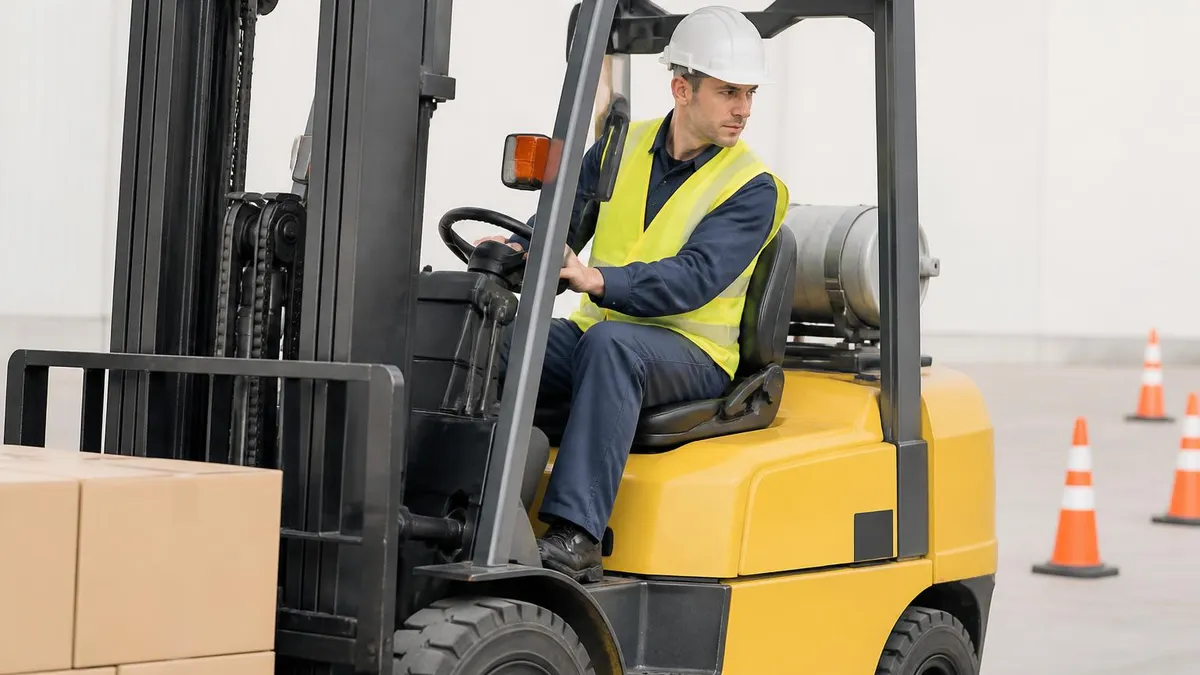
Forklift Rentals: Complete Guide to Pricing, Types, and Operator Requirements
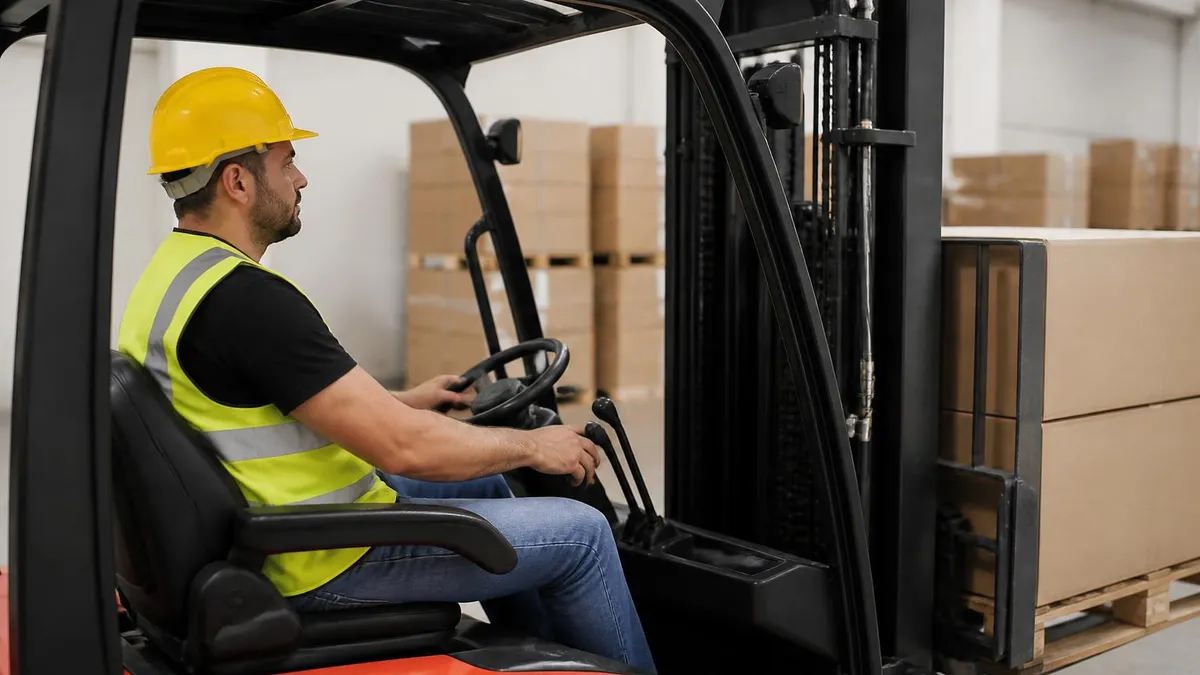
Forklift Hydraulic Fluid: Complete Guide to Types, Specifications, Change Intervals, and Troubleshooting for 2026
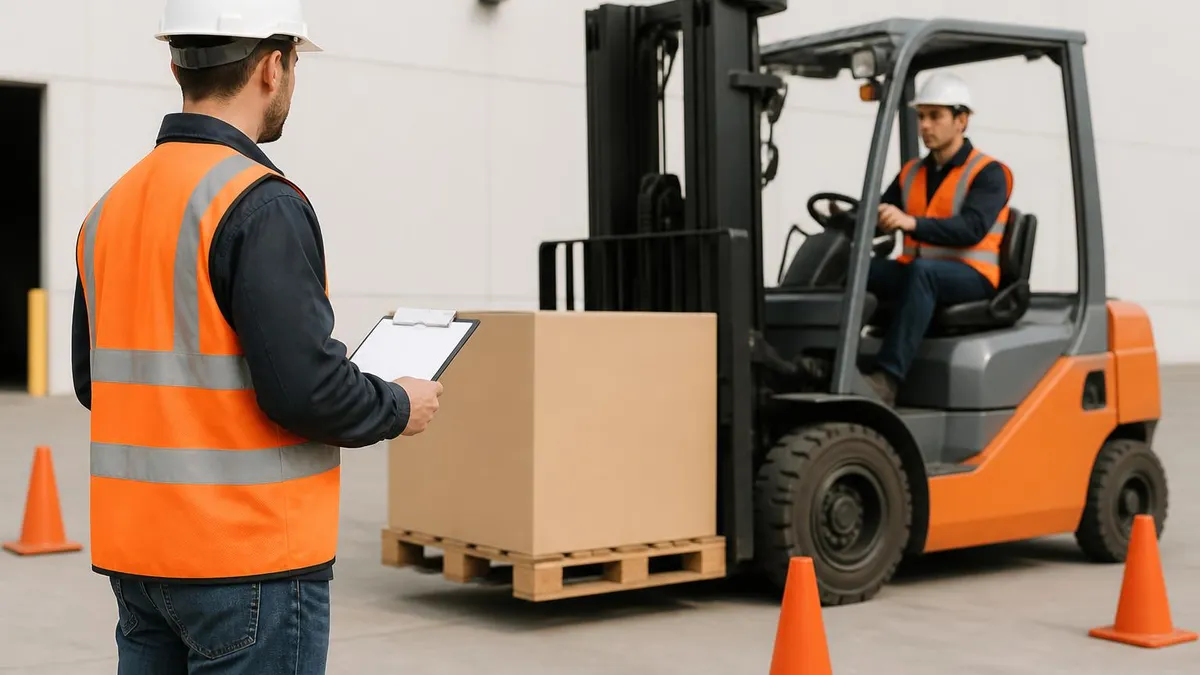
Forklift Parts and Maintenance: Complete Guide to Batteries, Chargers, and Replacement Components
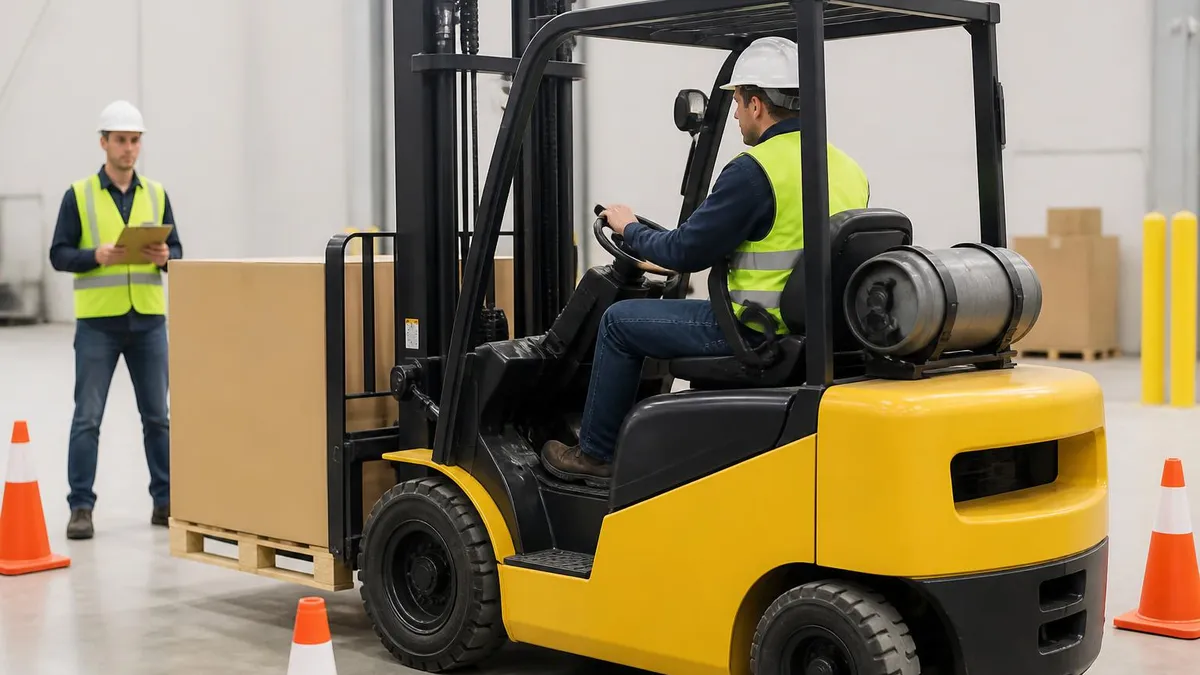
Big Forklift Guide: Heavy-Duty Lift Trucks, Capacity Classes, Rental Costs, and Operator Requirements
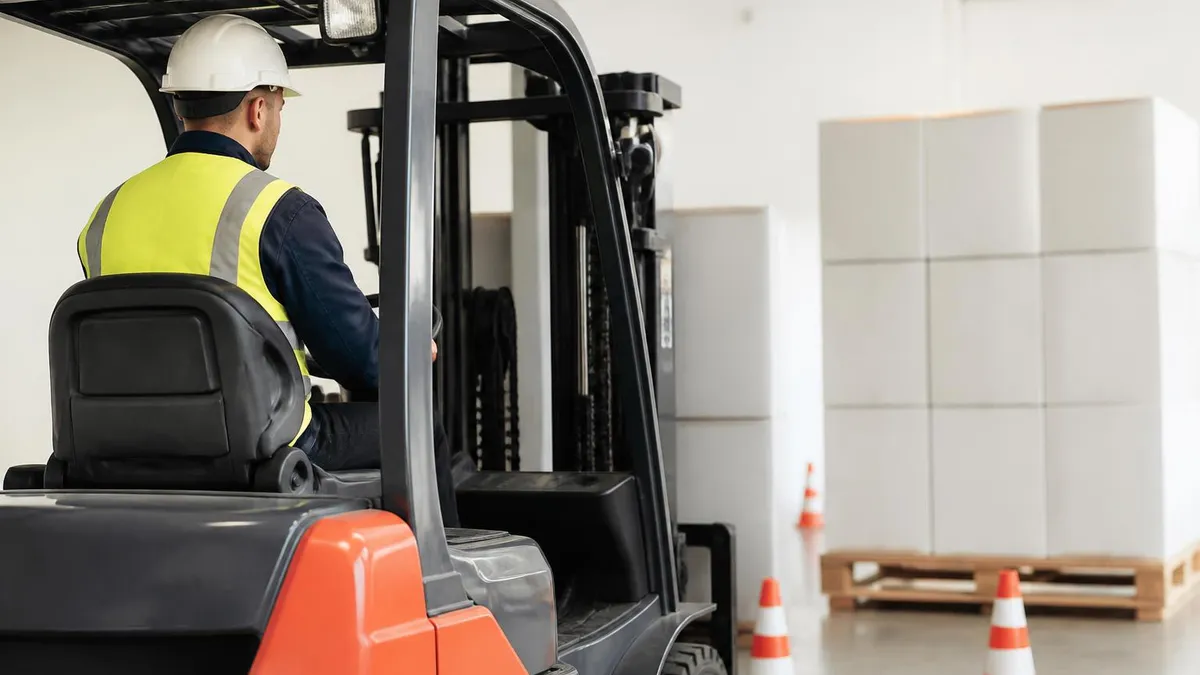
Forklift License Renewal: Complete Guide to Forklift License Expiry, OSHA Recertification, and Operator Requirements for 2026
About the Author

Certified Crane Operator & Skilled Trades Exam Specialist
Ferris State UniversityRobert Martinez is a Journeyman Ironworker, NCCCO-certified crane operator, and forklift trainer with a Bachelor of Science in Construction Technology from Ferris State University. He has 21 years of ironworking, rigging, and heavy equipment operation experience across high-rise and industrial construction sites. Robert prepares candidates for crane operator, rigger, forklift, and skilled trades certification examinations.