
CPR Process: Complete Step-by-Step Guide to Cardiopulmonary Resuscitation in 2026 September
Master the CPR process with our complete guide. Learn compressions, ⏳ rescue breaths, AED use, and the ACLS algorithm for adults, children, and infants.
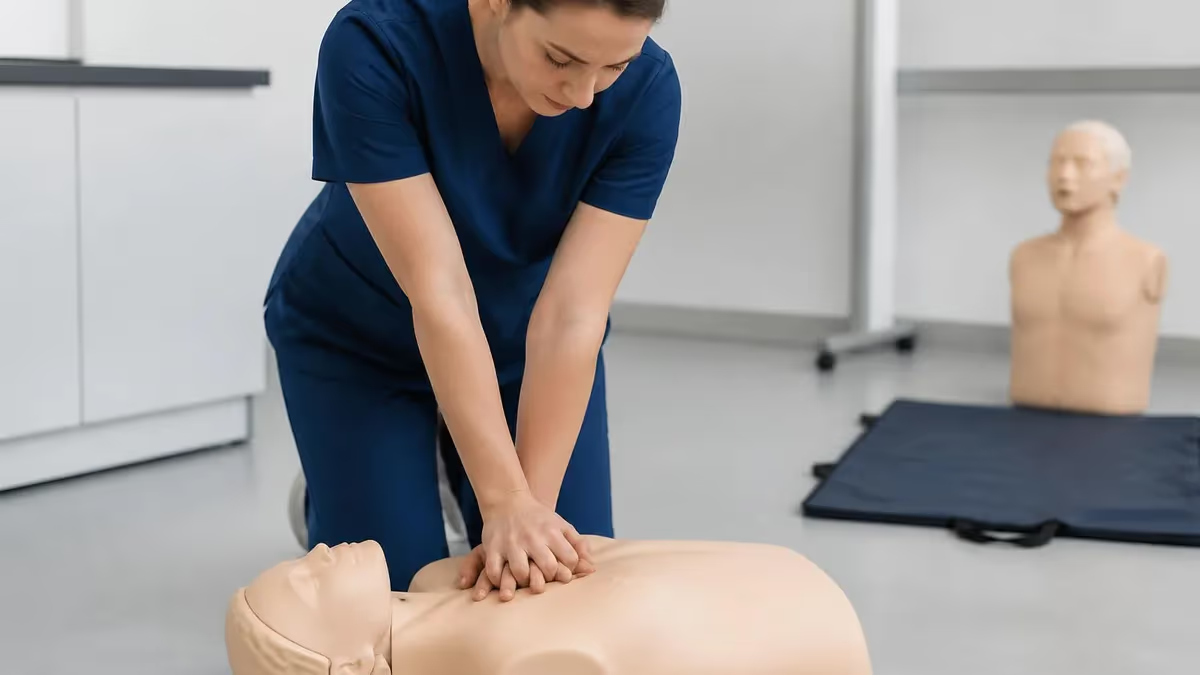
The cpr process is a structured, evidence-based sequence of actions designed to restore circulation and breathing in someone whose heart has stopped. Whether you are a first-time responder or a healthcare professional reviewing the acls algorithm, knowing the precise steps can mean the difference between life and death. Cardiac arrest claims more than 350,000 lives outside hospitals annually in the United States, and bystander CPR can double or triple survival odds when performed correctly within the first few minutes of collapse.
Modern CPR guidelines, updated by the American Heart Association and supported by the national cpr foundation, emphasize high-quality chest compressions at a rate of 100 to 120 per minute, a depth of at least 2 inches for adults, and minimal interruptions. The process integrates seamlessly with automated external defibrillator (AED) deployment, advanced airway management, and post-resuscitation care. Every link in this chain matters, from the moment a bystander recognizes collapse to the moment emergency medical services arrive on scene.
This guide walks through the complete cpr process for adults, children, and infants, covering the recognition phase, the compression-ventilation cycle, defibrillation, and team-based resuscitation. We also cover what does aed stand for, how respiratory rate factors into assessment, and how the recovery position is used for unconscious but breathing patients. The goal is to give you a clear mental model you can actually execute under pressure.
Beyond mechanics, the cpr process requires situational awareness. You must rapidly assess the scene for hazards, determine responsiveness, summon help, and begin compressions within ten seconds of confirming arrest. Hesitation is the most common reason bystander CPR fails. Training programs, including pals certification for pediatric providers and basic life support classes for laypeople, drill these reflexes until they become automatic.
We will also clarify common confusion points, including why searches for cpr cell phone repair or cpr phone repair sometimes appear alongside CPR training queries (the acronym is shared but the contexts are unrelated). Our focus here is exclusively cardiopulmonary resuscitation as a life-saving medical procedure.
By the end of this article, you should be able to describe the cpr process step-by-step, recognize when to start and stop, perform compressions correctly, integrate an AED, and adapt your technique for infants and children. You will also understand how the process fits into the broader continuum of life support and post-arrest care delivered by EMS and hospital teams.
Bookmark this guide, take the linked practice quizzes, and revisit the material regularly. CPR skills decay within three to six months without practice, so consistent review is essential whether you are a parent, teacher, lifeguard, nurse, or anyone who might one day need to act.
CPR Process by the Numbers

The CPR Process: Step-by-Step Timeline
Check the Scene & Patient
Activate EMS & Get an AED
Begin Chest Compressions
Deliver Rescue Breaths
Apply the AED
Continue Until Help Arrives
Recognition is the gateway to the entire cpr process. Before you ever place hands on a chest, you must correctly identify cardiac arrest, distinguish it from fainting or seizure, and verify that compressions are appropriate. The American Heart Association defines arrest by three findings: unresponsiveness, absent or abnormal breathing (including agonal gasps), and no detectable pulse. Lay rescuers are not expected to check a pulse; if the patient is unresponsive and not breathing normally, begin CPR immediately.
Scene safety comes first. Approach from a direction that lets you see hazards such as live wires, oncoming traffic, smoke, or aggressive bystanders. If the environment is unsafe, move the patient only if absolutely necessary, because spinal injury is a real concern after falls or motor vehicle collisions. Once you confirm safety, kneel beside the patient at the level of the chest so you can transition smoothly to compressions without repositioning yourself mid-rescue.
Assess responsiveness with a firm shoulder tap and clear verbal challenge. Avoid shaking the head, especially in trauma patients. If there is no response, immediately shout for help. The phrase 'You in the red shirt, call 911 and bring back an AED' is far more effective than a generic 'someone call 911,' because it assigns responsibility and prevents the bystander effect from paralyzing the crowd.
Breathing assessment takes no more than ten seconds. Look at the chest, listen at the mouth, and feel for air movement. Agonal gasps — slow, irregular, gulping breaths — are a sign of cardiac arrest, not adequate breathing. Many lay rescuers mistake these gasps for normal respiration and delay CPR, with tragic consequences. When in doubt, start compressions.
The respiratory rate of a healthy adult at rest is 12 to 20 breaths per minute. A patient with fewer than 6 breaths per minute, irregular breathing, or no breathing at all needs immediate intervention. For lay rescuers, the simpler rule is: if breathing does not look normal, treat it as arrest and begin compressions.
Pulse checks are reserved for healthcare providers and are limited to ten seconds. Use the carotid artery in adults and children, and the brachial artery in infants. If you cannot definitively feel a pulse within ten seconds, assume arrest and begin compressions. Delays cost brain tissue at a rate of roughly ten percent of viable neurons per minute without circulation.
Finally, document the time of arrest if possible. Knowing the downtime helps EMS and hospital teams make decisions about advanced interventions, targeted temperature management, and prognosis. Even a rough estimate written on a piece of paper or noted to the dispatcher provides valuable continuity of care.

CPR Practice Test Questions
Prepare for the CPR Cardiopulmonary Resuscitation Practice exam with our free practice test modules. Each quiz covers key topics to help you pass on your first try.
CPR Basic CPR
CPR Exam Questions covering Basic CPR. Master CPR Test concepts for certification prep.
CPR and First Aid
Free CPR Practice Test featuring and First Aid. Improve your CPR Exam score with mock test prep.
CPR (Cardiopulmonary Resuscitation) Adult ...
CPR Mock Exam on (Cardiopulmonary Resuscitation) Adult CPR and AED Usage. CPR Study Guide questions to pass on your first try.
CPR (Cardiopulmonary Resuscitation) Airway...
CPR Test Prep for (Cardiopulmonary Resuscitation) Airway Obstruction and Choking. Practice CPR Quiz questions and boost your score.
CPR (Cardiopulmonary Resuscitation) Cardio...
CPR Questions and Answers on (Cardiopulmonary Resuscitation) Cardiopulmonary Emergency Recognition. Free CPR practice for exam readiness.
CPR (Cardiopulmonary Resuscitation) Child ...
CPR Mock Test covering (Cardiopulmonary Resuscitation) Child and Infant CPR. Online CPR Test practice with instant feedback.
CPR (Cardiopulmonary Resuscitation) High-P...
Free CPR Quiz on (Cardiopulmonary Resuscitation) High-Performance Team Dynamics. CPR Exam prep questions with detailed explanations.
CPR (Cardiopulmonary Resuscitation) Legal ...
CPR Practice Questions for (Cardiopulmonary Resuscitation) Legal and Ethical Considerations. Build confidence for your CPR certification exam.
CPR for Specific Populations
CPR Test Online for for Specific Populations. Free practice with instant results and feedback.
CPR Airway & Breathing Management
CPR Exam Questions covering Airway & Breathing Management. Master CPR Test concepts for certification prep.
CPR Assessment & Recognition of Cardiac Ar...
Free CPR Practice Test featuring Assessment & Recognition of Cardiac Arrest. Improve your CPR Exam score with mock test prep.
CPR Chest Compressions & Defibrillation
CPR Mock Exam on Chest Compressions & Defibrillation. CPR Study Guide questions to pass on your first try.
CPR Post-Resuscitation Care & Recovery
CPR Test Prep for Post-Resuscitation Care & Recovery. Practice CPR Quiz questions and boost your score.
Compressions, Airway, and AED Integration
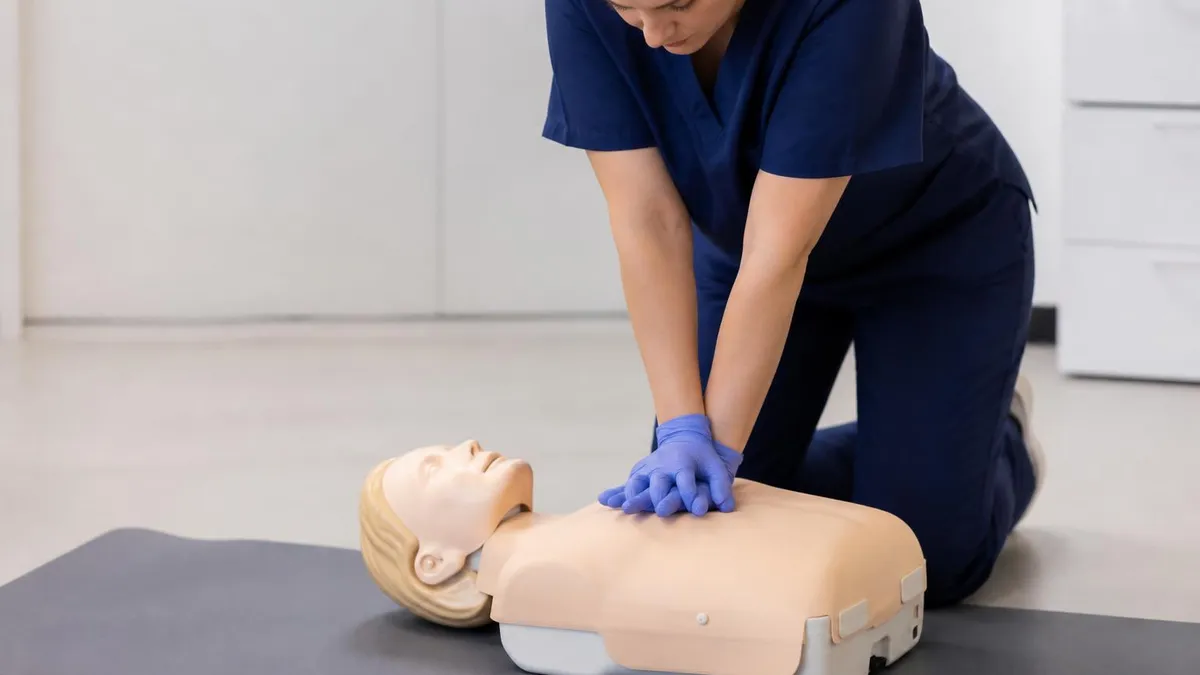
High-quality chest compressions are the single most important element of the cpr process. Place the heel of your dominant hand on the lower half of the sternum, between the nipples. Stack your other hand on top, interlock your fingers, and keep your elbows locked and shoulders directly over your hands. Push straight down at least two inches for adults, allowing complete chest recoil after each compression so the heart can refill with blood.
Pace yourself to 100 to 120 compressions per minute, roughly the tempo of the Bee Gees' 'Stayin' Alive.' Minimize interruptions: every pause longer than ten seconds reduces coronary perfusion pressure and decreases survival odds. Switch with another rescuer every two minutes or sooner if you tire, because compression quality degrades quickly. Rescuer fatigue is one of the most underestimated threats to successful resuscitation outcomes.
Hands-Only CPR vs. Standard 30:2 CPR
- +Easier for untrained bystanders to remember and execute
- +Eliminates barrier-device hesitation and disease-transmission fears
- +Maintains continuous chest compressions with fewer interruptions
- +Equally effective for adult sudden cardiac arrest in the first few minutes
- +Higher rate of bystander participation in public emergencies
- +Reduces rescuer fatigue from switching tasks repeatedly
- +Endorsed by the AHA for laypeople who are unwilling or untrained
- −Less effective for respiratory arrest, drowning, or overdose
- −Not ideal for pediatric arrest where breaths are critical
- −Skips ventilation entirely after prolonged downtime
- −May reinforce incomplete training in some communities
- −Does not satisfy formal healthcare provider certification requirements
- −Less effective beyond the first 6-8 minutes of arrest
- −Misses opportunity to correct hypoxia in primary respiratory events

Pre-CPR Readiness Checklist for Responders
- ✓Confirm the scene is safe from traffic, electrical, fire, or chemical hazards
- ✓Don personal protective equipment including gloves and a barrier mask
- ✓Assess responsiveness with a firm shoulder tap and verbal challenge
- ✓Check for normal breathing within ten seconds, ignoring agonal gasps
- ✓Activate EMS by calling 911 and request an AED from a specific bystander
- ✓Position the patient supine on a firm flat surface, removing soft mattresses
- ✓Expose the chest by removing or cutting away clothing and undergarments
- ✓Locate the correct hand position on the lower half of the sternum
- ✓Begin compressions within ten seconds of confirming cardiac arrest
- ✓Switch rescuers every two minutes to maintain compression quality
- ✓Document the approximate time of arrest and any interventions performed
- ✓Hand off care to EMS with a clear SBAR-style verbal report on arrival
Push hard, push fast, and let the chest recoil completely.
Studies consistently show that compression depth and full recoil predict survival more reliably than ventilation. Even if you forget rescue breaths, uninterrupted chest compressions at the correct depth and rate can keep oxygenated blood circulating to the brain for several critical minutes until defibrillation or advanced care arrives.
The cpr process for infants and children follows the same general principles as adult CPR but with critical modifications that reflect their unique anatomy and physiology. Infant cpr, defined for patients under one year of age, uses two fingers placed just below the nipple line for compressions, with a depth of approximately 1.5 inches or about one-third the chest diameter. Children between one year and puberty receive compressions with one or two hands depending on body size, at a depth of approximately two inches.
Pediatric arrest is more often respiratory in origin than cardiac, which is why pals certification programs heavily emphasize airway management, oxygenation, and ventilation. Common pediatric causes include drowning, choking, severe asthma, sepsis, and trauma. Because hypoxia precedes arrest, rescue breaths are far more important in children than in adults, and the lone-rescuer ratio remains 30:2 while the two-rescuer ratio shifts to 15:2.
For infant rescue breaths, cover both the mouth and nose with your mouth, since the small face makes a tight seal otherwise impossible. Deliver gentle puffs just sufficient to produce visible chest rise, taking care not to over-inflate the small lungs. Excessive pressure can cause gastric distension, vomiting, or even pneumothorax in fragile infant tissue, complicating an already critical resuscitation.
If you are alone with an unresponsive child or infant and did not witness the collapse, perform two minutes of CPR before calling 911. This 'CPR first' approach reflects the respiratory etiology of pediatric arrest. If the collapse was sudden and witnessed, suggesting a primary cardiac event, call 911 first and retrieve an AED if available, then return to begin CPR immediately upon getting back to the child.
Pediatric AEDs use attenuated pads or a key that reduces the energy dose for children under eight years old or under 55 pounds. If pediatric pads are unavailable, use standard adult pads but place one on the front of the chest and the other on the back to prevent overlap on a small torso. Never delay defibrillation waiting for pediatric equipment when adult pads can be adapted safely.
Choking is a leading cause of pediatric cardiac arrest, particularly in toddlers exploring small objects. For conscious infants, deliver five back blows followed by five chest thrusts, repeating until the object is expelled or the infant becomes unresponsive. For conscious children, use the abdominal thrust (Heimlich) maneuver. If the patient becomes unconscious, begin CPR and check the mouth for visible objects before each set of rescue breaths.
Finally, emotional regulation matters in pediatric resuscitation. Family members are often present and panicking, and you may be the only person capable of acting. Speak calmly, assign tasks, and remember that imperfect CPR is dramatically better than no CPR. Survival rates for pediatric out-of-hospital arrest remain low, but every bystander intervention measurably improves neurologically intact outcomes.
If an AED or barrier device is not immediately available, do not wait. Start chest compressions within ten seconds of confirming arrest. Every minute without compressions reduces survival by approximately ten percent, and hands-only CPR significantly outperforms no CPR. Have a bystander continue retrieving equipment while you provide continuous care.
Post-resuscitation care begins the moment a patient regains a pulse, and it is just as critical to neurological outcome as the initial CPR. Return of spontaneous circulation (ROSC) marks the transition from basic life support to advanced life support, where the focus shifts to stabilizing hemodynamics, protecting the brain, and identifying the underlying cause of arrest. Without aggressive post-arrest care, many ROSC patients deteriorate again within hours of initial resuscitation.
Immediately after ROSC, place the patient in the recovery position if they are breathing adequately on their own and you have no advanced equipment. The position recovery technique involves rolling the patient onto their side with the upper leg bent for stability and the lower arm extended to support the head. This position keeps the airway open and allows fluids to drain, preventing aspiration if the patient vomits before EMS arrives on the scene.
For healthcare providers, the acls algorithm guides post-arrest management. Priorities include securing a definitive airway, optimizing ventilation with target oxygen saturations of 94 to 99 percent, supporting blood pressure with fluids and vasopressors, and obtaining a 12-lead ECG to identify ST-elevation myocardial infarction that may benefit from emergent cardiac catheterization. Targeted temperature management at 32 to 36 degrees Celsius for at least 24 hours improves neurological outcomes in comatose survivors.
Identifying and treating reversible causes is essential. The ACLS framework uses the Hs and Ts mnemonic: hypovolemia, hypoxia, hydrogen ion (acidosis), hypo/hyperkalemia, hypothermia, tension pneumothorax, tamponade (cardiac), toxins, thrombosis (pulmonary), and thrombosis (coronary). Addressing the underlying cause prevents recurrent arrest and improves overall mortality.
Family communication during post-arrest care requires honesty balanced with hope. Survival to hospital discharge after out-of-hospital cardiac arrest averages around 10 percent nationally, though rates climb substantially with rapid bystander CPR and early defibrillation. Communicate uncertainty, explain interventions in plain language, and involve chaplaincy or social work early to support the family through what is often a prolonged ICU course.
Rehabilitation begins in the ICU. Even patients who survive neurologically intact often face cognitive, emotional, and physical challenges in the months following arrest. Post-intensive-care syndrome affects memory, attention, and mood, and many survivors require occupational therapy, counseling, and cardiac rehabilitation. Educating survivors about implantable cardioverter-defibrillators, medication compliance, and lifestyle modification reduces recurrence risk significantly.
Finally, debrief with the resuscitation team. Whether the outcome was good or poor, structured debriefs improve future performance, identify system weaknesses, and support rescuer mental health. CPR is high-acuity, emotionally taxing work, and ignoring its psychological toll on responders leads to burnout and erosion of skills over time.
Practical CPR mastery comes from repetition, not just reading. Sign up for a hands-on certification course through the American Heart Association, the American Red Cross, or the national cpr foundation, and recertify every two years at minimum. Hands-on manikin practice builds the muscle memory and rhythm that simply cannot be replicated by reading articles or watching videos. Most courses combine online modules with in-person skill sessions, making them accessible even for busy professionals.
If you are a healthcare provider, pursue Basic Life Support (BLS), Advanced Cardiovascular Life Support (ACLS), and Pediatric Advanced Life Support (PALS) certifications appropriate to your scope of practice. Pals certification is especially important for pediatricians, emergency nurses, school nurses, and pediatric intensive care staff who need confidence in managing arrest in infants and children. These advanced courses dive deep into pharmacology, rhythm interpretation, and team dynamics.
Practice your skills regularly between formal recertifications. CPR retention research consistently shows that skills deteriorate within three to six months without practice. Use online refresher quizzes, attend mock codes at your workplace, and rehearse the steps mentally when you encounter CPR-related news stories. Your brain treats deliberate visualization almost as effectively as physical rehearsal for procedural memory.
Equip your home, vehicle, and workplace appropriately. Keep an AED accessible if your community supports it, maintain a basic first aid kit with barrier masks and gloves, and ensure family members know the location and operation of safety equipment. Many workplaces are required by OSHA or state law to have AEDs and trained responders, and many states have Good Samaritan laws protecting bystanders who attempt CPR in good faith.
Teach others. CPR survival rates are limited not by medical knowledge but by community participation. Encourage friends, family, and coworkers to take a class. Hands-only CPR can be taught in under an hour and dramatically expands the pool of potential rescuers in any neighborhood, workplace, or school. Schools in many states now require CPR training before graduation, reflecting growing recognition of its public health value.
Stay current on guideline changes. The American Heart Association updates its resuscitation guidelines on a five-year cycle, with interim recommendations issued as new evidence emerges. Following authoritative sources, attending continuing education, and subscribing to journals like Circulation or Resuscitation keeps your knowledge current and your practice aligned with best evidence available worldwide.
Most importantly, be willing to act. Hesitation kills. The legal protection of Good Samaritan laws, the simplicity of hands-only CPR, and the wide availability of AEDs mean that any willing bystander can save a life. Trust your training, follow the cpr process, and intervene without delay when someone collapses in front of you. Your decision to act, however imperfect, is the single most powerful predictor of survival.
CPR Questions and Answers
CPR Card Lookup: How to Verify, Replace, and Access Your CPR Certification in 2026
Adult CPR: Complete Step-by-Step Guide to Hands-Only and Standard CPR in 2026

CPR - Cardiopulmonary Resuscitation: Complete Study Guide 2026
Inappropriate CPR Songs: What Not to Play, Why It Matters, and Better Beat-Per-Minute Alternatives
AHA CPR Recertification: How to Recertify CPR Online with the American Heart Association in 2026
About the Author

Registered Nurse & Healthcare Educator
Johns Hopkins University School of NursingDr. Sarah Mitchell is a board-certified registered nurse with over 15 years of clinical and academic experience. She completed her PhD in Nursing Science at Johns Hopkins University and has taught NCLEX preparation and clinical skills courses for nursing students across the United States. Her research focuses on evidence-based exam preparation strategies for healthcare certification candidates.
Join the Discussion
Connect with other students preparing for this exam. Share tips, ask questions, and get advice from people who have been there.
View discussion (5 replies)