
Cheap CPR and First Aid Certification: Complete 2026 October Guide to Affordable Life-Saving Training
Find cheap CPR and first aid certification options in 2026 October. Compare costs, providers, and tips to get certified fast. 🎓 Save money without cutting corners.
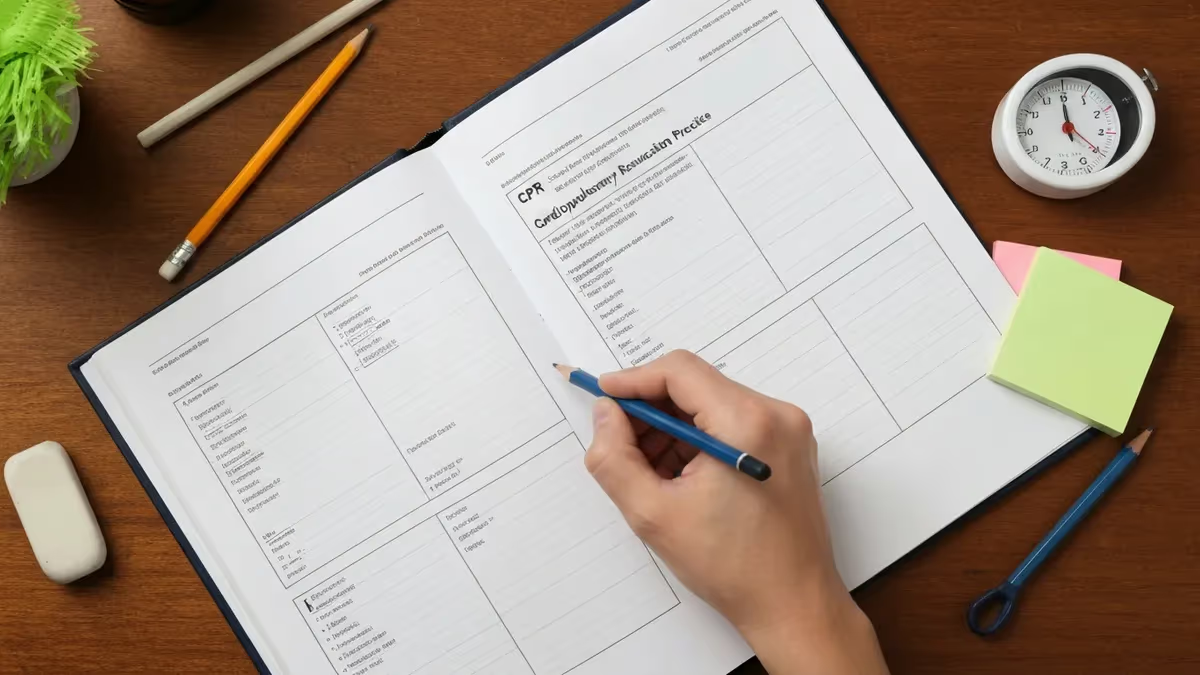
Finding cheap cpr and first aid certification does not mean settling for low-quality training. Across the United States, dozens of accredited providers offer affordable courses that meet workplace requirements, satisfy employer mandates, and deliver the same life-saving skills taught in premium programs. Whether you need basic CPR for a job application, advanced credentials like ACLS or PALS certification, or a full first aid bundle, budget-friendly options exist at every level — and knowing where to look can save you $50 to $150 per course.
The cost of CPR and first aid certification varies widely depending on the provider, the format of delivery, and the level of credential you need. A standard hands-on CPR class through the American Red Cross or the American Heart Association typically runs $50 to $100.
The National CPR Foundation and similar online-first providers often charge $20 to $40 for a basic certification card. Blended learning courses — where you complete the knowledge portion online and attend a brief in-person skills session — frequently land in the $30 to $60 range, making them one of the most cost-effective paths for most adults.
Understanding exactly what the ACLS algorithm covers, what infant CPR requires, and what does AED stand for in the context of your certification will help you choose the right course at the right price. The ACLS algorithm — short for Advanced Cardiovascular Life Support — is a structured decision-making framework used by healthcare professionals during cardiac arrest, respiratory emergencies, and other life-threatening events. Knowing whether your job requires basic CPR, ACLS, or PALS certification before you enroll prevents wasted spending on credentials you do not yet need.
Respiratory rate monitoring, recovery position technique, and proper AED usage are all covered in entry-level first aid and CPR courses. An AED, or Automated External Defibrillator, is a portable device that analyzes a victim's heart rhythm and delivers an electric shock when needed. Understanding what does AED stand for and how to operate one is a core competency in virtually every CPR course, from the most basic community class to advanced life support programs used by paramedics and emergency room nurses.
Many people searching for affordable certification are surprised to discover that their employer, local fire department, community college, or library system may offer free or heavily subsidized classes. Workplace safety programs funded by OSHA compliance budgets, community health grants, and municipal emergency preparedness initiatives often provide CPR training at no charge to participants. The same is true for volunteer fire departments, faith-based organizations, and neighborhood health fairs, where trained instructors donate time to ensure community members can respond during emergencies.
Infant CPR is another area where cost-conscious learners sometimes hesitate to enroll. Parents, grandparents, babysitters, and childcare workers who need infant CPR training can often find dedicated infant and pediatric CPR modules tacked onto standard adult CPR courses at minimal extra cost. Some providers offer family pricing packages that cover multiple household members simultaneously, reducing the per-person investment significantly. These packages are especially common through the National CPR Foundation and regional Red Cross chapters that prioritize community-wide preparedness.
This guide walks you through every dimension of affordable CPR and first aid certification: what each course level covers, how to compare providers by cost and credibility, how to prepare effectively using free practice resources, and how to avoid common pitfalls like expired cards, unaccredited providers, and certifications your employer will not accept. By the end, you will have a clear roadmap for getting certified quickly, affordably, and with the confidence to actually use those skills when it matters most.
Cheap CPR Certification by the Numbers

CPR Certification Cost Tiers: What You Get at Each Price Point
Community health fairs, workplace OSHA programs, volunteer fire departments, and library-sponsored classes often provide CPR training at zero cost. Cards may be basic but are typically accepted for non-clinical employment. Check local hospitals and municipal emergency preparedness offices.
Providers like the National CPR Foundation issue instant digital cards after a video and quiz module. Widely accepted in schools, gyms, and retail settings. Not appropriate for clinical healthcare roles requiring hands-on skills validation under direct instructor supervision.
Complete knowledge modules online, then attend a short in-person skills check with a certified instructor. The most popular format for value-conscious learners who still need a hands-on stamp of approval. AHA HeartCode and Red Cross Simulation Learning use this model.
Traditional classroom or community center course with mannequin practice, AED training, and instructor feedback. Best for healthcare workers, first responders, and anyone whose employer specifically requires an in-person credential with a signed skills verification sheet.
ACLS algorithm training and PALS certification require hands-on scenario practice and are mandatory for emergency medical professionals. Hospital education departments sometimes subsidize renewal for employed staff, reducing out-of-pocket costs to $50 or less.
Choosing the right CPR and first aid provider comes down to three questions: Will my employer accept this card? Does the course format fit my schedule and learning style? And what is the total out-of-pocket cost when you factor in travel, time off work, and renewal fees? Answering these questions before you register prevents costly mistakes and ensures you do not spend $80 on a credential that gets rejected on your first day at a new job because it came from an unrecognized issuing organization.
The American Heart Association and the American Red Cross remain the gold standard for clinical and non-clinical environments alike. Hospitals, nursing homes, school districts, and government agencies almost universally accept cards from these two organizations. The National CPR Foundation occupies a middle tier — widely accepted in fitness, childcare, and retail industries but sometimes rejected by hospitals and EMS agencies that require AHA or Red Cross credentials specifically. When in doubt, ask your HR department or licensing board which issuing organization they recognize before you spend a single dollar.
Online-only certifications have expanded dramatically since the pandemic accelerated remote learning adoption. Platforms operated under the National CPR Foundation umbrella, CPR Select, ProCPR, and similar providers issue laminated or digital cards within minutes of course completion. These cards are valid, accredited, and accepted by millions of employers — but the lack of hands-on mannequin practice means they are not appropriate for roles where skill demonstration is required by law, such as licensed nursing, paramedic certification, or school nurse positions that fall under state-regulated first aid requirements.
Blended learning, sometimes called HeartCode or Skills Online, splits the course into two phases. Phase one is a self-paced online module covering the science of cardiac arrest, respiratory rate assessment, the recovery position technique, infant CPR protocols, and AED operation. You complete this at your own pace, rewinding and reviewing as needed.
Phase two is a brief in-person skills check — typically 30 to 90 minutes — where a certified instructor watches you perform compressions, rescue breaths, and AED deployment on a mannequin before signing off your card. This format combines the convenience of online learning with the hands-on validation that most employers and licensing bodies require.
Group discounts represent one of the most underutilized cost-reduction strategies in CPR certification. If you can organize five or more colleagues, family members, or community members to attend the same session, most providers — including local Red Cross chapters and independent AHA training centers — will offer 15 to 30 percent off the per-person rate. Corporate accounts can push discounts even higher. Churches, parent-teacher associations, neighborhood watch groups, and small business owners are all natural organizers for group certification sessions that bring per-person costs well under $30.
Renewal timing also affects total cost over a career. Standard CPR and first aid cards expire after two years, and renewal courses are typically shorter and cheaper than initial certification — often half the price. Staying on schedule with renewals avoids the need to retake a full initial course, which would cost more. Setting calendar reminders eighteen months after your certification date gives you a three-month window to find the most affordable renewal option rather than scrambling at the last minute and paying full price at the only available class on your expiration week.
Scholarship programs and sliding-scale pricing are available but rarely advertised prominently. The American Red Cross offers financial assistance for individuals who cannot afford standard course fees — you simply need to ask. Some community health centers funded under the Federally Qualified Health Center program provide CPR training free of charge to uninsured or low-income community members as part of their preventive health mandate. Digging into these resources before assuming certification is out of reach financially can reveal options that make high-quality training genuinely accessible to anyone who wants it.
ACLS Algorithm, PALS Certification, and Advanced Life Support Overview
The ACLS algorithm is a systematic decision tree used by healthcare providers during cardiac arrest, stroke, and other cardiovascular emergencies. It covers ventricular fibrillation, pulseless ventricular tachycardia, asystole, and pulseless electrical activity — each with a distinct intervention pathway involving CPR cycles, defibrillation timing, and medication administration. Mastering the ACLS algorithm requires familiarity with rhythm interpretation, drug dosing sequences (epinephrine, amiodarone), and team-based resuscitation communication protocols used in hospital settings.
ACLS certification courses cost between $150 and $350 at most accredited training centers, though hospital-employed nurses and residents often have renewal costs subsidized by their employer's education department. The written exam component typically consists of 50 multiple-choice questions covering pharmacology, airway management, and algorithm application. Practice tests that simulate the ACLS algorithm scenarios — including megacode simulations — are widely available online and dramatically improve first-attempt pass rates, saving the cost of a retest.

Online vs. In-Person CPR Certification: Key Trade-Offs
- +Online and blended courses cost 40–60% less than traditional in-person classes
- +Self-paced modules let you study around work and family schedules without time pressure
- +Instant digital card delivery means certification is complete within hours, not days
- +National CPR Foundation and similar accredited providers are accepted at millions of workplaces
- +Video demonstrations of infant CPR, recovery position, and AED use are often clearer than live demos
- +No commuting cost or time lost to travel to a training center across town
- −Online-only cards are rejected by most hospitals, EMS agencies, and state-licensed clinical roles
- −No instructor feedback on compression depth, hand placement, or rescue breath technique
- −Mannequin practice — essential for building real muscle memory — is absent in fully online formats
- −Some employers explicitly list AHA or Red Cross as the only accepted issuing organizations
- −Technical issues during online exams can delay card issuance and create last-minute stress
- −Renewal reminders and expiration tracking are entirely the learner's responsibility in online formats
Pros and Cons at a Glance
| Pros | Cons |
|---|---|
| Self-paced modules let you study around work and family schedules without time pressure | Online-only cards are rejected by most hospitals, EMS agencies, and state-licensed clinical roles |
| Instant digital card delivery means certification is complete within hours, not days | No instructor feedback on compression depth, hand placement, or rescue breath technique |
| National CPR Foundation and similar accredited providers are accepted at millions of workplaces | Mannequin practice — essential for building real muscle memory — is absent in fully online formats |
| Video demonstrations of infant CPR, recovery position, and AED use are often clearer than live demos | Some employers explicitly list AHA or Red Cross as the only accepted issuing organizations |
| No commuting cost or time lost to travel to a training center across town | Technical issues during online exams can delay card issuance and create last-minute stress |
CPR Certification Prep Checklist: 10 Steps Before Exam Day
- ✓Confirm your employer's accepted issuing organizations (AHA, Red Cross, National CPR Foundation) before enrolling.
- ✓Choose the correct certification level — basic CPR/AED, CPR/First Aid combo, BLS, ACLS, or PALS — based on your job requirements.
- ✓Compare at least three providers on total cost including materials, card fees, and skills session charges.
- ✓Review the ACLS algorithm flowcharts or basic CPR compression ratios using free online study resources.
- ✓Practice infant CPR technique separately if your course includes pediatric skills, as hand position differs from adult CPR.
- ✓Memorize what AED stands for, the pad placement diagram, and the sequence of voice prompts to expect during a shock advisory.
- ✓Study normal respiratory rate ranges by age group — adults (12–20 breaths/min), children (20–30), infants (30–60) — as these appear on exams.
- ✓Learn the correct recovery position technique: lateral, stable, airway open, used for unconscious breathing victims.
- ✓Complete at least two full-length practice exams before your test date to identify weak areas.
- ✓Bring a valid photo ID, your course confirmation code, and arrive 10 minutes early to your in-person skills session.
Blended Learning Cuts Cost Without Cutting Credibility
The AHA HeartCode BLS blended learning course consistently costs 30–50% less than a traditional full-day in-person class while still producing a card accepted by hospitals, schools, and clinical employers. The online knowledge portion takes roughly 60–90 minutes; the hands-on skills check adds another 30–60 minutes. Total investment: under $60 at most AHA training sites, and under 3 hours of your day.
Understanding the full landscape of blended versus online versus in-person CPR certification requires looking at who accepts each format and why. Healthcare institutions — hospitals, surgery centers, dialysis clinics, home health agencies — almost universally require a hands-on skills verification component. This is not arbitrary bureaucracy.
Chest compression depth, recoil quality, ventilation rate, and AED pad placement are all skills that can be performed incorrectly by someone who watched a video but never practiced on a mannequin. Incorrect compression depth — too shallow or too deep — can be the difference between successful resuscitation and fractured ribs without meaningful cardiac output. In-person or blended formats catch these errors before they occur in real emergencies.
Non-clinical employers — gyms, schools, retail stores, restaurants, summer camps, construction sites — have far more flexibility. Most accept cards from any accredited provider, including the National CPR Foundation, CPR Select, and other online-first organizations. The key requirement is accreditation: the issuing body should be recognized by a national standard-setting organization or should explicitly reference compliance with the most current American Heart Association Guidelines for CPR and Emergency Cardiovascular Care, updated every five years based on the latest resuscitation science.
Life support training extends beyond the single-rescuer scenario most people imagine. Team-based CPR — used in hospital cardiac arrest response — involves a team leader, compressor, ventilator, medication nurse, and timekeeper, each with distinct roles defined by the ACLS algorithm.
Even if you are not pursuing ACLS certification, understanding team dynamics, clear communication, and closed-loop confirmation (repeating orders back before executing) improves your effectiveness as any member of a response team. Some advanced BLS courses introduce these concepts, making them a worthwhile upgrade for healthcare workers who want to go beyond the basics without committing to the full ACLS curriculum and its associated cost.
The recovery position is a foundational skill covered in virtually every first aid course and many CPR programs. When a victim is unconscious but breathing, placing them in the lateral recovery position — on their side with the lower arm extended, upper knee bent forward for stability, and head tilted to keep the airway open — prevents aspiration of vomit and maintains a clear breathing passage.
Correct recovery position technique requires knowing how to roll a victim safely without causing spinal injury in the event of a suspected fall or trauma, a nuance that is tested in most comprehensive first aid certification exams.
Respiratory rate is another vital sign that first aid and CPR certifications address directly. Normal adult respiratory rate is 12 to 20 breaths per minute at rest. A rate below 12 (bradypnea) or above 20 (tachypnea) signals potential respiratory distress requiring intervention.
In infants, normal respiratory rate ranges from 30 to 60 breaths per minute, which is why infant CPR protocols differ from adult protocols in both compression rate and depth. Knowing these numbers — and being able to count breaths accurately over a 30-second or 60-second interval — is a tested competency in most comprehensive first aid programs and is frequently tested on both written and practical CPR certification exams.
First aid modules bundled with CPR certification cover wound management, burn classification, choking response (Heimlich maneuver for adults, back blows and chest thrusts for infants), allergic reaction recognition, diabetic emergency response, and stroke identification using the FAST acronym — Face drooping, Arm weakness, Speech difficulty, Time to call 911. These bundled CPR plus first aid courses typically cost $10 to $30 more than standalone CPR certification and represent exceptional value given the breadth of knowledge and skills they deliver in a single three-to-four hour session.
Supplementing formal course preparation with free online practice tests is one of the most effective strategies for first-attempt certification success, regardless of which provider or format you choose. Practice questions that mirror the format and content of your actual exam reduce test anxiety, reinforce key facts like compression ratios (30:2 for adults, 15:2 for two-rescuer infant CPR), and help you identify gaps in knowledge before you walk into the testing environment.
Many candidates who fail their first attempt do so not because of inadequate skills, but because of unfamiliar question phrasing or uncertainty about edge cases — gaps that targeted practice questions directly address.

Not every website that sells a CPR card is accredited. Sites that offer certification with no video content, no quiz, or no skills component may issue cards that look legitimate but will be rejected by employers and licensing boards. Always verify that your provider references the current AHA Guidelines for CPR and ECC and is affiliated with a recognized accrediting body before completing any purchase. A $15 card that gets rejected costs more than a $60 card that is accepted.
Preparing effectively for your CPR certification exam — whether it is a basic written test at the end of an online module or a comprehensive skills evaluation in a clinical simulation lab — follows a predictable set of best practices that experienced instructors recommend consistently. The most important of these is spaced repetition: reviewing key facts about compression depth (at least 2 inches for adults), compression rate (100–120 per minute), the correct sequence of C-A-B (Compressions, Airway, Breathing), and what does AED stand for across multiple short study sessions rather than a single marathon cram the night before your course.
Written exam questions in CPR certification programs frequently focus on decision points: when to start CPR, when to stop, when to use an AED versus when to wait, how long to check for a pulse (no more than 10 seconds), and what to do if a victim begins breathing normally during compressions.
These decision-based questions reward candidates who have internalized the algorithm rather than memorized isolated facts. Working through scenario-based practice questions — where you follow a victim from collapse to successful AED shock to recovery position — is far more effective preparation than simply reading the textbook chapter on cardiac arrest management.
Infant CPR preparation deserves special attention from candidates who are parents, childcare workers, babysitters, or pediatric healthcare providers.
Infant CPR technique differs from adult CPR in four critical ways: you use two fingers instead of two hands for compressions; the target compression depth is about 1.5 inches rather than 2 inches; you cover both the infant's mouth and nose simultaneously during rescue breaths; and the compression-to-breath ratio for a single rescuer is 30:2, identical to adult CPR, but switches to 15:2 when two trained rescuers are present. These distinctions are consistently tested and frequently missed by candidates who have only practiced adult CPR scenarios.
The ACLS algorithm study approach that earns the highest pass rates involves three layers of preparation. Layer one is conceptual: understand why each step in the algorithm exists — why epinephrine is given every 3 to 5 minutes, why amiodarone is preferred over lidocaine in shockable rhythms, and why the team leader role is separated from the compressor role during resuscitation.
Layer two is pattern recognition: use flashcards, rhythm strip practice tools, and algorithm flowcharts until you can identify ventricular fibrillation, pulseless VT, and asystole on an ECG strip in under five seconds. Layer three is simulation: talk through or physically walk through megacode scenarios until the sequence of actions feels automatic under pressure.
PALS certification preparation follows a similar three-layer model but adds pediatric-specific content: the pediatric assessment triangle (appearance, work of breathing, circulation to skin), weight-based drug dosing using Broselow tape, and the recognition that children compensate for shock more effectively than adults — meaning a child can maintain normal blood pressure while in severe decompensated shock, masking the severity of their condition until imminent cardiovascular collapse.
These pediatric nuances are tested in both the written exam and the clinical scenarios that form the PALS skills evaluation, and candidates who review them specifically — rather than relying solely on adult ACLS knowledge — consistently outperform those who do not.
Beyond formal study materials, some of the most valuable preparation resources are free and immediately accessible. YouTube channels maintained by certified ACLS and PALS instructors offer high-quality algorithm walkthroughs, rhythm strip interpretation tutorials, and megacode simulation videos that match the exact format of the skills evaluation you will face. The American Heart Association's own website provides free algorithm summary cards in PDF format.
And the practice quiz tools available on platforms like PracticeTestGeeks allow you to work through timed, exam-format questions that simulate the pressure of the real certification test — building the calm, methodical decision-making that distinguishes candidates who pass on the first attempt from those who need to reschedule and repay the exam fee.
One often-overlooked resource for people seeking affordable CPR and first aid certification is the local chapter network of the American Red Cross. Red Cross chapters in most metropolitan areas run monthly community CPR courses at reduced rates for individuals who demonstrate financial need, and many run periodic free community events — particularly around September, which is National Preparedness Month — where hands-only CPR training and AED awareness workshops are offered at no cost. Signing up for your local chapter's email newsletter or following their social media accounts is the easiest way to catch these events before they fill up.
Practical preparation for any CPR or first aid certification course begins well before the class itself. Reading the provider's course outline in advance — which most reputable organizations publish on their websites — lets you identify the specific skills and knowledge areas that will be evaluated and tailor your pre-study accordingly.
For a basic CPR/AED course, this typically means reviewing the hands-only CPR technique, understanding the AED operation sequence, and being familiar with the universal choking response. For a BLS provider course, add rescue breathing ratios and two-rescuer team dynamics. For ACLS or PALS, the preparation investment is substantially larger and should begin at least two to three weeks before the course date.
Physical practice on a mannequin — even a borrowed or low-cost training mannequin — makes a meaningful difference in skills performance during the certification evaluation. Many fire departments, community centers, and libraries allow the public to borrow CPR training mannequins for short periods, and some Amazon sellers offer basic practice torsos for under $30.
Thirty minutes of actual hands-on compression practice will reveal things that no amount of video watching can: how tiring sustained compressions are at the correct rate of 100 to 120 per minute, how easy it is to compress too shallowly when fatigued, and how important proper posture and arm position are for sustaining effective compressions over a two-minute cycle without exhaustion.
Time management during the written portion of your certification exam is a skill worth practicing. Most multiple-choice CPR and first aid exams allow 30 to 60 minutes for 25 to 50 questions — more than enough time if you move through questions steadily. Candidates who read questions too slowly, second-guess answers excessively, or spend too long on unfamiliar questions risk running out of time before completing the exam.
The strategy recommended by most instructors: answer every question you are confident about first, flag uncertain ones, then return to flagged items with remaining time. Never leave a question blank — an educated guess scores better than an empty answer.
After passing your certification exam and receiving your card, the work does not end. Building real-world readiness means periodically reviewing the skills you certified in, particularly if months pass without practice. Some CPR instructors recommend a simple quarterly refresh: spend 15 minutes reviewing the compression sequence, practicing the recovery position on a willing family member, and rehearsing the steps for operating an AED using a video tutorial. This informal maintenance keeps the skills accessible rather than buried under two years of non-use, so that if you ever face a real cardiac emergency, muscle memory kicks in rather than panic.
Workplace AED programs represent a tangible extension of your certification investment. Many states require certain workplaces — gyms, schools, large office buildings — to maintain AEDs on premises and ensure that a sufficient number of employees are certified in their use.
If your workplace has an AED and you are newly certified, take five minutes to locate it, read the instructions on the case, and note the expiration date of the pads. Knowing exactly where your building's AED is located and how to retrieve it saves critical seconds during a cardiac emergency when every minute without defibrillation reduces survival probability by 7 to 10 percent.
Cost-conscious certification seekers should also consider the long-term financial picture. A two-year certification card that costs $60 today requires renewal in 24 months. Setting aside $2.50 per month in a dedicated account means your next renewal is fully funded when due. For families with multiple members who need certification — two parents, an older teenager, a live-in grandparent — group renewal sessions organized through a local training center can reduce the per-person renewal cost to $25 to $35, making ongoing certification genuinely affordable for households on any budget.
The investment in CPR and first aid certification — whether you spend $20 on an online course or $80 on a comprehensive in-person class — is one of the highest-return commitments any adult can make. Cardiac arrest kills over 350,000 Americans outside of hospital settings every year, and survival rates double or triple when a bystander begins CPR within the first two minutes.
First aid knowledge prevents minor injuries from becoming life-threatening complications. The skills you gain in three to four hours of training remain with you for a lifetime and may, at some critical moment, be the difference between a neighbor's life and death. No other $60 expenditure in your budget carries that potential impact.
CPR Questions and Answers
How Long Does CPR Certification Last? 2026 Renewal Guide

CPR Certification License Number: Complete Guide to ACLS Algorithm, Credentials, and Certification Logistics
Extracorporeal CPR (ECPR): Complete Guide to Mechanical Circulatory Support During Cardiac Arrest in 2026
Free Online CPR Certification: Complete Guide to Legitimate Courses, Costs, and Workplace Acceptance in 2026
CPR Instructor Certification 2026: Complete Path to Teaching CPR
About the Author

Registered Nurse & Healthcare Educator
Johns Hopkins University School of NursingDr. Sarah Mitchell is a board-certified registered nurse with over 15 years of clinical and academic experience. She completed her PhD in Nursing Science at Johns Hopkins University and has taught NCLEX preparation and clinical skills courses for nursing students across the United States. Her research focuses on evidence-based exam preparation strategies for healthcare certification candidates.
Join the Discussion
Connect with other students preparing for this exam. Share tips, ask questions, and get advice from people who have been there.
View discussion (5 replies)