
BLS CPR Course: Complete Guide to Basic Life Support Certification in 2026 October
Complete BLS CPR course guide: 🗨️ certification requirements, costs, ACLS algorithm prep, online vs in-person options, and renewal timelines for 2026 October.
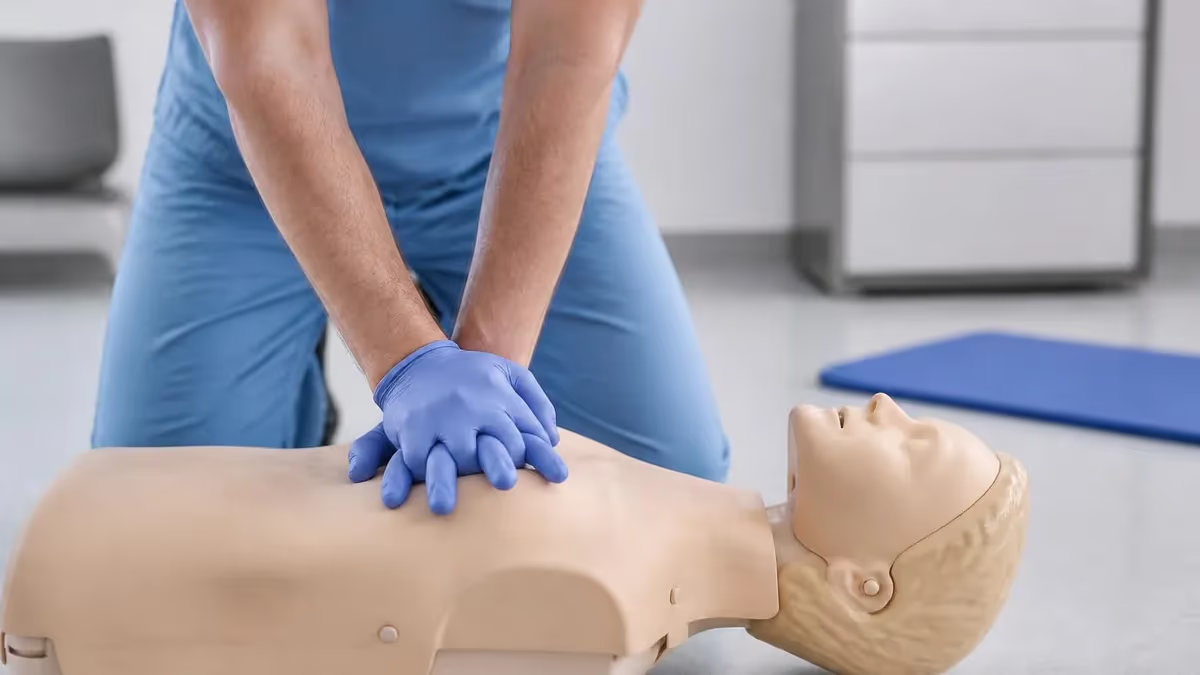
A bls cpr course is the foundational basic life support training that prepares healthcare providers, first responders, lifeguards, and clinical students to manage cardiac arrest, choking, and respiratory emergencies in adults, children, and infants. Unlike general community CPR classes, the BLS certification is designed for professionals who will use these skills in clinical or public-safety settings, and it covers high-quality chest compressions, ventilations with a bag-valve mask, AED operation, team-based resuscitation, and the early stages of the acls algorithm. Most accredited providers issue a two-year certification card upon successful completion.
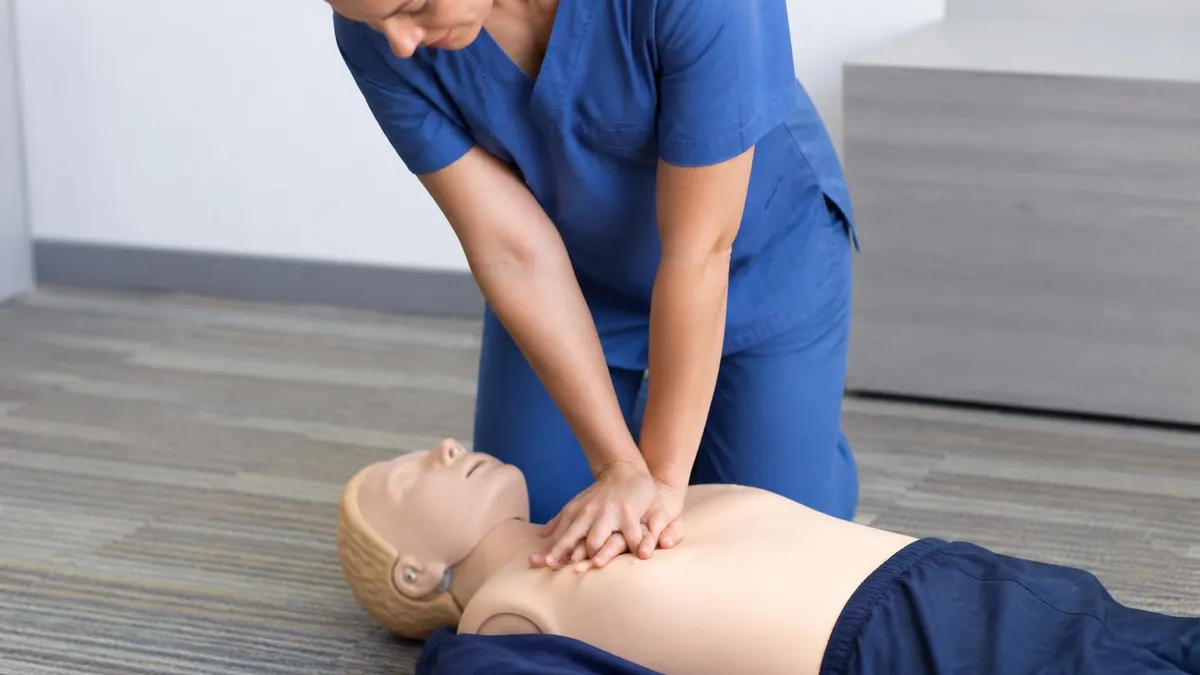
The course is built around the most recent American Heart Association and ILCOR guideline updates, which emphasize chest compression fraction, minimizing pauses, and early defibrillation. Students learn to push at a depth of at least 2 inches in adults at 100 to 120 compressions per minute, deliver effective rescue breaths without overventilation, and rotate compressors every two minutes to reduce fatigue. The instructor evaluates each candidate through written testing and a hands-on megacode that mirrors real cardiac arrest scenarios encountered in hospital corridors, urgent care clinics, and ambulance bays.
BLS is required for entry into nursing programs, paramedic school, dental hygiene programs, medical school clinical rotations, and many allied health roles such as respiratory therapy, physical therapy, and surgical technology. Hospital credentialing departments verify your card before granting patient-care privileges, and lapsed certifications can suspend your ability to work shifts. Because of this, employers strongly prefer cards issued by AHA, American Red Cross, Health & Safety Institute, or the national cpr foundation — organizations with verifiable training records and instructor oversight.
Choosing the right provider matters because not every BLS card is universally accepted. Hospitals affiliated with academic medical centers typically require AHA-issued cards, while community clinics, dental offices, and personal trainers often accept any nationally recognized provider. Before enrolling, always confirm with your employer or program director which issuing body they recognize. The price ranges from roughly $35 for a fully online refresher to about $110 for an in-person initial certification with skills check, hands-on practice mannequins, and instructor evaluation.
The typical BLS course runs four to four and a half hours for initial certification and two to three hours for renewal. Blended learning formats let you complete didactic content online at your own pace, then attend a brief in-person skills session where an instructor verifies your compression depth, rate, ventilation technique, and AED use. This format works well for busy clinicians and students juggling rotations or shift work. Pure classroom courses remain available and are sometimes preferred by visual learners or those new to medical training.
If you are preparing for BLS, you should also know how it fits into the broader life support continuum. After mastering BLS, many providers progress to ACLS for adult cardiac care or PALS for pediatric emergencies. To get a feel for the testing format and identify your weak areas before class day, try a free AHA CPR practice quiz online. Most candidates who score above 80% on practice tests pass the actual BLS exam on the first attempt with confidence.
BLS CPR Course by the Numbers
Key Facts at a Glance
| Item | Value | Details |
|---|---|---|
| Initial Course Length | 4-4.5 hrs | Renewal is 2-3 hours |
| Typical Course Cost | $35-$110 | Online vs in-person |
| Certification Validity | 2 years | Renewal required |
| Compressions Per Minute | 100-120 | Adult, child, infant |

BLS CPR Course Structure and Requirements
Open to anyone 13 and older. No prior medical training required, though healthcare students, EMTs, nurses, and dentists make up the majority of candidates. Bring photo ID on test day.
Most providers assign a 60-90 minute online module covering the chain of survival, AED basics, and high-quality CPR mechanics. Complete this before arriving at skills day.
A 2-3 hour in-person session where you demonstrate adult, child, and infant CPR, AED use, bag-valve-mask ventilation, and two-rescuer team dynamics on manikins.
25-question multiple-choice test covering scene safety, compression-to-ventilation ratios, recovery position, choking relief, and team communication. Passing score is 84%.
Issued within 24 hours of passing, valid for two years from date of completion. Digital eCards are now standard and verifiable through the provider's online lookup tool.
A comprehensive BLS CPR course teaches far more than chest compressions. You will master infant cpr techniques using the two-finger or two-thumb encircling hands method for newborns and infants under one year of age, with a compression depth of about 1.5 inches and a 30:2 compression-to-ventilation ratio for single rescuers (15:2 for two rescuers). For children one year to puberty, the depth increases to about 2 inches, and adult compressions reach 2 to 2.4 inches. Understanding these age-based differences is critical for clinical accuracy.
Airway management receives substantial attention in the curriculum. You will practice the head-tilt chin-lift maneuver for non-trauma patients and the jaw-thrust for suspected cervical spine injuries. Bag-valve-mask ventilation is a high-failure skill that instructors specifically watch for — common mistakes include poor mask seal, excessive volume, and over-rapid delivery. The recommended ventilation rate during CPR with an advanced airway is one breath every six seconds, which produces a target respiratory rate of about 10 breaths per minute without interrupting compressions.
AED operation forms the third pillar of BLS. So what does aed stand for? Automated External Defibrillator — a portable device that analyzes heart rhythm and delivers a shock if the patient is in ventricular fibrillation or pulseless ventricular tachycardia. The course teaches you to power on the unit, expose the chest, apply pads correctly (avoiding the sternum and any implanted devices), clear the patient before analysis and shock, and resume compressions immediately after the shock is delivered or denied.
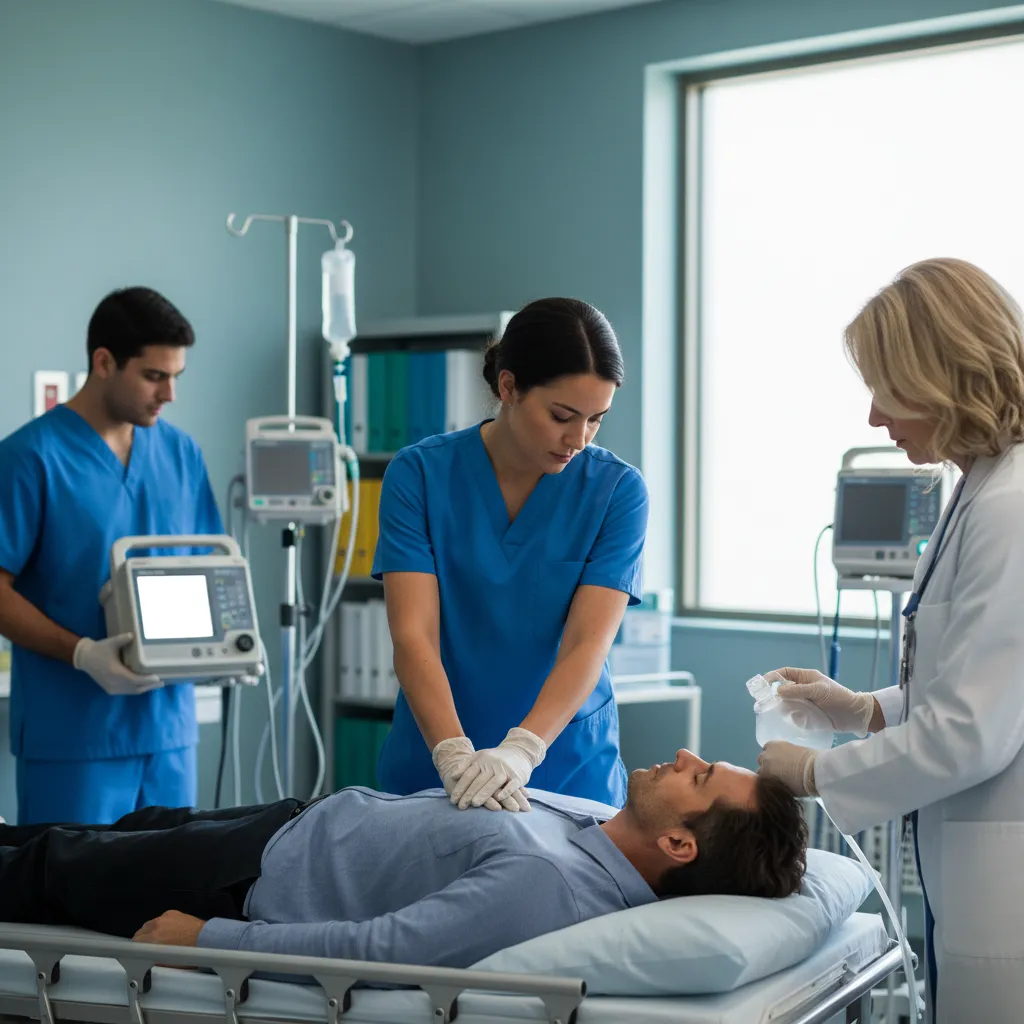
Team dynamics is a newer emphasis in BLS. Resuscitations rarely involve a single rescuer in clinical settings — they involve a team leader, a compressor, a ventilator, an AED operator, a medication runner, and a recorder. The course teaches closed-loop communication, clear role assignment, constructive intervention, and knowledge sharing. These soft skills directly improve survival outcomes and are tested in the megacode scenario at the end of class.
You will also learn to recognize and respond to choking. For conscious adults and children, the abdominal thrust (Heimlich maneuver) is the standard intervention. For pregnant women, obese patients, and infants under one year, the technique changes — chest thrusts replace abdominal thrusts for the former, and a combination of five back blows and five chest thrusts is used for the latter. Recognition of mild versus severe airway obstruction is tested on the written exam.
Finally, the course introduces the early steps of the acls algorithm for healthcare providers, including the BLS survey (check responsiveness, activate emergency response, check pulse and breathing, defibrillate) and the primary assessment (airway, breathing, circulation, disability, exposure). While ACLS goes much deeper into pharmacology and rhythm interpretation, the BLS foundation is non-negotiable. For an excellent free study companion, review the CPR - Cardiopulmonary Resuscitation: Complete Study Guide 2026 before your class to reinforce these concepts.
CPR Practice Test Questions
Prepare for the CPR Cardiopulmonary Resuscitation Practice exam with our free practice test modules. Each quiz covers key topics to help you pass on your first try.
CPR Basic CPR
CPR Exam Questions covering Basic CPR. Master CPR Test concepts for certification prep.
CPR and First Aid
Free CPR Practice Test featuring and First Aid. Improve your CPR Exam score with mock test prep.
CPR (Cardiopulmonary Resuscitation) Adult ...
CPR Mock Exam on (Cardiopulmonary Resuscitation) Adult CPR and AED Usage. CPR Study Guide questions to pass on your first try.
CPR (Cardiopulmonary Resuscitation) Airway...
CPR Test Prep for (Cardiopulmonary Resuscitation) Airway Obstruction and Choking. Practice CPR Quiz questions and boost your score.
CPR (Cardiopulmonary Resuscitation) Cardio...
CPR Questions and Answers on (Cardiopulmonary Resuscitation) Cardiopulmonary Emergency Recognition. Free CPR practice for exam readiness.
CPR (Cardiopulmonary Resuscitation) Child ...
CPR Mock Test covering (Cardiopulmonary Resuscitation) Child and Infant CPR. Online CPR Test practice with instant feedback.
CPR (Cardiopulmonary Resuscitation) High-P...
Free CPR Quiz on (Cardiopulmonary Resuscitation) High-Performance Team Dynamics. CPR Exam prep questions with detailed explanations.
CPR (Cardiopulmonary Resuscitation) Legal ...
CPR Practice Questions for (Cardiopulmonary Resuscitation) Legal and Ethical Considerations. Build confidence for your CPR certification exam.
CPR for Specific Populations
CPR Test Online for for Specific Populations. Free practice with instant results and feedback.
CPR Airway & Breathing Management
CPR Exam Questions covering Airway & Breathing Management. Master CPR Test concepts for certification prep.
CPR Assessment & Recognition of Cardiac Ar...
Free CPR Practice Test featuring Assessment & Recognition of Cardiac Arrest. Improve your CPR Exam score with mock test prep.
CPR Chest Compressions & Defibrillation
CPR Mock Exam on Chest Compressions & Defibrillation. CPR Study Guide questions to pass on your first try.
CPR Post-Resuscitation Care & Recovery
CPR Test Prep for Post-Resuscitation Care & Recovery. Practice CPR Quiz questions and boost your score.
Online vs Blended vs In-Person BLS Formats
Pure online BLS courses are offered by providers like the national cpr foundation and several smaller online vendors. The entire training, including the final exam, is completed via video modules and a digital test. There is no in-person skills check, no manikin practice, and no instructor evaluation. Cost is typically $20 to $40 and turnaround is under two hours.
The trade-off is acceptance. Many hospitals, nursing schools, and EMS agencies do not recognize online-only certifications because they lack a psychomotor skills component. Verify with your employer or program before enrolling. Online-only cards are best for personal trainers, daycare workers, and informal caregivers who need documentation but not clinical credentialing.

Is a BLS CPR Course Worth It Compared to Standard CPR?
- +Required for nursing, medical, dental, paramedic, and allied health programs
- +Covers adult, child, and infant CPR plus AED in one course
- +Two-year validity period with straightforward renewal process
- +Includes bag-valve-mask ventilation training that standard CPR omits
- +Teaches two-rescuer team dynamics critical in clinical settings
- +Digital eCards are verifiable online by employers and credentialing offices
- +Recognized internationally by most healthcare systems and licensing boards
- −Higher cost than community CPR classes ($75-$110 vs $35-$50)
- −Longer time commitment than basic CPR (4+ hours vs 2 hours)
- −More technical depth may overwhelm casual learners
- −Some employers require AHA-specific cards, limiting provider choice
- −Renewal every two years adds recurring cost and scheduling burden
- −Skills checks can be intimidating for first-time clinical students
BLS CPR Course Pre-Class Preparation Checklist
- ✓Confirm your employer or program accepts your chosen provider's certification card
- ✓Register at least one week in advance to secure your preferred date and location
- ✓Complete all assigned online pre-coursework before skills session day
- ✓Print or download the current BLS Provider Manual and review compression rates
- ✓Memorize compression depths for adult, child, and infant patients
- ✓Practice the 30:2 compression-to-ventilation ratio mentally before class
- ✓Bring photo ID, payment confirmation, and a printed pre-course completion certificate
- ✓Wear comfortable clothing that allows kneeling and bending over manikins
- ✓Eat a balanced meal beforehand — skills sessions are physically demanding
- ✓Arrive 15 minutes early to complete sign-in and find your station
- ✓Review choking relief sequences for adults, infants, and pregnant patients
- ✓Download the AHA Student or Red Cross app for digital card retrieval
Students who complete pre-course modules score 23% higher on the final exam
Internal AHA data shows that candidates who finish 100% of the online pre-coursework pass the BLS skills check and written exam on the first attempt 91% of the time, compared to 68% for those who skip or partially complete prep. The single biggest predictor of failure is poor familiarity with compression rate and depth standards before walking into the skills room.
Understanding the true cost of a BLS CPR course goes beyond the sticker price. The base tuition typically runs $75 to $110 for an in-person initial certification, $65 to $95 for blended formats, and $35 to $50 for online-only options that may not be widely accepted. On top of tuition, you should budget for the BLS Provider Manual (about $15 if not included), parking or transportation, and potentially a re-test fee of $25 to $40 if you fail the skills check on your first attempt. Group rates and employer-sponsored classes can reduce costs significantly.
Renewal is required every two years and is generally less expensive than initial certification. A two- to three-hour renewal course costs $55 to $85 and focuses on skills verification rather than full theory instruction. If your card has lapsed by more than 30 days, most providers require you to take the full initial course again rather than the abbreviated renewal — so set a calendar reminder 60 days before your expiration date to schedule your refresher and avoid the extra time and expense.
Card validity is uniformly two years from the date of course completion, not the date of card issuance. Digital eCards have largely replaced plastic cards because they are verifiable online, harder to falsify, and instantly retrievable if lost. Employers can confirm authenticity by entering the eCard ID on the issuing organization's website. If you cannot find your card, most providers offer free lookup tools and can resend the digital version within minutes for current certifications.
Some employers reimburse BLS course costs as part of their continuing education or compliance budget. Ask your HR department before paying out of pocket. Hospital-employed nurses, respiratory therapists, and EMTs often have BLS classes offered free on-site as part of annual competency days. Students in nursing or paramedic programs should check whether tuition includes a BLS course bundled with skills lab fees — many programs cover the first certification automatically.
Be cautious of suspiciously cheap online certifications. Cards from unaccredited providers may be rejected during employer credentialing checks, forcing you to retake the course at the legitimate provider's full price. Look for accreditation through the American Heart Association, American Red Cross, Health & Safety Institute (ASHI/MEDIC First Aid), or the American Safety & Health Institute. These four cover roughly 95% of US healthcare-employer acceptance and offer transparent verification systems.
Renewal timing matters for career continuity. A lapsed BLS card can suspend your patient-care privileges, force you off the schedule, and even trigger licensing board notification in some states. Set two calendar reminders — one at 90 days before expiration to schedule the course, and one at 30 days to confirm registration. If you work in a multi-certification role (BLS plus ACLS plus PALS), consider grouping renewals into a single weekend with a combined provider to save travel time and bundle discounts.

Hospital credentialing offices audit BLS certification dates quarterly. If your card lapses, your employer is legally required to remove you from direct patient-care assignments until you are re-certified. Some institutions place a financial hold on paychecks. Schedule your renewal at least 60 days before expiration to avoid scheduling gaps, especially during peak training months of August and January.
A BLS CPR course is more than a checkbox on a clinical onboarding form — it is a career-defining credential that signals you can deliver life support competently under pressure. For nursing students, completing BLS during the first semester is essential before any clinical rotation. For paramedics, it is the prerequisite for advanced cardiac life support and prehospital trauma life support. For medical students, BLS opens the door to clerkships, sub-internships, and residency applications where competency in resuscitation is assumed from day one.
Beyond direct patient care, a BLS certification benefits roles you might not immediately associate with emergency response. Personal trainers, ski instructors, daycare directors, hotel security, summer camp counselors, and corporate safety officers all benefit from holding a recognized card. In many states, group homes, dental offices, and assisted living facilities are legally required to staff a certain ratio of BLS-certified employees on every shift. Holding the card can be the difference between being hired and being passed over for these jobs.
Once you hold a current BLS card, the natural next step is pals certification for those working with pediatric populations — pediatric ICU nurses, NICU staff, pediatricians, family medicine residents, and pediatric ED technicians. PALS builds on BLS by teaching pediatric rhythm interpretation, pharmacology dosing by weight, and respiratory failure management. The course runs 12 to 14 hours over two days and costs $200 to $300. Most providers require a current BLS card as a prerequisite before you can enroll in PALS.
For adult-focused providers, ACLS is the equivalent next step. ACLS teaches rhythm recognition, defibrillation strategy, advanced airway management, intravenous and intraosseous medications, and post-cardiac-arrest care. It is required for ICU nurses, ED physicians, anesthesiologists, hospitalists, and rapid response team members. Like PALS, ACLS requires a current BLS card. Many hospitals pay for staff to obtain both ACLS and PALS as part of clinical ladder advancement and shift differential eligibility.
BLS also confers a sense of confidence outside of work. Cardiac arrest happens at home, in gyms, at restaurants, and during youth sports more often than people realize — about 350,000 out-of-hospital cardiac arrests occur in the US each year, and bystander CPR doubles or triples the chance of survival. Holding a valid BLS card means you can act decisively while waiting for EMS, perform compressions to the rhythm of the song "Stayin' Alive" at 100 to 120 beats per minute, and use a public AED without hesitation. That confidence is priceless.
To extend your skills into the broader emergency response space, consider stacking BLS with first aid, bloodborne pathogens training, naloxone administration certification, and tactical emergency casualty care depending on your role. Each of these is a short add-on (2 to 4 hours) and significantly broadens what you can offer in a crisis. Before you start the BLS course, take a moment to review Adult CPR: Complete Step-by-Step Guide to Hands-Only and Standard CPR in 2026 for a complete pre-class refresher on the core skills you'll be tested on.
On the day of your BLS skills check, arrive 15 minutes early, dress in comfortable layers, and bring a water bottle. The skills room is often kept warm, and compressions are physically demanding. You will rotate through stations for adult CPR, child and infant CPR, AED operation, bag-valve-mask ventilation, and two-rescuer team scenarios. Instructors use real-time feedback manikins that display compression depth, rate, and recoil, so the manikin will essentially tell you when you are off target — listen to the feedback and adjust immediately.
The most common reasons candidates fail the skills check are insufficient compression depth (less than 2 inches in adults), incomplete chest recoil between compressions, leaning on the chest, and ventilation volume that is too high. To avoid these, practice at home with a pillow or rolled-up towel beforehand. Push hard, let the chest fully recoil between compressions, and deliver breaths over only one second each — just enough to see the chest rise. Overventilation is one of the most common errors and can actually reduce coronary perfusion pressure during arrest.
Use the recovery position confidently for unresponsive patients who are breathing normally and have a pulse. The position recovery technique places the patient on their side with the head tilted to keep the airway open and prevent aspiration of vomit or secretions. This is tested in the post-resuscitation scenario portion of the skills check. Practice rolling a partner or manikin once or twice the night before — it is mechanically simple but easy to fumble under exam pressure.
For the written exam, focus your studying on the chain of survival sequence, compression-to-ventilation ratios for one and two rescuers across all age groups, AED pad placement variations (including pediatric attenuators, hairy chests, wet skin, and implanted devices), choking relief sequences, and team dynamics terminology. The exam is open-book at some providers and closed-book at others — verify your provider's policy in advance. Either way, knowing the material cold beats searching for answers under time pressure.
Avoid common test-day mistakes. Do not skip the post-resuscitation debrief portion — it is a graded component at many providers. Do not argue with the instructor if they correct your technique; thank them and adjust. Do not let nerves cause you to deliver compressions too fast — anything above 120 per minute reduces coronary perfusion and is marked down.
Use a metronome app or the rhythm of a 100-120 BPM song mentally to stay on tempo.
Finally, after passing, save your digital eCard in three places: download the PDF to your phone, save it to cloud storage, and email a copy to your employer's credentialing office. Set calendar reminders for 90 days, 60 days, and 30 days before your two-year expiration. This three-tiered backup ensures you never lose access to proof of your certification, and you never let your card lapse — which protects your job, your patients, and your professional standing in healthcare.
CPR Questions and Answers
CPR Card Lookup: How to Verify, Replace, and Access Your CPR Certification in 2026
AHA CPR: What It Is, Which Course You Need, and How to Get Certified
Adult CPR: Complete Step-by-Step Guide to Hands-Only and Standard CPR in 2026
CPR - Cardiopulmonary Resuscitation: Complete Study Guide 2026
Inappropriate CPR Songs: What Not to Play, Why It Matters, and Better Beat-Per-Minute Alternatives
About the Author

Registered Nurse & Healthcare Educator
Johns Hopkins University School of NursingDr. Sarah Mitchell is a board-certified registered nurse with over 15 years of clinical and academic experience. She completed her PhD in Nursing Science at Johns Hopkins University and has taught NCLEX preparation and clinical skills courses for nursing students across the United States. Her research focuses on evidence-based exam preparation strategies for healthcare certification candidates.
Join the Discussion
Connect with other students preparing for this exam. Share tips, ask questions, and get advice from people who have been there.
View discussion (5 replies)