
CPR Ratio: Complete Guide to Compression-to-Ventilation Rates for Adults, Children & Infants
Master the CPR ratio for adults, children, and infants. 🟢 Learn 30:2, 15:2, and rescuer-specific ratios aligned with current AHA guidelines.
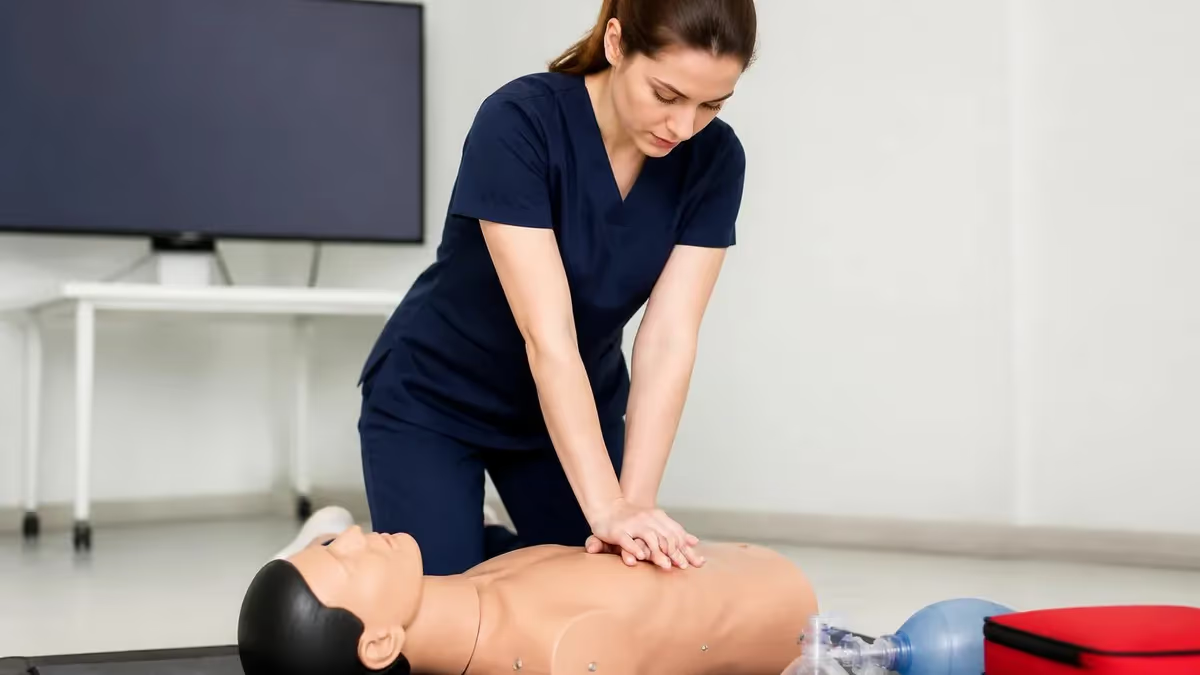
The cpr ratio is the foundation of every effective resuscitation attempt, dictating exactly how many chest compressions you deliver before pausing to give rescue breaths. For adult cardiac arrest, the universally taught ratio is 30 compressions to 2 breaths, regardless of whether one or two rescuers are present. This ratio aligns with the acls algorithm taught by the American Heart Association and reflects decades of resuscitation science showing that minimizing interruptions to compressions dramatically improves survival outcomes when blood flow to the brain and heart is restored.
For children and infants, the ratio shifts depending on how many trained rescuers are available. A lone rescuer still uses 30:2, but two trained rescuers switch to a 15:2 ratio because pediatric arrests are more often respiratory in origin, demanding more frequent ventilations. Understanding why these numbers differ — not just memorizing them — is what separates a confident responder from a hesitant bystander when seconds matter most during a sudden collapse at home, work, or in public.
This guide breaks down every cpr ratio variation you need to know for certification exams, workplace response, and real-world emergencies. We cover adult, child, and infant cpr scenarios, single-rescuer versus two-rescuer dynamics, compression depth and rate targets, and the precise moment when ratios change once an advanced airway is in place. Whether you're studying for the BLS exam or refreshing skills before recertification, the practical breakdowns here mirror what instructors emphasize during hands-on testing.
You'll also see how the cpr ratio integrates with AED use, airway management, and pulse checks within the broader chain of survival. Many learners arrive thinking CPR is just "push and blow," but the science is precise: compression depth, hand placement, recoil time, and ventilation volume all interact with the ratio you choose. Get one variable wrong and perfusion pressure collapses within seconds, undoing the work of every prior compression cycle you delivered.
If you're preparing for certification, pairing this guide with practice questions sharpens recall under pressure. Repetition is what cements the 30:2 cadence into muscle memory so you don't have to think about it when adrenaline floods the room and someone screams for help.
The remainder of this article is organized so you can jump to the section you need. Use the table of contents to navigate quickly, or read end-to-end for a complete picture. Throughout, we connect ratio knowledge to broader certification topics including ACLS, PALS, and pediatric emergency response — the same knowledge tested on every BLS card renewal and required for healthcare provider roles across hospitals, dental offices, schools, and emergency services.
By the end, you'll have a clear mental model of which ratio applies to which patient, how to switch roles smoothly with a partner, and how to avoid the most common ratio mistakes that examiners flag during skill checks. This isn't theory — it's the operational core of CPR competency, and getting it right buys time for advanced care to arrive and take over.
CPR Ratios by the Numbers

CPR Ratio Quick Reference by Patient Type
Use 30 compressions followed by 2 rescue breaths for any patient who has reached puberty. The ratio does not change with two rescuers unless an advanced airway is placed during the resuscitation attempt.
For children aged 1 year to puberty with one rescuer, use 30 compressions to 2 breaths. This matches the adult ratio so lay responders only need to memorize one number under high-stress circumstances.
With two trained rescuers, switch to 15 compressions and 2 breaths. The lower count delivers more ventilations, which matters because pediatric arrest is usually respiratory rather than primarily cardiac in origin.
For infants under 1 year with one rescuer, use 30:2 with two fingers or the two-thumb technique encircling the chest. Compression depth targets about 1.5 inches, roughly one-third of chest diameter.
Once an endotracheal tube or supraglottic airway is placed, stop cycles entirely. Deliver continuous compressions at 100-120 per minute and 1 breath every 6 seconds (about 10 breaths per minute).
The adult cpr ratio of 30 compressions to 2 breaths applies the moment a patient reaches puberty, generally signaled by visible secondary sex characteristics. There is no upper age limit, no exception for frail patients, and no difference between lay rescuer and healthcare provider practice. The American Heart Association consolidated to this single ratio in 2005 specifically to reduce confusion and increase compression delivery, after research showed earlier 15:2 protocols produced too many interruptions that crashed coronary perfusion pressure between cycles.
Why 30 and not 20 or 50? The number reflects a compromise between two competing physiological needs. Compressions generate forward blood flow only after several beats build coronary perfusion pressure, and that pressure collapses to near-zero the instant you stop pushing. Longer compression runs preserve that hard-won pressure. But oxygen still must enter the bloodstream eventually, and waiting too long between breaths drops arterial oxygen saturation below useful levels. Thirty compressions strikes the balance modern resuscitation science endorses.
Compression rate matters as much as the ratio itself. The target is 100 to 120 compressions per minute — fast enough to maintain forward flow, slow enough to allow full chest recoil between pushes. Without complete recoil, the heart cannot refill with blood, and your next compression squeezes an empty chamber. Many rescuers under stress accelerate past 130, sacrificing depth and recoil. Use a metronome, the beat of "Stayin' Alive," or any pacing tool to lock in the correct cadence.
Depth is the third pillar. For adults, push at least 2 inches but no more than 2.4 inches. Going shallower fails to compress the heart between the sternum and spine; going deeper risks rib fractures, liver laceration, and pneumothorax. The chest of an average adult is far stiffer than most students expect, and many fail their first skill check by underestimating how hard they must lean in. Lock your elbows, stack your shoulders directly over your hands, and use your body weight rather than your arm strength.
The two breaths in 30:2 each take about 1 second and should produce visible chest rise — no more, no less. Excessive ventilation is a documented killer in resuscitation. Forcing too much air or breathing too fast raises intrathoracic pressure, which reduces venous return to the heart and undermines the compressions you just delivered. Squeeze the bag-mask or seal mouth-to-mask gently and watch the chest. If it doesn't rise on the first breath, reposition the airway and try once more — then return to compressions.
Two-rescuer adult CPR keeps the same 30:2 ratio but adds role rotation. Switch the compressor every 2 minutes — roughly five cycles — to prevent fatigue-driven shallow compressions. Studies consistently show compression quality degrades within 60 to 90 seconds even among trained providers who don't feel tired. Plan the switch during the rhythm check or AED analysis so the pause is no longer than necessary. A clean handoff in under 5 seconds is the standard taught in every BLS course and tested during skill verification.
For broader exam prep beyond ratios, the cpr index covers the full spectrum of BLS content including AED operation, choking response, and team dynamics. Mastering ratios is foundational, but real-world resuscitation also demands fluency in airway management, pulse assessment, and recognizing rhythms an AED will or won't shock. Build the complete skill set rather than memorizing isolated numbers in a vacuum.

CPR Practice Test Questions
Prepare for the CPR Cardiopulmonary Resuscitation Practice exam with our free practice test modules. Each quiz covers key topics to help you pass on your first try.
CPR Basic CPR
CPR Exam Questions covering Basic CPR. Master CPR Test concepts for certification prep.
CPR and First Aid
Free CPR Practice Test featuring and First Aid. Improve your CPR Exam score with mock test prep.
CPR (Cardiopulmonary Resuscitation) Adult ...
CPR Mock Exam on (Cardiopulmonary Resuscitation) Adult CPR and AED Usage. CPR Study Guide questions to pass on your first try.
CPR (Cardiopulmonary Resuscitation) Airway...
CPR Test Prep for (Cardiopulmonary Resuscitation) Airway Obstruction and Choking. Practice CPR Quiz questions and boost your score.
CPR (Cardiopulmonary Resuscitation) Cardio...
CPR Questions and Answers on (Cardiopulmonary Resuscitation) Cardiopulmonary Emergency Recognition. Free CPR practice for exam readiness.
CPR (Cardiopulmonary Resuscitation) Child ...
CPR Mock Test covering (Cardiopulmonary Resuscitation) Child and Infant CPR. Online CPR Test practice with instant feedback.
CPR (Cardiopulmonary Resuscitation) High-P...
Free CPR Quiz on (Cardiopulmonary Resuscitation) High-Performance Team Dynamics. CPR Exam prep questions with detailed explanations.
CPR (Cardiopulmonary Resuscitation) Legal ...
CPR Practice Questions for (Cardiopulmonary Resuscitation) Legal and Ethical Considerations. Build confidence for your CPR certification exam.
CPR for Specific Populations
CPR Test Online for for Specific Populations. Free practice with instant results and feedback.
CPR Airway & Breathing Management
CPR Exam Questions covering Airway & Breathing Management. Master CPR Test concepts for certification prep.
CPR Assessment & Recognition of Cardiac Ar...
Free CPR Practice Test featuring Assessment & Recognition of Cardiac Arrest. Improve your CPR Exam score with mock test prep.
CPR Chest Compressions & Defibrillation
CPR Mock Exam on Chest Compressions & Defibrillation. CPR Study Guide questions to pass on your first try.
CPR Post-Resuscitation Care & Recovery
CPR Test Prep for Post-Resuscitation Care & Recovery. Practice CPR Quiz questions and boost your score.
Child and Infant CPR Ratios in the ACLS Algorithm Framework
For children between one year of age and puberty, ratio selection depends on rescuer count. A single lay rescuer uses 30:2, matching the adult sequence to reduce cognitive load when seconds matter. Compression depth targets about 2 inches, or one-third the anterior-posterior chest diameter, using one or two hands depending on the child's size and your hand strength. The compression rate stays 100-120 per minute regardless of patient age.
When two trained rescuers are present, the ratio drops to 15:2. The rationale is physiologic: pediatric cardiac arrest is overwhelmingly secondary to respiratory failure or shock rather than primary cardiac causes seen in adults. More frequent ventilation cycles deliver oxygen sooner and improve outcomes. This 15:2 ratio is the same pattern emphasized in pals certification courses and tested on every pediatric advanced life support exam taken by healthcare providers.
Single Universal Adult Ratio: Strengths and Limitations
- +Simplifies memorization for lay rescuers who may panic under stress
- +Maximizes compression count per cycle, preserving coronary perfusion pressure
- +Reduces hands-off time between cycles compared to older 15:2 adult protocols
- +Standardizes training across BLS, ACLS, and lay responder courses
- +Aligns with AED prompts that pause every two minutes for rhythm analysis
- +Translates cleanly across solo and team resuscitation scenarios
- −May under-ventilate patients with primary respiratory arrest like overdose victims
- −Same ratio for very different physiologies — drowning vs. cardiac arrest
- −Counting to 30 under stress is harder than counting to 15 for many learners
- −Provides less frequent reassessment opportunities than shorter ratios
- −Fatigue effects accumulate before the cycle-end natural rest point arrives
- −Less forgiving of compression depth errors over a longer uninterrupted run
Pros and Cons at a Glance
| Pros | Cons |
|---|---|
| Simplifies memorization for lay rescuers who may panic under stress | May under-ventilate patients with primary respiratory arrest like overdose victims |
| Maximizes compression count per cycle, preserving coronary perfusion pressure | Same ratio for very different physiologies — drowning vs. cardiac arrest |
| Standardizes training across BLS, ACLS, and lay responder courses | Provides less frequent reassessment opportunities than shorter ratios |
| Aligns with AED prompts that pause every two minutes for rhythm analysis | Fatigue effects accumulate before the cycle-end natural rest point arrives |
| Translates cleanly across solo and team resuscitation scenarios | Less forgiving of compression depth errors over a longer uninterrupted run |

CPR Ratio Performance Checklist for Skill Verification
- ✓Confirm scene safety before approaching the patient
- ✓Check responsiveness and call for help including AED within 10 seconds
- ✓Assess breathing and pulse simultaneously for no more than 10 seconds
- ✓Position hands at the lower half of the sternum, fingers interlaced
- ✓Deliver 30 compressions at 100-120 per minute for adult patients
- ✓Push at least 2 inches deep with full chest recoil between compressions
- ✓Open the airway using head-tilt chin-lift unless trauma is suspected
- ✓Deliver 2 breaths of 1 second each producing visible chest rise
- ✓Resume compressions within 10 seconds of the last breath delivered
- ✓Switch rescuer roles every 2 minutes to prevent fatigue-driven quality loss
Minimize interruptions — every pause costs perfusion pressure
Modern resuscitation science prioritizes chest compression fraction — the percentage of arrest time spent actively compressing. Targets exceed 80%. Every pause longer than 10 seconds drops coronary perfusion pressure to near-zero, and it takes multiple compressions to rebuild it. When in doubt, keep pushing.
The cpr ratio changes the instant an advanced airway is in place. Once a clinician inserts an endotracheal tube, supraglottic airway like an i-gel or LMA, or a King airway, the cycle-based 30:2 pattern ends. Compressions become continuous at 100-120 per minute without pause for breaths, and ventilations are delivered asynchronously at one breath every 6 seconds — approximately 10 breaths per minute. This shift is a frequent test question on BLS, ACLS, and pals certification exams and a common point of confusion.
Why does this change happen? With a sealed airway, ventilation no longer requires opening the mouth, sealing a mask, or pausing compressions to avoid air being forced into the stomach. The advanced airway protects the lungs and lets the ventilator-rescuer pace breaths independently. Continuous compressions then maintain maximum perfusion pressure. The 10 breaths per minute target is also tied to respiratory rate physiology — enough to clear carbon dioxide without inducing hyperventilation, which would raise intrathoracic pressure and impair venous return.
Ratios also shift during specific clinical scenarios. Opioid overdose resuscitation by lay rescuers emphasizes rescue breathing first, because the cause is respiratory depression rather than cardiac arrhythmia. Drowning victims similarly benefit from initial rescue breaths before compressions when a single rescuer must choose what to start with. These exceptions appear in the AHA's 2025 update and any rigorous national cpr foundation curriculum. Knowing them is critical for healthcare providers but optional for lay responders following the simpler universal algorithm.
When an AED arrives, the rhythm and energy decisions take priority over ratio management for those moments. Apply pads immediately while compressions continue, then pause briefly for rhythm analysis. If a shock is advised, clear the patient, deliver the shock, and resume compressions instantly — do not pause to check pulse. The next 2-minute compression cycle proceeds with the same 30:2 ratio until the next analysis. Many learners mistakenly check pulse after every shock, wasting precious perfusion time.
Pulse checks are themselves ratio-adjacent moments where rescuers commonly err. Limit pulse assessments to no more than 10 seconds. If you cannot confidently feel a pulse in that window, resume compressions. The cost of compressing a beating heart briefly is far lower than the cost of withholding compressions from a stopped one. This rule appears in every iteration of the acls algorithm and is hammered into ICU and emergency department staff during megacode practice.
Team dynamics also reshape how the ratio plays out in practice. Closed-loop communication — "Compressor switching in 30 seconds," "Switch confirmed" — keeps everyone aligned. Designate a timekeeper who calls cycle counts and a recorder who logs medications and rhythm changes. The ratio itself doesn't change, but execution quality depends entirely on whether the team operates as a coordinated unit or as parallel individuals working past one another with different mental models of where the resuscitation stands.
Finally, ratios connect directly to outcomes data. Studies of in-hospital cardiac arrest show survival to discharge climbs by several percentage points for every 10% increase in chest compression fraction. The ratio you choose is less important than the quality with which you execute it. Two seconds shaved off every pause, two more compressions per cycle, and one fewer interruption can mean the difference between a neurologically intact survivor and a death certificate. Treat every cycle as if it's the only one that matters.
Examiners most often flag three errors: counting compressions too fast (rate above 120), pausing more than 10 seconds between cycles for breaths, and incomplete chest recoil. Any of these will fail your BLS skill check even if your ratio numbers are correct. Practice with a CPR feedback manikin before testing.
The most common cpr ratio mistakes cluster into a predictable set that examiners watch for during certification testing. Number one is rate drift — pushing too fast or too slow because the rescuer is counting without a pacing reference. Under adrenaline, most untrained rescuers accelerate past 140 compressions per minute, which sacrifices depth and recoil. Use a metronome app, the rhythm of "Stayin' Alive" or "Another One Bites the Dust," or any consistent audible beat to lock the cadence at the 100-120 target.
The second common error is depth compromise. Many rescuers compress only to about 1.5 inches because the adult chest is stiffer than they anticipate. Get over the patient, stack shoulders directly above your hands, and use body weight rather than triceps. If you finish a cycle without feeling muscle fatigue in your back and core, you probably weren't pushing hard enough. Real CPR is physically exhausting — that's why rescuer rotation every two minutes exists in the first place.
Third is the recoil failure: leaning on the chest between compressions. This prevents the heart from refilling, so each subsequent push moves less blood. Lift your hands fully off the chest at the top of each compression while keeping them in position. Modern feedback manikins detect leaning with sensors and will mark you down even if your depth and rate are otherwise perfect. The same applies in real arrests — a leaning rescuer produces measurable drops in end-tidal CO2, the field's best real-time CPR quality indicator.
Fourth is the dreaded long pause between cycles. The transition from compression 30 to breath 1 should be seamless — fingers releasing pressure, partner ready with the mask, breath delivered in 1 second, second breath in another 1 second, fingers back on the chest. The entire ventilation pause should clock in under 5 seconds total. Anything beyond 10 seconds is a fail-point on official skill rubrics and a measurable harm to the patient. Train the transition until it becomes automatic.
Fifth involves over-ventilation. Squeezing the bag too hard, too fast, or for too long pumps air into the stomach, causing regurgitation and aspiration. It also raises intrathoracic pressure, compressing the heart and great vessels and reducing the very perfusion you're working to create. Each breath gets one second and stops when you see the chest just begin to rise — no more. If you find yourself wondering whether the breath is enough, it almost certainly is.
Sixth is ratio confusion between patient types. Under stress, a rescuer trained on multiple ratios may freeze trying to remember whether a 4-year-old gets 30:2 or 15:2 with one rescuer. The simple rule: any single rescuer uses 30:2 for any patient. Two rescuers switch to 15:2 only for pediatric patients. Newborns are the only exception at 3:1. Repeat that rule until it's reflex. To find hands-on practice locations, the classes near me resource lists certified instructors and skill verification sites near you.
Seventh and final common error is failure to call for help and an AED before starting CPR alone. The single most important determinant of survival from sudden cardiac arrest is time-to-defibrillation. Every minute without a shock drops survival probability by roughly 10%. Send someone for the AED, or activate emergency services on speakerphone yourself, before you begin compressions. Compressions buy time — defibrillation restarts the heart. Both must arrive together for the best outcomes.
Practical preparation for cpr ratio mastery starts with deliberate, repetitive practice on a feedback-enabled manikin. Reading about ratios builds the mental model, but only physical repetition cements the timing, depth, and recoil patterns into procedural memory. Aim for at least three practice sessions of 30 minutes each before testing. Use a manikin that reports real-time depth and rate so you can correct in the moment rather than finding out you failed after the fact. Most certified training centers rent or loan these units for take-home practice.
Pair manikin work with timed cycle drills. Set a timer for 2 minutes and run five full 30:2 cycles continuously, monitoring rate with a metronome. Note the cycle when fatigue starts degrading your depth — usually around cycle three for untrained rescuers, cycle four to five for trained ones. This personal data tells you when you'd need to swap with a partner in a real resuscitation. Build stamina with short runs and progressively extend duration as your form holds under fatigue.
Combine ratio practice with AED integration drills. The realistic flow is: recognize arrest, call for help, begin compressions, attach AED pads while compressions continue, pause for analysis, deliver shock if advised, resume compressions instantly. Many learners can perform compressions or operate an AED in isolation but struggle to coordinate both fluidly. Practice the handoff: who runs the AED, who continues compressions during pad placement, how the pause is timed. Smooth integration is what examiners reward and what saves lives in actual events.
Study the underlying physiology, not just the numbers. Understanding why 30:2 works — coronary perfusion pressure dynamics, the cost of pauses, the role of full recoil — makes the ratio resilient under stress. When something goes wrong in a real arrest, rescuers who understand the principles improvise correctly. Rescuers who only memorized numbers freeze. Spend 30 minutes reading about cardiac arrest hemodynamics before your skills test. The knowledge will reinforce everything else you've practiced.
Plan your team roles in advance whenever the setting allows. Workplace response teams, school staff, and dental office personnel can pre-assign roles: who calls 911, who retrieves the AED, who starts compressions, who relieves the compressor at the two-minute mark. Rehearse a mock scenario quarterly. The first time your team coordinates should not be the first time someone needs CPR. Pre-planned teams perform measurably better on every metric than ad-hoc groups assembled during the emergency.
Refresh your certification on schedule. Most cards expire after two years, and skills decay measurably starting around six months post-training. Brief monthly mental rehearsal — visualizing the steps, ratios, and decision points — combined with annual hands-on practice keeps competency high between formal recertifications. Apps with scenario simulations help too, especially for less common variations like pediatric or newborn protocols you may rarely encounter but must execute flawlessly when they appear.
Finally, build context by exploring related skills. Foreign-body airway obstruction response, recovery position placement, opioid overdose management, and bleeding control all share decision-making frameworks with CPR. Mastering the broader first-response toolkit makes ratio knowledge more useful because you'll know when CPR is the right tool and when something else needs to happen first. A confident, broad-spectrum responder is more effective than a narrow CPR specialist who freezes when the scene presents an unfamiliar wrinkle.
CPR Questions and Answers


About the Author

Registered Nurse & Healthcare Educator
Johns Hopkins University School of NursingDr. Sarah Mitchell is a board-certified registered nurse with over 15 years of clinical and academic experience. She completed her PhD in Nursing Science at Johns Hopkins University and has taught NCLEX preparation and clinical skills courses for nursing students across the United States. Her research focuses on evidence-based exam preparation strategies for healthcare certification candidates.
Join the Discussion
Connect with other students preparing for this exam. Share tips, ask questions, and get advice from people who have been there.
View discussion (5 replies)