
AHA Cardiopulmonary Resuscitation Guidelines 2026 October: Complete Reference
AHA cardiopulmonary resuscitation guidelines 2026 October: 🗨️ compression depth, ACLS algorithm, infant CPR, AED steps, and updated rescue breath ratios.
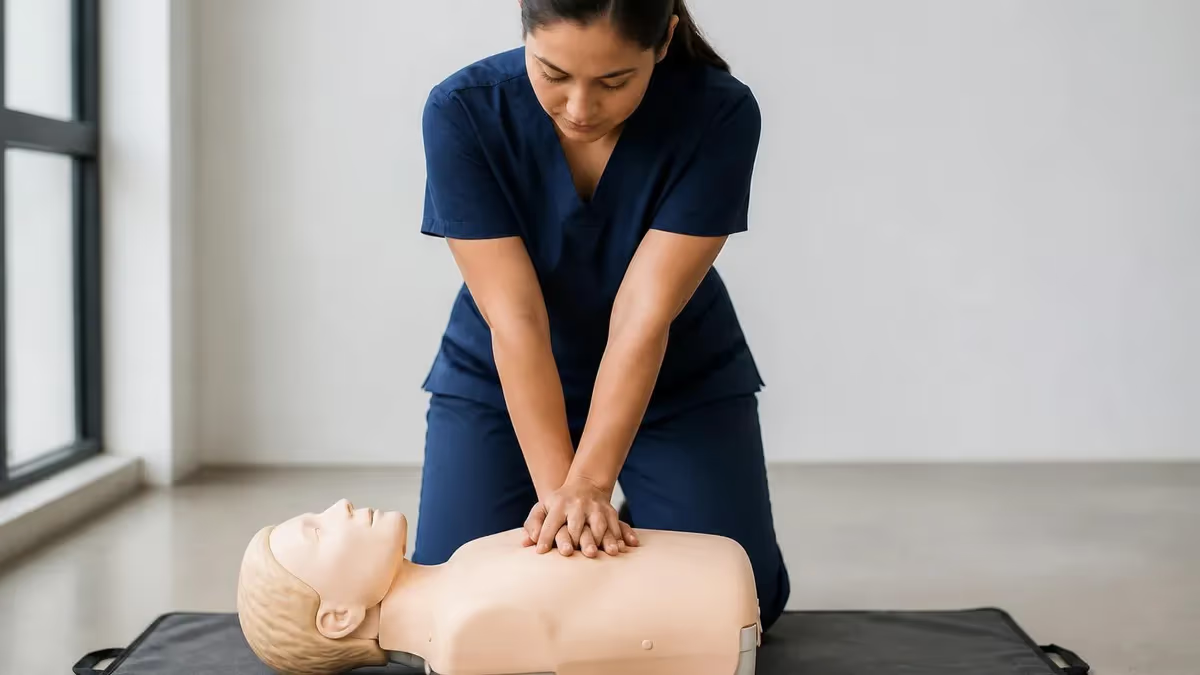
The aha cardiopulmonary resuscitation guidelines are the gold-standard playbook every rescuer, nurse, paramedic, and first responder leans on when a heart stops. Published by the American Heart Association and refreshed roughly every five years, the guidelines distill thousands of peer-reviewed studies into clear, actionable steps. The 2025 focused update — the framework still active through 2026 — fine-tuned ventilation rates, reinforced high-quality compressions, expanded post-arrest care, and folded the acls algorithm into a more streamlined decision tree for in-hospital and out-of-hospital cardiac arrest.
Understanding these guidelines is not optional for healthcare professionals. Hospitals require BLS, ACLS, and PALS certification renewals every two years, and employers audit compliance against the current AHA standards. Even lay rescuers benefit: chest compression depth, rate, and recoil principles in the guidelines have been validated to double survival when bystanders follow them precisely. The 2025 emphasis on bystander CPR has pushed survival-to-discharge numbers in several states above 12% for the first time in a decade.
This reference walks through every layer of the current AHA framework — from the Chain of Survival to drug timing in ACLS, from infant cpr techniques to AED operation. We translate dense scientific statements into practical bedside language. If you want a deeper category-wide refresher, the cpr index covers adjacent skills like choking relief, recovery position, and team dynamics that pair with these guidelines.
One major shift in the 2025 update is the heavier weight given to physiologic monitoring during resuscitation. End-tidal CO2, arterial pressure, and capnography waveforms are now first-class signals — not afterthoughts. If end-tidal CO2 stays under 10 mmHg after 20 minutes of high-quality CPR, the guidelines now explicitly say teams can consider termination of efforts. That single sentence changes hundreds of code conversations every day in U.S. emergency departments.
Compression quality remains the spine of every recommendation. Push hard (at least 2 inches in adults, never deeper than 2.4), push fast (100–120 per minute), allow full chest recoil, minimize interruptions, and avoid excessive ventilation. These five rules, drilled into every BLS class, account for roughly 70% of the survival variance in witnessed arrests. Everything else — drugs, devices, advanced airways — sits on top of that foundation.
The guidelines also formally recognize the role of the National CPR Foundation and other accredited bodies in distributing standardized training, but they remind employers to verify any non-AHA certification against state and Joint Commission requirements. Throughout this article we cite the exact 2025 numbers, the rationale behind each change, and how the recommendations apply to adults, children, and infants — so you walk into your next renewal or your next real code with confidence.
AHA Guidelines by the Numbers

The Chain of Survival: Six Critical Links
Recognition & Activation
Early CPR
Rapid Defibrillation
Advanced Resuscitation
Post-Arrest Care
Recovery & Survivorship
Adult Basic Life Support sits at the center of every AHA recommendation. The current sequence — Check, Call, Compress, Defibrillate — replaced the older A-B-C approach more than a decade ago, and the 2025 update reinforces it again. The reason is simple: oxygenated blood already circulating in the body at the moment of collapse will sustain the brain for several minutes if you keep it moving with compressions. Stopping to manage an airway before pushing on the chest squanders that reservoir.
High-quality compressions are defined with four numbers you should know cold. Depth: at least 2 inches but no more than 2.4 inches in adults. Rate: 100 to 120 per minute. Recoil: full release between each push, hands lifted just enough to let the chest spring back. Fraction: chest compression fraction (the percentage of code time spent actively compressing) should exceed 60%, and elite teams target 80%.
Ventilation has been trimmed in the 2025 update. For a single rescuer on an adult, the ratio remains 30 compressions to 2 breaths. Once an advanced airway is in place, give one breath every 6 seconds — that's 10 breaths per minute — while compressions continue without pause. Hyperventilation (more than 12 breaths per minute or excessive volume) raises intrathoracic pressure, drops coronary perfusion, and worsens outcomes. The 6-second cadence is conservative on purpose.
Switch compressors every two minutes, or sooner if quality drops. Fatigue degrades compression depth within 60 to 90 seconds, often without the rescuer realizing it. Use a metronome, a feedback device, or out-loud counting. Modern manikins and real-time feedback tools log depth, rate, and recoil — and AHA-accredited courses now require feedback devices for instructor sign-off in nearly every region.
Hand placement matters more than many learners appreciate. Place the heel of one hand on the lower half of the sternum, between the nipples, with the other hand on top, fingers interlaced. Lock your elbows, stack your shoulders directly over your hands, and drive the compression from your hips — not your arms. This biomechanics tip alone preserves depth for ten extra minutes of work in most rescuers.
Special populations need small adjustments. Pregnant patients require left lateral uterine displacement to relieve aortocaval compression. Patients with implanted defibrillators or pacemakers still receive standard CPR — just place AED pads at least one inch away from the device. Drowning victims should receive five rescue breaths before compressions because hypoxia, not arrhythmia, is the precipitating event. For a quick visual primer on these scenarios, the AHA Heartsaver curriculum and the classes near me directory both cover them in detail.
Finally, debrief after every code. A 60-second hot debrief asking what went well, what slowed us down, and what we'd change tomorrow has been shown to improve compression quality on the next event by measurable margins. The 2025 guidelines call this practice out by name — it is no longer optional in high-performing systems.

CPR Practice Test Questions
Prepare for the CPR Cardiopulmonary Resuscitation Practice exam with our free practice test modules. Each quiz covers key topics to help you pass on your first try.
CPR Basic CPR
CPR Exam Questions covering Basic CPR. Master CPR Test concepts for certification prep.
CPR and First Aid
Free CPR Practice Test featuring and First Aid. Improve your CPR Exam score with mock test prep.
CPR (Cardiopulmonary Resuscitation) Adult ...
CPR Mock Exam on (Cardiopulmonary Resuscitation) Adult CPR and AED Usage. CPR Study Guide questions to pass on your first try.
CPR (Cardiopulmonary Resuscitation) Airway...
CPR Test Prep for (Cardiopulmonary Resuscitation) Airway Obstruction and Choking. Practice CPR Quiz questions and boost your score.
CPR (Cardiopulmonary Resuscitation) Cardio...
CPR Questions and Answers on (Cardiopulmonary Resuscitation) Cardiopulmonary Emergency Recognition. Free CPR practice for exam readiness.
CPR (Cardiopulmonary Resuscitation) Child ...
CPR Mock Test covering (Cardiopulmonary Resuscitation) Child and Infant CPR. Online CPR Test practice with instant feedback.
CPR (Cardiopulmonary Resuscitation) High-P...
Free CPR Quiz on (Cardiopulmonary Resuscitation) High-Performance Team Dynamics. CPR Exam prep questions with detailed explanations.
CPR (Cardiopulmonary Resuscitation) Legal ...
CPR Practice Questions for (Cardiopulmonary Resuscitation) Legal and Ethical Considerations. Build confidence for your CPR certification exam.
CPR for Specific Populations
CPR Test Online for for Specific Populations. Free practice with instant results and feedback.
CPR Airway & Breathing Management
CPR Exam Questions covering Airway & Breathing Management. Master CPR Test concepts for certification prep.
CPR Assessment & Recognition of Cardiac Ar...
Free CPR Practice Test featuring Assessment & Recognition of Cardiac Arrest. Improve your CPR Exam score with mock test prep.
CPR Chest Compressions & Defibrillation
CPR Mock Exam on Chest Compressions & Defibrillation. CPR Study Guide questions to pass on your first try.
CPR Post-Resuscitation Care & Recovery
CPR Test Prep for Post-Resuscitation Care & Recovery. Practice CPR Quiz questions and boost your score.
Inside the ACLS Algorithm
Ventricular fibrillation and pulseless ventricular tachycardia are the rhythms most likely to respond to electricity. The acls algorithm calls for an immediate biphasic shock — typically 120 to 200 joules per manufacturer recommendation — followed by two minutes of CPR before reassessment. Do not pulse-check after the shock; resume compressions instantly. Coronary perfusion pressure collapses during any pause, and even five extra seconds off the chest reduces ROSC odds noticeably.
After the second rhythm check, give epinephrine 1 mg IV/IO every 3 to 5 minutes. After the third shock, add amiodarone 300 mg bolus (or lidocaine 1–1.5 mg/kg). Treat reversible causes simultaneously — the H's and T's framework guides this search. Hypoxia, hypovolemia, hypothermia, hydrogen ion (acidosis), hypo/hyperkalemia, tension pneumothorax, tamponade, toxins, and thrombosis (coronary or pulmonary) must each be ruled in or out.
Following AHA Guidelines vs Improvising at the Scene
- +Standardized 30:2 ratio reduces decision fatigue under stress
- +Evidence-based compression depth proven to improve survival
- +Clear ACLS algorithm shortens drug-delivery delays
- +Hospital and insurance audits accept AHA documentation
- +Team roles defined in advance prevent leadership gaps
- +Post-arrest bundle is the only intervention shown to raise discharge rates
- −Numbers change every five years requiring active recertification
- −Guidelines assume equipment availability not always present in field
- −Some rural systems lack the personnel for full ACLS team roles
- −Lay rescuers may freeze trying to recall exact ratios
- −Strict ratios can slow trained pros if not internalized
- −Adherence drops sharply when crews exceed 25-minute resuscitations

Infant CPR & Pediatric AHA Checklist
- ✓Confirm unresponsiveness by tapping the foot — never shake an infant
- ✓Check brachial pulse for no more than 10 seconds in infants under one year
- ✓Use two fingers (single rescuer) or two-thumb encircling (two rescuers) on the sternum
- ✓Compress to one-third the chest depth — about 1.5 inches in infants, 2 inches in children
- ✓Maintain a rate of 100–120 compressions per minute, identical to adults
- ✓Use a 30:2 ratio with one rescuer, 15:2 with two trained rescuers
- ✓Give breaths just large enough to see the chest rise — avoid over-inflation
- ✓Attach a pediatric-dose AED with attenuator pads for infants and children under 8
- ✓Address reversible causes early — respiratory failure causes most pediatric arrests
- ✓Transfer immediately after ROSC because pediatric post-arrest care is highly specialized
60% is the floor — 80% is the goal
Chest compression fraction is the strongest single modifiable predictor of survival in cardiac arrest. Every team should track CCF in real time using AED or monitor data. If your code review shows CCF below 60%, redesign your pause habits — pulse checks, intubation pauses, and rhythm analyses are the biggest offenders. Elite resuscitation teams routinely exceed 80%.
The automated external defibrillator is the most consequential piece of resuscitation equipment a layperson can use, and the AHA guidelines build the entire community response around it. So what does aed stand for? Automated External Defibrillator — a device that analyzes the heart rhythm and delivers a calibrated electrical shock when it detects a shockable pattern. Modern AEDs are nearly idiot-proof: voice prompts walk a frightened bystander through pad placement, shock delivery, and CPR cycles without requiring any clinical interpretation.
Pad placement is straightforward. For adults, place one pad on the upper right chest below the clavicle and one on the lower left chest along the mid-axillary line. Anterior-posterior placement is acceptable when standard positioning isn't possible — placing one pad on the chest and one on the back. For pediatric patients under 8 years old or under 25 kg, use pediatric pads or an attenuator; if neither is available, adult pads are acceptable rather than withholding defibrillation entirely.
Shave excessive chest hair only if pads cannot make contact. Wipe the chest dry if it is wet. Remove transdermal medication patches and wipe off any residue before applying pads. If the patient has an implanted pacemaker or ICD visible under the skin, simply place pads at least one inch away from the device. None of these issues should delay defibrillation by more than ten seconds — speed matters more than perfect technique.
The defibrillation timing rule every rescuer must internalize: shock, then CPR. After every shock, immediately resume compressions for two minutes before any pulse check or rhythm reassessment. Pulse-checking right after a shock burns precious perfusion time and is now explicitly discouraged. Even if the rhythm appears organized on the monitor, two minutes of CPR primes the coronary arteries and dramatically improves the odds that organized electrical activity will translate into a palpable pulse.
Public access defibrillation programs in airports, schools, gyms, and offices have driven survival rates above 50% in some witnessed-arrest registries. The 2025 update urges states and municipalities to expand AED registries and to integrate them with 911 dispatch systems so callers can be directed to the nearest device within seconds. Several jurisdictions now embed AED locations in mapping apps, which has cut median time-to-shock by more than three minutes in pilot studies.
Maintaining an AED is also part of the guidelines. Check the readiness indicator monthly, replace pads before their expiration date, and replace the battery at the manufacturer-specified interval. Document every check in a logbook — the Joint Commission and many state EMS agencies audit AED programs annually. For organizations with multiple devices, consider a managed-service contract that handles inventory automatically. A neglected AED is a liability dressed up as preparedness.
Training is the other half of the equation. Hands-on practice with a trainer AED removes the hesitation that costs lives. If you've never opened the case on a real device, a 60-minute lay-rescuer course pays the rest of your career in confidence. Recognizing heart attack vs cardiac arrest in the moment is equally crucial — chest pain with a pulse is not an AED case, while a collapse with no breathing is.
For witnessed ventricular fibrillation, every minute without a shock drops survival by 7 to 10 percent. Do not wait for a pulse check, an advanced airway, or IV access. The AED comes out the moment it arrives, and the shock is delivered the moment the device advises it. Compressions continue around the device, not the other way around.
Return of spontaneous circulation is the beginning of the work, not the end. Post-cardiac-arrest care is the bundle of interventions that converts a temporary pulse into a neurologically intact survivor. The 2025 AHA guidelines treat post-ROSC management as a distinct phase with its own algorithm, and hospitals that codify the bundle in standing order sets see measurable improvements in discharge rates.
Oxygenation comes first. Titrate FiO2 to keep SpO2 between 92% and 98%. Hyperoxia after ROSC produces oxidative injury that worsens neurologic outcomes — the days of running 100% oxygen indefinitely are over. Ventilation targets a normal PaCO2 of 35 to 45 mmHg. Hyperventilation lowers cerebral perfusion at exactly the moment the brain needs it most, while hypoventilation drives acidosis and arrhythmia. Capnography monitoring is mandatory.
Hemodynamics receive equally tight control. Target a mean arterial pressure of at least 65 mmHg, and higher (80–100) if the team suspects poor cerebral perfusion or persistent hypotension. Use norepinephrine as the first-line vasopressor, add epinephrine or vasopressin as needed, and consider dobutamine if the post-arrest myocardium is stunned and cardiac output is low. Track lactate, urine output, and central venous oxygen saturation if available.
Targeted temperature management remains a cornerstone. Maintain a constant body temperature between 32°C and 36°C for at least 24 hours in any comatose post-ROSC patient. Aggressive fever prevention continues for 72 hours total — even a single degree of post-arrest hyperthermia worsens neurologic outcomes. Surface and intravascular cooling devices both work; the key is precise temperature control, not the modality.
Coronary catheterization deserves a fast-track. Roughly 70% of out-of-hospital arrests of presumed cardiac origin have an acute coronary lesion. Any post-ROSC patient with STEMI on the 12-lead, or with high clinical suspicion of acute coronary syndrome even without classic ECG findings, goes to the cath lab. Delaying catheterization for neurologic prognostication is a documented mistake — early revascularization improves both cardiac and brain outcomes.
Neuroprognostication is intentionally slow. The 2025 guidelines reinforce that no single test should determine withdrawal of life-sustaining therapy before 72 hours post-rewarming. Combine clinical exam, EEG, somatosensory evoked potentials, neuron-specific enolase, and neuroimaging. Family conversations should occur, but irreversible decisions should not — early withdrawal accounts for a non-trivial fraction of preventable post-arrest mortality.
Rehabilitation begins in the ICU. Early mobility, swallowing assessment, and screening for anxiety, depression, and post-intensive-care syndrome are now part of the standard bundle. Survivors and their families need clear, written discharge instructions covering medication, return-to-driving rules, and cardiac follow-up. The 2025 update is the first AHA document to formally recognize caregiver burden as a clinical issue requiring intervention. For families just starting baby cpr education at home, post-arrest discharge is also a teachable moment that often translates into bystander confidence at the next family event.
Studying the AHA guidelines is one thing — performing under pressure is another. A few habits separate practitioners who execute calmly from those who freeze. First, narrate out loud during simulations. Saying "I'm checking for a pulse, no pulse, starting compressions" forces sequential thinking and signals roles to the team. Silent codes invite duplicate efforts and missed steps. Verbalization is a deliberate technique, not a personality trait — drill it until it feels automatic.
Second, practice in the environment you'll work in. Do mock codes in the actual rooms where real codes happen, with the same crash carts and monitors. Most teams discover surprising gaps — a missing intraosseous gun, a broken suction canister, a code cart that won't fit through a doorway — only during drills. Fixing these issues in advance is the difference between a 4-minute compression-to-shock interval and a 9-minute one.
Third, master the metronome rate. 100 to 120 beats per minute is the cadence of Stayin' Alive, Crazy in Love, and Another One Bites the Dust. Pick one and hum it in your head. The pop-song mnemonic is silly, but it works. Many AEDs and feedback devices also produce live audio cues — use them. Compression rate drift, almost always toward too fast, is the single most common quality lapse in U.S. resuscitations.
Fourth, practice handoffs. Compressor changes every two minutes should take under five seconds. Practice the verbal cue, the hand swap, and the simultaneous rhythm check until it becomes choreography. Slow handoffs destroy CCF. Elite teams treat the swap like a Formula 1 pit stop — every second over five is a deliberate failure to be debriefed.
Fifth, study the respiratory rate carefully. Adult ventilation post-airway is one breath every six seconds. Pediatric goes faster — one breath every 2 to 3 seconds in infants and children with an advanced airway. Memorize both. Overventilation drives the cardiac arrest deeper by raising intrathoracic pressure and stealing preload from a heart that desperately needs it.
Sixth, prepare for the family. Survivors and witnesses both remember whether the team explained what was happening. Designate a family liaison in every code — often a chaplain, social worker, or senior nurse — to stay with relatives, narrate the actions in plain language, and offer the option to observe. Family presence during resuscitation is no longer controversial; the AHA endorses it when staffed and supported appropriately.
Finally, take care of yourself. Codes — especially failed ones — carry psychological weight. The 2025 guidelines explicitly recommend structured debriefing for clinical teams after any resuscitation, with attention to both performance and emotional impact. Critical-incident stress, burnout, and PTSD are real outcomes for repeated exposure. Hospitals that take this seriously retain their best resuscitationists longer, which in turn produces better outcomes for the next patient.
CPR Questions and Answers


About the Author

Registered Nurse & Healthcare Educator
Johns Hopkins University School of NursingDr. Sarah Mitchell is a board-certified registered nurse with over 15 years of clinical and academic experience. She completed her PhD in Nursing Science at Johns Hopkins University and has taught NCLEX preparation and clinical skills courses for nursing students across the United States. Her research focuses on evidence-based exam preparation strategies for healthcare certification candidates.
Join the Discussion
Connect with other students preparing for this exam. Share tips, ask questions, and get advice from people who have been there.
View discussion (5 replies)