
American Red Cross Basic Life Support: Complete 2026 October Certification Guide
American Red Cross Basic Life Support guide: 🔎 course content, exam tips, renewal options, AHA comparison, and free practice questions for healthcare
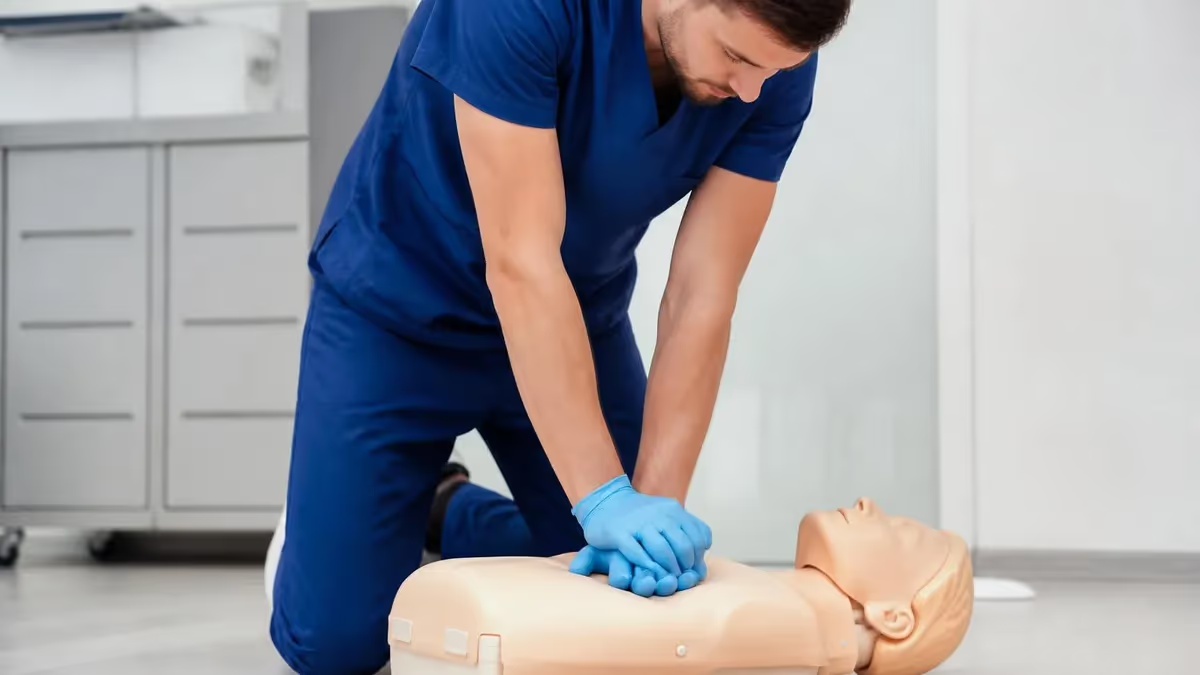
The american red cross basic life support program is one of the two nationally recognized certifications healthcare professionals rely on to deliver high-quality resuscitation, and it has become a primary alternative to the American Heart Association pathway for hospitals, nursing schools, and EMS agencies across the United States. If you are asking what is a bls certification, this guide will walk you through every part of the Red Cross course, the exam, the skills checks, and the renewal process so you know exactly what to expect before, during, and after class.
Red Cross BLS is built around the same 2020 international consensus on cardiopulmonary resuscitation that drives every modern resuscitation program, but the Red Cross uses its own video-based teaching model, its own digital skills tracking, and a 35-question online exam. The course was redesigned in 2024 and remains current for 2026, with updated scenarios on opioid overdose, suspected stroke, and team-based resuscitation in both adult and pediatric patients. It is accepted in all 50 states by hospital credentialing offices.
The certification card is valid for two years and is delivered digitally within minutes of passing. You can present it on your phone, share a verifiable link with your employer, or print a wallet card from your Red Cross account. Many learners ask is bls the same as cpr, and the short answer is no — BLS includes lay-rescuer CPR but adds bag-mask ventilation, two-rescuer technique, AED integration, choking response across age groups, and team dynamics that lay CPR courses do not cover.
The Red Cross course is offered in three formats: a full in-person classroom session lasting roughly four and a half hours, a blended online and in-person skills check that splits theory and hands-on practice, and a Review Course designed for current providers renewing within thirty days of expiration. The blended option is the most popular for working clinicians because it lets you complete the cognitive module on your own schedule and book a short skills session at a local training center.
Pricing for the initial certification typically ranges from $70 to $110 depending on your region and whether the class is hosted by the Red Cross directly or an authorized provider. Renewal classes are slightly cheaper, often $55 to $90, and most employers cover the cost through their education benefit. Group rates are available for hospitals and clinics enrolling five or more learners, which is why many health systems have transitioned from AHA to Red Cross over the past three years.
Whether you are a new nursing student preparing for your first clinical rotation, a paramedic recertifying for license renewal, or a dental hygienist meeting state board requirements, this guide gives you the structure, the exam strategy, and the practice resources you need. Below you will find a complete breakdown of course content, the exam blueprint, side-by-side comparison with AHA, study schedules, common pitfalls, and ten of the most frequently asked questions from past learners.
Red Cross BLS by the Numbers
Key Facts at a Glance
| Item | Value | Details |
|---|---|---|
| Exam Questions | 35 | Online, multiple choice, 80% passing score |
| Initial Cost | $70-$110 | Renewal averages $55-$90 |
| Card Validity | 2 yrs | Digital card issued the same day |

How the Red Cross BLS Course Is Structured
Self-paced video lessons covering CPR science, AED operation, choking response, and team communication. Average completion time is 90 minutes and you can pause, rewind, or repeat lessons as needed.
A certified Red Cross instructor evaluates adult, child, and infant CPR, bag-mask ventilation, AED placement, and team dynamics on a manikin. The session takes 90 to 120 minutes depending on class size.
35 multiple-choice questions delivered online after the skills check. You need 80% to pass, with two free retake attempts if you fall short on your first try.
Each learner must demonstrate compressions at 100 to 120 per minute, ventilations with visible chest rise, and an AED shock delivery within 30 seconds of pad placement to earn the card.
Upon passing both exam and skills, the Red Cross emails a digital certification card with a QR code your employer can scan to verify authenticity in real time.
The Red Cross BLS curriculum is divided into ten teaching segments, each anchored to a measurable skill that you will perform in front of an instructor. The course begins with scene safety, personal protective equipment, and the activation of emergency response, which sounds elementary but accounts for nearly 10% of exam questions because new providers consistently skip these steps when stressed. Practicing them deliberately in the first hour of class builds the muscle memory you need on exam day and, more importantly, on a real code.
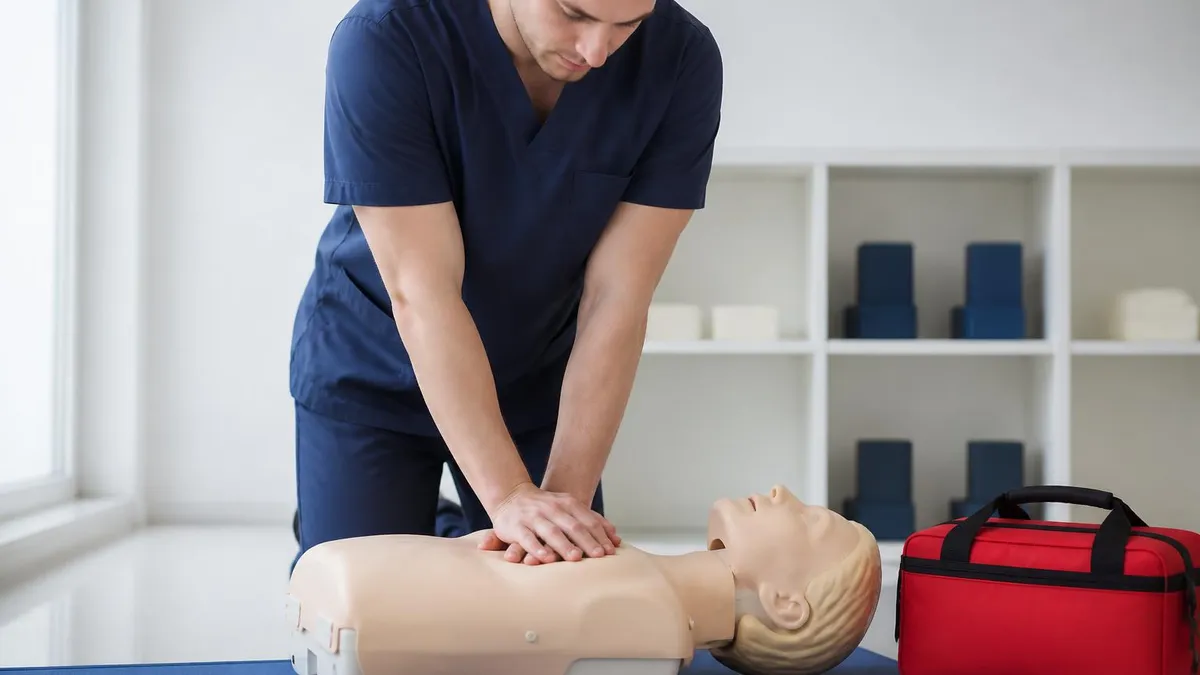
Adult CPR is taught next, with emphasis on a compression depth of at least 2 inches but no more than 2.4 inches, a rate of 100 to 120 per minute, and full chest recoil between compressions. The Red Cross uses real-time feedback manikins in most training centers, so you receive immediate audio and visual cues if you compress too shallow or too fast. This feedback loop is the single biggest reason first-time pass rates have climbed above 95% at certified Red Cross sites.
Two-rescuer CPR introduces the 30:2 ratio for adults without an advanced airway and the continuous compression model with asynchronous ventilations once an airway is placed. You will rotate roles every two minutes — coinciding with rhythm checks — and you will be expected to call out clear, closed-loop communication: "I am switching to compressions, you take ventilations." Instructors fail learners who remain silent during transitions, even if their compression mechanics are flawless, because team communication is now a graded competency.
Pediatric and infant CPR follow, with key adaptations including a compression depth of about one-third of chest depth, the two-thumb encircling-hands technique for infants with two rescuers, and the use of pediatric AED pads or attenuators for children under 8 years old. The course also covers the special circumstance of unwitnessed pediatric arrest, where rescuers perform two minutes of CPR before activating EMS if alone. This is a high-frequency exam topic and trips up many adult-focused providers.
Bag-valve-mask ventilation receives a full segment because mask seal is the most common skill failure in Red Cross BLS testing. You will practice the E-C clamp technique, the two-handed thenar grip, and the head-tilt-chin-lift maneuver, learning to deliver each breath over one second with just enough volume to produce visible chest rise. Over-ventilation is explicitly tested and penalized because it raises intrathoracic pressure and reduces coronary perfusion during CPR, which is a concept the basic life support exam american heart association also emphasizes.
AED operation is taught with multiple device brands so learners are not surprised by an unfamiliar interface in the field. Skills include rapid pad placement in the anterolateral position, the special pad placement for pacemakers and implantable defibrillators, the pediatric pad protocol, and the safety call "clear" before shock delivery. Choking response — both conscious and unconscious — closes the curriculum and is tested on adult, child, and infant manikins during the final skills station.
The course concludes with a team-based megacode scenario that ties every skill together. You will be assigned a role — compressor, ventilator, AED operator, or team leader — and asked to manage a simulated cardiac arrest from recognition through rhythm analysis and shock delivery. This scenario mirrors the real-world expectations of hospital code teams and is the segment most learners describe as the most valuable part of the class.
BLS Practice Test Questions
Prepare for the BLS - Basic Life Support exam with our free practice test modules. Each quiz covers key topics to help you pass on your first try.
BLS High-Quality CPR & Provider Skills
BLS Exam Questions covering BLS High-Quality CPR & Provider Skills. Master BLS Test concepts for certification prep.
BLS Special Situations & Scenarios
Free BLS Practice Test featuring BLS Special Situations & Scenarios. Improve your BLS Exam score with mock test prep.
BLS Adult, Child & Infant Resuscitation
BLS Mock Exam on Adult, Child & Infant Resuscitation. BLS Study Guide questions to pass on your first try.
BLS Airway Management & Ventilation
BLS Test Prep for Airway Management & Ventilation. Practice BLS Quiz questions and boost your score.
BLS Automated External Defibrillator (AED)...
BLS Questions and Answers on Automated External Defibrillator (AED) Use. Free BLS practice for exam readiness.
BLS Certification: Cardiac Arrest
BLS Mock Test covering Certification: Cardiac Arrest. Online BLS Test practice with instant feedback.
BLS Certification: Choking
Free BLS Quiz on Certification: Choking. BLS Exam prep questions with detailed explanations.
BLS Certification: Respiratory Arrest
BLS Practice Questions for Certification: Respiratory Arrest. Build confidence for your BLS certification exam.
BLS Chain of Survival
BLS Test Online for Chain of Survival. Free practice with instant results and feedback.
BLS CPR Techniques & Procedures
BLS Study Material on CPR Techniques & Procedures. Prepare effectively with real exam-style questions.
BLS Legal & Ethical Considerations
Free BLS Test covering Legal & Ethical Considerations. Practice and track your BLS exam readiness.
BLS Post-Resuscitation Care
BLS Exam Questions covering Post-Resuscitation Care. Master BLS Test concepts for certification prep.
Red Cross vs the AHA Basic Life Support Exam
Both organizations teach the same 2020 international consensus on resuscitation science, so the actual clinical content is nearly identical. Compression depth, ventilation rate, and AED protocols are word-for-word the same. The differences lie in delivery style: AHA uses Watch-Practice-Watch video segments with extensive instructor narration, while Red Cross uses scenario-driven case studies and decision-point branching that many learners find more engaging.
What does bls stand for in both programs? Basic Life Support — and both award a two-year certification card recognized by hospital credentialing offices nationwide. If your employer accepts one, they almost always accept the other. Verify with your HR department before enrolling because a small number of military and federal facilities still specify AHA exclusively in their bargaining agreements.

Pros and Cons of Choosing Red Cross BLS
- +Digital certification card delivered within minutes of passing the final skills check
- +Lower passing threshold (80%) than AHA, with two free retake attempts included
- +Generally $10 to $25 cheaper than equivalent AHA classes in most regions
- +Scenario-driven curriculum that better mirrors real clinical decision-making
- +Wider availability of evening and weekend sessions across all 50 states
- +QR-coded card lets employers verify your certification instantly online
- −Slightly less international recognition compared to AHA outside the United States
- −Some federal and military facilities still mandate AHA cards in writing
- −Blended format requires reliable internet for the cognitive module completion
- −Skills check still requires in-person attendance — no fully online option exists
- −Course content updates lag AHA guideline releases by 30 to 90 days typically
- −Fewer specialty add-ons than AHA's ACLS or PALS bridge programs offer
Your Red Cross BLS Exam Day Checklist
- ✓Confirm your appointment time, location, and instructor name 24 hours in advance
- ✓Complete the online cognitive module if you are enrolled in the blended format
- ✓Bring a government-issued photo ID — required for skills check sign-in
- ✓Wear loose, comfortable clothing that lets you kneel and lean over a manikin
- ✓Eat a substantial meal one to two hours before class to maintain focus
- ✓Review the most common rates: 100 to 120 compressions per minute, 2 inch depth
- ✓Memorize the cycle: 30 compressions to 2 ventilations for single-rescuer adult CPR
- ✓Practice closed-loop communication aloud the night before the session
- ✓Charge your phone or laptop for the post-class online exam attempt
- ✓Take a free <a href="/bls-practice-test-video-answers">aha basic life support exam</a> practice run within 48 hours of class
Practice your bag-mask seal before class
Mask seal is the number-one reason learners fail their Red Cross BLS skills check. Spend ten minutes with a friend or family member practicing the E-C clamp grip on their face (no actual ventilation needed) so the hand position is automatic. Learners who arrive with this single skill rehearsed pass the ventilation station on the first attempt at a 98% rate, according to Red Cross instructor reports.
A basic life support renewal class with the Red Cross is shorter, cheaper, and structurally different from the initial certification course. The renewal pathway, sometimes called the Review Course, condenses the in-person time to roughly two hours by focusing exclusively on skills demonstration and updated guideline points rather than re-teaching foundational content. To qualify for the renewal class rather than a full initial course, your current card must be unexpired or expired by no more than 30 days at the time of class enrollment.
The renewal exam is identical in length and difficulty to the initial exam — 35 questions at 80% passing — but learners typically score higher because they already have two years of clinical exposure to the material. The skills check covers the same six stations as the initial course: adult CPR, child CPR, infant CPR, bag-mask ventilation, AED operation, and choking response across all three age groups. Plan for two and a half hours total from arrival to receiving your digital card.
Renewal costs vary by region but generally fall between $55 and $90 nationally, with Red Cross direct-hosted classes running cheaper than third-party authorized providers. Many hospital systems negotiate group rates of $40 to $50 per learner when recertifying ten or more staff simultaneously, so check with your education department before paying out of pocket. Most employers offer paid continuing education time off to attend renewal, which reduces the total cost of staying certified to zero for many clinicians.
If your card has expired by more than 30 days, the Red Cross requires you to take the full initial certification course rather than the renewal. This rule is strictly enforced — instructors will deny entry to the Review Course and offer you a refund or transfer to a full class. Plan ahead: set a calendar reminder 90 days before expiration so you have plenty of time to find a convenient session. The Red Cross website allows you to filter classes by zip code, date range, and time of day.
The digital card you receive at renewal is functionally identical to the initial card, with a fresh two-year expiration date stamped from your renewal class date. The card includes a QR code that links to your verifiable certification record on the Red Cross site, allowing hospital credentialing teams, school clinical coordinators, and licensing boards to confirm authenticity in seconds. Keep a screenshot of the card on your phone and a printed copy in your work bag as a backup.
For nurses, paramedics, and respiratory therapists with multiple advanced certifications stacking on top of BLS — such as ACLS, PALS, or NRP — the renewal class is the foundation skill check that gates the others. Most ACLS and PALS courses now require a current BLS card before the first day of class and refuse late uploads. Schedule your BLS renewal first, then your advanced cards, so you do not get caught in a credential gap that pulls you from the clinical schedule.
If you change employers between renewals, the certification follows you. The Red Cross card is portable, the digital record sits in your Red Cross account, and you can re-download the card or share the verification link with a new employer at any time during the two-year validity window. There is no transfer fee and no per-employer registration step — your certification is yours, not the institution's.

If more than 30 days pass after your BLS card expiration date, the Red Cross will not accept you into a renewal class. You must register for the full initial course, pay the higher initial fee, and sit through the entire 4.5-hour session. Set a 90-day reminder before your expiration to avoid this gap, especially if your state license, hospital privileges, or clinical school program depend on an active card.
Passing the Red Cross BLS exam on the first attempt is a matter of preparation strategy rather than raw intelligence. The exam tests applied judgment more than memorization, so the most effective preparation method is to work through scenario-based practice questions until the decision pathways feel automatic. Aim for at least 100 practice questions across two or three sessions in the week leading up to your class, focusing on the explanations for any answer you get wrong rather than simply re-reading textbook chapters.
Start with the official Red Cross student manual, which is included with your course enrollment and accessible through your Red Cross account once you register. The manual is roughly 80 pages and can be read in two focused sittings. Read it once cover to cover for context, then return for a second pass focused on the algorithm boxes, the compression and ventilation numbers, and the special situations chapter on opioid overdose, drowning, hypothermia, and pregnancy.
Build a one-page cheat sheet of the numbers you must know cold: 100 to 120 compressions per minute, 2 inches adult depth, one-third chest depth for children and infants, one breath every six seconds for advanced airway, 30:2 ratio for single-rescuer adult and child CPR, 15:2 for two-rescuer child and infant CPR, and AED shock delivery within 30 seconds of pad placement. These numbers reappear across nearly every exam in slightly different wording.
Use spaced repetition to lock in the algorithms. Quiz yourself on day one, day three, day six, and the morning of class. Five minutes per session is enough — the spacing matters more than the duration. Many learners use flashcard apps like Anki or Quizlet preloaded with Red Cross BLS decks, which are freely available and updated to current guidelines. Pair the flashcards with a free basic life support renewal class practice exam to simulate the timing pressure of the real test.
On exam day, read every question twice before selecting an answer. The Red Cross exam writers frequently include a clearly wrong distractor, a partially correct option, and a fully correct option. Slow down on questions that include the words "first," "next," or "most important" — these are testing your priority-setting skills and the seemingly obvious answer is often a step that should come second or third in the sequence.
If you fall short of 80% on the first attempt, the Red Cross gives you two additional attempts at no extra cost. Use the gap between attempts to review the rationales for every question you missed; the system shows your incorrect answers with full explanations after each attempt. Most learners who fail the first attempt pass the second by a comfortable margin once they see the pattern of their knowledge gaps. Do not panic — the retake policy is designed to support you.
Finally, get a full night of sleep before class. Compression skills degrade noticeably when learners are sleep-deprived, and instructor reports consistently show that the small percentage of learners who fail the skills check on the first attempt are disproportionately those who attended a late evening class after a full clinical shift. Treat exam day as you would a real shift: hydrate, eat, sleep, and arrive ten minutes early to settle your nerves.
Once your card is in hand, the real work of staying competent begins. BLS skills decay measurably within three to six months without practice, with compression depth and ventilation timing being the first to slip. Hospitals that perform quarterly low-dose, high-frequency refreshers — short ten-minute manikin sessions at the start of shift — report up to a 40% improvement in cardiac arrest survival to discharge compared to facilities that rely solely on the two-year certification cycle. Build short refreshers into your routine even if your employer does not require them.
Most learners ask whether is bls and cpr the same thing in practice, and the answer is partial. Layperson CPR teaches compressions and rescue breaths to community responders. Basic life support for healthcare providers adds bag-mask ventilation, two-rescuer mechanics, AED integration with clinical decision points, team communication, and the assumption that you may be the first link in a longer chain leading to advanced cardiac life support or pediatric advanced life support. If your role involves any clinical responsibility, lay CPR is not enough.
Keep your digital card backed up in two places: the Red Cross app on your phone and a screenshot saved to a cloud folder you can access from any device. Credentialing audits happen without warning and being able to surface your card in under sixty seconds is a small but real professional advantage. If you change phones, log into your Red Cross account on the new device first so the app downloads your current card automatically.
Look for opportunities to act as a Red Cross BLS instructor if you have several years of clinical experience and want to deepen your own mastery. The Instructor Training Program is roughly a week of additional coursework plus a teaching observation, and it lets you teach classes at hospitals, community colleges, fire departments, and corporate sites. Instructors often earn $40 to $80 per student taught and report meaningful improvement in their own clinical performance from the act of teaching the material repeatedly.
Consider stacking advanced certifications on top of your BLS card if your clinical role expects them. Advanced Cardiac Life Support, Pediatric Advanced Life Support, and Neonatal Resuscitation Program are the three most common adders for nurses and emergency medical providers. The Red Cross does not yet offer ACLS or PALS — for those you would typically use AHA — but the Red Cross BLS card is accepted as a prerequisite for both AHA advanced courses without any bridge requirement.
Network with your fellow learners during class. Cardiac arrest survival in any environment depends heavily on the quality of the responding team, and a small but real number of bystander resuscitations have been performed by groups of BLS-trained strangers who happened to be in the same gym, restaurant, or airport at the time of an emergency. Knowing you are not alone — and that hundreds of thousands of new providers are certified every year — is part of what makes the system work.
Finally, hold onto your sense of why you took the course. Whether your motivation was a clinical job requirement, a school admission checkbox, a community responder role, or personal preparedness for a family member with cardiac risk, BLS is one of the most directly life-saving skill sets a person can carry. Refresh it, practice it, teach it when you can, and trust that the time you invested in this certification will pay back many times over in confidence, competence, and — at some point in your career — an outcome you will never forget.
Sample BLS - Basic Life Support Practice Questions
Try these questions from our free BLS - Basic Life Support practice tests. The correct answer and an explanation follow each question.
Which sign best indicates a SEVERE (complete) airway obstruction in an adult?
- A. Loud, high-pitched stridor
- B. Strong, productive cough
- C. Inability to speak or make any sound
- D. Mild throat clearing
Answer: C. Inability to speak or make any sound
Inability to speak, cry, or make any sound indicates a complete airway obstruction requiring immediate intervention.
A hospital implements a rapid response team (RRT) to evaluate deteriorating patients before cardiac arrest. Which Chain of Survival link does this MOST directly support?
- A. Surveillance and prevention (in-hospital first link)
- B. Early CPR
- C. Rapid defibrillation
- D. Post-cardiac arrest care
Answer: A. Surveillance and prevention (in-hospital first link)
RRTs are a surveillance and prevention strategy unique to the in-hospital chain, intervening before arrest occurs.
What should a rescuer do if the victim shows obvious signs of life during CPR?
- A. Continue CPR for 2 more minutes to confirm ROSC
- B. Stop compressions and reassess breathing and pulse
- C. Deliver two rescue breaths and then reassess
- D. Apply the AED and check for a shockable rhythm
Answer: B. Stop compressions and reassess breathing and pulse
If signs of life appear (breathing, movement, coughing), compressions should stop and the rescuer should reassess pulse and breathing.
You deliver a shock and the victim shows signs of life (breathing, movement). What should you do?
- A. Remove AED pads and discontinue monitoring
- B. Place the victim in recovery position if breathing normally and leave AED attached
- C. Begin CPR regardless of signs of life
- D. Deliver a second shock to confirm the rhythm is stable
Answer: B. Place the victim in recovery position if breathing normally and leave AED attached
If the victim resumes normal breathing and has signs of life, place them in the recovery position (if no suspected spinal injury) and keep AED attached until EMS arrives.
BLS Questions and Answers
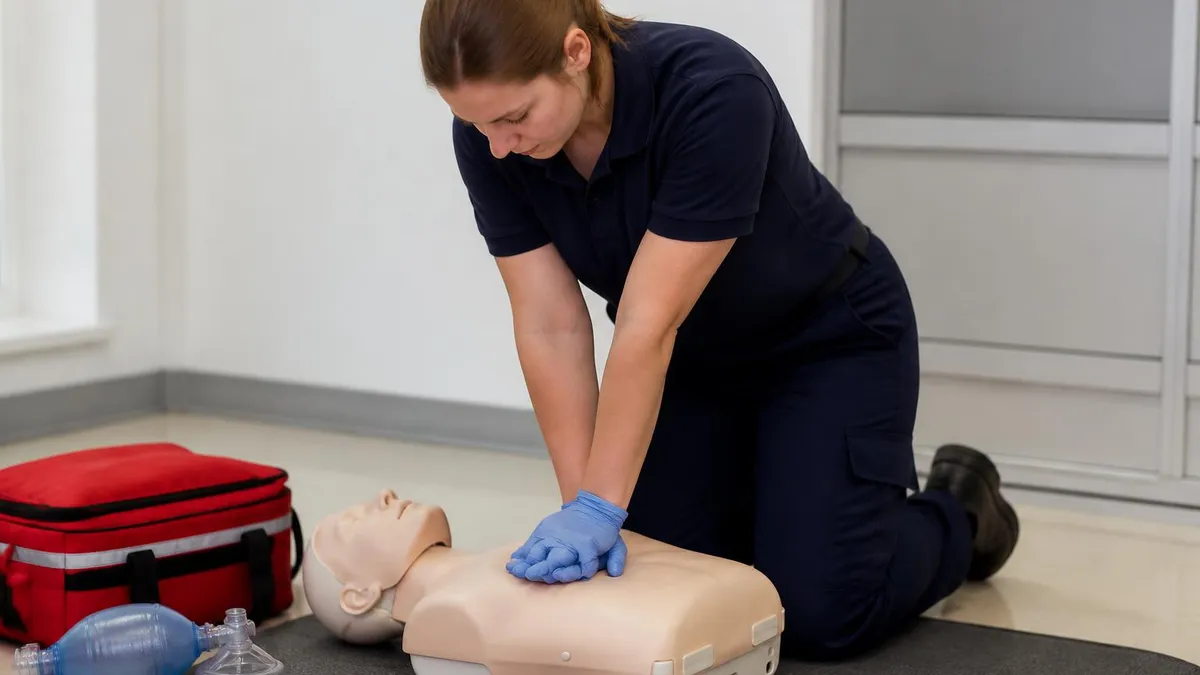
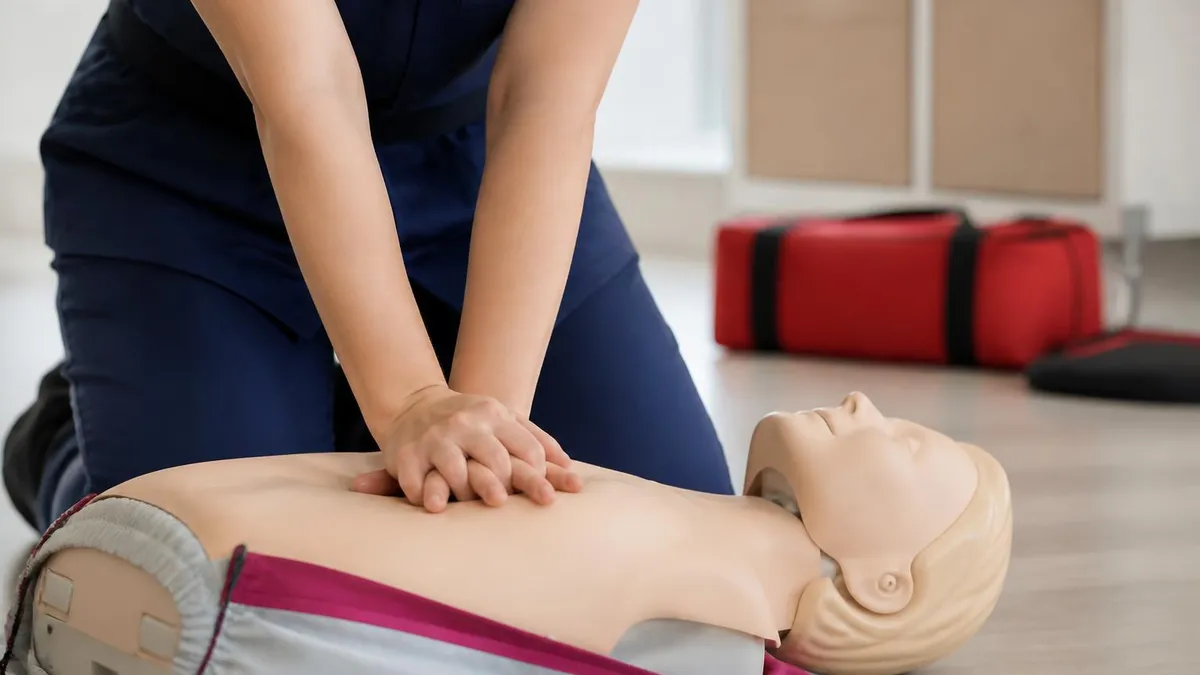
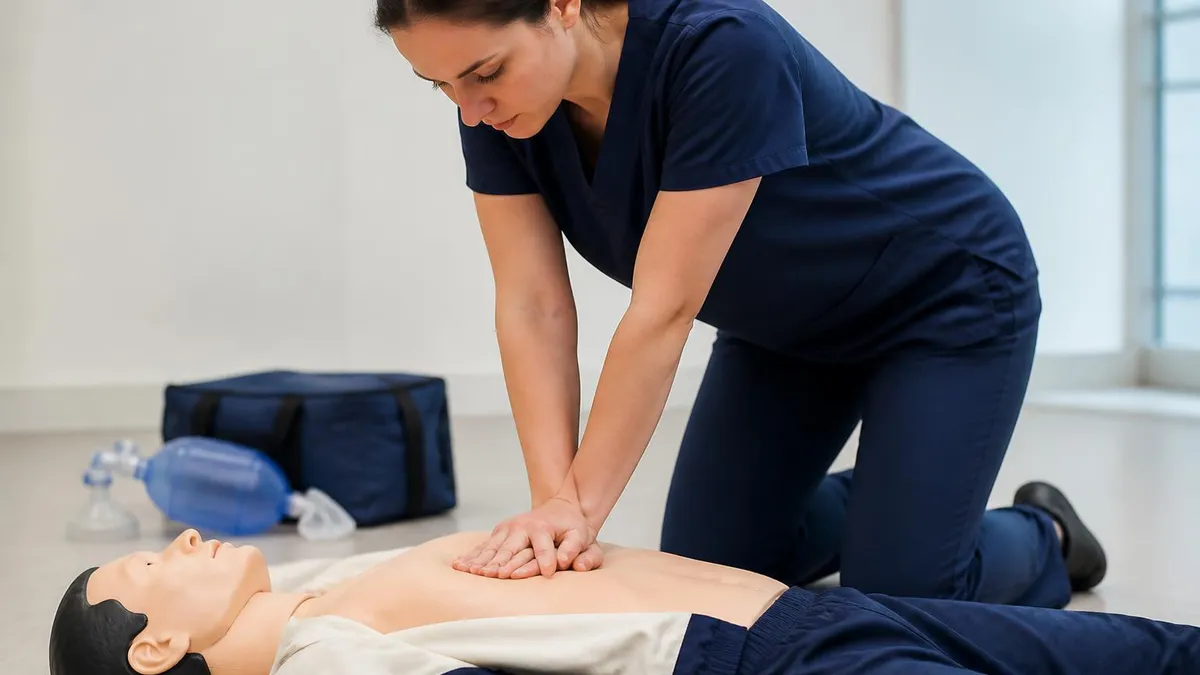
About the Author

Registered Nurse & Healthcare Educator
Johns Hopkins University School of NursingDr. Sarah Mitchell is a board-certified registered nurse with over 15 years of clinical and academic experience. She completed her PhD in Nursing Science at Johns Hopkins University and has taught NCLEX preparation and clinical skills courses for nursing students across the United States. Her research focuses on evidence-based exam preparation strategies for healthcare certification candidates.
Join the Discussion
Connect with other students preparing for this exam. Share tips, ask questions, and get advice from people who have been there.
View discussion (8 replies)