
AHA BLS Card: Cost, Validity, Renewal, and How to Pass in 2026 October
Complete 2026 October guide to the AHA BLS card: 🎯 cost, 2-year validity, renewal options, skills test, and how to pass the BLS Provider exam first try.
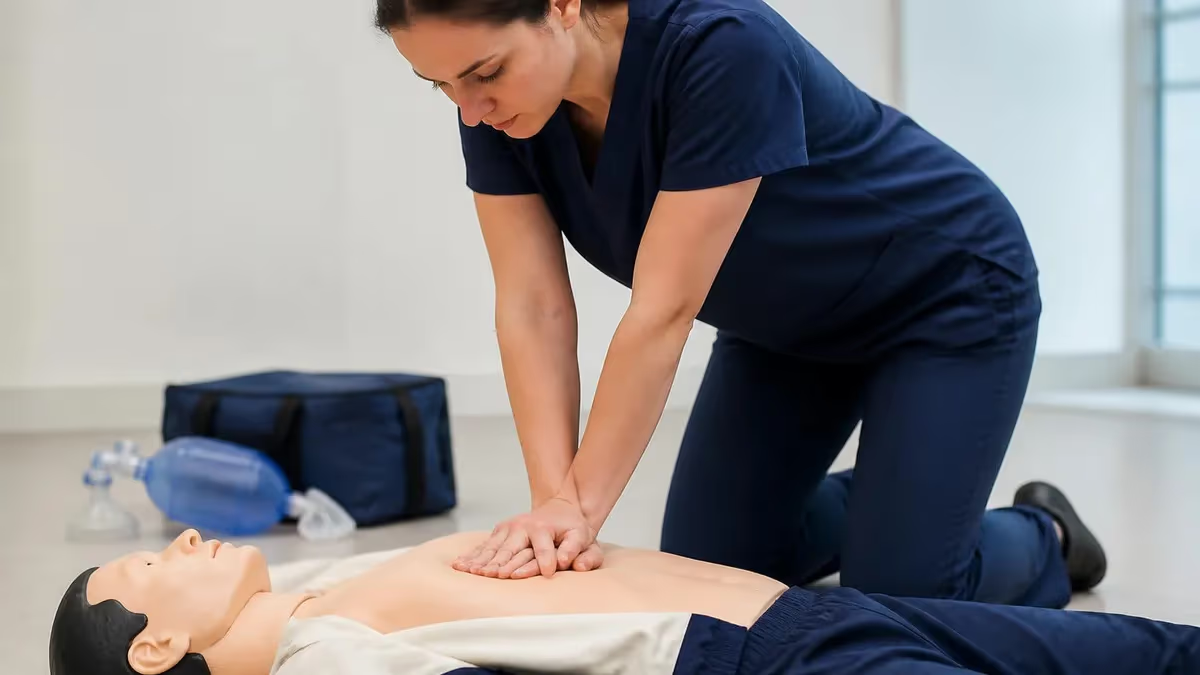
The AHA BLS card is the credential that proves you completed Basic Life Support training through the American Heart Association. Hospitals, clinics, dental offices, EMS agencies, lifeguard programs, and dozens of allied health employers ask for it before you set foot on the floor. If you are starting a healthcare program or renewing for the third time, the card itself is the small piece of paper (or, more often these days, a digital eCard) that lets you legally and safely respond to a cardiac emergency in a clinical setting.
Here is the thing most candidates do not realize until the day of class: the card you walk out with is not the same physical wallet card the AHA issued five or ten years ago. The AHA officially retired printed cards for most training centers and switched to digital eCards delivered through its eCards system.
Your instructor enters your name and email after you pass the skills test, you claim the card on the AHA portal, and from that point forward the card lives on your phone or in your employee file as a QR-verified PDF. It works the same way for renewal as it does for an initial provider course.
This guide walks through everything that matters when you are chasing that card: what it certifies, how much it costs in 2026, how long it lasts, what the skills test covers, and how to renew without retaking the full provider course. We also cover the difference between an AHA card and other Basic Life Support credentials so you can tell your HR department exactly what you are about to hand them. Studying right now? Try the free BLS practice tests.
What the AHA BLS Card Actually Certifies
The AHA BLS Provider card certifies that you completed the American Heart Association's Basic Life Support course and passed both a written exam and a hands-on skills evaluation administered by an AHA-aligned Training Center. The card is governed by the 2025 AHA Guidelines for CPR and ECC, which is the current science-update cycle most candidates train under in 2026.
When an employer sees the card, they know three specific things happened during your training. First, you watched (or attended) the AHA Provider course content, which runs roughly 4 to 4.5 hours for the initial course and 3 to 3.5 hours for a renewal.
Second, you demonstrated single-rescuer adult, child, and infant CPR with a real manikin, plus two-rescuer CPR with bag-mask ventilation. Third, you passed a 25-question multiple-choice written exam at 84% or higher. Miss those benchmarks and the instructor does not issue the eCard.
The credential is not a license. It does not give you scope of practice. What it does is satisfy a competency requirement that nearly every clinical employer and nursing program ties to your offer letter, your clinical rotation, or your hospital privileges. Think of it as a checkbox that has to stay checked the entire time you work in a healthcare environment.
One nuance: the BLS Provider card is the only AHA BLS-level credential that counts for healthcare professionals. The AHA's HeartSaver CPR card, by contrast, is built for laypeople, daycare staff, fitness instructors, and corporate first-aid teams. If your hospital orientation packet says BLS for Healthcare Providers or BLS Provider, do not show up with a HeartSaver card. They are different products, and HR will send you back.
AHA BLS Card by the Numbers
Key Facts at a Glance
| Item | Value | Details |
|---|---|---|
| Card validity | 2 years | |
| Passing score | 84% | |
| Exam questions | 25 | |
| Typical cost | $55-$150 |

Your AHA BLS Provider card is valid for exactly two years from the issue month. Renew 30 to 60 days early to avoid a gap in your hospital credentialing file. Hospitals routinely block shifts the day after a card lapses.
How Much an AHA BLS Card Costs in 2026
Total cost depends on whether you take an in-person class, a blended (HeartCode) course, or a renewal-only skills check. Prices in the United States in 2026 typically land between $55 and $150 all-in, with the wide range explained by location, instructor overhead, and whether your employer reimburses.
A traditional in-person initial course at a community training center runs $60 to $90. Hospital-based programs and university medical schools often run closer to $100 to $150, partly because they bundle the cost of the AHA student manual and the manikin rental into the per-seat fee.
The blended HeartCode BLS option from the AHA splits the course into an online cognitive section (about $35 to $40 directly from elearning.heart.org) plus a separate in-person skills session (usually $40 to $70 at a local Training Center).
HeartCode is the most popular option for working nurses who cannot give up a full Saturday and want to do the lectures on their own time. The total comes in around $75 to $110 and the card is identical to the one issued at a traditional course.
Renewal is usually 10 to 20 percent cheaper than an initial course because the curriculum is condensed. A typical renewal class runs about $55 to $80 in person, and roughly the same range for HeartCode renewal. Some hospitals run free in-house renewals for staff every two years, so check with your unit educator before paying out of pocket.
How Long the Card Is Valid
An AHA BLS Provider card is valid for two years from the issue month printed on the card. That is the same expiration window the AHA has used for decades and it has not changed under the 2025 Guidelines update.
Your card lists a clear expiration date, usually on the last day of the issue month two years out. A card issued on June 12, 2026 will list June 30, 2028 as the expiration. Most healthcare employers want you to renew at least 30 to 60 days before the expiration date.
Hospital credentialing offices in particular tend to flag your file once the card is inside 60 days of expiry, and some will block you from picking up shifts the day after it lapses. Schedule your renewal early so you are not scrambling for an open seat in the last week of the month.
If your card expires before you renew, you are not automatically forced into the full initial course. The AHA allows a grace period at the Training Center's discretion, and in practice most centers will let you take a renewal class up to 30 days past expiration.
Past 30 days, expect to take the full provider course again. Some employers, especially trauma centers and EMS agencies, will not honor any grace period at all and will require the full initial course the moment your card expires.
Course Format Options Compared
Full 4 to 4.5 hour in-person or HeartCode blended class. Required if you have never held an AHA BLS card or your previous card expired more than 30 days ago. Covers all algorithms, written exam, and full skills evaluation. Most common at hospital-based Training Centers and community health programs.
- ▸4 to 4.5 hours total time
- ▸Cost $60 to $150 typical
- ▸Written exam plus skills test
- ▸Open to first-time candidates
Condensed 3 to 3.5 hour class focused on recertification rather than initial teaching. Open to anyone with a current AHA BLS card or one expired less than 30 days. Slightly cheaper than the initial course and faster to schedule.
- ▸3 to 3.5 hours total time
- ▸Cost $55 to $80 typical
- ▸Same written and skills test
- ▸Current card required
Online cognitive section plus separate in-person skills session. Most popular option for working nurses, students, and second-shift hospital staff who cannot give up a full Saturday for class. Card is identical to the traditional course.
- ▸Online lectures self-paced
- ▸Skills session 60 to 90 min
- ▸Cost $75 to $110 total
- ▸Two appointments needed
60 to 90 minute in-person skills check available only after completing the HeartCode online module. Schedule it within 30 days of finishing the online portion or the cognitive credit expires and you start over.
- ▸60 to 90 minutes only
- ▸Cost $40 to $70 typical
- ▸Must hold valid HeartCode credit
- ▸Schedule within 30 days

What the Skills Test Covers
The skills evaluation is the part of the day candidates worry about most, and it is also the part most likely to get you sent home without a card. Your instructor watches you perform a complete BLS sequence on adult, child, and infant manikins and scores you against the AHA's published skills checklist. You either meet every critical performance criterion or you do not pass the station.
For adult single-rescuer CPR, you are expected to assess scene safety, check responsiveness, shout for help and activate the emergency response system, and check for a pulse and breathing for no more than 10 seconds. You must begin compressions within 10 seconds of identifying cardiac arrest.
Compressions must be at a rate of 100 to 120 per minute, at a depth of at least 2 inches (5 cm) but no more than 2.4 inches (6 cm), with full chest recoil and minimal interruptions. You will deliver 30 compressions to 2 breaths and switch with a partner every 2 minutes when two-rescuer CPR is being demonstrated.
The AED portion expects you to power on the device, attach pads correctly (clearing the chest and clipping or shaving hair if needed), clear the patient during analysis, deliver a shock if advised, and resume compressions immediately after the shock without any delay to recheck a pulse.
Most candidates lose points here for pausing too long after the shock or for talking through the AED voice prompts instead of acting on them. The AED is a coach; your job is to follow its prompts and keep moving.
Pediatric and infant CPR follows the same general framework with a few key differences. For infants, compressions are done with two fingers or two thumbs (the encircling-hands technique for two rescuers) at a depth of about 1.5 inches (4 cm), or roughly one-third of the chest diameter.
The compression-to-ventilation ratio shifts to 30:2 for a single rescuer and 15:2 when two rescuers are working an infant or child. You are also expected to demonstrate relief of foreign-body airway obstruction in both a responsive and unresponsive infant.
How to Renew Your AHA BLS Card
Renewing is straightforward if you do not let the card expire. The standard renewal pathway is the AHA BLS Provider Renewal Course, which is identical in content to the initial course but shortened because you are not learning the skills from scratch.
You can take it the traditional way (one in-person class that runs 3 to 3.5 hours) or as a HeartCode renewal (online cognitive section plus a skills session lasting about 60 to 90 minutes). The renewal pathway is open to anyone holding a current, unexpired AHA BLS Provider card.
Some Training Centers will also accept candidates whose cards have lapsed within the past 30 days, but you should call ahead and confirm. If your card has been expired longer than that, plan on the initial course and budget the extra hour and the slightly higher fee.
After you pass the renewal class, your instructor enters your information into the AHA eCards system. You will receive a claim email within a few business days, you log in to www.heart.org/cpr/mycards, and you download the PDF.
The new card has a fresh two-year expiration starting from the day you completed the skills test. Print a copy for your records and forward the digital file to your employer's credentialing office; most hospitals upload the PDF to their compliance portal so the verification QR code stays on file.
Compression Rates by Age Group
30:2 compression-to-ventilation ratio whether you are working alone or with a partner. Rate 100 to 120 compressions per minute, paced to the tempo of Stayin' Alive. Depth at least 2 inches (5 cm) but no more than 2.4 inches (6 cm). Full chest recoil between compressions is essential because incomplete recoil reduces venous return and cardiac output.
Use the heel of one hand on the lower half of the sternum with the second hand stacked on top, fingers interlaced. Keep your elbows locked and use your body weight rather than arm strength. Switch with a partner every two minutes to avoid fatigue and maintain compression quality.
AHA HeartSaver CPR is for laypeople, daycare workers, and fitness staff. AHA BLS Provider is the healthcare-level credential hospitals require. They are different cards and HR will not accept the wrong one. Always confirm with your employer before booking.
AHA Card vs Red Cross, ASHI, and NSC Cards
Not every employer accepts every BLS card. The AHA dominates the hospital and EMS market, the Red Cross has carved out a solid share in lifeguarding, school nursing, and some hospitals, and ASHI (American Safety and Health Institute) and NSC (National Safety Council) tend to show up in industrial, occupational, and corporate settings.
The science is essentially the same across all four because they all follow the ILCOR consensus guidelines that the AHA helps publish, but the cards are not always interchangeable.
If your offer letter or clinical handbook says "AHA BLS Provider" specifically, do not assume a Red Cross or ASHI card will be accepted. Hospital credentialing committees often write their bylaws around AHA specifically because AHA is the source of the underlying guidelines, and substituting another card requires committee approval.
Nursing schools, dental schools, paramedic programs, and most major hospital systems are AHA-only. There is no point fighting it; just take the AHA course up front.
Red Cross BLS is generally accepted in EMS and lifeguard programs, in many community college nursing pre-requisites, and in some smaller hospital networks. ASHI BLS is commonly accepted in dental practices, urgent care chains, and industrial first-response teams. NSC is most often found in workplace safety contexts.
Before you book a class, get written confirmation from your school or employer about which provider cards are acceptable. The phrase you want to see is either "AHA BLS Provider" or "AHA BLS Provider or equivalent."
How to Pass the BLS Exam on the First Try
The written exam is 25 multiple-choice questions and the passing score is 84%, which translates to 21 correct answers. That sounds easy until you realize most candidates miss it the first time because they study the wrong material.
The exam is not testing what you remember from your last CPR class three years ago. It is testing the current 2025 Guidelines, which include updated language around high-quality compressions, opioid-associated emergencies, and team dynamics during a resuscitation.
The single most reliable preparation strategy is to read the AHA BLS Provider Manual cover-to-cover before class. The manual is short (about 80 pages), it is structured around the exact algorithms you will be tested on, and the practice questions inside the manual closely mirror the actual exam.
If you only have an hour, skim the BLS algorithms (adult cardiac arrest, child cardiac arrest, infant cardiac arrest, opioid-associated emergency) and memorize the compression and ventilation rates for each age group.
After the manual, run timed practice questions. Free online BLS practice tests are a fast way to spot the gaps in your memory, especially around AED use, two-rescuer dynamics, and the differences between adult and pediatric protocols.
Most candidates who fail the first attempt do so because they freeze on a question about the correct compression depth or the correct ratio for two-rescuer infant CPR, both of which are easy to lock in with 20 minutes of focused review.
AHA BLS Card Day-Of Checklist
- ✓Read the AHA BLS Provider Manual cover-to-cover at least three days before class
- ✓Complete at least two timed practice tests scoring 88% or higher each
- ✓Bring a government-issued photo ID and your registration confirmation to the Training Center
- ✓Wear comfortable clothes you can kneel, lean, and move in without restriction
- ✓Confirm in writing with your employer that AHA (not Red Cross or ASHI) is accepted
- ✓Eat a real meal beforehand because the class runs 4 to 4.5 hours with limited breaks
- ✓Claim your eCard from heart.org/cpr/mycards within 24 hours of class while it is fresh
- ✓Forward the PDF to HR or credentialing the same week to avoid compliance flags
- ✓Set a calendar reminder 90 days before expiration so you can book early for renewal
- ✓Save the PDF to a cloud drive so you never lose it during a phone replacement
Submitting Your Card to an Employer
Once you have the digital PDF, your employer's credentialing or HR office will ask you to upload it to their compliance portal. The portal usually scans the QR code on the card to confirm authenticity with the AHA's eCards system in real time.
Counterfeit cards have become enough of a problem that hospitals routinely verify the QR code on every new hire and every renewal, so do not be surprised if HR asks you to forward the original PDF rather than a screenshot.
Print a paper copy for your home file even though the official record is digital. Some clinical sites still require a physical card during preceptorship orientation, and lifeguard agencies in particular will sometimes ask to see a printed card pool-side. The PDF is the official version, but a backup print never hurts.
If you change employers, you do not need a new card. Your existing AHA card transfers with you because it is tied to your name and the AHA Training Center's record, not to a specific facility. Just upload the same PDF to the new employer's compliance system and you are done.
Final Word Before You Sign Up
The AHA BLS card is one of the easiest credentials in healthcare to earn and one of the easiest to let slip. Block off a Saturday morning, pay the $75 or so, prep with the AHA manual plus a few rounds of practice questions, and walk out with the digital card the same day.
Then put the renewal date on your calendar with a 90-day reminder so you never end up in the panic-renewal-the-day-it-expires situation that so many busy nurses and EMTs get caught in.
If you are still in the prep phase and want to test where you stand right now, run through the practice tests linked above. They mirror the actual AHA exam format closely enough that a score above 88% on the practice set is a good predictor that you will pass the real thing without breaking a sweat.
HeartCode Blended vs Traditional In-Person
- +HeartCode lets you study at your own pace on weeknights
- +Skills session is only 60 to 90 minutes
- +Identical card to the traditional course
- +Saves a full Saturday for working nurses and students
- +Slightly cheaper total cost in many markets
- −Need a quiet space and a reliable laptop for the online module
- −Some learners absorb hands-on cues better in a full classroom
- −Two separate appointments instead of one
- −Online section expires if you wait too long to book skills
- −Not all Training Centers offer skills-only sessions
Sample BLS - Basic Life Support Practice Questions
Try these questions from our free BLS - Basic Life Support practice tests. The correct answer and an explanation follow each question.
You see a teen kid lying on the ground in the hallway where you work at a high school. What is your initial course of action after establishing the safety of the situation?
- A. check for a pulse by palpating a carotid pulse
- B. check for breathing by scanning the victim's chest
- C. begin CPR with chest compressions using two hand technique
- D. check responsiveness by tapping the victim's shoulder and shouting "are you OK?"
Answer: D. check responsiveness by tapping the victim's shoulder and shouting "are you OK?"
After ensuring scene safety, the very first step in assessing an unresponsive person is to check for responsiveness. Tapping the victim's shoulder and shouting 'Are you OK?' helps determine if the person is conscious or unconscious. This initial assessment guides subsequent actions, such as calling for help or initiating CPR.
What is the most important consideration when using a bag-valve-mask?
- A. Fast squeezing of the bag
- B. High oxygen flow
- C. Proper hand hygiene
- D. Proper seal on the face
Answer: D. Proper seal on the face
The most important consideration when using a bag-valve-mask (BVM) is achieving and maintaining a proper seal on the patient's face. A tight seal prevents air leakage, ensuring that the delivered breaths effectively enter the lungs and provide adequate ventilation. Without a good seal, breaths will be ineffective, regardless of other factors.
When performing rescue breathing for an infant, what is the correct mouth-to-airway technique?
- A. Mouth-to-mouth only, pinching the nose shut
- B. Mouth-to-nose only
- C. Mouth covering both the mouth and nose of the infant
- D. Using a standard adult pocket mask
Answer: C. Mouth covering both the mouth and nose of the infant
For infants, the rescuer covers both the mouth and nose with their mouth, because the infant's face is small enough to allow a complete seal over both openings.
Which factor has the GREATEST impact on survival when the first two links of the Chain of Survival (recognition/activation and early CPR) are already in place?
- A. Time to defibrillation
- B. Patient age
- C. Bystander CPR rate
- D. Number of EMS responders
Answer: A. Time to defibrillation
When CPR is underway, time to defibrillation becomes the dominant determinant of survival for shockable rhythms.
BLS Questions and Answers
About the Author

Registered Nurse & Healthcare Educator
Johns Hopkins University School of NursingDr. Sarah Mitchell is a board-certified registered nurse with over 15 years of clinical and academic experience. She completed her PhD in Nursing Science at Johns Hopkins University and has taught NCLEX preparation and clinical skills courses for nursing students across the United States. Her research focuses on evidence-based exam preparation strategies for healthcare certification candidates.
Join the Discussion
Connect with other students preparing for this exam. Share tips, ask questions, and get advice from people who have been there.
View discussion (8 replies)