
BLS Online Course — Complete Guide (2026 September)
BLS online course options compared: AHA Heartcode BLS, Red Cross blended, costs, time, skills check. What employers actually accept. ❓
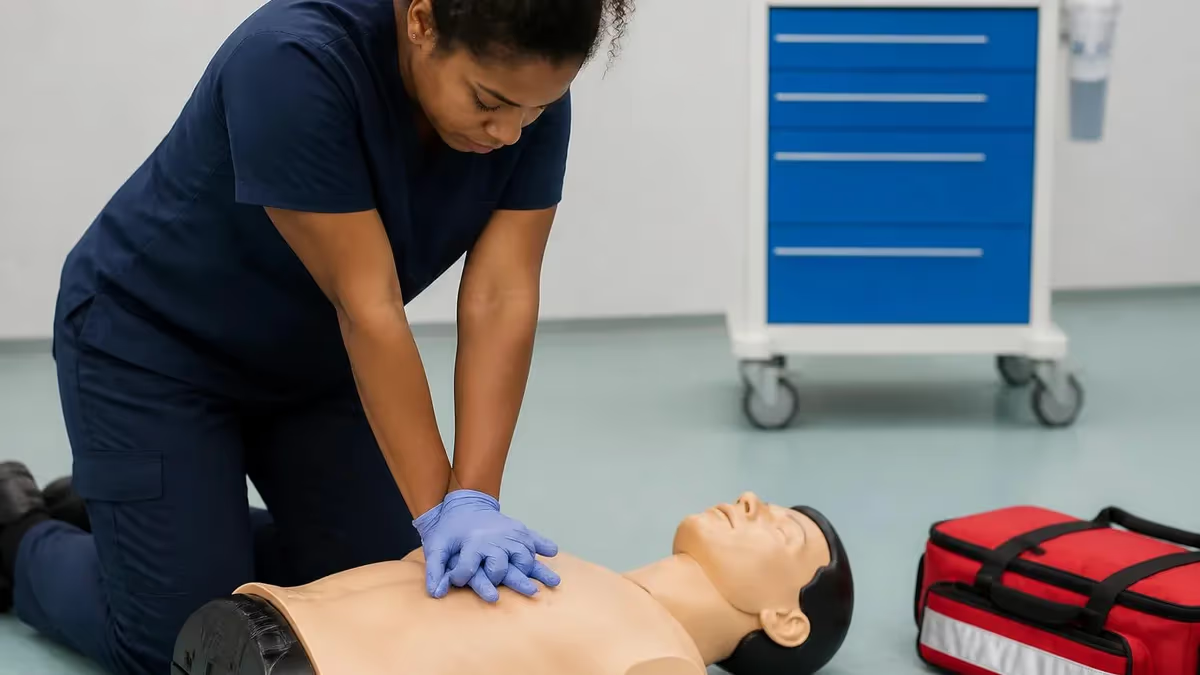
BLS Online Course at a Glance

BLS Online Course: What Actually Counts in 2026
You don't get a real BLS card from a course that's 100% online. That's the part most search results bury. The American Heart Association — the gatekeeper for almost every hospital, ambulance service, and nursing program in the U.S. — won't sign off on a BLS certification unless a live human watches you do compressions, ventilations, and use an AED. Anything else is a quiz, not a credential.
So when you search "BLS online course," you're really shopping for two things stitched together. First, an online cognitive portion you knock out at home, usually 1 to 2 hours of video, scenarios, and a multiple-choice exam. Second, a short hands-on skills check — done at a training center, a hospital, or on a self-directed RQI (Resuscitation Quality Improvement) station. That combo is called blended learning. It's the only path the AHA accepts.
Heads up.
If you're a healthcare provider — nurse, EMT, dental hygienist, medical student, anyone whose job requires a real BLS card — you need this distinction nailed down before you pay. A site that promises an instant, fully-online BLS certificate is either selling something employers will reject or stretching the truth about what "online" means.
This guide walks through every option that actually counts: AHA Heartcode BLS, the Red Cross blended path, and the smaller providers that get used by people who only need a CPR-equivalent card. We'll cover what each one costs, how long it takes, where to do the skills check, and which employers accept which.
Quick reminder while you're here: the basic life support certification standard hasn't changed since the 2025 AHA guidelines update — 30:2 ratio for adults, 100–120 compressions per minute, push at least 2 inches deep. The course content is locked. What changes between providers is the delivery format and the price.
If you've never been certified before, skim the what is bls overview first so the course material makes sense. If you're renewing, jump straight to the AHA Heartcode section — that's the path most renewals take now.
Online vs Blended vs In-Person
What it is: Video lessons + a final exam, all on your laptop. No instructor, no skills check.
Cost: $20–$50
Card issued? Yes, but it's a participation/CPR-awareness certificate — not AHA BLS.
Who accepts it? Almost nobody in healthcare. Some daycare centers, gyms, or office first-aid roles might count it. Hospitals, EMS, nursing programs, dental practices — no.
Bottom line: Fine for personal knowledge. Won't satisfy a job requirement that says "BLS for Healthcare Providers."
AHA Heartcode BLS — The Real "Online" Option
Heartcode BLS is the American Heart Association's own e-learning program. It exists because the AHA knows people don't want to sit in a classroom for four hours just to renew a card. So they split the course in two.
The online half runs in your browser. You'll watch short videos of cardiac arrest scenarios, answer questions as you go, and finish with a 25-question multiple choice exam. Pass at 84% and you get a completion certificate — which is not your BLS card. It's the ticket that lets you book the skills session.
You can move at your own pace. Most people finish in 1 to 1.5 hours. If you bomb the exam, you re-take it for free. The system bookmarks your progress so you can split it across lunch breaks, which is genuinely useful if you've got a busy shift schedule.
The Heartcode platform also runs on tablets and even most modern smartphones. The video player isn't fancy, but it works on hospital wifi, on cellular data, and offline once you've downloaded a module. Closed captions are available in English and Spanish.
Two Ways to Do the Skills Check
Option one: RQI station. RQI stands for Resuscitation Quality Improvement, and it's a self-directed manikin kiosk you'll find in hospital corridors, EMS bases, and some large clinics. You scan your badge, the manikin tracks your compression depth and rate, and the software gives you instant feedback. The whole thing takes maybe 20 minutes. If your hospital has RQI, this is the easiest path on Earth — no appointment, no instructor, no waiting.
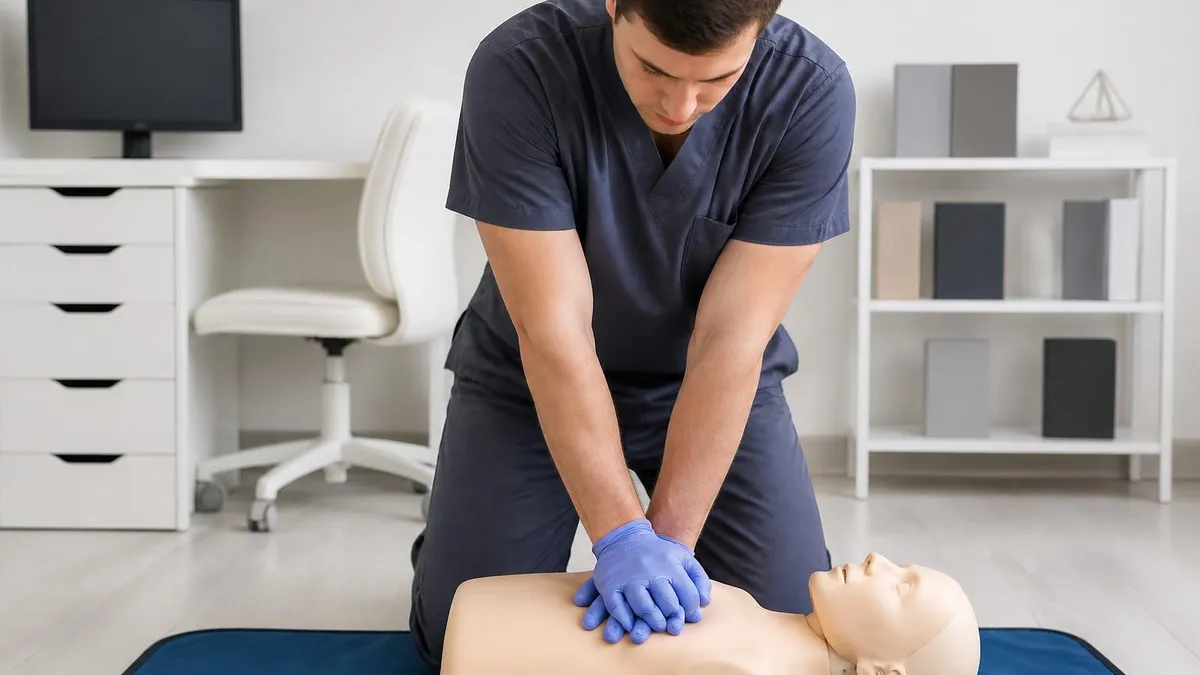
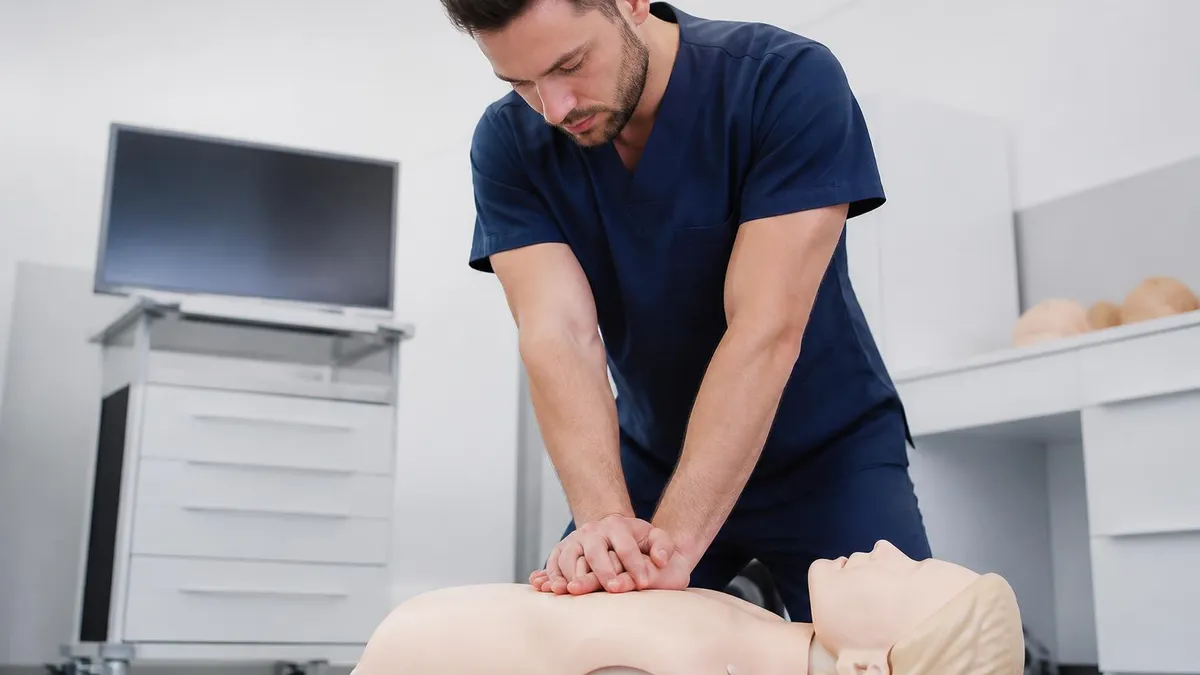
Option two: scheduled instructor session. You book a 30–45 minute slot at a local AHA training center. The instructor watches you do high-quality CPR on an adult and infant manikin, demonstrate AED use, manage an obstructed airway, and run a two-rescuer cycle. Pass everything and the instructor activates your eCard within 24 hours.
For a deeper look at how the AHA structures its certifications, the aha bls overview covers the broader program — Heartcode is just one delivery format inside it.
What It Costs
The online cognitive portion runs $35–$90 depending on where you buy it. Direct from the AHA's online portal it's around $40. Resellers like ProMed, ACLS Certification Institute, or Medical Education Inc. may charge slightly more or bundle in extras like printable pocket cards or quick-reference algorithm sheets.
The skills session is a separate fee — $35–$50 at most training centers, sometimes free if your employer hosts RQI stations onsite. All-in you're looking at $70–$140 once both pieces are done and the eCard is issued.
Worth knowing. If your employer reimburses BLS, ask them to bill the skills session directly. Saves you from fronting the cash. Some hospital systems also negotiate group rates with nearby AHA training centers — your HR rep usually has a list.
BLS Online Course Cost Breakdown

Red Cross BLS for Healthcare Providers
The American Red Cross runs a parallel BLS program that competes with the AHA. Both are accepted by hospitals — the AHA card is more dominant nationally, but Red Cross has strong footholds in the Midwest, the Northeast, and in some chain hospital systems that have official Red Cross contracts.
Here's the catch: Red Cross does not offer a fully-online BLS option for healthcare providers. Their healthcare BLS is blended-only, period. You complete the online module (about 90 minutes), then schedule a 30-minute in-person skills check at a Red Cross training site. No RQI equivalent — you have to book a real human.
What Red Cross does offer 100% online is something called "CPR/AED for the Workplace" or "Adult First Aid/CPR/AED." Those are workplace safety courses, not BLS for Healthcare Providers. Don't confuse them — the names sound similar, the cards look similar, but a hospital won't accept the workplace version.
Cost and Format
The Red Cross blended BLS course runs $70–$95 total, depending on your city. It's a flat fee that bundles the online module and the skills session — you don't pay separately. Card is valid 2 years, just like AHA.
One advantage: Red Cross digital cards are easy to share. They live in your Red Cross account and you can email them straight to an employer's credentialing department.
If your employer specifically asks for Red Cross BLS, see the red cross basic life support course guide for the full breakdown of locations, course IDs, and how to redeem digital cards.
ProTrainings, ProCPR, NSC and the Smaller Providers
A handful of smaller providers run online BLS courses that cater to non-healthcare audiences — coaches, daycare workers, dental office staff who don't need full AHA certification, parents, foster carers. These include ProTrainings, ProCPR, the National Safety Council (NSC), and a few others.
Most issue a certificate the moment you finish the online exam. Some are 100% online; a few partner with local instructors for an optional skills check. Cost is the appeal: $20 to $50 for an instant card.
The honest answer on whether these count: it depends entirely on who's asking to see the card. A daycare licensing board in Ohio might accept ProCPR. A hospital in Boston won't. A dental office might accept NSC for an office assistant but require AHA for the hygienists. Always ask your employer or licensing body which providers they accept before you pay.
You'll see online BLS providers advertise as "OSHA-accepted" or "OSHA-compliant." Worth knowing what that means: OSHA doesn't certify or approve specific BLS providers. They have general workplace safety regulations that require first-aid trained employees in certain roles. Any reasonable certificate satisfies OSHA at the workplace level. That phrase doesn't make a course AHA-equivalent. Don't let it sway you if you need a healthcare-grade card.
What the Hands-On Skills Check Actually Looks Like
For people who've only ever taken online tests, the skills check is the part that causes anxiety. It shouldn't. It's structured, predictable, and the instructor's job is to help you pass.
Typical Skills Stations
You'll cycle through five or six stations, each lasting 3–5 minutes. Adult one-rescuer CPR with AED. Adult two-rescuer CPR with bag-mask ventilation. Infant one-rescuer CPR. Child CPR. Choking — adult and infant. Some sites add a team dynamics scenario where you and another student switch roles mid-resuscitation.
The instructor uses an AHA-published checklist. They're looking for specific behaviors: compression depth at least 2 inches for adults, rate 100–120 per minute, full chest recoil, minimal interruptions, correct AED pad placement, effective ventilations that produce visible chest rise.
If You Fail
If you miss a critical action on the checklist, the instructor will stop you, explain what went wrong, and let you re-attempt the station. Most centers give you two re-attempts on the same day at no extra charge. Beyond that, you'd rebook the skills portion only — you don't redo the online cognitive piece.
The pass rate at AHA training centers runs above 90% for renewals and above 80% for first-timers. The most common slip-ups are shallow compressions and forgetting to switch compressors every two minutes during the two-rescuer scenario. Practice on a couch cushion at home if you're nervous — depth muscle memory is the hardest thing to nail.
What You'll Actually Learn in a BLS Online Course
Every BLS course — online cognitive portion or classroom — covers the same six core competencies. The 2025 AHA guideline update tightened a few thresholds but didn't change the structure. Here's what your card means you've been tested on.
BLS Core Skills You'll Be Tested On
- ✓High-quality CPR for adults — 30:2 compression-to-breath ratio, depth at least 2 inches, rate 100–120/min, full recoil between compressions.
- ✓High-quality CPR for children and infants — different hand positions, depth ratios, and rescue breath techniques.
- ✓AED operation — turn on, attach pads (avoiding patches and pacemakers), follow voice prompts, clear before shocking.
- ✓Bag-mask ventilation — proper seal, gentle squeeze, visible chest rise without over-ventilation.
- ✓Choking relief — Heimlich for conscious adults/children, back blows for infants, CPR-with-airway-check for unconscious victims.
- ✓Two-rescuer CPR with team dynamics — switching compressors every 2 minutes, clear closed-loop communication, role assignment.
- ✓Recognition of cardiac arrest vs other emergencies — agonal breathing, unresponsiveness, no pulse within 10 seconds.
- ✓Activating the emergency response system — calling 911 or pulling a code blue, requesting an AED, directing bystanders.
- ✓Post-cardiac-arrest care basics — recovery position, monitoring breathing, handing off to advanced providers.
Which Employers Accept Which Cards
This is where most people get burned. They buy a course, pass the exam, then hand the card to HR and watch them shake their head. Save yourself the wasted afternoon and money — match the card to the job before you pay.
Hospitals, EMS, Nursing Schools, Dental Boards
These require AHA BLS Provider, period. Some accept Red Cross BLS for Healthcare Providers as an equivalent. None will accept a fully-online or non-blended card. If you're applying for a clinical role, only consider Heartcode BLS or Red Cross blended.
State nursing boards publish lists of accepted providers. Most lists are short: AHA, Red Cross, sometimes ASHI (American Safety & Health Institute). If a provider isn't on the list, the card doesn't count toward your license requirements.
Daycares, Schools, Coaches, Personal Trainers
More flexibility here. Most states accept any nationally recognized CPR/AED course. ProTrainings, ProCPR, NSC, ASHI, Red Cross workplace courses, and AHA Heartsaver all typically count. Check your state's child care licensing rules — they're usually published online.
Workplace First-Aid Roles
OSHA-compliant is enough. Just about any reputable provider works. The cheapest fully-online option is usually fine for a designated office first-aid responder.
Dental Offices
Split situation. Dentists, hygienists, and most clinical staff need AHA BLS. Receptionists and non-clinical staff often just need standard CPR — many state dental boards specify this distinction in writing. If you're a hygiene student, don't go cheap; you need the real AHA card.
If you're still figuring out your category, check the basic life support certification online guide which breaks down acceptance by job type and links to state-board verification pages.

How Long Each Option Takes
Timing and the 2-Year Renewal Cycle
Course duration matters more than people realize. If your job starts Monday and HR wants a card by Friday, your provider choice changes. Heartcode online runs 1–2 hours but you have to wait until a skills slot opens — at busy training centers that can be a week out. RQI stations have no wait if your employer offers them. In-person classroom gets you a card the same day. For renewals specifically, see the bls renewal walkthrough — there's a shorter Heartcode renewal track that knocks the cognitive portion to about 45 minutes if you're renewing within the grace window.
A few practical scheduling tips. Don't buy the online course on a Friday night if your skills check needs to happen the following week — most training centers post their weekly schedule on Sundays and slots fill within 24 hours. Call the center before booking online; some keep walk-in slots they don't list publicly. And if you're renewing as part of a hospital orientation cohort, your unit educator can usually fast-track a group skills session that bypasses the public booking queue entirely.
The 2-Year Card and What Happens at Renewal
Every BLS card — AHA, Red Cross, or third-party — is valid for exactly 2 years from the date of issue. There's a 30-day grace window after expiration during which most employers will still consider you compliant, but you should book renewal at least 60 days before the expiration date to avoid scheduling pressure.
Renewal is the same blended structure: online cognitive + hands-on skills. The cognitive piece is often shorter because the system recognizes you as a renewing provider. You will still re-do the full skills check — no shortcuts on the hands-on part. The price is identical to first-time certification, which catches a lot of people off guard. There's no "renewal discount."
If your card lapses more than 30 days, you'll need to retake the full initial course (not the renewal track) at most training centers. Some accept extended grace periods with extra documentation. Always check before paying.
Tracking Your Card
AHA eCards live in the AHA Atlas portal. You'll get an email with a redemption code after your skills check — use it within 90 days or it expires and you'll have to ask the instructor to re-issue. Red Cross cards live in your Red Cross account dashboard. Print or screenshot both for offline backup. Some hospital credentialing systems also require a PDF upload, not just a link — download the official PDF version directly from your portal and keep a copy in your personal files. The PDF includes the QR code that HR uses to verify authenticity.
That's the BLS online course landscape for 2026. The honest summary: there's no such thing as a fully-online BLS that healthcare employers respect.
Heartcode plus a skills check is the closest you'll get, and for most people it's the smartest path — fastest, cheapest hands-on time, and accepted everywhere that matters. Pay attention to the skills-check requirement before you click "buy," match the provider to the job you're applying for, and book the hands-on appointment the same week you start the online portion so nothing expires on you.
Online BLS Course Pros and Cons
- +Self-paced cognitive portion — finish in 1–2 hours on your schedule
- +Cheaper than classroom for renewals when employer offers RQI stations onsite
- +AHA eCard accepted by every U.S. hospital, EMS service, and nursing program
- +Skills check is short (20–45 min) and bookable within a week
- +Re-take exam for free if you fail — no penalty
- +Digital card delivered within 24 hours of skills completion
- −Still requires an in-person skills appointment — not truly remote
- −Fully-online "BLS" cards from non-AHA providers won't satisfy healthcare jobs
- −Renewal pricing is the same as first-time — no loyalty discount
- −If you fail the skills check twice, you may need to rebook another day
- −RQI stations only available at participating employer sites
- −Online portion is dry — long videos with limited interactivity
Which Online BLS Course Fits Your Situation
Pick AHA Heartcode BLS with skills at an employer RQI station if available, otherwise an AHA training center.
- Best path: Heartcode + RQI
- Why: Universal acceptance, fastest renewal
- Avoid: Fully online providers — will be rejected
AHA BLS Provider required by dental schools. Heartcode bundle with skills at a local training center is standard.
- Best path: Heartcode bundle
- Cost: $70–$140
- Avoid: Workplace CPR courses
State licensing typically accepts any nationally recognized provider. Check your state's child care rules first.
- Best path: Red Cross workplace or ProTrainings
- Cost: $20–$60
- Card validity: 2 years
Most gyms and youth sports leagues accept any major CPR/AED card. AHA Heartsaver is the safest bet.
- Best path: AHA Heartsaver online + skills
- Cost: $45–$80
- Tip: Confirm with league or facility first
OSHA-compliant courses are sufficient. The cheapest fully-online option from a recognized provider works.
- Best path: NSC or ProTrainings online
- Cost: $20–$40
- Skills check: Optional, not required
Heartcode BLS renewal track. Cognitive portion is shorter; skills check is full length. Renew 60 days before expiry.
- Best path: Heartcode renewal + RQI
- Cognitive: About 45 min
- Grace period: 30 days post-expiry
Heartcode BLS — Step by Step
Step 1: Buy the Online Course
Step 2: Complete the Cognitive Portion
Step 3: Download Your Completion Certificate
Step 4: Book a Skills Session
Step 5: Complete the Hands-On Check
Step 6: Receive Your AHA eCard
BLS includes everything plain CPR teaches, plus team-based resuscitation, bag-mask ventilation, AED for healthcare settings, and recognition of cardiac arrest in clinical contexts. A workplace CPR/AED course teaches you to save someone collapsing in a parking lot. BLS teaches you to run a code in a clinical environment — switching compressors every two minutes, communicating with a team, integrating with arriving EMS. That's why hospitals require BLS specifically, not just any CPR card. The is bls the same as cpr guide unpacks the differences if you want a side-by-side comparison.
BLS Questions and Answers
About the Author

Registered Nurse & Healthcare Educator
Johns Hopkins University School of NursingDr. Sarah Mitchell is a board-certified registered nurse with over 15 years of clinical and academic experience. She completed her PhD in Nursing Science at Johns Hopkins University and has taught NCLEX preparation and clinical skills courses for nursing students across the United States. Her research focuses on evidence-based exam preparation strategies for healthcare certification candidates.
Join the Discussion
Connect with other students preparing for this exam. Share tips, ask questions, and get advice from people who have been there.
View discussion (8 replies)