
AHA BLS Renewal Cost: What Is a BLS Certification and How Much Does It Cost?
What is a BLS certification and how much does AHA BLS renewal cost? Full breakdown of fees, formats, and tips. ✅

Understanding what is a BLS certification is the first step for any healthcare professional navigating the world of emergency response credentials. BLS — Basic Life Support — is a structured training program designed to equip nurses, physicians, paramedics, medical students, and other clinical personnel with the core skills needed to respond to cardiac arrest, respiratory failure, and airway obstruction. The American Heart Association (AHA) is the most widely recognized issuing body, and the aha bls renewal cost typically ranges from $30 to $75 for online components and $40 to $100 for in-person or blended courses depending on your training center.
So what does BLS stand for? The acronym stands for Basic Life Support, a term that encompasses a specific set of emergency interventions including high-quality chest compressions, rescue breathing, and the use of an automated external defibrillator (AED). These skills are considered foundational to advanced cardiac life support (ACLS) and pediatric advanced life support (PALS), making BLS the entry-level requirement for virtually every clinical role in the United States healthcare system.
A common point of confusion among both new learners and experienced clinicians is whether BLS and CPR are the same thing. The short answer: they overlap significantly, but they are not identical. CPR (cardiopulmonary resuscitation) refers to the physical technique of chest compressions and rescue breaths. BLS certification, by contrast, is a formalized credential that covers CPR along with AED use, team-based resuscitation, and recognition of life-threatening emergencies — making BLS the professional-grade version of CPR training.
The basic life support exam American Heart Association administers as part of its BLS Provider Course tests candidates on compression rate and depth, ventilation ratios, AED operation, recognition of cardiac arrest, and coordinated two-rescuer response. Both a skills check-off with a certified instructor and a written or digital knowledge test must be passed to earn the credential. Most candidates find the written portion straightforward if they have reviewed the AHA's provider manual, though high-stakes testing environments can catch even experienced clinicians off guard.
For healthcare professionals already holding BLS cards, renewal is required every two years. The basic life support renewal class format mirrors the original course but is compressed into a shorter session — typically two to three hours — because candidates are presumed to have foundational knowledge. Both the AHA and the American Red Cross offer renewal pathways, with the Red Cross BLS course also widely accepted by hospitals, clinics, and educational programs across the country.
Whether you are a nursing student preparing for your first clinical rotation or a seasoned ER physician whose card is about to expire, understanding the cost structure, format options, and preparation strategies for BLS renewal will save you time and money. This guide covers everything from what to expect on the AHA BLS exam to how to find the lowest-cost renewal option in your area — so you can stay compliant and confident in your emergency response skills without unnecessary expense or stress.
Before diving into specific costs and formats, it is worth noting that preparation matters even for renewal candidates. Many clinicians underestimate the written portion of the BLS provider exam, particularly questions about compression-to-ventilation ratios for infants, two-rescuer scenarios, and AED pad placement variations. Using basic life support certification cost resources and practice tests — like those available on PracticeTestGeeks — can help you walk in confident and walk out certified on the first attempt.
AHA BLS Certification by the Numbers
Key Facts at a Glance
| Item | Value | Details |
|---|---|---|
| Typical BLS Renewal Cost | $30–$100 | Varies by format and training center |
| BLS Card Validity Period | 2 Years | Renewal required before expiration |
| Written Exam Questions | 25 Qs | AHA BLS Provider knowledge test |
| Minimum Passing Score | 84% | Must score 21/25 or higher |

AHA BLS Renewal Cost Breakdown by Format
When comparing the AHA and the American Red Cross for BLS renewal, it helps to understand that both organizations offer accredited, widely accepted certifications — but there are meaningful differences in course structure, testing format, and cost. The American Red Cross basic life support program is slightly shorter in its online module delivery and tends to use a slightly different testing interface, though the core competencies are identical. Most hospitals and healthcare employers accept both cards interchangeably, though it is always worth confirming with your HR department before enrolling.
The red cross basic life support course typically costs between $45 and $80 for a renewal blended learning session. The Red Cross also offers a fully online option for select healthcare settings, though skills verification is still required to receive the provider card. One advantage of the Red Cross pathway is that its training centers are distributed very broadly across the US, including in rural areas where AHA-authorized training centers may be less accessible.
For the aha basic life support exam, candidates must complete both a skills check-off and a written knowledge test. The written component consists of 25 multiple-choice questions delivered either on paper or through the AHA's digital platform. The passing threshold is 84 percent, meaning you must answer at least 21 of 25 questions correctly. Questions focus on high-quality CPR parameters (rate of 100–120 compressions per minute, depth of at least 2 inches for adults), rescue breathing ratios, AED operation steps, and multi-rescuer team dynamics.
The skills check-off is conducted by an AHA-certified instructor who evaluates your hands-on technique. You will typically be asked to demonstrate adult one-rescuer CPR, two-rescuer CPR with bag-mask ventilation, infant CPR, and AED use. Instructors look for proper hand placement, adequate compression depth, full chest recoil between compressions, minimal interruptions, and correct mask seal. Renewal candidates who have not actively practiced these skills in the two years since their last certification often struggle more with the hands-on portion than the written test.
One important distinction between AHA formats is the HeartCode BLS blended learning option versus the traditional instructor-led class. HeartCode is an adaptive eLearning platform that allows you to complete the didactic portion at your own pace before attending a shorter, focused skills session. This format is particularly popular with busy clinicians who cannot commit to a full four-hour classroom day. The HeartCode license typically costs $25–$40 directly from AHA, with the skills session priced separately by your local training center — usually $30–$60 additional.
If you are unsure about how many ceus is bls renewal, the answer depends on your state licensing board and professional organization. The AHA BLS Provider Course is approved for continuing education credit by the American Nurses Credentialing Center (ANCC), and many state nursing boards, physical therapy boards, and respiratory therapy boards recognize BLS renewal hours toward CE requirements. Typically, BLS renewal earns between one and three CE hours, though this varies. Always verify with your own licensing board before counting BLS toward your CE total.
Another factor that affects AHA BLS renewal cost is your geographic location. Training centers in major metropolitan areas often charge more due to higher overhead costs, while community colleges, fire departments, and nonprofit training centers frequently offer lower rates. Some employers — particularly large hospital systems and academic medical centers — provide BLS renewal as a mandatory, employer-funded benefit, meaning their staff pay nothing out of pocket. If your employer offers this benefit, taking advantage of it is always the most cost-effective route to maintaining your credential.
Is BLS the Same as CPR? Understanding BLS for Healthcare Providers
Many people ask whether BLS and CPR are the same — the answer is that CPR is a component of BLS, not a synonym. CPR refers specifically to the physical act of chest compressions and rescue breathing performed on someone in cardiac arrest. BLS certification, by contrast, covers CPR plus AED operation, recognition of cardiac emergencies, airway management, relief of choking, and coordinated multi-rescuer response protocols. BLS for healthcare providers is held to a higher standard than lay-rescuer CPR training.
For healthcare professionals, the distinction matters because employers and licensing boards require BLS — not merely CPR awareness. The basic life support for healthcare providers credential validates that you can function effectively in a clinical emergency, including as part of a resuscitation team. This includes knowing when to switch roles with a partner during prolonged CPR, how to operate a bag-mask device, and how to minimize interruptions in chest compressions — skills that go well beyond what is covered in a basic community CPR class.

AHA BLS vs. American Red Cross BLS: Which Should You Choose?
- +AHA BLS is the gold standard in most hospital systems and academic medical centers
- +HeartCode blended learning lets you complete didactic content at your own pace online
- +AHA materials are updated frequently to reflect the latest resuscitation science guidelines
- +AHA training centers are available in all 50 states with a broad instructor network
- +AHA BLS is universally recognized by nursing boards, medical schools, and residency programs
- +Digital verification of AHA credentials is available through the AHA's eCard system
- −AHA in-person renewal classes can be harder to schedule in rural or underserved areas
- −HeartCode eLearning license and skills session are often priced and booked separately, adding friction
- −AHA renewal costs at private training centers can reach $100+ in high-cost metro areas
- −No fully online AHA BLS option exists — a hands-on skills session is always required
- −AHA cards must be renewed strictly every 2 years with no grace period at most employers
- −Some community colleges and fire departments only offer Red Cross BLS, limiting AHA access
BLS Renewal Checklist: 10 Things to Do Before Your Class
- ✓Confirm your current BLS card expiration date and schedule renewal at least 30 days early
- ✓Verify with your employer or HR department whether BLS renewal is employer-sponsored or reimbursable
- ✓Choose between AHA HeartCode blended learning and in-person instructor-led renewal based on your schedule
- ✓Complete the HeartCode eLearning module fully before attending your skills session if using blended format
- ✓Review current AHA BLS compression parameters: rate 100–120/min, adult depth ≥2 inches
- ✓Practice two-rescuer CPR technique with a colleague, focusing on smooth role switching and bag-mask use
- ✓Review AED operation steps: power on, attach pads, analyze rhythm, deliver shock, resume CPR immediately
- ✓Study infant and child CPR differences: two-finger technique, compression depth ≥1.5 inches for infants
- ✓Take at least two full BLS practice tests on PracticeTestGeeks to identify knowledge gaps before your exam
- ✓Bring your previous BLS card, a valid photo ID, and your training center confirmation to the renewal session
The Skills Check-Off Is Where Most Renewal Candidates Struggle
Data from AHA training centers consistently shows that the hands-on skills check-off — not the written test — is the component that causes renewal candidates to require remediation. Compression depth and rate drift significantly over a two-year period without active practice. Spending 20 minutes rehearsing on a CPR manikin or using a compression feedback app before your class dramatically increases your first-attempt pass rate.
Passing the AHA BLS provider exam on your first attempt is highly achievable with the right preparation strategy. The written test is not designed to trick candidates — it tests whether you know the core parameters, ratios, and sequences that define high-quality BLS. The most commonly missed questions on the AHA BLS exam fall into four categories: compression rate and depth thresholds, the correct compression-to-ventilation ratio in two-rescuer CPR, the sequence of steps after AED shock delivery, and the specific parameters that differentiate adult from infant and child CPR protocols.
For the written portion, the key numbers to memorize are: 100–120 compressions per minute (the recommended rate for all age groups), at least 2 inches compression depth for adults, at least 1.5 inches for infants, 30:2 compression-to-ventilation ratio for single-rescuer adult CPR, and 15:2 ratio for two-rescuer infant or child CPR. The AED sequence — power on, attach pads, analyze, shock if advised, immediately resume CPR — must be automatic. Many candidates who fail the written test do so because they reverse the compression-to-ventilation ratios for single- versus two-rescuer pediatric CPR.
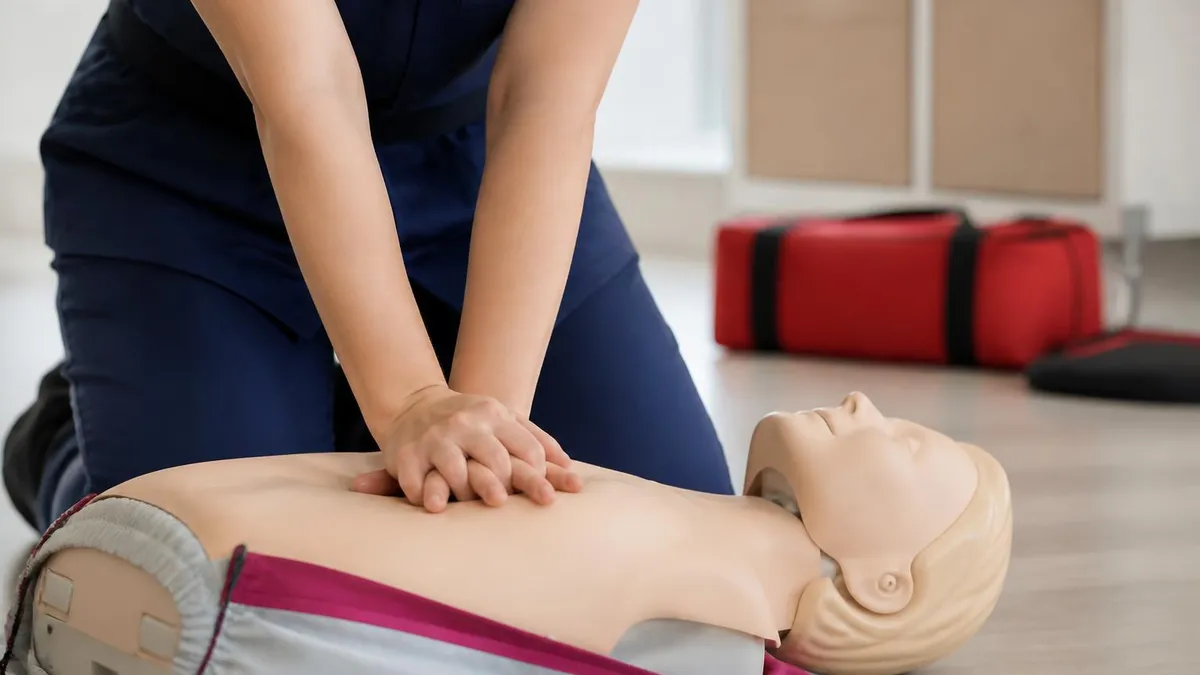
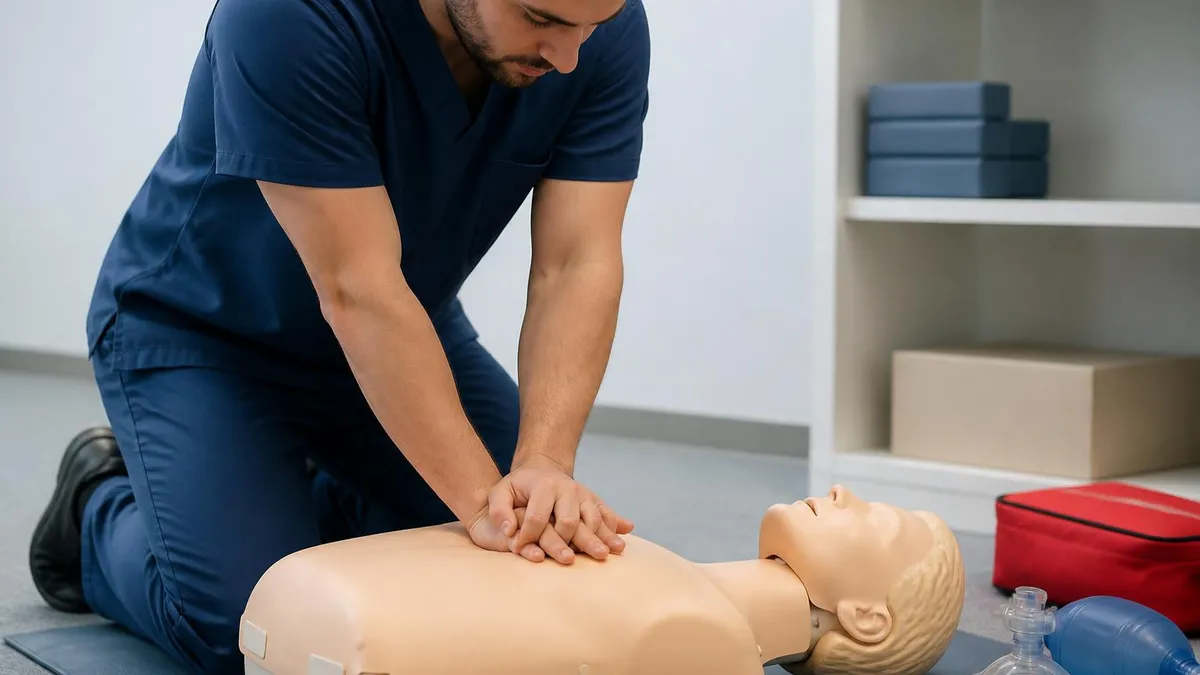
The skills check-off evaluates technique in real time, and the AHA's evaluation criteria are specific. For adult CPR, the instructor will use a feedback device or visual estimation to confirm compression rate falls between 100 and 120 per minute, depth reaches at least 2 inches (5 centimeters), the heel of your hand is correctly placed on the lower half of the sternum, and your elbows are locked throughout each compression cycle.
Full chest recoil between compressions — meaning you release all pressure without lifting your hands — is also evaluated and is a point of failure for candidates who lean on the chest between compressions.
Bag-mask ventilation technique is evaluated during the two-rescuer CPR sequence. The E-C clamp technique — forming a C with your thumb and index finger over the mask and an E with the remaining three fingers under the jaw to create a tight seal — is the AHA's preferred approach. Each breath should deliver enough volume to produce visible chest rise, take approximately one second to deliver, and avoid excess volume that causes gastric inflation. Candidates who squeeze the bag too hard or too fast frequently fail the ventilation portion of the check-off.
For the AED component, the instructor will ask you to simulate AED use on a manikin or using an AED trainer device. The sequence must be performed without hesitation: turn on the AED, attach the pads in the correct positions (right subclavicular and left lateral chest for adults), allow the device to analyze, ensure all rescuers are clear before delivering the shock, and immediately resume CPR starting with compressions the moment the shock is delivered.
A common mistake is pausing to check for a pulse before resuming compressions — AHA guidelines specify that CPR must restart immediately after shock delivery without a pulse check.
Infant CPR during the skills check-off is assessed separately from adult CPR. For single-rescuer infant CPR, you will use two fingers placed on the center of the chest just below the nipple line. For two-rescuer infant CPR, the two-thumb encircling technique — both thumbs on the sternum while your hands encircle the infant's thorax — is preferred and often evaluated in renewal courses.
Compression depth for infants must reach at least 1.5 inches (4 centimeters), approximately one-third the anterior-posterior chest depth. Ventilation volumes are correspondingly smaller — just enough to see the chest rise, typically a small puff rather than a full breath.
Relief of foreign body airway obstruction (FBAO) is another skill area that may be evaluated in your renewal skills session. For responsive adults and children, the Heimlich maneuver — five abdominal thrusts until the object is expelled or the patient becomes unresponsive — is the AHA-recommended approach. For infants, the technique switches to alternating five back blows and five chest thrusts. If the patient becomes unresponsive, you immediately activate the emergency response system (call 911 or the code team), begin CPR, and check the mouth for a visible object before each ventilation attempt.
Many hospital credentialing systems automatically flag expired BLS cards and can restrict clinical privileges until a valid card is on file. Some travel nursing agencies and locum tenens companies will not place you in a shift without a current BLS credential. If your card expires mid-contract, you may be required to complete a full renewal before your next scheduled shift — so renew early and keep a digital copy of your eCard accessible at all times.
Finding a low-cost BLS renewal option requires knowing where to look and understanding the pricing structures of different types of training centers. The AHA does not set a fixed price for BLS renewal courses — instead, it authorizes training centers to set their own rates within general guidelines. This means the same AHA BLS renewal course can cost $45 at a community college and $95 at a private medical education company, even in the same city. Comparison shopping is both allowed and encouraged.
Community colleges and community education programs are consistently among the most affordable AHA-authorized training centers. Many offer BLS renewal as part of their continuing education catalog at rates 30–50 percent lower than private training centers, with flexible scheduling including evenings and weekends. Fire departments and EMS agencies sometimes open their internal BLS renewal sessions to community healthcare workers at reduced or no cost. Calling your local fire station or EMS agency to ask about public access is worth the effort.
If you are in a hospital system, your employee health or education department is your first call. The majority of large hospital networks offer free or nearly free BLS renewal as part of their mandatory credentialing maintenance — they have a vested interest in ensuring staff maintain current BLS cards. Even if your hospital does not directly sponsor a class, many have preferred vendor relationships with local training centers and can direct you to discounted rates negotiated for their employees.
For those who prefer maximum flexibility, the basic life support online renewal pathway through HeartCode BLS allows you to complete the eLearning module from any device, at any time, at your own pace. Once the online module is finished, you schedule a skills session at any AHA-authorized training center that accepts HeartCode completions — which is the majority of centers nationwide. This blended approach is increasingly popular because it eliminates the full classroom day while still satisfying the hands-on skills requirement that prevents a fully online BLS certification.
Group discounts are another underutilized cost-saving strategy. If you work in a clinic, practice, or school with multiple colleagues needing renewal around the same time, contacting a training center about a group booking can unlock per-person rates 20–40 percent below individual pricing. Many training centers will also send an instructor to your workplace for an on-site renewal session, which eliminates travel time and can be cost-effective for groups of ten or more.
Healthcare students — nursing students, PA students, medical students, and respiratory therapy students — should check with their program's financial aid office and student health resources before paying out of pocket for BLS renewal. Many academic programs build BLS certification costs into program fees or offer subsidized access to training centers through institutional contracts. Some nursing school programs include initial BLS certification in tuition and then provide one free or discounted renewal during enrollment.
Finally, do not overlook professional association membership benefits when calculating the true cost of BLS renewal. Organizations such as the American Association of Critical-Care Nurses (AACN), the Emergency Nurses Association (ENA), and the American Academy of Physician Associates (AAPA) sometimes negotiate member discounts with AHA training centers or offer CE credit reimbursement programs that can offset renewal costs. Reviewing your membership benefits before scheduling renewal is a quick and often-overlooked step that can save meaningful money over the course of a career.
Practical preparation for BLS renewal goes beyond reading the provider manual. The most effective strategy combines targeted knowledge review with deliberate hands-on practice in the days immediately before your class. Starting your review two weeks before your scheduled renewal session gives you enough time to identify and address weak areas without the stress of last-minute cramming. Begin by reading the current AHA BLS Provider Manual — focusing on the algorithms, the chain of survival, and the specific numeric parameters for each age group.
Practice tests are among the most efficient study tools available for BLS renewal candidates. Free and low-cost BLS practice question banks — including the quizzes available on PracticeTestGeeks — allow you to simulate the written exam format, identify knowledge gaps, and build confidence before the actual test. Focus on questions about compression-to-ventilation ratios, AED sequences, special situations like pregnancy and opioid overdose, and the differences between adult, child, and infant protocols. Candidates who complete at least three full practice tests before their renewal class consistently outperform those who rely solely on their clinical experience.
Hands-on rehearsal is equally important, particularly if it has been more than 12 months since you last performed CPR on a patient or manikin. If your workplace has a CPR manikin available, use it. If not, consider using a compression feedback app on your smartphone — apps like PocketCPR or Resus Annie can provide real-time rate and depth feedback even without a physical manikin. Even practicing the hand placement and compression motion on a firm cushion for 10 minutes can reactivate muscle memory and improve your technique at the skills check-off.
Pay special attention to the bag-mask ventilation skill if you work in a specialty where you rarely use this technique. Many clinicians in outpatient settings, school health, or administrative roles go months or years between encounters requiring bag-mask use, and the E-C clamp seal technique deteriorates without practice. Watching a short video demonstration of the technique — readily available through the AHA's website and YouTube — and then practicing the hand position on a manikin or pillow can make a significant difference in your skills check-off performance.
On the day of your renewal class, arrive a few minutes early to settle in and review any last-minute notes. Bring your current BLS card if it has not yet expired, your photo ID, and confirmation of your HeartCode completion if using the blended learning format. Wear comfortable clothing that allows you to kneel on the floor for manikin CPR practice — dress pants or a pencil skirt will make the skills session more difficult than necessary. Stay hydrated and plan for the session to last two to four hours depending on format and class size.
After passing, download your AHA eCard immediately from the AHA's Training Network website. The eCard is a digital, verifiable credential that your employer, hospital credentialing office, or licensing board can authenticate online. Keep a PDF copy in your email and on your phone. Some healthcare systems require you to upload the eCard directly to your employee record within 30 days of renewal — failing to do so in time can trigger an administrative credentialing lapse even if you passed the course successfully.
Looking ahead, set a calendar reminder for 60 days before your new BLS card expires. Two years passes faster than it seems, and the same scheduling challenges that make renewal inconvenient now will still exist in two years. Building BLS renewal into your annual professional development calendar — alongside license renewals, specialty certifications, and CE deadlines — ensures you never face the anxiety of an expiring credential during a busy clinical period. With consistent preparation and the right resources, BLS renewal is a manageable, affordable, and confidence-building part of your professional maintenance routine.
Sample BLS - Basic Life Support Practice Questions
Try these questions from our free BLS - Basic Life Support practice tests. The correct answer and an explanation follow each question.
A bag-mask device should deliver approximately how much air volume per breath to an adult?
- A. 200–300 mL
- B. 400–600 mL
- C. 800–1000 mL
- D. 1200–1500 mL
Answer: B. 400–600 mL
Each breath should deliver approximately 500–600 mL (roughly 400–600 mL range), enough to produce visible chest rise without causing gastric inflation.
During a cardiac arrest, every minute without defibrillation for a shockable rhythm decreases survival by approximately how much?
- A. 7–10%
- B. 1–2%
- C. 15–20%
- D. 25–30%
Answer: A. 7–10%
Survival from ventricular fibrillation decreases by approximately 7–10% for every minute that defibrillation is delayed without CPR.
A post-arrest patient on mechanical ventilation has a PaO2 of 350 mmHg on 100% FiO2. What action should be taken?
- A. Maintain current settings — high PaO2 improves outcomes
- B. Wean FiO2 down to achieve SpO2 of 92–98%
- C. Increase PEEP to raise PaO2 further
- D. Hyperventilate to reduce PaCO2
Answer: B. Wean FiO2 down to achieve SpO2 of 92–98%
Hyperoxia (PaO2 >300 mmHg) is harmful; FiO2 should be weaned to maintain SpO2 92–98%, avoiding excessive oxygen exposure.
A competent adult refuses CPR after being found pulseless and unresponsive. Which scenario makes refusal legally problematic?
- A. The patient verbally refused CPR two days earlier
- B. The patient is currently unconscious and cannot express a current wish
- C. The patient's family members disagree with the refusal
- D. The patient is elderly and in poor baseline health
Answer: B. The patient is currently unconscious and cannot express a current wish
Refusal requires current decisional capacity; an unconscious patient cannot exercise real-time refusal, making implied consent applicable.
BLS Questions and Answers

BLS Certificate Lookup: What Is a BLS Certification and How to Get Yours
Free Basic Life Support MCQ Questions and Answers Guide
AHA BLS Certification: Course, Renewal, and Exam Guide
BLS Training: Course Content, Format & How to Get Certified

Online BLS: Complete Guide to Getting Your Basic Life Support Certification
About the Author

Registered Nurse & Healthcare Educator
Johns Hopkins University School of NursingDr. Sarah Mitchell is a board-certified registered nurse with over 15 years of clinical and academic experience. She completed her PhD in Nursing Science at Johns Hopkins University and has taught NCLEX preparation and clinical skills courses for nursing students across the United States. Her research focuses on evidence-based exam preparation strategies for healthcare certification candidates.
Join the Discussion
Connect with other students preparing for this exam. Share tips, ask questions, and get advice from people who have been there.
View discussion (8 replies)