
What Is a Forklift License? Complete Training Guide & Certification Requirements
What is a forklift license? Learn OSHA certification requirements, training steps, costs, and how to become a certified forklift operator. 🎯

Understanding what is a forklift license is essential for anyone entering the warehousing, logistics, or construction industries in the United States. A forklift license — more accurately called a forklift certification or operator card — is official documentation proving that a worker has completed the required safety training and demonstrated competency to operate powered industrial trucks. Unlike a standard driver's license issued by a government agency, forklift certification is employer-issued under OSHA's 29 CFR 1910.178(l) standard, but it carries legal weight on every job site across the country.
The Occupational Safety and Health Administration (OSHA) mandates that every forklift operator must be trained and evaluated before operating any powered industrial truck. This regulation covers everything from the classic counterbalanced sit-down forklifts you see in big-box warehouses to stand up forklift models used in narrow-aisle applications, electric forklift units in cold-storage environments, and rough-terrain lifts on outdoor construction sites. Failing to hold valid certification can result in fines up to $15,625 per violation for employers and puts workers at serious risk of injury.
Forklift training is not a one-time checkbox. OSHA requires refresher training whenever an operator is observed operating the vehicle in an unsafe manner, is involved in an accident or near-miss, or receives an evaluation that reveals unsafe operation. Beyond compliance, certified operators earn more, advance faster, and are far more attractive to employers managing large fleets — whether those fleets are owned outright or sourced through forklift rental agreements to handle seasonal demand spikes.
The certification process involves three core phases: formal instruction (classroom or online), practical hands-on training in the workplace, and a performance evaluation conducted by a qualified trainer. Each phase builds on the last, ensuring operators understand the physics of load handling, pre-shift inspection procedures, refueling and battery-charging protocols, and emergency response. Operators who complete all phases receive a certification card that lists the specific truck classes they are authorized to run.
Many workers wonder whether forklift certifications transfer between employers. OSHA's standard does not mandate transferability — a new employer can accept a prior certification or require the operator to requalify on their specific equipment and operating conditions. In practice, most companies require at least a site-specific evaluation even when a candidate holds a current card from a previous job. This is especially true when the truck type differs, such as moving from a sit-down propane unit to an electric forklift with different load dynamics and braking characteristics.
The demand for certified forklift operators continues to grow alongside e-commerce expansion. The Bureau of Labor Statistics reports that material moving occupations — a category that includes forklift operators — employ more than 700,000 workers nationwide, with median annual wages around $40,000 and experienced operators in high-demand metro markets earning well above $50,000.
Whether you are exploring a new career, renewing an existing certification, or evaluating forklift rental near me options for a short-term project, understanding the certification landscape is your first step. You can also explore what is a forklift license requirements in rental contexts to understand how operators must be credentialed before taking possession of rented equipment.
This guide walks through every dimension of forklift licensing in the US: the legal framework, truck classes, step-by-step training process, costs, employer responsibilities, and the practical strategies that help candidates pass their evaluations on the first attempt. By the end, you will have a complete picture of what certification requires and how to achieve it efficiently.
Forklift Certification by the Numbers

Forklift Classes and License Types
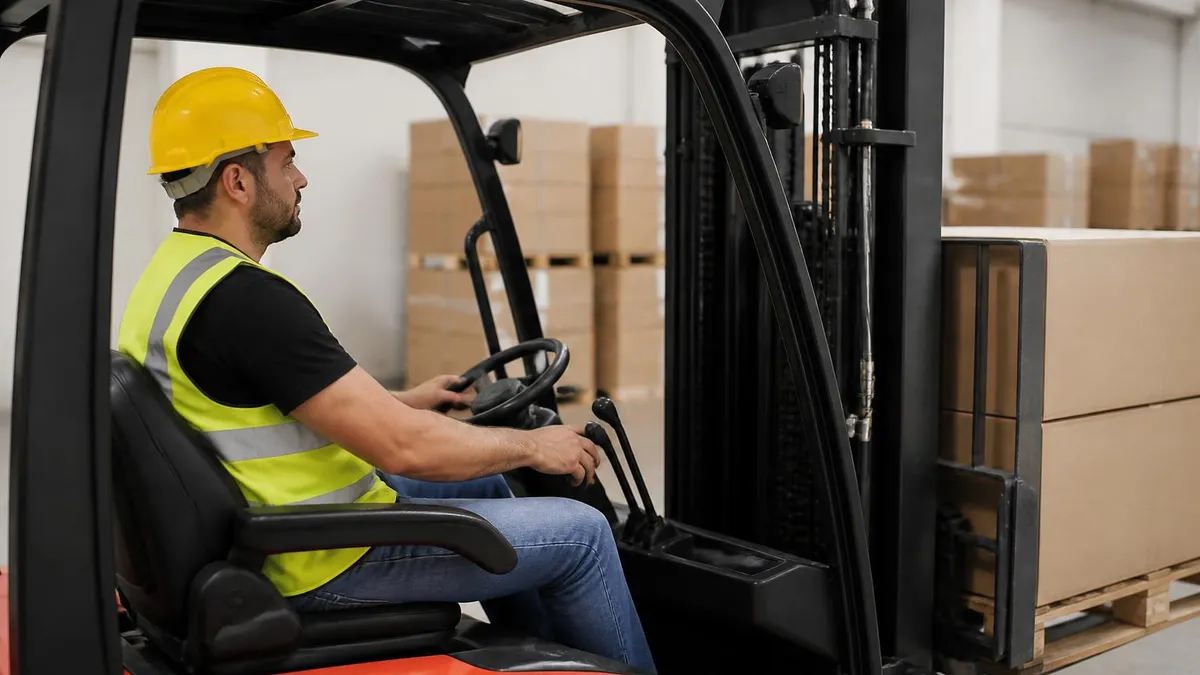
Includes sit-down counterbalanced electric forklifts used in warehouses and distribution centers. Operators must be trained on battery charging, water levels, and specific load capacity charts for each model in the fleet.
Covers reach trucks, order pickers, and turret trucks designed for tight aisle operations. Training emphasizes elevated platform safety, fall protection awareness, and precise load positioning at heights above 20 feet.
Walkie stackers, pallet jacks, and rider pallet trucks fall here. Though lower to the ground, these machines cause a significant share of foot and ankle injuries, making pedestrian awareness training critical.
Class IV uses cushion tires for indoor smooth-surface use; Class V uses pneumatic tires for outdoor or uneven surfaces. Both require training on propane cylinder exchange, exhaust ventilation, and outdoor slope navigation.
Includes tow tractors, rough-terrain variable-reach trucks, and telehandlers. Common in construction and agriculture. Operators need site-specific evaluation covering ground conditions, overhead hazards, and stabilizer use.
OSHA's forklift training standard, codified at 29 CFR 1910.178(l), sets the legal floor for every forklift operator certification in America. The regulation requires that training be conducted by a person with the knowledge, training, and experience necessary to train operators and evaluate their competence — a role commonly called the qualified trainer or evaluator. Employers cannot simply hand a worker an online certificate and send them to the floor; they must also conduct a site-specific, hands-on evaluation of each operator on the actual equipment types and in the actual operating conditions of the workplace.
The formal instruction component of forklift training must cover a defined set of topics regardless of delivery method. These include truck-related topics such as operating instructions and warnings in the operator manual, differences and similarities between forklifts and automobiles, controls and instrumentation, engine or motor operation, steering and maneuvering, visibility, fork and attachment adaptation, vehicle capacity, vehicle stability, inspection and maintenance, refueling and charging, and operating limitations. Workplace-related topics must address surface conditions, load composition, load manipulation, pedestrian traffic, narrow aisles and restricted places, hazardous locations, ramps and inclines, closed environments, and other unique environmental conditions.
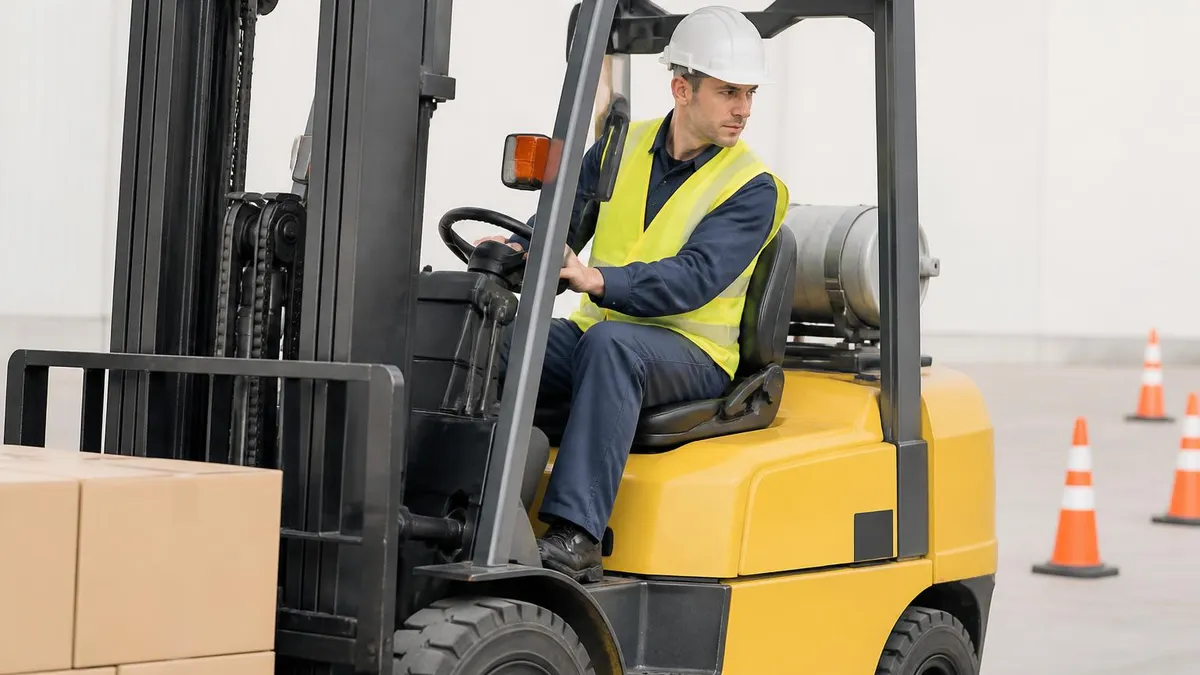
Practical training must occur in the actual workplace environment and on the specific types of forklifts the operator will use. This requirement exists because a warehouse floor with heavy pedestrian traffic, tight racking, and dock doors presents entirely different risks than an outdoor lumber yard with rough terrain and variable lighting. An operator certified on a sit-down counterbalanced model cannot legally operate a stand up forklift or a reach truck without additional class-specific training and evaluation, even if both vehicles carry the same load rating.
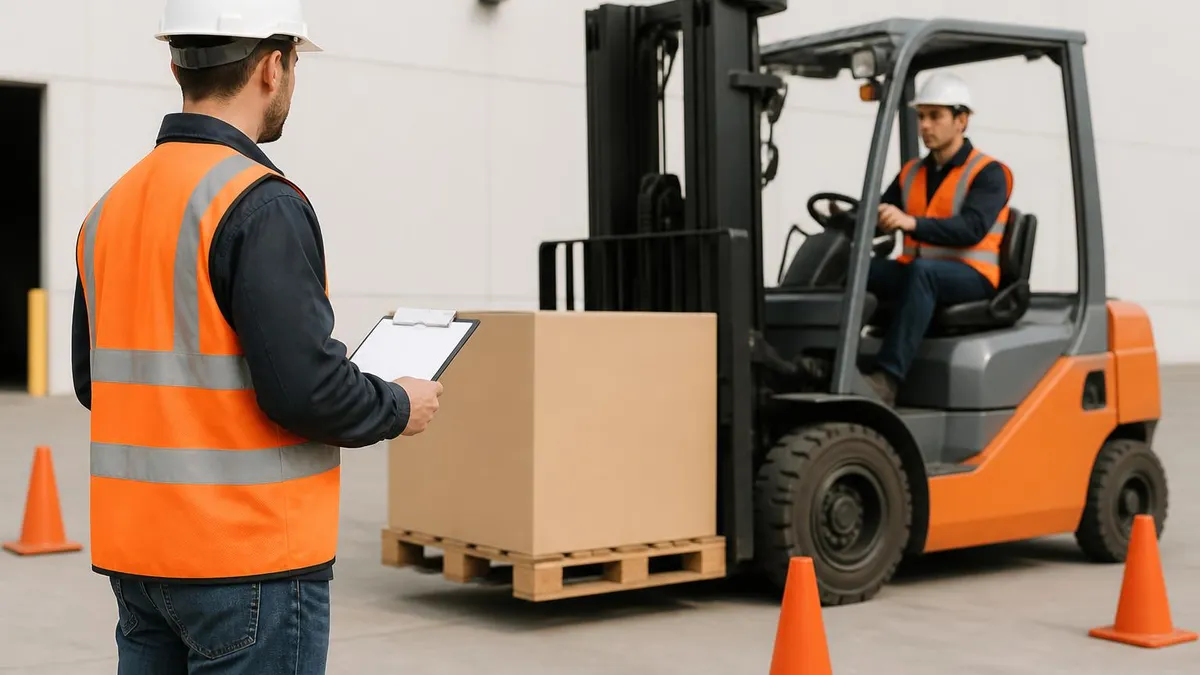
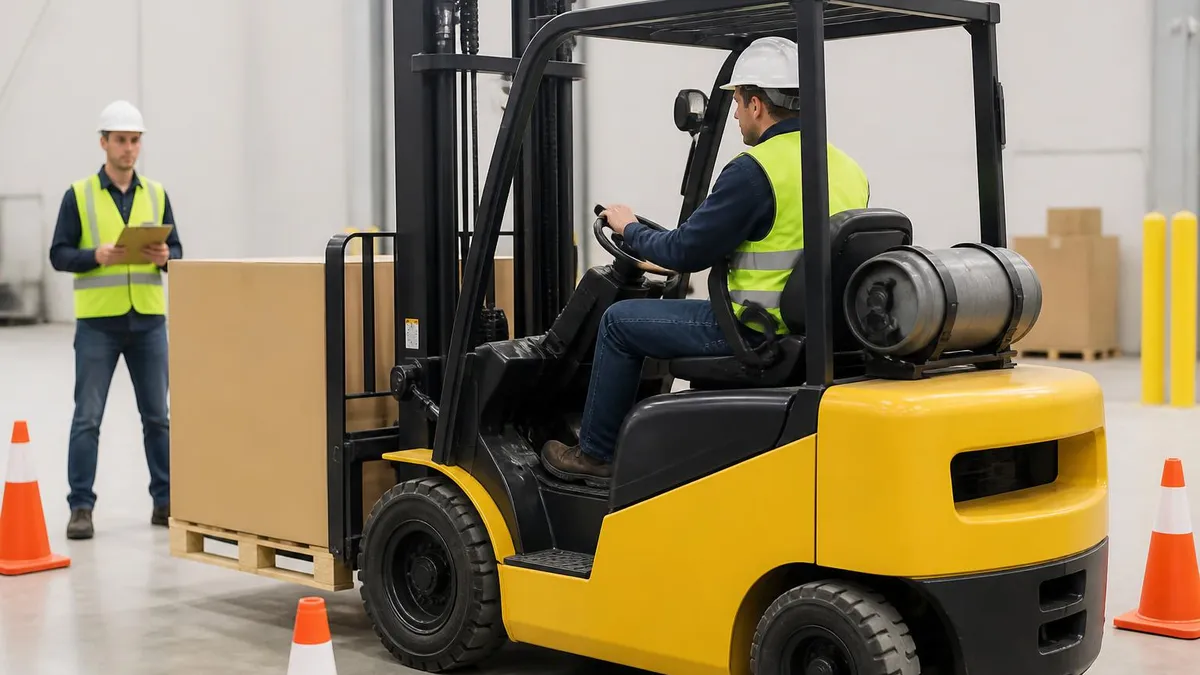
Evaluation is the final — and most legally significant — step. The qualified trainer must observe the trainee operating the forklift and assess competency across all the topics covered in formal and practical training. If the operator demonstrates any unsafe behavior during the evaluation, additional training must be provided before the evaluation is repeated. Only after a satisfactory evaluation can the employer issue the certification card documenting the specific truck classes the operator is authorized to run and the date of initial certification.
OSHA also specifies conditions that trigger mandatory refresher training outside the normal three-year renewal cycle. These include observation of unsafe operation, involvement in an accident or near-miss incident, a change in the workplace that could affect safe operation (such as new racking layout or dock leveler installation), and a change in truck type — for example, swapping a fleet of propane forklifts for electric forklift models. Employers who fail to provide refresher training after a triggering event face potential citations even if all operators hold current certification cards.
Record-keeping is a practical extension of the OSHA standard. While the regulation does not specify a precise documentation format, employers should maintain records showing each operator's name, the date of training, the date of evaluation, the truck classes covered, and the name of the trainer or evaluator. These records protect the employer in the event of an OSHA inspection or a workplace injury claim. Many companies issue a wallet-sized certification card to operators along with a master roster kept in the safety department, creating a two-layer documentation system that satisfies both internal audits and external compliance reviews.
Understanding these requirements in full is particularly important for companies that rely on forklift rental solutions to expand their fleet during peak seasons. When a rented electric forklift or a specialty rough-terrain unit arrives on site, every operator who will touch that truck must be evaluated on that specific class of equipment before operating it — a point that rental agreements increasingly make explicit in their liability clauses. Staying ahead of these requirements protects both individual workers and the organizations that depend on efficient, safe materials handling.
Forklift Training Methods: Classroom, Online, and On-Site
Traditional classroom forklift training brings operators together with a certified instructor for four to eight hours of structured learning. Instructors use slide presentations, videos, and printed manuals to cover OSHA-required topics including stability triangle physics, load center calculations, hazard recognition, and pre-shift inspection procedures. This format works well for new employees who benefit from peer discussion and the ability to ask questions in real time, and it allows the trainer to gauge comprehension across the group before moving to hands-on evaluation.
Classroom sessions typically conclude with a written or oral knowledge assessment that confirms the trainee understands the material before proceeding to the practical phase. Scores are documented and filed with the trainee's certification record. Many employers combine classroom instruction with a short video component — particularly for topics like propane cylinder exchange and battery watering procedures — that reinforces visual learning. The main limitation of classroom training is scheduling: gathering multiple employees at one time can be logistically challenging in high-turnover warehouse environments where onboarding is ongoing throughout the year.

Pros and Cons of Getting Forklift Certified
- +Higher earning potential — certified operators command $3–$8 more per hour than uncertified counterparts in most markets
- +Broader job eligibility — most warehouse, logistics, and construction employers require certification as a minimum hiring standard
- +Legal protection — a current certification card demonstrates you operated within OSHA guidelines if an incident occurs
- +Career advancement — certification is often a prerequisite for lead operator, supervisor, or trainer roles within materials handling
- +Transferable skill — forklift operation knowledge applies across industries from food distribution to automotive manufacturing
- +Safety awareness — trained operators are statistically far less likely to be involved in tip-over, struck-by, or fall incidents on the job
- −Upfront time cost — completing formal instruction plus hands-on evaluation typically requires a full workday or more
- −Employer dependency — certification is issued by employers, not government agencies, so quality and rigor vary significantly between workplaces
- −Limited transferability — a new employer may require full requalification even when you hold a valid card from a previous job
- −Recurring renewal cost — recertification every three years means ongoing time and sometimes out-of-pocket expense for independent contractors
- −Class-specific restrictions — certification on one truck class does not authorize operation of a different class without additional training
- −Online-only certificates are insufficient — paying for an online-only program without hands-on evaluation creates a compliance gap that exposes both worker and employer to OSHA risk
Forklift Certification Checklist: Steps to Get Certified
- ✓Confirm which OSHA truck class(es) you need to operate based on your specific job duties and equipment.
- ✓Complete the formal instruction phase — classroom, online, or a combination — covering all OSHA-required topics.
- ✓Review the operator's manual for each specific forklift model you will drive before the practical phase.
- ✓Perform a supervised pre-shift inspection on the actual equipment using the manufacturer's inspection checklist.
- ✓Complete hands-on practical training in your actual workplace environment under a qualified trainer's supervision.
- ✓Demonstrate all required operating skills including load pickup, stacking, ramp navigation, and safe parking.
- ✓Pass the performance evaluation conducted by your employer's designated qualified trainer or evaluator.
- ✓Ensure your employer documents your certification with name, date, truck classes, and trainer signature.
- ✓Receive your operator certification card and keep it accessible during every shift you operate a forklift.
- ✓Schedule your next refresher training or recertification before the three-year renewal window expires.
OSHA Certification Is Employer-Issued — But It Carries Federal Legal Weight
Unlike a commercial driver's license or a state-issued credential, forklift certification is issued by your employer — but it is governed by federal OSHA law. If your employer skips the hands-on evaluation phase or fails to document your certification properly, both you and the company face legal exposure. Always verify that your certification record includes the evaluation date, truck classes covered, and your trainer's signature before you operate any forklift on a job site.
The cost of forklift certification varies considerably depending on the delivery method, provider type, and whether the training is employer-sponsored or self-funded. For workers seeking certification independently — perhaps to improve their employability before landing a warehouse job — third-party training centers typically charge between $150 and $400 for a complete program that includes formal instruction, practical training on the center's equipment, and a final evaluation. In major metro areas like Los Angeles, Chicago, or Houston, costs at established training facilities can reach $500 or more for programs that certify operators across multiple truck classes in a single session.
Employer-sponsored training is the most common path for workers already on the job. In this scenario, the employer absorbs the cost of training as part of onboarding, since OSHA's standard places the compliance obligation squarely on the employer rather than the individual worker.
Companies that use online eLearning platforms to deliver the formal instruction component spend as little as $15 to $75 per employee for the course content, then allocate one to three hours of a qualified trainer's paid time to conduct the hands-on evaluation. When calculated at a loaded labor rate, the total per-employee cost for an employer-sponsored program typically falls between $100 and $300 depending on the trainer's wage and the number of truck classes being covered.
Community college and vocational school programs represent a middle ground for workers who want formal credentials and broad equipment exposure before entering the job market. These programs often run four to eight weeks and cover multiple forklift classes alongside related topics like warehouse management systems, basic inventory control, and workplace first aid. Costs range from $500 to $2,000 depending on the institution and program length, but graduates typically enter the workforce with certification across several truck classes and a structured learning transcript they can show potential employers.
From a career earnings perspective, the return on investment for forklift certification is exceptionally fast. The Bureau of Labor Statistics places median annual pay for industrial truck and tractor operators at approximately $40,000, with the top 25 percent earning above $50,000. In high-cost-of-living markets and specialized industries like semiconductor manufacturing, pharmaceutical distribution, and e-commerce fulfillment, experienced certified forklift operators can earn $60,000 to $70,000 per year including shift differentials and overtime. At those wage levels, even a $400 out-of-pocket certification investment pays back within the first week of employment.
The certification of forklift operators also affects the economics of forklift rental for businesses. When a company arranges a short-term forklift rental to handle peak production volume, they must ensure that every employee who will operate the rented equipment is certified on that specific class of truck. Some forklift rental near me providers offer bundled training packages — a practical option for small businesses that need both the equipment and the certified operator in a single arrangement. Understanding these cost structures helps operations managers budget accurately for seasonal capacity expansions without running afoul of OSHA compliance requirements.
Beyond base wages, certified forklift operators often access a broader range of benefits than uncertified warehouse workers. Health insurance, retirement contributions, and paid time off are more commonly offered to operators classified as skilled workers — a category that increasingly requires documented certification as a baseline credential. Union shops in the logistics and manufacturing sectors frequently tie pay grades to certification level, with operators certified across three or more truck classes earning at the top of the pay scale. This financial incentive structure makes pursuing multi-class certification a strategically sound investment for workers planning a long career in materials handling.
Insurance implications are another dimension of certification economics that business owners should not overlook. Workers' compensation insurers and general liability carriers increasingly audit employer certification records when processing claims related to forklift accidents. An employer who cannot produce documentation showing a certified, evaluated operator was at the controls at the time of an incident may face denial of coverage or a significant premium surcharge at renewal. Maintaining rigorous certification records is therefore not just an OSHA compliance matter — it is a direct financial risk management strategy that protects the company's insurance position and overall liability exposure.

Many websites sell online forklift certification cards for $20–$50, but these documents do not satisfy OSHA's 29 CFR 1910.178(l) standard. OSHA requires hands-on practical training and a site-specific performance evaluation in addition to formal instruction. Employers who allow operators to run forklifts based solely on an online completion certificate are subject to citations, fines up to $15,625 per violation, and increased liability if an accident occurs. Always complete the full three-phase process: formal instruction, practical training, and documented evaluation.
Forklift license renewal — more formally called recertification — is required whenever an operator's certification is no longer considered current. OSHA's standard does not mandate a specific recertification interval in years, but the agency's compliance guidance and industry best practice firmly establish three years as the standard renewal cycle.
Many employers formalize this in their safety policy manuals, scheduling recertification evaluations every 36 months for all certified operators as a proactive compliance measure. Understanding the renewal process is as important as understanding initial certification, especially for experienced operators who have not revisited their training since they were first licensed years ago.
Refresher training requirements are triggered by specific events enumerated in OSHA's standard and should not be confused with the routine three-year renewal. An operator who has an accident or near-miss, is observed operating unsafely, or transitions to a new truck class must complete refresher training before continuing to operate — regardless of how recently their last scheduled recertification occurred.
Employers who treat refresher training as a paperwork exercise rather than a genuine retraining event face elevated risk: OSHA citations for failure to provide refresher training after a triggering event have become increasingly common as the agency has intensified its powered industrial truck enforcement focus.
The practical steps for renewal mirror the initial certification process. The operator completes a refresher of formal instruction topics — often condensed to a two- to four-hour review session rather than a full day — followed by a hands-on performance evaluation conducted by a qualified trainer.
If the operator's role or equipment has not changed significantly, the evaluation may be shorter than the initial assessment, focusing on verifying that safe habits are still in place rather than teaching new skills from scratch. Any deficiencies identified during the evaluation must be corrected through additional targeted training before the renewal certification is issued.
Documentation for renewal follows the same standards as initial certification. The employer must record the renewal date, the truck classes recertified, and the qualified trainer's identity. Many companies use a digital workforce management system to track certification expiration dates and automatically notify supervisors 60 to 90 days before an operator's card expires. This proactive approach ensures no operator is accidentally allowed to continue working beyond their certification window — a lapse that would put both the worker and the employer in violation of OSHA standards even if no incident occurs.
For operators who change employers between certification cycles, the renewal landscape can be confusing. A new employer is not obligated to accept a certification card from a previous company, particularly if the prior certification does not specify the truck classes covered, if the operating environment differs substantially, or if the new employer cannot verify the qualifications of the trainer who issued the prior certification.
In these situations, the new employer may require the operator to complete a full initial certification cycle — or at minimum a practical evaluation on the specific equipment used at the new facility — before authorizing independent operation. Workers can reduce friction in this process by retaining their original certification documentation, including the evaluation form and the trainer's credentials, which allows new employers to make informed decisions about whether to accept or supplement prior training.
Renewal also intersects with the broader question of forklift rental compliance. When businesses arrange forklift rental near me for short-term projects, project managers must verify that every operator assigned to rented equipment holds current certification for that specific truck class. Rental agreements increasingly include indemnification clauses that shift liability back to the renter if an uncertified or lapsed-certified operator causes an incident.
Reviewing operator certification records before any rental equipment arrives on site — and scheduling renewal evaluations well in advance of expiration — is a best practice that protects both the individual operator and the organization. For a deeper dive into how certification intersects with equipment access, the what is a forklift license requirements page covers the specific operator credential standards that most rental providers enforce as part of their agreement terms.
Staying ahead of renewal deadlines is ultimately an act of professional self-management. Certified operators who keep their credentials current and their skills sharp are consistently the first hired, the last laid off, and the most likely to be promoted into training, supervisory, or safety coordination roles. In a labor market where certified forklift operators remain in consistent demand across virtually every sector of the goods-producing economy, an up-to-date certification card is one of the most cost-effective professional investments a warehouse or industrial worker can maintain throughout their career.
Passing your forklift operator evaluation on the first attempt requires more than reviewing a study guide the night before. The most successful candidates treat the evaluation as a performance — one that must demonstrate safe, consistent habits across every observable behavior, not just adequate knowledge of OSHA rules.
Start your preparation by reading the operator's manual for the specific forklift model you will be evaluated on. Manufacturers include load capacity charts, control descriptions, and safety warnings specific to that truck's engineering, and evaluators frequently ask candidates to locate and interpret capacity plate information during the pre-shift inspection portion of the evaluation.
Pre-shift inspection is typically the first thing an evaluator observes, and it sets the tone for the entire assessment. Practice performing the inspection in the correct sequence — fluid levels, tire condition, forks and carriage, mast chains, lights and horn, battery or fuel, and safety devices — using the manufacturer's checklist rather than a generic template.
Speed matters less than thoroughness: evaluators want to see that you check every item methodically and report any deficiencies rather than ignoring minor issues that could develop into serious hazards mid-shift. If you discover a defect during your practice inspections, practice the correct response: tag the truck out of service and notify your supervisor before any operation begins.
Load handling skills are where many candidates stumble during evaluations. The physics of a forklift — a heavy counterweight at the rear balancing a load at the front — means that every movement of the mast, every turn, and every change in speed affects load stability. Practice tilting the mast back slightly when traveling with a load to keep the weight close to the front axle.
Practice slowing down well before turns, particularly when carrying a load that obscures your forward visibility and forces you to travel in reverse. Practice placing loads at varying rack heights, because accurate positioning at height three or four is significantly harder than placing at ground level and evaluators will test this skill specifically.
Pedestrian awareness is another common evaluation failure point that is entirely preventable with deliberate practice. In your facility, identify every intersection, doorway, and blind corner where pedestrians and forklifts share space. Practice sounding the horn at each of these points — not as a courtesy but as a mandatory safety action that your evaluator will be watching for.
Practice making eye contact with pedestrians before moving through shared zones. Practice recognizing when a pedestrian has not seen you and stopping completely until the path is clear. These behaviors must become automatic during supervised practice so they occur naturally without conscious thought during the formal evaluation.
If you are preparing for certification on an electric forklift, pay particular attention to battery management procedures during your practice sessions. Evaluators on electric units often include battery state-of-charge checks in the pre-shift inspection and may ask you to demonstrate proper connection and disconnection of the charging plug. Know the specific battery capacity threshold below which the truck should be removed from service for charging — typically when the state-of-charge indicator reaches 20 to 30 percent depending on the manufacturer's recommendation — and understand why deep-discharging lithium or lead-acid forklift batteries shortens their service life and increases replacement costs.
Practice your documentation habits as well as your operating skills. After each practice session, fill out a simulated pre-shift inspection form completely, noting any items you checked and any findings — even if everything was within normal parameters. This habit reinforces thoroughness and prepares you for the documentation expectations your employer will have after certification. Evaluators appreciate candidates who are already in the habit of generating complete, legible inspection records, as it signals that the operator will maintain compliant paperwork independently once certified and no longer under direct supervision.
Finally, manage your physical readiness on evaluation day. Forklift operation requires sustained concentration, fine motor control for the hydraulic levers, and spatial awareness while operating in tight quarters. Get adequate rest the night before your evaluation, eat a proper meal, and arrive early enough to walk the facility and mentally map the routes you will be asked to navigate.
Nervousness is natural, but candidates who have genuinely practiced all of the above skills consistently find that the evaluation feels like a normal shift rather than a high-stakes test — because the habits are already embedded and the evaluator is simply watching them perform tasks they have already mastered.
Forklift Questions and Answers
Forklift Rentals: Complete Guide to Pricing, Types, and Operator Requirements
Forklift Hydraulic Fluid: Complete Guide to Types, Specifications, Change Intervals, and Troubleshooting for 2026
Forklift Parts and Maintenance: Complete Guide to Batteries, Chargers, and Replacement Components
Big Forklift Guide: Heavy-Duty Lift Trucks, Capacity Classes, Rental Costs, and Operator Requirements
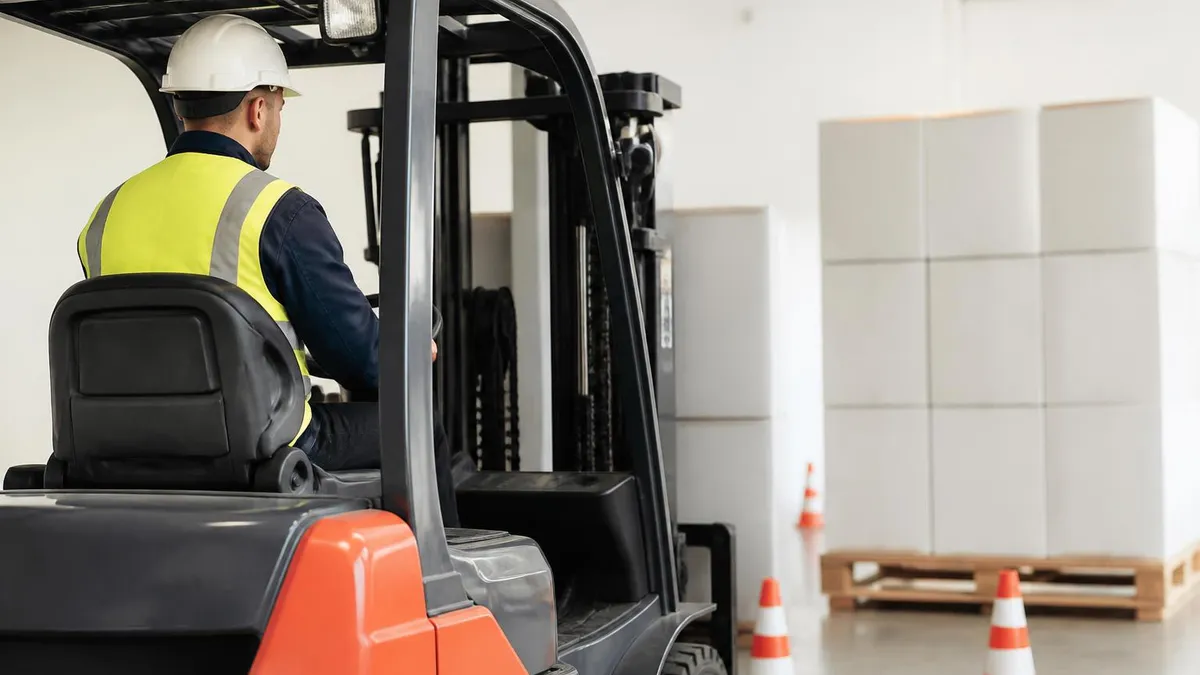
Forklift License Renewal: Complete Guide to Forklift License Expiry, OSHA Recertification, and Operator Requirements for 2026
About the Author

Certified Crane Operator & Skilled Trades Exam Specialist
Ferris State UniversityRobert Martinez is a Journeyman Ironworker, NCCCO-certified crane operator, and forklift trainer with a Bachelor of Science in Construction Technology from Ferris State University. He has 21 years of ironworking, rigging, and heavy equipment operation experience across high-rise and industrial construction sites. Robert prepares candidates for crane operator, rigger, forklift, and skilled trades certification examinations.