
Warehouse Forklifts: Complete Guide to Types, Rentals, Training, and Operator Certification for 2026 September
Complete guide to warehouse forklifts: 📝 forklift rental costs, electric models, operator training, OSHA certification, and stand up forklift selection tips.
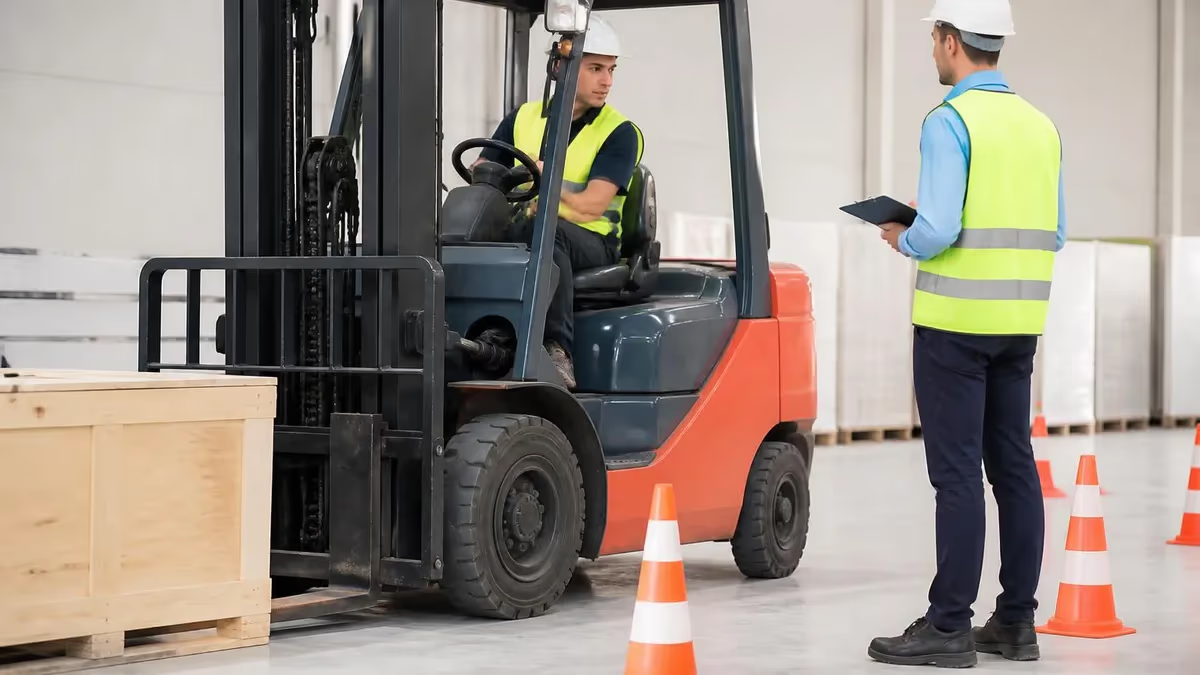
Warehouse forklifts are the backbone of modern distribution, and understanding the full landscape of equipment options, forklift rental pricing, training requirements, and operator certification has never been more important than it is in 2026. Whether you operate a small fulfillment center handling 50 pallets a day or a regional distribution hub moving 5,000, the right combination of equipment and trained operators directly affects throughput, safety, and overhead. This guide breaks down everything from electric forklift advantages to OSHA compliance so warehouse managers and operators can make informed decisions.
The U.S. material handling market continues to grow at roughly 6% annually, with warehouse forklifts representing the single largest category of industrial trucks deployed across logistics, retail, manufacturing, and cold storage facilities. Demand for skilled forklift operators has outpaced supply in 38 states, pushing average hourly wages above $22 and creating real career opportunities for certified workers. At the same time, employers face mounting pressure to reduce emissions, lower total cost of ownership, and meet stricter safety benchmarks.
Choosing between a Class I electric rider, a Class II narrow-aisle reach truck, or a Class III walkie pallet jack depends on aisle width, ceiling height, load weight, run-time requirements, and floor surface. Most modern warehouses now run hybrid fleets that pair sit-down counterbalance trucks for dock work with stand-up reach trucks for high-bay storage. Battery technology, particularly lithium-ion, has reshaped the economics of electric forklifts and made them viable for multi-shift operations that historically demanded propane or diesel.
Forklift rental remains the fastest way to scale capacity for seasonal peaks, special projects, or fleet replacements. Short-term rentals typically run $150 to $400 per day, weekly rates land between $700 and $1,500, and monthly contracts average $1,800 to $4,500 depending on capacity, fuel type, and attachments. National providers like United Rentals, Sunbelt, and Toyota Material Handling dealers compete with regional outfits, and searching community forklift directories can surface local options with faster delivery windows.
Operator certification under OSHA 29 CFR 1910.178 is non-negotiable. Every operator must complete formal classroom instruction, hands-on practical training, and an evaluation by a qualified trainer before stepping onto a lift truck. Certification is equipment-specific and workplace-specific, meaning a driver certified on a sit-down counterbalance at one facility must be re-evaluated when moving to a stand-up reach at another. Recertification is mandatory every three years, after any accident, or following observation of unsafe operation.
This guide walks through every major decision point: equipment classes, fuel options, rental versus purchase economics, training pathways, certification logistics, daily inspection protocols, and the most common questions that warehouse supervisors face when building or upgrading a fleet. By the end, you will have a clear framework for matching equipment to application, budgeting realistically, and ensuring every operator on your floor meets federal safety standards. Let's start with the numbers that define the industry today.
Warehouse Forklifts by the Numbers

Forklift Classes Used in Warehouses
Sit-down counterbalance trucks powered by lead-acid or lithium-ion batteries. Capacities from 3,000 to 12,000 lbs. Ideal for indoor dock work, food-grade environments, and zero-emission requirements.
Stand up forklift reach trucks designed for aisles as tight as 8 feet. Telescoping mast handles racking up to 35 feet. Most common in high-bay storage and distribution centers with selective racking.
Electric pallet jacks for ground-level loading, picking, and short hauls. Operators walk behind or ride on a platform. Capacity typically 4,500 to 8,000 lbs with run times of 6-8 hours per charge.
Internal combustion trucks with solid cushion tires for smooth indoor floors. Propane-fueled, capacities 3,000 to 17,500 lbs. Common in lumber yards and high-throughput indoor manufacturing.
Rough-terrain capable trucks with air-filled tires for mixed indoor/outdoor warehouse yards. Higher capacities up to 36,000 lbs make them standard for lumber, steel, and container handling operations.
Forklift rental economics have shifted dramatically over the last five years, and understanding the current pricing structure helps warehouse managers avoid both overpaying and under-specifying equipment. A standard 5,000-pound capacity electric sit-down counterbalance now rents for $185 to $275 per day, $850 to $1,250 per week, and $2,200 to $3,400 per month from major national providers. Reach trucks and order pickers command 20-30% premiums because of their specialized use and lower fleet availability across rental yards.
Short-term rentals make sense for clearly defined needs: a three-week inventory project, a holiday peak that requires two extra trucks, or temporary replacement while a fleet unit is in for major repair. Long-term rentals, typically 12-60 months, blur the line between renting and leasing and often include scheduled maintenance, replacement units during downtime, and the option to purchase at fair market value at the end of term. Many warehouses now structure entire fleets around long-term rental to convert capital expenses into operating expenses.
Searching forklift rental near me on Google returns dozens of local options, but national chains offer advantages that matter at scale: same-day delivery in most metros, standardized billing, multi-location contracts, and 24-hour breakdown support. Regional dealers often beat national pricing by 10-15% and provide more personalized service, particularly for specialty equipment or unusual attachments. For warehouses operating in more than three states, a national master service agreement typically delivers the best blend of price and reliability.
Beyond the headline daily rate, several line items affect total rental cost. Delivery and pickup fees range from $125 to $350 depending on distance and truck type. Damage waivers add 8-12% to monthly invoices but can be worth it for high-traffic environments. Attachment rentals — side shifters, fork positioners, paper roll clamps, drum handlers — typically add $50 to $200 per week. Fuel surcharges apply to propane units, and battery charger rentals can add another $75-150 weekly if your facility does not already have charging infrastructure.
Many operations approach the rent-versus-buy decision purely by sticker price, which misses the bigger picture. A new 5,000-pound electric forklift costs $28,000 to $42,000, with lithium-ion battery packs adding another $8,000 to $14,000. Financing over 60 months at current rates produces monthly payments of $650 to $950, often less than long-term rental rates. However, ownership transfers all maintenance, repair, battery replacement, and end-of-life disposal risk to the warehouse. Some experienced fleet managers browse forklifts for sale markets for off-lease units that combine low hours with significant discounts.
The right answer depends on utilization. Forklifts used less than 4 hours per day per shift rarely justify ownership; rental delivers better economics and frees capital for inventory or labor. Trucks running 6 or more hours daily on a single shift cross the breakeven point and favor ownership. Multi-shift operations push the analysis back toward rental or leasing because cumulative wear accelerates maintenance costs and resale value drops sharply once a truck exceeds 10,000 lifetime hours.
Used forklift for sale listings can deliver 40-60% savings versus new equipment, but buyers need to scrutinize hour meters, lift cylinder seals, mast wear, and tire condition. A reputable dealer will provide service history, recent inspection reports, and a short warranty on powertrain components. Auction purchases from companies like Ritchie Bros. carry higher risk but can produce exceptional value when warehouses know exactly what they need and have in-house mechanics to handle reconditioning.

Forklift certification Practice Test Questions
Prepare for the Forklift certification Certification exam with our free practice test modules. Each quiz covers key topics to help you pass on your first try.
Forklift certification Certification Forkl...
Forklift certification Exam Questions covering Certification Forklift certification Maintenance and Repairs. Master Forklift certification Test concepts for certification prep.
Forklift certification Certification Forkl...
Free Forklift certification Practice Test featuring Certification Forklift certification Maintenance and Repairs Questions and Answers. Improve your Forklift certification Exam score with mock test prep.
Forklift certification Certification Forkl...
Forklift certification Mock Exam on Certification Forklift certification Operator Training and Certification Requirements. Forklift certification Study Guide questions to pass on your first try.
Forklift certification Certification Forkl...
Forklift certification Test Prep for Certification Forklift certification Operator Training and Certification Requirements Questions and Answers. Practice Forklift certification Quiz questions and boost your score.
Forklift certification Load Handling and S...
Forklift certification Questions and Answers on Load Handling and Stability. Free Forklift certification practice for exam readiness.
Forklift certification OSHA Regulations an...
Forklift certification Mock Test covering OSHA Regulations and Compliance. Online Forklift certification Test practice with instant feedback.
Forklift certification Pre-Operation Inspe...
Free Forklift certification Quiz on Pre-Operation Inspections. Forklift certification Exam prep questions with detailed explanations.
Forklift certification Refueling and Recha...
Forklift certification Practice Questions for Refueling and Recharging Procedures. Build confidence for your Forklift certification certification exam.
Forklift certification Safe Driving and Ma...
Forklift certification Test Online for Safe Driving and Maneuvering. Free practice with instant results and feedback.
Forklift certification Workplace Hazard Id...
Forklift certification Study Material on Workplace Hazard Identification. Prepare effectively with real exam-style questions.
Forklift certification Forklift Instructions
Free Forklift certification Test covering Forklift Instructions. Practice and track your Forklift certification exam readiness.
Forklift certification Forklift MCQ
Forklift certification Exam Questions covering Forklift MCQ. Master Forklift certification Test concepts for certification prep.
Forklift certification Forklift Employer R...
Free Forklift certification Practice Test featuring Forklift Employer Responsibilities. Improve your Forklift certification Exam score with mock test prep.
Forklift certification Forklift Penalties ...
Forklift certification Mock Exam on Forklift Penalties for Non-Compliance. Forklift certification Study Guide questions to pass on your first try.
Electric Forklift vs Propane vs Diesel Comparison
Electric forklift models dominate modern warehouse fleets because they produce zero emissions, run quietly, and require less maintenance than internal combustion alternatives. Lithium-ion battery systems now support multi-shift operations with opportunity charging during breaks, eliminating the battery-swap process that plagued lead-acid fleets. Energy costs typically run $1.50-$2.50 per shift versus $8-12 for propane equivalents.
The trade-off is upfront cost. A new electric forklift with lithium battery runs 25-40% more than a comparable propane unit, though the total cost of ownership crosses over within 3-4 years for most operations. Cold-storage warehouses below 28°F historically struggled with battery performance, but modern lithium chemistries handle freezer applications well with insulated battery boxes and warming systems.
Renting vs Buying Warehouse Forklifts
- +Lower upfront capital — preserves cash for inventory and labor
- +Maintenance and breakdown coverage typically included
- +Easy fleet scaling for seasonal demand spikes
- +Access to newest models with current safety technology
- +Tax-deductible operating expense versus depreciated asset
- +Replacement unit provided immediately if truck fails
- −Higher long-term cost when utilization exceeds 6 hours daily
- −Damage waivers and delivery fees add 15-25% to base rate
- −Limited customization for specialty attachments
- −Rental availability tight during peak retail seasons
- −No equity built — never own the asset
- −Branding and modifications generally not permitted

Daily Pre-Shift Forklift Inspection Checklist
- ✓Check tire pressure, tread depth, and look for cuts, gouges, or chunking on cushion or pneumatic tires
- ✓Inspect forks for cracks, bends, wear at the heel, and verify positioning lock engages firmly
- ✓Test mast operation through full raise, lower, tilt forward, and tilt back without hesitation or chatter
- ✓Verify hydraulic hoses, fittings, and the lift cylinder show no leaks, drips, or wet spots underneath
- ✓Confirm horn, backup alarm, headlights, strobe, and brake lights all function correctly before driving
- ✓Test service brake, parking brake, and steering for proper response and travel resistance
- ✓Check battery water levels on lead-acid units or state of charge indicator on lithium systems
- ✓Inspect overhead guard, load backrest, seat belt, and operator restraint system for damage or wear
- ✓Verify data plate is legible, capacity rating matches expected loads, and serial number is intact
- ✓Document inspection on OSHA-required daily checklist and report any defects to supervisor immediately
OSHA Requires Documented Daily Inspections
Under 29 CFR 1910.178(q)(7), every powered industrial truck must be examined before each shift and any defects must be reported and corrected before use. Most warehouses are cited not for skipping inspections, but for failing to document them. Keep a written or digital log signed by every operator on every shift — average OSHA penalties for inspection violations now exceed $4,000 per finding.
OSHA forklift training requirements have not changed substantively since the standard was last revised, but enforcement has tightened and penalties have climbed sharply. Every forklift operator must complete a three-part program before independent operation: formal instruction covering equipment, hazards, and regulations; practical hands-on training on the specific truck type they will operate; and a performance evaluation conducted by a qualified trainer. The certification of forklift operators is workplace-specific and equipment-class-specific, which surprises many supervisors who assume a single certificate transfers everywhere.
The formal instruction portion typically runs 4-6 hours and covers truck-specific topics like stability, capacity, load handling, refueling or charging procedures, and operating limitations. Workplace topics include surface conditions, pedestrian traffic patterns, narrow aisles, ramps, slopes, hazardous atmospheres, and trailer or rail car loading. Instructors can be in-house qualified trainers, outside consultants, or accredited training providers, but the employer remains responsible for the adequacy of the program regardless of who delivers it.
Practical training takes 2-4 hours and must occur on the exact truck class the operator will use in actual work. A driver certified on a Class I sit-down counterbalance is not authorized to operate a Class II reach truck or a Class III electric pallet jack without additional class-specific training and evaluation. This is one of the most commonly cited violations during OSHA inspections — employers assume one certification covers everything, and OSHA aggressively disagrees with stiff penalties to back the position.
The performance evaluation is conducted by a qualified trainer who watches the operator complete representative tasks: pre-shift inspection, mounting and dismounting, traveling loaded and unloaded, stacking, retrieving, and refueling or charging. The trainer evaluates technique, safety awareness, and ability to recognize hazards. Documentation must include operator name, training date, evaluation date, trainer name and signature, and equipment classes covered. Many warehouses now use digital training platforms that maintain audit-ready records automatically.
Recertification is required every three years and any time an operator is observed driving unsafely, involved in an accident or near-miss, assigned to a new truck class, or moved to a workplace with different operating conditions. Most warehouses build recertification into a regular safety calendar to avoid lapses. Operators who let certification expire cannot legally drive even one minute, and the employer faces fines up to $15,625 per violation under current OSHA penalty schedules.
Training costs vary widely. In-house programs using a qualified trainer can run as low as $50 per operator in materials and time once the program is established. Outside training providers charge $150-$350 per operator for group sessions and $300-$500 for individual sessions. Online classroom portions paired with on-site practical evaluations are increasingly popular and typically cost $75-$150 per operator while standardizing the curriculum across multiple facilities. Many state workforce boards and OSHA consultation programs offer free or subsidized training for qualifying employers.
Operators who pursue certification independently — perhaps before applying for a forklift operator position — should understand that OSHA does not recognize standalone third-party certificates as sufficient. The employer must still verify equipment-specific training and complete a workplace evaluation. However, completing a third-party program first signals commitment and reduces employer onboarding time, which makes candidates more competitive. Combined with a clean driving record and a willingness to work flexible shifts, certification frequently leads to job offers within days of application.
OSHA penalty schedules updated in 2026 set serious violations at up to $16,131 each and willful violations at up to $161,323. The most common citation under 1910.178 is operating with expired or missing certification documentation. Audit your operator records every 90 days and schedule recertifications 60 days before expiration to avoid lapses and the inevitable enforcement exposure.
Safety culture in warehouse forklift operations extends well beyond initial certification. The Bureau of Labor Statistics records approximately 34,900 forklift-related injuries annually in the United States, with roughly 85 fatalities. Most fatal incidents fall into four categories: tip-overs, struck-by-forklift events involving pedestrians, falls from elevated forks, and crushes between the truck and a fixed object. Each category traces back to predictable failures in training, supervision, or equipment maintenance that can be systematically addressed.
Tip-overs account for nearly 25% of fatalities and almost always involve operator error — turning too sharply at speed, traveling with an elevated load, exceeding capacity, or driving on inclines incorrectly. The single most effective tip-over countermeasure is a seat belt or operator restraint system that keeps the driver inside the operator compartment during a lateral tip. The second is rigorous load-capacity training that ensures operators understand the relationship between load weight, load center, and mast height.
Pedestrian strikes typically occur at blind intersections, in narrow aisles, or near dock doors where visibility is reduced and pedestrian traffic is unpredictable. Engineering controls — physical barriers, painted walkways, blue spotter lights, motion-activated alarms, intersection mirrors — produce dramatic reductions in pedestrian incidents when properly deployed. Administrative controls like dedicated pedestrian lanes, mandatory eye contact protocols, and high-visibility apparel reinforce the engineering layer. Searching forklift driver equipment options reveals dozens of aftermarket safety upgrades available for most truck classes.
Maintenance neglect contributes to a significant share of warehouse forklift incidents that get classified as operator error. Worn brakes, leaking hydraulic seals, sticking mast rollers, and failing horn or alarm systems all reduce the operator's margin for correction when something else goes wrong. Planned maintenance intervals — typically every 250 operating hours for major service and every 50 hours for basic checks — should be scheduled by hour meter readings, not calendar dates, to ensure trucks running multiple shifts get service before degradation accumulates.
Battery and fuel handling produces its own injury category. Lead-acid battery changes expose workers to electrical hazards, chemical burns, and serious lifting injuries unless proper equipment and procedures are used. Lithium-ion has eliminated most battery-change risks but introduced new ones around thermal events. Propane refueling causes burns and fires when operators skip pre-fill leak checks or refuel in unventilated areas. Written procedures, training videos, and quarterly drills keep these specialized tasks safe across multi-shift operations.
Site-specific risk assessments are required under OSHA's general duty clause and most effective when conducted jointly by operations, safety, and frontline operators. Walk the facility during peak production, note every place a forklift crosses a pedestrian path, every blind corner, every uneven floor section, every charging station, every dock door. Document hazards, prioritize by severity and frequency, implement controls, and reassess every 12 months or after any process change. Insurance carriers increasingly require these assessments and often offer premium discounts for documented programs.
Reporting culture determines whether a warehouse identifies hazards before they cause harm or only afterward. Near-miss reporting systems that protect reporters from blame and produce visible corrective action produce 4-6x more hazard signals than incident-only reporting systems. The data consistently shows that for every serious injury, there are roughly 30 minor injuries, 300 property-damage incidents, and 3,000 unsafe acts or conditions. Acting on signals from the bottom of that pyramid prevents the events at the top.
Practical fleet management for warehouse forklifts comes down to three disciplines: right-sizing the fleet, maintaining utilization data, and keeping certifications current. Right-sizing means matching the number and class of trucks to actual workload, not historical staffing patterns or worst-case peak demand. Telematics systems now provide hour-by-hour utilization data showing exactly when each truck is moving, idling, or parked. Most warehouses discover they have 15-25% more trucks than required once they look at the data honestly.
Telematics also surfaces operator behavior patterns that affect both safety and maintenance costs. Sudden braking, mast slamming, excessive speed, and impact events all correlate with higher repair costs and elevated incident risk. Coaching operators using their own data — without punitive overlay — typically reduces unsafe events by 30-50% within 90 days. The data also identifies operators who consistently outperform peers, who become natural candidates for trainer roles and shift supervisor advancement.
Parts and service availability should drive fleet standardization decisions more than headline equipment cost. A warehouse running five different brands across three truck classes maintains five parts inventories, trains technicians on five service procedures, and waits longer for any single part to arrive. Standardizing on one or two manufacturers reduces inventory carrying cost, accelerates repairs, and improves operator familiarity when trucks rotate between bays. Finding qualified forklift repair near me becomes much easier when the local dealer network supports your chosen brand.
Charging infrastructure planning is the most overlooked element of electric forklift conversions. Lead-acid batteries need 8 hours to charge plus 8 hours to cool, requiring battery rooms, hoists, watering systems, and ventilation. Lithium-ion eliminates dedicated battery rooms but requires high-amperage circuits — often 480V three-phase — at the points where opportunity charging will occur. Many warehouses underbudget the electrical work and discover mid-project that service upgrades and panel additions add $25,000-$80,000 to the conversion budget.
Attachments dramatically expand forklift utility but require their own training and certification. Side shifters, fork positioners, paper roll clamps, drum handlers, push-pull units, and rotators each change the truck's capacity, stability, and operating characteristics. OSHA requires the truck's modified capacity to be calculated and documented on a supplemental data plate, and operators must receive specific training on each attachment they will use. Skipping this step is one of the more common violations identified during regulatory inspections.
Cold-storage operations add layers of complexity around equipment selection, battery performance, and operator comfort. Freezer-rated trucks include heated cabs, sealed components, and battery insulation. Operator productivity drops measurably as temperatures decrease, and shift rotations need to account for cold exposure limits. Lithium batteries outperform lead-acid in freezer environments but still benefit from warming systems during prolonged storage. Fleet managers running both ambient and freezer operations typically dedicate specific trucks to freezer work rather than rotating units in and out.
Finally, succession planning for operators and supervisors deserves more attention than it usually receives. The warehouse forklift workforce skews older than most logistics roles, and the next decade will see significant retirements among the most experienced operators. Apprenticeship-style mentoring programs that pair new operators with veterans for the first 90 days produce dramatically better safety outcomes and retention than classroom-only onboarding. The investment in mentor time pays back through reduced incidents, lower turnover, and a stronger internal pipeline for trainer and supervisor positions.
Forklift Questions and Answers
Forklift Tires: Complete Guide to Types, Sizing, Wear Patterns, and Replacement Costs
Forklift Accessories: Complete Guide to LED Lights, Attachments, Safety Gear, and Productivity Upgrades for 2026
Forklift License Renewal: Complete Guide to Forklift License Expiry, OSHA Recertification, and Operator Requirements for 2026
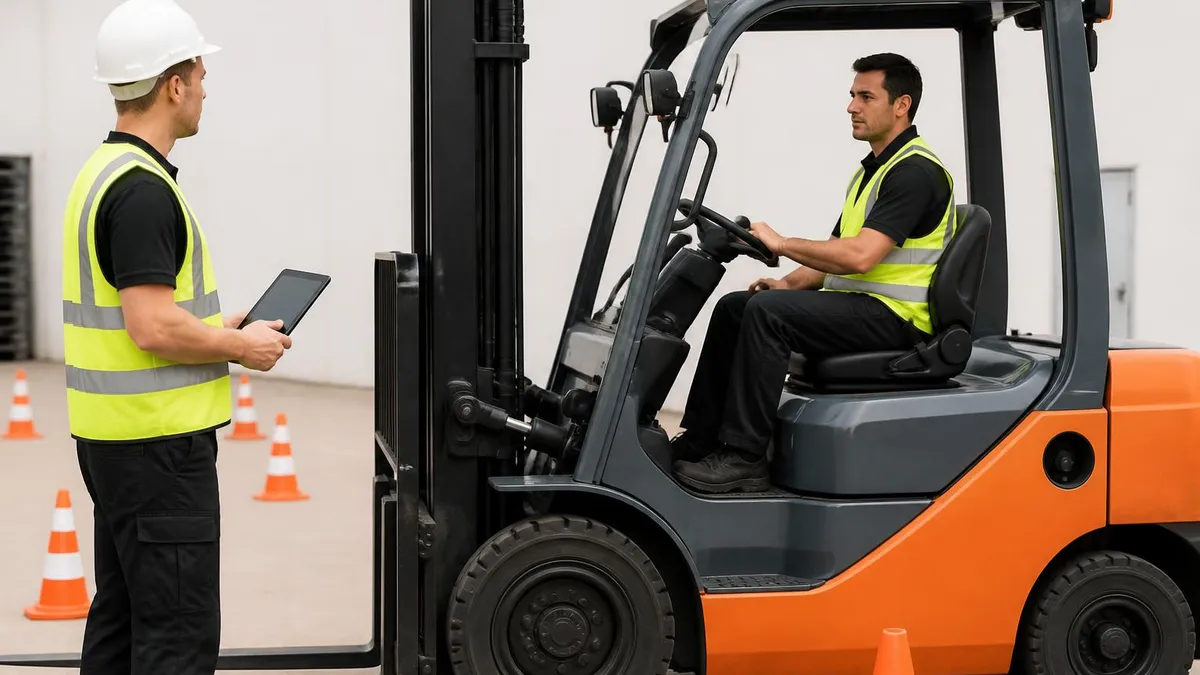
Forklift Safety Training: Complete OSHA Compliance Guide for Operators and Employers
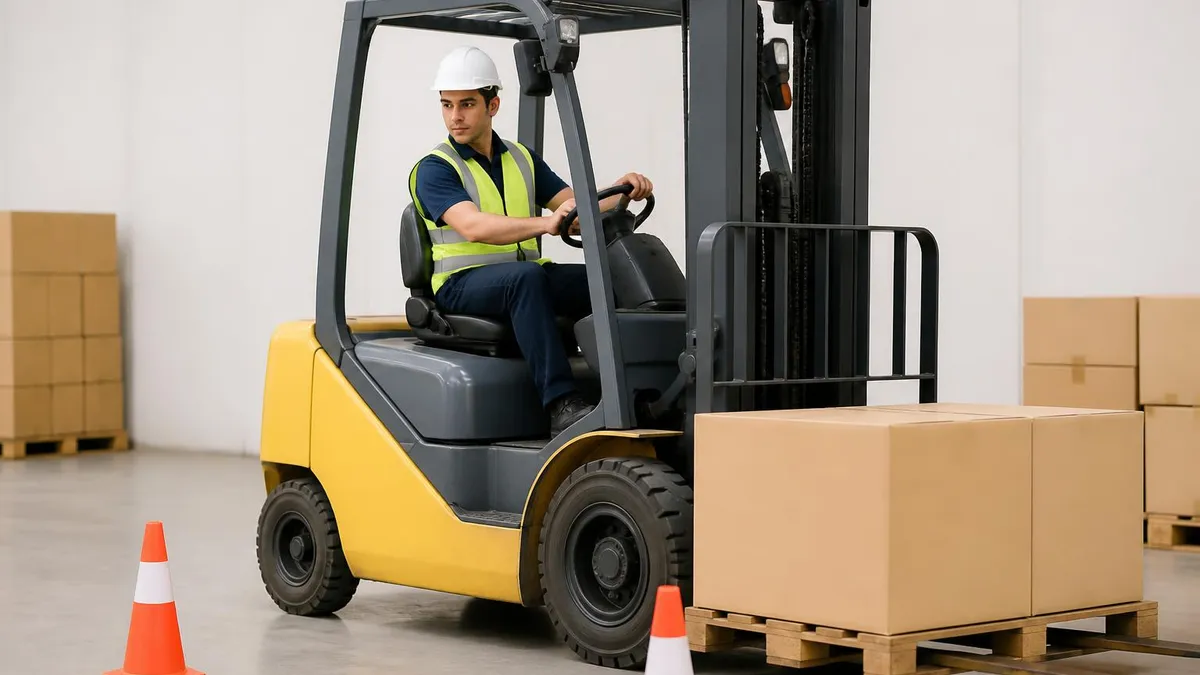
Forklift Repair Service: Complete Guide to Costs, Common Repairs, and Choosing the Right Technician
About the Author

Certified Crane Operator & Skilled Trades Exam Specialist
Ferris State UniversityRobert Martinez is a Journeyman Ironworker, NCCCO-certified crane operator, and forklift trainer with a Bachelor of Science in Construction Technology from Ferris State University. He has 21 years of ironworking, rigging, and heavy equipment operation experience across high-rise and industrial construction sites. Robert prepares candidates for crane operator, rigger, forklift, and skilled trades certification examinations.