
Warehouse Forklift Jobs Near Me: Complete 2026 October Guide to Finding Local Operator Positions, Pay Rates, and Hiring Requirements
Find warehouse forklift jobs near me with current pay rates, hiring requirements, certification tips, and how to land local operator positions fast ✅
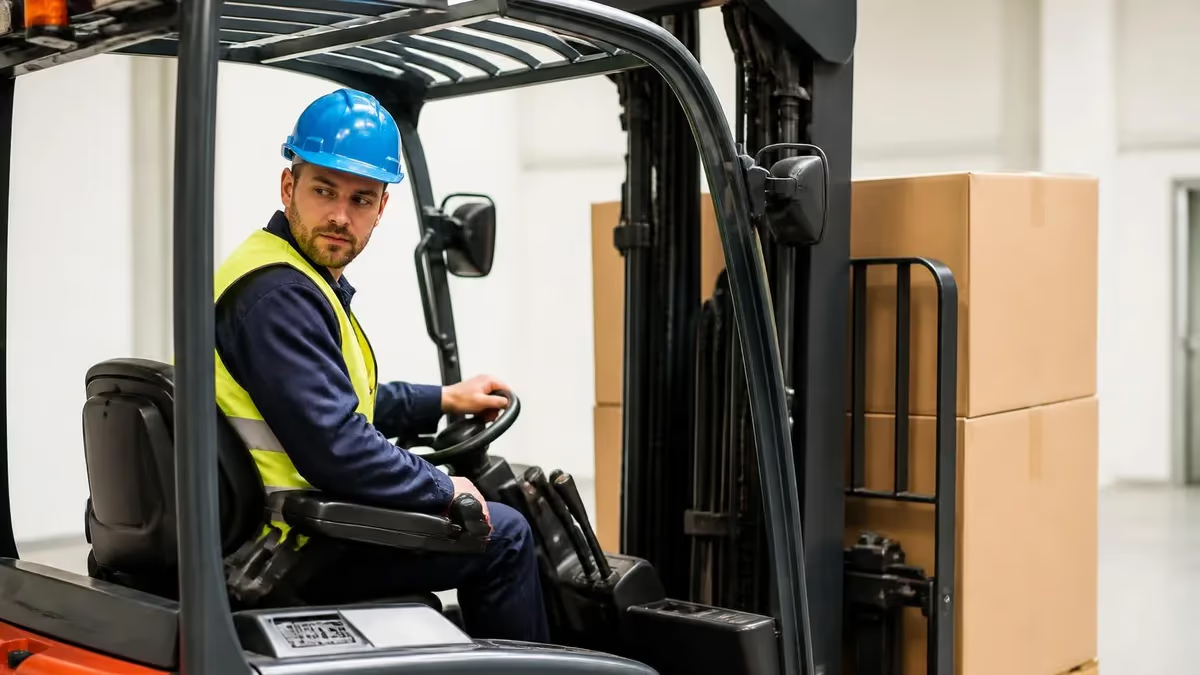
Searching for warehouse forklift jobs near me has become one of the most common employment queries in the United States, with logistics demand pushing hourly wages to record highs in 2026. Distribution centers, third-party logistics providers, retail backroom operations, manufacturing plants, and cold storage facilities are all competing for skilled operators who can safely move pallets, load trailers, and keep inventory flowing. Whether you are brand new to material handling or a seasoned operator looking to upgrade your pay, understanding the local market is the first step toward landing a position that fits your skills and schedule.
Today's warehouse forklift operator earns significantly more than the national average for entry-level industrial jobs, thanks to a persistent labor shortage and the explosion of e-commerce fulfillment networks. Companies like Amazon, Walmart, Target, FedEx Ground, UPS, XPO, and thousands of regional 3PLs are posting openings weekly across nearly every metro area. The competition between employers means signing bonuses, shift differentials, and accelerated promotion paths are now standard offerings rather than rare perks for new hires.
The forklifts you will operate vary wildly by facility. A grocery distribution warehouse may use stand up forklift models exclusively, while a lumber yard relies on rough-terrain machines and a beverage distributor leans on electric forklift fleets that recharge between shifts. Knowing which equipment a local employer runs helps you tailor your application and demonstrate that you already have hands-on experience with the exact lift truck you would be operating on day one of the job.
Certification is the single biggest gatekeeper between you and a higher-paying warehouse position. OSHA requires every operator to be formally evaluated and trained on the specific class of lift truck they will use, and most employers will not even schedule an interview without proof of an active certification. The good news is that forklift training is faster and more affordable than ever, with hybrid online programs and on-site practical evaluations available in nearly every region of the country for under $200.
Local market conditions also dictate which shifts pay the most and which warehouses hire most aggressively. Overnight slots in high-volume fulfillment centers routinely add $2 to $4 per hour in differentials, while weekend warrior schedules let workers cover 40 hours in three days and stack overtime on holidays. Cold storage operations pay even more because of the physical demands of working in sub-zero freezers, often topping $25 per hour before bonuses for certified reach truck operators.
This guide walks through every step of finding, applying for, and winning warehouse forklift jobs in your area. You will learn how to read job postings critically, what background and physical screens to expect, which certifications carry the most weight with hiring managers, and how to negotiate pay when you have multiple offers on the table. The goal is to help you skip the trial-and-error phase that costs other applicants weeks of lost wages and move straight into a stable, well-paying material handling career.
Warehouse Forklift Jobs by the Numbers

Pay Rates by Warehouse Type
Amazon, Walmart, Target, and Shopify-affiliated 3PLs typically pay $19-$24 per hour with regular overtime and quarterly bonuses tied to throughput metrics.
Sub-zero environments command premium pay of $23-$28 per hour plus PPE allowances, with reach truck and order-picker certifications adding more value.
Automotive, food processing, and consumer goods plants offer $20-$26 per hour with strong benefits, pensions, and union representation in many regions.
Big-box DCs pay $18-$23 per hour with predictable shifts, weekend differentials, and clear promotion paths into lead and supervisor roles.
Lumber yards, building material distributors, and rough-terrain operations pay $20-$25 per hour and often include CDL training as a career upgrade.
Earning your certification of forklift competency is the fastest way to qualify for warehouse forklift jobs near me listings that actually pay well. OSHA regulation 1910.178(l) requires every employer to formally train, evaluate, and certify each operator on the specific equipment classes they will use. The standard recognizes seven classes of powered industrial trucks, ranging from electric motor rider trucks to rough terrain machines, and a certification on one class does not automatically qualify you for another type of equipment.
Forklift training programs typically combine classroom instruction with hands-on practical evaluation. The classroom portion covers OSHA regulations, load handling physics, stability triangles, daily inspections, refueling and charging procedures, and pedestrian safety. The practical portion places the trainee on an actual lift truck under the supervision of a qualified evaluator, who scores the operator on tasks like stacking pallets at height, navigating narrow aisles, and executing safe shutdown procedures.
Most reputable training programs cost between $75 and $200 and can be completed in a single day or split across two evenings. Online-only programs that issue a certificate without any practical evaluation are not OSHA-compliant and will not satisfy a serious employer. If a website promises a certification in under an hour with no in-person component, treat it as a red flag and look for a program that includes an on-site practical test or partners with a local employer to provide one.
Many warehouses now offer paid in-house certification as part of the new-hire onboarding process. Amazon, Walmart, and most major 3PLs train selected new hires on company equipment during the first week of employment, paying full wages during the training period. This approach is ideal for candidates with strong work histories who lack a current credential, because it removes the upfront cost while still delivering a portable, employer-issued certification that travels with you.
Certifications are valid for three years and must be renewed sooner if the operator is involved in an accident, observed operating unsafely, assigned to a different class of truck, or if workplace conditions change significantly. Renewal is faster and cheaper than initial certification, usually requiring only a refresher of classroom material and a brief evaluation drive. Keep your wallet card or digital credential easily accessible because supervisors and OSHA inspectors can request proof at any time.
The forklift operator credential carries more weight when paired with adjacent certifications. Adding OSHA 10 general industry, a basic first aid card, or a sit-down to stand up forklift cross-training expands the job pool dramatically. Some warehouses prefer applicants who already hold order-picker, reach truck, and clamp attachment endorsements because it lets supervisors flex labor between zones without scheduling additional training events.
Forklift certification Practice Test Questions
Prepare for the Forklift certification Certification exam with our free practice test modules. Each quiz covers key topics to help you pass on your first try.
Forklift certification Certification Forkl...
Forklift certification Exam Questions covering Certification Forklift certification Maintenance and Repairs. Master Forklift certification Test concepts for certification prep.
Forklift certification Certification Forkl...
Free Forklift certification Practice Test featuring Certification Forklift certification Maintenance and Repairs Questions and Answers. Improve your Forklift certification Exam score with mock test prep.
Forklift certification Certification Forkl...
Forklift certification Mock Exam on Certification Forklift certification Operator Training and Certification Requirements. Forklift certification Study Guide questions to pass on your first try.
Forklift certification Certification Forkl...
Forklift certification Test Prep for Certification Forklift certification Operator Training and Certification Requirements Questions and Answers. Practice Forklift certification Quiz questions and boost your score.
Forklift certification Load Handling and S...
Forklift certification Questions and Answers on Load Handling and Stability. Free Forklift certification practice for exam readiness.
Forklift certification OSHA Regulations an...
Forklift certification Mock Test covering OSHA Regulations and Compliance. Online Forklift certification Test practice with instant feedback.
Forklift certification Pre-Operation Inspe...
Free Forklift certification Quiz on Pre-Operation Inspections. Forklift certification Exam prep questions with detailed explanations.
Forklift certification Refueling and Recha...
Forklift certification Practice Questions for Refueling and Recharging Procedures. Build confidence for your Forklift certification certification exam.
Forklift certification Safe Driving and Ma...
Forklift certification Test Online for Safe Driving and Maneuvering. Free practice with instant results and feedback.
Forklift certification Workplace Hazard Id...
Forklift certification Study Material on Workplace Hazard Identification. Prepare effectively with real exam-style questions.
Forklift certification Forklift Instructions
Free Forklift certification Test covering Forklift Instructions. Practice and track your Forklift certification exam readiness.
Forklift certification Forklift MCQ
Forklift certification Exam Questions covering Forklift MCQ. Master Forklift certification Test concepts for certification prep.
Forklift certification Forklift Employer R...
Free Forklift certification Practice Test featuring Forklift Employer Responsibilities. Improve your Forklift certification Exam score with mock test prep.
Forklift certification Forklift Penalties ...
Forklift certification Mock Exam on Forklift Penalties for Non-Compliance. Forklift certification Study Guide questions to pass on your first try.
Types of Forklift Roles in Warehouse Operations
The stand up forklift, often called a stand-up rider or reach truck, dominates narrow-aisle warehouse operations where every square foot of storage counts. Operators stand sideways on a small platform, which improves visibility when traveling in reverse and reduces fatigue during long shifts dedicated to put-away and replenishment tasks. Distribution centers in apparel, pharmaceuticals, and consumer electronics rely heavily on this class because it allows racking aisles as narrow as eight feet wide.
Mastering a stand up forklift typically takes a few weeks of supervised practice after initial certification, and operators who add this skill see noticeable pay bumps. Warehouses pay reach truck and turret truck operators $1 to $3 per hour above sit-down rates because the position requires more precise control, faster put-away speeds, and the ability to handle loads at heights of 30 feet or more. Demand for this skill remains strong in any metro with high real estate costs.

Pros and Cons of Warehouse Forklift Careers
- +Steady year-round demand with hiring across every US metro area regardless of economic cycle
- +Pay rates significantly higher than retail or food service entry-level work
- +Clear promotion ladder from operator to lead, supervisor, and operations manager roles
- +Multiple shift options including overnight, weekend warrior, and four-on-three-off schedules
- +Certification cost is low and recoverable within the first week of paid employment
- +Skills are portable across industries, regions, and employer types nationwide
- +Many employers offer tuition assistance for CDL training and supply chain degrees
- −Physically demanding work including repetitive motion, climbing on and off equipment all day
- −Cold storage and outdoor operations involve harsh temperature extremes that wear on the body
- −Some warehouses run mandatory overtime during peak season that limits personal scheduling
- −Productivity metrics in e-commerce fulfillment can feel pressured for new operators
- −Accident or safety incidents may result in immediate decertification and termination
- −Night shift pay differentials come with sleep schedule and family time tradeoffs
- −Promotion to lead requires soft skills, attendance records, and additional training time
Pros and Cons at a Glance
| Pros | Cons |
|---|---|
| Steady year-round demand with hiring across every US metro area regardless of economic cycle | Physically demanding work including repetitive motion, climbing on and off equipment all day |
| Pay rates significantly higher than retail or food service entry-level work | Cold storage and outdoor operations involve harsh temperature extremes that wear on the body |
| Clear promotion ladder from operator to lead, supervisor, and operations manager roles | Some warehouses run mandatory overtime during peak season that limits personal scheduling |
| Multiple shift options including overnight, weekend warrior, and four-on-three-off schedules | Productivity metrics in e-commerce fulfillment can feel pressured for new operators |
| Certification cost is low and recoverable within the first week of paid employment | Accident or safety incidents may result in immediate decertification and termination |
| Skills are portable across industries, regions, and employer types nationwide | Night shift pay differentials come with sleep schedule and family time tradeoffs |
Warehouse Forklift Job Application Checklist
- ✓Confirm your OSHA forklift certification is current and not expired in the last three years
- ✓Update your resume with specific lift truck classes operated and brands you have used
- ✓Gather two professional references who can confirm safe operating habits and reliability
- ✓Take a free practice test on the forklift operator written knowledge questions
- ✓Verify your state ID, Social Security card, and work authorization documents are ready
- ✓Research the warehouse on Indeed, Glassdoor, and Reddit for shift culture insights
- ✓Pre-write a one-paragraph cover letter mentioning the specific equipment they operate
- ✓Apply to at least five facilities within your target commute radius the same week
- ✓Set up calendar alerts for follow-up calls 48 hours after each application submission
- ✓Have steel-toe boots, safety glasses, and high-vis vest ready for the practical evaluation
Apply to multiple openings the same week
Recruiters move fast in the warehouse sector and the first qualified candidate to complete the screening process usually wins the role. Applying to five or more openings within a single week dramatically increases your chances of receiving competing offers, which gives you negotiation use on starting pay and shift selection.
Finding open positions starts with the major job boards but should never end there. Indeed, ZipRecruiter, LinkedIn, and SimplyHired aggregate listings from thousands of employers and let you filter by distance, hourly pay, shift, and required experience. Set up daily email alerts for the exact keyword combinations you want, including warehouse forklift jobs near me, reach truck operator, and material handler, and check the alerts every morning before competition fills the spots.
Staffing agencies remain one of the fastest paths into a warehouse. Firms like ProLogistix, Aerotek, Adecco, Manpower, Integrity Staffing, and Spherion specialize in light industrial placements and often have exclusive contracts with major distribution centers. Many of these agencies will pay for your certification of forklift competency if you commit to a placement, then convert successful temps to permanent staff after 90 or 120 days. The temp-to-perm path is especially valuable if your work history has gaps or you are new to the area.
Direct employer websites are an underused resource. Amazon Jobs, Walmart Careers, Target Distribution, FedEx Careers, UPS Jobs, and the careers portals of regional grocery chains list openings that never reach the big aggregator boards. Applying directly often gets your application in front of a recruiter faster because there are no platform fees attached to the requisition. Bookmark the careers pages of every major employer within your commute radius and check them weekly.
Local resources still matter. State workforce agencies, community college job placement offices, and one-stop career centers maintain relationships with regional manufacturers and warehouses that prefer to hire through trusted channels. Veterans should explore SkillBridge programs, the DOL Apprenticeship.gov site, and union-affiliated training pipelines in markets where the Teamsters, ILWU, or industry-specific councils represent warehouse workers and negotiate higher base wages.
Social media and community networks now drive a meaningful share of warehouse hiring. Facebook job groups specific to your metro often post openings that managers share before HR formalizes the requisition. Reddit subreddits dedicated to warehouse work, logistics, and Amazon employment surface real-time intelligence on which facilities treat operators well and which to avoid. A few hours of research can save months of frustration in a poorly run warehouse.
Walk-in applications still work in many small and mid-sized warehouses. Independent 3PLs, lumber yards, beverage distributors, and family-owned distribution operations frequently hire on the spot when a qualified candidate arrives during business hours with a current credential, steel-toe boots, and a willingness to demonstrate ability on the yard truck. Dress in clean work clothes, bring printed copies of your resume, and ask for the operations manager rather than the front office receptionist.

Any website promising a fully online OSHA forklift certification without a practical hands-on evaluation is not compliant with 29 CFR 1910.178. Employers can be fined heavily for accepting these credentials, and you may be terminated when audited. Always confirm your training includes an in-person operator evaluation by a qualified instructor.
Most warehouse interviews follow a predictable structure. Expect a 15 to 20 minute conversation with a recruiter or operations supervisor focused on attendance history, safety mindset, physical capability, shift preference, and your experience with specific lift truck classes. Many employers run a brief written test covering OSHA basics, load handling, and inspection items. Practicing forklift training questions in advance lets you answer crisply and confidently, which signals competence to the hiring manager.
The practical evaluation is the moment that closes most offers. You will be asked to perform a pre-shift inspection out loud, mount the lift truck safely, navigate a marked course, pick up a pallet from floor level, place it on a rack at height, retrieve a pallet from height, and shut down the equipment correctly. Speed matters less than precision and safety habits. Always honk at intersections, check mirrors, keep loads tilted back, and travel in reverse when visibility is blocked.
Background checks and drug screens are standard for warehouse work. Most employers run a seven-year criminal background check, verify employment history for two to five years, and require a pre-employment urine drug screen. Marijuana policies vary by state and by employer, so research the specific company before scheduling the screen. Federal contractors and DOT-regulated facilities maintain zero-tolerance policies regardless of state law, while many regional 3PLs have relaxed cannabis testing for non-safety-sensitive roles.
Physical capability tests increasingly show up in the screening process. Expect to demonstrate lifting 50 pounds from floor to waist, carrying that weight 25 feet, climbing on and off equipment repeatedly, and standing or walking for the duration of a shift. Some facilities use third-party assessment vendors who score range of motion, grip strength, and cardiovascular endurance. Arrive well-rested, hydrated, and dressed for movement to give yourself the best chance of passing without restriction.
Pay negotiation is fair game once an offer is on the table. Research the local market on Glassdoor, Payscale, and Indeed Salary to confirm the median for your role and experience level. If a competing offer is in hand, share the number politely and ask whether the employer can match or beat it. Shift differential, signing bonus, attendance bonus, and overtime guarantee are all negotiable points beyond the base hourly rate, and many warehouses will move on at least one of these levers for a strong candidate.
Onboarding sets the tone for the rest of your career at the facility. Show up early on day one, bring your wallet card and steel-toe boots, ask questions during equipment orientation, and learn the names of your supervisor, lead operator, and safety coordinator within the first week. Operators who build relationships early are first in line for the best shifts, the newest equipment, and the promotions to lead and supervisor that come with substantial pay raises.
Long-term success in warehouse forklift jobs requires more than just operating skill. The operators who advance fastest combine perfect attendance, zero safety incidents, willingness to cross-train on multiple equipment classes, and proactive communication with supervisors about workload and challenges. Tracking your daily picks per hour, cases moved, or trailer loads completed builds a record you can reference during performance reviews and when negotiating raises or promotions.
Cross-training is the single highest-return investment a new operator can make in their career. Once you are comfortable on a sit-down counterbalance, ask your supervisor to schedule you on the reach truck, order picker, walkie rider, and clamp attachment. Each additional endorsement adds flexibility for the warehouse and pay use for you. Operators with five or more endorsements often earn 25 to 40 percent above the starting rate within their first two years at the same facility.
Maintenance awareness separates good operators from great ones. Knowing how to spot a leaking hydraulic line, a worn forklift tire, low brake fluid, or an early sign of mast bearing failure prevents unscheduled downtime and earns trust from the maintenance team. Many warehouses promote experienced operators into the maintenance department, where pay rates climb into the $28 to $35 per hour range and the work environment is typically less physically demanding than full-time material handling.
Consider your long-term trajectory from day one. Some operators stay on the floor for decades and love it. Others use the warehouse role as a launching pad into transportation through CDL training, into supply chain management through company-paid tuition programs, or into industrial sales by using product knowledge gained handling specific commodities. Set a goal at the start of each year and check progress quarterly to stay intentional about where the job is taking you.
Networking matters even in blue-collar work. Connect with co-workers on LinkedIn, save the contact information of supervisors you respected, and keep in touch with the recruiters who placed you. The warehouse industry is smaller than it looks, and the same operations managers move between facilities every few years. A strong network means that when you are ready for your next move, you have warm leads at multiple employers rather than starting from scratch with cold applications.
Finally, take care of your body. Stretching before shifts, lifting with proper technique, alternating between standing and seated tasks when possible, and getting eight hours of sleep all extend your career and protect your earning power. Operators who burn out their backs, knees, or shoulders in their thirties lose access to the highest-paying physical roles in their forties. Invest in good footwear, ergonomic accessories, and consistent recovery habits because your body is the most valuable equipment on the warehouse floor.
Sample Forklift certification Practice Questions
Try these questions from our free Forklift certification practice tests. The correct answer and an explanation follow each question.
An operator is maneuvering a forklift in a warehouse and notices a pedestrian walking near their path. According to safety regulations, what is the operator's primary responsibility?
- A. Sound the horn to warn the pedestrian to get out of the way.
- B. Continue driving but slow down significantly.
- C. Stop the forklift and wait for the pedestrian to clear the area.
- D. Yield the right of way to the pedestrian.
Answer: D. Yield the right of way to the pedestrian.
OSHA regulations state that forklift operators must yield the right of way to pedestrians. While sounding the horn and slowing down are important actions, the fundamental rule is that pedestrians have priority in any interaction to prevent accidents.
An operator is using an LPG-powered forklift inside a refrigerated warehouse with limited air circulation. Which of the following represents the MOST significant, yet least obvious, environmental hazard in this situation?
- A. Slippery floors from condensation
- B. Reduced battery efficiency due to the cold
- C. The buildup of carbon monoxide (CO)
- D. Loud noise from the engine echoing in the space
Answer: C. The buildup of carbon monoxide (CO)
Forklifts powered by internal combustion engines, including LPG, produce carbon monoxide (CO), a colorless, odorless, and highly poisonous gas. In poorly ventilated or enclosed areas like a refrigerated warehouse, CO can accumulate to deadly levels without being easily detected.
A propane-powered forklift develops a strong fuel odor inside a warehouse. What is the FIRST action the operator should take?
- A. Continue working but alert a supervisor at the end of the shift
- B. Shut off the forklift, move to fresh air, and report the leak immediately
- C. Open all warehouse doors and continue operating
- D. Refill the propane tank to ensure it seals properly
Answer: B. Shut off the forklift, move to fresh air, and report the leak immediately
A propane leak is a fire and explosion hazard; the operator must immediately shut off the engine, evacuate the area, and report it to a supervisor.
What is the maximum safe travel speed for a forklift in a busy warehouse aisle?
- A. As fast as the machine allows
- B. A walking pace or slower
- C. 25 mph
- D. Whatever keeps up with foot traffic
Answer: B. A walking pace or slower
Forklifts should travel at a walking pace or slower in areas with pedestrians and tight spaces.
Forklift Questions and Answers
Forklift Tires: Complete Guide to Types, Sizing, Wear Patterns, and Replacement Costs
Forklift Operator Duties: Complete Guide to Daily Responsibilities, Safety Tasks, and Career Path for 2026
Forklift License Renewal: Complete Guide to Forklift License Expiry, OSHA Recertification, and Operator Requirements for 2026
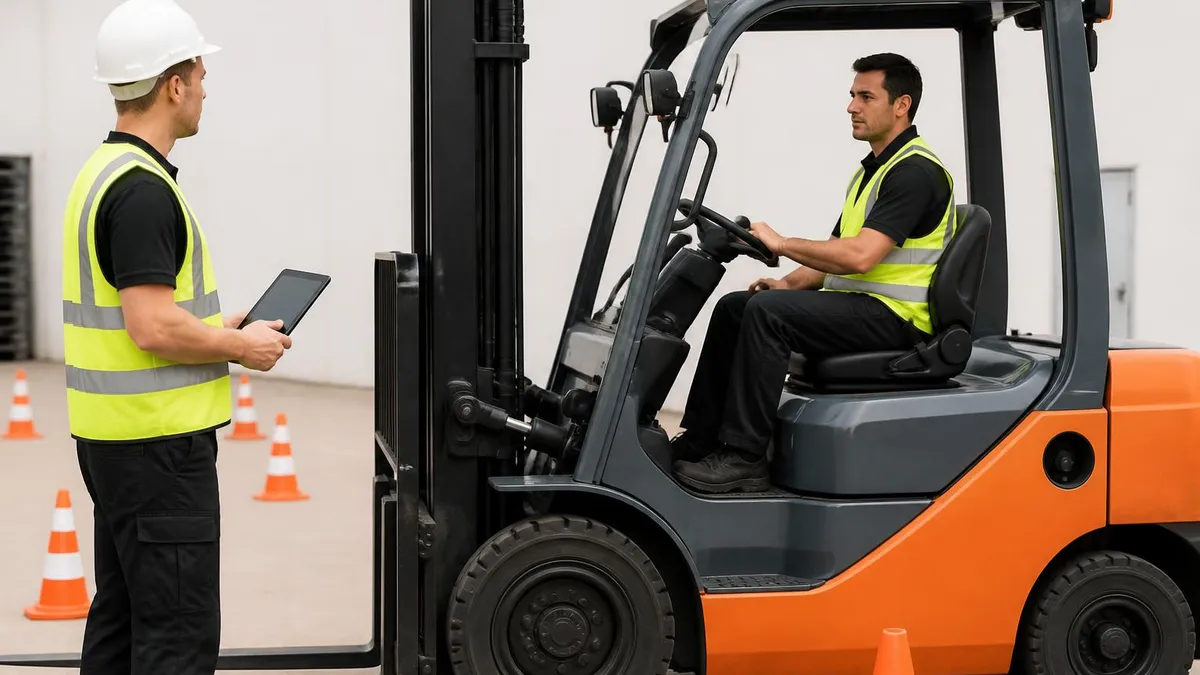
Forklift Safety Training: Complete OSHA Compliance Guide for Operators and Employers
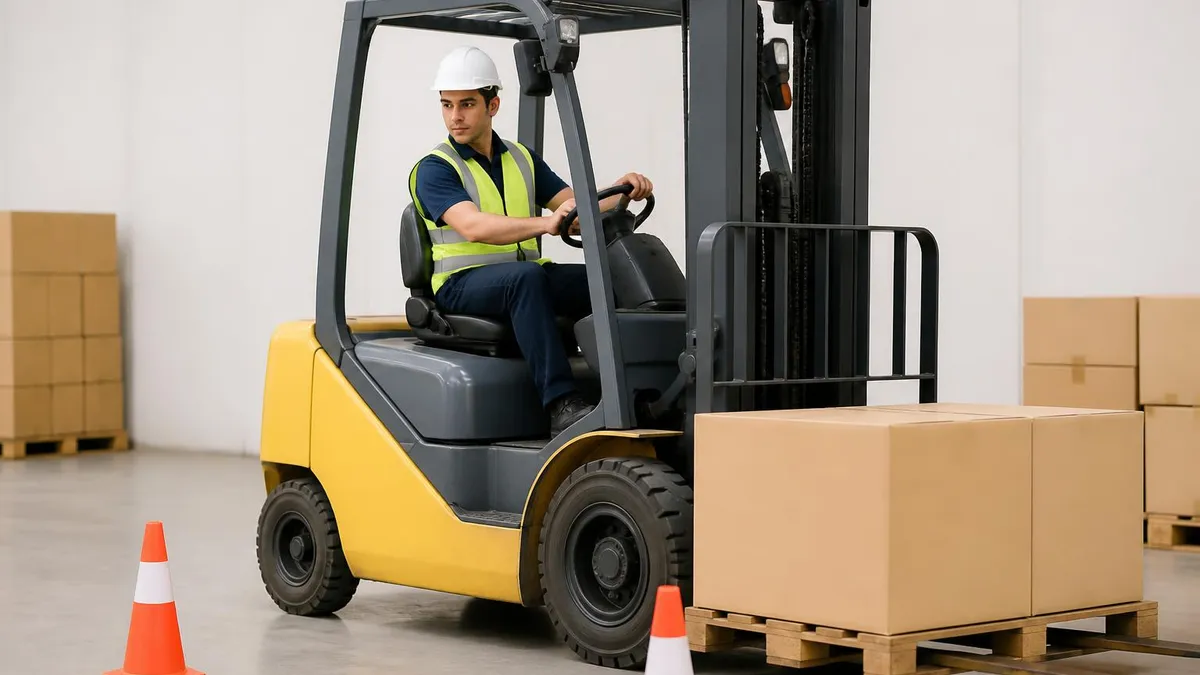
Forklift Repair Service: Complete Guide to Costs, Common Repairs, and Choosing the Right Technician
About the Author

Certified Crane Operator & Skilled Trades Exam Specialist
Ferris State UniversityRobert Martinez is a Journeyman Ironworker, NCCCO-certified crane operator, and forklift trainer with a Bachelor of Science in Construction Technology from Ferris State University. He has 21 years of ironworking, rigging, and heavy equipment operation experience across high-rise and industrial construction sites. Robert prepares candidates for crane operator, rigger, forklift, and skilled trades certification examinations.