
Hyster Forklift Maintenance: Complete Guide to Oil Changes, Service Intervals, and Preventive Care for 2026 October
Master hyster forklift oil change procedures, service intervals, and preventive maintenance. 📚 Complete 2026 October guide for operators and fleet managers.
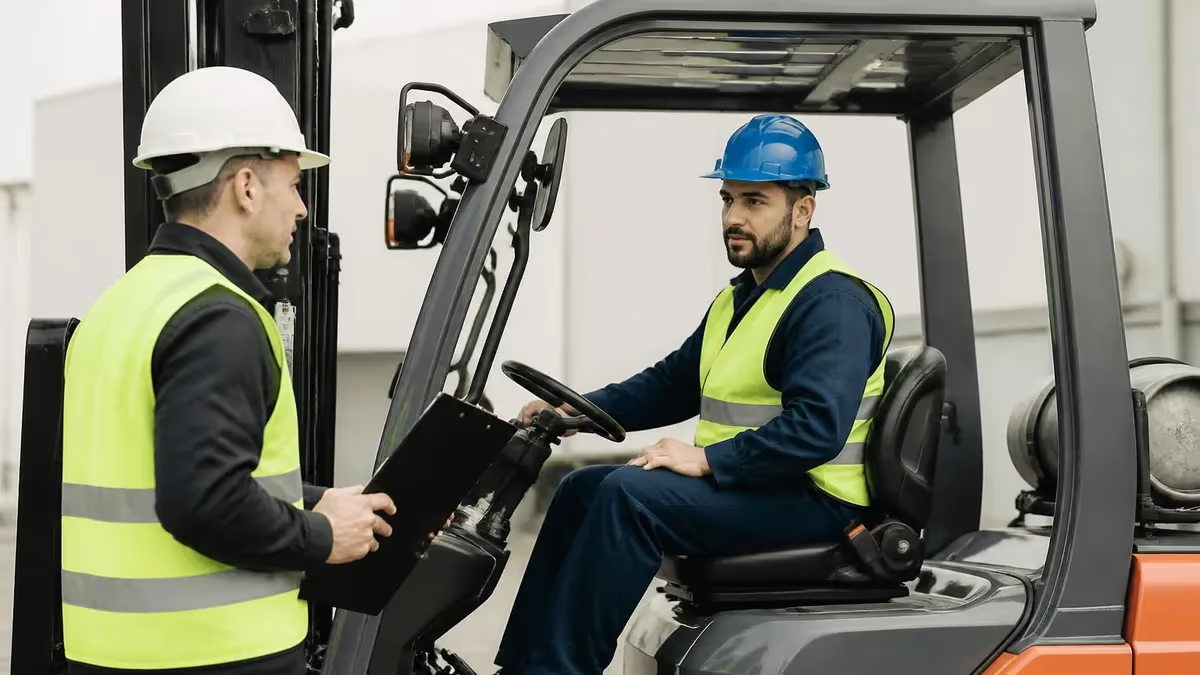
Whether you operate a fleet of forklifts or manage a single warehouse lift, knowing how to perform a proper hyster forklift oil change is one of the most valuable skills you can develop. Hyster trucks are built tough, but they reward operators who follow strict maintenance routines with years of dependable service. From internal combustion models running on LP gas or diesel to the latest electric forklift platforms, the maintenance fundamentals overlap significantly, and understanding them protects your investment, your team, and your bottom line.
This guide is built for everyone touching a Hyster lift truck, from new hires fresh out of forklift training to seasoned fleet supervisors handling a forklift rental program for multiple sites. We will walk through service intervals, fluid specifications, common wear points, daily inspection routines, and the warning signs that tell you a repair is overdue. The information is structured around real shop floor practice, not abstract theory, so you can apply it the next time you open the engine compartment.
Hyster has been building industrial trucks since 1929, and the brand is now part of Hyster-Yamar Group, sharing engineering with sister brand Yale. That heritage matters because Hyster forklifts are engineered around long service life when proper maintenance is followed. A neglected Hyster will fail just as fast as any other brand, but a maintained one routinely logs 15,000 to 20,000 operating hours before major overhaul. The difference between those two outcomes is almost entirely operator discipline and scheduled service.
OSHA 1910.178 requires that powered industrial trucks be examined at least daily before being placed in service, and trucks used on a round-the-clock basis must be examined after each shift. That regulation puts the burden of maintenance squarely on the employer, and by extension on the trained forklift operator who performs the pre-shift inspection. Failing to document these checks is one of the most common OSHA citations issued in warehouse and distribution settings, with average fines exceeding $15,000 per occurrence.
Beyond compliance, maintenance is about economics. A planned oil change on a Hyster H50 internal combustion unit runs roughly $85 in parts and 45 minutes of labor. A neglected oil change leading to engine failure can cost $8,000 to $12,000 in repairs and weeks of downtime. The math is overwhelmingly in favor of preventive service, which is why every major forklifts fleet operator builds maintenance schedules into their operations playbook from day one.
This article also covers what to inspect on rental units, since many companies supplement their fleet with units rented short term. If you are searching for forklift rental near me, understanding maintenance helps you spot a poorly maintained rental unit before you sign for it. A rental Hyster with leaking hydraulic fluid, glazed forks, or worn lift chains is a liability the moment it rolls off the delivery truck, and refusing delivery is your right as the renting party.
By the end of this guide you will have a clear maintenance calendar, a parts and fluids reference, a troubleshooting framework, and the inspection discipline to keep your Hyster running safely. Bookmark the checklists, share them with your team, and pair them with practice quizzes at the end to reinforce the knowledge until it becomes second nature on the shop floor.
Hyster Maintenance by the Numbers

Hyster Service Interval Timeline
Daily Pre-Shift (8-10 hours)
250-Hour Service
500-Hour Service
1000-Hour Service
2000-Hour Major Service
Performing a hyster forklift oil change correctly takes about 45 minutes once you know the routine, and the procedure is virtually identical across the H40 through H80 internal combustion family. The truck should be on level ground, parked with forks lowered to the floor, parking brake set, and key removed. Wheel chocks are mandatory under both rear tires before any work begins under the chassis. If your facility employs lockout tagout protocols, follow them to the letter, including disconnecting the battery negative terminal.
Run the engine to operating temperature before draining, because warm oil flows more completely and carries suspended contaminants with it. Position a drain pan with at least 8 quart capacity directly under the oil pan drain plug. Hyster H50 through H80 LP models use a 15mm hex plug located on the driver side of the pan. Remove the plug carefully, allow the oil to drain completely for 10 to 15 minutes, then reinstall the plug with a new copper crush washer torqued to 25 foot-pounds.
The oil filter on most Hyster GM-powered units is a spin-on type located on the passenger side of the engine block. Use a band-style filter wrench to break it loose, then thread it off by hand. Wipe the filter mounting surface clean, apply a thin film of fresh oil to the new filter gasket, and thread the new filter on by hand until it contacts the mounting surface, then turn an additional three-quarter turn. Never use a wrench to tighten a spin-on filter, which crushes the gasket and causes leaks.
Refill capacity for the GM 2.4L engine is 5 quarts of SAE 10W-30 conventional or synthetic motor oil meeting API SN specification. The Kubota diesel option used in some H50 models takes 6 quarts of 15W-40 diesel-rated oil with CK-4 certification. Always check the operator manual for your specific serial number because Hyster makes running production changes, and what worked on a 2019 unit may not match a 2024 build. Pour slowly to avoid spillage, then wait two minutes before checking the dipstick.
After the refill, start the engine and let it idle for two minutes while watching the oil pressure gauge. The reading should stabilize within 30 seconds at 30 to 60 psi at idle on a warm engine. Inspect the filter and drain plug for leaks, shut the engine off, wait five minutes, and recheck the dipstick. Top off as needed to bring the level to the full mark. Record the service in the truck logbook with date, hour meter reading, technician initials, and oil type used.
Used oil disposal is regulated by EPA and most state environmental agencies. Used motor oil is classified as hazardous waste when mixed with solvents or contaminated with metals, so always store drained oil in dedicated, labeled containers. Most auto parts stores accept used oil for recycling at no charge, and high-volume fleets typically contract with a waste oil pickup service. Never pour used oil on the ground, into floor drains, or into the dumpster. Your forklift operator team should know exactly where the waste oil drum lives in your shop.
If your operation runs a mixed fleet that includes a stand up forklift on the electric side, remember that those units have no engine oil to change but require different scheduled service. Electric Hysters need battery watering, terminal cleaning, brush inspection on DC motors, and gear oil changes in the drive axle. Confusing the two service routines is a common mistake among new technicians, so post the schedules separately and color-code the maintenance tags on each truck for instant identification.

Forklift certification Practice Test Questions
Prepare for the Forklift certification Certification exam with our free practice test modules. Each quiz covers key topics to help you pass on your first try.
Forklift certification Certification Forkl...
Forklift certification Exam Questions covering Certification Forklift certification Maintenance and Repairs. Master Forklift certification Test concepts for certification prep.
Forklift certification Certification Forkl...
Free Forklift certification Practice Test featuring Certification Forklift certification Maintenance and Repairs Questions and Answers. Improve your Forklift certification Exam score with mock test prep.
Forklift certification Certification Forkl...
Forklift certification Mock Exam on Certification Forklift certification Operator Training and Certification Requirements. Forklift certification Study Guide questions to pass on your first try.
Forklift certification Certification Forkl...
Forklift certification Test Prep for Certification Forklift certification Operator Training and Certification Requirements Questions and Answers. Practice Forklift certification Quiz questions and boost your score.
Forklift certification Load Handling and S...
Forklift certification Questions and Answers on Load Handling and Stability. Free Forklift certification practice for exam readiness.
Forklift certification OSHA Regulations an...
Forklift certification Mock Test covering OSHA Regulations and Compliance. Online Forklift certification Test practice with instant feedback.
Forklift certification Pre-Operation Inspe...
Free Forklift certification Quiz on Pre-Operation Inspections. Forklift certification Exam prep questions with detailed explanations.
Forklift certification Refueling and Recha...
Forklift certification Practice Questions for Refueling and Recharging Procedures. Build confidence for your Forklift certification certification exam.
Forklift certification Safe Driving and Ma...
Forklift certification Test Online for Safe Driving and Maneuvering. Free practice with instant results and feedback.
Forklift certification Workplace Hazard Id...
Forklift certification Study Material on Workplace Hazard Identification. Prepare effectively with real exam-style questions.
Forklift certification Forklift Instructions
Free Forklift certification Test covering Forklift Instructions. Practice and track your Forklift certification exam readiness.
Forklift certification Forklift MCQ
Forklift certification Exam Questions covering Forklift MCQ. Master Forklift certification Test concepts for certification prep.
Forklift certification Forklift Employer R...
Free Forklift certification Practice Test featuring Forklift Employer Responsibilities. Improve your Forklift certification Exam score with mock test prep.
Forklift certification Forklift Penalties ...
Forklift certification Mock Exam on Forklift Penalties for Non-Compliance. Forklift certification Study Guide questions to pass on your first try.
Fluids and Specifications for Hyster Forklifts
Hyster internal combustion forklifts running GM 2.4L or 4.3L gasoline and LP engines specify SAE 10W-30 motor oil meeting API service category SN or higher. Synthetic blends extend drain intervals but always confirm the operator manual before stretching past 250 hours. In cold storage operations below 20°F, switch to a 5W-30 viscosity to ensure adequate cold cranking flow during startup cycles.
Diesel Hysters powered by Kubota or Yanmar engines specify SAE 15W-40 diesel oil with API CK-4 or higher. Diesel oil contains additional detergents and anti-soot additives that gasoline oil lacks, and using the wrong oil shortens engine life dramatically. Never mix oil types in the same engine, and always perform a complete drain when switching grades. Track oil consumption between changes as a diagnostic indicator of engine condition.
In-House Maintenance vs Contracted Service
- +Lower long-term cost per service event when volume justifies a dedicated technician
- +Immediate response to unscheduled breakdowns without waiting for vendor dispatch
- +Direct quality control over parts brand, oil grade, and torque specifications used
- +Training opportunity for forklift operator team to learn diagnostic and repair skills
- +Maintenance records stay in-house and integrate with your CMMS or work order system
- +Faster turnaround on routine PMs since the truck stays on your dock
- +Inventory of common wear parts can be standardized across your fleet
- −Upfront investment in tools, lifts, fluids, and parts inventory exceeds $25,000 typical
- −Requires hiring or training a certified technician with forklift-specific experience
- −Warranty work on newer Hysters must still go through authorized dealers
- −Liability exposure if internal repairs fail and cause injury or property damage
- −Specialty diagnostic software for engine and transmission may not be available
- −Small fleets under 8 trucks rarely justify the fixed cost of in-house service
- −Burden of EPA compliance for waste oil, coolant, and battery acid falls on you
Pros and Cons at a Glance
| Pros | Cons |
|---|---|
| Lower long-term cost per service event when volume justifies a dedicated technician | Requires hiring or training a certified technician with forklift-specific experience |
| Immediate response to unscheduled breakdowns without waiting for vendor dispatch | Warranty work on newer Hysters must still go through authorized dealers |
| Direct quality control over parts brand, oil grade, and torque specifications used | Liability exposure if internal repairs fail and cause injury or property damage |
| Training opportunity for forklift operator team to learn diagnostic and repair skills | Specialty diagnostic software for engine and transmission may not be available |
| Maintenance records stay in-house and integrate with your CMMS or work order system | Burden of EPA compliance for waste oil, coolant, and battery acid falls on you |

Daily Pre-Shift Inspection Checklist for Hyster Forklifts
- ✓Walk around the truck and check tires for cuts, chunks missing, or low pressure on pneumatic units
- ✓Inspect forks for cracks, bends, heel wear exceeding 10 percent, or missing fork pins and locks
- ✓Check lift chains for stretched links, rust, kinks, or missing connecting pins between rail and chain
- ✓Verify mast rails are straight, rollers turn freely, and hydraulic hoses show no chafing or weeping seals
- ✓Open the engine compartment and check oil, coolant, hydraulic, and transmission fluid levels visually
- ✓Test horn, headlights, tail lights, backup alarm, and warning strobe before moving the truck
- ✓Apply service brake at low speed to confirm stopping action and check parking brake hold on incline
- ✓Cycle hoist, tilt, and sideshift functions through full range to confirm smooth hydraulic operation
- ✓Check seat belt condition, mirror adjustment, and overhead guard for any cracks or damaged welds
- ✓Record inspection on the daily checklist sheet and report any defects to the supervisor before operating
Track Hours, Not Calendar Days
The single most expensive mistake in forklift fleet management is scheduling maintenance by calendar date instead of actual operating hours. A truck running two shifts daily accumulates service intervals four times faster than a single-shift unit, and ignoring that variable leads to early failure. Install hour meters on every truck and base every service on hour meter reading, not the last Tuesday of the month.
Even well-maintained Hyster forklifts develop predictable failure patterns over their service life, and recognizing the warning signs early prevents catastrophic breakdowns. Hydraulic system failures lead the list, typically caused by contaminated fluid or worn pump components. The first symptom is usually slow lift response under load, followed by jerky operation and audible whining from the pump. By the time the pump fully fails the operator usually notices the lift cylinder drifting downward under load, which is an immediate red tag condition.
Engine cooling problems are the second most common failure mode, especially in outdoor yards and dusty environments. Radiators clog with debris from above and oil mist from below, restricting airflow and causing overheating under heavy load. The temperature gauge climbing into the red is the late warning, while the early warning is the cooling fan running constantly even at low load. A quarterly cleaning of the radiator fins with compressed air prevents 90 percent of cooling failures and costs almost nothing in materials.
Mast and lift chain problems show up gradually but become dangerous quickly once they cross a threshold. OSHA requires immediate replacement of any lift chain that has stretched more than 3 percent of its original length, and most Hyster service manuals call out the same standard. A chain gauge tool measures elongation in seconds and should be part of every monthly inspection. Cracked welds on the mast carriage, bent fork pins, and worn mast rollers all develop slowly until they fail under load, which is why visual inspection during every shift matters.
Electrical issues plague both internal combustion and electric Hyster models, though for different reasons. IC trucks suffer from corroded ground connections, worn starter motors, and battery cable degradation. Electric trucks face contactor pitting, brush wear on traction motors, and connector corrosion at the battery interface. The common thread is that electrical faults often present intermittent symptoms that come and go, which makes diagnosis tricky. Document every fault code, the operating conditions when it occurred, and the time elapsed between events.
Brake system problems are particularly dangerous because they often fail progressively. Drum brakes on older Hyster models develop glazed shoes from heat, while disc brakes on newer units suffer from contaminated pads when wheel cylinder seals leak. The first sign is usually a longer stopping distance noticed by the operator, followed by a soft pedal or pulling to one side during braking. Any change in brake feel warrants immediate inspection because the consequences of brake failure on a loaded forklift are severe.
Tire wear patterns tell you a great deal about the overall condition of the truck. Even wear across both front tires indicates a healthy steer axle and properly inflated rears. Cupping or scalloping on cushion tires suggests worn wheel bearings or a bent axle. Excessive wear on one shoulder of a pneumatic tire points to bad alignment or worn kingpins. Treat tire inspection as a diagnostic tool, not just a wear measurement, and you will catch chassis problems before they cascade.
Hour meter mismatches between trucks in the same age range often indicate operator-induced damage. If your H50 with 8000 hours needs the same level of repair as another H50 with 14000 hours, the difference is almost always operator behavior. Investigate who runs the higher-wear truck, look at telemetry data if equipped, and consider additional forklift training for the operator involved. Poor habits like riding the brakes, slamming forks into pallets, and traveling with the load raised destroy trucks faster than any mechanical issue.
Any Hyster forklift with a known defect that affects safe operation must be removed from service immediately and tagged with a red OUT OF SERVICE tag per OSHA 1910.178(p)(1). Operators who use a tagged truck face termination, and supervisors who fail to enforce removal face personal liability. The truck stays out until a qualified technician inspects, repairs, and signs off on the corrective work in writing.
Budgeting for Hyster forklift maintenance requires thinking in three buckets: routine consumables, scheduled service, and unplanned repairs. Routine consumables include oil, filters, grease, hydraulic fluid, coolant, and tires. For a typical H50 LP unit running 1500 hours per year in single-shift duty, plan on $850 to $1100 annually in fluids and filters alone. That number doubles for double-shift operations and can triple in extreme environments like cold storage, foundries, or outdoor lumber yards exposed to rain and dust.
Scheduled professional service from a Hyster dealer or qualified third-party shop typically runs $400 to $600 per 1000-hour service event, including parts and labor. Most fleet operators contract preventive maintenance separately from breakdown response, which gives predictable monthly costs and faster service prioritization. Compare contracts carefully because the cheap option often excludes hydraulic filter replacement, valve adjustments, or coolant service, and those add-ons hide in the fine print until the invoice arrives.
Unplanned repairs are the budget killer in any fleet without strong preventive discipline. The average major repair on a Hyster IC truck runs $2400 to $4200, covering items like transmission overhaul, hydraulic pump replacement, or engine top-end rebuild. Mast and carriage repairs frequently exceed $5000 once labor, parts, and crane time are tallied. Setting aside 15 percent of acquisition cost annually as a repair reserve aligns with industry best practice and prevents budget shocks during peak season.
If you are weighing forklift rental against owning, maintenance is the single biggest variable in the total cost of ownership calculation. Rental rates of $500 to $900 per month for a typical 5000-pound IC truck include all scheduled maintenance and most breakdown response. Owning the same truck costs $350 to $450 monthly in depreciation plus another $200 to $400 in maintenance for an annualized total close to the rental figure. The decision usually comes down to utilization, with rentals winning below 30 hours per week and ownership winning above 40 hours per week.
For operations searching forklift rentals to handle seasonal peaks, ask the rental company for their maintenance records on the specific unit being delivered. Reputable suppliers track hours, services performed, and any open issues by serial number. If the company cannot or will not produce these records, that is a strong signal to source from a different vendor. Likewise inspect the unit thoroughly before signing the delivery receipt, because once you sign, any pre-existing damage becomes your problem to dispute.
Used forklift purchases require especially careful maintenance budgeting because the previous owner's habits dictate the next 5000 hours of repair costs. When evaluating a used forklift for sale, request all available service records, oil sample analysis if available, and a pre-purchase inspection from an independent technician. A $300 inspection that uncovers a $4000 transmission issue is the best money you spend on the deal. Pay attention to the hour meter, but verify the reading against wear patterns on the operator controls, seat, and step plates.
Battery costs dominate electric forklift maintenance budgets, with lead-acid replacements running $4000 to $8000 every 5 to 7 years and lithium-ion options costing $15000 to $25000 with 10-year service life. Factor in the watering labor, terminal cleaning, and charger maintenance, and the electric platform looks comparable to IC on operating cost despite the cleaner exhaust profile. For warehouses with strict indoor air quality standards or food handling requirements, the math usually favors electric anyway since IC exhaust forces ventilation upgrades that exceed battery costs over the truck life.
Mastering Hyster forklift maintenance starts with building habits, not memorizing manuals. Pick three specific routines you can perform consistently every shift and every week, then expand from there. The three foundational habits are pre-shift inspection completed on paper or tablet, fluid level checks performed cold before startup, and immediate reporting of any abnormal sound, vibration, or response. Operators who develop these reflexes catch 80 percent of developing problems before they become breakdowns, and the data on fleet performance backs that up across every industry segment.
Build a maintenance binder or digital file for every truck in your fleet. The binder should contain the operator manual, parts manual, service manual, original purchase invoice, hour meter log, oil analysis history, and every work order or service receipt from day one. When the truck needs major service, the technician walks in armed with complete history and saves hours of diagnostic time. When the truck is sold or traded, the binder adds resale value because buyers can see the maintenance investment.
Train your forklift operator team to be the first line of maintenance defense. The operator who runs the truck eight hours a day knows it better than any technician who sees it once a month. Enable operators to write up defects without fear of being blamed for damage, and follow up on every report quickly so they know their observations matter. A culture where operators hide problems leads directly to catastrophic failures, while a culture where operators flag issues early keeps the fleet running at peak availability.
For certification of forklift operators, OSHA requires both classroom and practical training, and maintenance awareness should be part of the curriculum. Operators do not need to perform repairs, but they must understand what a healthy truck sounds like, looks like, and feels like, so they can recognize departures from normal. Include hands-on inspection drills during initial training and during the required three-year recertification cycle. Operators who can perform a thorough pre-shift inspection in under 10 minutes are doing it right.
Develop relationships with two or three local Hyster service providers before you need them. Emergency response is faster when you are already in the vendor's system, parts inventory, and dispatch queue. Compare hourly labor rates, travel charges, parts markups, and response time guarantees in writing. The cheapest hourly rate often loses to a slightly higher rate with same-day response when your peak season picking schedule depends on every truck being available. Loyalty discounts and contracted PM agreements also stretch the budget further than spot-purchase service calls.
Use telematics data if your Hyster fleet supports it. Modern Hyster trucks with the Hyster Tracker telematics platform report hours, impacts, idle time, fault codes, and operator login data to a cloud dashboard. Reviewing the data weekly identifies trucks needing service, operators needing coaching, and trends pointing to systemic issues across the fleet. Even without factory telematics, aftermarket systems retrofit easily and pay for themselves within a year through reduced downtime and improved utilization tracking.
Finally, plan for end of life. Every Hyster has a point where continued repair costs exceed replacement value, and most fleet operators set that threshold at 50 percent of replacement cost per year. When a truck crosses that line, sell or scrap it and bring in a replacement, either through purchase or long-term lease. Continuing to feed a worn-out truck drains both budget and operator morale, and a fresh unit pays back the investment quickly through higher availability, lower fuel use, and modern safety features that older trucks simply lack.
Sample Forklift certification Practice Questions
Try these questions from our free Forklift certification practice tests. The correct answer and an explanation follow each question.
When should a forklift be tagged out of service?
- A. At the end of each shift
- B. Only when the engine fails completely
- C. Whenever a defect that affects safe operation is found
- D. Once a week for routine maintenance
Answer: C. Whenever a defect that affects safe operation is found
A forklift must be taken out of service and tagged immediately when any unsafe defect is identified during inspection or operation.
If the forklift's counterweight approaches any structure closer than a predetermined distance, extra safety precautions need to be taken. How far away is that?
- A. 750 mm
- B. 1000 mm
- C. 300 mm
- D. 600 mm
Answer: D. 600 mm
If a forklift's counterweight approaches any structure closer than 600 mm (approximately 2 feet), extra safety precautions are required. This predetermined distance is a safety standard to prevent crushing hazards for personnel or damage to structures. Operating within this zone necessitates heightened awareness, clear communication, and often the implementation of exclusion zones or spotters to ensure safety.
Operating a propane forklift indoors with poor ventilation creates what health hazard?
- A. Carbon monoxide buildup
- B. Excess oxygen exposure
- C. High humidity only
- D. Static electricity buildup
Answer: A. Carbon monoxide buildup
Internal-combustion forklifts release carbon monoxide, which can accumulate to dangerous levels in poorly ventilated spaces.
The data plate (nameplate) on a forklift should be inspected to confirm it is:
- A. Legible and matches attachments in use
- B. Painted over
- C. Removed for cleaning
- D. Covered by a sticker
Answer: A. Legible and matches attachments in use
The data plate must be readable and accurate for the load capacity and any attachments installed.
Forklift Questions and Answers
Forklift Tires: Complete Guide to Types, Sizing, Wear Patterns, and Replacement Costs
Forklift Operator Duties: Complete Guide to Daily Responsibilities, Safety Tasks, and Career Path for 2026
Forklift License Renewal: Complete Guide to Forklift License Expiry, OSHA Recertification, and Operator Requirements for 2026
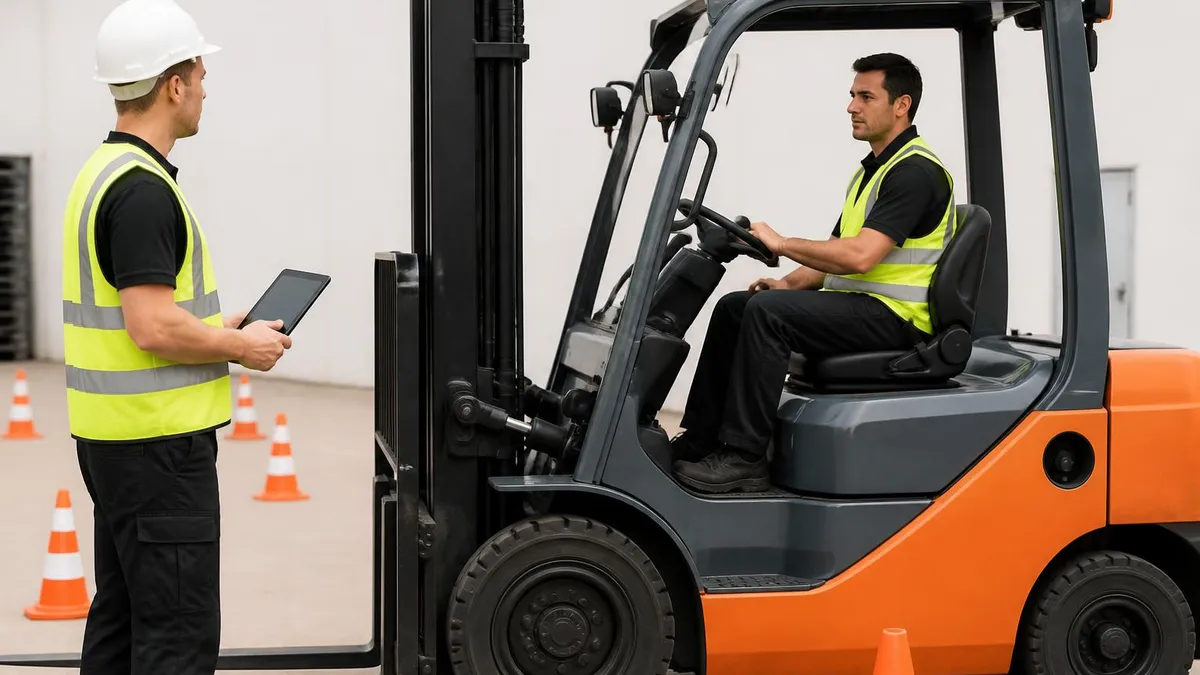
Forklift Safety Training: Complete OSHA Compliance Guide for Operators and Employers
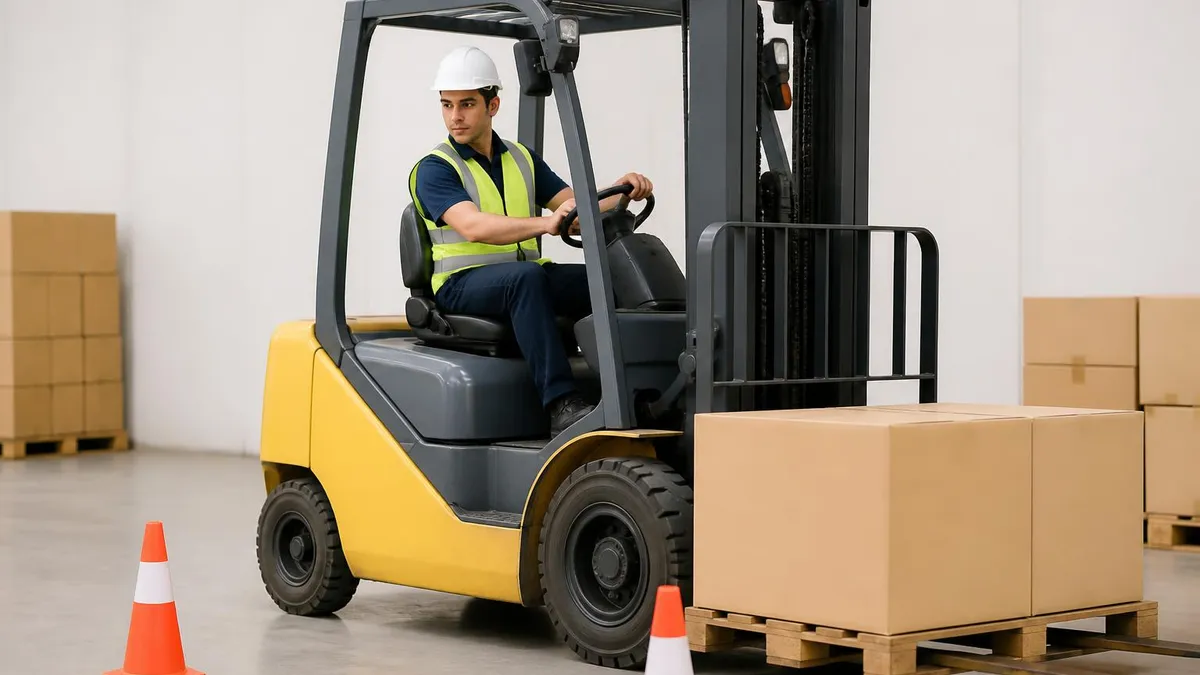
Forklift Repair Service: Complete Guide to Costs, Common Repairs, and Choosing the Right Technician
About the Author

Certified Crane Operator & Skilled Trades Exam Specialist
Ferris State UniversityRobert Martinez is a Journeyman Ironworker, NCCCO-certified crane operator, and forklift trainer with a Bachelor of Science in Construction Technology from Ferris State University. He has 21 years of ironworking, rigging, and heavy equipment operation experience across high-rise and industrial construction sites. Robert prepares candidates for crane operator, rigger, forklift, and skilled trades certification examinations.