
Forklift Companies Near Me: Complete Guide to Finding Local Rental, Sales, Training, and Service Providers in 2026
Find the best forklift companies near me for rental, sales, training, and repair. Compare local providers, pricing, and services in this 2026 guide. ✍🏼
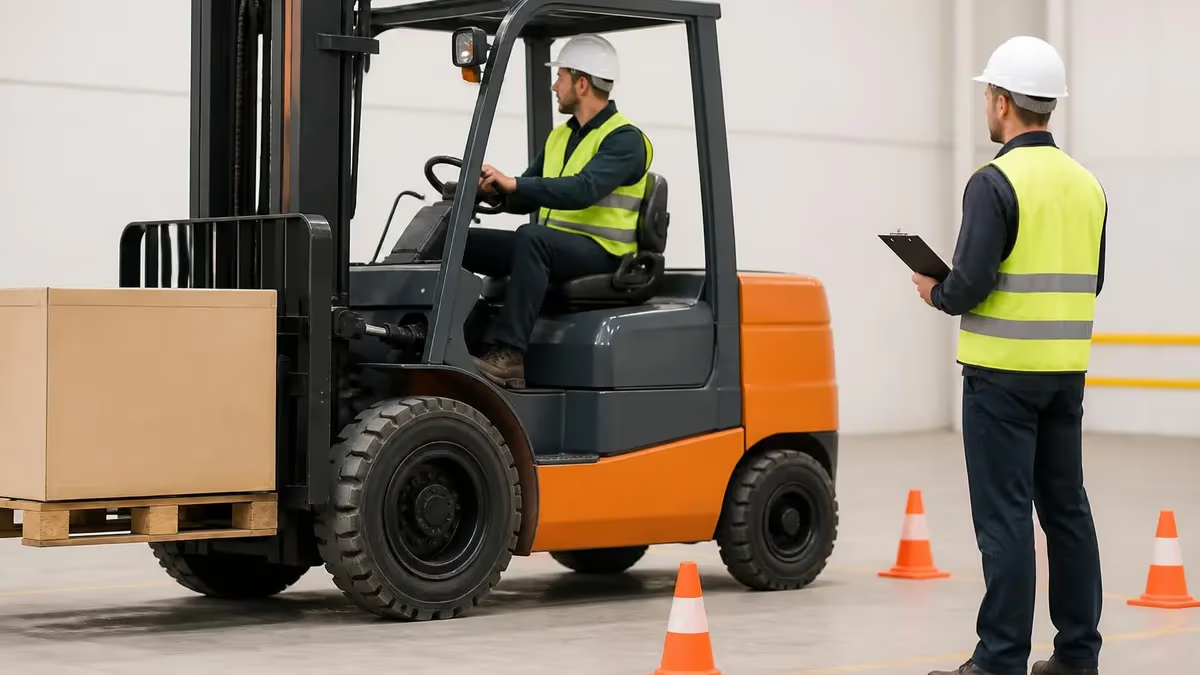
Searching for forklift companies near me is the first step thousands of warehouse managers, contractors, and small business owners take every week when they need lift trucks fast. Whether you need a forklift rental for a weekend project, want to purchase a new electric forklift for daily warehouse operations, or require certified forklift training for your team, choosing the right local provider can save you thousands of dollars and prevent dangerous downtime. The local forklift market includes dealerships, rental yards, repair shops, and training centers — each with very different strengths.
The American material handling industry generated over $32 billion in revenue last year, and nearly 70% of that activity flows through regional dealers and independent rental yards. That means when you type forklift companies near me into Google, you are rarely looking at one type of business. You are scanning a landscape that includes authorized OEM dealers like Toyota and Hyster-Yale, multi-brand independents, used equipment specialists, and pure-play rental fleets. Knowing which type fits your job is half the battle in getting a fair quote.
Pricing varies enormously by region, brand, and equipment age. A daily forklift rental near me can cost as little as $135 for a basic 5,000-pound pneumatic-tire unit in rural Texas or as much as $385 per day for a stand up forklift in metro New York. Weekly rates typically run $450 to $850, and monthly contracts settle between $1,400 and $2,800 depending on capacity, fuel type, and attachments. Always request itemized quotes that separate delivery, fuel surcharges, damage waivers, and end-of-rental cleaning fees.
The federal certification of forklift operators is non-negotiable. OSHA Standard 1910.178(l) requires every employer to train, evaluate, and certify each operator before they touch a powered industrial truck, and recertification is mandatory every three years. Many local forklift companies bundle hands-on forklift training with rental or purchase contracts, which is convenient but not always the cheapest path. Standalone training centers often charge $75 to $150 per operator and complete the course in four to eight hours, including the written and practical evaluations.
Beyond price and certification, the quality of local service should drive your decision. A nearby dealer who can dispatch a technician within 24 hours is worth far more than a cheap online quote from a company two states away. Ask any forklift companies near me about average response time, parts inventory on hand, and whether they stock your specific make and model. A no-show service truck during peak shipping season can cost a distribution center $20,000 in lost productivity per day.
This complete guide walks you through how to evaluate forklift dealers, rental yards, and training providers in your area. You will learn what questions to ask, which red flags to avoid, how to compare quotes apples-to-apples, and how local companies stack up against national chains. We cover new and used forklift for sale options, short-term and long-term forklifts rentals, OSHA-compliant training programs, and ongoing service contracts. By the end you will be ready to call three providers and pick the right one with confidence.
Whether you operate a single-bay garage, a 500,000-square-foot distribution center, or a construction company that needs rough-terrain machines twice a year, the right local forklift partner becomes a long-term competitive advantage. The cheapest provider rarely wins — uptime, safety, and trained forklift operator support are what keep your business moving. Read on for the framework professional buyers use to vet local companies, plus the negotiation tactics that consistently shave 10 to 20 percent off published rates.
Free Forklift certification Study Tools
Interactive Forklift certification resources on PracticeTestGeeks, free to start:
- Forklift certification flashcards — review key terms and concepts card by card
- Forklift certification study guide — topic-by-topic overview of what the exam covers
- Forklift certification cheat sheet — one-page printable summary for last-minute review
Local Forklift Market by the Numbers

Types of Forklift Companies You'll Find Locally
Factory-backed dealers for Toyota, Crown, Hyster, Yale, Cat, Komatsu, and Mitsubishi. Highest parts availability, strongest warranties, premium pricing. Best for fleets that need consistent service and OEM-trained technicians.
Carry several lines and used inventory. Often more flexible on price and willing to source rare attachments. Service quality varies widely — verify ASE or manufacturer certifications before committing.
Focus exclusively on short-term and long-term rentals. Massive fleets, fast delivery, but limited sales options. Ideal when you need a forklift today and don't want a long-term commitment.
Refurbish and resell off-lease lift trucks at 40-60% of new pricing. Great for budget buyers who don't need the latest tech. Always demand maintenance records and a third-party inspection.
OSHA-compliant mobile and classroom training companies. They come to your site, certify operators, and issue cards. Cheaper than dealer bundles but offer no equipment support.
Rental pricing is where most buyers get burned, and it is also where you have the most negotiating use with local providers. The published rate is almost always a starting point — experienced buyers know that forklift rental quotes are built like hotel reservations, with a base rate plus a stack of optional and not-so-optional fees. A 5,000-pound capacity Class IV cushion-tire truck typically rents for $135 to $185 daily, $450 to $625 weekly, and $1,400 to $1,950 monthly. A larger 8,000-pound pneumatic unit climbs another 20 to 30 percent across all three tiers.
Stand up forklift rentals, particularly narrow-aisle reach trucks, command a premium because they are specialty equipment with smaller available fleets. Expect $185 to $275 per day and $1,800 to $2,600 per month. Order pickers and turret trucks for very narrow aisle warehouses rent for $2,400 to $4,200 monthly. If your facility uses these machines daily, the math almost always favors purchase or lease over rental after about 14 months of continuous use.
Delivery fees catch first-time renters off guard. Most local forklift companies charge $125 to $275 each way within a 30-mile radius, with $4 to $6 per loaded mile beyond that. Some providers waive delivery on rentals longer than 30 days — always ask. Damage waivers run 8 to 12 percent of the base rental rate and are usually optional if you can prove general liability coverage of at least $1 million. Fuel surcharges of $15 to $45 apply to LP and diesel trucks returned with empty tanks.
Seasonality matters more than most renters realize. Peak demand for forklift rentals near me runs from August through December as retailers stock up for back-to-school and holiday shipping. Rates climb 10 to 20 percent and availability tightens — you may wait two weeks for the truck you want. Conversely, January through March is buyer's market territory. Local yards have idle inventory and will often discount monthly rates by 15 percent or throw in free delivery to keep machines moving.
Long-term rental contracts, often called rental purchase options or RPOs, deserve careful attention. These agreements let you rent for 12 to 60 months with the option to buy at a pre-set residual. They preserve cash flow, include full maintenance, and let you upgrade equipment as your business grows. Effective monthly rates land between $750 and $1,400 for standard Class IV trucks. The catch is mileage and hours caps — exceeding 1,800 to 2,000 hours per year triggers per-hour overage fees of $3 to $7.
Insurance is another line item to verify before signing. Local rental companies require renters to carry general liability and, in some states, additional inland marine coverage that protects the equipment itself. Your existing business policy may already cover rented equipment up to $25,000 or $50,000 — check before paying for the dealer's damage waiver. If you rent a forklift for sale on a try-before-you-buy basis, ask whether rental payments apply toward the purchase price; reputable dealers credit 50 to 100 percent of paid rent toward your final invoice within the first 90 days.
Finally, beware of equipment age and condition mismatches in quoted prices. A $115 daily rate on a 2009 model with 14,000 hours is no bargain if it breaks down mid-shift. Always ask for the model year, current hour meter reading, and most recent service date. Quality local forklift companies will share these openly. If a provider refuses or claims not to know, walk away — you are looking at a fleet that is not being maintained to professional standards.
Forklift certification Practice Test Questions
Prepare for the Forklift certification Certification exam with our free practice test modules. Each quiz covers key topics to help you pass on your first try.
Forklift certification Certification Forkl...
Forklift certification Exam Questions covering Certification Forklift certification Maintenance and Repairs. Master Forklift certification Test concepts for certification prep.
Forklift certification Certification Forkl...
Free Forklift certification Practice Test featuring Certification Forklift certification Maintenance and Repairs Questions and Answers. Improve your Forklift certification Exam score with mock test prep.
Forklift certification Certification Forkl...
Forklift certification Mock Exam on Certification Forklift certification Operator Training and Certification Requirements. Forklift certification Study Guide questions to pass on your first try.
Forklift certification Certification Forkl...
Forklift certification Test Prep for Certification Forklift certification Operator Training and Certification Requirements Questions and Answers. Practice Forklift certification Quiz questions and boost your score.
Forklift certification Load Handling and S...
Forklift certification Questions and Answers on Load Handling and Stability. Free Forklift certification practice for exam readiness.
Forklift certification OSHA Regulations an...
Forklift certification Mock Test covering OSHA Regulations and Compliance. Online Forklift certification Test practice with instant feedback.
Forklift certification Pre-Operation Inspe...
Free Forklift certification Quiz on Pre-Operation Inspections. Forklift certification Exam prep questions with detailed explanations.
Forklift certification Refueling and Recha...
Forklift certification Practice Questions for Refueling and Recharging Procedures. Build confidence for your Forklift certification certification exam.
Forklift certification Safe Driving and Ma...
Forklift certification Test Online for Safe Driving and Maneuvering. Free practice with instant results and feedback.
Forklift certification Workplace Hazard Id...
Forklift certification Study Material on Workplace Hazard Identification. Prepare effectively with real exam-style questions.
Forklift certification Forklift Instructions
Free Forklift certification Test covering Forklift Instructions. Practice and track your Forklift certification exam readiness.
Forklift certification Forklift MCQ
Forklift certification Exam Questions covering Forklift MCQ. Master Forklift certification Test concepts for certification prep.
Forklift certification Forklift Employer R...
Free Forklift certification Practice Test featuring Forklift Employer Responsibilities. Improve your Forklift certification Exam score with mock test prep.
Forklift certification Forklift Penalties ...
Forklift certification Mock Exam on Forklift Penalties for Non-Compliance. Forklift certification Study Guide questions to pass on your first try.
Electric Forklift vs Propane vs Diesel — Choosing the Right Power Source
An electric forklift is the dominant choice for indoor warehouse work in 2026. Zero tailpipe emissions, quiet operation under 70 dB, and lower lifetime fuel costs make Class I and II trucks the default for food-grade facilities, pharmaceuticals, and any operation with strict air quality rules. Modern lithium-ion battery packs charge in 60 to 90 minutes and deliver 7 to 9 hours of continuous run time per cycle.
The upfront cost is higher — expect $32,000 to $48,000 for a new 5,000-pound electric forklift versus $24,000 to $34,000 for a comparable propane unit. Over a five-year ownership window, however, electrics typically save $9,000 to $14,000 in fuel and another $4,000 to $6,000 in maintenance because there is no engine, no oil changes, and no exhaust system to service. Local dealers can often quote both lead-acid and lithium options.

Renting vs Buying From Local Forklift Companies
- +No upfront capital — preserve cash for inventory and payroll
- +Maintenance and repairs included in monthly rate
- +Easy to scale fleet up or down with seasonal demand
- +Try multiple makes and models before committing to purchase
- +Latest emission-compliant trucks without trade-in hassle
- +Tax deduction as operating expense, no depreciation tracking
- +Insurance often bundled at fleet-discounted rates
- −Higher total cost over 3+ years of continuous use
- −Hour caps trigger overage fees on long-term contracts
- −Limited attachment customization on rental units
- −You build no equity — return the truck with nothing to show
- −Availability tightens during August-December peak season
- −Damage waivers and fuel surcharges inflate effective rate
- −Cannot resell or trade in for fleet refresh credit
Pros and Cons at a Glance
| Pros | Cons |
|---|---|
| No upfront capital — preserve cash for inventory and payroll | Hour caps trigger overage fees on long-term contracts |
| Maintenance and repairs included in monthly rate | Limited attachment customization on rental units |
| Easy to scale fleet up or down with seasonal demand | You build no equity — return the truck with nothing to show |
| Try multiple makes and models before committing to purchase | Availability tightens during August-December peak season |
| Latest emission-compliant trucks without trade-in hassle | Damage waivers and fuel surcharges inflate effective rate |
| Tax deduction as operating expense, no depreciation tracking | Cannot resell or trade in for fleet refresh credit |
Forklift Pre-Purchase Inspection Checklist
- ✓Verify model year, serial number, and current hour meter reading against the dealer's listing.
- ✓Request the complete maintenance log for the past 24 months from the local provider.
- ✓Test cold start, then run the truck for 20 minutes to check for hydraulic leaks and overheating.
- ✓Inspect mast channels, lift chains, and forks for bends, wear, or cracks exceeding OSHA limits.
- ✓Check tire condition — pneumatics should have 50%+ tread, cushions should show no chunking.
- ✓Operate every hydraulic function — lift, tilt, sideshift, attachments — through full travel range.
- ✓Test all safety systems: horn, backup alarm, seat belt, parking brake, and lights.
- ✓Verify the data plate is intact and matches the truck specifications you intend to buy.
- ✓Request a third-party inspection report if buying used over $15,000 — costs $250 to $450.
- ✓Negotiate a 30-day powertrain warranty on used trucks, even if dealer markets as-is.
Always get three written quotes — and share them.
Local forklift companies sharpen their pencils when they know you are talking to competitors. Get quotes from at least one OEM dealer, one independent, and one rental yard. Share the lowest number with your preferred provider and ask them to match or beat it. This single tactic consistently saves buyers 10 to 18 percent on rentals and 6 to 12 percent on purchases — without changing equipment quality or service terms.
Operator training and certification of forklift drivers is where local companies offer the most underrated value. OSHA does not specify a particular curriculum, but it requires three components: formal instruction (lecture, video, or written materials), practical training (hands-on demonstrations and operator practice), and a workplace-specific evaluation by a qualified trainer. Skipping any element exposes employers to citations of $16,131 per serious violation and up to $161,323 for willful or repeated offenses under 2026 OSHA penalty schedules.
Most quality forklift training programs run four to eight hours for new operators and one to three hours for recertification. The classroom portion covers stability principles, the load center concept, pedestrian safety, refueling and recharging procedures, and a review of all 11 truck classifications. The practical session requires the trainee to demonstrate competency on the exact class and model they will operate at work — meaning a class I sit-down rider certification does not transfer to a class II reach truck without additional evaluation.
Pricing for local forklift training is surprisingly consistent nationwide. Standalone training companies typically charge $75 to $125 per operator for group classes of six or more, and $150 to $225 for one-on-one private instruction. Many dealers throw in free training when you purchase a truck — ask about it before signing. Mobile trainers who travel to your facility charge a $250 to $500 travel fee plus per-operator pricing, which is well worth it for facilities with eight or more operators because it minimizes downtime.
Beware of online-only forklift certification programs that promise instant cards for $39 to $59. These programs satisfy the formal instruction component but cannot legally substitute for the hands-on practical evaluation that OSHA requires. An online card without a documented in-person evaluation is not valid certification. Employers who rely solely on online cards are routinely cited during OSHA inspections, even when the operator passed every online module.
Recertification is required every three years, after an accident or near-miss, when an operator is observed performing unsafely, or when assigned to a new type of truck. Smart employers run brief annual refreshers even when not required — operators who attend yearly safety reviews have 38 percent fewer recordable incidents according to National Safety Council data. Local training companies often offer annual maintenance retainers that cover refreshers and new-hire onboarding for a flat monthly fee of $200 to $450.
Train-the-trainer programs are worth considering for operations with 15 or more forklift operator positions. Sending one or two supervisors through a 16-hour certified instructor course costs $895 to $1,495 per person, but it lets you handle all internal training and new-hire certification in-house going forward. The break-even point is typically 18 to 24 operators trained over three years. Many local dealers offer subsidized train-the-trainer slots when you buy a fleet of three or more units.
Documentation is the final piece operators and employers must get right. OSHA requires a written record of each operator's training that includes the operator's name, training date, evaluation date, and the name of the person who performed the evaluation. Keep these records for the entire duration of employment plus three years. Quality local training providers issue both a wallet card and a corporate-style certificate, and many now offer cloud-based records portals where you can pull documentation during an OSHA inspection in under 60 seconds.
Operator certification violations were the #6 most-cited OSHA standard in 2025, generating over 2,100 citations with average penalties exceeding $9,400. Inspectors now routinely demand documentation during walk-throughs, and untrained operator findings often trigger broader audits of your entire safety program. If you cannot produce a current evaluation record for every active operator, you face serious financial exposure. Schedule certification with a local provider before adding any new operator to your floor.
Service contracts and warranties are the hidden differentiator between great local forklift companies and the ones you will regret choosing. A new truck warranty typically covers the powertrain for 12 months or 2,000 hours, whichever comes first, with extended coverage available for 24 to 60 months. What is and isn't covered varies dramatically — read the fine print before assuming wear items like tires, forks, brakes, and hydraulic seals are included. Most are not.
Planned maintenance contracts, often called PM agreements, are where local providers earn their margins and where you can either save thousands or overspend. A basic PM contract for a single Class IV truck running 1,500 hours per year typically costs $1,800 to $2,800 annually and includes four scheduled service visits, all fluid changes, hydraulic filter replacements, and a comprehensive 75-point inspection. Full-maintenance contracts run $3,200 to $4,800 and add coverage for repairs, parts, and emergency service calls.
Response time guarantees deserve specific contract language. The industry-standard service-level agreement promises a technician on-site within 4, 8, or 24 business hours, with parts availability windows of 24 or 48 hours. Insist on written response time commitments with penalty clauses — typically a 10 percent monthly credit for missed SLAs. Without contractual teeth, response time promises evaporate when a provider gets busy. Quality local forklift companies stand behind their SLAs and will provide references from current clients.
Parts availability is the unsung hero of forklift ownership. A truck down for a $40 sensor that is on three-week backorder costs you the same as one waiting on a $4,000 transmission. When evaluating local dealers, walk through their parts warehouse if possible. Top-tier providers stock 18,000 to 35,000 SKUs and can fulfill 92 to 96 percent of common repair parts same-day. Independents typically stock 4,000 to 10,000 SKUs and lean on overnight orders for the rest.
Telematics and fleet management software now come standard on most new lift trucks. These systems track operator hours, impact events, battery status, and maintenance intervals — and they feed directly to your dealer's service team. Used properly, telematics cut unplanned downtime by 35 to 50 percent and surface operator coaching opportunities you would never spot manually. Local providers vary widely in how well they use this data, so ask for a live demo before buying a connected fleet.
If you are deep into the buying process, the maintenance experience matters as much as the truck itself. Pair this guide with a deeper look at the forklift repair service landscape so you understand parts pricing, technician certifications, and typical labor rates in your market. Forklift companies that excel at sales but lag on service create expensive problems three to five years into ownership, when warranty coverage thins and your trucks need real wrench time.
Finally, the right local relationship pays dividends in unexpected ways. Dealers and rental yards regularly tip preferred customers about used trade-ins before they hit the open market, share early intelligence on price increases, and provide loaner trucks during major repairs. Treat your forklift provider like a strategic supplier, not a vendor. Pay invoices on time, give honest feedback, and refer other businesses when service is excellent. A strong partnership with a local forklift company is one of the most reliable ways to keep your operation moving for the next decade.
Putting all of this into action begins with a clear written specification of what you actually need. Before calling forklift companies near me, document your load capacity requirements, the maximum lift height, indoor versus outdoor use, fuel type preference, daily operating hours, and any required attachments like sideshifters, fork positioners, or rotators. A one-page spec sheet shared with three providers produces apples-to-apples quotes within 48 hours. Without it, every quote looks different and comparison becomes guesswork that favors the dealer.
When the quotes arrive, build a simple spreadsheet that breaks every line item into the same categories: base price, delivery, fuel, maintenance, insurance, training, and contingency fees. Convert everything to a total cost of ownership per hour figure across a five-year window. The winner is rarely the lowest base price — it is the provider with the cleanest total cost number and the strongest service track record. Most professional buyers find that mid-tier providers beat both the cheapest and most expensive options on TCO.
References are non-negotiable for any purchase over $20,000 or any service contract of 12 months or more. Ask for three current customer references in businesses similar to yours, then actually call them. Good questions include: What is the average response time you experience? How often do parts have to be back-ordered? Has the dealer ever surprised you with fees not in the original contract? Would you renew? Five minutes on the phone with a current customer reveals more than any sales pitch.
Site visits work both ways. Visit the dealer's facility to see their parts inventory, technician bays, and rental fleet condition. Have them visit your site to assess aisle widths, dock heights, floor conditions, and traffic patterns. A salesperson who never walks your warehouse and proposes equipment based on a phone call is guessing. Local providers who insist on a site survey before quoting are demonstrating professionalism that translates to better long-term outcomes.
Don't skip the financing conversation. Local dealers partner with captive finance arms like Toyota Industries Commercial Finance and De Lage Landen, plus regional banks who specialize in equipment loans. Current rates for qualified buyers run 7.5 to 11.5 percent on five-year terms, with lease residuals between 15 and 35 percent. Many dealers will absorb a half point of interest in exchange for service contract commitments — bundling can save $3,000 to $6,000 over a typical lease.
Once you sign and take delivery, the relationship management phase begins. Schedule a quarterly business review with your account manager to discuss truck utilization, upcoming maintenance, operator training refreshers, and any new equipment needs. Quality local forklift companies welcome these conversations because they reveal upsell opportunities — but more importantly, they keep your fleet aligned with your business growth. Companies that disappear after the sale are exactly the providers you want to replace at the next renewal cycle.
If you ever find yourself dissatisfied with a local provider, document the issues, communicate them clearly in writing, and give the dealer 30 days to remediate before switching. Most contracts allow termination for cause with proper notice. Lining up a replacement provider before issuing termination letters prevents service gaps that hurt your operation. Local forklift markets are competitive, and a well-prepared buyer can almost always find a comparable provider eager to earn the business at favorable terms within two weeks.
Sample Forklift certification Practice Questions
Try these questions from our free Forklift certification practice tests. The correct answer and an explanation follow each question.
Which of the following topics is required to be covered in forklift operator training related to the workplace?
- A. Company sales targets
- B. Surface conditions where the vehicle will be operated
- C. HR policies and vacation scheduling
- D. Customer service procedures
Answer: B. Surface conditions where the vehicle will be operated
OSHA requires training to address workplace-specific conditions including floor surfaces, ramps, and environmental hazards where the forklift will be used.
When should a forklift be tagged out of service?
- A. At the end of each shift
- B. Only when the engine fails completely
- C. Whenever a defect that affects safe operation is found
- D. Once a week for routine maintenance
Answer: C. Whenever a defect that affects safe operation is found
A forklift must be taken out of service and tagged immediately when any unsafe defect is identified during inspection or operation.
A near-miss or accident involving a forklift triggers what OSHA requirement?
- A. No action needed
- B. Operator refresher training
- C. Immediate termination
- D. A one-time fine
Answer: B. Operator refresher training
An accident or near-miss requires the operator to receive refresher training.
Can an employer allow an untrained employee to operate a forklift under direct supervision for training purposes?
- A. Yes, only during supervised training where it does not endanger the trainee or others
- B. No, never under any circumstance
- C. Yes, unsupervised if brief
- D. Yes, if the employee signs a waiver
Answer: A. Yes, only during supervised training where it does not endanger the trainee or others
Trainees may operate a truck only under direct supervision and where operation does not endanger anyone.
Forklift Questions and Answers
Forklift Tires: Complete Guide to Types, Sizing, Wear Patterns, and Replacement Costs
Forklift Operator Duties: Complete Guide to Daily Responsibilities, Safety Tasks, and Career Path for 2026
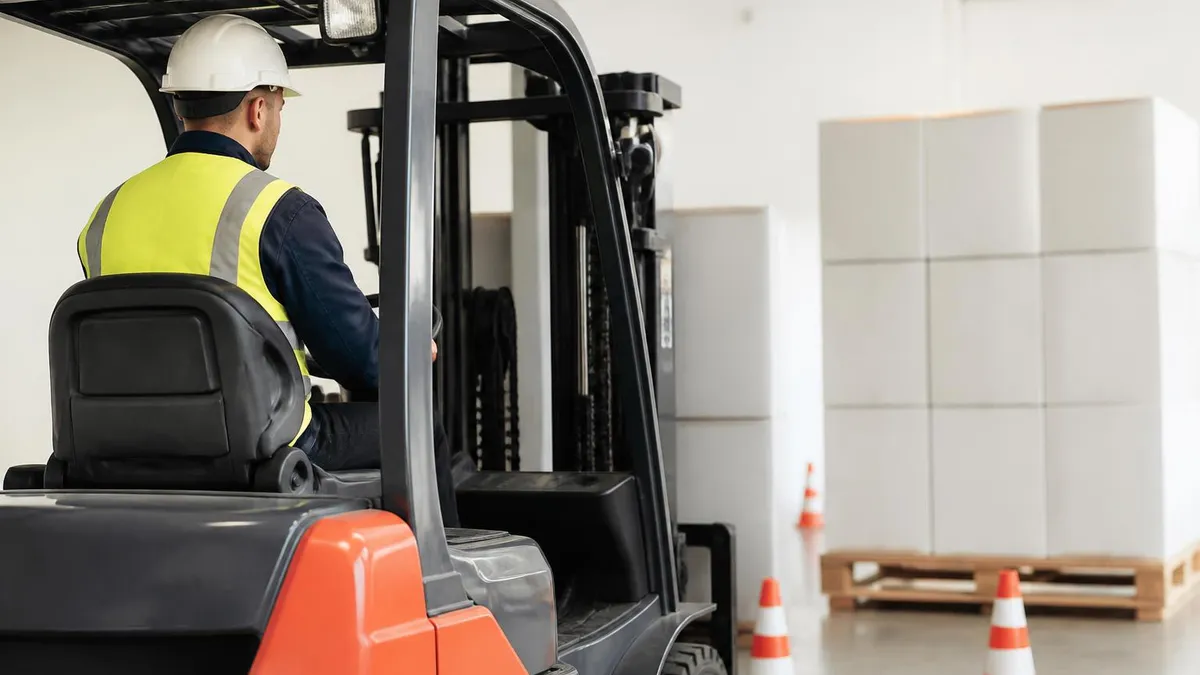
Forklift License Renewal: Complete Guide to Forklift License Expiry, OSHA Recertification, and Operator Requirements for 2026
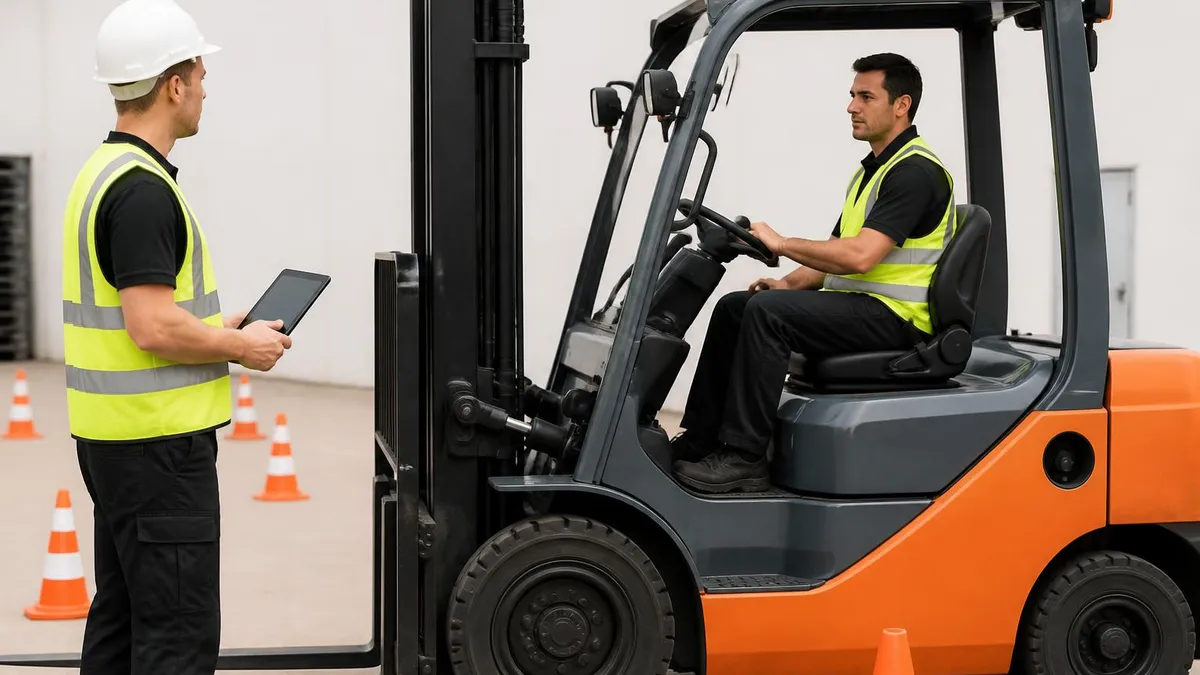
Forklift Safety Training: Complete OSHA Compliance Guide for Operators and Employers
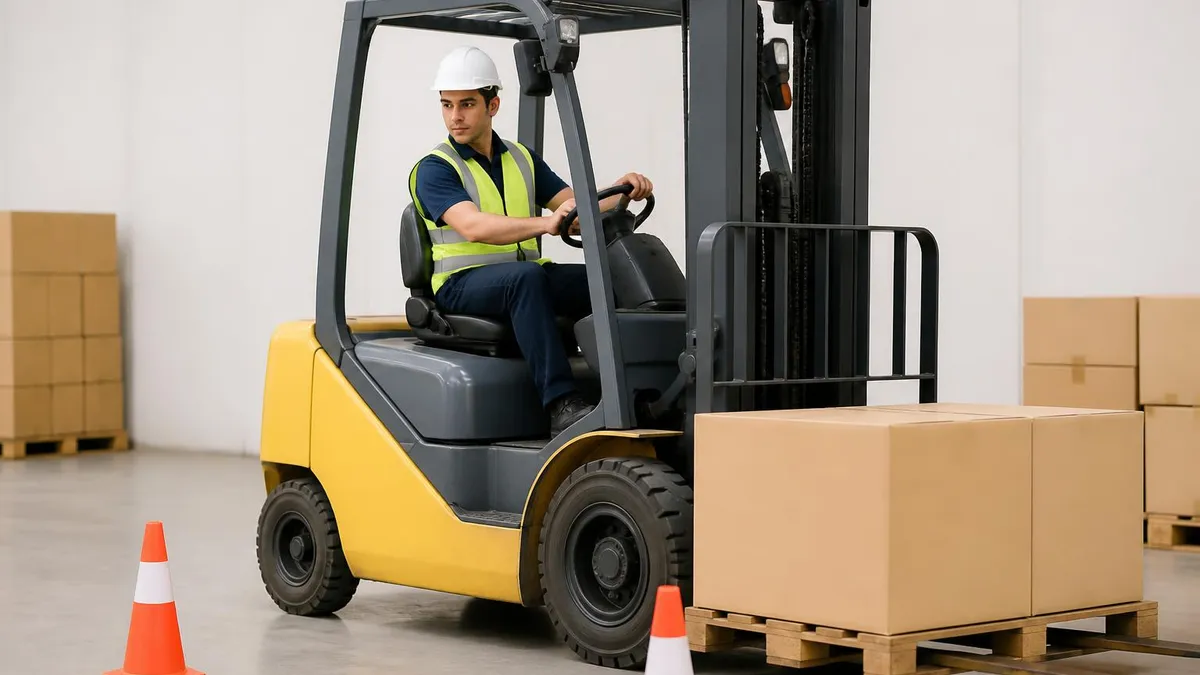
Forklift Repair Service: Complete Guide to Costs, Common Repairs, and Choosing the Right Technician
About the Author

Certified Crane Operator & Skilled Trades Exam Specialist
Ferris State UniversityRobert Martinez is a Journeyman Ironworker, NCCCO-certified crane operator, and forklift trainer with a Bachelor of Science in Construction Technology from Ferris State University. He has 21 years of ironworking, rigging, and heavy equipment operation experience across high-rise and industrial construction sites. Robert prepares candidates for crane operator, rigger, forklift, and skilled trades certification examinations.