
Blue Forklift Light Guide: How Warning Lights and Other Forklift Safety Equipment Protect Pedestrians
🔎 Blue forklift light guide: how it works, OSHA rules, costs, and the forklift safety equipment to check before any forklift rental or purchase.

What a Blue Forklift Light Does and Why It Matters
A blue forklift light is a small LED spotlight mounted on the front or rear of a lift truck that throws a bright blue spot onto the floor roughly 10 to 20 feet away. Pedestrians see the glow before they hear or see the truck itself. Whether your site buys equipment or arranges a forklift rental for a busy season, this simple lamp is one of the cheapest ways to prevent a collision between people and powered industrial trucks.
Forklifts are involved in a surprising share of warehouse harm. OSHA estimates that roughly 85 workers die in forklift incidents each year, and tens of thousands more suffer injuries serious enough to need medical care. A large portion involve pedestrians struck or pinned, often at blind corners, aisle intersections, and dock doors. Visual warnings like a blue spot address the exact moment when a walking worker steps into a path they cannot see.
Electric forklifts make the problem worse. A battery-powered truck produces almost no engine noise, so a worker wearing hearing protection may not notice it approaching until it is only a few feet away. Many facilities have moved toward electric models for emissions and operating-cost reasons, and those same facilities now add lights, alarms, and speed controls to compensate. Light works where sound fails, because it does not compete with machinery, music, or ear protection.
This guide explains how blue lights work, how they differ from red zone lights and strobes, and where they fit in the wider group of forklift safety equipment that OSHA and industry standards expect. You will also see what to check before signing a rental agreement, how a stand up forklift and a cherry picker forklift change the equipment list, and how safety gear connects to operator certification and daily inspections.
One point is worth stating clearly. OSHA's powered industrial truck standard, 29 CFR 1910.178, does not name blue lights as a required item. It does require a working horn, auxiliary directional lighting where general lighting falls below 2 lumens per square foot, and trained, evaluated operators. Blue lights are therefore a recommended layer that employers add after assessing pedestrian traffic, not a box an inspector ticks during a site visit.
That distinction matters for budgeting. A quality aftermarket blue spot light typically costs somewhere between 50 and 250 dollars per unit, plus a few dollars for wiring and a mounting bracket. Compared with a single medical claim, a damaged rack, or a lost workday, the expense is small. Safety managers often justify the purchase by counting near misses over a two week observation period and showing how many happened at crossings and blind turns.
Throughout this article you will find practice questions that mirror what operators face on the certification exam, including load handling, stability, and emergency procedures. Treat the equipment knowledge here as a foundation. A light cannot save a worker if the operator drives too fast, carries a load too high, or ignores pedestrian right of way. Equipment and training always work together, and neither one replaces the other in a well-run warehouse.
Forklift Safety by the Numbers
Core Forklift Safety Equipment Every Truck Should Carry
Blue spot lights mark the truck's path on the floor, while red zone lights outline a danger perimeter around the machine. Both give pedestrians a visual cue in noisy aisles, at blind intersections, and around dock doors where sound warnings are easily missed.
OSHA requires a working horn on every powered industrial truck. Backup alarms add an audible warning during reversing, and many sites also use strobe beacons so that people with hearing protection still notice the truck approaching.
Sit-down trucks use seat belts to keep the driver inside the protective frame during a tip-over. Stand-up models use rear-entry designs, operator restraints, or closed compartments. Wearing the restraint is the single most effective rollover protection available.
The overhead guard shields the operator from falling objects, and the load backrest stops items from sliding back toward the driver. Never remove or modify either part, because they are engineered to the truck's rated capacity and application.
The data plate lists rated capacity, load center, lift height, and attachments. Operators must read it before each job, because adding an attachment or raising the load beyond the listed values can reduce stability in ways that are not obvious to the eye.
How Blue Forklift Lights and Other Warning Lights Work
Blue spot lights use high-intensity LEDs and a focused lens to project a small, sharply defined dot or short bar onto the floor ahead of or behind the truck. Because the beam travels along the floor, it appears before the machine rounds a corner or crosses an aisle. A pedestrian watching the floor edge sees the blue mark moving toward them and has time to stop, step back, or wave to the operator.
Red zone lights work differently. Instead of marking a point in front of the truck, they project parallel lines or a wide rectangle that outlines a danger zone on both sides of the machine. The message is simple: do not stand inside this area. Many warehouses use blue lights on the front and rear for travel direction, and red zone lines on the sides where pinch points and swinging forks create risk.
Halo or arc lights combine both ideas, drawing a curved line a few feet in front of the truck that bends as the vehicle steers. This is helpful on trucks that make tight turns in narrow aisles, because the curve shows where the truck is heading, not just where it is pointing. Operators often like halos because the line also helps them judge clearance next to racking.
Strobe beacons and rotating lights sit on the overhead guard and make the truck visible from a distance in every direction. They are especially helpful in yards, loading docks, and large distribution centers with long sight lines. A beacon does not tell a pedestrian which way the truck is moving, so it works best when paired with a floor-projected blue spot light for directional information.
Voltage compatibility is a practical detail that buyers often overlook. Most blue lights are made for a wide input range, typically 10 to 80 volts DC, so one model can run on 12-volt, 24-volt, 36-volt, 48-volt, or 80-volt electric trucks. Internal combustion trucks with 12-volt systems work too. Always check the product label and install through a fused connection to avoid damaging the light or the truck's electrical system.
Placement affects performance more than most people expect. Mount the light low enough that its beam hits the floor at a shallow angle, and angle it so the spot lands where a pedestrian would have time to react. Avoid mounting where forks, a load, or the mast block the beam when the carriage is raised. Test the result by walking the aisle and checking visibility from a pedestrian's point of view.
Maintenance is minimal but not zero. LEDs last tens of thousands of hours, yet lenses collect dust, shrink wrap, and oil, which dims the projection. Wipe the lens during your pre-shift inspection, confirm the light turns on with the truck, and tag the truck out of service if it fails and your site has made lights part of its safety plan. Record the repair like any other safety defect.
Safety Equipment for Electric Forklift, Stand Up Forklift, and Cherry Picker Forklift Models
An electric forklift is quiet, which is the main reason blue lights and strobe beacons are so valuable on these trucks. A worker wearing earplugs in a cold storage room may not hear a battery-powered truck at all. Pair a blue spot light with a sensitive horn habit at intersections, and consider speed limiting so the truck slows automatically in pedestrian zones.
Battery safety equipment matters as well. Charging areas need eyewash stations, splash-resistant gloves and face protection, and good ventilation to disperse hydrogen. Operators should also know the correct procedure for changing or charging batteries, because acid burns and heavy lifting injuries happen frequently when the process is rushed or when the proper hoist or roller bed is not used.
Are Blue Forklift Lights Worth Installing?
- +They warn pedestrians before the truck reaches a blind corner
- +They work when noise or hearing protection masks audible alarms
- +Aftermarket units cost far less than a single injury claim
- +Installation takes under an hour on most trucks
- +LED life spans tens of thousands of hours with little upkeep
- +They fit sit-down, stand-up, and electric trucks with wide voltage ranges
- −OSHA does not require them, so adoption depends on site policy
- −Beams are harder to see in bright daylight or on light-colored floors
- −Dirty lenses or blocked mounting positions reduce visibility
- −Workers may over-rely on lights and stop checking for trucks
- −Too many different light colors can confuse pedestrians
- −Poor wiring or incorrect voltage can damage the light or the truck
Forklift Operator Pre-Shift Safety Equipment Checklist
- ✓Confirm the blue spot light turns on with the truck.
- ✓Wipe dust and shrink wrap from every light lens.
- ✓Test the horn before leaving the parking area.
- ✓Listen for the backup alarm when shifting into reverse.
- ✓Fasten the seat belt or engage the operator restraint.
- ✓Check that the overhead guard has no cracks or missing bolts.
- ✓Read the capacity plate and match it to today's loads.
- ✓Inspect forks, chains, and hoses for damage or leaks.
- ✓Check tires, brakes, and steering for normal response.
- ✓Report any failed safety item and tag the truck out.
Lights Help, but Right of Way Still Rules
OSHA requires auxiliary lighting on the truck whenever general lighting is below 2 lumens per square foot. A blue light is an extra warning, not a license to drive faster. Pedestrians always have the right of way, and operators must slow down, sound the horn, and make eye contact at every intersection.
Forklift Rental, Forklift for Sale, and Safety Equipment Checks
Safety equipment should be part of every purchase or forklift rental decision, not an afterthought. When you search for a forklift rental near me, compare more than the daily rate. Ask which lights, alarms, restraints, and attachments come standard, and whether the truck has a recent inspection record. A rate that looks 15 percent cheaper can disappear fast if you must pay a technician to add missing equipment.
Before accepting delivery, walk around the truck and inspect it just as an operator would. Look for a legible capacity plate, a working horn, intact overhead guard, and seat belt or restraint in good condition. Confirm that any blue light or beacon works, and that hydraulic hoses show no cracks or leaks. Document the condition with photos and have the rental company sign off on any existing damage.
Training responsibility is another point many renters miss. The rental company may supply the truck, but your company, as the employer, must ensure each driver is trained and evaluated for that particular type of truck and workplace. A generic card is not enough. Ask whether the rental firm offers familiarization sessions, and plan time for operators to practice with unfamiliar controls before the work begins.
Buyers browsing a forklift for sale listing face a similar checklist. Used trucks may be missing guards, restraint systems, or data plates, and some have been modified without engineering approval. Ask for the service history, the hour meter reading, and the original capacity plate. If an attachment was added, the plate must reflect the new rated capacity, or the truck should not be used at full load.
Budget for upgrades on any used purchase. Adding a blue light, red zone lights, a backup alarm, and a strobe beacon usually adds a few hundred dollars, which is small compared with the truck itself. Speed limiters and pedestrian detection systems cost more, ranging from a few hundred to a few thousand dollars, but they can pay back quickly in sites with heavy foot traffic and frequent near misses.
Consider the type of truck that matches the job, because the safest choice is often the one that fits the task. An electric forklift suits indoor work with good floors, while internal combustion models handle rough outdoor yards. A stand up forklift fits narrow aisles, and an order picker supports case picking at height. Using the wrong truck forces awkward maneuvers, which increases the chance of a collision or tip-over.
Finally, put the safety expectations in writing. Your rental or purchase contract should state who maintains lights and alarms, who is responsible for repairs, and how quickly a replacement truck will arrive if a safety defect appears. Clear terms prevent arguments later and make it easier to remove a defective truck from service immediately instead of waiting for approval while workers keep using unsafe equipment.
If the horn, brakes, steering, restraint, or required lighting is not working, OSHA expects the truck to be removed from service until repaired. Do not disable alarms or tape over lights to avoid noise or glare. Report the defect, tag the truck, and request a replacement.
Certification of Forklift Operators and How Training Covers Safety Equipment
Equipment is only half of the safety picture. Under OSHA's standard, every forklift operator must complete formal instruction, practical training, and an evaluation of performance in the workplace before operating a truck alone. Certification of forklift operators is therefore an employer responsibility, and the evaluation must be repeated at least every three years, or sooner after an accident, a near miss, or an observed unsafe act.
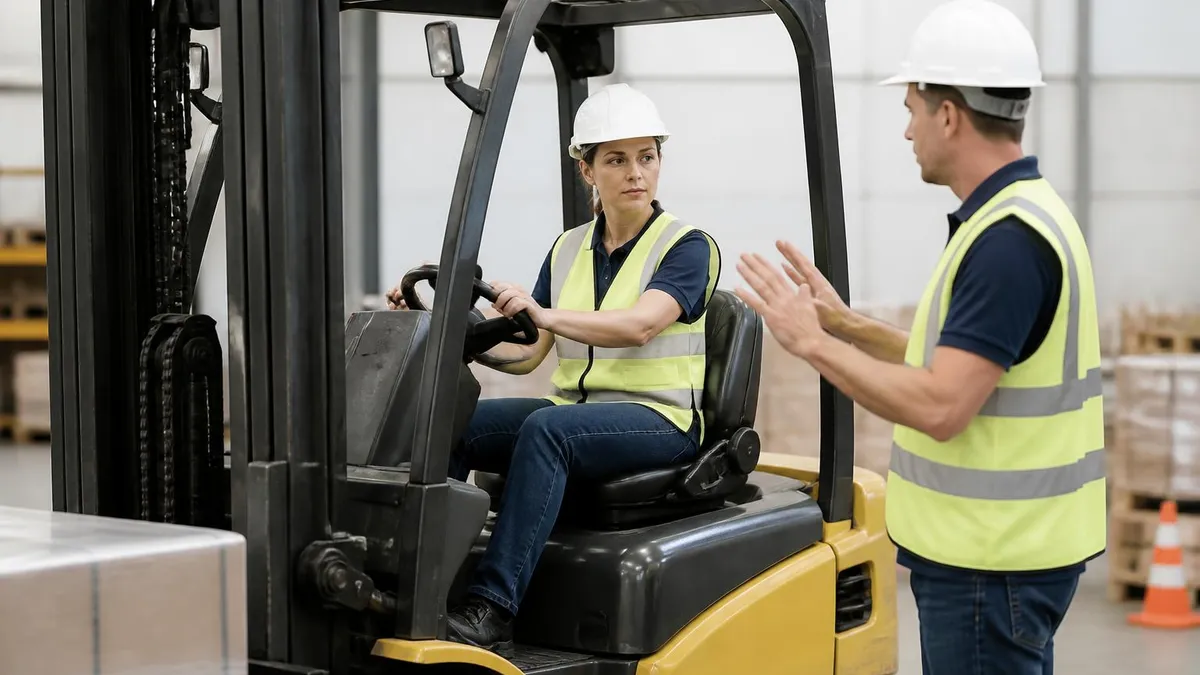
Good forklift training teaches operators what every safety device does and why it matters. Students learn to read the data plate, test the horn, check lights, fasten the restraint, and recognize when a truck should not be used. They also practice pedestrian awareness: slowing at intersections, sounding the horn at blind corners, and stopping completely when a person steps into the travel path instead of assuming they will move.
Classroom content typically covers truck types, load center, the stability triangle, and fueling or charging procedures. The hands-on portion adds driving in a controlled course, stacking and unstacking loads, and parking correctly with forks lowered and brake set. Instructors watch for habits like traveling with forks raised or turning on ramps, and correct them before they become permanent. Strong habits formed in training are very hard to replace later.
Many people assume a license issued by a training school lets them operate anywhere. In practice, the employer must evaluate the operator on the specific truck and environment. A driver who earned a card on a sit-down counterbalanced truck needs additional instruction before using a stand up forklift or a cherry picker forklift, because controls, restraints, and hazards differ. The paperwork should list the truck type the worker is approved to operate.
Online courses are common and can satisfy the classroom portion, but they cannot complete the hands-on evaluation. A qualified person at the workplace must observe the operator driving and handling loads. Costs vary, with online classroom modules often ranging from about 50 to 100 dollars and in-person programs costing more. Employers who pay for training usually reduce incident costs and may see lower insurance premiums over time.
Refresher training matters as much as the initial course. OSHA requires it when an operator is seen driving unsafely, is involved in an accident or near miss, receives a poor evaluation, or is assigned to a different type of truck. Changes to the workplace, such as new racking layouts or heavier pedestrian flow, also trigger retraining. Treat refreshers as a chance to introduce new equipment such as blue lights and speed limiters.
Documentation closes the loop. Employers must keep a record of each operator's name, training date, evaluation date, and the person who performed the evaluation. Auditors and insurers look at these records first after an incident. A neat file with dated inspection sheets, training certificates, and equipment repair logs shows that safety is managed consistently and that the blue light on the truck is part of a real program.
Practical Tips for Forklift Operators and Safety Managers
Start with a walk-through of your own site as if you were a pedestrian. Stand at each intersection, dock door, and blind corner and ask what you can see and hear. Mark spots where a truck appears suddenly, and note whether aisle mirrors, floor markings, or lights are present. Most sites find three or four hot spots that cause the majority of near misses, and fixing them is inexpensive.
Use a layered approach rather than relying on one device. Combine blue spot lights, audible alarms, speed limits, clear floor markings, and designated walkways. Each layer catches what another misses. For example, a blue light helps in a noisy area, while a horn helps when a worker is not looking at the floor. Layers also protect you when one component fails unnoticed.
Train pedestrians as well as operators. Workers on foot should know what the blue light means, stay out of the red zone, make eye contact before crossing, and never walk under raised forks. Include visitors, drivers, and temporary staff in a short orientation. Many pedestrian injuries involve people who simply did not know the rules of the aisle or assumed the operator had seen them.
Set realistic speed limits and enforce them. Five miles per hour is a common limit in many warehouses, with lower limits in congested zones. Speed-limiting devices can enforce this automatically, which removes the temptation to rush at the end of a shift. Slower travel gives the blue light time to be noticed and gives the operator time to stop within a safe distance.
Keep a simple defect log. When an operator reports a dim light, weak horn, or loose restraint, record the date, the truck number, and the repair. Review the log monthly for patterns, such as repeated light failures on one truck that suggest a wiring fault. A log also proves that your site takes small problems seriously, which strengthens your position in any inspection or claim discussion.
Plan lighting for the whole building, not just the truck. If general lighting falls below 2 lumens per square foot in aisles, add auxiliary lights on the trucks, as OSHA requires. Replace burned-out overhead fixtures promptly, and avoid placing bright lamps where glare blinds operators at intersections. Good lighting makes the blue spot easier to see and reduces eye strain during long shifts.
Finally, prepare for your exam or evaluation by practicing. Review the stability triangle, load capacity calculations, inspection items, and emergency procedures, then take timed quizzes to find weak areas. Use the practice questions linked below as part of a weekly routine, and discuss any missed answers with a supervisor. Confident, well-prepared operators are safer operators, and they will use every safety device correctly.
Forklift Questions and Answers
Forklift License vs Certification: OSHA Requirements, Cost, and Training
Forklift Price Guide 2026: New, Used, Rental, and Total Cost of Ownership Breakdown
Forklift Salary 2026: Complete Guide to Operator Pay, Certifications, and Career Growth
Forklift Maintenance Services: Complete Guide to Costs, Schedules, and Choosing the Right Provider for 2026
Forklift Certification Course: Complete Training Guide, Requirements, and Operator Tips for 2026
How this page was made: written with AI tools and published by Nathan Beja, founder of Practice Test Geeks, who is responsible for its content. Exam facts are checked against the official sources listed below. Not reviewed by a subject-matter expert. Editorial policy
Sources & references
Exam facts on this page (fees, format, dates, passing scores) are checked against these official sources; the date is our last check. Editorial policy
- osha.gov — Test delivery, eligibility, renewal · verified Oct 2026