
Forklift Weight and Specs: What Every Operator and Buyer Needs to Know
Learn typical forklift weight, specs, and rental tips. Get certified fast. ✅ Complete US guide for operators and buyers.

Understanding typical forklift weight is one of the most practical pieces of knowledge any warehouse worker, logistics manager, or aspiring forklift operator can have. A standard counterbalanced sit-down forklift weighs between 8,000 and 10,000 pounds — roughly two to three times the weight of a full-size pickup truck. That mass is not accidental; it exists to counterbalance heavy loads and keep the machine stable during lifts, turns, and travel across uneven surfaces.
When you start comparing forklifts across different classes and capacities, the weight differences become dramatic. A compact electric forklift designed for narrow-aisle warehouse work may weigh as little as 4,500 pounds, while a heavy-duty internal combustion model built for lumber yards or steel service centers can tip the scales at 20,000 pounds or more. Knowing where a specific machine falls on that spectrum affects floor-loading calculations, transport logistics, and the type of forklift training your operators need to complete before climbing into the cab.
Weight also plays a direct role in forklift rental decisions. Rental companies price machines partly by class and partly by how much specialized equipment is needed to deliver and position the unit at your facility. A lightweight electric forklift for indoor use is far easier to transport than a large propane-powered unit with pneumatic tires, and those delivery logistics are reflected in the rental rate. If you are comparing forklift rental options, understanding machine weight helps you anticipate total project costs.
The relationship between forklift weight and load capacity is governed by a concept called the load center, which is the horizontal distance from the face of the forks to the center of gravity of the load. Most capacity ratings assume a 24-inch load center. When you shift the load center forward — by carrying an unusually long or unevenly balanced pallet — the effective capacity drops, sometimes by 30 to 50 percent. This is a critical safety concept covered in every certification of forklift program in the United States.
For anyone shopping for a forklift for sale, weight specifications appear on the data plate mounted inside the cab. This plate lists the rated capacity, load center, lift height, and the machine's own operating weight. OSHA requires that data plates remain legible and that operators consult them before attempting any lift. Ignoring the data plate is one of the leading causes of tip-over accidents, which account for a significant share of the roughly 85 forklift-related fatalities reported in the US each year.
The stand up forklift, also called a reach truck or stand-up rider, represents a different category entirely. These machines are lighter than sit-down counterbalanced forklifts — typically 4,000 to 7,000 pounds — but are engineered for high-rack warehouses where aisle width is at a premium. Their compact footprint and high lift capacity make them indispensable in distribution centers, though they require specific operator training that goes beyond standard sit-down certification. You can find an overview of forklift weight and specs across all major classes to help you match the right machine to your facility.
Whether you are a new operator preparing for your certification exam, a facility manager evaluating a fleet upgrade, or a contractor pricing a short-term forklift rental near me search, weight and specifications form the foundation of every smart decision. The sections below break down each major forklift class, explain how weight interacts with safety rules, and give you the practical knowledge you need to pass your OSHA-mandated forklift operator evaluation on the first attempt.
Forklift Weight and Specs by the Numbers

Forklift Weight Classes: From Compact to Heavy-Duty
Three-wheel and four-wheel electric sit-down and stand up forklift models. Ideal for smooth indoor surfaces. Battery weight is a major component — a single lead-acid pack can weigh 1,500 to 3,000 pounds and doubles as counterbalance ballast.
Walkie stackers, pallet jacks, and reach trucks fall here. Lightweight and maneuverable, these machines are perfect for narrow aisles and mezzanine floors where floor-load limits are tight and heavier equipment is not permitted.
Propane, gasoline, and diesel sit-down forklifts. The pneumatic-tire version adds significant weight but handles outdoor ramps and uneven dock plates. These are the most common machines available through forklift rental companies nationwide.
Telescopic handlers, container handlers, and large rough-terrain lifts. Used in construction, ports, and steel mills. Operators need specialized forklift training beyond standard OSHA 29 CFR 1910.178 requirements for these high-capacity machines.
Every forklift specification sheet contains several numbers that directly affect how safely and effectively the machine can be operated, and understanding each one is essential for the forklift operator certification exam. The rated capacity is the maximum weight the machine can lift at its standard load center — typically 24 inches from the heel of the forks. This number is only valid when the mast is vertical and the forks are at a standard height; tilting the mast forward or raising the load significantly reduces safe lifting capacity.
The mast height specification tells you how high the forks can reach when fully extended. Standard warehouse forklifts offer free-lift heights of 130 to 188 inches, while high-reach models designed for very tall racking systems can extend to 300 inches or beyond. Free-lift refers to how far the forks can rise before the mast itself begins to extend — a critical measurement when working in low-clearance environments like truck trailers, where overhead obstructions are always a concern.
Wheelbase and overall length are key specifications for turning radius calculations. A longer wheelbase provides greater stability but requires wider aisles for maneuvering. The turning radius of a sit-down counterbalanced forklift with a 5,000-pound capacity is typically around 85 to 95 inches, while a stand up forklift of similar capacity may need only 75 inches of aisle width. These numbers should always be verified against your specific facility layout before committing to a forklift for sale or long-term rental.
Tire type is another specification that interacts heavily with weight distribution. Cushion tires — solid rubber units mounted directly on the wheel rim — offer lower ride height and a tighter turning radius, making them ideal for smooth warehouse floors. Pneumatic tires, whether solid or air-filled, provide better shock absorption on rough outdoor surfaces but raise the machine's center of gravity slightly, which affects stability ratings. The data plate accounts for this by listing capacity ratings specific to the tire configuration installed at the factory.
Lift speed and lowering speed are less-discussed specs but matter enormously in high-throughput operations. A typical electric forklift lifts at 80 to 100 feet per minute with a full load and can lower at up to 120 feet per minute with no load. Internal combustion forklifts tend to lift slightly faster under load — 100 to 120 feet per minute — because the engine can respond more aggressively to throttle input than a battery-powered motor operating under voltage constraints near the end of a charge cycle.
Hydraulic system pressure determines how smoothly the mast, tilt cylinders, and any attachments respond. Most standard forklifts operate their lift circuits at 2,500 to 3,500 PSI and their tilt circuits at slightly lower pressure. When attachments like rotators, clamps, or side-shifters are added, the hydraulic system must supply additional circuits, and the weight of those attachments must be subtracted from the machine's net load capacity. This is often miscalculated, leading to overloaded conditions that are technically invisible to an operator who only reads the base capacity plate.
Battery specifications are uniquely important for the electric forklift. A standard 48-volt, 1,000-amp-hour battery pack can weigh between 2,400 and 3,200 pounds and is integral to the machine's counterbalance system. Removing the battery — even temporarily for charging — fundamentally changes the machine's stability profile. OSHA regulations require that forklifts not be operated with a battery that has been substituted with a unit of significantly different weight without recalculating the machine's rated capacity. Many forklift training programs include this as a specific module to ensure operators understand why battery swaps must be carefully managed.
Electric Forklift vs. Propane vs. Diesel: Weight and Performance
An electric forklift typically weighs 4,500 to 8,000 pounds depending on capacity class, with a significant portion of that weight coming from the lead-acid or lithium-ion battery pack. The battery itself can account for 25 to 35 percent of the machine's total operating weight, which is by design — the battery serves as the primary counterbalance. Electric models produce zero direct emissions, making them the preferred choice for food-grade warehouses, cold storage facilities, and any indoor environment where air quality standards are strictly enforced.
Lithium-ion battery technology is changing the weight profile of electric forklifts. Lithium packs weigh roughly 40 percent less than equivalent lead-acid units, which means manufacturers must add ballast plates to maintain proper stability ratings. Opportunity charging — plugging in during lunch breaks rather than swapping entire battery packs — allows lithium-equipped forklifts to run multiple shifts without a dedicated charging room, significantly reducing infrastructure costs for fleet operators who rely on forklift rentals supplemented by owned machines.

Heavier vs. Lighter Forklifts: Tradeoffs for Your Operation
- +Greater counterbalance stability for heavy and awkward loads
- +Higher rated lift capacities without needing specialized attachments
- +More durable frames that withstand rough outdoor terrain and shock loads
- +Better traction on wet, sloped, or uneven surfaces due to tire footprint
- +Longer service life in high-cycle applications like ports and steel service centers
- +Fewer tip-over incidents when operators are properly trained on data plate limits
- −Heavier machines exceed floor load limits in many older warehouse buildings
- −Higher transport costs for forklift rental deliveries due to specialized flatbed requirements
- −Wider turning radius limits use in narrow-aisle storage configurations
- −Greater tire wear and higher maintenance costs per operating hour
- −Longer stopping distances at speed, increasing collision risk in busy facilities
- −Requires more advanced forklift operator certification and ongoing recertification hours
Pros and Cons at a Glance
| Pros | Cons |
|---|---|
| Greater counterbalance stability for heavy and awkward loads | Heavier machines exceed floor load limits in many older warehouse buildings |
| Higher rated lift capacities without needing specialized attachments | Higher transport costs for forklift rental deliveries due to specialized flatbed requirements |
| More durable frames that withstand rough outdoor terrain and shock loads | Wider turning radius limits use in narrow-aisle storage configurations |
| Better traction on wet, sloped, or uneven surfaces due to tire footprint | Greater tire wear and higher maintenance costs per operating hour |
| Longer service life in high-cycle applications like ports and steel service centers | Longer stopping distances at speed, increasing collision risk in busy facilities |
| Fewer tip-over incidents when operators are properly trained on data plate limits | Requires more advanced forklift operator certification and ongoing recertification hours |
Pre-Operation Weight and Spec Safety Checklist for Forklift Operators
- ✓Locate and read the data plate before every shift — confirm rated capacity and load center.
- ✓Verify the load weight using shipping documentation or a floor scale before lifting.
- ✓Calculate adjusted capacity if using a non-standard attachment that adds front-end weight.
- ✓Check that the battery or fuel level is adequate and recorded on the pre-shift inspection sheet.
- ✓Inspect tires for cuts, flat spots, or chunking that could alter the machine's stability profile.
- ✓Confirm the mast is vertical and forks are at the correct travel height before moving.
- ✓Ensure the load is centered on both forks and does not exceed the marked load center distance.
- ✓Verify floor load ratings are sufficient for the combined weight of machine plus maximum load.
- ✓Check that all hydraulic functions — lift, lower, tilt — operate smoothly with no hesitation.
- ✓Report any data plate damage, missing information, or weight discrepancies to your supervisor immediately.
The Stability Triangle: Why Forklift Weight Distribution Saves Lives
A forklift's stability depends on keeping its combined center of gravity — machine plus load — inside a triangular zone defined by the two front wheels and the rear axle pivot point. When the load is too heavy, the load center is too far forward, or the machine is turning at speed, the center of gravity shifts outside this triangle and tip-over becomes instantaneous. No operator reaction is fast enough to prevent it. Understanding this geometry is the single most important concept in every certification of forklift program in the United States.
Certification of forklift in the United States is governed by OSHA standard 29 CFR 1910.178(l), which requires that every powered industrial truck operator be trained and evaluated before operating any forklift in the workplace. The standard does not specify a single national exam or a government-issued license, which surprises many new operators. Instead, it places the responsibility on employers to ensure their workers are trained on the specific types of equipment they will operate in the specific workplace conditions they will encounter.
This employer-based model means that a forklift training certificate earned at a previous job does not automatically transfer to a new employer. If you were certified on a propane sit-down forklift at a distribution center and then take a new position where you will operate an electric reach truck in a high-rack warehouse, your new employer is required to conduct a fresh evaluation. The machines are different classes with fundamentally different weight distributions, turning characteristics, and stability profiles, and OSHA recognizes that cross-training cannot be assumed.
The practical evaluation component of OSHA forklift certification directly tests a candidate's understanding of weight-related concepts. Evaluators observe whether the operator checks the data plate, whether they verify load weight before lifting, and whether they correctly adjust their travel speed and turning behavior when carrying a load near the machine's rated capacity. Candidates who treat the forklift as a simple point-and-drive machine — ignoring the physics of shifting load centers and stability triangles — consistently fail the evaluation, even if they pass a written exam on the same topics.
For workers who are new to the industry, accredited forklift training programs typically run four to eight hours for the initial certification, combining classroom instruction on OSHA regulations and forklift physics with hands-on practical time on the actual equipment. Refresher training is required every three years at minimum, or sooner if the operator is involved in an incident, observed operating unsafely, or assigned to a new type of equipment. Many employers conduct annual evaluations to exceed the OSHA minimum and reduce liability exposure.
The cost of forklift certification training varies by provider and format. On-site employer-sponsored training is the most common and typically the least expensive option, since OSHA allows employers to self-certify their programs.
Third-party training companies charge between $75 and $200 per operator for group sessions, while online-only certification programs — which many OSHA compliance experts consider insufficient on their own, since the practical evaluation component cannot be completed virtually — are available for as little as $20 to $50. A hybrid approach, using an online course for classroom content and a workplace supervisor for the practical evaluation, satisfies OSHA requirements at a reasonable cost.
Understanding forklift weight and specifications is a core component of the written portion of most certification exams. Questions typically ask candidates to interpret a data plate, calculate whether a given load is within the machine's rated capacity at a specific load center, and identify which machine class is appropriate for a described application. Practice tests that mirror these question formats are the most efficient way to prepare, since they reinforce both the memorization of key numbers and the reasoning process needed to apply those numbers to real-world scenarios.
Operators who earn their certification with a strong grounding in weight and specification concepts consistently demonstrate better safety records than those who view certification as a procedural checkbox. The physics of a 9,000-pound machine carrying a 4,500-pound load at speed does not forgive inattention, and the operators who internalize the stability triangle concept — rather than simply memorizing it for a test — are the ones who build long, incident-free careers as forklift operators in warehouses, manufacturing facilities, and distribution centers across the United States.

OSHA standard 29 CFR 1910.178(e) requires that every forklift display a legible data plate at all times. Operating a forklift with a missing, damaged, or altered data plate is a citable violation that can result in fines starting at $15,625 per incident under OSHA's current penalty structure. If a data plate is worn or missing, the machine must be taken out of service until the manufacturer or an authorized dealer provides a replacement. Never attempt to estimate capacity from memory or informal operator knowledge.
Forklift rental is the most practical path for businesses that need lift capacity for a project, seasonal surge, or equipment trial before committing to a purchase. The US forklift rental market covers every class from compact electric warehouse units to large rough-terrain machines, with daily rates starting around $150 to $250 for a standard sit-down propane forklift and weekly rates ranging from $500 to $1,200 depending on capacity class and geographic market. Monthly rentals for the same machines typically run $1,500 to $3,500, with discounts available for multi-unit commitments or extended contract terms.
When you search for forklift rental near me, the results will typically include national equipment rental chains like United Rentals, Sunbelt Rentals, and Maxim Crane Works, as well as regional dealers who often offer more competitive pricing and faster delivery windows for customers with ongoing needs. National chains have the advantage of broad inventory and standardized maintenance protocols, while local dealers may provide more flexible terms and faster response to service calls when equipment breaks down mid-project.
One often-overlooked aspect of forklift rental pricing is the delivery and pickup charge, which is directly tied to machine weight. A standard sit-down forklift weighing around 9,000 pounds requires a flatbed trailer and a pickup truck or medium-duty tow vehicle for transport. Larger machines — particularly rough-terrain forklifts weighing 15,000 to 20,000 pounds — require a step-deck or lowboy trailer and may need a pilot car for highway transport depending on state regulations. These transport costs can add $200 to $600 to a rental transaction, which catches many first-time renters off guard when they receive their final invoice.
The decision between renting and buying forklifts is largely driven by utilization rate. The general industry rule of thumb is that equipment used more than 60 to 70 percent of available working hours on an ongoing basis is a candidate for purchase rather than rental. Below that threshold, the flexibility and reduced maintenance burden of rental typically wins on a total-cost-of-ownership analysis. For businesses that need a forklift for one specific project — a facility move, a trade show, or a seasonal inventory buildup — rental is almost always the right answer regardless of utilization rate during that specific window.
Forklift for sale listings on platforms like Machinery Trader, Iron Planet, and Equipment Trader include detailed specification sheets that allow buyers to compare operating weight, capacity, lift height, and hours of use across multiple machines.
When evaluating a used forklift purchase, the operating hours are analogous to mileage on a used car — a machine with 8,000 to 10,000 hours on a well-maintained propane engine is nearing the end of its productive life, while an electric forklift with the same hours on a recently replaced battery pack and a rebuilt motor may have many productive years remaining. Weight-related components like the counterweight and mast assembly are virtually maintenance-free in normal operation, so their condition is rarely a purchase differentiator for standard warehouse machines.
Fleet managers who oversee multiple forklifts across a large facility benefit enormously from standardizing on a single machine class and weight range. When all forklifts in a fleet have similar operating weights, floor-load calculations become simpler, driver cross-training is more efficient, and spare parts inventory can be consolidated. Mixed fleets — combining heavy-duty outdoor IC machines with lightweight electric indoor units — require more complex maintenance programs, separate parts bins, and operator certification on multiple equipment classes. The administrative overhead is manageable for large operations, but for mid-size facilities it is worth paying a slight premium for standardization.
Before finalizing any forklift rental or purchase decision, review the complete weight and specification data against your facility's structural drawings, aisle dimensions, and racking load ratings. A forklift that is theoretically correct for your load requirements but too heavy for your slab or too wide for your aisles creates operational problems that cannot be solved with training alone. The investment of an hour with a facility engineer and a forklift dealer's application specialist will save far more time and money than discovering a floor-load conflict after the machine has already been delivered and put into service.
Passing your forklift operator certification exam on the first attempt requires more than memorizing OSHA regulation numbers. It requires building a mental model of how forklift weight, load weight, and machine geometry interact to create safe or dangerous conditions. The most effective study strategy combines reading the official OSHA forklift safety guidelines with hands-on exposure to the equipment you will be evaluated on, and then reinforcing both with targeted practice tests that mirror the question formats used in real evaluations.
Start your preparation by downloading the OSHA publication on powered industrial truck safety, which is available free of charge on the OSHA website. This document covers all major forklift classes, explains the stability triangle in plain language with diagrams, and walks through the data plate interpretation process step by step. Read it at least twice — once for general familiarity and once specifically looking for the numbers and thresholds that appear most frequently in certification exam questions, such as the 24-inch load center standard, the three-year recertification interval, and the requirement for pre-shift inspections before every operating period.
After working through the regulatory material, shift to practical application. If you have access to a forklift through your employer or a training facility, spend time reading the data plates on multiple machines and calculating hypothetical load scenarios. Can the machine you are sitting in safely lift a 4,000-pound load at a 30-inch load center?
What about a 3,500-pound load at a 36-inch load center? These calculations are straightforward once you understand the load moment principle — capacity decreases proportionally as load center distance increases — but they feel abstract until you have physically stood at the heel of the forks and visualized the geometry.
Practice tests are the bridge between theoretical knowledge and exam confidence. The most valuable questions are those that present a machine with a specific data plate and ask you to evaluate whether a described load is within safe limits, or that describe an operational scenario and ask you to identify the correct response. These scenario-based questions test reasoning, not memorization, and they are the format most commonly used by professional evaluators conducting OSHA-compliant practical assessments in the field.
Time management matters on longer written exams. Many certification programs include 50 to 100 questions, and candidates who spend too long on calculation-heavy questions early in the test run out of time for the straightforward regulatory questions at the end — which are often the easiest points to capture.
Practice under timed conditions using sets of 25 to 50 questions to build the pacing instincts you need on test day. After each practice session, review every question you got wrong and trace the error back to a specific knowledge gap, whether it is a misremembered number, a misunderstood concept, or a calculation error in load center adjustment.
On the day of your practical evaluation, arrive with your pre-shift inspection process already rehearsed. Walk around the machine systematically — tires, forks, mast, overhead guard, data plate, fluid levels, battery or fuel — and narrate what you are checking to the evaluator. This demonstrates that your inspection process is methodical and complete, not reactive.
When the evaluator asks you to perform a load movement, confirm the load weight against the data plate before touching the controls. This single habit — pausing to verify capacity before lifting — is the behavior that separates operators with strong safety instincts from those who will eventually be involved in a weight-related incident.
After earning your initial certification, treat the three-year recertification requirement as a floor, not a ceiling. Operators who voluntarily seek additional training on specialized equipment classes, updated OSHA guidance, and emerging technologies like lithium-ion battery management and telematics-enabled load monitoring are the ones who advance to lead operator, trainer, and fleet management roles. The forklift industry is evolving rapidly, with autonomous and semi-autonomous lift trucks entering commercial service at major distribution centers, and the operators who combine strong foundational knowledge with a commitment to ongoing learning will be best positioned to grow with it.
Sample Forklift certification Practice Questions
Try these questions from our free Forklift certification practice tests. The correct answer and an explanation follow each question.
A forklift operator needs to lift a pallet that is not centered and has its weight concentrated on one side. What is the safest way to handle this off-center load?
- A. Lift with only one fork positioned under the heaviest part.
- B. Position the forks so the heaviest part of the load is closest to the mast.
- C. Drive faster than usual to minimize travel time with the unstable load.
- D. Counterbalance the load by having another person stand on the opposite side of the forklift.
Answer: B. Position the forks so the heaviest part of the load is closest to the mast.
When a load cannot be centered, the heaviest part should be positioned as close to the mast (or carriage) as possible. This minimizes the load center distance and helps keep the combined center of gravity within the stability triangle.
A forklift operator needs to move a large, palletized load that obstructs their forward view. What is the safest way to travel?
- A. Raise the load slightly higher to try and see underneath it.
- B. Drive in reverse, looking in the direction of travel.
- C. Proceed forward slowly, using the horn continuously.
- D. Ask a nearby coworker to walk in front and guide them.
Answer: B. Drive in reverse, looking in the direction of travel.
When a load blocks the forward view, the safest and OSHA-recommended procedure is to drive the forklift in reverse. The operator must turn and look in the direction of travel to maintain a clear view of the path and any potential hazards.
The process of lifting loads onto loading out racking is about to commence. Before you start, what do you need to know?
- A. The upper weight that the racking tower can safely hold
- B. What material the racking tower is made of
- C. The length of the forklift
- D. Whether the load is correctly insured
Answer: A. The upper weight that the racking tower can safely hold
Before lifting loads onto racking, it is critical to know the maximum weight the racking tower can safely support. Exceeding this weight limit can lead to structural failure, causing the racking to collapse and resulting in severe accidents, injuries, or fatalities. This information ensures the load is within the racking's capacity, maintaining safety and preventing damage.
What part of the inspection ensures the operator can safely stop the forklift?
- A. Horn test
- B. Service and parking brake test
- C. Seat adjustment
- D. Mirror cleaning
Answer: B. Service and parking brake test
Testing both the service brake and parking brake confirms the truck can stop and hold safely.
Forklift Questions and Answers
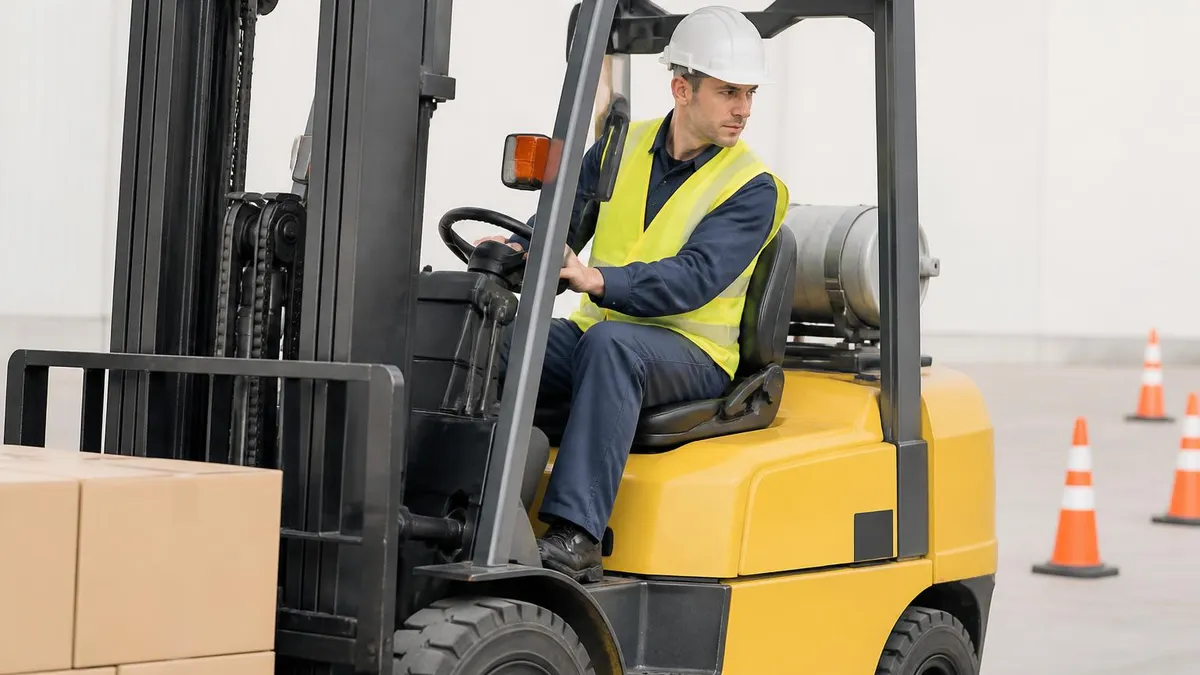
Forklift Rentals: Complete Guide to Pricing, Types, and Operator Requirements
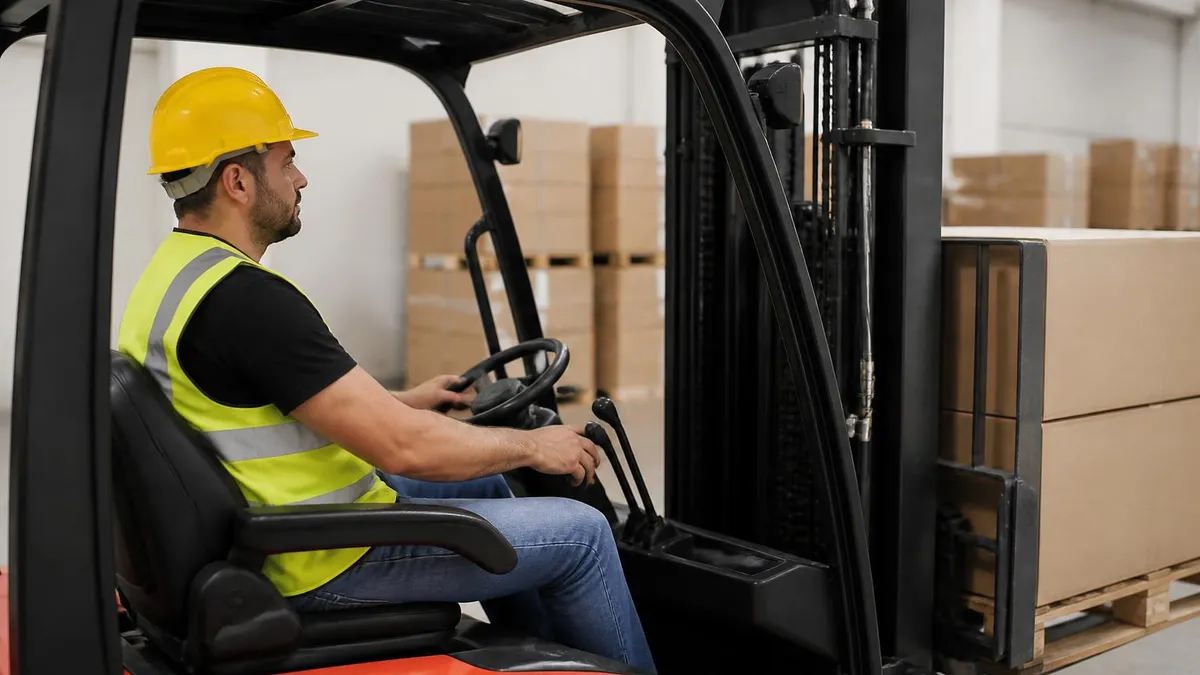
Forklift Hydraulic Fluid: Complete Guide to Types, Specifications, Change Intervals, and Troubleshooting for 2026
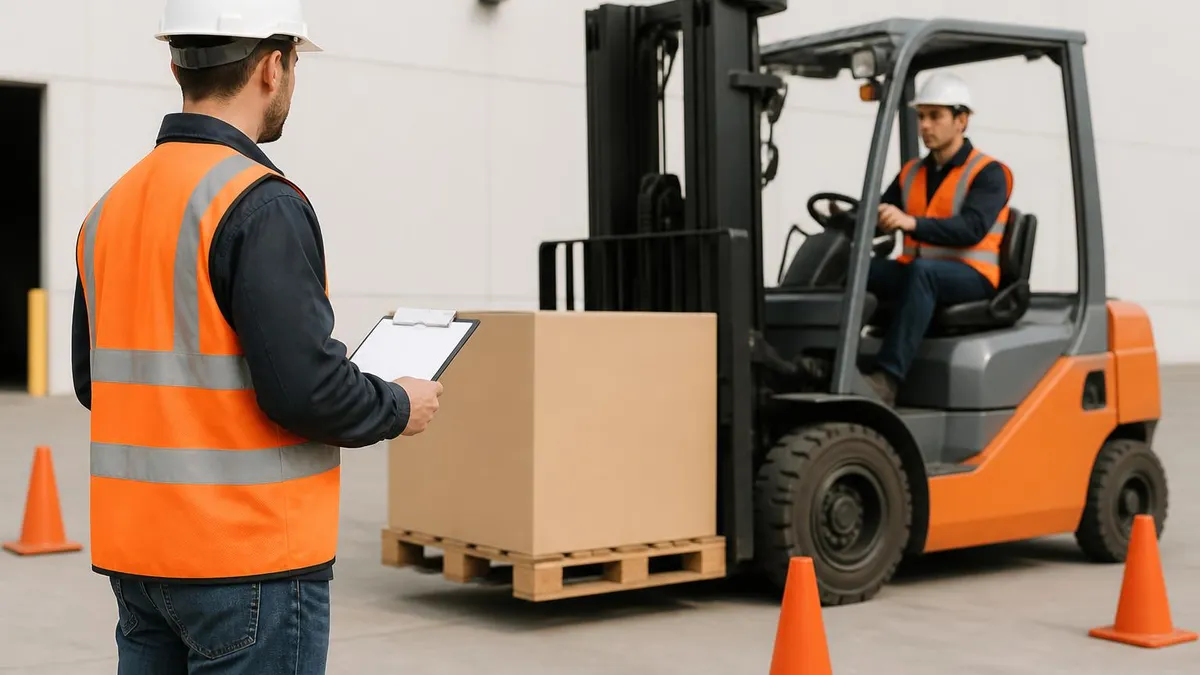
Forklift Parts and Maintenance: Complete Guide to Batteries, Chargers, and Replacement Components
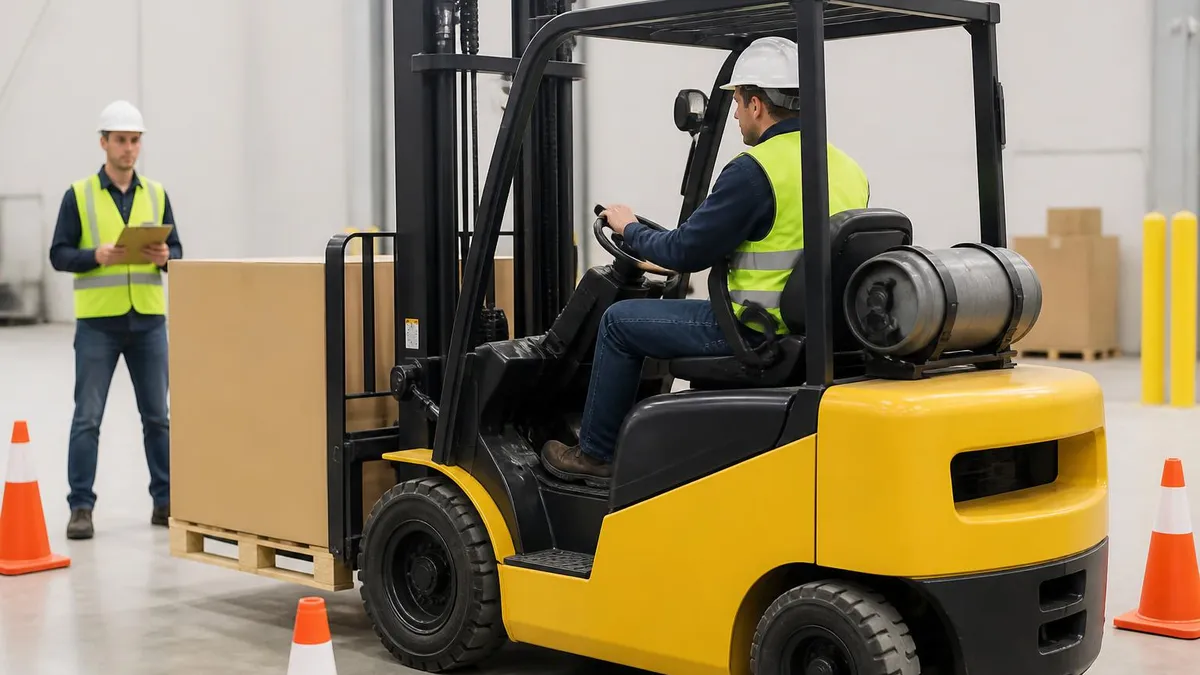
Big Forklift Guide: Heavy-Duty Lift Trucks, Capacity Classes, Rental Costs, and Operator Requirements
Forklift License Renewal: Complete Guide to Forklift License Expiry, OSHA Recertification, and Operator Requirements for 2026
About the Author

Certified Crane Operator & Skilled Trades Exam Specialist
Ferris State UniversityRobert Martinez is a Journeyman Ironworker, NCCCO-certified crane operator, and forklift trainer with a Bachelor of Science in Construction Technology from Ferris State University. He has 21 years of ironworking, rigging, and heavy equipment operation experience across high-rise and industrial construction sites. Robert prepares candidates for crane operator, rigger, forklift, and skilled trades certification examinations.