
Forklift LP Gas: Complete Guide to Propane Forklifts, Certification, Training, and Rental
Learn about forklift LP gas systems, rental costs, certification requirements, and training. Everything forklift operators need to know. 🎓

Forklift rental is one of the most practical ways for businesses to access reliable material-handling equipment without the upfront cost of ownership, and LP gas forklifts — commonly called forklift lp units — dominate the rental market across warehouses, distribution centers, and construction sites throughout the United States. Propane-powered forklifts have earned their reputation because they combine the power output needed for heavy industrial tasks with the flexibility to operate both indoors and outdoors, something neither pure electric nor diesel machines can match as effectively.
Understanding how LP gas systems work on forklifts is essential knowledge for any forklift operator, supervisor, or facility manager. Propane is stored in pressurized steel or composite cylinders — typically 33-pound tanks holding approximately 8 gallons of liquid propane — and is delivered to the engine through a regulator that converts the liquid fuel into a combustible vapor. Most LP forklift engines in North America displace between 2.0 and 4.0 liters and produce between 50 and 100 horsepower, giving them comparable performance to internal combustion counterparts running on gasoline.
The certification of forklift operators is a federal requirement under OSHA standard 29 CFR 1910.178, and this requirement applies regardless of whether the machine runs on propane, electricity, or diesel fuel. However, LP-specific training adds an extra layer of safety knowledge because workers must understand proper cylinder handling, leak detection, and safe fueling procedures. An improperly connected propane cylinder can lead to fuel leaks, fire hazards, or sudden loss of power at precisely the wrong moment — all scenarios that comprehensive forklift training is designed to prevent.
The market for forklifts and related equipment has grown significantly in recent years, driven by the expansion of e-commerce fulfillment, the reshoring of manufacturing, and increased infrastructure investment across the country. Industry analysts estimate the North American forklift market at roughly $7 billion annually, with LP gas models accounting for approximately 35 to 40 percent of all new industrial truck registrations. That figure underscores why understanding propane systems matters not just for safety but for career advancement in the logistics and warehousing sectors.
When businesses search for a forklift rental near me, they frequently encounter LP gas units as the default option because propane is widely available, cylinders can be swapped out in under five minutes, and the machines deliver consistent power throughout a full shift.
Unlike electric forklifts that require multi-hour charging cycles, a propane forklift can be refueled and back in service almost instantly — a critical advantage in high-throughput operations where every minute of downtime has a measurable cost. A stand up forklift powered by propane is a common sight in retail distribution, where operators need both maneuverability and sustained runtime.
For businesses deciding between purchasing and renting, a forklift for sale listing typically shows prices ranging from $15,000 for a used LP unit to $45,000 or more for a new high-capacity propane truck. Rental contracts, by contrast, can start as low as $500 per month for a small-capacity machine, making forklift rentals an attractive option for seasonal operations, project-based work, or companies that need to scale their fleet rapidly without capital expenditure. The choice between buying and renting depends heavily on utilization rates, maintenance capabilities, and the duration of the intended use case.
This guide covers everything you need to know about LP gas forklifts — from how propane systems work and what OSHA requires for operator certification, to practical advice on training programs, rental pricing, and the daily checks that keep propane-powered equipment running safely and efficiently. Whether you are a new forklift operator preparing for your certification exam or a fleet manager evaluating your equipment options, the information here will give you a solid foundation for making informed decisions.
Forklift LP Gas Industry by the Numbers

How an LP Gas Forklift System Works: Step by Step
Propane Stored in Pressurized Cylinder
Regulator Converts Liquid to Vapor
Fuel Delivered to Carburetor or Fuel Injection
Engine Produces Power for Hydraulics and Drive
Exhaust Treated and Vented
Cylinder Swap Restores Full Runtime
Forklift training is not optional in the United States — it is a legal requirement backed by OSHA enforcement authority, and violations can result in fines of up to $16,131 per serious violation or $161,323 for willful or repeated violations. Every employer who operates forklifts must ensure that each forklift operator is trained and evaluated before operating any powered industrial truck, and that evaluation must cover the specific type of truck the operator will actually use. This means an operator certified on an electric stand-up reach truck must receive additional training and evaluation before driving an LP sit-down counterbalanced forklift.
The structure of forklift certification is employer-driven under OSHA rules — meaning an employer (or a qualified trainer they designate) administers the training and evaluation rather than a government agency. Training must cover formal instruction (lectures, videos, written materials), practical training (hands-on demonstrations and exercises), and an evaluation of the operator performing tasks in the workplace. Third-party training programs from organizations like the National Safety Council, trade associations, and private training providers can satisfy the formal instruction component, but the workplace evaluation must still occur at the actual job site.
For LP gas forklifts specifically, training programs should include dedicated modules on propane fuel system safety. This covers recognizing symptoms of a cylinder leak (the distinctive rotten-egg odor from added mercaptan, visible frost on the cylinder valve in cold weather, or hissing sounds near fuel connections), the correct procedure for safely exchanging cylinders in compliance with NFPA 58 (the Liquefied Petroleum Gas Code), and what to do in the event of a propane fire or uncontrolled leak. These scenarios are not hypothetical — the U.S. Fire Administration reports that propane-related incidents cause hundreds of injuries annually in industrial settings.
The certification of forklift operators must be refreshed at least every three years, and employers must also re-evaluate operators more frequently whenever an unsafe operation is observed, an accident or near-miss occurs, or the operator is assigned to a different type of equipment. Keeping documentation of all training, evaluations, and recertification dates is critical because OSHA inspectors commonly request these records during site inspections. A missing training record is treated the same as no training at all from an enforcement standpoint.
Forklift training courses range from free online modules to multi-day classroom-and-hands-on programs costing $150 to $500 per person. Online-only courses can satisfy the formal instruction requirement but cannot substitute for the mandatory hands-on evaluation. A hybrid approach — completing written and video coursework online, then conducting a supervised workplace evaluation — is both cost-effective and OSHA-compliant. Many companies find it economical to train one or two internal employees as qualified evaluators who can then certify the entire workforce on an ongoing basis.
The forklift operator job market is strong across the United States, with the Bureau of Labor Statistics reporting median annual wages of approximately $40,000 to $50,000, and experienced operators with LP certification and multiple truck-type endorsements often earning $55,000 to $65,000 or more. Operators who also hold hazardous materials handling credentials, reach truck certifications, or experience with high-capacity machines (above 10,000-pound capacity) command premium wages in logistics hubs like the Inland Empire in California, the Dallas–Fort Worth metroplex, and the Chicago area. Investing in comprehensive forklift training pays dividends in both safety outcomes and earning potential throughout a career.
Electric forklifts have grown in popularity due to zero direct emissions and lower per-hour fuel costs, but LP forklifts still hold a decisive advantage in applications requiring all-day runtime without downtime, outdoor use in wet or rough conditions, or operations in facilities without adequate electrical infrastructure for charging stations. Understanding both propane and electric systems — and holding certification across multiple truck types — positions a forklift operator as a highly valuable asset in today's competitive labor market, where skilled, safety-conscious operators are consistently in demand.
LP Gas vs Electric Forklift vs Stand Up Forklift: Which Is Right for You?
LP gas forklifts are the most versatile option for operations that span both indoor and outdoor environments. Propane engines deliver consistent power throughout the entire shift without the performance fade that electric batteries experience as they discharge, and a cylinder swap takes less than five minutes compared to an eight-hour recharge cycle for lead-acid batteries. This makes LP the preferred choice in multi-shift facilities like food distribution warehouses, building material yards, and automotive parts distribution centers where continuous runtime is non-negotiable.
From a cost perspective, propane fuel typically runs between $2.50 and $4.00 per gallon depending on location and contract pricing, and a standard 33-pound cylinder provides roughly six to eight hours of runtime under normal working conditions. Maintenance costs for LP engines are well understood because the technology is mature — most diesel and LP forklift mechanics can service propane systems with existing tools and training. The main environmental consideration is carbon monoxide output, which requires proper ventilation management in enclosed spaces and periodic exhaust system inspections to ensure CO stays within OSHA limits.

LP Gas Forklifts: Advantages and Disadvantages
- +Consistent full-power performance throughout entire shift with no voltage fade
- +Cylinder swap in under 5 minutes eliminates multi-hour downtime for recharging
- +Suitable for both indoor and outdoor operation in a single machine
- +Widely available propane supply with established dealer networks across the US
- +Lower purchase price compared to equivalent lithium-ion electric models
- +Mature maintenance ecosystem — most technicians already trained on LP engines
- −Produces carbon monoxide requiring ventilation management in enclosed spaces
- −Ongoing propane fuel cost adds up over years compared to electricity rates
- −Cylinder storage and handling require NFPA 58 compliance and dedicated storage areas
- −Higher emissions footprint than electric, conflicting with sustainability goals
- −Propane prices fluctuate with energy markets, making budgeting less predictable
- −Regular engine maintenance (spark plugs, filters, regulators) adds service complexity
Pros and Cons at a Glance
| Pros | Cons |
|---|---|
| Consistent full-power performance throughout entire shift with no voltage fade | Produces carbon monoxide requiring ventilation management in enclosed spaces |
| Suitable for both indoor and outdoor operation in a single machine | Ongoing propane fuel cost adds up over years compared to electricity rates |
| Widely available propane supply with established dealer networks across the US | Higher emissions footprint than electric, conflicting with sustainability goals |
| Lower purchase price compared to equivalent lithium-ion electric models | Propane prices fluctuate with energy markets, making budgeting less predictable |
| Mature maintenance ecosystem — most technicians already trained on LP engines | Regular engine maintenance (spark plugs, filters, regulators) adds service complexity |
Forklift LP Gas Pre-Shift Safety Checklist for Operators
- ✓Inspect the LP cylinder for dents, corrosion, damaged valves, or expired recertification dates before mounting.
- ✓Check the cylinder connection O-ring for cracks, deformation, or missing material before attaching the fuel line.
- ✓Open the cylinder valve slowly and sniff for any propane odor indicating a fuel system leak.
- ✓Verify the fuel gauge or check cylinder weight to confirm adequate fuel for the planned shift duration.
- ✓Start the engine and check for rough idling, hesitation, or stalling that could signal regulator or fuel delivery issues.
- ✓Test the horn, lights, and backup alarm to ensure all warning systems are fully operational before operating.
- ✓Inspect the mast, forks, and carriage for cracks, bends, or wear that could compromise load stability or structural integrity.
- ✓Check tire condition and pressure — LP forklifts are heavier than electrics, making proper inflation critical for stability.
- ✓Verify hydraulic fluid level and check for leaks around hoses, cylinders, and fittings beneath the machine.
- ✓Confirm your OSHA certification is current and that you are authorized to operate this specific type of LP forklift.
Carbon Monoxide Is the Hidden Hazard of Indoor LP Operation
OSHA requires CO levels to stay below 35 PPM as an 8-hour time-weighted average in workplaces. A poorly tuned LP forklift engine can produce CO levels 10 to 20 times above this limit in poorly ventilated spaces. Always verify exhaust tune-up dates on rental units, and never operate an LP forklift in a sealed enclosure without confirmed, adequate ventilation — symptoms of CO poisoning (headache, dizziness, nausea) can appear within minutes at high concentrations.
The cost of renting or purchasing forklifts and understanding the full financial picture is essential for any business making equipment decisions. Forklift rental rates vary significantly by machine capacity, geographic market, and contract duration, but broad benchmarks help businesses set realistic budgets. For a standard 5,000-pound capacity LP sit-down counterbalanced forklift — the most common configuration in the United States — monthly rental rates typically range from $800 to $1,500 for a new or late-model machine, while daily rates for short-term forklift rentals run $150 to $350 depending on the equipment dealer and local market conditions.
Long-term rental contracts (12 months or more) generally unlock the best per-month pricing and often include maintenance packages covering scheduled service, filter and spark plug replacement, and emergency breakdown support. This bundled approach is particularly attractive for businesses that lack in-house forklift maintenance expertise, because an out-of-service forklift can disrupt warehouse throughput far more expensively than the cost of the maintenance contract itself. When comparing rental quotes, always confirm whether the rate includes LP fuel delivery, maintenance, and tires — or whether these are billed separately.
For businesses evaluating a forklift for sale, the purchase decision hinges on utilization. Industry rule of thumb suggests that owning becomes more cost-effective than renting when a machine operates more than 2,000 hours per year (roughly full-time, single-shift use). A new Class 4 or Class 5 LP internal-combustion forklift with 5,000-pound capacity typically lists between $25,000 and $40,000 from major manufacturers such as Toyota, Crown, Hyster, Yale, Caterpillar, and Mitsubishi.
Used LP forklifts with 5,000 to 8,000 hours can be purchased for $8,000 to $18,000, though buyers should budget for near-term maintenance including regulator service, cooling system flush, and transmission service.
Propane fuel costs are a significant ongoing operating expense that buyers often underestimate. At $3.00 per gallon and consumption of approximately 1.5 gallons per hour, a forklift running two shifts (16 hours) daily consumes roughly $72 in propane per day — about $18,000 to $20,000 per year at five-day-week utilization. Companies operating large LP fleets often negotiate direct contracts with propane suppliers for bulk pricing and on-site tank delivery, which can reduce per-gallon costs by 20 to 30 percent compared to exchanging pre-filled cylinders through a forklift dealer or industrial gas retailer.
When searching for a forklift rental near me, it is worth contacting not just national chains like Sunbelt Rentals, H&E Equipment Services, and United Rentals, but also local and regional equipment dealers who may offer more competitive pricing, better local service response times, and the ability to negotiate flexible terms.
Regional dealers often have newer LP fleets because they turn over equipment more frequently to attract local customers, and they may provide free delivery and pickup within a defined radius — a cost that national chains sometimes charge separately. Getting three quotes before signing any rental agreement is standard practice for operations managers.
For businesses considering forklifts as a capital investment, Section 179 of the IRS tax code allows the full purchase price of qualifying equipment — including LP forklifts — to be deducted in the year of purchase rather than depreciated over the equipment's useful life. For a $35,000 LP forklift purchase in 2026, this deduction can effectively reduce the after-tax cost to under $25,000 for a business in the 28 percent federal tax bracket, making ownership even more financially competitive with long-term rental. Consulting a tax advisor familiar with equipment financing is strongly recommended before making large fleet decisions.
The forklift rental and used-equipment market has experienced significant price volatility since 2020, driven by supply chain disruptions affecting new machine production, increased demand from e-commerce and manufacturing reshoring, and inflationary pressure on labor and materials. As of 2026, new forklift lead times from major manufacturers range from three to twelve months for popular configurations, which has pushed many buyers toward the used market or extended rental contracts. Understanding these market dynamics helps businesses make better-timed purchasing decisions and negotiate more effectively with equipment dealers and rental companies.

NFPA 58 (Liquefied Petroleum Gas Code) mandates that spare LP cylinders be stored outdoors or in a dedicated, ventilated storage area away from ignition sources, drains, and building openings. Storing full or empty propane cylinders inside a warehouse without proper compliance is a fire code violation that can result in facility closure and insurance policy cancellation. Always verify that your cylinder storage setup has been reviewed by your local fire marshal or a qualified LP gas safety inspector.
Passing your forklift certification exam and succeeding as a forklift operator requires more than memorizing OSHA regulations — it demands a practical understanding of the physics of load handling, the mechanics of the specific equipment you operate, and the situational awareness to make safe decisions in a dynamic, often unpredictable warehouse or job site environment.
Most employer-administered evaluations assess both written knowledge and observed performance, so preparation must address both dimensions. Online practice tests are one of the most effective tools for building written knowledge, and the practice questions available on PracticeTestGeeks.com are designed specifically to mirror the types of questions evaluators use in formal certification assessments.
The physics of forklift stability are fundamental knowledge for any operator, and the concept most commonly tested on certification evaluations is the stability triangle. On a sit-down counterbalanced forklift, the machine's stability is determined by the triangle formed between the two front wheels (the drive axles) and the single rear steering axle's pivot point.
The combined center of gravity of the forklift plus its load must remain within this triangle for the machine to remain stable — when a load is too heavy, carried too high, or positioned too far forward on the forks, the center of gravity shifts forward of the front axle and a forward tip-over becomes possible.
Load capacity ratings are a critical area of forklift operator knowledge that is consistently tested on certification exams. The nameplate capacity shown on a forklift's data plate is rated at a specific load center — typically 24 inches for standard 48-inch pallets — and at a specific mast height with the mast in the fully lowered and tilted-back position.
Raising the mast, extending attachment reach, or using an attachment (like a side-shifter or paper roll clamp) all reduce the effective capacity of the truck. Operators who do not understand these derating factors risk tipping over machines that appear to have adequate rated capacity for the load they are attempting to lift.
Pre-shift inspections are another major focus of certification training and examinations. OSHA requires operators to inspect their forklift before each shift, and the inspection must cover both the operational and safety systems of the machine. For an LP forklift, this means checking the propane fuel system in addition to the standard items covered on all powered industrial trucks — brakes, steering, mast and carriage components, tires, lights, and warning devices.
Knowing what to look for and how to document deficiencies correctly is tested on both written evaluations and practical assessments, so operators should practice conducting full pre-shift inspections as part of their certification preparation.
Pedestrian safety is consistently one of the highest-priority topics in forklift safety programs, and for good reason — the Bureau of Labor Statistics reports that forklift-related fatalities kill approximately 85 workers per year in the United States, and a significant proportion of those fatalities involve pedestrians struck by forklifts in shared work areas.
Certification evaluations test knowledge of pedestrian right-of-way rules, proper horn usage at blind intersections, speed limits in pedestrian zones, and safe loading-dock procedures. Operators must understand that a forklift traveling at just 5 MPH with a 5,000-pound load has enormous kinetic energy and cannot stop nearly as quickly as a road vehicle.
Ramp and grade operations are another commonly tested area, particularly relevant for LP forklifts used in construction, lumber yards, and outdoor material handling. OSHA specifies that loads must be carried on the uphill side when traveling on grades — meaning you drive forward going up a ramp with a load and in reverse going down.
This rule prevents the load from rolling forward if the forklift stops or loses traction on the slope. Understanding the maximum grade ratings for your specific machine, which are listed on the data plate or in the operator's manual, is essential for safe ramp operations and will be evaluated during your certification assessment.
Emergency procedures are the final major area that certification programs address, and many operators find these questions among the most anxiety-provoking because they involve high-stakes scenarios that demand calm, correct action under pressure. If a forklift begins to tip over, the correct response is counterintuitive: do not jump — brace yourself against the steering wheel, grip the wheel firmly, and lean away from the direction of fall.
Jumping out of a tipping forklift has killed operators who were then crushed by the falling overhead guard. LP-specific emergencies include cylinder leaks (leave the area immediately, do not attempt to reconnect, call emergency services and the propane supplier) and fuel system fires (do not attempt to extinguish a propane fire if the fuel source cannot be safely shut off — evacuate and call the fire department).
Preparing effectively for your forklift certification evaluation requires a structured approach that addresses both the theoretical knowledge tested on written assessments and the practical skills evaluated during observed operation. The most successful candidates treat certification preparation the same way a pilot treats flight training — not as a one-time event but as the foundation of an ongoing commitment to safe operating habits. Building strong habits from the start of your forklift career pays dividends not just in exam performance but in decades of incident-free operation that protects you, your coworkers, and your employer's bottom line.
Written exam preparation should begin with a thorough review of OSHA standard 29 CFR 1910.178, which is the primary federal regulation governing powered industrial truck operation. While you are not expected to memorize regulatory citation numbers, understanding the scope and requirements of this standard gives you the conceptual framework to answer almost any question correctly by reasoning from first principles. Pay particular attention to the sections on operator training requirements, pre-shift inspection obligations, safe operating rules, and refueling procedures — these are the most frequently tested areas across virtually all forklift certification programs.
Practice questions are among the most powerful study tools available for certification preparation, and the key to using them effectively is active review rather than passive answering. When you get a question wrong, do not simply note the correct answer and move on — instead, read the explanation carefully, trace the reasoning to a specific rule or physical principle, and mentally create a scenario where that rule applies.
This active-encoding approach builds the kind of deep understanding that allows you to answer novel questions correctly, not just the specific questions you practiced. PracticeTestGeeks.com offers a large bank of forklift certification questions organized by topic, making it easy to identify and drill your weakest areas.
For the practical evaluation component, the most important preparation you can do is conduct full, deliberate pre-shift inspections on the equipment you will be evaluated on. Many candidates who do well on the written component stumble on the practical evaluation because they rush through the inspection, miss required items, or cannot articulate why each inspection item matters.
Practice inspecting the LP fuel system in detail — trace the fuel path from the cylinder valve through the regulator to the engine, and be able to explain what you are checking at each point and what a deficiency would look like. Evaluators reward candidates who demonstrate systematic, knowledgeable inspection habits.
During the practical driving evaluation, focus intensely on communication behaviors that are easy to overlook when you are concentrating on maneuvering the machine. Sound your horn at every blind intersection without exception, make full stops before entering pedestrian walkways, and verbalize your awareness of pedestrian traffic to your evaluator. These behaviors signal safety consciousness and professional competence.
Equally important is demonstrating correct travel posture — forks lowered to 6 to 8 inches above the floor, mast tilted back, traveling at a controlled speed that allows safe stopping within the operator's field of vision. Avoid the common mistake of raising the load height for visibility in a loading dock scenario without evaluating whether this reduces mast clearance for overhead obstacles.
Load handling during your practical evaluation is where physics knowledge meets hands-on skill. Approach loads squarely, center the forks on the pallet, and drive completely under the load before lifting. When tilting the mast back to stabilize the load for travel, use smooth, controlled hydraulic movements rather than jerky inputs that can shift the load.
When placing loads on elevated racking, approach the shelf squarely and at a creep speed, level the forks before insertion, and lower the load gently onto the shelf before retracting. These smooth, deliberate movements demonstrate the level of control that evaluators are looking for and that experienced operators develop through systematic practice.
After passing your initial certification, the best ongoing investment you can make in your career as a forklift operator is to broaden your certification to cover additional truck types. Each additional certified truck type on your record makes you more valuable to any employer with a mixed fleet.
Pursue reach truck, order picker, and rough-terrain certifications over the first few years of your career, and consider manufacturer-specific training programs from Toyota, Crown, or Hyster-Yale that demonstrate advanced competency on their specific equipment. The combination of a strong safety record, OSHA-compliant documentation, and multi-truck-type certification is the fastest path to senior operator or trainer roles that command the highest wages in the material handling industry.
Sample Forklift certification Practice Questions
Try these questions from our free Forklift certification practice tests. The correct answer and an explanation follow each question.
When changing a Liquid Propane Gas (LPG) cylinder on a forklift, what is the correct first step after parking the forklift in a designated area and setting the brake?
- A. Immediately disconnect the fuel hose from the cylinder.
- B. Close the valve on the LPG cylinder.
- C. Unfasten the straps holding the cylinder in place.
- D. Use a wrench to check the tightness of the fittings.
Answer: B. Close the valve on the LPG cylinder.
Before disconnecting any hoses, the valve on the LPG cylinder must be closed to stop the flow of gas. The engine should then be run until it stops to purge any remaining fuel from the lines, preventing a release of flammable gas when the hose is disconnected.
A propane-powered forklift develops a strong fuel odor inside a warehouse. What is the FIRST action the operator should take?
- A. Continue working but alert a supervisor at the end of the shift
- B. Shut off the forklift, move to fresh air, and report the leak immediately
- C. Open all warehouse doors and continue operating
- D. Refill the propane tank to ensure it seals properly
Answer: B. Shut off the forklift, move to fresh air, and report the leak immediately
A propane leak is a fire and explosion hazard; the operator must immediately shut off the engine, evacuate the area, and report it to a supervisor.
Before refueling a propane (LPG) forklift, what should the operator do first?
- A. Turn off the engine and remove the key
- B. Leave the engine idling to keep pressure stable
- C. Disconnect the battery
- D. Open all cab windows only
Answer: A. Turn off the engine and remove the key
The engine must be shut off and the ignition key removed before any fuel connection is handled.
When operating a propane-powered forklift inside a poorly ventilated truck trailer, which of the following represents the MOST significant, invisible hazard that OSHA regulations address?
- A. Excessive noise levels from the engine.
- B. High concentrations of carbon monoxide (CO).
- C. Depletion of oxygen due to combustion.
- D. Vibrations affecting the trailer's stability.
Answer: B. High concentrations of carbon monoxide (CO).
Internal combustion engines, like those on propane forklifts, produce carbon monoxide (CO), a colorless, odorless, and highly toxic gas. In enclosed or poorly ventilated spaces, CO can quickly accumulate to dangerous levels, posing a severe risk of poisoning to the operator. OSHA has specific limits for CO exposure (29 CFR 1910.1000).
Forklift Questions and Answers
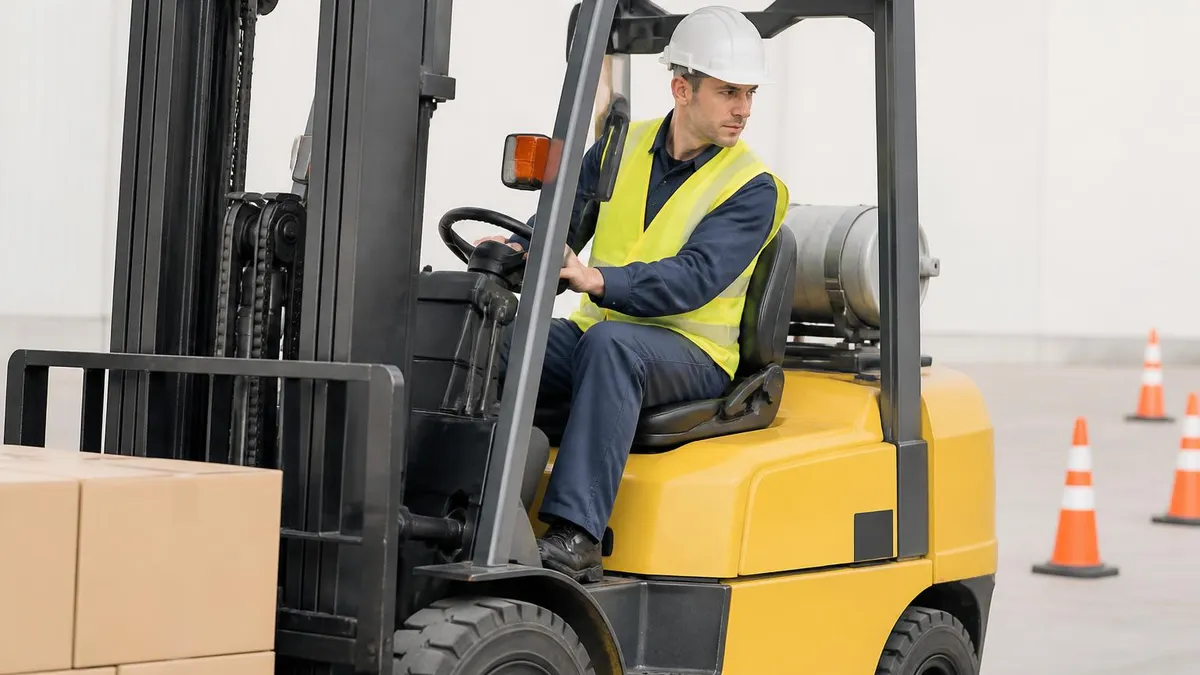
Forklift Rentals: Complete Guide to Pricing, Types, and Operator Requirements
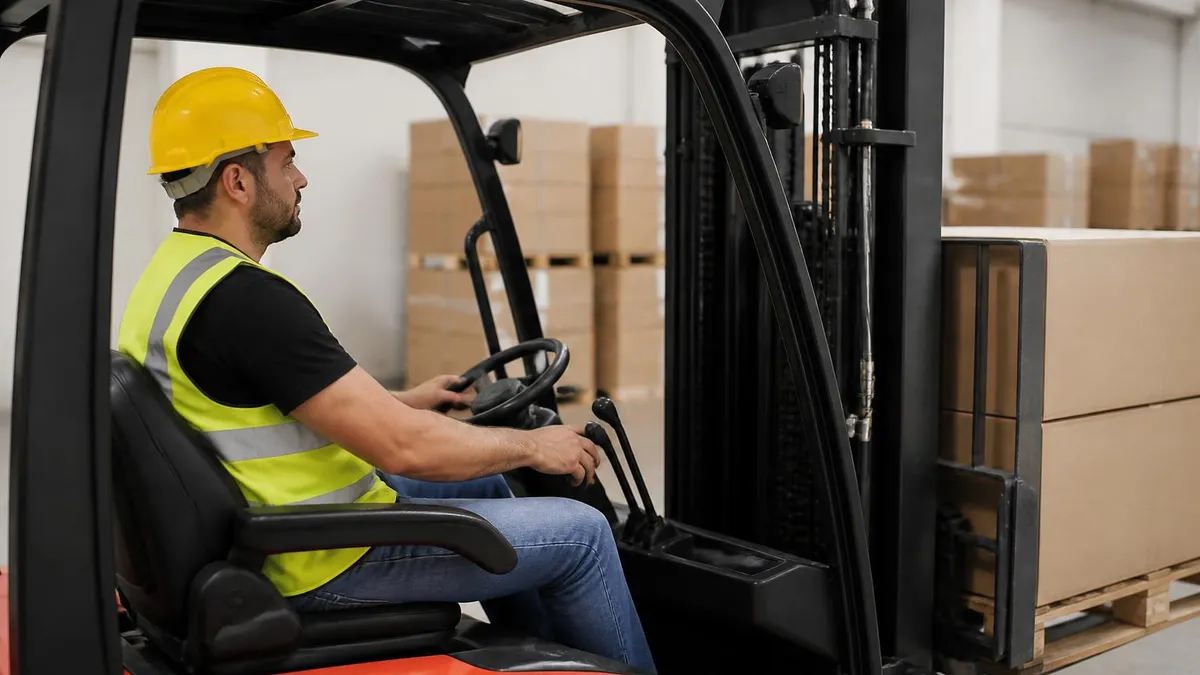
Forklift Hydraulic Fluid: Complete Guide to Types, Specifications, Change Intervals, and Troubleshooting for 2026
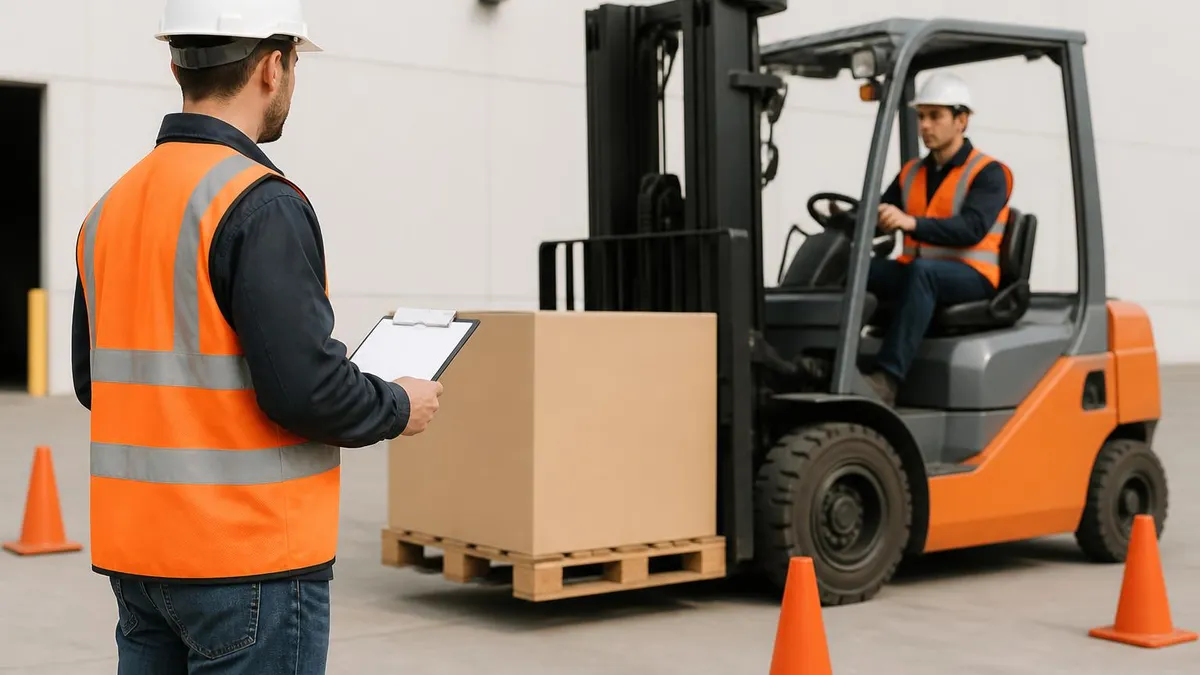
Forklift Parts and Maintenance: Complete Guide to Batteries, Chargers, and Replacement Components
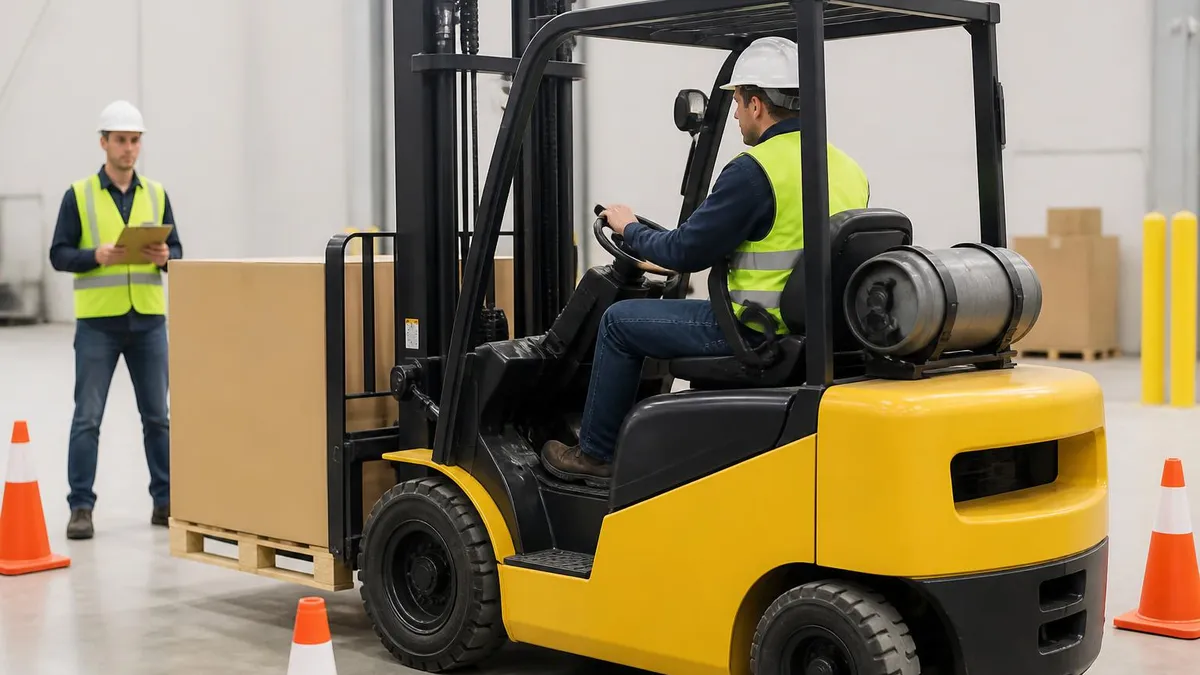
Big Forklift Guide: Heavy-Duty Lift Trucks, Capacity Classes, Rental Costs, and Operator Requirements
Forklift License Renewal: Complete Guide to Forklift License Expiry, OSHA Recertification, and Operator Requirements for 2026
About the Author

Certified Crane Operator & Skilled Trades Exam Specialist
Ferris State UniversityRobert Martinez is a Journeyman Ironworker, NCCCO-certified crane operator, and forklift trainer with a Bachelor of Science in Construction Technology from Ferris State University. He has 21 years of ironworking, rigging, and heavy equipment operation experience across high-rise and industrial construction sites. Robert prepares candidates for crane operator, rigger, forklift, and skilled trades certification examinations.