
Forklift Certification Los Angeles: Complete Training Guide, Requirements & How to Get Certified in 2026 September
Get forklift certification in Los Angeles. Training requirements, costs, OSHA rules & practice tests. 🎯 Everything operators need to know.

If you are pursuing forklift certification los angeles employers and OSHA require, you are entering one of the most in-demand skilled trades in Southern California. Los Angeles County hosts thousands of warehouses, distribution centers, ports, and construction sites where certified forklift operators are essential every single day. Getting your certification is not just a legal requirement — it is the key that unlocks higher wages, better job security, and access to union and non-union positions across dozens of industries throughout the greater LA metro area.
The Occupational Safety and Health Administration mandates that every forklift operator in the United States complete formal training and evaluation before operating any powered industrial truck. This federal regulation applies whether you are driving a small electric forklift in a retail backroom or a large stand up forklift at a major port facility. In Los Angeles, where workplace safety enforcement is particularly strict, employers face significant fines for allowing uncertified operators to use forklifts on their premises, so demand for certified workers remains consistently high.
Forklift training in Los Angeles typically covers three core areas: formal instruction through classroom or online study, hands-on practical training under direct supervision, and a final performance evaluation. The entire process can often be completed in a single day for experienced candidates, while beginners may need two to three days to become comfortable with the equipment. Programs are offered through community colleges, private training centers, and on-site employer programs throughout the city and surrounding counties.
The cost of forklift training varies considerably depending on the format you choose. Community college courses in the LA area typically run between $100 and $300, while private training centers charge anywhere from $150 to $500 for a comprehensive certification program. Some employers sponsor their workers entirely, covering all training expenses as part of onboarding. Online forklift certification programs start as low as $40 to $75, though these must always be paired with in-person hands-on evaluation to satisfy OSHA requirements fully.
Los Angeles is home to the Port of Los Angeles and the Port of Long Beach, collectively the busiest port complex in North America. These facilities alone employ thousands of forklift operators working around the clock to move cargo containers, palletized goods, and industrial equipment. Beyond the ports, the LA metro area has one of the largest concentrations of warehouses and logistics hubs in the entire country, driven in large part by e-commerce fulfillment operations, cold storage facilities, and manufacturing plants in the Inland Empire region just east of the city.
Understanding which type of forklift you will be operating matters significantly when choosing your certification program. A counterbalance sit-down forklift used in a grocery distribution center handles very differently from a reach truck or an order picker used in a high-rack warehouse environment. Electric forklifts, which are increasingly popular in indoor LA facilities due to California's strict emissions regulations, have their own operational nuances including battery management and charging procedures that operators must understand thoroughly.
Whether you are a first-time applicant trying to break into the logistics industry or an experienced operator who needs to renew an expired card, this guide covers everything you need to know about obtaining and maintaining your forklift certification in Los Angeles. We detail the exact OSHA requirements, walk through the training process step by step, compare available programs, and provide practice resources to help you pass your evaluation with confidence the first time around.
Forklift Certification in Los Angeles by the Numbers

How to Get Your Forklift Certification in Los Angeles
Complete Formal Instruction
Log Hands-On Practical Training
Pass the Written Knowledge Test
Complete the Practical Performance Evaluation
Receive Your Certification Card
Renew Every Three Years
Los Angeles offers more forklift training options than almost any other city in the country, which is both an advantage and a source of confusion for candidates trying to choose the right program. Community colleges within the LA Community College District, including Los Angeles Trade-Technical College and Los Angeles Harbor College, offer affordable forklift operator courses that combine classroom instruction with hands-on time on actual equipment. These programs often align with broader warehouse logistics or material handling certificates that can further boost your resume.
Private forklift training centers in Los Angeles include facilities that specialize exclusively in powered industrial truck certification. These centers typically offer more flexible scheduling, including weekend and evening classes designed for working adults who cannot attend daytime programs. Training sessions at private centers often move faster because the instructor-to-student ratio is lower, giving each candidate more time on the machine. Costs at private centers range from $200 to $500 depending on whether you choose a single-class certification or a multi-class program covering several forklift types simultaneously.
On-site employer training remains the most common pathway to forklift certification in Los Angeles. Major logistics companies including Amazon, FedEx, XPO Logistics, and numerous cold chain operators routinely certify their own employees using internal training programs developed in compliance with OSHA standards. If you are already employed at a company that uses forklifts, check with your HR or safety department before paying for external training — your employer may cover the entire cost as part of your onboarding or advancement pathway.
Online forklift certification has grown significantly in popularity since 2020, and numerous reputable providers now offer comprehensive digital courses that satisfy OSHA's formal instruction requirement. These online programs typically cost between $40 and $100 and can be completed at your own pace over one to three days. However, it is critically important to understand that online certification alone is never sufficient. OSHA explicitly requires that forklift training include hands-on evaluation on actual equipment, so any online course must be followed by an in-person practical assessment conducted by a qualified trainer.
The type of forklift class you get certified on matters tremendously when searching for work in Los Angeles. OSHA classifies powered industrial trucks into seven classes ranging from Class I electric counterbalanced riders to Class VII rough terrain forklifts. Most entry-level warehouse positions in LA require Class I or Class IV/V certification for sit-down internal combustion or electric counterbalanced forklifts. Positions at the ports or in construction may require Class VII rough terrain certification, which involves additional training due to the more complex operating environment.
Bilingual training programs are an important resource in Los Angeles given the city's diverse workforce. Many training providers in the area offer instruction in both English and Spanish, and some facilities also offer courses in Mandarin, Korean, or other languages common in LA's manufacturing and logistics sectors. If English is not your primary language, specifically seek out bilingual programs — understanding safety instructions clearly can literally be the difference between a successful career and a serious workplace injury. OSHA standards require that training be delivered in a language and vocabulary that the operator can understand.
Job placement assistance is another factor worth considering when evaluating training programs in Los Angeles. Several community colleges and private training centers maintain relationships with local employers and actively refer certified graduates to open positions. The Alameda Corridor, the Inland Empire logistics corridor, and downtown LA's garment and food distribution districts all have consistent demand for certified forklift operators. Pairing your certification with a resume that lists your equipment class experience, any warehouse management system familiarity, and a clean driving record will position you competitively in the LA job market.
Forklift Operator Types and Equipment in Los Angeles
Electric forklifts have become the dominant choice for indoor warehouses across Los Angeles, driven by California's strict air quality regulations enforced by the South Coast Air Quality Management District. Unlike propane or diesel-powered forklifts, electric models produce zero direct emissions, making them ideal for enclosed spaces such as cold storage facilities, food distribution centers, and retail fulfillment warehouses. Modern electric forklifts from manufacturers like Toyota, Crown, and Raymond offer lift capacities from 3,000 to 12,000 pounds and run times of six to eight hours on a single charge.
Operating an electric forklift requires specific knowledge of battery maintenance, charging procedures, and state-of-charge monitoring that is not relevant to internal combustion models. Operators must learn to recognize signs of battery depletion, understand proper watering of flooded lead-acid batteries, and follow safe battery swap procedures in facilities that use hot-swap systems. As a stand up forklift or sit-down counterbalanced rider, electric models also handle differently than IC trucks — they tend to accelerate more smoothly and have regenerative braking — so operators transitioning from gas or propane equipment should expect a brief adjustment period.

Forklift Certification in Los Angeles: Benefits and Challenges
- +High demand in one of the nation's largest logistics markets with 11,000+ open positions
- +Certified operators earn $15–$25 more per hour than uncertified material handlers
- +Certification can be completed in as little as one full day at many LA training centers
- +Multiple class certifications open doors to ports, warehouses, construction, and cold storage roles
- +California state labor laws provide strong protections and benefit requirements for certified operators
- +Abundant bilingual training resources accommodate LA's diverse multilingual workforce
- −Private training center costs of $200–$500 can be a barrier for entry-level applicants
- −Online-only certification is insufficient — in-person evaluation is always required by OSHA
- −Certification must be renewed every three years, adding recurring time and cost
- −Class-specific certification means switching equipment types requires additional training
- −Cal/OSHA enforcement is stricter than federal OSHA, increasing compliance pressure on employers
- −High cost of living in Los Angeles may offset wage gains compared to inland or suburban markets
Forklift Certification Checklist for Los Angeles Operators
- ✓Confirm which OSHA forklift class (I through VII) applies to the equipment at your workplace.
- ✓Choose an LA-area training provider that offers both classroom instruction and hands-on evaluation.
- ✓Complete a minimum of four to eight hours of formal instruction covering OSHA 29 CFR 1910.178.
- ✓Log supervised hands-on operation time on the specific type of forklift you will use on the job.
- ✓Pass the written or oral knowledge test with a score of 70% or higher.
- ✓Complete the practical performance evaluation observed by a qualified trainer or supervisor.
- ✓Obtain your official certification card listing equipment class and evaluation date.
- ✓Provide a copy of your certification documentation to your employer for their personnel file.
- ✓Complete a site-specific orientation before operating any forklift at a new employer location.
- ✓Schedule your three-year recertification evaluation before your current certification expires.
Cal/OSHA Enforces Stricter Standards Than Federal OSHA
California operates its own OSHA-approved state plan, and Cal/OSHA frequently enforces forklift safety standards more strictly than the federal baseline. Fines for uncertified forklift operation in California can reach $25,000 per serious violation and up to $100,000 for willful violations. Always carry your current certification card on your person while operating, and ensure your employer maintains complete training records on site.
Understanding the salary landscape for certified forklift operators in Los Angeles helps you evaluate whether the investment in training delivers a strong return. According to Bureau of Labor Statistics data and regional wage surveys, entry-level certified forklift operators in the LA metro area earn between $17 and $22 per hour, which translates to approximately $35,000 to $46,000 annually for full-time work. Operators with two to five years of experience and certifications across multiple equipment classes typically earn between $22 and $32 per hour, putting annual compensation in the $46,000 to $67,000 range.
Port-based forklift operators in Los Angeles and Long Beach earn significantly more than their counterparts in standard warehouse environments, primarily because port work is often unionized through the International Longshore and Warehouse Union. ILWU-represented forklift operators at the ports can earn $35 to $45 per hour or more with full benefits, making port certification one of the most lucrative career tracks available to lift truck operators anywhere in the country. However, port hiring is highly competitive, and candidates typically need several years of experience plus union sponsorship to access these positions.
The forklift for sale market in Los Angeles also creates career opportunities for operators with maintenance or mechanical skills. Equipment dealers, auction houses, and used forklift refurbishers throughout the LA basin employ technicians who must understand forklift operation deeply in order to test, inspect, and demonstrate machines for sale. If you combine your operator certification with coursework in diesel mechanics, hydraulic systems, or electrical systems, you can position yourself for these higher-paying technical roles that blend hands-on operation with mechanical expertise.
Forklifts used in the construction industry — particularly telescoping handlers and rough terrain models — command additional pay premiums in Los Angeles because the skill level required is higher and the working conditions are more physically demanding. Construction sites throughout the city, from high-rise developments in downtown LA to large industrial parks in the San Fernando Valley, regularly employ certified rough terrain forklift operators at wages 20 to 35 percent higher than standard warehouse rates. Class VII and Class IX certification programs specifically targeting construction equipment are available through several trade-focused training providers in the LA area.
Benefits packages for full-time certified forklift operators in Los Angeles often include health insurance, retirement contributions, and paid time off, particularly at large logistics employers who compete aggressively for skilled labor. Amazon, Walmart distribution, Costco warehousing, and major third-party logistics providers all offer competitive total compensation packages that can add $8,000 to $15,000 in annual value on top of base wages. Calculating total compensation rather than just hourly rate is important when comparing job offers in the LA market, where cost of living makes benefits particularly valuable.
Forklift operators who advance into lead operator, trainer, or supervisor roles can earn $70,000 to $90,000 annually in Los Angeles. These advancement opportunities are most readily available to operators who invest in additional credentials beyond basic certification, such as OSHA 10 or OSHA 30 general industry cards, first aid and CPR certification, or warehouse management system training on platforms like SAP, Oracle WMS, or Manhattan Associates. Combining forklift expertise with technology skills positions you for logistics coordinator and operations supervisor roles that supervise multiple operators and manage broader warehouse functions.
The long-term career trajectory for forklift operators in Los Angeles remains strong despite increasing automation in warehouse environments. While automated guided vehicles and autonomous mobile robots are being deployed in some facilities, the complexity of LA's diverse logistics infrastructure means that human-operated forklifts will remain essential for decades. Construction, port operations, cold storage, and specialized cargo handling are particularly resistant to full automation, ensuring sustained demand for certified human operators well into the 2030s and beyond.

Your forklift certification is only valid for the specific class of equipment you were evaluated on. If your employer assigns you to operate a different type of forklift — for example, switching from a sit-down counterbalanced electric to a reach truck or order picker — OSHA requires you to complete additional training and evaluation on the new equipment type before operating it independently. Document each class of equipment separately on your certification records.
Recertification and renewal requirements are an important ongoing commitment for forklift operators in Los Angeles that many workers underestimate when they first get certified. OSHA's standard under 29 CFR 1910.178(l)(4) requires that operators be re-evaluated at a minimum of every three years, but California's Cal/OSHA plan adds additional nuance: operators must also be re-evaluated whenever a supervisor observes unsafe operation, after the operator is involved in any accident or near-miss incident, when assigned to operate a different type or class of forklift, or when workplace conditions change in a way that could affect safe operation of the equipment.
Many employers in Los Angeles opt for annual refresher training rather than waiting the full three-year cycle. This is particularly common in high-volume operations like e-commerce fulfillment centers and food distribution warehouses, where the volume of forklift traffic and the resulting risk of incidents justifies more frequent skill assessments. Annual refresher programs typically take two to four hours per operator, covering updated OSHA guidance, any incident reports from the past year, and a brief practical skills review to confirm operators have not developed unsafe habits over time.
When your certification card approaches its three-year expiration date, you have several options for renewal in the Los Angeles area. Many of the same training providers who issued your original certification offer streamlined recertification programs that take less time than the initial course because the formal instruction component can be shortened for experienced operators who demonstrate existing knowledge. The practical evaluation component, however, must still be completed in full and documented with the same rigor as the original evaluation — there are no shortened practical tests for renewals under OSHA regulations.
If you have changed employers since your original certification, your new employer is responsible for conducting a site-specific evaluation even if your certification card has not yet expired. OSHA places responsibility for forklift safety on each individual employer, not on the worker personally, which means your new employer cannot simply accept your old certification card and send you onto their floor without verifying your skills on their specific equipment in their specific work environment. Most large LA employers have standardized orientation processes that include this site-specific practical evaluation as a standard part of new hire onboarding.
Operators who let their certification lapse without renewal face the same situation as completely uncertified operators — their employer cannot legally assign them to operate a forklift until they complete the full training and evaluation cycle again.
In the highly competitive Los Angeles job market, allowing your certification to lapse can create a gap in employment eligibility at your current employer, and it will immediately disqualify you from consideration at new employers who verify certification dates during background screening. Tracking your renewal date on your calendar and scheduling refresher training at least 60 days before expiration is a simple practice that protects your employment status and earning potential.
Several Los Angeles area employers and training providers now use digital credentialing platforms that make it easier to track and verify certification status. These platforms issue digital certification cards that can be stored on a smartphone, verified by employers via QR code, and automatically flagged when renewal dates approach. As the forklift industry in California continues to modernize, digital credential management is becoming an expected standard rather than a premium feature, particularly among tech-forward logistics operators and large third-party logistics providers operating in the LA basin.
If you are an employer managing a fleet of certified forklift operators in Los Angeles, maintaining organized training records is not just a good practice — it is a legal requirement under Cal/OSHA. Employers must document the identity of the operator, the date of training and evaluation, and the name of the person who conducted the evaluation for every certified operator on their payroll.
These records must be kept on file and made available to Cal/OSHA inspectors upon request. Employers who cannot produce complete documentation face the same penalties as those whose operators are entirely uncertified, so robust recordkeeping systems are an essential part of any compliant forklift safety program in California.
Preparing effectively for your forklift certification evaluation in Los Angeles means focusing on three areas simultaneously: understanding the theory, building physical comfort on the machine, and internalizing the inspection and safety habits that evaluators score most critically. Many candidates who fail their initial evaluation do so not because they cannot operate the forklift mechanically, but because they skip steps in the pre-operation inspection checklist or fail to perform verbal spotting announcements at intersections — habits that feel unnecessary when practicing alone but are non-negotiable during formal evaluation.
The OSHA-mandated pre-operation inspection, often called the pre-shift check, covers a specific list of items that operators must inspect before starting their forklift at the beginning of each shift. For most forklifts, this includes checking fluid levels, tire condition, forks for cracks or bends, mast chains for proper tension and lubrication, horn and warning lights, brakes, and the overhead guard for structural integrity. Electric forklifts additionally require checking battery charge levels, cable connections, and water levels in flooded cell batteries. Memorizing and practicing this inspection sequence is one of the highest-yield preparation activities for any certification candidate.
Load capacity awareness is another area that evaluators watch carefully and that many inexperienced operators misunderstand. Every forklift has a data plate that specifies its rated load capacity at a specific load center — typically 24 inches for standard pallet loads. When a load is longer than standard or is positioned differently on the forks, the effective capacity is reduced.
Operators must be able to read the data plate, understand the load center concept, and demonstrate that they verify load weight against capacity before picking up any load during their evaluation. Getting this wrong is a common cause of evaluation failure and, more importantly, a common cause of real workplace tip-over accidents.
Travel safety habits are scrutinized heavily during practical evaluations in Los Angeles training programs. Evaluators expect to see operators slow to three miles per hour or less at intersections, come to a complete stop and look both ways before crossing pedestrian lanes, travel with loads at the lowest safe travel height (typically six to twelve inches above the floor), and tilt the mast back slightly when traveling with loads to prevent forward tipping.
Operators who speed through turns, carry loads high while traveling, or fail to observe pedestrian right-of-way will receive deductions that can result in a failed evaluation even if their basic machine handling is technically competent.
Practicing your evaluation checklist aloud while training helps build muscle memory for the verbal announcements and checks that evaluators expect. Many successful candidates narrate their actions during the evaluation — saying things like "checking load weight against capacity plate," "horn at intersection," and "checking overhead clearance" out loud — because this demonstrates to the evaluator that they are consciously applying safety protocols rather than just performing mechanical actions. This technique feels awkward at first but becomes natural with practice and makes a measurable difference in evaluation scores.
Using practice tests and knowledge quizzes before your evaluation is highly effective for reinforcing the regulatory knowledge that the written portion tests. OSHA regulations, load center calculations, equipment class definitions, battery safety procedures, and emergency shutdown protocols are all fair game on forklift certification knowledge tests. Online practice resources and the quiz tools linked throughout this guide are specifically designed to help you test your knowledge, identify weak areas, and build confidence before your evaluation day arrives. Candidates who complete at least 50 to 100 practice questions before their test consistently report higher confidence and better first-attempt pass rates.
The night before your forklift certification evaluation, avoid trying to cram entirely new material — instead, review your inspection checklist one final time, get a good night's sleep, and arrive at your evaluation site at least 15 minutes early. Bring valid photo identification, any pre-training documentation your program requires, and comfortable closed-toe shoes appropriate for industrial environments. Most evaluation facilities in Los Angeles provide high-visibility vests and hard hats, but confirming this in advance saves the embarrassment of showing up without required personal protective equipment and having your evaluation rescheduled to a later date.
Forklift Questions and Answers
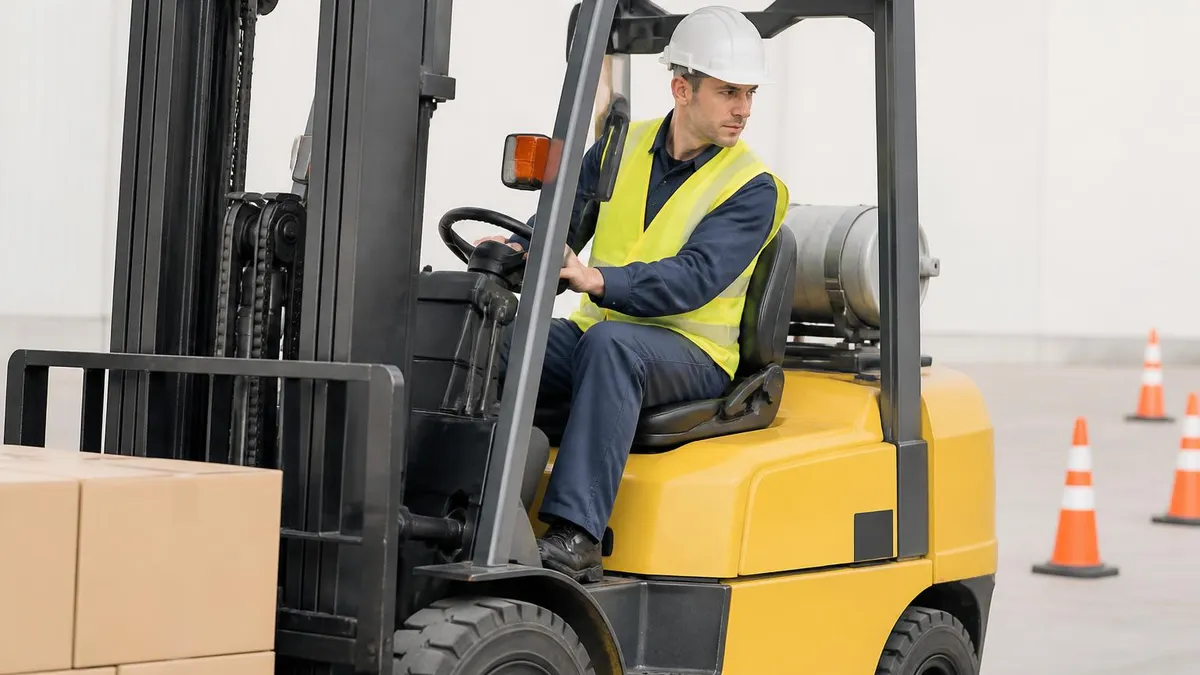
Forklift Rentals: Complete Guide to Pricing, Types, and Operator Requirements
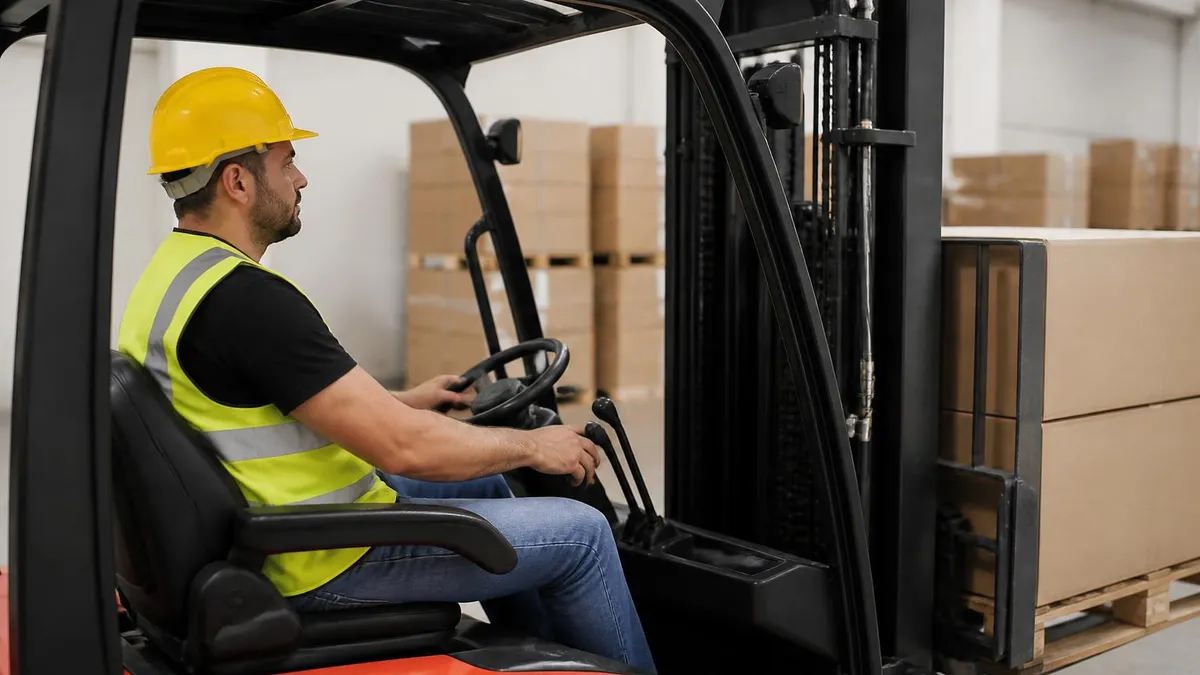
Forklift Hydraulic Fluid: Complete Guide to Types, Specifications, Change Intervals, and Troubleshooting for 2026
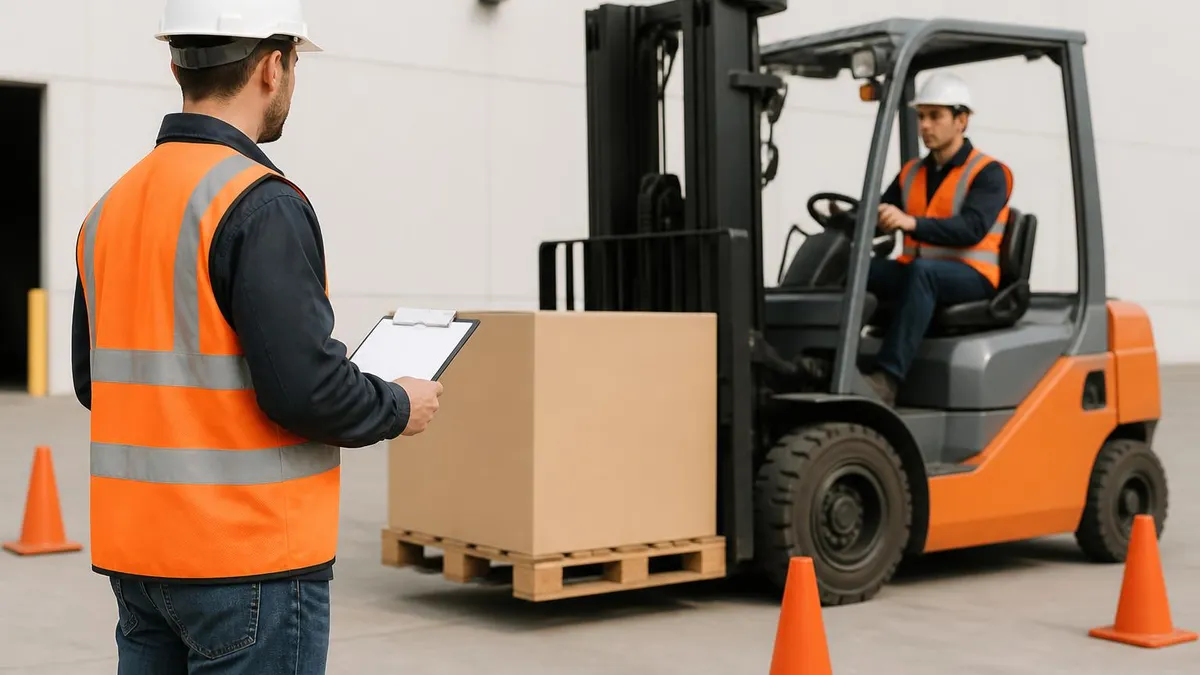
Forklift Parts and Maintenance: Complete Guide to Batteries, Chargers, and Replacement Components
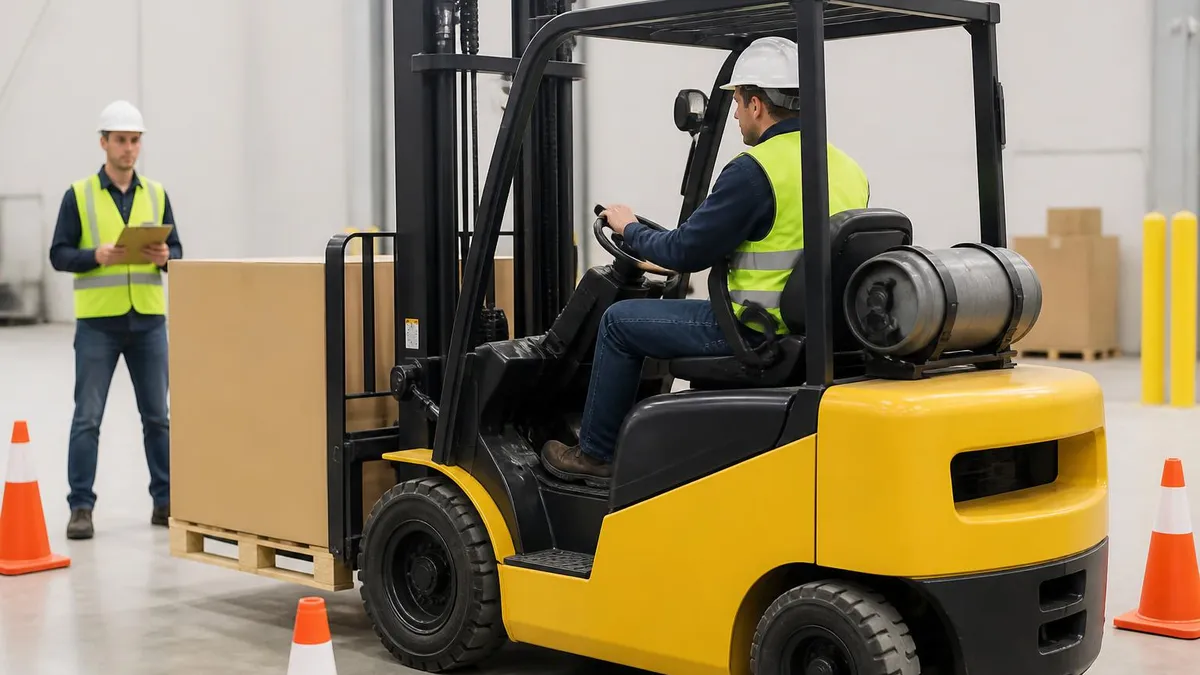
Big Forklift Guide: Heavy-Duty Lift Trucks, Capacity Classes, Rental Costs, and Operator Requirements
Forklift License Renewal: Complete Guide to Forklift License Expiry, OSHA Recertification, and Operator Requirements for 2026
About the Author
Certified Crane Operator & Skilled Trades Exam Specialist
Ferris State UniversityRobert Martinez is a Journeyman Ironworker, NCCCO-certified crane operator, and forklift trainer with a Bachelor of Science in Construction Technology from Ferris State University. He has 21 years of ironworking, rigging, and heavy equipment operation experience across high-rise and industrial construction sites. Robert prepares candidates for crane operator, rigger, forklift, and skilled trades certification examinations.