
When to Administer CPR: Recognizing Cardiac Arrest and Acting in the Critical First Minutes
📗 Learn when to administer CPR with clear signs, age-based rules, and ACLS algorithm steps. Recognize cardiac arrest fast and act in the first 60 seconds.
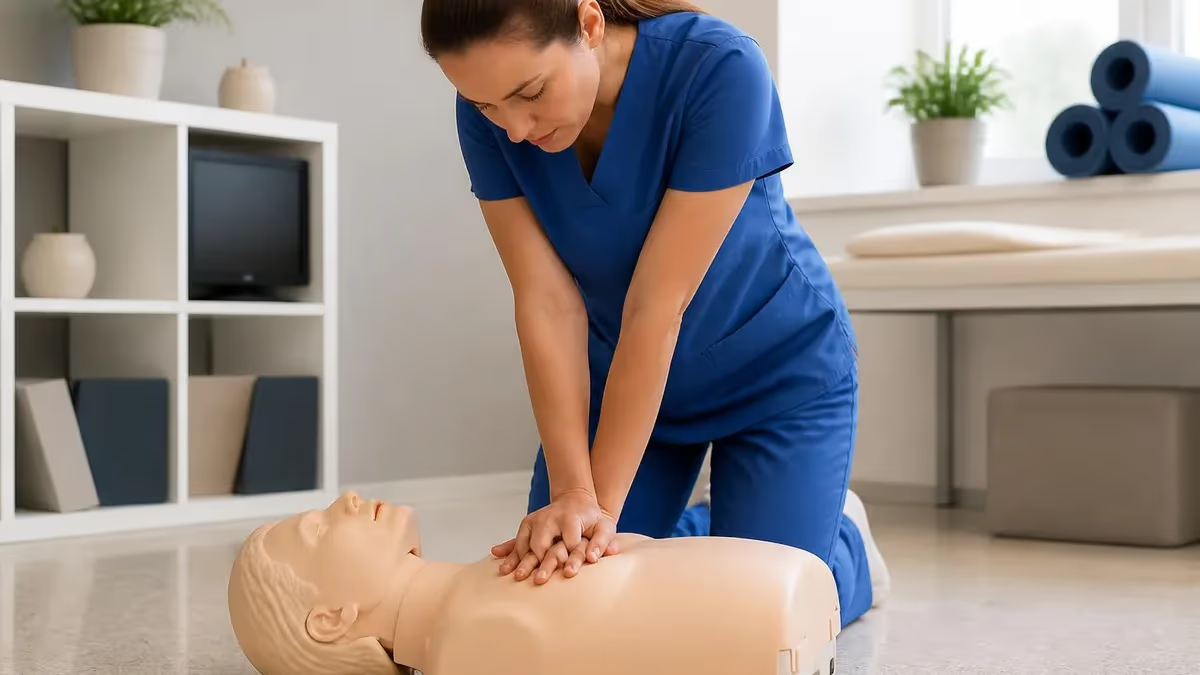
Knowing when to administer CPR is the single most important judgment call a bystander, parent, or healthcare provider can make. Cardiopulmonary resuscitation should begin the moment a person is unresponsive, not breathing normally, and shows no signs of life — and every second of hesitation cuts survival odds by roughly 7 to 10 percent. The acls algorithm built by the American Heart Association codifies this urgency, but the truth is most cardiac arrests happen at home, in front of family members who have never touched a manikin and are paralyzed by fear.
This guide strips away the confusion around when to administer cpr by walking through the exact recognition cues, the differences between adult and infant cpr, and the timing rules that determine whether you should start compressions immediately or pause to check a pulse. We will also clarify the public confusion between cpr cell phone repair franchises and certified CPR education — because typing "cpr near me" into a search bar should not return a phone store when someone you love is dying.
Cardiac arrest is not a heart attack. A heart attack is a plumbing problem caused by a blocked artery, and the victim is often awake and complaining of pain. Cardiac arrest is an electrical problem — the heart quivers or stops, the victim collapses, and consciousness disappears within 10 to 20 seconds. CPR is the bridge that keeps oxygenated blood reaching the brain until an automated external defibrillator or advanced life support team arrives.
The 2020 and updated 2025 AHA guidelines emphasize one rule above all others: if in doubt, start compressions. Pushing on the chest of someone who turns out to have a pulse rarely causes serious harm, but withholding compressions from someone who needs them is almost always fatal. The fear of "doing it wrong" kills more people than incorrect technique ever has, which is why hands-only CPR has become the default recommendation for untrained rescuers.
National cpr foundation surveys consistently show that fewer than 40 percent of out-of-hospital cardiac arrest victims receive bystander CPR before EMS arrives. That statistic is the gap this article is written to close. By the end, you will be able to identify the seven scenarios that demand immediate compressions, the three situations where you should pause, and the age-specific modifications that apply to infants, children, and adults.
We will also cover what aed stands for, how the device integrates with manual compressions, and why the recovery position is a post-CPR consideration rather than a substitute for it. Whether you are studying for pals certification, refreshing your basic life support card, or simply trying to be the person who can help a stranger collapse in a grocery store, the recognition skills below are the foundation.
When to Administer CPR by the Numbers

The First 60 Seconds: Decision Timeline
Scene Safety
Check Responsiveness
Call 911 and Get AED
Check Breathing
Begin Compressions
Attach AED When Available
The recognition of cardiac arrest is built on a three-part test that every rescuer — lay or professional — should be able to perform in under 15 seconds: the victim is unresponsive, they are not breathing normally, and they have no detectable pulse. For non-medical bystanders, the AHA actually removes the pulse check entirely because misreading a pulse under stress is so common that it causes dangerous delays. If the first two criteria are met, start compressions and let the AED sort out the rhythm.
Normal breathing is regular, quiet, and produces visible chest rise every three to five seconds. What confuses rescuers is agonal breathing — a slow, irregular, snorting or gasping pattern that occurs in 40 to 60 percent of witnessed cardiac arrests. Family members frequently mistake these gasps for life and delay CPR, when in fact agonal breathing is a brainstem reflex that signals the heart has stopped. If breathing looks weird, fish-like, or far apart, treat it as no breathing.
The acls algorithm formalizes this recognition into a structured loop: identify arrest, begin high-quality CPR, attach a monitor or AED, deliver a shock if indicated, and continue cycles of compressions and rhythm checks every two minutes. For lay rescuers, the algorithm collapses into a simpler triad — push hard, push fast, and don't stop until trained help takes over or the person wakes up.
One of the most common questions in CPR classes is whether you can hurt someone by doing CPR on a victim who turns out to have a pulse. The honest answer is yes, you may cause bruising, soreness, or even a rib fracture — but those injuries heal. Brain damage from four to six minutes of zero circulation does not. Studies of bystander CPR show that the rate of serious injury from "unnecessary" compressions is under 2 percent, while the survival benefit when CPR is actually needed climbs from 9 to 38 percent.
Children and infants present a slightly different calculus because their arrests are most often respiratory in origin rather than cardiac. A toddler who drowns, chokes, or stops breathing from a severe asthma attack will usually have a heart that is still beating for a minute or two before it gives out. This is why pediatric protocols emphasize rescue breaths and why pals certification spends significant time on respiratory rate assessment and airway management before chest compressions.
Witnessed versus unwitnessed arrest also changes the response. If you see a person collapse in front of you and they are immediately unresponsive, the cause is almost certainly an arrhythmia — ventricular fibrillation or pulseless ventricular tachycardia — and the most important intervention is rapid defibrillation. If you find someone already down and you do not know how long they have been there, compressions to restore circulation come first, with the AED applied as soon as it arrives.
Finally, do not let the search for confirmation paralyze you. Many bystanders waste two or three minutes trying to wake the victim, look up instructions on a phone, or wait for someone more qualified. By the time those minutes pass, neurological recovery becomes unlikely. The default action when you find an unresponsive adult who is not breathing normally is simple: kneel down, place your hands, and push.

CPR Practice Test Questions
Prepare for the CPR Cardiopulmonary Resuscitation Practice exam with our free practice test modules. Each quiz covers key topics to help you pass on your first try.
CPR Basic CPR
CPR Exam Questions covering Basic CPR. Master CPR Test concepts for certification prep.
CPR and First Aid
Free CPR Practice Test featuring and First Aid. Improve your CPR Exam score with mock test prep.
CPR (Cardiopulmonary Resuscitation) Adult ...
CPR Mock Exam on (Cardiopulmonary Resuscitation) Adult CPR and AED Usage. CPR Study Guide questions to pass on your first try.
CPR (Cardiopulmonary Resuscitation) Airway...
CPR Test Prep for (Cardiopulmonary Resuscitation) Airway Obstruction and Choking. Practice CPR Quiz questions and boost your score.
CPR (Cardiopulmonary Resuscitation) Cardio...
CPR Questions and Answers on (Cardiopulmonary Resuscitation) Cardiopulmonary Emergency Recognition. Free CPR practice for exam readiness.
CPR (Cardiopulmonary Resuscitation) Child ...
CPR Mock Test covering (Cardiopulmonary Resuscitation) Child and Infant CPR. Online CPR Test practice with instant feedback.
CPR (Cardiopulmonary Resuscitation) High-P...
Free CPR Quiz on (Cardiopulmonary Resuscitation) High-Performance Team Dynamics. CPR Exam prep questions with detailed explanations.
CPR (Cardiopulmonary Resuscitation) Legal ...
CPR Practice Questions for (Cardiopulmonary Resuscitation) Legal and Ethical Considerations. Build confidence for your CPR certification exam.
CPR for Specific Populations
CPR Test Online for for Specific Populations. Free practice with instant results and feedback.
CPR Airway & Breathing Management
CPR Exam Questions covering Airway & Breathing Management. Master CPR Test concepts for certification prep.
CPR Assessment & Recognition of Cardiac Ar...
Free CPR Practice Test featuring Assessment & Recognition of Cardiac Arrest. Improve your CPR Exam score with mock test prep.
CPR Chest Compressions & Defibrillation
CPR Mock Exam on Chest Compressions & Defibrillation. CPR Study Guide questions to pass on your first try.
CPR Post-Resuscitation Care & Recovery
CPR Test Prep for Post-Resuscitation Care & Recovery. Practice CPR Quiz questions and boost your score.
Adult, Child, and Infant CPR Differences
For adults, the assumption is a primary cardiac event — typically ventricular fibrillation triggered by coronary artery disease. Begin with 30 chest compressions at a depth of at least two inches and a rate of 100 to 120 per minute, then deliver two rescue breaths if you are trained. Hands-only CPR is fully acceptable for untrained lay rescuers and produces nearly identical outcomes in the first 10 minutes.
The AED should be attached the moment it arrives because defibrillation is the definitive treatment for shockable rhythms. Place pads on the upper right chest and lower left side, follow voice prompts, and resume compressions immediately after any shock. Pulse checks are limited to under 10 seconds, and the resting respiratory rate of a recovering patient is monitored once circulation returns.
Hands-Only CPR vs Standard CPR with Rescue Breaths
- +Easier to remember under stress — no breath counts to track
- +Eliminates hesitation around mouth-to-mouth contact with strangers
- +Equally effective for adult cardiac arrest in the first 10 minutes
- +Allows continuous, uninterrupted chest compression for higher perfusion
- +Recommended by AHA for untrained bystanders since 2008
- +Reduces dispatcher-assisted instruction time by roughly 40 percent
- +Compatible with AED use without modification
- −Less effective for asphyxia-related arrest (drowning, overdose, choking)
- −Not recommended for infants and most pediatric arrests
- −Misses the oxygenation step in prolonged resuscitations beyond 10 minutes
- −May not meet professional rescuer protocols or workplace requirements
- −Cannot replace standard CPR in healthcare or BLS certification settings
- −Provides no ventilation support during extended EMS response delays
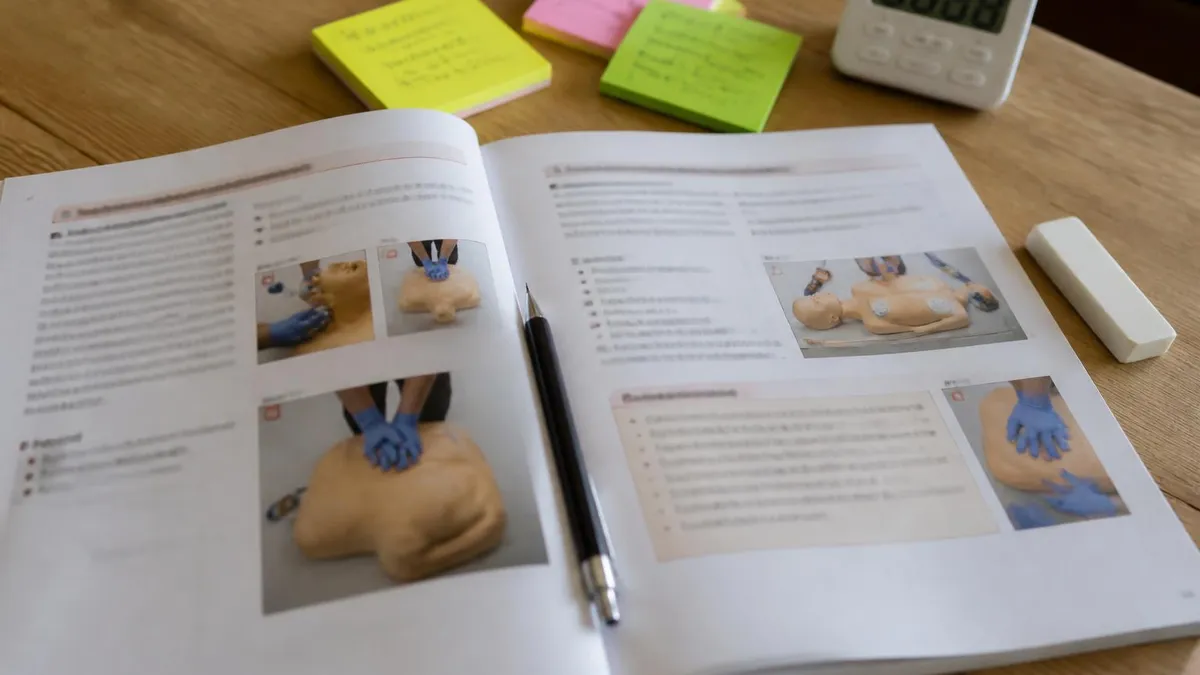
Pre-CPR Recognition Checklist: What to Confirm in 10 Seconds
- ✓Scene is safe from traffic, electricity, water, or violence
- ✓Victim does not respond to firm shoulder tap and loud verbal prompt
- ✓No normal chest rise observed during a 5 to 10 second scan
- ✓Any breathing present is gasping, snoring, or irregular agonal pattern
- ✓Pulse check (if trained) is limited to 10 seconds or less at the carotid
- ✓911 has been called or a specific bystander has been assigned to call
- ✓An AED has been requested by name and pointed bystander
- ✓Victim is on a firm, flat surface — move from bed to floor if needed
- ✓Clothing over the chest is open or removable for AED pad placement
- ✓You are mentally committed to continuous compressions until help arrives
If you cannot confirm normal breathing in 7 seconds, start CPR.
The AHA permits up to 10 seconds for the breathing and pulse check, but field data shows that rescuers who commit to action at the 7-second mark dramatically improve survival outcomes. Hesitation past 10 seconds is the single biggest preventable factor in failed bystander resuscitation. When in doubt, push.
There are a small number of situations where CPR should not be initiated, and recognizing them is just as important as recognizing arrest. The first is obvious irreversible death: rigor mortis, dependent lividity, decapitation, or injuries incompatible with life such as a transected torso. In these cases, beginning compressions is futile and may interfere with scene investigation. EMS protocols universally allow termination or non-initiation in the presence of unmistakable death signs.
The second exception is a valid Do Not Resuscitate order. A POLST form, MOLST document, or DNR bracelet that is physically present and clearly identified should be honored. Verbal claims from family members alone are not sufficient in most jurisdictions — paramedics and physicians need to see the paperwork. If there is any ambiguity about validity, lay rescuers should default to providing CPR and let medical professionals sort out the documentation later.
The third situation is when continuing CPR places the rescuer in serious danger. An active shooter scene, an unstable building, a vehicle on fire, or a confined space with toxic gas requires extraction first. You cannot help a victim if you become one. This is the rationale behind the scene safety step that opens every protocol, and it is non-negotiable even when the patient is a family member.
What does aed stand for? Automated external defibrillator — and the device's analysis function is one of the few tools that can definitively tell you when CPR is the wrong intervention. If an AED reads "no shock advised" and you have a clear pulse and breathing, you are watching the patient recover and should transition to monitoring and the recovery position. The AED's voice prompts are designed to keep lay rescuers from second-guessing themselves.
Recovery position is the post-event placement of a breathing, unconscious patient on their side to maintain an open airway and prevent aspiration of vomit. It is not a treatment for cardiac arrest. Placing an arrested patient on their side instead of starting compressions is a fatal error that occasionally appears in first aid videos. The rule is simple: if they are breathing normally, recovery position; if they are not, CPR.
Confusion in the search results is another modern barrier. When you need actual life support training, search specifically for "American Heart Association CPR class" or "BLS certification course" to filter out the unrelated retail business. National CPR Foundation, AHA, and Red Cross are the three primary certification bodies in the United States.
The fear of legal consequences also stops some bystanders. Good Samaritan laws in all 50 states protect lay rescuers who provide CPR in good faith from civil liability, as long as they do not act with gross negligence and stop when professional help arrives or the scene becomes unsafe. The legal risk of doing nothing — particularly for healthcare providers, lifeguards, and others with a duty to act — is far greater than the risk of acting within your training.
Up to 60% of sudden cardiac arrest victims display agonal gasping in the first minutes after collapse. These slow, irregular gasps are a brainstem reflex, not normal breathing. If a victim is unresponsive and breathing in this abnormal pattern, begin compressions immediately. Waiting for the gasps to stop is waiting for the brain to die.
Once compressions begin, the rescuer's job is to deliver continuous, high-quality CPR until one of four things happens: the patient shows signs of life, an AED instructs you to clear and analyze, professional EMS takes over, or you are physically too exhausted to continue. Switching compressors every two minutes, when a second trained rescuer is available, preserves quality because fatigue degrades depth and rate within 90 seconds of nonstop work.
High-quality CPR has five measurable elements that the AHA emphasizes in every basic and advanced life support course: rate of 100 to 120 per minute, depth of at least two inches in adults, full chest recoil between compressions, minimal interruptions of under 10 seconds, and adequate ventilation when breaths are delivered. CPR feedback devices and AED metronomes help maintain these parameters, but a simple count of "one and two and three" matched to a 100 bpm song works for untrained rescuers.
The recovery position is the appropriate next step only after return of spontaneous circulation — meaning the patient is breathing on their own, has a palpable pulse, and is moving or responsive. Place them on their side with the lower arm extended, the upper leg bent for stability, and the head tilted slightly back to maintain an open airway. Reassess respiratory rate and pulse every two minutes until EMS arrives.
Handoff to EMS is more than just stepping back. Provide a brief verbal report: time of collapse, time CPR started, number of shocks delivered by the AED, any known medical history, and whether the patient ever showed signs of life. This information shapes the advanced life support decisions paramedics will make in the next 10 minutes, including airway management, medication administration, and transport destination.
Emotional aftermath is real. Performing CPR — successful or not — is traumatic, and rescuers commonly experience shaking, nausea, intrusive memories, and disrupted sleep for days afterward. Critical incident stress debriefing is recommended for professional rescuers and increasingly available to lay bystanders through EMS agencies, fire departments, and community programs. Reaching out is a strength, not a weakness.
Refreshing your training matters more than most certified rescuers realize. Skill decay begins within three to six months of a CPR class, and within a year, most untrained users have lost the precise depth and rate they once had. Annual refresher courses, monthly manikin practice at a workplace or gym, and apps with metronome features all help. If your last class was more than two years ago, you are functionally untrained for the high-stakes moment.
Practical preparation for the moment you may need to administer CPR begins long before the emergency. Take a hands-on certification course rather than relying on YouTube videos — the muscle memory of pushing on a manikin chest and feeling the recoil cannot be learned passively. Look for AHA, Red Cross, or National CPR Foundation classes, and verify that the course offers both classroom and skills evaluation components if you need a certification card for work.
Know the locations of AEDs in the places you spend time. Airports, gyms, schools, malls, and corporate offices are required by law in most states to maintain AEDs, but they are often locked in unmarked cabinets. Walk your workplace once and note the nearest device, the route, and the person responsible. The PulsePoint AED app crowdsources device locations in many U.S. cities and can save critical minutes during a real event.
Have the conversation with your family about cardiac history, signs to watch for, and what to do if someone collapses at home. Adults over 50, anyone with known coronary artery disease, and athletes with undiagnosed conditions are at elevated risk. Knowing that your father has stents or your child has long QT syndrome changes how quickly you recognize and respond when something looks off.
Keep your phone charged and your address visible. When 911 is called, dispatchers ask for the address first, and unclear or delayed location information adds precious minutes to response time. Smart speakers and modern phones can call emergency services hands-free — practice the voice commands before you need them, and make sure family members know how to use them.
If you live alone or with elderly relatives, consider a medical alert device with fall detection. These devices automatically contact monitoring services if a fall is detected and the wearer does not respond, dispatching EMS even when the victim cannot call for help. They are not a substitute for bystander CPR, but they shrink the window between collapse and professional response.
Finally, build the mental rehearsal habit. Each time you walk into a public space — a restaurant, a movie theater, a stadium — take three seconds to note exits, AED locations, and the closest staff member. This is not paranoia; it is the same situational awareness pilots, lifeguards, and emergency physicians develop through training. The day someone collapses in front of you, the mental map you built in advance will compress your reaction time from minutes to seconds.
The most important takeaway is that the rescuer who acts imperfectly always outperforms the rescuer who waits for perfection. Push hard, push fast, and trust that the system — dispatcher coaching, AED voice prompts, arriving paramedics — will fill in the gaps. The patient does not need a hero; they need a heartbeat, and that is something your two hands can deliver.
CPR Questions and Answers
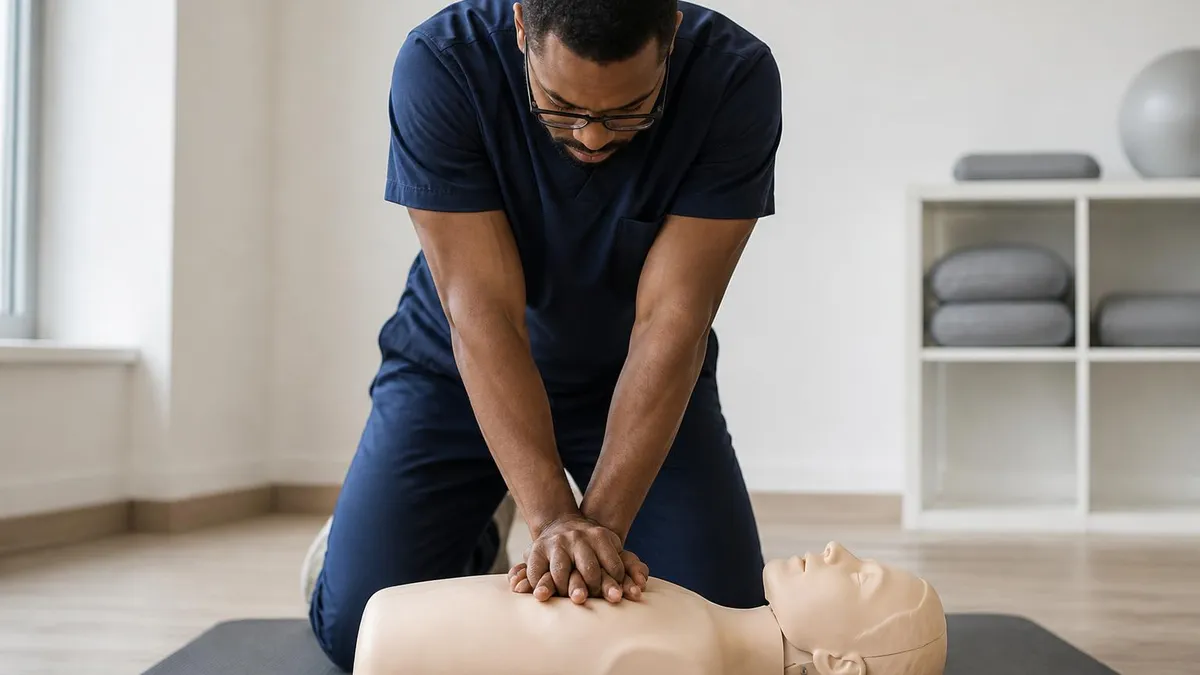
CPR Card Lookup: How to Verify, Replace, and Access Your CPR Certification in 2026
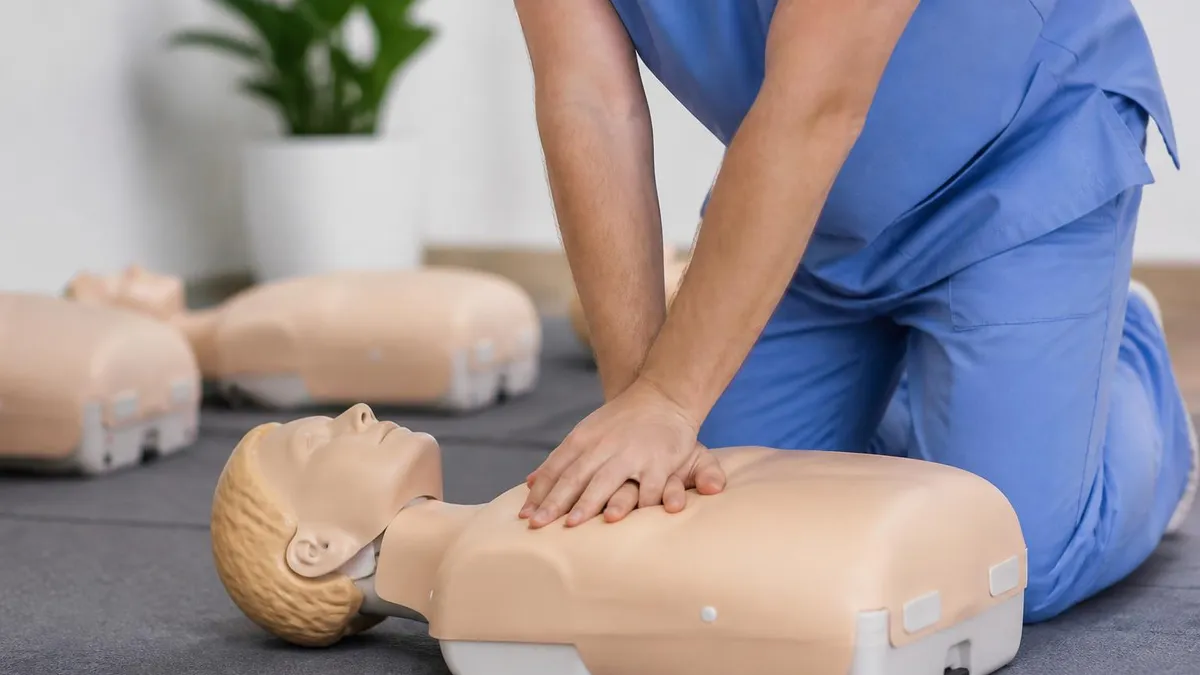
AHA CPR: What It Is, Which Course You Need, and How to Get Certified
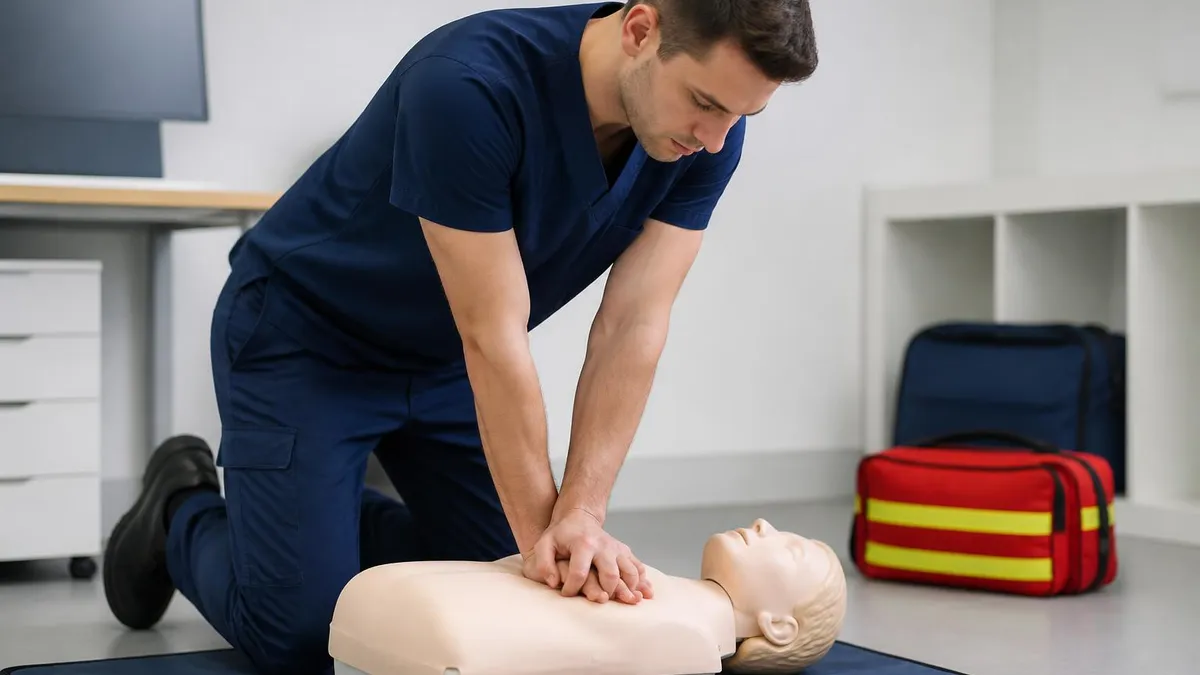
Adult CPR: Complete Step-by-Step Guide to Hands-Only and Standard CPR in 2026
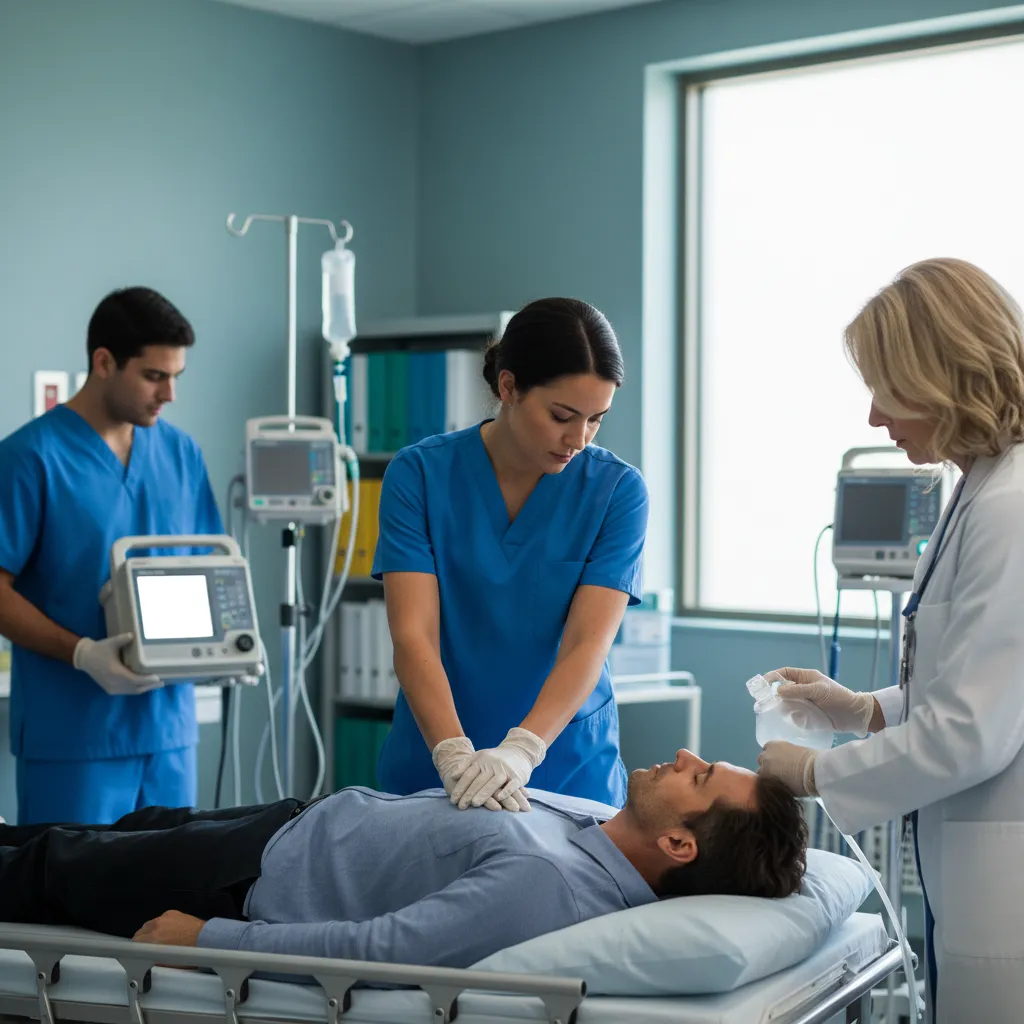
CPR - Cardiopulmonary Resuscitation: Complete Study Guide 2026
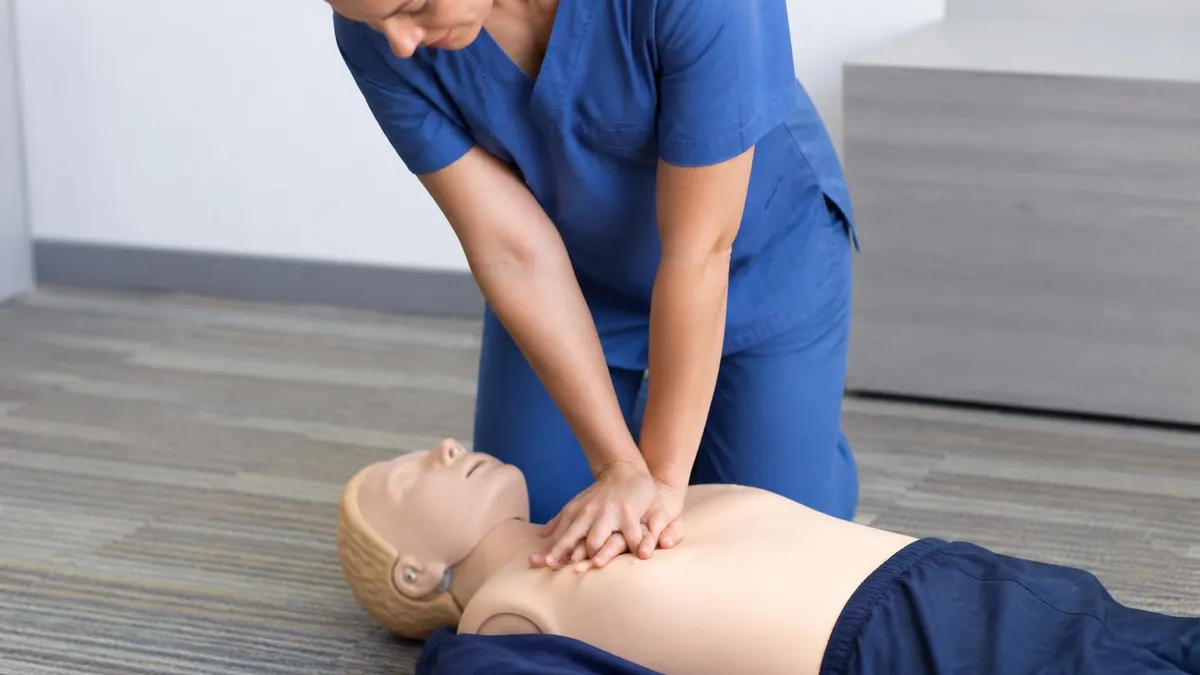
Inappropriate CPR Songs: What Not to Play, Why It Matters, and Better Beat-Per-Minute Alternatives
About the Author

Registered Nurse & Healthcare Educator
Johns Hopkins University School of NursingDr. Sarah Mitchell is a board-certified registered nurse with over 15 years of clinical and academic experience. She completed her PhD in Nursing Science at Johns Hopkins University and has taught NCLEX preparation and clinical skills courses for nursing students across the United States. Her research focuses on evidence-based exam preparation strategies for healthcare certification candidates.
Join the Discussion
Connect with other students preparing for this exam. Share tips, ask questions, and get advice from people who have been there.
View discussion (5 replies)