
First Aid CPR Training: Complete 2026 October Guide to Certification, Courses, and Skills
Complete first aid cpr training guide covering ACLS algorithm, 🟢 PALS certification, infant CPR, AED use, and recovery position. Get certified in 2026 October.
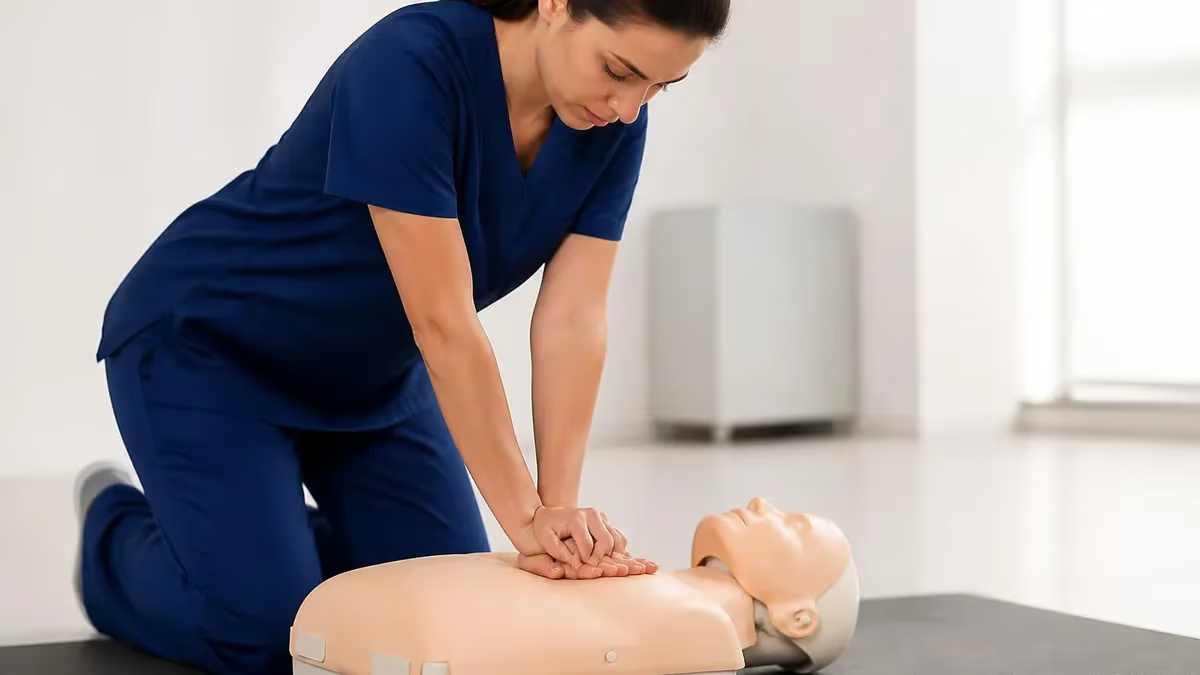
First aid cpr training has become one of the most valuable life skills any American adult can acquire in 2026, with the American Heart Association estimating that bystander CPR doubles or even triples the survival rate for victims of out-of-hospital cardiac arrest. Whether you are a healthcare professional preparing for advanced practice, a teacher fulfilling state requirements, a parent worried about infant choking, or a workplace safety coordinator, structured training programs combine practical skills like chest compressions, rescue breathing, choking relief, and automated external defibrillator operation into a single coherent curriculum that prepares you for real emergencies.
The modern first aid cpr training landscape includes several certification tiers, ranging from basic lay-rescuer courses that take three to four hours to complete to professional programs such as Basic Life Support (BLS), Advanced Cardiac Life Support, and Pediatric Advanced Life Support. Each tier targets a different audience, and choosing the wrong one wastes time and money. Lay rescuers benefit most from blended hands-on classes, while clinicians need provider-level certifications that align with the latest cpr fix phones guideline updates and scope-of-practice rules in their state.
The 2025 AHA guideline revisions introduced subtle but important changes to compression depth, ventilation timing, and post-resuscitation care that every refreshed certificate now reflects. Compression rate remains 100-120 per minute, depth at least two inches for adults, and the compression-to-ventilation ratio holds at 30:2 for single rescuers without an advanced airway. New emphasis on team dynamics, debriefing, and high-quality CPR metrics means modern courses spend more time on feedback devices, video review, and structured communication than older programs ever did.
Cost is another major factor families and employers weigh before enrolling. A heart-saver course averages $60-$90, BLS providers pay $75-$120, and ACLS courses run $200-$300 with PALS in a similar range. Some platforms like the National CPR Foundation offer fully online certifications for under $30, which is acceptable for non-clinical roles in most states but rarely sufficient for hospital credentialing. Always verify with your employer or licensing board before paying for any course you cannot use on the job.
Eligibility for most courses is wide open — students as young as twelve can complete heartsaver-level training, while ACLS and PALS typically require an active healthcare license or enrollment in a clinical program. Course providers must be accredited by the American Heart Association, American Red Cross, American Safety and Health Institute, or another recognized body to issue cards that survive workplace audits. Beware of unaccredited online mills that issue PDFs with no skills verification — they may not be honored when you start a new job.
This complete guide walks you through every aspect of first aid cpr training in 2026: course tiers and prerequisites, what each session covers minute by minute, the ACLS algorithm and PALS certification pathway, how to perform infant CPR safely, the role of respiratory rate assessment in initial triage, what AED stands for and how to use one, recovery position techniques, life support priorities, and the differences between online, blended, and in-person formats.
By the end, you will know exactly which course fits your goals, what to expect on the skills test, and how to keep skills sharp between two-year renewal cycles.
Training is only the start — retention is the harder challenge. Studies published in Resuscitation show that compression quality begins to decay within three to six months of certification, and rescue breathing skills fade even faster. The strongest programs build in quarterly micro-refreshers, manikin self-practice, and short e-learning modules that fight skill decay. Pair your formal certification with monthly five-minute practice sessions on a kitchen-table manikin or pillow, and you will hit your two-year renewal with confidence rather than dread.
First Aid CPR Training by the Numbers

Course Tiers and Certification Levels
Lay-rescuer course for teachers, parents, coaches, and workplace responders. Covers adult, child, infant CPR, AED use, and choking relief. Takes 3-4 hours and costs $60-$90.
Required for nurses, EMTs, medical students, and most clinical staff. Adds team dynamics, two-rescuer techniques, and bag-mask ventilation. Runs 4-5 hours at $75-$120 per seat.
Advanced Cardiac Life Support for physicians, ICU nurses, paramedics. Covers ACLS algorithm, rhythm recognition, pharmacology, and megacode. Takes 12-16 hours, $200-$300.
Pediatric Advanced Life Support for pediatric, ED, and PICU clinicians. Covers respiratory failure, shock, and pediatric resuscitation algorithms. Runs 14 hours, $220-$300.
Combines basic first aid skills like bleeding control, burns, fractures with CPR/AED training. Popular for OSHA-compliant workplaces and youth coaches. 6-8 hours, $80-$130.
Walking into your first day of first aid cpr training can feel overwhelming, but every accredited course follows a predictable arc designed by the American Heart Association or the American Red Cross. After a brief safety and scene-survey lecture, students rotate through skill stations where adult chest compressions, bag-mask ventilation, and AED pad placement are practiced on adult manikins. Instructors use real-time feedback devices that beep when compressions are too shallow, too slow, or recoil is incomplete, giving you objective proof of competence before written testing begins.
The cognitive portion covers chain-of-survival concepts, scene assessment, and the importance of early activation of EMS. Modern blended courses front-load this material in a self-paced online module so that classroom time can focus entirely on hands-on practice. Expect short video segments demonstrating proper hand placement, a quick discussion of compression fraction (the percentage of cardiac arrest time spent actively compressing), and group debrief on common mistakes such as leaning, inadequate depth, or excessive ventilation. Most instructors weave in cases from local EMS systems.
Respiratory rate assessment is a sleeper skill that often surprises students. Knowing the normal average respiratory rate in adults — typically 12-20 breaths per minute — helps you decide whether a victim needs rescue breathing, supplemental oxygen, or simply repositioning. Slower than 8 or faster than 30 is an early warning sign of impending respiratory failure, and recognizing it before the heart stops can prevent the arrest entirely. Pediatric ranges shift higher: infants normally breathe 30-60 times per minute, and children 20-30, which we cover in the pediatric module.
Choking relief gets its own dedicated station because partial-airway obstructions are one of the most common emergencies bystanders face. You will practice the Heimlich maneuver on adults and children, back-blow and chest-thrust technique on infants, and what to do when the victim becomes unresponsive (call EMS, begin CPR, check the mouth before each rescue breath). Pregnant women and obese patients receive chest thrusts rather than abdominal thrusts, and that variation is tested on the skills exam in most accredited programs.
The AED station is the most popular part of the day for many students. You will open a real or training defibrillator, attach pads to the manikin, follow voice prompts, and clear the patient before shock delivery. Modern AEDs analyze the rhythm automatically and only advise shock for shockable rhythms (ventricular fibrillation and pulseless ventricular tachycardia), removing the ambiguity that older defibrillators introduced. Pediatric pads or a pediatric key are used for children under eight, and you will practice switching between modes.
Two-rescuer CPR is introduced once single-rescuer skills are solid. Coordinating compression handoffs every two minutes minimizes fatigue and keeps compression depth consistent. The off-going compressor calls out cycle counts, the on-coming rescuer takes over without interrupting flow, and the team leader monitors for return of spontaneous circulation. BLS, ACLS, and PALS courses spend significant time on these team dynamics because real codes are rarely solo events, and seamless transitions are linked to survival outcomes in published registry data.
Skills testing happens at the end of class. The instructor calls a simulated scenario, you assess the scene, check for responsiveness, call for help, begin compressions, deploy the AED, and continue cycles until told to stop. A written exam follows, usually 25-50 multiple-choice questions for heartsaver and BLS, longer for ACLS and PALS. Passing requires 84% on the written portion and instructor sign-off on the megacode or skills station. You walk out with a digital eCard valid for two years.
CPR Practice Test Questions
Prepare for the CPR Cardiopulmonary Resuscitation Practice exam with our free practice test modules. Each quiz covers key topics to help you pass on your first try.
CPR Basic CPR
CPR Exam Questions covering Basic CPR. Master CPR Test concepts for certification prep.
CPR and First Aid
Free CPR Practice Test featuring and First Aid. Improve your CPR Exam score with mock test prep.
CPR (Cardiopulmonary Resuscitation) Adult ...
CPR Mock Exam on (Cardiopulmonary Resuscitation) Adult CPR and AED Usage. CPR Study Guide questions to pass on your first try.
CPR (Cardiopulmonary Resuscitation) Airway...
CPR Test Prep for (Cardiopulmonary Resuscitation) Airway Obstruction and Choking. Practice CPR Quiz questions and boost your score.
CPR (Cardiopulmonary Resuscitation) Cardio...
CPR Questions and Answers on (Cardiopulmonary Resuscitation) Cardiopulmonary Emergency Recognition. Free CPR practice for exam readiness.
CPR (Cardiopulmonary Resuscitation) Child ...
CPR Mock Test covering (Cardiopulmonary Resuscitation) Child and Infant CPR. Online CPR Test practice with instant feedback.
CPR (Cardiopulmonary Resuscitation) High-P...
Free CPR Quiz on (Cardiopulmonary Resuscitation) High-Performance Team Dynamics. CPR Exam prep questions with detailed explanations.
CPR (Cardiopulmonary Resuscitation) Legal ...
CPR Practice Questions for (Cardiopulmonary Resuscitation) Legal and Ethical Considerations. Build confidence for your CPR certification exam.
CPR for Specific Populations
CPR Test Online for for Specific Populations. Free practice with instant results and feedback.
CPR Airway & Breathing Management
CPR Exam Questions covering Airway & Breathing Management. Master CPR Test concepts for certification prep.
CPR Assessment & Recognition of Cardiac Ar...
Free CPR Practice Test featuring Assessment & Recognition of Cardiac Arrest. Improve your CPR Exam score with mock test prep.
CPR Chest Compressions & Defibrillation
CPR Mock Exam on Chest Compressions & Defibrillation. CPR Study Guide questions to pass on your first try.
CPR Post-Resuscitation Care & Recovery
CPR Test Prep for Post-Resuscitation Care & Recovery. Practice CPR Quiz questions and boost your score.
ACLS Algorithm, PALS Certification, and BLS Compared
The acls algorithm is the backbone of advanced resuscitation, organizing care into a clear flow: high-quality CPR, rhythm check every two minutes, shock if indicated, epinephrine every three to five minutes, and consideration of reversible causes (the Hs and Ts). Students memorize separate algorithms for ventricular fibrillation/pulseless VT, asystole/PEA, bradycardia, and tachycardia with and without a pulse.
Mastery requires more than memorization. Instructors run megacode scenarios where students rotate through team-leader, compressor, airway, and recorder roles. Real-time decision making — when to shock, when to push epinephrine, when to consider amiodarone — is graded against the AHA pocket card. Most providers pass on their first attempt if they review the algorithm sheets the night before and practice closed-loop communication during the simulation.
Online vs In-Person First Aid CPR Training: Which Is Right for You?
- +Online blended courses cost 30-50% less than fully in-person classes
- +Self-paced cognitive modules let you study evenings and weekends
- +Digital eCard delivered instantly after skills check-off
- +Convenient for busy professionals juggling clinical schedules
- +Most state boards and employers accept blended AHA certifications
- +Cuts classroom seat time roughly in half for the same content
- +Mobile-friendly platforms make reviewing algorithms easy between shifts
- −Fully online courses without skills check may not be employer-accepted
- −Less peer interaction and team-dynamics practice than full in-person
- −Requires reliable internet and a quiet study environment at home
- −Self-discipline needed to finish modules before the in-person session
- −Skills decay faster without classroom reinforcement and repeated reps
- −Some specialty units still mandate traditional in-person ACLS or PALS
- −Refunds and reschedules are harder once online portions are started
Pros and Cons at a Glance
| Pros | Cons |
|---|---|
| Self-paced cognitive modules let you study evenings and weekends | Fully online courses without skills check may not be employer-accepted |
| Digital eCard delivered instantly after skills check-off | Less peer interaction and team-dynamics practice than full in-person |
| Convenient for busy professionals juggling clinical schedules | Requires reliable internet and a quiet study environment at home |
| Most state boards and employers accept blended AHA certifications | Self-discipline needed to finish modules before the in-person session |
| Cuts classroom seat time roughly in half for the same content | Skills decay faster without classroom reinforcement and repeated reps |
| Mobile-friendly platforms make reviewing algorithms easy between shifts | Some specialty units still mandate traditional in-person ACLS or PALS |
Pre-Class Preparation Checklist for CPR Index Success
- ✓Download the AHA student manual or Red Cross handbook a week ahead
- ✓Complete the online cognitive module before arriving — do not skip it
- ✓Review the BLS or ACLS algorithm pocket cards the night before
- ✓Wear comfortable clothes and flat shoes for floor-based skills practice
- ✓Bring a watch or phone with a second hand for compression rate timing
- ✓Eat a real meal beforehand — most classes have only one short break
- ✓Practice counting compressions out loud at 100-120 per minute
- ✓Print your eCard reference number from prior certification if renewing
- ✓Verify your provider is AHA, ARC, or ASHI accredited before paying
- ✓Confirm with HR or licensing board that the course meets their requirements
High-Quality Compressions Save More Lives Than Any Drug
Decades of resuscitation data make one fact unmistakably clear: chest-compression quality outweighs every medication, advanced airway, and gadget in the crash cart. Push hard (at least 2 inches), push fast (100-120/min), allow full recoil, minimize interruptions, and avoid excessive ventilation. If you remember nothing else from your first aid cpr training, remember this — and the next victim has a real chance.
Infant cpr is the topic that drives more parents and grandparents into the classroom than any other, and rightly so — the techniques differ enough from adult resuscitation that intuition alone can do harm. For an infant under one year of age, compressions are delivered with two fingers (single rescuer) or two thumbs encircling the chest (two rescuer), to a depth of about 1.5 inches or one-third the chest depth, at the same 100-120 per minute rate used for adults. Rescue breaths cover both the mouth and nose because the infant's anatomy is too small for a mouth-only seal.
The choking infant gets a unique sequence: lay the baby face down along your forearm with head lower than torso, deliver five firm back blows between the shoulder blades with the heel of your hand, flip the baby supine, and deliver five chest thrusts using two fingers on the breastbone. Repeat until the object dislodges or the infant becomes unresponsive, at which point you begin infant CPR and check the mouth before each rescue breath. Never perform blind finger sweeps — they can push objects deeper into the airway.
Recognition of respiratory arrest in infants and children is critical because pediatric cardiac arrest is almost always a downstream consequence of inadequate breathing. Warning signs include nasal flaring, grunting, intercostal retractions, head bobbing, and a respiratory rate persistently above 60 or below 20 in an infant. Cyanosis around the lips is a late sign, and altered mental status (limp tone, no eye contact, no cry) suggests imminent collapse. Intervening at the respiratory stage often prevents the cardiac arrest entirely, which is why PALS-trained clinicians spend so much time on early assessment.
Children between one and eight years of age receive what looks like a hybrid of adult and infant CPR. Compressions use one or two hands depending on the rescuer's size and the child's body, depth is about two inches or one-third the chest, and the same 30:2 ratio applies for single rescuers. AED pads designed for children deliver attenuated energy doses, and most modern devices include either pediatric pads or a key/switch that automatically reduces output. If pediatric pads are unavailable, adult pads on a child are still preferable to no defibrillation.
Rescue breathing for both infants and children should produce visible chest rise but no more. Excessive ventilation is a common error that increases intrathoracic pressure, reduces venous return, and worsens outcomes. Each breath should last about one second, with a brief pause before the next compression cycle resumes. In a two-rescuer pediatric scenario without an advanced airway, the ratio shifts to 15:2 — a key difference from adult two-rescuer CPR that often appears on PALS exams.
Drowning, sudden infant death events, and severe asthma attacks are common scenarios that drive pediatric arrests in the home. Parents who complete first aid cpr training learn to recognize early decompensation and respond before paramedics arrive. Several state laws now require new-parent CPR training before infants leave the hospital, and many pediatricians distribute discounted-class vouchers at the six-month well visit. Workplaces in childcare, schools, and youth sports likewise mandate pediatric-focused CPR for all staff who supervise minors.
Family practice is the secret to retention. Set up a $30 manikin in a closet, run a five-minute drill once a month with your partner, and quiz each other on choking response while making dinner. Parents who train and practice together respond faster and more accurately than those who train alone, according to several family-medicine studies. The American Heart Association also offers a free family-and-friends CPR kit that includes a small inflatable manikin and a 22-minute video, perfect for refresher sessions between formal recertifications.

Most AHA cards expire exactly two years after the issue date, and a lapsed card means you cannot legally function in many clinical roles until you reinstate it. Renewal courses are shorter and cheaper than initial certification, but only if you complete them before the expiration date. After lapse, you may be required to take the full initial course again at full price — and some hospitals suspend clinical privileges immediately. Mark your calendar 60 days out.
Few questions come up more often in class than "what is aed and how is it different from a defibrillator?" An AED — automated external defibrillator — is a portable device designed for lay rescuers to deliver a life-saving shock to a victim in cardiac arrest. The unit analyzes the heart rhythm, advises whether a shock is needed, and uses voice prompts to coach the rescuer through every step. Modern AEDs are nearly impossible to misuse because they refuse to shock non-shockable rhythms, eliminating most fear-of-harm hesitation among bystanders.
Pad placement is the only manual step that requires attention. For adults, one pad goes on the upper right chest below the collarbone and the other on the lower left side under the armpit, creating an electrical pathway across the heart. For infants and small children, pads may go front-and-back (anterior-posterior) to avoid overlap. Wipe the chest dry, shave heavy hair if a razor is included in the kit, and remove medication patches before applying pads — burns and skin injury are otherwise possible. The voice prompt will tell you when to stand clear for analysis and shock.
Public-access defibrillation programs have placed AEDs in airports, gyms, schools, malls, and corporate campuses across the country. Locating one quickly is the difference between life and death — survival drops about 10% for every minute defibrillation is delayed. Apps like PulsePoint AED map crowd-sourced device locations in many cities, and 911 dispatchers can guide callers to the nearest unit. During first aid cpr training you will practice retrieving, transporting, and deploying an AED while another rescuer continues compressions, so the workflow becomes second nature.
The recovery position is the unsung hero of post-resuscitation and post-seizure care. Once a victim has return of spontaneous circulation but remains unresponsive and is breathing normally, rolling them onto their side prevents aspiration of vomit and helps maintain a patent airway. The HAINES (High Arm in Endangered Spine) variant is preferred when spinal injury is suspected. Continue to monitor breathing every minute and be ready to roll back to supine and resume CPR if breathing stops. Never leave the patient alone before EMS arrives.
Life support extends beyond the moment of arrest into the post-cardiac-arrest care window. The first hour after return of spontaneous circulation is critical: targeted temperature management between 32-36°C, controlled oxygenation to avoid hyperoxia, blood pressure support, and rapid identification of the underlying cause (STEMI, pulmonary embolism, toxic ingestion, electrolyte disturbance) all influence neurological outcome. Lay rescuers stay in the BLS lane, but advanced providers are trained to begin these interventions in the field or the emergency department.
The cpr index refers to a composite metric used by some training platforms and resuscitation registries to rate compression quality. It typically combines depth, rate, recoil, and chest-compression fraction into a single score from 0 to 100. Feedback devices on modern manikins display the score in real time, and instructors use it to identify which students need extra reps before testing. Tracking your CPR index over multiple practice sessions is a great way to measure objective improvement and to demonstrate competence to skeptical employers.
Documentation is the final link in the chain. Every certified rescuer should know how to brief arriving EMS in 30 seconds: time of collapse, time CPR began, number of shocks delivered, any medications given, current rhythm if known, and any known medical history. Hospitals and registries use this Utstein-style data to track outcomes and improve community survival rates. Your first aid cpr training will include practice handoffs, and getting comfortable with this brief, structured communication is one of the most valuable skills you walk away with.
Walking out of class with a fresh card is exciting, but the work of becoming a confident rescuer begins the moment training ends. Skill decay is real and measurable — studies show compression depth and rate quality drop noticeably within three months and meaningfully within six. The antidote is short, frequent practice. Five minutes a week on a kitchen-table manikin, an inflatable home model, or even a firm pillow keeps the muscle memory alive. Pair practice with mental rehearsal: imagine the scene, talk through your steps, and visualize delivering compressions at the correct depth and tempo.
Build a personal emergency-ready kit at home, in your car, and at work. Include a barrier mask or face shield, gloves, scissors for cutting through clothing, a small notepad and pen, a flashlight, and a one-page algorithm reminder card. Some families add a pulse oximeter and a manual blood pressure cuff if a member has chronic cardiovascular disease. Knowing exactly where your kit lives saves precious seconds during a real emergency and is a tangible expression of preparedness.
If you live in a state with Good Samaritan protections (all 50 do, with variations), familiarize yourself with the specific language before you act. The law generally protects bystanders from civil liability when they render reasonable emergency aid without expectation of compensation. Acting within the scope of your training, calling EMS promptly, and not abandoning the victim once you start care are the three key conditions in most jurisdictions. Knowing this in advance removes the hesitation that costs lives.
Mental rehearsal matters as much as physical practice. Visualize specific scenarios: a coworker collapses at the desk next to you, your child chokes on a piece of food at dinner, an elderly neighbor falls and is unresponsive when you arrive. Walk through your response step by step in your head — checking the scene, calling for help, beginning compressions, sending someone for the AED. This kind of mental rehearsal is used by military medics, firefighters, and ER physicians, and the evidence supports it as a powerful tool for performance under stress.
Build a refresher schedule into your calendar. The AHA recommends a two-year recertification cycle, but high-stakes clinicians and lay rescuers alike benefit from quarterly self-checks. Watch a 10-minute YouTube video on adult CPR every January, infant CPR every April, AED use every July, and choking response every October. These micro-sessions take less than 45 minutes a year combined and keep recall sharp enough to act without freezing. Many training providers also offer free monthly newsletters with case studies and skill reminders.
Consider becoming an instructor yourself. After two years as a provider, most disciplines allow you to enroll in an instructor course for that level. Instructor candidates not only multiply community capacity to train new rescuers but also reach the highest levels of personal retention because teaching forces deep mastery. Compensation ranges from $30 to $75 per student taught, making it a reasonable side income for nurses, paramedics, firefighters, and even motivated lay rescuers in their communities. Many large employers reimburse instructor course costs.
Finally, treat each renewal as an opportunity to upgrade, not just maintain. Did you start with heartsaver? Consider adding BLS if your job evolves. Already a BLS provider? Look at ACLS or PALS depending on your patient population. Each tier opens new clinical opportunities, increases your earning potential by an average of 3-8%, and most importantly, equips you with deeper expertise to act decisively when seconds matter. The journey from bystander to skilled rescuer is one of the most meaningful any American can take in 2026.
CPR Questions and Answers
CPR vs BLS: Complete Comparison Guide for 2026 — Which Certification Do You Need?
CPR Card Lookup: How to Verify, Replace, and Access Your CPR Certification in 2026
AHA CPR: What It Is, Which Course You Need, and How to Get Certified
CPR Instructor Jobs 2026: How to Become a Certified Instructor, Salary Expectations, and Career Pathways
Adult CPR: Complete Step-by-Step Guide to Hands-Only and Standard CPR in 2026
About the Author

Registered Nurse & Healthcare Educator
Johns Hopkins University School of NursingDr. Sarah Mitchell is a board-certified registered nurse with over 15 years of clinical and academic experience. She completed her PhD in Nursing Science at Johns Hopkins University and has taught NCLEX preparation and clinical skills courses for nursing students across the United States. Her research focuses on evidence-based exam preparation strategies for healthcare certification candidates.
Join the Discussion
Connect with other students preparing for this exam. Share tips, ask questions, and get advice from people who have been there.
View discussion (5 replies)