
CPR for Pets: How to Perform CPR on a Dog or Cat in 2026 October
Learn how to cpr a dog or cat with step-by-step compressions, rescue breaths, recovery position, and emergency vet guidance for pet owners. 📝
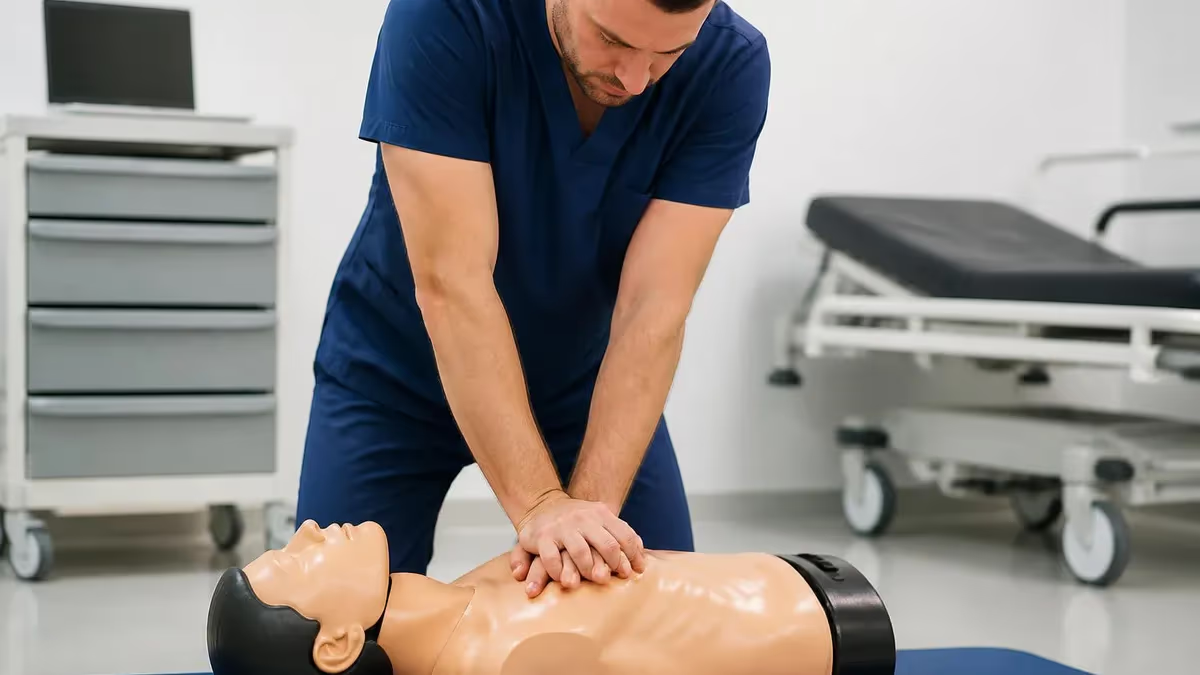
If your dog or cat collapses, stops breathing, and has no pulse, you have three or four minutes to act before brain damage starts piling up. Veterinary clinics aren't always seconds away. Whoever's standing closest at that moment is the one who decides what happens next — and that's almost always going to be you, not a vet.
Pet CPR is real CPR. The chest compressions are the engine, the rescue breaths are the gas, and the rate is the same 100 to 120 per minute that you'd use on a human. What changes is the technique by size, the hand position, and the way you deliver breaths — through the nose, not the mouth.
This guide walks through everything: how to tell if your animal actually needs CPR, the exact compression technique for large dogs, small dogs, cats, and puppies or kittens, when to call the emergency vet, and when CPR is the wrong answer. The framework comes from the RECOVER CPR Initiative — the veterinary equivalent of the AHA guidelines — and a decade of evidence on out-of-hospital animal arrests.
Before we go further, here's the one thing to remember: most pets that arrest at home don't survive. Bystander CPR roughly doubles the survival odds, but baseline survival is grim. You're not failing if it doesn't work. You're giving your pet the only chance they had.
Pet CPR by the Numbers

How to Tell If Your Pet Needs CPR
Tap the shoulder firmly and call the animal's name. No reaction, no blink reflex when you touch the corner of the eye, no head turn — that's unconsciousness, not just drowsiness.
Watch the chest for 5 to 10 seconds. Slow agonal gasps every 10 to 15 seconds are not breathing — they're a sign of arrest. Look for steady rhythmic chest movement; its absence confirms respiratory failure.
Press the inside of the upper rear leg, at the crease where the leg meets the body, against the femur. The femoral pulse is the most reliable landmark on a dog or cat. Ten seconds max — no pulse means start compressions.
Healthy gums are pink and refill in under 2 seconds when pressed. Gray, muddy, or cyanotic blue gums confirm that oxygen isn't reaching the tissues. Pair this with no breathing and no pulse and you have cardiac arrest.
Shine a phone light at the eye. Pupils that don't constrict and don't track movement confirm absent brainstem perfusion. This is a late sign — by the time pupils are fixed, you should already be deep into compressions.
A firm pinch between the toes normally produces an immediate withdrawal. No reaction confirms loss of consciousness. Don't waste more than a few seconds on this — combined with the signs above, start CPR immediately.
Cardiac arrest in a dog or cat has three signs, and you need to confirm all three within about 10 seconds before starting compressions. First, the animal is unresponsive — no reaction to its name, no reaction to a firm tap on the shoulder or rib cage, no blink reflex when you touch the corner of the eye. Unresponsive means out cold, not just dazed.
Second, no breathing. Watch the chest for 5 to 10 seconds. Don't confuse agonal gasps — those slow, dramatic, fish-out-of-water motions — with normal breathing. Agonal gasps are a sign of arrest, not life. If you see one gasp every 10 or 15 seconds and nothing else, that animal is not breathing.
Third, no pulse. The carotid pulse on a pet is hard to find under stress. The easier landmark is the femoral artery — run your fingers along the inside of the upper rear leg, at the crease where the leg meets the body. You're looking for a pulse against the femur. If you can't find one in 10 seconds, treat as arrest.
Two more cues confirm the picture. Gums turn pale gray, blue, or muddy — that's cyanosis, and it means oxygen isn't circulating. And the eyes go fixed and dilated, no longer tracking light. Any combination of unresponsive plus no breathing plus blue gums is enough. Start CPR.
Human 911 dispatchers are not required to dispatch for animal calls and most won't. The faster path is a direct call to the nearest 24-hour veterinary emergency hospital. If poisoning is the suspected cause — antifreeze, rat bait, chocolate, xylitol, lily ingestion in cats — call ASPCA Animal Poison Control at 1-888-426-4435. They'll talk you through CPR and brief the receiving hospital with the toxin profile before you arrive.
The moment you confirm arrest, get help moving. If you're alone, switch your phone to speaker mode and dial the nearest 24-hour emergency vet while you start compressions. If poisoning is the suspected cause — antifreeze, rat bait, chocolate overdose, xylitol gum, lily ingestion in cats — call ASPCA Animal Poison Control at 1-888-426-4435. They charge a consult fee, but they'll talk you through CPR and prepare the receiving hospital with the exact toxin profile.
Human 911 dispatchers can sometimes route you to the right animal hospital, but they aren't required to dispatch for animal calls. The faster path is a direct call to the emergency vet or ER hospital. If a second person is in the room, point at them — don't talk to the room generally — and tell that specific person to call and to drive while you continue CPR in the back seat.
The arrival window matters. Veterinary CPR studies show that animals arriving at the ER with active bystander compressions in progress have a meaningfully higher chance of return of spontaneous circulation than animals brought in cold. Don't pause to "make sure" before you transport. Compressions in the car, on the way, with someone else driving.
The RECOVER CPR Initiative is the veterinary equivalent of the AHA guidelines. Its consensus protocol — first published in 2012 and updated every five years — is the standard taught at every major vet school and emergency hospital in North America. Owner CPR sits in the Basic Life Support layer: recognition, compressions, ventilation. Everything past that — drugs, IV access, intubation, defibrillation — happens at the hospital. Unlike adult human CPR, ventilation is not optional in pets, because a large fraction of animal arrests start as respiratory failure. Plan to do breaths.
The protocol you're about to use comes from the RECOVER CPR Initiative — Reassessment Campaign on Veterinary Resuscitation. It's a multi-institution consensus group that published the first evidence-based veterinary CPR guidelines in 2012 and has updated them roughly every five years since. The RECOVER framework is what's taught at every major vet school and emergency hospital in North America, and it's what the AVMA recommends for owner-administered CPR in the moments before professional care.
RECOVER divides resuscitation into Basic Life Support and Advanced Life Support. BLS is what an owner does — recognition, compressions, ventilation. ALS is everything that requires drugs, IV access, intubation, defibrillation, or end-tidal CO2 monitoring. You're operating in the BLS layer until the vet team takes over. The framework is identical in principle to human BLS, which is why so much of it will feel familiar if you've ever taken a Red Cross or AHA course.
One important difference from human CPR: ventilation matters more in animals. A large fraction of animal arrests start as respiratory arrests — choking, anaphylaxis, drowning, drug reaction — that progress to cardiac arrest. That means the rescue breaths aren't optional in the way that hands-only CPR is sometimes acceptable for adult humans. Plan to do compressions and breaths together.
Pet CPR Compression Technique by Size
Lay the dog on its right side on a hard, flat surface — never on a bed or couch. Identify the widest part of the chest, which on most dogs sits where the elbow touches the chest wall in a relaxed position. Stack your palms heel-to-heel, lock your arms straight, and put your shoulders directly over your hands so you're driving compressions with body weight, not arm strength.
Compress one-third to one-half the width of the chest — roughly 2 to 3 inches on a 60-pound Labrador, 3 to 4 inches on a Great Dane. Rate is 100 to 120 per minute, the same as adult human CPR. Allow full chest recoil between every compression. If you lean on the chest between cycles, the heart never refills.
A large dog — anything over about 25 pounds, but the technique works for anything roughly Labrador-sized or bigger — needs lateral recumbency CPR. Lay the dog on its right side on a hard, flat surface. The floor is fine. A bed or couch is too soft; compressions on soft surfaces dissipate into the cushion instead of into the chest. If you're outside, the ground works as long as it's level.
Find the widest point of the chest. On most dogs this is roughly where the elbow touches the chest wall when the front leg is in a relaxed position. That's your hand placement target. Stack your palms heel-to-heel, fingers interlocked, arms locked straight, and shoulders directly over your hands. The geometry is the same as adult human CPR — you're driving compressions with your body weight, not your arm strength.
Compression depth is one-third to one-half the width of the chest. On a 60-pound dog that's roughly 2 to 3 inches; on a Great Dane it can be closer to 4 inches. The principle is consistent: about a third of the chest's resting diameter. The rate is 100 to 120 compressions per minute — identical to humans. Hum "Stayin' Alive" if it helps.
Barrel-chested breeds like English Bulldogs, Boxers, and French Bulldogs are an exception. Their chests are wider than they are deep, and lateral compressions don't generate enough cardiac output. For these breeds, put the dog on its back (dorsal recumbency) with the legs in the air, place your hands over the sternum directly above the heart, and compress straight down. Same rate, same depth — different geometry.

Animals under 25 pounds — small dogs and cats — use a different geometry than large dogs. You don't drive compressions downward with body weight; you wrap one hand around the chest from underneath and squeeze your thumb toward your fingers. The chest gets compressed circumferentially, not linearly. Rate stays at 100 to 120 per minute. Depth is still one-third to one-half the chest width — which means real, decisive squeezes, not gentle taps. Most owners undercompress small pets out of fear of hurting them. That fear is what kills the animal.
For dogs under 25 pounds and for cats, the wrap-around technique works better than two-handed lateral compressions. Place the animal on its side. Wrap one hand around the chest from underneath so your thumb sits on one side of the sternum and your fingers grip the other side. Compress by squeezing your thumb toward your fingers — you're using one-handed circumferential pressure rather than driving down with body weight.
The compression rate is the same 100 to 120 per minute. Depth is one-third to one-half the chest width, which on a Chihuahua or a small terrier is roughly an inch. On a cat it's about three-quarters of an inch to an inch and a quarter. You're aiming for a real, decisive squeeze, not a polite poke. Most owners under-compress small animals because they're afraid of hurting them — that fear is what kills the animal, not the pressure.
Cats specifically: lay the cat on its right side. Wrap your hand around the chest just behind the front legs. Squeeze 100 to 120 times per minute, with full chest recoil between each squeeze. The chest must return completely to its resting position before the next compression — partial recoil collapses the refill phase and drops cardiac output to nothing.
Muzzle-to-Nose Rescue Breath Technique
- ✓Close the dog or cat's mouth by holding the jaws shut with one hand
- ✓Extend the neck so the head and neck form a neutral straight line — don't over-flex
- ✓Make a seal with your lips around the nostrils — the seal must be airtight
- ✓Exhale a gentle one-second breath — watch for the chest to rise, then stop
- ✓Deliver 2 breaths after every 30 compressions for one-rescuer CPR (30:2 ratio)
- ✓If breathing alone for an intubated animal, deliver 10 breaths per minute — one every 6 seconds
- ✓If the chest doesn't rise, reposition the head and check the mouth for obstruction before retrying
- ✓Each breath should feel like blowing on a candle flame — never force air in or balloon the chest
Rescue breaths in pets go through the nose, not the mouth. Vets call this muzzle-to-nose ventilation, and it's the standard for dogs, cats, rabbits, and most other small mammals. The reason is anatomy — a dog's jaw doesn't seal cleanly, and trying to breathe into the mouth lets air escape sideways. The nose-to-nose seal works because you can close your hand around the muzzle to make it airtight.
The technique: close the mouth by holding the jaws shut with one hand. Extend the neck so the airway is straight — head and neck in a neutral line, not flexed. Make a seal with your lips around the nose and exhale a gentle breath. Watch the chest rise. As soon as it does, stop. Forcing more air in inflates the stomach instead of the lungs and can trigger vomiting.
The cadence: one breath every 6 seconds, which works out to about 10 breaths per minute. This is the rate for an animal that's intubated or one rescuer is doing continuous compressions. If you're doing one-rescuer CPR with compression cycles, use the standard 30:2 compression-to-breath ratio — 30 compressions, two breaths, repeat. Same as adult human CPR.
Each breath lasts one second. Long enough to see the chest rise, short enough to avoid over-inflation. If the chest doesn't rise, reposition the head, check for an obstruction in the mouth or throat, and try again. Persistent failure to ventilate after repositioning means you're likely dealing with an airway obstruction — switch to the choking protocol below.
Neonates under a few weeks old need two-fingertip compressions over the sternum just behind the front legs. Rate stays at 100 to 120 per minute. Ratio stays at 30:2. Breaths are the smallest possible puff — barely enough air to twitch the chest upward. A full adult-strength exhale can rupture the alveoli of a newborn kitten or puppy. For a litter where the mother died during whelping and a neonate is unresponsive, try 30 seconds of brisk towel stimulation and a bulb syringe to clear the airway before starting CPR. Compression-induced injury heals; oxygen deprivation past four minutes does not.
Puppies and kittens under a few weeks old are the most fragile cases. Their bones bend rather than break, but their lungs are tiny and easy to over-inflate. The compression technique uses two fingertips — index and middle finger — placed over the sternum just behind the front legs. Press straight down about a third of the chest depth, which on a newborn kitten is closer to half an inch.
Rate stays at 100 to 120 per minute. Ratio stays at 30:2 for single-rescuer CPR. Breaths are the smallest possible puff — barely enough air to make the chest twitch upward. A full adult-strength exhale can rupture alveoli in a kitten or newborn puppy. Think of it as blowing on a candle flame rather than blowing out a balloon.
For a litter where the mother died during whelping and a puppy or kitten is born unresponsive, the first move is actually neonatal stimulation rather than chest compressions — rub the body briskly with a warm towel and clear fluid from the airway with a bulb syringe. If there's no response within 30 seconds, then proceed to two-finger CPR.
Standard CPR vs Canine Heimlich: When to Use Each
- +Use CPR when the animal is unresponsive, not breathing, and has no femoral pulse
- +Use CPR when poisoning, drowning, or anaphylaxis caused the collapse
- +Use CPR if the animal goes unresponsive during a choking rescue — compressions can dislodge the object
- +Use CPR for neonates born without breathing after 30 seconds of towel stimulation fails
- +Use CPR if cardiac arrest is confirmed in a barrel-chested breed — switch to dorsal recumbency
- +Use CPR while transporting in a car if a second person is available to drive
- −Skip CPR if the dog is conscious, frantic, and pawing at its face — use the Heimlich instead
- −Skip CPR for visibly distended abdomen with weak rapid pulse — that's bleeding or bloat, not arrest
- −Skip CPR if rectal temperature is above 105°F and a pulse is present — cool the dog, don't compress
- −Skip CPR if the dog has obvious blunt-force trauma with deformity — internal bleeding, not arrest
- −Skip standard chest compressions for confirmed pneumothorax — needle decompression is the vet's job
- −Skip CPR if the animal already has a clear pulse and is breathing on its own — compressions can stop the heart
Pros and Cons at a Glance
| Pros | Cons |
|---|---|
| Use CPR when the animal is unresponsive, not breathing, and has no femoral pulse | Skip CPR if the dog is conscious, frantic, and pawing at its face — use the Heimlich instead |
| Use CPR when poisoning, drowning, or anaphylaxis caused the collapse | Skip CPR for visibly distended abdomen with weak rapid pulse — that's bleeding or bloat, not arrest |
| Use CPR if the animal goes unresponsive during a choking rescue — compressions can dislodge the object | Skip CPR if the dog has obvious blunt-force trauma with deformity — internal bleeding, not arrest |
| Use CPR if cardiac arrest is confirmed in a barrel-chested breed — switch to dorsal recumbency | Skip standard chest compressions for confirmed pneumothorax — needle decompression is the vet's job |
| Use CPR while transporting in a car if a second person is available to drive | Skip CPR if the animal already has a clear pulse and is breathing on its own — compressions can stop the heart |
A choking dog is awake, panicked, and pawing at its face. A dog in cardiac arrest is unresponsive and limp. The first needs the canine Heimlich — abdominal thrusts behind the last rib, upside-down shake for small dogs. The second needs chest compressions. Treating the wrong cause wastes the only window you have. Check the mouth between Heimlich thrusts — if you see the object, fish it out carefully. A panicked dog will bite. If the choking dog goes unresponsive mid-rescue, switch to CPR — the compressions themselves often dislodge what the Heimlich couldn't.
If your dog is conscious, frantic, pawing at its face, and not breathing properly, it's choking — not in cardiac arrest. CPR is the wrong move. The right move is the canine Heimlich. For a small dog, hold the dog upside-down by the back legs and give a sharp shake or two — gravity often dislodges the object. For a medium or large dog, stand behind the dog with the dog standing or sitting, wrap both arms under the rib cage, and deliver firm upward and inward thrusts behind the last rib, just like adult human Heimlich.
Check the mouth between thrusts. If you can see the object, fish it out with your fingers — be careful, a panicked dog will bite. If you can't see it and it doesn't come out after several thrusts, transport immediately while continuing periodic thrusts in the car. If the dog goes unresponsive mid-rescue, lay it down, open the mouth and look one more time, then start standard CPR with the compressions themselves often dislodging the object.
Cats choke much less often than dogs but the protocol is the same in miniature — upside-down by the back legs for tiny cats, abdominal thrusts behind the ribs for larger ones, finger sweep only if you can see the object. Cat teeth are sharper than dog teeth and infected cat bites are nasty; protect your fingers.

CPR Practice Test Questions
Prepare for the CPR Cardiopulmonary Resuscitation Practice exam with our free practice test modules. Each quiz covers key topics to help you pass on your first try.
CPR Basic CPR
CPR Exam Questions covering Basic CPR. Master CPR Test concepts for certification prep.
CPR and First Aid
Free CPR Practice Test featuring and First Aid. Improve your CPR Exam score with mock test prep.
CPR (Cardiopulmonary Resuscitation) Adult ...
CPR Mock Exam on (Cardiopulmonary Resuscitation) Adult CPR and AED Usage. CPR Study Guide questions to pass on your first try.
CPR (Cardiopulmonary Resuscitation) Airway...
CPR Test Prep for (Cardiopulmonary Resuscitation) Airway Obstruction and Choking. Practice CPR Quiz questions and boost your score.
CPR (Cardiopulmonary Resuscitation) Cardio...
CPR Questions and Answers on (Cardiopulmonary Resuscitation) Cardiopulmonary Emergency Recognition. Free CPR practice for exam readiness.
CPR (Cardiopulmonary Resuscitation) Child ...
CPR Mock Test covering (Cardiopulmonary Resuscitation) Child and Infant CPR. Online CPR Test practice with instant feedback.
CPR (Cardiopulmonary Resuscitation) High-P...
Free CPR Quiz on (Cardiopulmonary Resuscitation) High-Performance Team Dynamics. CPR Exam prep questions with detailed explanations.
CPR (Cardiopulmonary Resuscitation) Legal ...
CPR Practice Questions for (Cardiopulmonary Resuscitation) Legal and Ethical Considerations. Build confidence for your CPR certification exam.
CPR for Specific Populations
CPR Test Online for for Specific Populations. Free practice with instant results and feedback.
CPR Airway & Breathing Management
CPR Exam Questions covering Airway & Breathing Management. Master CPR Test concepts for certification prep.
CPR Assessment & Recognition of Cardiac Ar...
Free CPR Practice Test featuring Assessment & Recognition of Cardiac Arrest. Improve your CPR Exam score with mock test prep.
CPR Chest Compressions & Defibrillation
CPR Mock Exam on Chest Compressions & Defibrillation. CPR Study Guide questions to pass on your first try.
CPR Post-Resuscitation Care & Recovery
CPR Test Prep for Post-Resuscitation Care & Recovery. Practice CPR Quiz questions and boost your score.
The question every owner asks is when to stop. The honest answer: continue until the vet team takes over, until the animal regains a pulse and starts breathing on its own, or until you physically cannot continue. The veterinary CPR studies suggest about 20 minutes of high-quality bystander CPR is the rough outer limit for meaningful return of spontaneous circulation in the field — beyond that, even successful ROSC tends to be followed by neurological devastation.
But "20 minutes" assumes you're truly alone, with no transport possible. If you have a car and a driver, you're not stopping — you're loading the animal and continuing compressions in the back seat. Most successful outcomes involve compressions that started at home and continued until the moment the ER team took the leash.
Compression fatigue is real. Quality drops within two minutes of continuous compressions even when the rescuer feels fine. If a second person is available, swap every two minutes. The transition should take less than five seconds — count it down so the new rescuer's hands replace yours mid-cycle.
When Collapse Isn't Cardiac Arrest
- ✓Visibly distended belly with weak rapid pulse — that's internal bleeding from spleen or liver, needs surgery not compressions
- ✓Bloat (gastric dilatation-volvulus) — distended abdomen, unproductive retching, restlessness — transport, don't compress
- ✓Rectal temperature above 105°F with pulse still present — heatstroke, cool with wet towels and air movement instead
- ✓Blunt-force trauma with visible deformity — likely internal bleeding rather than arrest, transport on a flat surface
- ✓Confirmed pneumothorax — air in the pleural space — needle decompression is the vet's job, not yours
- ✓Severe hypothermia with apparent death but possibly still alive — rewarm slowly before any compressions
- ✓Animal already has a clear pulse and is breathing on its own — compressions during ROSC can re-arrest the heart
- ✓Obvious rigor mortis or fixed lividity — the animal has been dead too long for CPR to recover any function
Not every collapse is cardiac arrest, and treating the wrong cause wastes the only window you have. A dog hit by a car may have internal bleeding from a ruptured spleen or liver — that animal needs surgery, not chest compressions. Signs that point toward abdominal trauma instead of arrest include a visibly distended belly, pale gums with rapid weak pulse (rather than no pulse), and the animal still being responsive even if barely.
Bloat — gastric dilatation-volvulus — is another one that looks like collapse but isn't arrest. A dog with bloat has a hugely distended abdomen, repeated unproductive retching, and pacing or restlessness before it goes down. CPR doesn't help; what helps is getting to a surgical team within an hour. If you're 30 minutes from a vet and your dog has the classic signs, transport, don't compress.
Heatstroke can present as collapse without true arrest. A dog with rectal temperature above 105°F that's panting heavily, has bright red gums, and is unresponsive may still have a pulse. Cool the dog with wet towels and air movement, get IV fluids on the way to the vet, and don't compress unless pulse and breathing actually stop. Compressions on a hyperthermic animal that still has spontaneous circulation can cause more harm than good.
Pet CPR Certification at a Glance
If your pet regains a pulse and starts breathing, you're not done — you're in the post-arrest window. Survivors of cardiac arrest are at high risk for re-arrest in the first 4 to 6 hours. The animal needs to be in a veterinary ICU with oxygen, IV fluids, continuous ECG monitoring, and ideally targeted temperature management for at least 24 hours. Don't go home thinking it's over.
Most owners ask about long-term outcomes. Honest answer: of dogs and cats that survive to hospital discharge after an out-of-arrest CPR, about half have meaningful neurological recovery and roughly half have some degree of permanent deficit — circling, decreased appetite, behavioral change, vision loss, or seizures. The conversation about quality of life happens between you and your vet over the next several weeks, not on day one.
For owners who want to be ready next time, pet CPR certification through programs like ProTrainings, the Red Cross Pet First Aid app, or the AKC pet first aid courses is genuinely useful. Most are 3 to 6 hour online courses for $30 to $80. They include hands-on practice with mannequins or stuffed animals and cover wound care, poisoning response, fracture stabilization, and CPR. If you have multiple pets or work with animals, the certification pays for itself the first time you use it.
One last thing worth knowing: Good Samaritan laws for pet CPR vary by state. Some states explicitly protect bystanders who attempt good-faith CPR on an animal that isn't theirs; others are silent on the matter. In every state, attempting CPR on your own pet carries no legal risk regardless of outcome. If you're attempting it on a neighbor's animal, getting their verbal consent (or a witness to your attempt) is the cleanest path.
Veterinary clinics generally don't bill for a CPR attempt that fails on arrival — that varies by clinic. They do bill for resuscitation, ICU admission, and any drugs administered if the animal survives the initial attempt. Emergency vet bills for a successful CPR with overnight ICU run $2,000 to $6,000 depending on location. Pet insurance with accident coverage usually pays a substantial portion of this; cash pet owners should know the rough numbers in advance.
CPR Questions and Answers
CPR on a Dog: Complete Pet CPR Guide for Owners 2026
Adult CPR: Complete Step-by-Step Guide to Hands-Only and Standard CPR in 2026
Infant CPR: Steps, Technique, and Certification Guide
When to Do CPR: A Complete Guide to Recognizing Cardiac Arrest and Acting Fast in 2026
First Aid CPR Certification: Complete 2026 Guide to Courses, Requirements, and Recertification
About the Author

Registered Nurse & Healthcare Educator
Johns Hopkins University School of NursingDr. Sarah Mitchell is a board-certified registered nurse with over 15 years of clinical and academic experience. She completed her PhD in Nursing Science at Johns Hopkins University and has taught NCLEX preparation and clinical skills courses for nursing students across the United States. Her research focuses on evidence-based exam preparation strategies for healthcare certification candidates.
Join the Discussion
Connect with other students preparing for this exam. Share tips, ask questions, and get advice from people who have been there.
View discussion (5 replies)