
Animal CPR: How to Perform Lifesaving Resuscitation on Dogs, Cats, and Other Pets in 2026 October
Learn animal CPR for dogs, cats, and pets — 🎓 compression rates, rescue breaths, AED facts, and life support steps every owner should know.
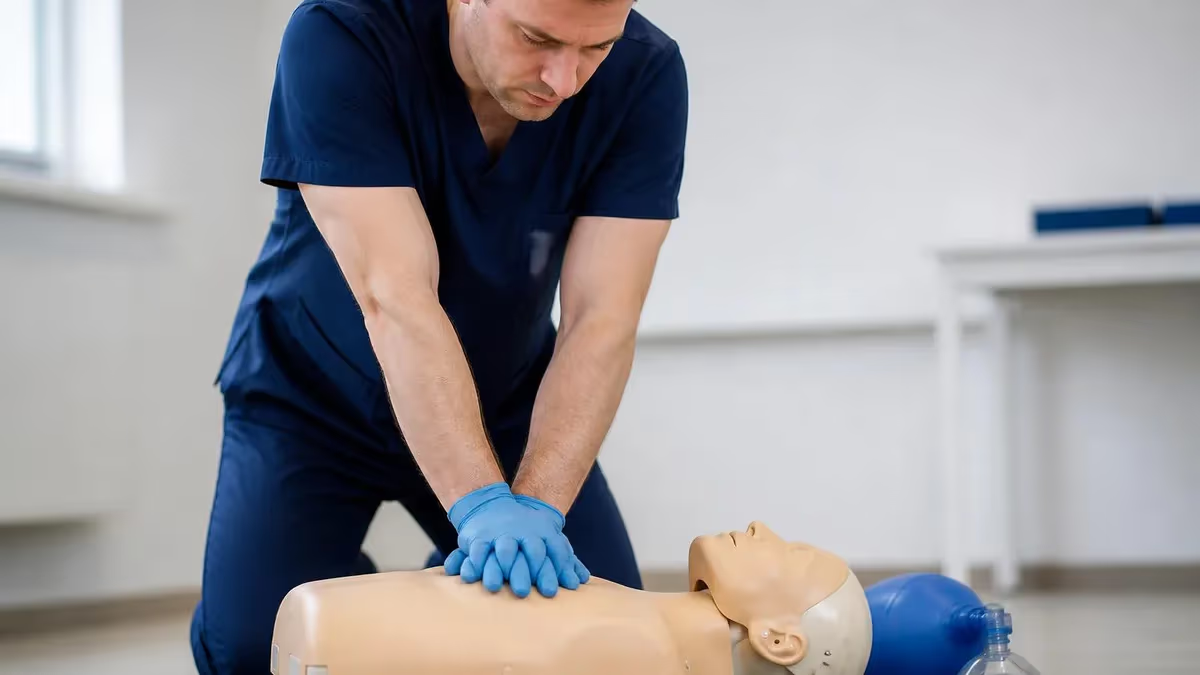
Animal CPR is the emergency technique used to restart circulation and breathing in a pet whose heart has stopped or who has lost consciousness due to drowning, choking, electrocution, trauma, or severe illness. While human resuscitation gets most of the headlines, the same physiologic principles that drive the acls algorithm — push hard, push fast, ventilate effectively, minimize interruptions — apply when the patient is a dog, cat, rabbit, or even a bird. Every pet owner should know the basics, because veterinarians are often minutes away and cardiac arrest gives you seconds.
The Recover Initiative, which publishes the leading veterinary CPR guidelines, modeled its protocols on human resuscitation science but adapted them for animal anatomy, size, and chest conformation. That means compression depth, hand placement, and ventilation rates differ between a teacup Chihuahua and a Great Dane. The core idea, however, is identical: oxygenated blood must reach the brain within four to six minutes of arrest, or neurologic damage becomes irreversible. Knowing where to push, how fast, and when to breathe can buy that critical window.
Cardiac arrest in pets is rarely a sudden cardiac event the way it is in adult humans. Dogs and cats are far more likely to arrest from respiratory failure first — choking on a toy, anaphylaxis from a bee sting, smoke inhalation, heatstroke, or progressive heart failure that finally tips over. Because of this, ventilation matters more in veterinary CPR than in adult human hands-only CPR. You cannot skip rescue breaths on a collapsed dog and expect a good outcome the way you sometimes can with a human bystander rescue.
This guide walks through the full sequence: how to recognize arrest, how to position and compress different species, how to deliver mouth-to-snout ventilation, when to attempt advanced techniques like a normal breathing rate assessment, and when to transport. We will cover dogs, cats, rabbits, ferrets, horses, and exotics, with size-specific compression points and realistic outcome expectations. We will also be honest about survival rates, which remain stubbornly low even in veterinary ICUs.
You will also learn how animal CPR connects to broader emergency preparedness — first aid kits, choking maneuvers, the Heimlich for pets, and what to do in the car on the way to the clinic. Many techniques overlap with human first aid, and skills you learned in a Red Cross or American Heart Association class transfer directly with minor modifications. The biggest gap for most owners is confidence: they freeze because they are not sure they remember the sequence. This article fixes that.
Finally, we will address common misconceptions: that mouth-to-snout breathing is dangerous, that small dogs need the same compressions as large ones, that AEDs work on pets (they generally do not), and that CPR is futile in animals (it is not — pre-arrest CPR, started before full arrest, has meaningful survival rates). By the end you will have a mental model you can actually execute when your dog collapses on a hike or your cat stops breathing after surgery recovery at home.
Keep in mind that animal CPR is a bridge, not a destination. The goal is always to get the animal to a veterinary hospital where intravenous epinephrine, oxygen, defibrillation when appropriate, and post-arrest critical care can give the patient a real chance. Your hands buy minutes. The clinic delivers hours. Together, that combination saves lives.
Animal CPR by the Numbers

Recognizing Cardiac Arrest in Pets
The animal does not react to its name, loud sounds, or firm pinching between the toes. A pet that is merely sleeping deeply will startle awake. One in arrest will not move at all.
Watch the chest for 10 seconds. Absent or agonal gasping breaths — slow, irregular, fish-out-of-water gulps — both count as not breathing and require immediate ventilation and compressions.
Feel the femoral artery on the inside of the thigh or place a hand flat on the left side of the chest behind the elbow. No pulse plus unresponsiveness equals start CPR immediately.
Pale, gray, or blue gum and tongue color signals severe hypoxia. Capillary refill greater than two seconds when you press the gum indicates poor perfusion and possible imminent arrest.
Fixed, dilated pupils that do not constrict when you shine a light are a late sign of arrest. Do not wait for this — start CPR on unresponsive plus apneic, even before pupil changes.
The animal CPR sequence follows the same C-A-B order taught in human BLS: Compressions first, then Airway, then Breathing. Lay the pet on its right side on a firm, flat surface. The floor is better than a couch because soft surfaces absorb force and reduce compression effectiveness. For barrel-chested breeds like English Bulldogs and Boxers, dorsal recumbency (on their back) works better because the chest is wider than it is deep. For most dogs and cats, right-lateral is correct.
Locate the compression point. For medium and large dogs, place the heel of one hand directly over the widest part of the chest — roughly the fifth intercostal space, which sits behind the elbow when the front leg is folded back. Stack your other hand on top, lock your elbows, and use your upper body weight. For cats and small dogs under fifteen pounds, use a one-handed technique, wrapping the chest with thumb on one side and fingers on the other, squeezing toward the spine and sternum simultaneously.
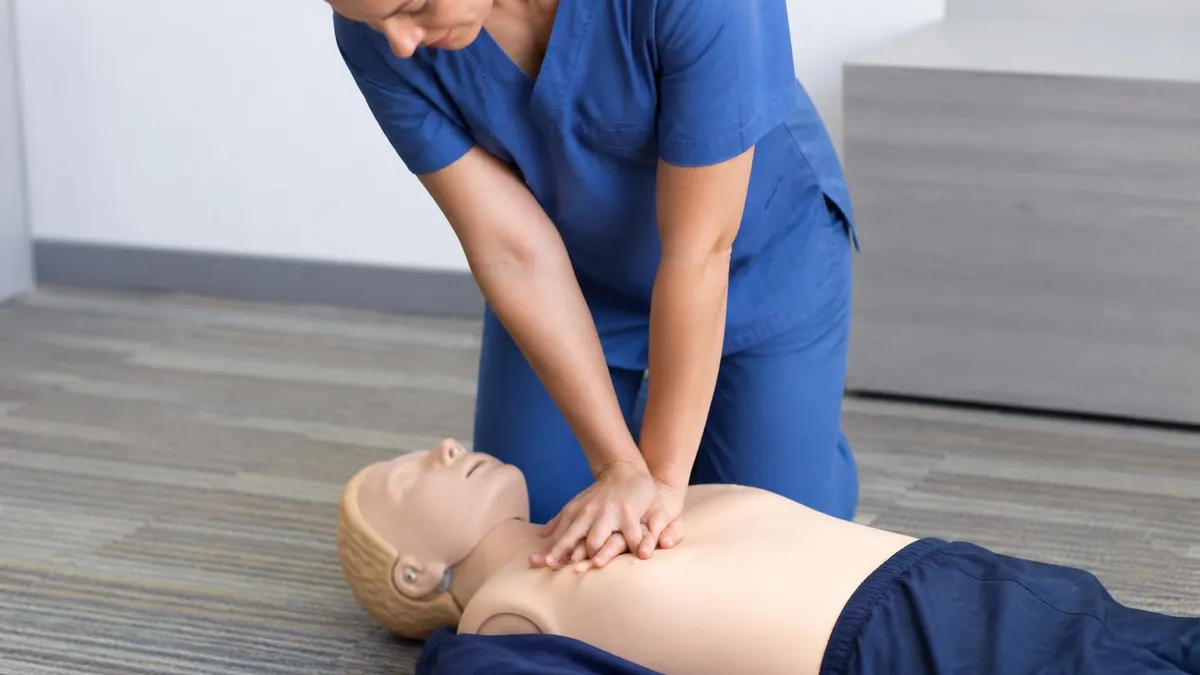
Compress to one-third to one-half the width of the chest, then allow full recoil. Recoil matters — it is when the heart refills with blood. Aim for one hundred to one hundred twenty compressions per minute. The Bee Gees song Stayin' Alive still works as a tempo guide, and so does Baby Shark, which clocks in at roughly the same rate. Count out loud in cycles of thirty so a partner can synchronize ventilations and you can monitor your own pace under stress.
After thirty compressions, open the airway. Pull the tongue forward to clear the oropharynx, look for foreign material, and sweep visible objects only — never blindly, because you can push debris deeper. Extend the neck gently to align the airway, similar to how the jaw thrust maneuver is used in human BLS to open the airway without flexing a possibly injured spine. For brachycephalic breeds, pull the tongue and lips fully forward.
Deliver two rescue breaths by closing the animal's mouth, sealing your lips around the nose, and exhaling gently until you see the chest rise. Do not blow forcefully — pet lungs are smaller than human lungs and can be barotraumatized. Each breath should take about one second. If the chest does not rise, reposition the head and try again. If still no rise, suspect airway obstruction and check for a foreign body before resuming compressions.
Return immediately to compressions. The ratio is thirty compressions to two breaths if you are alone, the same as adult human CPR. Continue cycles for two minutes, then briefly reassess for pulse and breathing — no longer than ten seconds. If no return of spontaneous circulation, resume immediately. Switch compressors every two minutes if help is available, because fatigue degrades compression quality faster than rescuers realize.
Continue CPR until the animal regains spontaneous breathing and pulse, until you reach veterinary care and a professional takes over, or until you are physically unable to continue. Most successful resuscitations happen within the first ten minutes. After twenty minutes of high-quality CPR without any signs of life, survival becomes extremely unlikely, though veterinarians may continue longer in special circumstances such as hypothermia or drug toxicity, where the brain is partially protected.

CPR Practice Test Questions
Prepare for the CPR Cardiopulmonary Resuscitation Practice exam with our free practice test modules. Each quiz covers key topics to help you pass on your first try.
CPR Basic CPR
CPR Exam Questions covering Basic CPR. Master CPR Test concepts for certification prep.
CPR and First Aid
Free CPR Practice Test featuring and First Aid. Improve your CPR Exam score with mock test prep.
CPR (Cardiopulmonary Resuscitation) Adult ...
CPR Mock Exam on (Cardiopulmonary Resuscitation) Adult CPR and AED Usage. CPR Study Guide questions to pass on your first try.
CPR (Cardiopulmonary Resuscitation) Airway...
CPR Test Prep for (Cardiopulmonary Resuscitation) Airway Obstruction and Choking. Practice CPR Quiz questions and boost your score.
CPR (Cardiopulmonary Resuscitation) Cardio...
CPR Questions and Answers on (Cardiopulmonary Resuscitation) Cardiopulmonary Emergency Recognition. Free CPR practice for exam readiness.
CPR (Cardiopulmonary Resuscitation) Child ...
CPR Mock Test covering (Cardiopulmonary Resuscitation) Child and Infant CPR. Online CPR Test practice with instant feedback.
CPR (Cardiopulmonary Resuscitation) High-P...
Free CPR Quiz on (Cardiopulmonary Resuscitation) High-Performance Team Dynamics. CPR Exam prep questions with detailed explanations.
CPR (Cardiopulmonary Resuscitation) Legal ...
CPR Practice Questions for (Cardiopulmonary Resuscitation) Legal and Ethical Considerations. Build confidence for your CPR certification exam.
CPR for Specific Populations
CPR Test Online for for Specific Populations. Free practice with instant results and feedback.
CPR Airway & Breathing Management
CPR Exam Questions covering Airway & Breathing Management. Master CPR Test concepts for certification prep.
CPR Assessment & Recognition of Cardiac Ar...
Free CPR Practice Test featuring Assessment & Recognition of Cardiac Arrest. Improve your CPR Exam score with mock test prep.
CPR Chest Compressions & Defibrillation
CPR Mock Exam on Chest Compressions & Defibrillation. CPR Study Guide questions to pass on your first try.
CPR Post-Resuscitation Care & Recovery
CPR Test Prep for Post-Resuscitation Care & Recovery. Practice CPR Quiz questions and boost your score.
Species-Specific Techniques and Respiratory Rate Considerations
Dogs vary enormously in size, so technique must scale. For large and giant breeds over sixty pounds, two-handed compressions over the widest part of the chest, with the dog on its right side, deliver the force needed. For medium dogs between twenty and sixty pounds, the same lateral position works but with less body weight behind each push. Aim for one-third chest depth and full recoil between compressions.
Small dogs and toy breeds need a circumferential one-handed squeeze, similar to infant CPR technique in humans. The normal respiratory rate for a resting dog is ten to thirty breaths per minute, but during CPR you will deliver ventilations at roughly ten per minute once an advanced airway is placed. Brachycephalic breeds like Pugs and Frenchies need extra airway attention — their soft palates frequently obstruct, so pulling the tongue forward is critical.
Is Performing Animal CPR Worth Attempting at Home?
- +Buys critical minutes during transport when no other option exists
- +Survival rates improve dramatically when CPR starts before full arrest
- +Skills transfer directly from human CPR training with minor modifications
- +Costs nothing to learn and requires no equipment for basic technique
- +Builds confidence and reduces panic in genuine emergencies
- +Protects against legal liability under most state Good Samaritan laws
- +Can be combined with the Heimlich maneuver for choking pets
- −Overall survival to hospital discharge remains low at six to seven percent
- −Risk of rib fractures, especially in older or small animals
- −Aggressive ventilation can cause pneumothorax in small patients
- −Untrained rescuers may compress in the wrong location and waste effort
- −Delays transport if performed solo without phoning ahead
- −Emotional toll on owners when resuscitation does not succeed
- −AEDs designed for humans are not effective on most pets
Pros and Cons at a Glance
| Pros | Cons |
|---|---|
| Buys critical minutes during transport when no other option exists | Overall survival to hospital discharge remains low at six to seven percent |
| Survival rates improve dramatically when CPR starts before full arrest | Risk of rib fractures, especially in older or small animals |
| Skills transfer directly from human CPR training with minor modifications | Aggressive ventilation can cause pneumothorax in small patients |
| Costs nothing to learn and requires no equipment for basic technique | Untrained rescuers may compress in the wrong location and waste effort |
| Builds confidence and reduces panic in genuine emergencies | Delays transport if performed solo without phoning ahead |
| Protects against legal liability under most state Good Samaritan laws | Emotional toll on owners when resuscitation does not succeed |

Animal CPR Readiness Checklist for Every Pet Owner
- ✓Take a Pet Tech or Red Cross Pet First Aid and CPR course in person at least once
- ✓Save the nearest 24-hour emergency veterinary hospital phone number in your phone favorites
- ✓Know your normal pet's resting respiratory rate so you recognize abnormal quickly
- ✓Keep a pet first aid kit in your home, car, and hiking backpack
- ✓Practice locating the femoral pulse on your pet while they are healthy
- ✓Identify the compression point on your specific pet's chest before an emergency
- ✓Refresh your knowledge of the Heimlich maneuver for dogs and cats annually
- ✓Avoid attempting human AED use on pets — it is not designed for animal physiology
- ✓Keep muzzles available; even gentle pets may bite when in pain or hypoxic
- ✓Pre-plan transport logistics — who drives, who continues CPR, which clinic
AED stands for Automated External Defibrillator
AEDs are designed to recognize shockable rhythms in adult human hearts and deliver a calibrated shock through pads sized for human chests. Veterinary defibrillators exist in hospitals, but consumer AEDs are not validated for dogs or cats, and most arrests in pets are non-shockable rhythms anyway. Focus on high-quality compressions and ventilation — they save more pets than any device.
Even when CPR is successful in achieving return of spontaneous circulation, the work is not over. The post-arrest period is dangerous because the heart and brain have just experienced an ischemic insult, and the body's response can include further arrhythmias, cerebral swelling, kidney injury, and a systemic inflammatory cascade similar to sepsis. Veterinarians call this post-cardiac-arrest syndrome, and managing it requires monitored fluids, oxygen, anti-arrhythmic drugs, and sometimes induced mild hypothermia.
For owners, this means resuscitation success at home is only step one. The animal must reach a hospital that can provide intensive monitoring for at least twenty-four to seventy-two hours after the event. Many pets that initially come back will arrest again within the first hour without continued life support. Do not assume that because your dog is breathing and has a heartbeat in the back seat of your car, the crisis is over. Drive directly to the clinic without stopping.
During transport, position the animal in lateral recumbency with the head slightly extended to maintain an open airway. If a second person is available, they should monitor breathing and pulse continuously and be ready to resume CPR if either fails. Cover the pet with a blanket — post-arrest patients are often hypothermic, which complicates recovery. Do not give food, water, or oral medications. If the animal seizes, time the seizure and protect them from injury but do not restrain forcefully.
At the hospital, the veterinary team will likely place an intravenous catheter, intubate if not already done, start oxygen therapy, run bloodwork, and obtain an electrocardiogram. Expect costs to climb quickly — emergency stabilization alone often runs eight hundred to two thousand dollars, and inpatient critical care can reach five thousand to fifteen thousand dollars or more. Pet insurance helps significantly here, and CareCredit is widely accepted for emergencies if you do not have coverage.
Long-term prognosis depends heavily on the underlying cause of arrest. Pets that arrested from a reversible cause — anesthetic complication, choking that was cleared, electrocution with intact heart — have meaningfully better outcomes than those who arrested from end-stage heart disease or massive trauma. Ask the veterinarian for an honest assessment within the first twelve hours. Quality of life conversations are appropriate, even when an animal has been resuscitated, because survival is not always the same as recovery.
For animals that recover fully, follow-up care typically includes cardiology consultation, echocardiogram, and sometimes lifelong medications such as pimobendan, furosemide, or anti-arrhythmics. Owners should monitor resting respiratory rate at home — counting breaths while the pet sleeps — and report any sustained elevation above thirty per minute to the veterinarian. Subtle changes often precede a second arrest by days, giving an opportunity to intervene electively rather than emergently.
Mental health for the human in this equation also matters. Performing CPR on a beloved pet is traumatic regardless of outcome. Many owners describe symptoms similar to post-traumatic stress for weeks afterward, including intrusive memories and avoidance of the area where the event occurred. This is normal. Talking with your veterinarian's social worker, a pet-loss support group, or a therapist who specializes in pet bereavement can be enormously helpful, whether the pet survived or not.
Unlike human CPR mannequins, pets cannot tell you when force becomes harmful. Compressing a healthy animal's chest can fracture ribs, bruise the heart, and cause lasting injury. Practice hand placement and counting cadence on stuffed animal models or specialized pet CPR mannequins available at veterinary continuing education courses. Save real compressions for real emergencies.
Formal training transforms confidence in animal CPR more than any article can. Several organizations offer in-person and online certification courses. Pet Tech is the largest pet first aid training company in North America and certifies thousands of dog walkers, groomers, kennel staff, and pet owners annually. The Red Cross offers a Cat and Dog First Aid online course that is inexpensive and accessible. Veterinary technicians can pursue advanced Recover certification, which is the veterinary equivalent of the normal breathing rate assessment standards and full BLS skills used in animal hospitals.
Human CPR certifications such as those from the American Heart Association or the national cpr foundation do not formally include animal CPR, but the underlying skills overlap by roughly seventy percent. Compression cadence, ventilation timing, two-rescuer choreography, and recognition of arrest are essentially identical. If you already hold a current BLS card, adding pet first aid is a relatively short course — typically four to eight hours — and pairs naturally with what you already know.
For pet professionals — groomers, daycare staff, dog walkers, trainers, sitters — pet CPR certification is increasingly required by liability insurance and by clients. A certified card on the wall reassures owners and gives staff a sequence to follow under stress. Renewal is typically every two years, similar to human BLS. Some pals certification programs for pediatric advanced life support providers also include optional veterinary modules for first responders who may encounter service animals.
Online-only courses are convenient and cost-effective, often running thirty-five to seventy-five dollars, but they cannot replicate the muscle memory of hands-on compression practice. Hybrid courses with a virtual lecture and in-person skills session offer the best of both worlds. Look for instructors who use mannequins specifically designed for dogs and cats, not improvised models. Realistic chest compliance matters when you are calibrating force.
Beyond formal courses, you can reinforce skills at home. Watch the Recover Initiative's free instructional videos, which are based on peer-reviewed veterinary guidelines updated every five years. Practice locating compression points on your own pet during calm moments, so the anatomy becomes familiar. Time yourself counting one hundred twenty beats per minute while tapping a table; the cadence is harder to maintain than people expect.
Equip your home and vehicle with a pet first aid kit. Useful inclusions: vet wrap, sterile gauze, hydrogen peroxide for vomiting induction (only when directed by a vet), styptic powder for nail bleeds, a muzzle, a digital thermometer, sterile saline, and a printed list of emergency veterinary hospitals with phone numbers. Add a pocket card with the CPR sequence — even certified rescuers benefit from a checklist when adrenaline is spiking and the patient is their own pet.
Finally, consider what your pet's emergency plan looks like in your absence. Pet sitters and dog walkers should know basic CPR, your vet's contact information, and where you keep the carrier or leash. Neighbors who watch the house when you travel should have written authorization to make emergency veterinary decisions on your behalf up to a dollar limit you set. Preparedness reduces panic, and panic is the single biggest barrier to performing animal CPR effectively when it counts.
Practical tips can mean the difference between a successful resuscitation and a tragic outcome. Tip one: always start with scene safety. If your dog was electrocuted, disconnect the power source before touching them. If your cat collapsed near a chemical spill, move them to fresh air. Rescuers who become victims help no one. This is the same first principle taught in every human BLS class and applies equally in veterinary emergencies, whether at home, on a trail, or at the dog park.
Tip two: do not waste time checking for a pulse if you cannot find one within ten seconds. A pet that is unresponsive and not breathing is in arrest by definition, and starting compressions on a heart that is still beating weakly does very little harm compared to the catastrophic harm of withholding compressions on one that has stopped. The current human guidelines recommend the same approach — when in doubt, push. Veterinary guidelines explicitly mirror this principle.
Tip three: ventilate effectively but not aggressively. Excessive ventilation pressure causes gastric distention, which pushes the diaphragm up and reduces compression effectiveness. It also can cause pulmonary barotrauma, particularly in small animals and cats. Each breath should be just enough to see the chest rise — about one second of gentle exhalation. If two rescuers are available, the ventilator should coordinate breaths between compressions rather than interrupting the rhythm.
Tip four: switch compressors every two minutes if possible. Even fit rescuers fatigue quickly, and compression quality drops measurably after one to two minutes of continuous effort. Studies in both human and veterinary BLS show that rescuers consistently overestimate the quality of their compressions after fatigue sets in. A simple stopwatch or smartwatch interval timer prevents this drift. If you are alone, persist anyway, because imperfect compressions are vastly better than none.
Tip five: communicate clearly under stress. Assign roles before or during the emergency — one person compresses, one ventilates, one calls the clinic, one drives. Closed-loop communication, where instructions are repeated back, prevents confusion. The veterinary team you are racing to will appreciate a phone call ahead of arrival so they can prepare the crash cart, intubation supplies, and emergency drugs before you walk through the door, saving precious additional minutes.
Tip six: do not stop too early. Spontaneous breathing and pulse can return after fifteen or even twenty minutes of high-quality CPR, particularly in hypothermic or pediatric patients. The decision to terminate resuscitation is a medical one, ideally made by a veterinarian with the full clinical picture. As a layperson, your job is to continue effective CPR until you reach professional help or until exhaustion makes continuing impossible. Switching rescuers extends the window meaningfully.
Tip seven: process the experience afterward. Whether your pet survives or not, performing CPR is emotionally significant. Give yourself permission to feel the full weight of what you did. Talk about it with a trusted friend, your veterinarian, or a counselor. The skill you used is rare and valuable, and the love that motivated it is even more so. Every owner who has performed animal CPR has done something extraordinary, regardless of the medical outcome that followed.
CPR Questions and Answers
CPR Card Lookup: How to Verify, Replace, and Access Your CPR Certification in 2026
AHA CPR: What It Is, Which Course You Need, and How to Get Certified
Adult CPR: Complete Step-by-Step Guide to Hands-Only and Standard CPR in 2026

CPR - Cardiopulmonary Resuscitation: Complete Study Guide 2026
Inappropriate CPR Songs: What Not to Play, Why It Matters, and Better Beat-Per-Minute Alternatives
About the Author

Registered Nurse & Healthcare Educator
Johns Hopkins University School of NursingDr. Sarah Mitchell is a board-certified registered nurse with over 15 years of clinical and academic experience. She completed her PhD in Nursing Science at Johns Hopkins University and has taught NCLEX preparation and clinical skills courses for nursing students across the United States. Her research focuses on evidence-based exam preparation strategies for healthcare certification candidates.
Join the Discussion
Connect with other students preparing for this exam. Share tips, ask questions, and get advice from people who have been there.
View discussion (5 replies)