
ACLS BLS Renewal: Complete Guide to Renewing Your Basic Life Support Certification
Learn what is a BLS certification, how ACLS BLS renewal works, 📗 deadlines, costs, and tips to pass your AHA Basic Life Support exam on the first try.

Understanding what is a BLS certification is the first step for any healthcare professional who needs to keep their credentials current. BLS stands for Basic Life Support, a structured set of clinical skills — chest compressions, rescue breathing, and AED use — that can sustain life until advanced care arrives. Whether you are renewing BLS alongside an ACLS BLS renewal or earning it for the first time, the certification is issued in two-year cycles by organizations such as the American Heart Association and the American Red Cross.
The term "ACLS BLS renewal" describes the process of simultaneously refreshing both your Advanced Cardiovascular Life Support card and your Basic Life Support card before either expires. Many hospitals and outpatient clinics require both credentials to be active at the same time, so pairing the renewals in a single session saves time, reduces scheduling conflicts, and often lowers the total course cost compared to booking them separately across two different dates.
A common source of confusion is whether BLS and CPR are the same thing. The short answer: BLS includes CPR but goes further. Standard CPR training is typically designed for laypeople responding to a cardiac event at home or in public. BLS, specifically the AHA BLS for Healthcare Providers course, adds two-rescuer CPR, bag-mask ventilation, team dynamics, and infant and child resuscitation protocols — skills essential for clinical settings.
The American Heart Association BLS exam and the American Red Cross Basic Life Support course are the two most widely accepted pathways in the United States. Both curricula align with the 2020 AHA Guidelines for CPR and Emergency Cardiovascular Care, meaning the compression-to-ventilation ratios, compression depths, and AED integration steps are essentially equivalent across providers. Your employer's credentialing office will generally accept either card, though it is always worth confirming before you register.
Renewal windows matter more than most providers realize. The AHA recommends completing your acls bls renewal before your current card's expiration date rather than waiting until it lapses. An expired card can trigger a remediation process, extra paperwork, or a requirement to complete the full initial course rather than the shorter renewal format — adding hours to what should be a simple recertification.
This guide walks through everything you need to know: the differences between BLS and CPR, how the AHA and Red Cross courses compare, step-by-step renewal timelines, costs, what to expect on the written and skills evaluations, and how to prepare so you pass without stress. By the end, you will have a clear action plan for keeping both your BLS and ACLS cards active and in compliance with your facility's requirements.
Practical preparation matters because the skills portion of BLS renewal is a hands-on competency check, not merely a formality. Instructors are required to verify that each participant can perform high-quality chest compressions at the correct rate and depth, deliver effective ventilations, and operate an AED safely. Reviewing the steps in advance — and using practice exams to sharpen your knowledge of protocols — dramatically increases the chance you will move through the skills station efficiently and leave with a new two-year card in hand.
BLS Renewal by the Numbers

BLS Renewal Requirements & Timeline
Check Your Card's Expiration Date
Confirm Your Employer's Accepted Providers
Register for a Renewal Course
Review Key Protocols Before Class
Complete Skills and Written Evaluation
Receive and Submit Your New Card
The AHA Basic Life Support exam and the American Red Cross Basic Life Support course are structurally similar, but understanding where they differ helps you choose the right pathway for your schedule and learning style. The AHA BLS for Healthcare Providers course is the industry benchmark in most hospital systems across the United States. It covers adult one-rescuer CPR, two-rescuer CPR with bag-mask ventilation, child CPR, infant CPR, AED use, and relief of foreign-body airway obstruction. The written exam component consists of 25 questions, and participants must score at least 84% to pass.
The American Red Cross Basic Life Support course follows the same 2020 AHA Guidelines and covers equivalent clinical content, but its course design incorporates video-based simulation stations alongside traditional instructor-led practice. Red Cross courses are often available through community colleges, fire departments, and independent training centers, sometimes at a slightly lower price point than AHA-authorized sites. For providers who need a basic life support renewal class quickly, Red Cross locations may offer more flexible scheduling windows including evenings and weekends.
One important consideration for those pursuing a basic life support online renewal is that neither the AHA nor the Red Cross permits a fully online BLS renewal. Both organizations require an in-person skills evaluation regardless of whether you completed the cognitive portion through their blended e-learning platform. This requirement exists because compression quality, hand placement, and ventilation effectiveness cannot be reliably assessed through a screen — a fact reinforced by outcome studies showing that in-person feedback improves skill retention significantly.
The AHA's HeartCode BLS is the most popular blended format. Learners complete interactive online modules covering protocols, scenarios, and a short knowledge assessment, then schedule a skills check session at a training site. The skills session typically lasts 60 to 90 minutes, making it far easier to fit into a clinical workday than a four-hour traditional course. Many hospital education departments offer dedicated HeartCode skills days monthly, so employees can cluster their renewals without pulling entire shifts off the floor.
For ACLS BLS renewal, the AHA offers a combined HeartCode ACLS plus HeartCode BLS blended track. Participants complete both online modules back to back, then attend a combined skills day where instructors rotate stations between ACLS megacode scenarios and BLS high-quality CPR checks. This approach compresses what could be two separate multi-hour courses into a single six-to-eight-hour day, which most providers find more efficient than taking them weeks apart.
Whichever provider you choose, confirm that the instructor is an AHA-authorized Training Center Faculty member or a Red Cross authorized instructor before paying. Unauthorized online-only courses that claim to issue AHA or Red Cross cards are not recognized by hospitals, accreditation bodies, or the Joint Commission. Checking the official course finder on each organization's website takes about two minutes and protects you from wasting money on a credential that your employer will reject during the next credentialing audit.
After completing your renewal, both the AHA and Red Cross maintain digital card systems accessible via their respective websites. Employers can verify your credential directly through these portals, which reduces paperwork and eliminates the risk of a card being lost in the mail. Saving your digital card as a PDF and uploading it to your employee health record the same day you renew ensures there is never a gap in your credentialing file — an especially important detail if your facility undergoes a Joint Commission survey.
Is BLS the Same as CPR? Understanding BLS vs. CPR vs. ACLS
A question that appears constantly in search results is "is BLS the same as CPR" — and the honest answer is no, though BLS includes CPR as a core component. Standard CPR courses aimed at the general public teach lay rescuers to perform chest compressions and rescue breaths on an unresponsive adult. The training is typically two to four hours and results in a layperson CPR card, which is not accepted for healthcare employment. BLS for Healthcare Providers adds two-rescuer coordinated CPR, bag-mask ventilation technique, child and infant protocols, team communication roles, and AED troubleshooting skills that go well beyond basic layperson CPR.
The distinction matters practically because employers check card type during credentialing. A standard CPR card from a health fair or community class will not satisfy a hospital's BLS requirement, even if the holder just completed the training last week. When employers or accreditation standards reference BLS, they specifically mean a provider-level course from an AHA-authorized or Red Cross-authorized training center. If you have ever wondered why two coworkers can both say "I have CPR" and mean very different things, this is the explanation — and it underscores why verifying the exact course title before registering for any renewal matters.

Online BLS Renewal vs. Traditional Classroom: Pros and Cons
- +Blended learning lets you complete cognitive modules at your own pace, reducing in-person time to 60–90 minutes
- +HeartCode BLS is available 24/7, so night-shift nurses can study between patient rounds
- +Skills sessions can be booked at hospital education days, avoiding the need to leave campus
- +Digital card delivery within 24 hours eliminates mail delays and lost physical cards
- +Combined ACLS BLS renewal tracks compress two credentials into a single workday
- +Immediate feedback from interactive simulations improves protocol retention before the skills check
- −Fully online-only BLS certification is not accepted by hospitals, the Joint Commission, or most state boards
- −Blended courses require reliable internet access and a compatible device for the online module portion
- −Skills sessions must still be scheduled around instructor availability and training center hours
- −Some employers require AHA-specific cards and will not accept Red Cross equivalents, limiting provider flexibility
- −Blended learning removes real-time instructor Q&A during the cognitive phase, which some learners miss
- −Fraudulent online-only providers exist and can issue unrecognized cards, wasting your time and money
Pros and Cons at a Glance
| Pros | Cons |
|---|---|
| Skills sessions can be booked at hospital education days, avoiding the need to leave campus | Fully online-only BLS certification is not accepted by hospitals, the Joint Commission, or most state boards |
| Combined ACLS BLS renewal tracks compress two credentials into a single workday | Blended courses require reliable internet access and a compatible device for the online module portion |
| Immediate feedback from interactive simulations improves protocol retention before the skills check | Skills sessions must still be scheduled around instructor availability and training center hours |
BLS Renewal Preparation Checklist
- ✓Locate your current BLS card and confirm the exact expiration date at least 60 days in advance.
- ✓Verify whether your employer requires AHA, Red Cross, or accepts either provider for Basic Life Support renewal.
- ✓Register for a renewal course — blended HeartCode BLS or traditional classroom — at an authorized training center.
- ✓Complete the online cognitive module (HeartCode) before your scheduled skills session to maximize in-person efficiency.
- ✓Review the 2020 AHA compression rate (100–120/min) and depth (at least 2 inches for adults, 1.5 inches for infants) standards.
- ✓Practice two-rescuer CPR rotation timing and bag-mask ventilation technique — both are tested in the skills evaluation.
- ✓Study AED operation steps: power on, attach pads, clear rescuers, deliver shock, immediately resume compressions.
- ✓Take at least two BLS practice exams online to reinforce protocol details and identify any knowledge gaps before class.
- ✓Bring a government-issued photo ID and your current BLS card to the renewal session.
- ✓After passing, submit your new digital or physical card to HR and update your credentialing file the same day.
The Skills Station Is the Most Common Failure Point
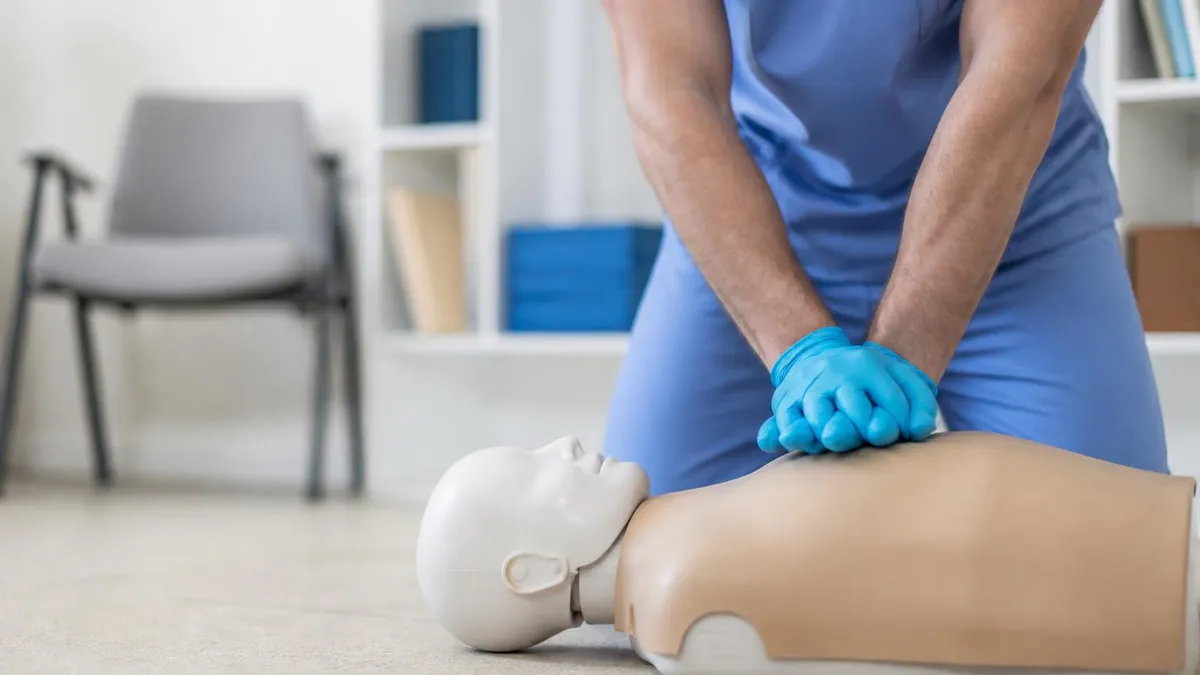
Most BLS renewal candidates who do not pass on the first attempt fail the hands-on skills check rather than the written exam. Specifically, compression depth below 2 inches and incomplete chest recoil are the two most frequently cited deficiencies. Spending 20 minutes with a manikin — or even practicing on a firm surface — before your renewal session dramatically improves muscle memory and ensures you meet the AHA's measurable performance criteria.
The cost of BLS renewal varies more than most providers expect, and understanding the full price landscape helps you budget accurately and avoid overpaying. At AHA-authorized training centers, a standalone BLS renewal class typically runs between $50 and $90 depending on geographic location, whether the course is blended or traditional, and whether the site is affiliated with a hospital, community college, or independent training company. Urban markets on the coasts tend to run higher; Midwest and rural training centers often price closer to the $50 floor.
Combined ACLS BLS renewal courses are priced differently. Because both certifications are handled in a single session, the bundled fee is usually $150 to $220, compared to paying $90 for BLS separately plus $160 to $180 for a standalone ACLS renewal — a savings of $50 to $80 in most markets. If your employer's education department subsidizes renewal costs, ask specifically whether the subsidy covers combined courses or only the primary certification, since reimbursement policies vary widely between facilities.
Some hospital systems have negotiated institutional rates with AHA training centers and offer free or heavily discounted renewals to employees during scheduled on-site education days. If your facility offers this, take advantage of it — not only for the cost savings but because on-site sessions are specifically designed around the provider documentation requirements your credentialing department uses, reducing the chance of paperwork errors that delay card issuance.
For independent practitioners — private-practice physicians, locum tenens providers, and traveling nurses — the cost of renewal is typically an out-of-pocket business expense deductible as a professional development cost. Keep receipts for course registration, materials, and any required textbooks. The AHA's BLS Provider Manual, which is frequently bundled into course fees, retails for approximately $25 separately and counts as a deductible educational resource if purchased independently.
Understanding how many ceus is bls renewal is a related question many providers ask, especially nurses managing their state board CE requirements. The AHA BLS renewal course does not itself carry CE credit in most states — it is a competency certification, not a continuing education course. However, some state nursing boards allow providers to petition for CE credit from professional development activities, and a handful of states explicitly award 1–3 contact hours for BLS renewal completion. Check your specific state board's website to determine whether a CE petition is worth pursuing.
The American Red Cross offers institutional pricing for hospitals and large healthcare networks that want to provide basic life support renewal class options to their workforce at scale. Red Cross Authorized Provider status allows an organization to train employees using Red Cross curriculum, with the facility serving as the training site. This model is common at community hospitals and long-term care facilities where large numbers of clinical staff need simultaneous renewal and transporting everyone to an off-site training center would be logistically difficult.
When comparing costs, also factor in travel time and opportunity cost. A course that costs $60 but requires 45 minutes of driving each way may be a worse value than an on-site session priced at $80 if you are billing clinical hours. The blended HeartCode BLS format is particularly cost-effective in this regard — online cognitive modules can be completed during non-billable downtime, with the skills session scheduled during a period of lighter clinical load, keeping the total time investment under two hours on a workday.

An expired BLS card is treated differently than an active card approaching renewal. Many AHA training centers and hospital credentialing offices require providers with lapsed certifications to complete the full initial BLS Provider course rather than the shorter renewal format — adding two or more hours to what should be a routine recertification. Some facilities also place providers with expired BLS on administrative leave from clinical duties until the credential is restored, which can affect patient assignments and pay. Start your renewal process at least 60 days before your card's expiration date.
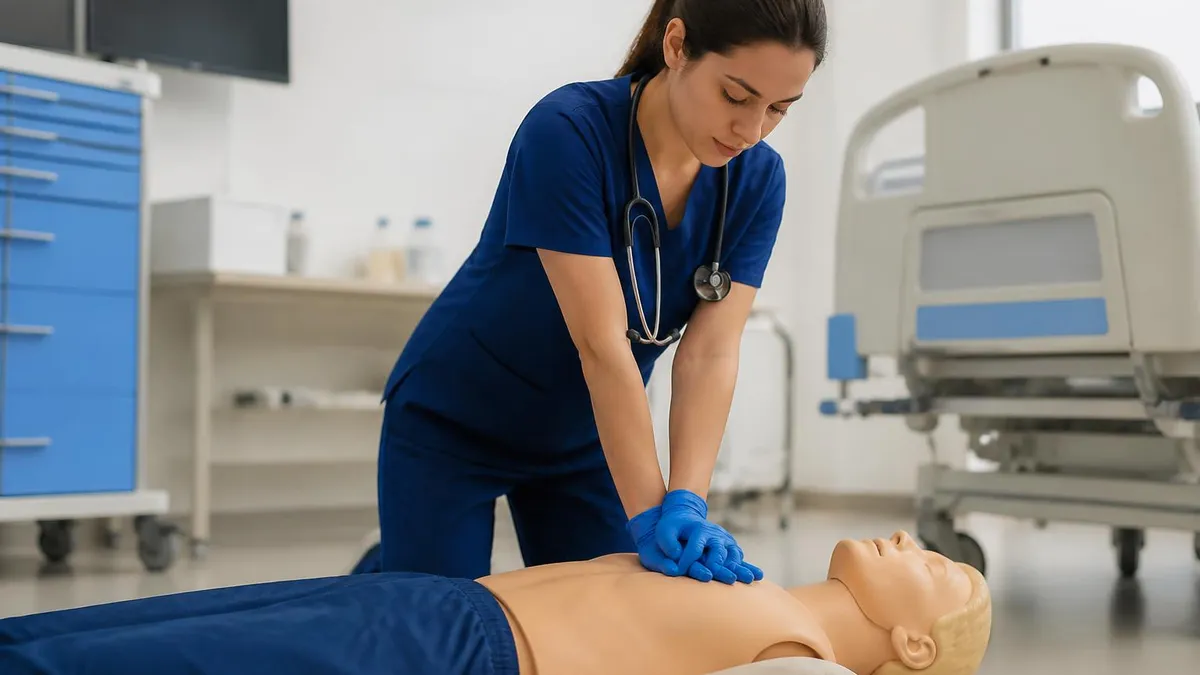
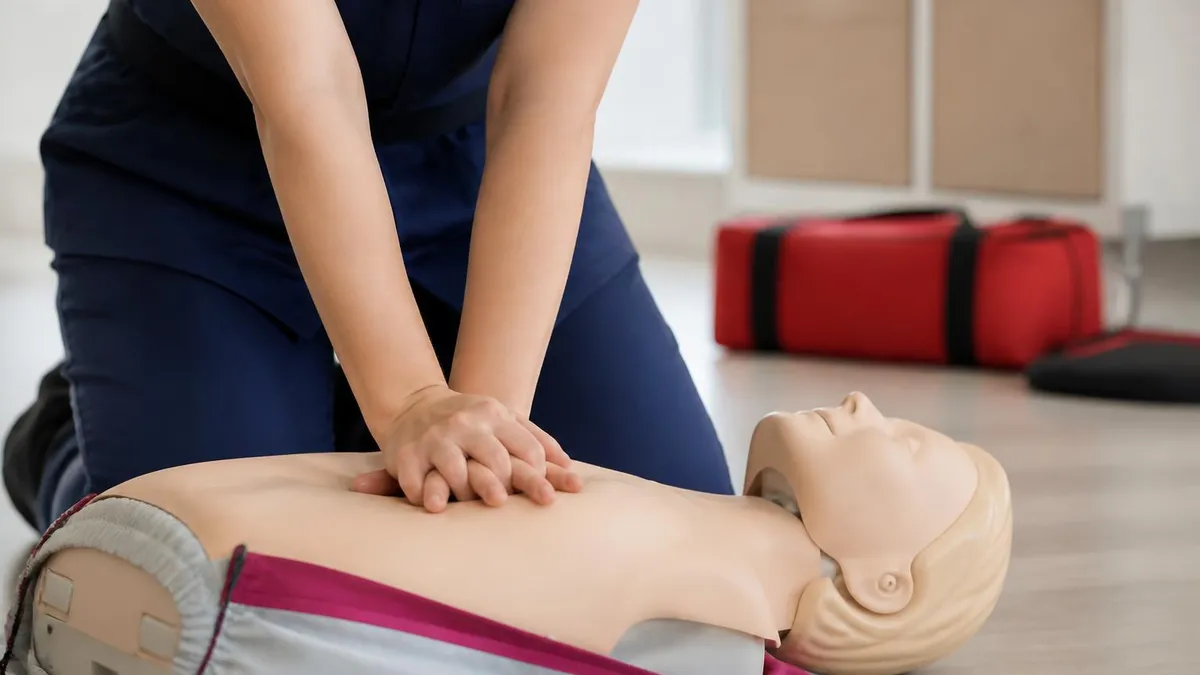
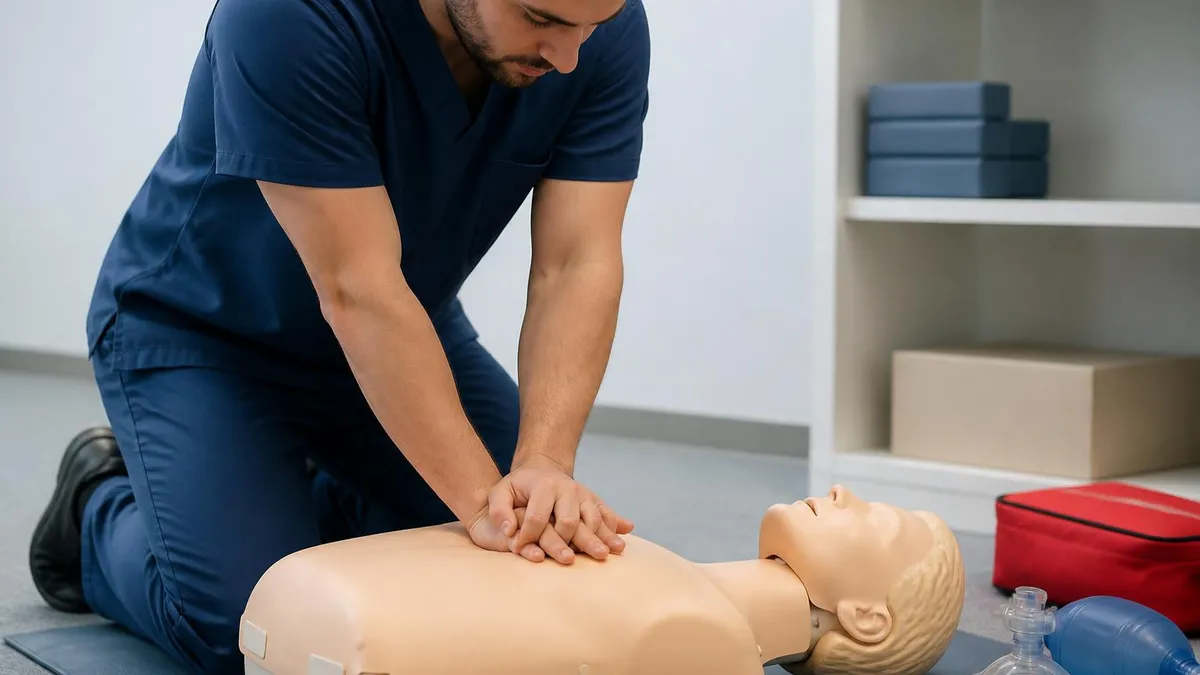
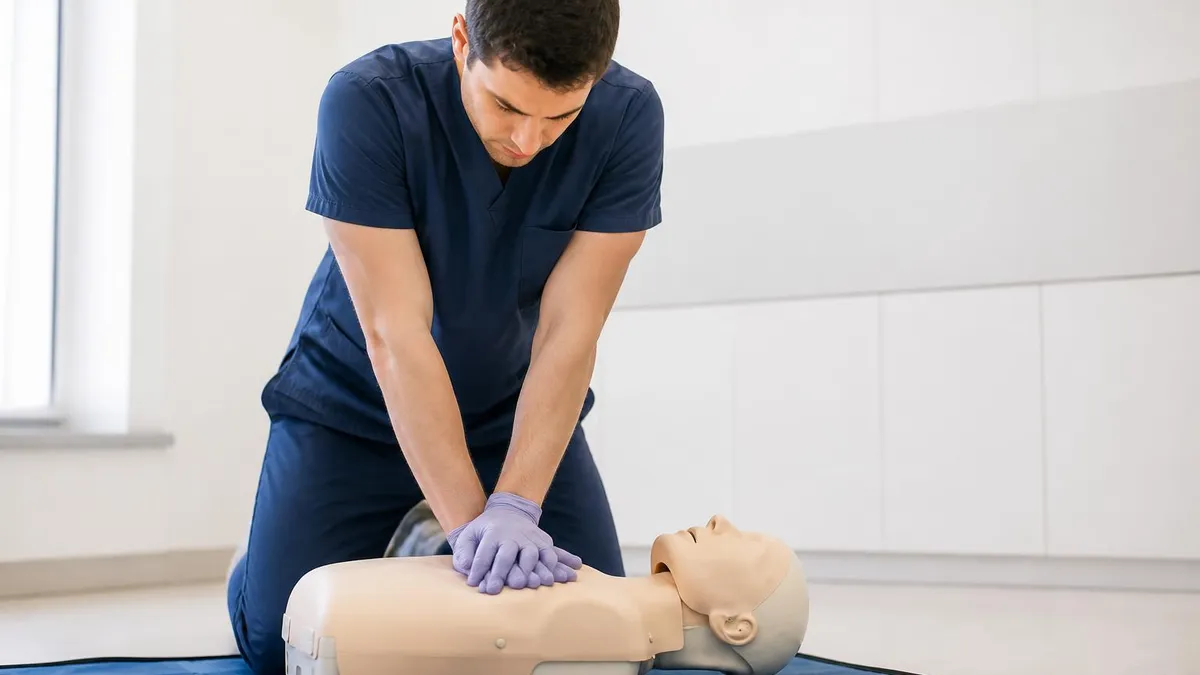
Passing the BLS skills evaluation requires more than simply knowing the protocols — it requires performing them correctly under observation, with an instructor actively watching your hand placement, compression depth, rate, and recoil. The most effective preparation strategy combines protocol review with at least one physical practice session before renewal day. Even 20 minutes of compression practice on a couch cushion (which approximates manikin resistance better than a bed or mattress) can make the difference between clean execution and a remediation pull-aside at the skills station.
For the written or online knowledge exam, the 25-question AHA format draws heavily from four areas: adult CPR sequence and ratios, pediatric and infant CPR differences, AED operation and troubleshooting, and two-rescuer roles and communication. Questions are scenario-based rather than purely factual, meaning they present a clinical situation and ask what action you should take next. Knowing the steps in order — recognize unresponsiveness, activate EMS, begin compressions, attach AED when available — is more useful than memorizing isolated facts.
The two-rescuer CPR component consistently surprises providers who trained primarily in single-rescuer scenarios. In two-rescuer adult CPR, one provider performs continuous chest compressions while the second manages the airway and delivers one breath every six seconds (10 breaths per minute) during ongoing compressions. Rescuer rotation should occur every two minutes to prevent compression quality from degrading due to fatigue. The instructor will watch for smooth handoffs, correct call-outs before rotation ("switching on next cycle"), and maintenance of compression rate during the transition.
Infant CPR is another area where renewal candidates sometimes need extra preparation, particularly if their clinical role does not routinely involve neonatal or pediatric patients. For infant CPR, two fingers are placed on the sternum just below the nipple line for single-rescuer technique, while two-thumb encircling hands technique is preferred in the two-rescuer scenario. Compression depth for infants is approximately 1.5 inches — about one-third the depth of the infant's chest. The ratio remains 30:2 for single rescuer and switches to 15:2 when a second rescuer is managing the airway.
AED operation is tested both in the written exam and during the skills check. The AHA BLS sequence for AED use is: power on the device, attach pads (right clavicle / left lateral ribcage for adults), analyze rhythm (ensure all rescuers are clear), deliver shock if advised, then immediately resume CPR beginning with compressions. A common exam trap involves the timing of CPR resumption — the AED will prompt another rhythm check after two minutes, but providers should not anticipate the prompt by stopping compressions early.
If you encounter a skills station remediation — meaning the instructor identifies a deficiency and asks you to repeat a component — approach it as a coaching opportunity rather than a failure. Instructors are required by AHA protocol to document the remediation and allow a second attempt during the same session. The vast majority of providers who receive remediation pass on the second attempt once they understand the specific correction needed. Common remediations involve compression depth (not reaching 2 inches consistently) and incomplete chest recoil (pressing down without allowing the chest to fully rise between compressions).
After completing acls bls renewal, take a moment to verify that the card your instructor issues matches your legal name exactly as it appears on your employer's file. Name discrepancies — a nickname versus a legal name, a missing middle initial — can create credentialing delays when HR attempts to match your card to your employee record. If a discrepancy exists, ask the instructor to reprint the card with the correct name before you leave the training site, as correcting it after the fact often requires contacting the training center's coordinator and waiting for a reprint cycle.
Building a sustainable renewal habit starts with treating BLS certification the same way you treat your state license renewal — as a fixed calendar commitment rather than something you scramble to complete when a credentialing reminder arrives. The simplest system: on the day you receive your new two-year card, immediately add a calendar event 22 months out labeled "Start BLS Renewal Search." That two-month buffer gives you time to find a convenient course, complete the online cognitive module at a relaxed pace, and schedule the skills session without the pressure of an imminent expiration date.
Providers who work at multiple facilities often face the challenge of satisfying each employer's specific card requirements while managing a single renewal schedule. If one facility accepts Red Cross and another requires AHA, the practical solution is to renew through the AHA, since AHA cards are universally recognized across the United States and accepted by virtually every Joint Commission-accredited facility. Carrying a Red Cross card when an AHA card is required creates administrative friction that you can avoid entirely by standardizing on the more widely accepted provider.
For traveling nurses and locum tenens physicians, maintaining a digital copy of your BLS card in cloud storage is essential. Services like Google Drive, Dropbox, or a secure healthcare credentialing app allow you to share your card instantly when a new facility requests it during onboarding. Some credentialing companies that work with traveling providers have integrated AHA digital card verification directly into their portals, so your renewal auto-populates when you log in with your AHA Training Network credentials — making the administrative side of renewal nearly seamless.
If you are approaching your first ACLS BLS renewal rather than an initial certification, the renewal course is meaningfully shorter and less intensive than the initial provider course. Initial BLS provider training for someone with no prior certification typically runs four to five hours with more time spent on foundational instruction. The renewal course assumes baseline competency and focuses on refreshing skills, reviewing guideline updates, and correcting any drift in technique that has developed over the preceding two years. Most providers find renewal significantly less stressful than initial certification once they experience it firsthand.
Guideline updates are the one area where renewal training genuinely adds new information rather than simply refreshing existing knowledge. The AHA publishes updated CPR and Emergency Cardiovascular Care guidelines every five years, with focused updates published between cycles when evidence warrants. The 2020 guidelines introduced changes to dispatcher-assisted CPR instructions, updated the approach to opioid-associated resuscitation emergencies, and refined the evidence around vasopressors in cardiac arrest. If your BLS card was issued in 2020 or earlier and you are renewing now, your instructor will specifically address any guideline changes that occurred since your last certification.
Opioid-associated cardiac arrest deserves particular attention in the current clinical environment. The 2020 AHA guidelines added specific guidance on recognizing opioid-associated emergency and the role of naloxone in the resuscitation sequence. BLS renewal courses now include a discussion of when to administer naloxone (if available and in-scope), how to recognize opioid-related respiratory arrest distinct from cardiac arrest, and the importance of continuing standard BLS algorithms even after naloxone administration. Providers working in emergency departments, inpatient medical units, or any setting with high opioid exposure should pay particular attention to this component of the renewal curriculum.
The single most impactful preparation step for any BLS renewal — whether standalone or as part of a combined ACLS BLS renewal — is taking several timed practice exams before class. Multiple-choice exam practice does two things simultaneously: it reinforces protocol sequences through retrieval practice (which research shows is more effective for retention than re-reading), and it reveals which specific topics you are less confident about so you can target your review time efficiently rather than re-studying content you already know well.
Thirty to forty-five minutes of focused exam practice the evening before your renewal session is a proven investment that virtually always translates into a smoother, faster experience at the skills and written evaluation stations.
Sample BLS - Basic Life Support Practice Questions
Try these questions from our free BLS - Basic Life Support practice tests. The correct answer and an explanation follow each question.
What is the role of 'advanced life support' (ALS) in the Chain of Survival?
- A. To provide medications, advanced airway management, and continued resuscitation by trained providers
- B. To perform the initial defibrillation shock
- C. To replace bystander CPR when EMS arrives
- D. To manage the patient exclusively after hospital discharge
Answer: A. To provide medications, advanced airway management, and continued resuscitation by trained providers
ALS providers deliver medications, advanced airway interventions, and ongoing resuscitation to optimize the chance of ROSC.
You see a middle-aged man collapse and hold his chest as you prepare to go into the elevator to go to the lunch room while you are alone and on your lunch break. Currently, the man is lying on the ground. What should your initial course of action be in cases of cardiac arrest emergencies like this one?
- A. verify scene safety
- B. get a defibrillator
- C. begin CPR
- D. verify unresponsiveness
Answer: A. verify scene safety
In any emergency situation, the absolute first step is always to ensure scene safety for yourself and the victim. You cannot effectively help someone if you become injured or put yourself in danger. Only after confirming the scene is safe should you proceed to check for unresponsiveness, call for help, and initiate further emergency actions like CPR or retrieving a defibrillator.
As your partner takes over chest compressions, you and your partner transfer from administering compressions to providing ventilations. While another assistant turns on and attaches the AED, this switch is made. The victim's rhythm is examined by the AED. (True or False) Rescue breathing should continue throughout the AED rhythm evaluation.
- A. False
- B. True
Answer: A. False
False. During AED rhythm evaluation and shock delivery, all rescuers must stand clear of the patient. Continuing rescue breathing or chest compressions during this time would interfere with the AED's analysis and could endanger the rescuer. CPR should be paused only for rhythm analysis and shock delivery, then immediately resumed.
You're in the hospital cafeteria on break. You observe a disturbance at a different table as you settle down to enjoy your lunch. A man appears to be in trouble as he stands up. He made the traditional choking sign by placing his hands at the victim's throat. You stand beside the person who is choking. (True or False) Your first line of defense should be encircling the victim's chest.
- A. False
- B. True
Answer: B. True
True. For a conscious adult choking victim, the first line of defense is to perform abdominal thrusts (Heimlich maneuver). This involves standing behind the victim and encircling their chest with your arms, then delivering quick, upward thrusts to the abdomen. This action helps to dislodge the foreign object from the airway.
BLS Questions and Answers
How this page was made: written with AI tools and published by Nathan Beja, founder of Practice Test Geeks, who is responsible for its content. Exam facts are checked against the official sources listed below. Not reviewed by a subject-matter expert. Editorial policy
Sources & references
Exam facts on this page (fees, format, dates, passing scores) are checked against these official sources; the date is our last check. Editorial policy
- redcross.org — Renewal, test delivery, fees, score validity · verified Oct 2026
- cpr.heart.org — Test delivery, exam format, passing score, retake policy, fees, score validity · verified Oct 2026