
Online BLS Renewal: Complete 2026 October Guide to Recertifying Your Basic Life Support Card
Online BLS renewal guide: 🎓 AHA vs Red Cross courses, costs, blended skills check, exam tips, and how to recertify your BLS card fast in 2026 October.
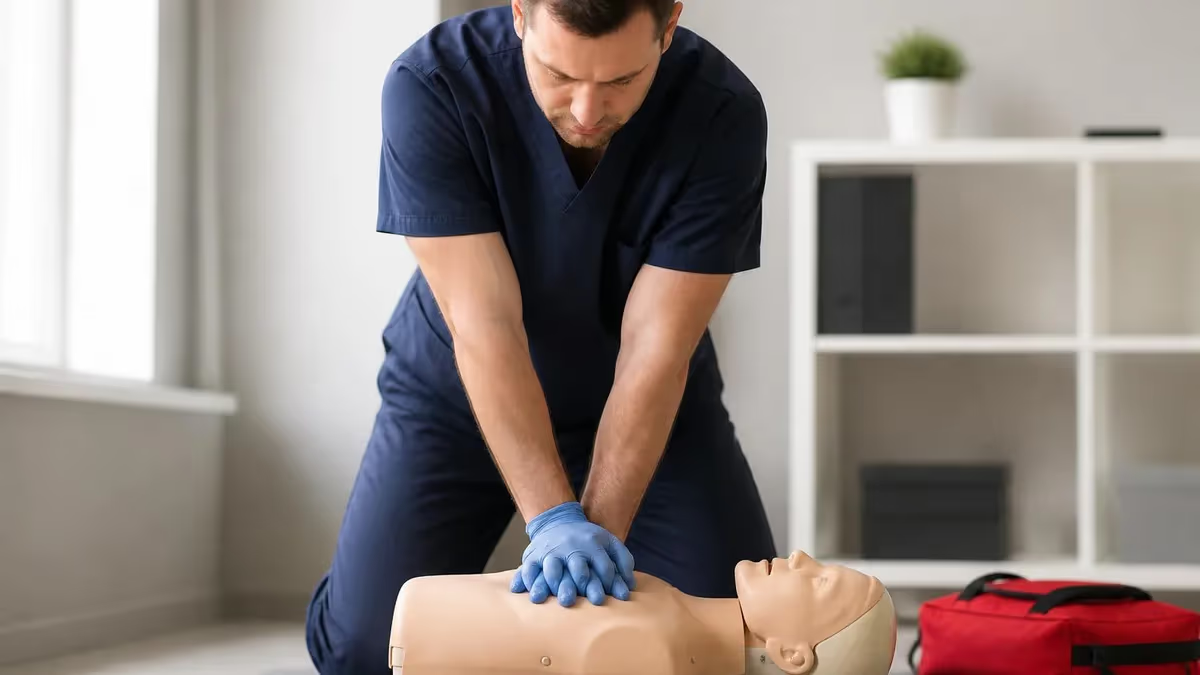
Online BLS renewal has become the fastest, most flexible way for nurses, paramedics, dental staff, medical assistants, and physicians to keep their resuscitation credentials current without sacrificing a full workday in a classroom. If you have ever wondered what is a BLS certification and why it must be renewed every two years, the short answer is that Basic Life Support is the structured, evidence-based protocol that healthcare providers follow during a cardiac or respiratory emergency, and the renewal cycle exists because the science changes and skills decay surprisingly fast.
In 2026, the most common path is a blended-learning model: you complete the cognitive coursework and a practice exam online, then perform a short, in-person skills check on a manikin. Some employers still accept fully online vendor cards for non-clinical roles, but most hospitals, surgery centers, and EMS agencies require a hands-on verification that complies with American Heart Association (AHA) or American Red Cross standards.
This guide walks through every realistic option, including AHA HeartCode BLS, the Red Cross Resuscitation Suite, and the major third-party providers. We will compare costs, time commitments, employer acceptance, and exam difficulty. You will also see how to prepare for the basic life support exam american heart association portion of the renewal so you do not waste a second attempt fee.
If you let your card expire by more than 30 days, most training centers will require you to take a full provider course rather than the abbreviated renewal class. That is roughly double the time and frequently double the cost, so the calendar matters. Plan to start your renewal at least 60 days before your card expires, especially if you work in a hospital that audits credentials quarterly.
We will also tackle the most persistent confusion in the field: is BLS the same as CPR, what does BLS stand for, and why do healthcare providers need a specialized course when there are free community CPR classes everywhere. The differences matter for both your wallet and your scope of practice, particularly if you are credentialed through a state board or a Joint Commission accredited facility.
Finally, this article includes practice quiz tiles, a study schedule, an exam format breakdown, a high-yield checklist, and a 10-question FAQ pulled from the questions real candidates ask on Reddit, Allnurses, and Facebook study groups. Bookmark the page, work through the practice tests linked throughout, and you will sit for your skills check fully prepared and confident.
Whether you are renewing for the first time or your tenth, the 2026 renewal landscape rewards candidates who understand the rules before they pay. The next sections cover every detail, starting with the numbers that define the renewal market today.
Online BLS Renewal by the Numbers
Key Facts at a Glance
| Item | Value | Details |
|---|---|---|
| Total Renewal Cost | $65–$110 | online + skills session |
| Card Validity Period | 24 months | from issue date |
| Minimum Passing Score | 84% | AHA written exam |

Your 30-Day Online BLS Renewal Timeline
Day 1–3: Verify Expiration & Pick a Provider
Day 4–10: Complete the Online Modules
Day 11–18: Practice Tests & Algorithm Review
Day 19–25: Schedule Skills Verification
Day 26–28: Final Megacode Walkthrough
Day 29–30: Skills Test & eCard Issuance
The two dominant issuers in the United States are the American Heart Association and the American Red Cross. Both meet the International Liaison Committee on Resuscitation (ILCOR) consensus guidelines, both are accepted by The Joint Commission, and both offer blended online renewal pathways. The differences come down to course architecture, employer preference, and which provider your local training centers actually host. The aha basic life support exam is the more common renewal endpoint because most U.S. hospitals are AHA training centers by contract.
The AHA HeartCode BLS renewal is a self-paced online module followed by a skills session with a certified instructor or a Voice Assisted Manikin (VAM) station. The cognitive portion uses adaptive eSimulation cases where you make clinical decisions in real time, get feedback, and must reach the 84 percent threshold. Once you complete the online portion, you have 60 days to complete the hands-on skills verification before the online portion expires and must be repeated.
The Red Cross Basic Life Support for Healthcare Providers course, often called the is bls the same as cpr alternative by candidates comparing the two, uses the Resuscitation Suite Platform with similar adaptive learning. The Red Cross course is often slightly cheaper, and its 2-year certification is digital-first with a QR-code verification feature that some employers prefer for fast audits during accreditation visits.
Employer acceptance is the single biggest variable. Before you pay for any course, log into your employer's learning management system or call HR and ask which issuers are accepted. Some teaching hospitals only accept AHA. Some surgery centers accept ASHI (American Safety and Health Institute) or Health and Safety Institute (HSI) cards. Dental offices and outpatient clinics are typically the most flexible. EMS agencies almost always require AHA because their medical directors are AHA aligned.
Cost ranges from $65 for a Red Cross blended renewal to $110 for an AHA HeartCode renewal at a major training center. Cheaper $30 to $50 fully online cards exist but are not accepted by hospitals or any facility that bills Medicare for skilled procedures. If a vendor promises a card without any in-person skills check and your job is clinical, that card will almost certainly be rejected during credentialing.
The renewal class itself is shorter than the initial provider course. A first-time provider course runs 4 to 4.5 hours including skills practice; a basic life support renewal class runs 1.5 to 2.5 hours because instructors assume you already know the algorithm and only need to demonstrate competency. This is why letting your card lapse by more than 30 days is so costly: you lose the renewal pricing entirely.
If you hold multiple credentials such as ACLS or PALS, you can often bundle renewals at the same training site on the same day, which saves both the travel time and frequently 10 to 20 percent on combined pricing. Ask the training center whether they offer a same-day combo discount, especially in markets like Chicago, Houston, and Phoenix where competition between training centers is strong.

BLS Practice Test Questions
Prepare for the BLS - Basic Life Support exam with our free practice test modules. Each quiz covers key topics to help you pass on your first try.
BLS High-Quality CPR & Provider Skills
BLS Exam Questions covering BLS High-Quality CPR & Provider Skills. Master BLS Test concepts for certification prep.
BLS Special Situations & Scenarios
Free BLS Practice Test featuring BLS Special Situations & Scenarios. Improve your BLS Exam score with mock test prep.
BLS Adult, Child & Infant Resuscitation
BLS Mock Exam on Adult, Child & Infant Resuscitation. BLS Study Guide questions to pass on your first try.
BLS Airway Management & Ventilation
BLS Test Prep for Airway Management & Ventilation. Practice BLS Quiz questions and boost your score.
BLS Automated External Defibrillator (AED)...
BLS Questions and Answers on Automated External Defibrillator (AED) Use. Free BLS practice for exam readiness.
BLS Certification: Cardiac Arrest
BLS Mock Test covering Certification: Cardiac Arrest. Online BLS Test practice with instant feedback.
BLS Certification: Choking
Free BLS Quiz on Certification: Choking. BLS Exam prep questions with detailed explanations.
BLS Certification: Respiratory Arrest
BLS Practice Questions for Certification: Respiratory Arrest. Build confidence for your BLS certification exam.
BLS Chain of Survival
BLS Test Online for Chain of Survival. Free practice with instant results and feedback.
BLS CPR Techniques & Procedures
BLS Study Material on CPR Techniques & Procedures. Prepare effectively with real exam-style questions.
BLS Legal & Ethical Considerations
Free BLS Test covering Legal & Ethical Considerations. Practice and track your BLS exam readiness.
BLS Post-Resuscitation Care
BLS Exam Questions covering Post-Resuscitation Care. Master BLS Test concepts for certification prep.
What Is a BLS Certification: Online Renewal Course Options
AHA HeartCode BLS is the most widely accepted online renewal course in U.S. healthcare. It combines an interactive eSimulation cognitive module with an in-person skills check using either a certified instructor or a Voice Assisted Manikin. The online portion takes about 2 hours, includes branching clinical scenarios, and ends with a 25-question exam requiring 84 percent or higher to pass.
HeartCode is the right choice if you work at a hospital, an academic medical center, an EMS agency, or any facility that audits credentials through The Joint Commission. The eCard is delivered within 24 hours of completing the skills verification and is verifiable on the AHA Atlas portal, which is what credentialing offices check during privileging renewal cycles.
Online BLS Renewal vs Traditional Classroom Renewal
- +Complete the cognitive portion on your own schedule, including evenings and weekends
- +Skip the 4-hour classroom lecture by demonstrating prior knowledge through adaptive eSimulation
- +Cheaper overall when blended with a fast in-person skills check
- +eCard delivered digitally within 24 to 72 hours of skills completion
- +Pause and resume the online modules without losing progress
- +Practice unlimited times on the eSimulation cases before the final exam
- +Reduces missed shifts and travel time, especially for rural healthcare providers
- −Requires self-discipline to finish the online portion before the 60-day cognitive expiration
- −In-person skills check is still mandatory for clinical employer acceptance
- −Fully online vendor cards (no skills check) are rejected by most hospitals
- −Technical glitches in eSimulation can require restarting modules
- −Some learners retain skills better in instructor-led environments
- −Skills check fees are sometimes hidden until after you buy the online portion

AHA Basic Life Support Exam Renewal Readiness Checklist
- ✓Verify your current BLS card expiration date and start renewal 60 days early
- ✓Confirm your employer accepts AHA, Red Cross, or ASHI cards before purchasing
- ✓Register for a blended HeartCode or Resuscitation Suite course from an authorized site
- ✓Complete the online cognitive module within one sitting if possible to maintain retention
- ✓Score at least 84 percent on the final written exam before scheduling skills
- ✓Book your in-person skills session within 60 days of finishing the online portion
- ✓Review compression depth (2–2.4 inches adult), rate (100–120/min), and full recoil
- ✓Practice 30:2 compression-to-ventilation ratio for single rescuer adult, child, and infant
- ✓Memorize the AED special considerations: pacemakers, patches, wet skin, pregnancy
- ✓Save your eCard PDF, upload to employer credentialing, and set 22-month reminder
Do not finish the online module too early
AHA HeartCode and Red Cross Resuscitation Suite online completions expire 60 days after you finish the cognitive portion if you have not completed the in-person skills check. Plan to finish online content within the same month you schedule your skills session, or you will pay for the course twice. Hundreds of candidates waste $80 to $110 each year by completing modules months before their physical card actually expires.
The in-person skills check is where most renewal candidates feel the most anxiety, but it is also the most predictable portion of the entire process. Instructors follow a printed AHA or Red Cross checklist with binary pass-or-fail criteria. You either deliver compressions at the correct depth and rate, or you do not. You either provide a bag-mask seal that produces visible chest rise, or you do not. There is no subjective judgment, and instructors are explicitly trained to remediate on the spot rather than failing you outright.
The adult skills station tests one-rescuer and two-rescuer CPR with bag-mask ventilation, AED use, and choking relief for a responsive and unresponsive adult. The compression metrics are unforgiving: depth between 2 and 2.4 inches, rate between 100 and 120 per minute, full chest recoil between compressions, and pause times under 10 seconds when switching rescuers or applying AED pads.
The infant and child skills station mirrors the adult sequence but with critical modifications. For infants, you use the two-thumb-encircling-hands technique with the second rescuer present, compress about 1.5 inches deep, and use a 15:2 ratio with an advanced airway transition. Foreign body airway obstruction relief uses back slaps and chest thrusts rather than abdominal thrusts, because abdominal thrusts can injure infant abdominal organs.
AED competency is tested separately and is the most common stumbling point for renewing nurses who do not work in code-team roles. Practice turning on the device, attaching pads to bare and dry skin, allowing the analysis, clearing the patient, delivering the shock, and immediately resuming compressions without a pulse check. The full sequence from arrival to first shock should take under 90 seconds in a witnessed arrest.
Team dynamics vocabulary appears on both the written and skills portions. Be ready to use phrases like closed-loop communication, clear roles, knowing your limitations, constructive intervention, knowledge sharing, and mutual respect. Instructors listen for these phrases because the AHA explicitly tests resuscitation team behavior as a domain, not just technical skill.
Special situations covered in the renewal include opioid overdose with naloxone administration, drowning resuscitation starting with rescue breaths, pregnancy with manual left uterine displacement, hypothermia with extended pulse checks, and suspected spinal injury with a jaw-thrust maneuver. Each scenario has a small twist on the standard algorithm and shows up on roughly one-third of all renewal exams.
Switching compressors every two minutes is non-negotiable because compression quality degrades sharply after that mark. Instructors will deduct points if you let one rescuer continue past five minutes without a switch, even if you are mid-cycle. Build the habit of calling out a clean switch during your at-home practice so the pattern is automatic when you are on the manikin.
Vendors selling $25 to $50 fully online BLS cards with no in-person verification dominate Google Ads, but their cards are rejected by virtually every U.S. hospital, surgery center, and EMS agency. The AHA does not issue cards without a hands-on skills check, and any card claiming AHA certification without one is fraudulent. Always verify the issuing organization on the AHA Atlas or Red Cross Digital Credentials portal before paying.
Passing the online portion of your renewal is mostly a matter of pattern recognition, because the exam is built from a finite question bank that emphasizes the same five domains every cycle: high-quality CPR metrics, the chain of survival, team dynamics, AED operation, and special situations. If you complete three full-length practice exams from a reputable bank, you will recognize the question stems on test day, and your average score on actual exams climbs by roughly 12 to 18 percentage points compared to taking the exam cold.
The 2025 to 2026 AHA guidelines reinforce two trends worth memorizing. First, compression-only CPR by untrained bystanders is preferred over no CPR while waiting for EMS, but trained healthcare providers should always use compressions plus ventilations at the appropriate ratio. Second, naloxone for suspected opioid overdose is now integrated into the BLS algorithm rather than being a separate adjunct, and exam questions about basic life support for healthcare providers reflect this change.
If you struggle with the AED special considerations, build a single-page cheat sheet covering pacemakers (place pad 1 inch away from the device), transdermal medication patches (remove and wipe the skin before placing pads), wet patients (dry the chest first), hairy chests (shave or use a second set of pads as a wax strip), pediatric pads (use adult pads only if pediatric pads are unavailable and place anterior-posterior), and pregnancy (no modification, defibrillate normally).
The team dynamics section trips up candidates who work primarily in non-code clinical roles. Spend 15 minutes watching an AHA megacode demonstration video and pay attention to how the team leader uses closed-loop communication. Every order is repeated back by name and dose, every completion is verbally confirmed, and every team member is empowered to raise safety concerns without retaliation. The exam tests these specific behaviors.
If your renewal site uses the Voice Assisted Manikin (VAM), arrive 10 minutes early to get comfortable with the audio prompts. The VAM gives real-time feedback on compression depth, rate, and recoil, and you must hit the target zone for a defined percentage of cycles to pass. This sounds harsh but is actually easier than instructor-led skills because there is no subjectivity. Hit the metric and you pass.
For the written exam, manage your time deliberately. With 25 questions and roughly 30 minutes available, you have over a minute per question, which is generous if you have studied. Read each stem twice, eliminate two obviously wrong answers, then choose between the remaining two using guideline specifics rather than instinct. Most missed questions are due to misreading rather than knowledge gaps.
Finally, do not skip the eSimulation feedback. After each branching scenario, the platform shows you exactly which decisions were optimal and which delayed care. Review every red flag before moving on. Candidates who treat the simulation as a graded test rather than a learning tool finish faster but pass at lower rates than those who pause and analyze the feedback after each case.
The most successful renewal candidates treat the week before their skills check like a mini training camp. Practice compression depth and rate for 90 seconds at a time using a metronome app set to 110 beats per minute. The Bee Gees song Stayin Alive, the Imperial March, and Cyndi Lauper's Girls Just Want to Have Fun all match this tempo if you prefer music to a metronome. Most candidates compress too slowly when nervous, so deliberate tempo practice pays off.
Bag-mask ventilation is the single most under-practiced skill among renewing nurses, physicians, and dental staff because they rarely deliver one outside of a true code. Practice the E-C clamp technique on a friend or a manikin if you have access. Two-rescuer bag-mask is dramatically easier than one-rescuer, so during your skills test request a partner whenever the scenario allows it.
For the written exam, build a 20-card flashcard deck covering compression depth (adult, child, infant), ventilation rate during a code with an advanced airway (1 breath every 6 seconds), the compression-to-ventilation ratio for one and two rescuers (30:2 adult, 30:2 single rescuer pediatric, 15:2 two rescuer pediatric), and the time targets for first shock (under 3 minutes from arrest recognition in a witnessed event).
Reach out to colleagues who recently renewed and ask which questions surprised them. The AHA rotates question pools quarterly, so a colleague who renewed three weeks ago has near-perfect intel on the current question mix. Reddit's r/nursing and r/EMS subreddits also run active threads on current exam content, though always verify against official AHA materials before changing your study plan.
If you take medications that affect your manual dexterity or stamina, take your renewal exam at a time of day when you feel sharpest. Skills testing is physical work, and a 30-minute uninterrupted compression and ventilation sequence will leave you winded. Eat a protein-forward meal 90 minutes before your session and bring a water bottle. Sites that limit your access to water during the skills check are rare but they exist.
Dress for the skills check the way you would dress for a clinical shift. Closed-toe shoes, fitted scrubs or athletic clothing, hair tied back, and no dangling jewelry. Instructors will not start the skills session if you arrive in flip-flops or loose clothing that interferes with compression form. This is a small detail that nonetheless delays roughly 5 percent of all skills check appointments nationwide.
Once you pass, save your eCard to a cloud service, your phone wallet, and a printed backup in your work locker or vehicle. Credentialing offices lose certificates more often than candidates do, and being able to email a verified PDF within 60 seconds of an audit request will earn you goodwill with your manager and HR. Set the 22-month calendar reminder before you celebrate, because the next renewal is already on the clock.
Sample BLS - Basic Life Support Practice Questions
Try these questions from our free BLS - Basic Life Support practice tests. The correct answer and an explanation follow each question.
Which method is used to open the airway in an unresponsive victim without suspected trauma?
- A. Jaw thrust
- B. Head tilt–chin lift
- C. Neck tilt only
- D. Chest thrust
Answer: B. Head tilt–chin lift
The head tilt–chin lift maneuver is the standard method for opening the airway in an unresponsive victim when there is no suspicion of spinal trauma. This technique lifts the tongue off the back of the throat, which is the most common cause of airway obstruction in an unconscious person. It ensures a clear path for air to enter the lungs.
In which of the following situations can an emergency medical provider give treatment without consent?
- A. When the person is conscious
- B. If the person is unconscious or unresponsive
- C. When the person is a minor
- D. If the person is under arrest
Answer: B. If the person is unconscious or unresponsive
Emergency medical providers can provide treatment without explicit consent when a person is unconscious or unresponsive, based on the principle of implied consent. In such critical situations, it is presumed that the person would want to receive life-saving care. This allows for immediate intervention to preserve life and prevent further harm.
Which of the following is TRUE about using an AED on an infant under 1 year of age?
- A. Use adult pads with no modification
- B. A manual defibrillator is preferred; if unavailable, use AED with pediatric pads or attenuator
- C. AEDs are contraindicated in all infants
- D. Use AED but increase the energy dose
Answer: B. A manual defibrillator is preferred; if unavailable, use AED with pediatric pads or attenuator
A manual defibrillator is preferred for infants under 1 year; if unavailable, use an AED with pediatric pads or a dose attenuator, or adult pads as a last resort.
Which behavior supports effective team performance?
- A. Team members work independently
- B. Roles are undefined
- C. Team members communicate roles clearly
- D. Everyone gives commands
Answer: C. Team members communicate roles clearly
Effective team performance in BLS relies heavily on clear role assignments and communication among members. When roles are clearly defined and communicated, it prevents duplication of effort, ensures all necessary tasks are covered, and promotes efficient coordination. This clarity allows the team to function smoothly, reducing chaos and improving the quality of care delivered.
BLS Questions and Answers
About the Author

Registered Nurse & Healthcare Educator
Johns Hopkins University School of NursingDr. Sarah Mitchell is a board-certified registered nurse with over 15 years of clinical and academic experience. She completed her PhD in Nursing Science at Johns Hopkins University and has taught NCLEX preparation and clinical skills courses for nursing students across the United States. Her research focuses on evidence-based exam preparation strategies for healthcare certification candidates.
Join the Discussion
Connect with other students preparing for this exam. Share tips, ask questions, and get advice from people who have been there.
View discussion (8 replies)