
BLS Certification Renewal: Complete 2026 October Guide to Recertifying Your Basic Life Support Card
BLS certification renewal guide: ⏳ AHA exam format, study tips, costs, deadlines, and free practice questions to pass your recert with confidence.
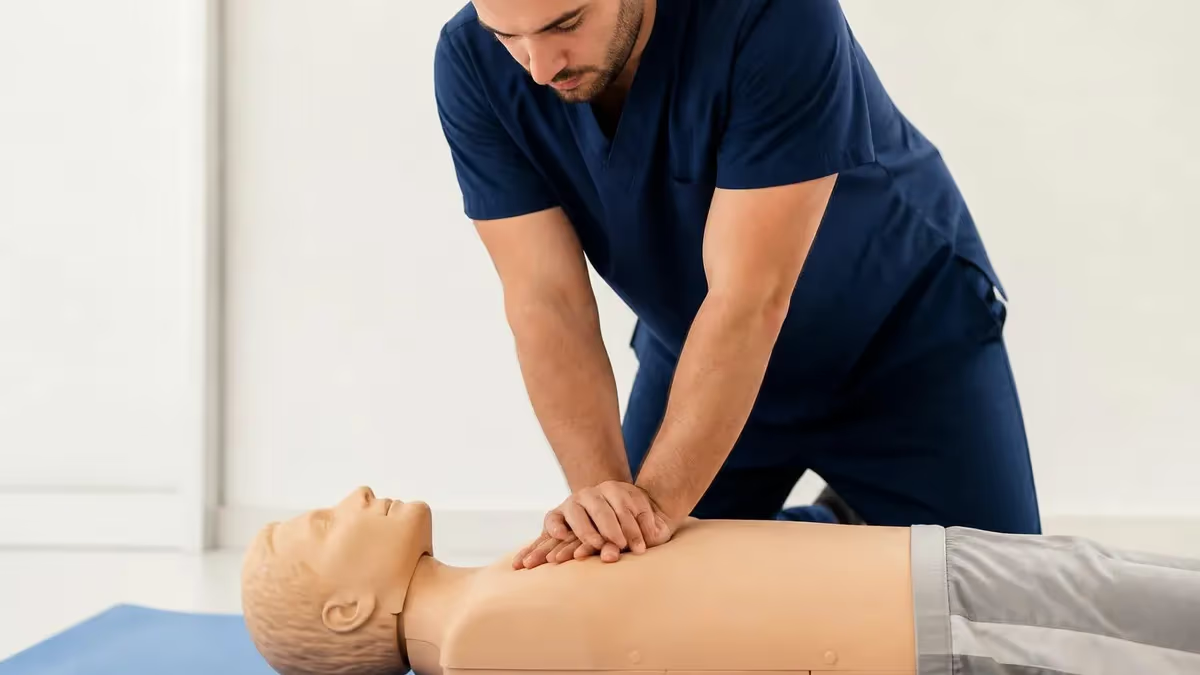
BLS certification renewal is the structured recertification process healthcare providers complete every two years to keep their Basic Life Support card current and their hospital credentials in good standing. If you are wondering exactly what is a BLS certification and how the renewal cycle works, the short answer is that BLS is the foundational resuscitation credential that proves you can deliver high-quality CPR, use an AED safely, and respond to choking or respiratory emergencies in adults, children, and infants according to current American Heart Association guidelines.
The 2025 Focused Updates and the 2020 AHA Guidelines for CPR and Emergency Cardiovascular Care still drive the renewal curriculum, with refinements around compression depth, ventilation timing in advanced airways, and team-based resuscitation. Most hospitals, surgery centers, dental practices, EMS agencies, and nursing schools in the United States require an unexpired BLS card as a condition of employment, clinical rotation, or licensure verification.
Renewal differs from the initial provider course in length, focus, and assumed knowledge. The provider course is around four hours of skills, lecture, and testing. A basic life support renewal class condenses that into roughly two hours because instructors assume you already understand the algorithms and only need to verify current skills, demonstrate the megacode-style scenarios, and pass the written exam at 84% or higher.
You can renew through three main pathways: a full in-person classroom course, the AHA HeartCode blended-learning option that pairs online cognitive work with a hands-on skills session, or a Red Cross digital renewal that combines simulation learning with an in-person skills check. Each pathway ends with the same outcome — a two-year provider card — but they differ in cost, time commitment, and how rigorously the skills station is run.
Pricing in 2026 typically ranges from $60 to $110 for renewal, depending on region, training center, and whether the course includes a printed manual. Group rates at hospitals or community colleges can drop the per-person cost below $50 when a department renews together. Online-only courses that promise a card without any skills check exist but are not accepted by AHA-aligned employers, so verify your facility's policy before purchasing anything advertised as 100% online.
This guide walks you through every step of renewal: eligibility windows, exam format, scoring, study planning, common failure points, what to bring on test day, and how to download your eCard within 20 days of passing. We have also linked free practice questions throughout so you can self-assess before you spend money on a course you may not be ready for.
By the end, you will know exactly what changed since your last cycle, how to budget your study hours, and how to walk into your skills session prepared to demonstrate compressions at 100–120 per minute, switch compressors in under five seconds, and run a two-rescuer scenario without prompting from the instructor.
BLS Renewal by the Numbers
Key Facts at a Glance
| Item | Value | Details |
|---|---|---|
| Card Validity | 2 yrs | From issue date, not exam date |
| Passing Score | 84% | AHA written exam minimum |
| Exam Questions | 25 | Multiple-choice format |
| Course Length | 2 hrs | Renewal vs 4 hrs for provider |

Your BLS Renewal Timeline
60 Days Before Expiration
30 Days Before
1 Week Before
Course Day
Within 20 Days
The AHA renewal exam follows the same blueprint as the provider exam — 25 multiple-choice questions drawn from the BLS Provider Manual — but the question pool emphasizes scenarios you should already recognize as a working clinician. Expect five to seven questions on adult one-rescuer and two-rescuer CPR, four to six on pediatric and infant resuscitation, two to three on choking relief, and the remainder distributed across AED operation, team dynamics, opioid emergencies, and post-event documentation.
Passing is 84%, which translates to missing no more than four questions. If you miss five or six, instructors are required to give immediate remediation and a second attempt with a different version of the test. Miss seven or more and you typically need to retake the full course. The remediation policy has tightened since 2023 because credentialing bodies pushed back on the prior practice of unlimited retries within a single session.
Content reflects the 2020 Guidelines plus the 2025 Focused Update. Key points the renewal exam now hammers harder: compression depth of at least 2 inches but no more than 2.4 inches in adults, a compression rate of 100–120 per minute, full chest recoil between compressions, and minimizing interruptions to keep the chest compression fraction above 60%. The basic life support exam american heart association renewal version asks about each of these targets in different ways.
Ventilation questions trip people up the most. For an adult in cardiac arrest with no advanced airway, you deliver 30 compressions to 2 breaths. With an advanced airway in place, you switch to continuous compressions and one breath every 6 seconds — that is 10 breaths per minute. The 2025 Focused Update reinforced this 6-second interval and removed the older 6-to-8-second range, so questions written before 2025 may have been updated.
Pediatric scenarios test whether you can identify the difference between single-rescuer and two-rescuer ratios. Solo rescuer in a child or infant uses 30:2, the same as adults. Two rescuers switch to 15:2. Many candidates miss this because they memorized one ratio for all pediatric scenarios. The exam often presents a witnessed collapse versus an unwitnessed collapse to test whether you remember to activate emergency response before or after starting CPR.
AED questions focus on placement, shock decision logic, and special situations. You should know to dry a wet chest before placing pads, shave excessive chest hair only if pads will not adhere, and not to place pads directly over a pacemaker bulge or medication patch. Pediatric pads are preferred for children under 8, but adult pads are acceptable if pediatric pads are unavailable — never withhold defibrillation because the right pads are missing.
Finally, opioid-associated emergencies are a growing slice of the exam. You should know that naloxone can be administered alongside CPR when an overdose is suspected and a pulse is absent, but CPR and ventilation remain the priority. The renewal test usually includes one or two questions on this topic, reflecting the public-health emphasis the AHA placed on the opioid algorithm in recent guideline cycles.

BLS Practice Test Questions
Prepare for the BLS - Basic Life Support exam with our free practice test modules. Each quiz covers key topics to help you pass on your first try.
BLS High-Quality CPR & Provider Skills
BLS Exam Questions covering BLS High-Quality CPR & Provider Skills. Master BLS Test concepts for certification prep.
BLS Special Situations & Scenarios
Free BLS Practice Test featuring BLS Special Situations & Scenarios. Improve your BLS Exam score with mock test prep.
BLS Adult, Child & Infant Resuscitation
BLS Mock Exam on Adult, Child & Infant Resuscitation. BLS Study Guide questions to pass on your first try.
BLS Airway Management & Ventilation
BLS Test Prep for Airway Management & Ventilation. Practice BLS Quiz questions and boost your score.
BLS Automated External Defibrillator (AED)...
BLS Questions and Answers on Automated External Defibrillator (AED) Use. Free BLS practice for exam readiness.
BLS Certification: Cardiac Arrest
BLS Mock Test covering Certification: Cardiac Arrest. Online BLS Test practice with instant feedback.
BLS Certification: Choking
Free BLS Quiz on Certification: Choking. BLS Exam prep questions with detailed explanations.
BLS Certification: Respiratory Arrest
BLS Practice Questions for Certification: Respiratory Arrest. Build confidence for your BLS certification exam.
BLS Chain of Survival
BLS Test Online for Chain of Survival. Free practice with instant results and feedback.
BLS CPR Techniques & Procedures
BLS Study Material on CPR Techniques & Procedures. Prepare effectively with real exam-style questions.
BLS Legal & Ethical Considerations
Free BLS Test covering Legal & Ethical Considerations. Practice and track your BLS exam readiness.
BLS Post-Resuscitation Care
BLS Exam Questions covering Post-Resuscitation Care. Master BLS Test concepts for certification prep.
BLS Renewal Pathways: AHA vs Red Cross vs Blended
The traditional American Heart Association classroom renewal is a two-hour, instructor-led session at an AHA Training Center. You walk in, watch updated technique videos, run through skills stations on adult, child, and infant manikins, and take the 25-question paper or tablet-based exam at the end. This is the most widely recognized format, accepted by every hospital credentialing office in the US.
Cost ranges from $70 to $110 and includes your eCard, issued within 20 business days. The advantage is real-time feedback from an instructor who can correct hand placement, compression depth, or ventilation technique on the spot. The disadvantage is scheduling — popular weekend slots fill three to four weeks ahead, so book early during peak hospital onboarding seasons.
Is BLS Renewal Worth the Time and Money?
- +Required for most clinical jobs, so renewal directly protects your employment status
- +Hands-on skills practice rebuilds muscle memory that fades between resuscitation events
- +Updated guidelines refresh your knowledge of compression depth, rate, and ventilation timing
- +AHA and Red Cross cards are accepted nationwide, giving job mobility across states
- +Renewal is faster and cheaper than the full provider course if you stay current
- +Group rates through your employer can reduce per-person cost below $50
- +eCards integrate with most hospital credentialing systems for instant verification
- −Out-of-pocket cost if your employer does not reimburse renewal fees
- −Scheduling conflicts with shift work, especially for weekend or evening sessions
- −Failing the skills check requires a paid retest at most training centers
- −Online-only courses that skip skills sessions are not accepted by AHA-aligned employers
- −Travel time to an in-person skills check adds hidden cost beyond the course fee
- −Manual purchases are sometimes required and add $15 to $25 to total cost
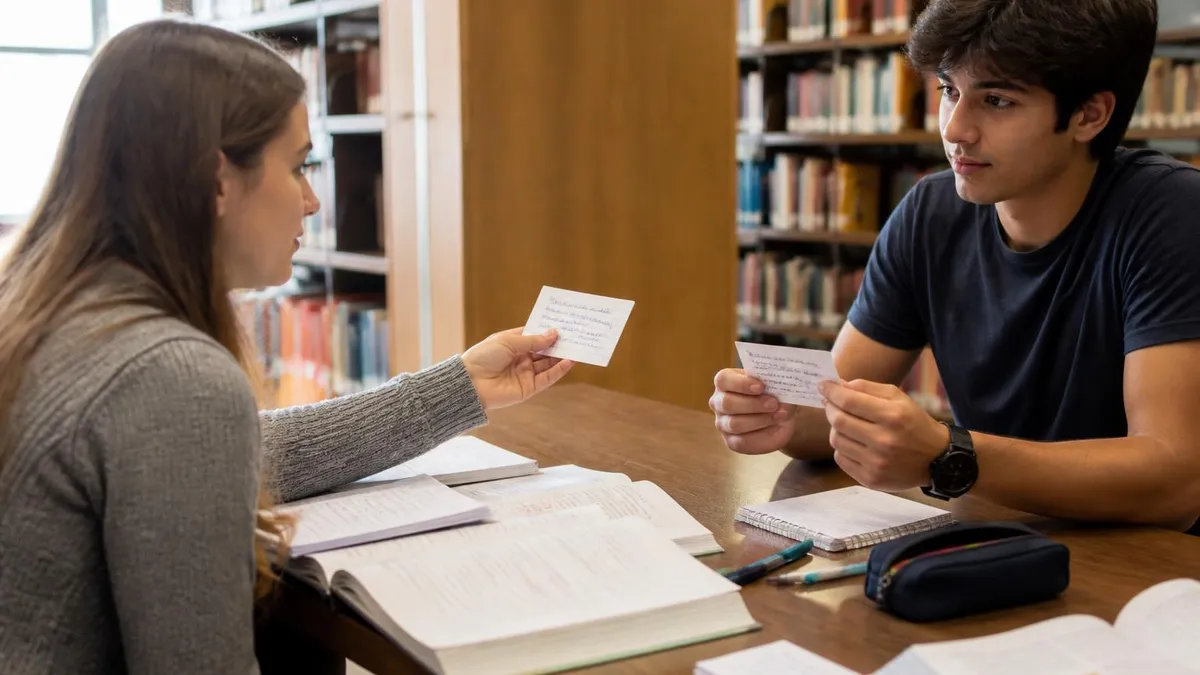
Pre-Renewal Preparation Checklist
- ✓Locate your current BLS card and confirm the exact expiration date
- ✓Verify whether your employer requires AHA, Red Cross, or accepts either
- ✓Book a renewal class at least three weeks before your card expires
- ✓Download or borrow the current BLS Provider Manual and read it cover to cover
- ✓Watch updated AHA technique videos on the 2025 Focused Update changes
- ✓Complete at least two timed practice exams and review every missed question
- ✓Memorize compression rate (100–120/min) and depth (2–2.4 inches adult)
- ✓Drill the 30:2 single-rescuer and 15:2 two-rescuer pediatric ratios
- ✓Practice AED pad placement on adult, pediatric, and special-situation patients
- ✓Confirm your photo ID and old card are ready for instructor verification on test day
Your card expires on the last day of the month — not the day of your prior exam.
This 30-day buffer is one of the most misunderstood parts of BLS renewal. If your card lists June 2026, you have until June 30, 2026 to test, even if your original course was June 3, 2024. Use that grace window — but do not let your card actually lapse, because most hospitals will pull you off the clinical schedule the moment expiration hits midnight on the last day.
The skills session is where most renewal anxiety lives, but it is also the most predictable part of the day. Instructors follow a published AHA checklist that grades you on a defined set of behaviors. If you know the checklist in advance, you can practice each item until it is automatic, and the assessment becomes a verification rather than a surprise.
Station one is typically adult one-rescuer CPR with AED. You will be expected to assess the scene, check responsiveness with the shoulder tap and shout, activate emergency response and request an AED, check breathing and pulse simultaneously for no more than 10 seconds, then begin compressions within roughly 10 seconds of confirming arrest. Compressions must hit 100–120 per minute, 2 to 2.4 inches deep, with full recoil.
Station two adds a second rescuer. The grading focus shifts to team dynamics — clear role assignment, closed-loop communication, switching compressors every two minutes (or sooner if fatigued), and limiting compression pauses to under 10 seconds. Many candidates lose points here not because their CPR is poor but because they fail to verbalize what they are doing or call out the switch.
Station three covers child and infant CPR. Hand position changes — two hands for a child but two fingers or two-thumb encircling for an infant. Depth changes to about 1.5 inches for infants and 2 inches for children, both roughly one-third of chest depth. Ventilation volumes are smaller and you should see visible chest rise without overinflating. The aha basic life support exam renewal skills station tests all three age groups in sequence.
Choking relief is usually a verbal walkthrough or brief demonstration rather than a full station. You should be able to differentiate mild versus severe airway obstruction, perform abdominal thrusts on a conscious adult or child, perform back blows and chest thrusts on an infant, and transition to CPR if the patient becomes unresponsive. The transition point — when to drop the choking patient and start compressions — is a frequent exam question.
Documentation, while not always graded as a separate skill, may come up in scenario debriefs. Instructors sometimes ask what you would document after the resuscitation: time of arrest recognition, time CPR started, number and timing of shocks delivered, medications administered if applicable, and time of return of spontaneous circulation. Knowing this shows you understand BLS in the context of a full code response.
If you struggle at any station, instructors are trained to remediate immediately rather than fail you outright. They will demonstrate the correct technique, let you practice once or twice, and reassess. Genuine inability to perform high-quality CPR is rare in healthcare providers who have been working clinically. Most failures come from rushing through assessment steps or forgetting to verbalize actions.
If your BLS card expires before you renew, many employers require you to take the full provider course again — not the shorter, cheaper renewal. That doubles your time commitment and adds $30 to $50 to the cost. Worse, some hospitals will suspend your clinical privileges on the day of expiration, meaning lost shifts and lost income. Always renew at least 30 days before expiration to leave room for rescheduling if you fail the first attempt.
Day-of-exam strategy starts the night before. Get seven to eight hours of sleep, lay out your photo ID, current BLS card, and any course confirmation emails, and pack a water bottle and light snack. Skills sessions can run long if a class is crowded, and you do not want to be making decisions about ventilation timing on an empty stomach or with a caffeine crash mid-station.
Arrive 15 minutes early. Training centers use this window to verify your identity, collect signed waivers, and assign you to a manikin and partner. Showing up exactly on time means you start behind, miss the instructor's introduction, and may not get the manikin you prefer. Arriving early also gives you time to chat with your partner — you will be working with this person during two-rescuer stations and a quick rapport reduces friction during the test.
During the written exam, read each question fully before scanning the answers. AHA questions often include a qualifier — "unwitnessed," "single rescuer," "with an advanced airway" — that changes the correct answer. Skipping past that qualifier is the most common cause of missed questions among candidates who actually know the content. If you finish early, go back and re-read every question with the qualifier in mind.
If you genuinely do not know an answer, eliminate clearly wrong options first. AHA questions usually have one or two distractors that are obviously incorrect — for example, a compression rate of 60 per minute or a depth of 4 inches. Eliminating those leaves a 50/50 between two plausible answers, dramatically improving your odds. Mark the question, move on, and return to it after you finish the easier ones.
For skills stations, verbalize everything. Say "the scene is safe," "checking for responsiveness," "activating emergency response and requesting an AED," "checking breathing and pulse," and "beginning compressions." Instructors grade what they can observe, and verbal narration leaves no ambiguity about whether you completed each step. Silent candidates sometimes do the steps but fail because the instructor cannot confirm it.
Take advantage of the is bls the same as cpr conceptual framing during your practice questions: BLS includes CPR, but it also includes AED operation, choking relief, team dynamics, and the special situations of opioid overdose, drowning, and pregnancy. Studying with that broader frame in mind helps you answer scenario questions that go beyond pure compression mechanics.
After passing, save your eCard in three places: a printed paper copy in your work bag, a PDF on your phone, and a backup PDF in your email. Hospital credentialing audits sometimes happen with little notice, and being unable to produce your card on demand can trigger a temporary clinical suspension even though the card is technically valid in the AHA database.
Beyond passing the renewal, the most useful mindset shift is treating BLS as a perishable clinical skill rather than a once-every-two-year box to check. Studies of in-hospital cardiac arrest consistently show that compression quality degrades within three to six months of training, even among providers who pass renewal cleanly. That is why high-performing code teams run quarterly in-service drills with feedback-equipped manikins rather than relying solely on biennial recertification.
If your hospital does not offer between-renewal practice, build your own. Many manikins now connect to free smartphone apps that measure compression rate, depth, and recoil in real time. Spend ten minutes a month on a friend's manikin, your unit's training dummy, or even a CPR-feedback pillow. The cost is zero and the payoff is that when a real code happens, your hands know exactly what 110 compressions per minute at 2.2 inches feels like.
Pay attention to upcoming guideline changes too. The AHA publishes Focused Updates between major five-year cycles, and the next significant update is expected in late 2026 or early 2027. Renewal courses taken in the months immediately after a Focused Update sometimes include transitional content where instructors flag what will change in the next cycle. Going into renewal with awareness of those changes gives you a head start when you recertify in two years.
For nurses, paramedics, respiratory therapists, and physicians who will progress to ACLS or PALS, strong BLS fundamentals are the foundation everything else rests on. ACLS megacode failures almost always trace back to weak underlying BLS — slow recognition, late compressions, poor compression quality, or sloppy team communication. Investing extra effort during BLS renewal pays off across the entire resuscitation education ladder.
For students, new grads, and clinicians returning after a career break, consider taking the full provider course rather than the renewal even if your card is still valid. The longer course gives you more practice time, more instructor feedback, and a fuller review of the manual. The price difference is modest and the confidence gained is significant, especially if you are about to start a high-acuity clinical role like ICU, ED, or rapid response.
Documentation of renewal is the final practical detail. Submit your new eCard to your credentialing office or unit manager within five business days of receiving it. Set a calendar reminder 90 days before your new card expires so you start the cycle early next time. A small amount of administrative discipline now prevents the much larger headache of an expired card and a missed shift two years from now.
Renewal is ultimately a small investment with a large return: continued employment, sharper clinical skills, and confidence that you can act effectively the next time a real patient deteriorates in front of you. Approach it with the seriousness the credential deserves, study the way you would for any high-stakes professional exam, and treat the skills session as a chance to genuinely refresh muscle memory rather than just clear a recertification hurdle.
Sample BLS - Basic Life Support Practice Questions
Try these questions from our free BLS - Basic Life Support practice tests. The correct answer and an explanation follow each question.
As your partner takes over chest compressions, you and your partner transfer from administering compressions to providing ventilations. While another assistant turns on and attaches the AED, this switch is made. The victim's rhythm is examined by the AED. (True or False) Rescue breathing should continue throughout the AED rhythm evaluation.
- A. False
- B. True
Answer: A. False
False. During AED rhythm evaluation and shock delivery, all rescuers must stand clear of the patient. Continuing rescue breathing or chest compressions during this time would interfere with the AED's analysis and could endanger the rescuer. CPR should be paused only for rhythm analysis and shock delivery, then immediately resumed.
You're in the hospital cafeteria on break. You observe a disturbance at a different table as you settle down to enjoy your lunch. A man appears to be in trouble as he stands up. He made the traditional choking sign by placing his hands at the victim's throat. You stand beside the person who is choking. (True or False) Your first line of defense should be encircling the victim's chest.
- A. False
- B. True
Answer: B. True
True. For a conscious adult choking victim, the first line of defense is to perform abdominal thrusts (Heimlich maneuver). This involves standing behind the victim and encircling their chest with your arms, then delivering quick, upward thrusts to the abdomen. This action helps to dislodge the foreign object from the airway.
You see a middle-aged man collapse and hold his chest as you prepare to go into the elevator to go to the lunch room while you are alone and on your lunch break. Currently, the man is lying on the ground. What should your initial course of action be in cases of cardiac arrest emergencies like this one?
- A. verify scene safety
- B. get a defibrillator
- C. begin CPR
- D. verify unresponsiveness
Answer: A. verify scene safety
In any emergency situation, the absolute first step is always to ensure scene safety for yourself and the victim. You cannot effectively help someone if you become injured or put yourself in danger. Only after confirming the scene is safe should you proceed to check for unresponsiveness, call for help, and initiate further emergency actions like CPR or retrieving a defibrillator.
How often should you provide one breath as you start your rescue breathing?
- A. every 2-3 seconds
- B. every 2-4 seconds
- C. every 8-10 seconds
- D. every 5-6 seconds
Answer: A. every 2-3 seconds
For children and infants requiring rescue breathing, the recommended frequency is one breath every 2-3 seconds, which translates to about 20-30 breaths per minute. This higher frequency compared to adults is crucial due to their faster metabolic rate and increased susceptibility to respiratory arrest. Ensuring adequate oxygenation is paramount in pediatric emergencies.
BLS Questions and Answers
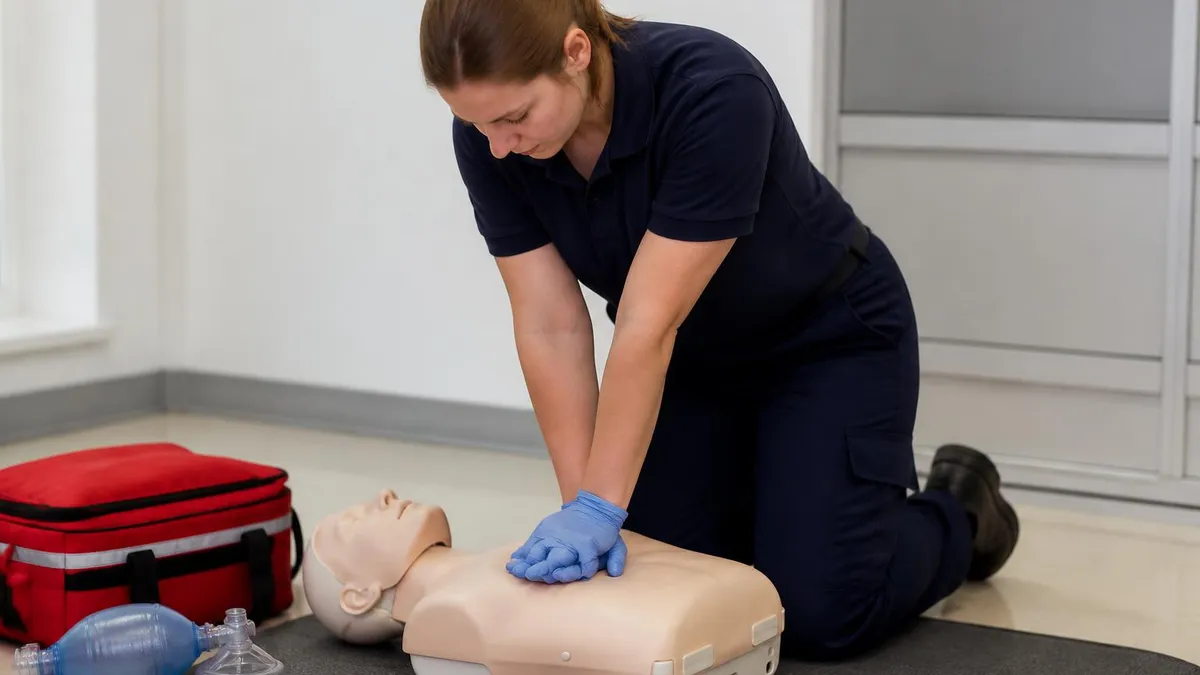
Pediatric BLS Algorithm: Complete 2026 Guide for Healthcare Providers
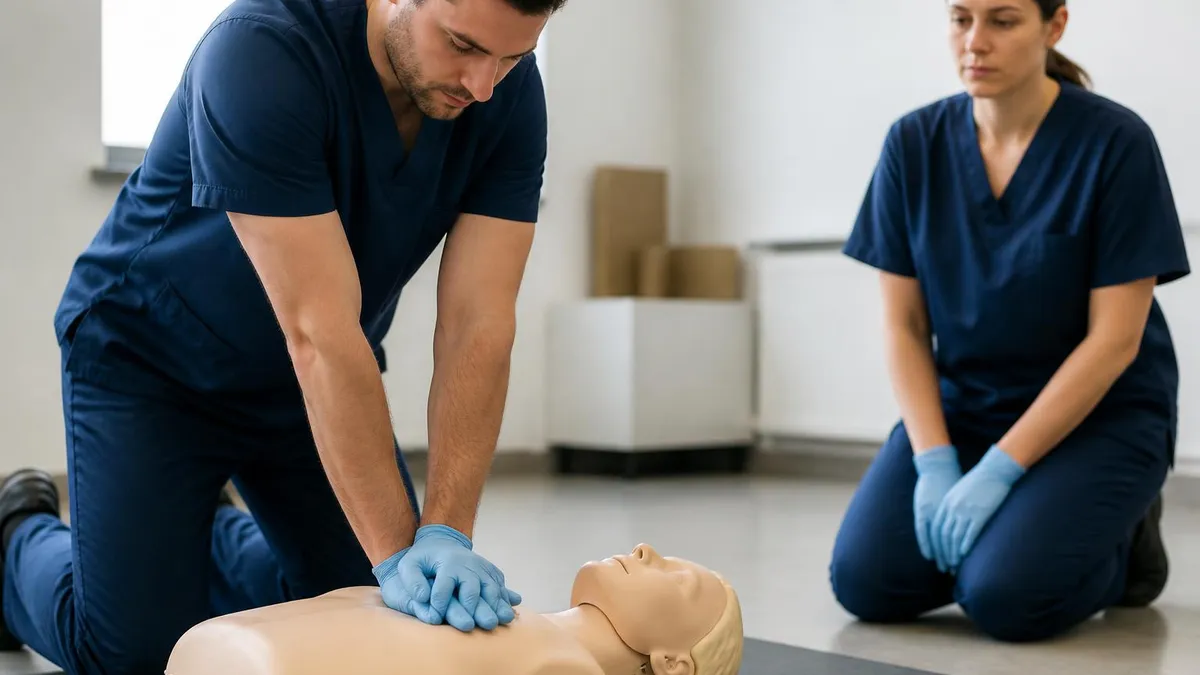
How Long Does BLS Certification Last? Complete 2026 Renewal Guide
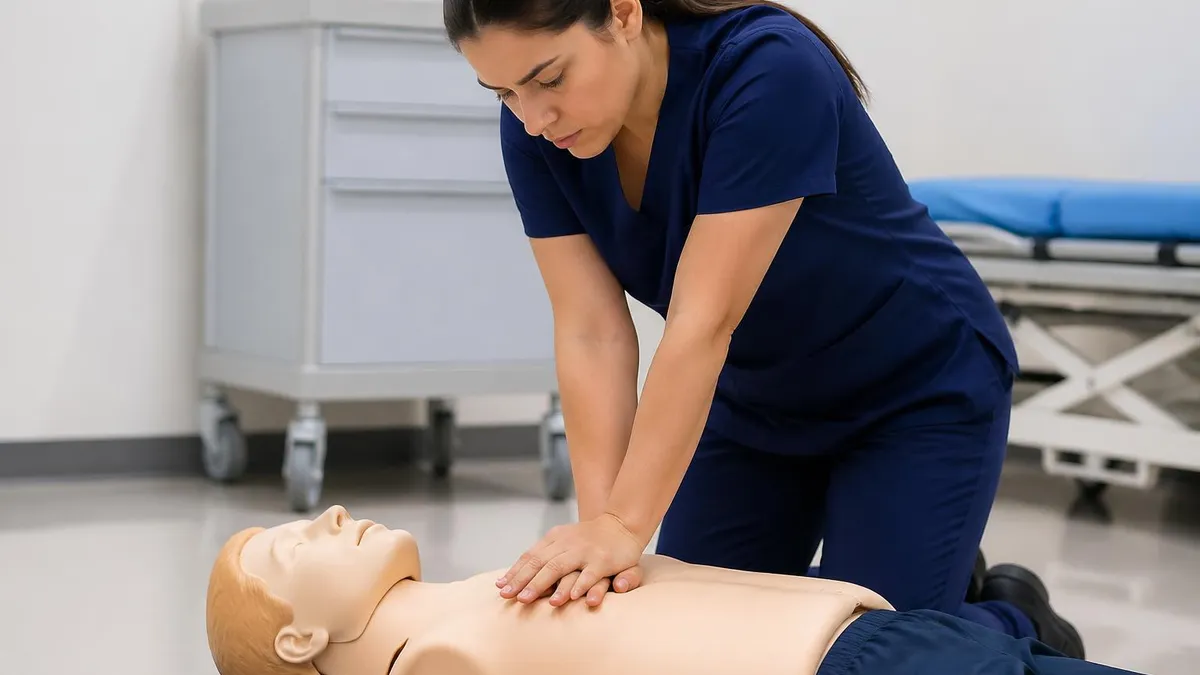
American Heart Association BLS: Certification, Renewal, Cost & What to Expect
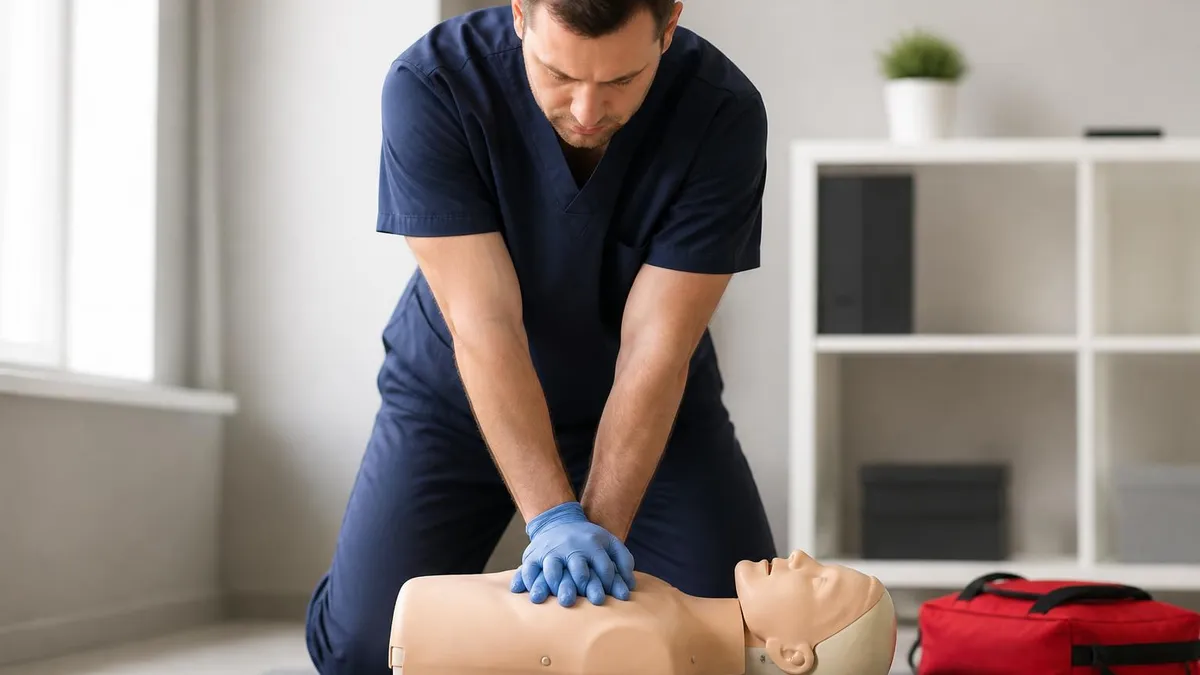
Online BLS Renewal: Complete 2026 Guide to Recertifying Your Basic Life Support Card
BLS Practice Test Video Answers
About the Author

Registered Nurse & Healthcare Educator
Johns Hopkins University School of NursingDr. Sarah Mitchell is a board-certified registered nurse with over 15 years of clinical and academic experience. She completed her PhD in Nursing Science at Johns Hopkins University and has taught NCLEX preparation and clinical skills courses for nursing students across the United States. Her research focuses on evidence-based exam preparation strategies for healthcare certification candidates.
Join the Discussion
Connect with other students preparing for this exam. Share tips, ask questions, and get advice from people who have been there.
View discussion (8 replies)