
What Is BLS? Basic Life Support, CPR, and AED Guide 2026 September
BLS (Basic Life Support) covers CPR, AED use, and choking relief for cardiac and respiratory emergencies. Learn who needs BLS certification and how 🆕
What Is BLS (Basic Life Support)?
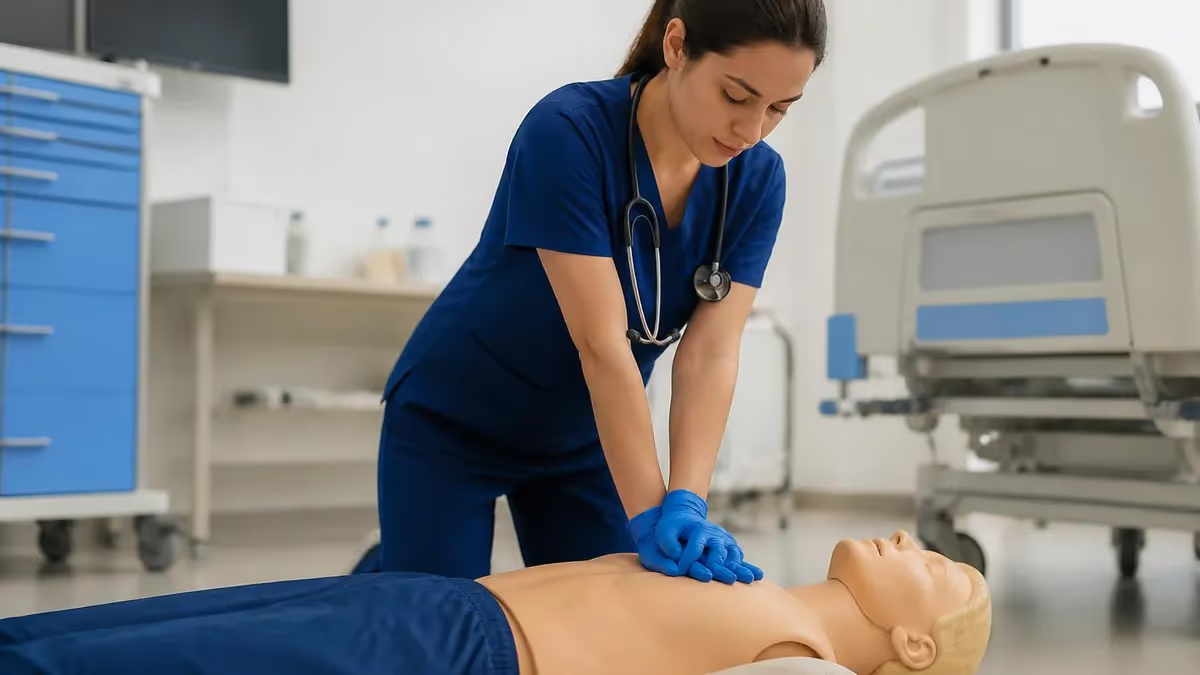
BLS — Basic Life Support — is a level of emergency medical care that healthcare providers and trained responders use to sustain life in people experiencing cardiac arrest, respiratory arrest, or airway obstruction until advanced medical care can be delivered. The three core skills of BLS are high-quality CPR (cardiopulmonary resuscitation), automated external defibrillator (AED) use, and relief of foreign body airway obstruction (choking). Together, these interventions keep oxygenated blood circulating to the brain and vital organs during the critical minutes before emergency medical services arrive or before a patient can receive advanced care.
The 'basic' in basic life support Support doesn't mean simple or unimportant — it refers to the level in the emergency care hierarchy. BLS is the foundation; Advanced Cardiovascular Life Support (ACLS) and Pediatric Advanced Life Support (PALS) build on BLS with more complex interventions like airway management, IV medications, and cardiac arrhythmia treatment. You need BLS certification before you can pursue ACLS or PALS training — it's the prerequisite level for most advanced emergency care certifications.
Cardiac arrest is one of the leading causes of death in the United States, with the American Heart Association estimating that approximately 350,000 out-of-hospital cardiac arrests occur each year. Survival rates drop by 7-10% for every minute without CPR and defibrillation. BLS training exists to address this time-critical gap: bystanders and healthcare workers who act immediately before paramedics arrive dramatically improve survival odds. Studies consistently show that immediate bystander CPR can double or triple survival rates from cardiac arrest.
BLS certification is required for a wide range of healthcare professions and is increasingly expected in non-clinical roles that involve regular contact with patients or the public. Nurses, medical assistants, EMTs, dental hygienists, respiratory therapists, physical therapists, lifeguards, and school nurses all commonly hold BLS certification as a job requirement. Many hospitals and healthcare facilities require all employees — including administrative staff — to hold current BLS certification as a condition of employment.
- What it stands for: Basic Life Support — the foundational level of emergency care for cardiac arrest, respiratory arrest, and choking
- Three core skills: High-quality CPR, AED (automated external defibrillator) use, and relief of foreign body airway obstruction
- Primary certifying bodies: American Heart Association (AHA) and American Red Cross — both are widely accepted by healthcare employers
- Course length: Approximately 4-6 hours for the full provider course; shorter renewal courses for recertification
- Certification validity: 2 years — renewal is required every 2 years to keep certification current
- Who needs it: Nurses, medical assistants, EMTs, respiratory therapists, dental hygienists, physical therapists, lifeguards, and many other healthcare and public-facing roles
- Is BLS the same as CPR? CPR is one component of BLS. BLS includes CPR plus AED use and choking relief — it's a broader certification than a basic CPR card
The BLS Response Sequence
Recognise the emergency and ensure safety
Begin high-quality CPR
Use the AED as soon as it arrives
Manage airway obstruction if present

Who Needs BLS Certification?
BLS certification is required for a broader range of professions than most people realise. Clinical healthcare providers are the obvious category — but requirements extend well beyond bedside clinicians. Understanding whether your role requires BLS, and which type of BLS certification your employer or licensing board accepts, matters before you sign up for a course.
Healthcare providers who virtually always need BLS certification include registered nurses (RNs) and licensed practical nurses (LPNs), physician assistants, medical assistants, emergency medical technicians (EMTs) and paramedics, respiratory therapists, dental hygienists and dental assistants, physical and occupational therapists, surgical technologists, radiologic technologists, and pharmacy technicians in clinical settings. Most nursing licensure boards and clinical credentialing bodies require current BLS certification from an approved provider as a condition of practice.
Non-clinical healthcare roles increasingly require BLS too. Hospital administrative staff, patient transport workers, security personnel, dietary staff in healthcare facilities, and volunteers with patient contact are commonly required to hold current BLS certification by the employing healthcare facility — even when their primary role doesn't involve direct clinical care. During a cardiac arrest in a hospital, whoever is nearest needs to be able to respond immediately; this drives certification requirements across the whole facility rather than just the clinical departments.
Community and public safety roles requiring BLS include school nurses, childcare workers, lifeguards, athletic trainers, coaches, fitness instructors, and flight attendants. Some states require BLS or equivalent CPR certification for daycare licensing, school employment, or pool staff certification. Lifeguard certifications typically include equivalent BLS skills as part of their training, though a separate BLS card may be needed for some employer requirements.
What is a BLS certification, exactly, in terms of what it proves? A BLS certification from the AHA or Red Cross demonstrates that you've successfully completed hands-on training in CPR, AED use, and airway obstruction management, and that you've been assessed meeting the provider-level skill standards. Most healthcare employers specifically require BLS for Healthcare Providers (the AHA's course) or the Red Cross's BLS for Healthcare Providers, rather than a general public CPR card — the healthcare provider versions include two-rescuer CPR techniques, bag-valve-mask ventilation, and other skills relevant to clinical settings.
BLS Core Skills Explained
The central BLS skill. Proper CPR technique: compress at least 2 inches deep at 100-120 compressions per minute, allow full chest recoil, minimise interruptions, use a 30:2 compression-to-breath ratio with one rescuer (15:2 with two rescuers for children), switch compressors every 2 minutes to maintain quality. High-quality CPR keeps oxygenated blood circulating to the brain — quality matters as much as quantity.
An automated external defibrillator (AED) analyses heart rhythm and delivers an electric shock to reset the heart's electrical activity in ventricular fibrillation and ventricular tachycardia without a pulse. BLS training covers turning the device on, placing the pads correctly, clearing the patient before shock delivery, and resuming CPR immediately after the shock. Modern AEDs provide voice guidance — the skill is knowing how to use them quickly and safely.
When two trained rescuers are available, BLS teaches a coordinated approach: one rescuer performs compressions while the other manages the airway and delivers rescue breaths. Rescuers switch every 2 minutes to prevent fatigue from degrading compression quality. Two-rescuer CPR also includes bag-valve-mask (BVM) ventilation technique, which delivers more consistent tidal volumes than mouth-to-mouth — a key clinical skill for the healthcare provider version of BLS.
BLS covers conscious and unconscious choking scenarios. For a conscious adult or child over one year with severe airway obstruction (unable to speak, cough, or breathe), abdominal thrusts (Heimlich manoeuvre) are the primary technique. For infants under one year, five back blows alternating with five chest thrusts. For an unconscious choking victim, each time you open the airway for rescue breaths, look for and remove any visible obstruction. Never perform blind finger sweeps.
AHA BLS vs. Red Cross BLS: Which Certification to Get
The American Heart Association (AHA) BLS for Healthcare Providers is the most widely recognised BLS certification in US healthcare settings:
- Full course: Approximately 4.5 hours in-person — includes instructor-led skills practice with mannequins and AED trainers, skills testing, and written exam
- HeartCode BLS: The AHA's blended learning option — complete the cognitive portion online (1-2 hours), then attend a shorter in-person skills session with an instructor for hands-on testing
- Accepted by: The vast majority of US hospitals, nursing schools, medical facilities, and state licensing boards — it's the dominant standard in clinical healthcare
- Certification card: Issued immediately after passing — a physical or digital card valid for 2 years
- Cost: Typically $50-$75 for an employer-sponsored course; $60-$100 through external training centres
- Renewal: AHA offers a renewal/recertification course (shorter than the full course) for providers with a current or recently expired certification
How BLS Differs from CPR and ACLS
The terms BLS, CPR, and ACLS get used interchangeably in some contexts and precisely in others — knowing the distinction helps you enrol in the right course and understand what your employer actually requires.
CPR vs. BLS: CPR (cardiopulmonary resuscitation) is a specific technique — chest compressions and rescue breaths — that is one component of BLS. A basic CPR card (often called Heartsaver CPR or community CPR) teaches CPR and AED basics for laypeople. BLS for Healthcare Providers goes further: it includes two-rescuer CPR, bag-valve-mask ventilation technique, infant and child resuscitation, and is assessed at a higher skill standard.
Most healthcare roles require BLS for Healthcare Providers specifically — a basic public CPR card doesn't meet those requirements. Is BLS certification the same as CPR? Not exactly: CPR is a subset of BLS, and healthcare employer requirements typically mean the full BLS provider course, not just a public CPR class.
BLS vs. ACLS: Advanced Cardiovascular Life Support (ACLS) builds on BLS with complex interventions: managing cardiac arrhythmias with medications and electrical therapy, advanced airway management (intubation, supraglottic airways), and team-based resuscitation leadership. ACLS is required for physicians, advanced practice nurses, ICU nurses, cardiac care nurses, anesthesiologists, and other providers who lead resuscitation teams. BLS is a prerequisite for ACLS — you must hold current BLS before you can take an ACLS course. Similarly, Pediatric Advanced Life Support (PALS) builds on BLS for providers working in paediatric care settings.
Understanding these distinctions also matters for NREMT (paramedic and EMT certification) requirements. EMT basic certification requires CPR certification, while paramedic certification requires ACLS. But in clinical practice, most hospitals require all patient-care staff to hold at minimum current BLS for Healthcare Providers, regardless of their specific role. The two-year BLS certification expiration means renewal is a regular operational requirement for anyone working in healthcare.
How long does BLS certification last? Two years — both AHA and Red Cross BLS certifications expire after 2 years. Some employers verify certification currency before each renewal period and require updated cards on file in the HR system. Letting certification lapse can create employment compliance issues, particularly in facilities where regulators check staff certification status. Most experienced healthcare workers set a calendar reminder 60-90 days before expiration to schedule their recertification course.
BLS Certification Checklist
- ✓Confirm your employer's specific BLS requirement — most healthcare employers require AHA BLS for Healthcare Providers or Red Cross BLS for Healthcare Providers, not just a basic CPR card
- ✓Choose the right course level — BLS for Healthcare Providers (not Heartsaver/community CPR) is required for most clinical and many non-clinical healthcare roles
- ✓Select an accredited training location — courses offered through your employer, hospital training department, AHA or Red Cross training centres, or authorised training sites are all valid
- ✓Consider blended learning (HeartCode BLS or Red Cross equivalent) if your schedule makes a full-day in-person course difficult — but confirm your employer accepts blended learning certifications
- ✓Bring your previous BLS card to renewal courses — it may qualify you for the shorter recertification course rather than the full provider course
- ✓Set a calendar reminder 60-90 days before your certification's 2-year expiration to schedule recertification before it lapses
- ✓Keep a copy of your certification card (physical and digital photo) and ensure a current copy is on file with your employer's HR or credentialing department
In-Person BLS vs. Online BLS Certification
- +In-person BLS courses provide hands-on practice with mannequins and real AED training devices — instructors give immediate feedback on compression depth, rate, and hand position that online formats can't replicate
- +Blended learning (online knowledge + in-person skills check) reduces the time commitment of a full in-person day while still including the hands-on skills validation that makes BLS meaningful
- +Online-only BLS courses (no in-person skills component) are convenient but may not meet employer requirements — many hospitals and clinical employers specifically require courses with an in-person skills validation component
- +Employer-sponsored in-person BLS training (during work hours or at no cost to the employee) is the most accessible option for new healthcare workers — check with your employer before paying out of pocket
- −Full in-person BLS courses require 4-6 hours in a scheduled session — a significant time commitment that blended learning or online options can reduce for experienced providers
- −Online-only BLS from some providers may not be accepted by Joint Commission-accredited hospitals or state licensing boards — always verify acceptance before enrolling in a fully online course
BLS Renewal and Staying Certified
BLS certification expires every two years. Most providers track the date on their physical or digital certification card and plan recertification before expiration. Letting certification lapse — even by a few weeks — can affect employment compliance, credentialing status, and in some cases your ability to legally practice in certain settings. Healthcare facilities that undergo accreditation surveys (Joint Commission, DNV, CMS) are expected to verify staff BLS certification status, making currency a real compliance matter rather than a formality.
The AHA offers a BLS renewal/recertification course that's significantly shorter than the initial full provider course. If your certification is current or expired within the last 90 days, you may be eligible for the shorter renewal course. If more time has passed, you typically need to complete the full BLS for Healthcare Providers course again. The Red Cross has similar recertification pathways — check with your training centre to confirm which course applies to your situation.
How long does it take to get BLS certification? The full in-person BLS for Healthcare Providers course runs approximately 4-5 hours — plan for a full morning or afternoon. Blended learning (HeartCode or Red Cross equivalent) splits into 1-2 hours of online work you complete at your own pace before a shorter 1-2 hour in-person skills session. Renewal courses run 3-4 hours for providers with current certifications. Most people complete initial BLS certification in a single day at a training centre, employer training session, or community college offering.
Many healthcare employers and hospital systems offer BLS courses on-site or through their education department at no cost to employees. This is the most convenient option for staff and ensures the employer has immediate verification of completion. If your employer doesn't offer on-site BLS training, the AHA's website allows you to search for authorised training centres by zip code.
Community colleges, fire departments, EMS agencies, and private training companies also offer AHA and Red Cross BLS courses regularly. What is a BLS certification from the Red Cross versus AHA — most employers accept both equally, though a small number of hospitals or state boards may specify one provider; always verify before enrolling.
BLS Key Facts
BLS in Healthcare Settings: What to Expect
In a clinical environment, BLS rarely happens exactly the way it's practised in a training course. Actual cardiac arrest events involve multiple responders arriving at different times, equipment that may not be immediately at hand, communication challenges, and patients who may be connected to monitors, IV lines, or other equipment. BLS training gives you the foundational skills; clinical experience and team-based training (like mock code exercises) develop the situational awareness to apply those skills effectively in real emergencies.
Most hospitals conduct 'code drills' or 'mock codes' — simulated cardiac arrest scenarios — to practice team coordination, equipment location, and role clarity. These exercises reinforce BLS skills in a realistic context and identify gaps in team communication or equipment access. Participation in mock codes is often part of ongoing clinical competency requirements, separate from but complementary to maintaining BLS certification.
Hospital crash carts (resuscitation carts) are stocked with AEDs or defibrillators, airway equipment, IV supplies, and resuscitation medications. Knowing the location of the nearest crash cart on your unit is an important complement to BLS certification. Some facilities conduct regular crash cart location quizzes as part of orientation. In the event of an actual cardiac arrest, the first responder begins CPR while another activates the code team — and the code team arriving with the crash cart brings the more advanced equipment that BLS providers use before the full code team is assembled.
For providers new to clinical settings, the most valuable BLS supplement is knowing your unit's code protocol: how to activate the code system (calling a code blue), where the AED or crash cart is, who has what role when the code team arrives, and how to hand off to the team leader effectively. BLS certification ensures you can perform until the team arrives; the handoff and team integration are unit-specific skills that come with orientation and experience.
How long does BLS certification last in terms of practical skill retention? Research suggests that CPR skill quality degrades within months without practice, which is why annual mock codes and skills refreshers are valuable even when formal recertification is only required every two years. Some hospital systems run quarterly CPR skill stations in the unit — brief opportunities for staff to practise compressions on a mannequin with feedback — specifically to maintain the muscle memory and technique that prevents skill fade between the two-year certification cycles.
A common misconception: that you need BLS certification to legally perform CPR on a stranger in public. You don't — Good Samaritan laws in all 50 US states protect bystanders who provide emergency assistance in good faith during a medical emergency, regardless of whether they're certified. BLS certification is required for professional roles and demonstrates a trained skill standard, but any person can and should perform CPR on someone in cardiac arrest without fear of legal liability. If someone collapses near you, don't wait for someone with a certification card — call 911, get the AED, and start CPR immediately. Every minute of delay reduces survival odds.
Getting Your First BLS Certification
For healthcare students and new professionals, BLS certification is one of the first credentials to obtain — often before clinical rotations begin. Nursing programmes, medical schools, physician assistant programmes, and respiratory therapy programmes typically require students to obtain BLS certification early in their first year, before patient contact begins. Some programmes arrange group BLS courses for incoming cohorts; others direct students to find their own training.
The AHA's website (heart.org) has a course locator that shows authorised training centres by location and date. Courses fill quickly at popular training centres — especially at the start of academic semesters — so booking early is wise. Prices vary by location; employer or school-sponsored courses are often subsidised or free. Some training centres offer group discounts for cohorts of students booking together.
When you complete the course and pass the skills station and written exam, you receive a BLS certification card — either immediately printed or sent by email within 24 hours depending on the training centre. Keep this card safely: your employer, clinical site, and licensing board may ask to see it, and a photo on your phone serves as a useful backup copy.
How long does it take to get BLS certification when you're doing it for the first time? Plan for a full morning or afternoon — the full BLS for Healthcare Providers course runs 4-5 hours. Allow extra time for any pre-course reading your training centre recommends and for completing skills stations that may require waiting for your turn with the mannequins. First-time takers who have read the pre-course material and watched the skills videos beforehand tend to find the in-person session goes more smoothly and efficiently.
After getting certified, the next natural step is understanding what comes after BLS in your career pathway. General nurses and support staff maintain BLS as their baseline emergency credential. ICU nurses, cardiac care nurses, and advanced practice providers typically add ACLS within the first year or two of practice in those specialties. Paediatric nurses and providers working with children pursue PALS. Emergency department staff often hold both ACLS and PALS alongside their BLS certification. Understanding this progression early helps you plan your continuing education and certification pathway as your career develops.
BLS Questions and Answers
About the Author

Registered Nurse & Healthcare Educator
Johns Hopkins University School of NursingDr. Sarah Mitchell is a board-certified registered nurse with over 15 years of clinical and academic experience. She completed her PhD in Nursing Science at Johns Hopkins University and has taught NCLEX preparation and clinical skills courses for nursing students across the United States. Her research focuses on evidence-based exam preparation strategies for healthcare certification candidates.
Join the Discussion
Connect with other students preparing for this exam. Share tips, ask questions, and get advice from people who have been there.
View discussion (8 replies)