
How to Get BLS Certification: Step-by-Step Path for 2026 October
🗨️ How to get BLS certification fast: pick AHA or Red Cross, finish the online module, pass the in-person skills test, and download your e-card.
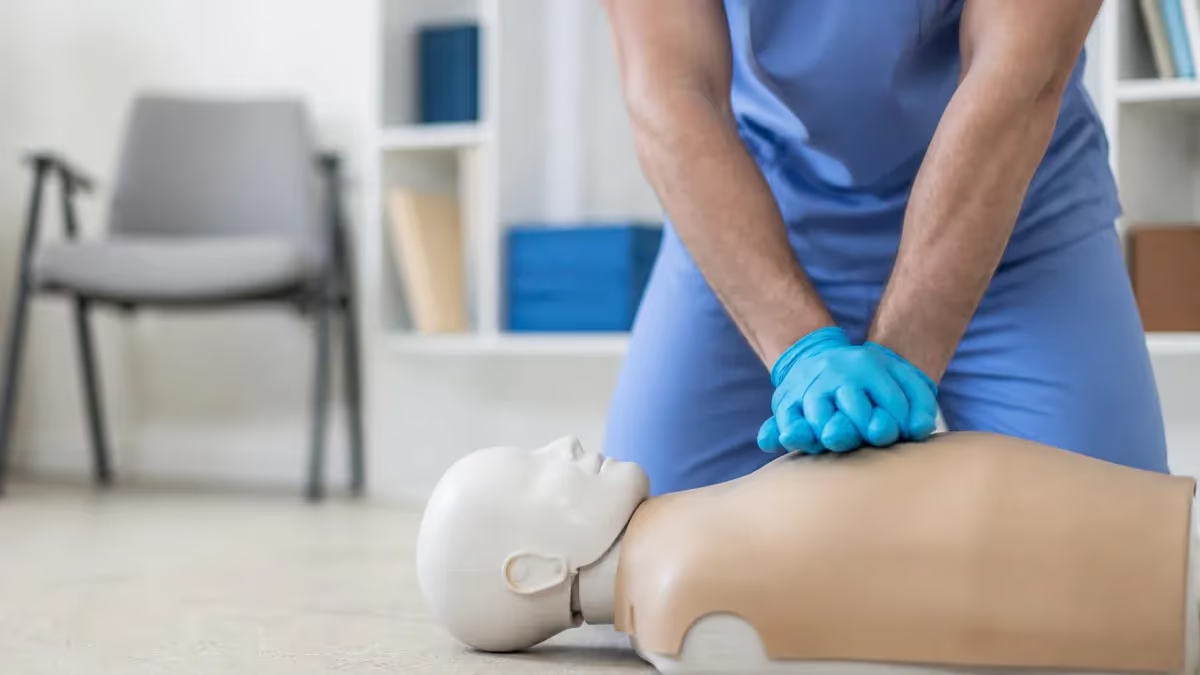
Getting your BLS certification sounds like a maze of acronyms, fees, and skills checklists — but it really comes down to three moving parts. Pick a provider that your employer accepts. Finish the online or classroom portion. Show up to a short skills session and prove you can do chest compressions, ventilations, and team CPR without freezing.
Whether you're a nursing student, a brand-new EMT, a dental hygienist, or a personal trainer who just got told "you need BLS by next week," the path is the same. The American Heart Association (AHA) and the American Red Cross run the two cards that hospitals universally accept. A few smaller programs exist, but they often get rejected at HR — so we'll focus on what actually works.
This guide walks you through every decision point: which provider to pick, how much it costs in 2026, how long it takes (spoiler: most people finish in one day), and what to expect at the skills check. By the time you finish reading, you'll have a clear plan to walk into class confident and walk out with a two-year card.
BLS Certification at a Glance
Key Facts at a Glance
| Item | Value | Details |
|---|---|---|
| Card validity | 2 years | |
| Total time | 3–5 hours | |
| Pass mark | 84% |
Those numbers shift slightly by region. A class in rural Ohio runs $55. The same class on Manhattan's Upper East Side hits $130. Online-plus-skills (the "blended" route) usually saves you ten or fifteen bucks because the instructor only books a 60-minute slot instead of a full day. If your employer is paying, none of that matters — but if it's coming out of your pocket, the price gap is worth shopping around.
And about that two-year window: don't wait until the last week. Renewal classes fill up around graduation season (May, June) and at the start of the hospital fiscal year (July, August). Book six to eight weeks before your card expires and you'll dodge the scramble.
The 60-second version
Choose AHA or Red Cross. Register online. Watch the videos and pass the online test (about 70 questions, retakes allowed). Drive to a training site. Practice on a manikin for an hour with an instructor. Pass the skills check. Download your e-card the same day. Total time: roughly half a day. Total cost: under $110 for most people.
That's the whole show. The rest of this article is just unpacking each step so nothing surprises you on test day. Let's start with the question almost everyone asks first: which provider should I pick?
The answer depends mostly on your job. Hospitals and major health systems almost always require AHA. Lifeguards, camp staff, and YMCA employees tend to need Red Cross. Some EMS agencies accept either. Before you pay anyone anything, call your HR department or check your onboarding paperwork — picking the wrong card means paying twice.
If you have flexibility, AHA is the more universally accepted credential in clinical settings. Red Cross is slightly cheaper in some markets and has a friendlier online interface. Both follow the same 2020 ILCOR resuscitation science updates, so the actual skills you learn are identical.
BLS Provider Options Compared
The gold standard for hospital and clinical jobs. Required by most nursing programs, medical schools, and dental boards.
Equally valid and slightly cheaper. Common for lifeguards, fitness trainers, and some EMS systems.
Lower-cost option accepted by many fire and EMS agencies, but often rejected by hospitals. Check first.
Tempting because it's $20 and 100% online — but most employers do not accept skills-free certificates. Skip it.
One more note on online-only "certifications": you'll see ads for $19 BLS cards that promise instant download with no skills check. They are not equivalent to AHA or Red Cross. Hospitals know it. HR systems flag them automatically. The card looks real, the seal looks legit, and it will get you rejected at orientation. Save the twenty bucks and put it toward a real class.
Now let's break down exactly what happens once you register, hour by hour. Most students assume the day will be stressful. It really isn't — instructors expect you to be nervous and the skills are designed to be learnable in one sitting.
Your BLS Certification Day, Step by Step
The skills test is the part everyone worries about, so let's be honest: it's not designed to fail you. Instructors are paid per certification, training centers want repeat customers, and the AHA wants more BLS providers in the world — not fewer. As long as you show up having watched the videos and you genuinely try, you'll pass.
The two things that trip up first-timers are compression depth and full recoil. Adults need at least 2 inches of depth per compression. Don't be polite — push hard. And let the chest come all the way back up between compressions. The manikin has a click or a light that tells the instructor whether you're hitting the target. Watch it, adjust, breathe.
The other common slip is the breath-to-compression ratio in two-rescuer infant CPR. It's 15:2 with two rescuers (not 30:2 like an adult). Memorize that one ratio before class and you'll outperform half the room.
Friends Friday CPR classes at a community center, or the 30-minute "hands-only CPR" demo at a health fair, do not produce a BLS card. Those are awareness courses. BLS specifically certifies you to perform two-rescuer CPR with airway adjuncts and AEDs in a professional setting. If a class doesn't include a skills check on a manikin with an instructor in the room, it isn't BLS.
That distinction matters because some students think they've already completed BLS through a high school health class or a workplace safety briefing. Those count as great prep, but they're not the credential. Same with online-only certificates from sketchy providers — they may teach you the material, but the card itself won't pass an HR audit.
If you're a complete beginner and you're worried about looking silly during the skills portion, try this: watch one full run-through on YouTube before class. Search for "AHA BLS skills test demonstration" and you'll find half a dozen videos from training centers. Watching one rescuer-with-AED scenario start to finish removes 90% of the anxiety because nothing in the actual test will surprise you.
Skills Test Day Checklist
- ✓Photo ID (driver's license or state ID)
- ✓Printed or digital proof you completed the online module
- ✓Comfortable clothes you can kneel and move in
- ✓Water and a snack — sessions can run over
- ✓Your AHA or Red Cross account login (in case the instructor needs to verify)
- ✓A mask if your training center still requires one (call ahead)
- ✓Pen and notebook for any local protocols the instructor adds
Practice tests are the single highest-ROI thing you can do before class. Twenty minutes of timed questions beats two hours of passive video review. You spot the gaps in your memory, you rehearse the test-taking rhythm, and you walk into the online exam with muscle memory for the format.
Most students who fail the online portion fail because they got over-confident on the AED section or because they confused infant ratios with adult ratios under time pressure. A handful of practice runs fixes both problems. Aim for 90%+ on practice questions before you sit the real thing — the cushion gives you room to slip on the day without blowing the 84% cutoff.
BLS Certification Pros and Cons
- +Two-year card accepted by virtually every U.S. healthcare employer
- +Blended (online + in-person) format finishes in one day
- +Renewal classes are shorter and cheaper than initial certification
- +Most regions offer evening and weekend sessions
- +Digital e-cards are issued within hours, not weeks
- −Some markets have month-long waitlists during graduation season
- −Online-only providers are tempting but usually rejected by HR
- −Costs can creep up to $130 in major metros
- −Renewal requires re-doing the full skills test, not just paperwork
- −Lost cards take 2–4 weeks to replace through customer service
One thing worth highlighting from that cons list: do not lose your e-card login. AHA and Red Cross e-cards live in your account portal. If you change jobs and your old employer's email was used to register you, getting back into that account can take weeks of customer service tickets. Use your personal email when you register, screenshot the card to your phone, and save a PDF to a cloud folder. Future-you will be grateful.
Renewals work almost the same way as initial certification, but the online portion is shorter (about 90 minutes instead of 2 hours) and the skills test is faster because the instructor assumes you've done this before. If your card has lapsed by more than 30 days, most centers will still let you renew at the renewal price — but if it's been lapsed longer than a year, you may need to redo the full initial course.
Sample BLS - Basic Life Support Practice Questions
Try these questions from our free BLS - Basic Life Support practice tests. The correct answer and an explanation follow each question.
An infant is choking and becomes unresponsive. What is your next step?
- A. Continue back blows and chest thrusts
- B. Begin CPR starting with chest compressions
- C. Call 911 and wait for help
- D. Perform abdominal thrusts
Answer: B. Begin CPR starting with chest compressions
When an infant becomes unresponsive due to choking, begin CPR starting with 30 chest compressions, looking for the object before giving breaths.
What is the first step in assessing a person who may be in cardiac arrest?
- A. Begin chest compressions
- B. Look for signs of circulation
- C. Check responsiveness by tapping and shouting
- D. Attach an AED
Answer: C. Check responsiveness by tapping and shouting
The first step in assessing a potentially unconscious person is to determine their responsiveness. Tapping and shouting helps ascertain if the person is merely sleeping or truly unresponsive, which guides subsequent assessment steps. This initial check is crucial before proceeding with checks for breathing and pulse, ensuring appropriate and timely intervention.
After a shock is delivered by an AED, what is the immediate next step?
- A. Check for a pulse
- B. Analyze the rhythm again
- C. Resume CPR beginning with chest compressions
- D. Deliver a second shock
Answer: C. Resume CPR beginning with chest compressions
Immediately after delivering a shock, resume CPR starting with chest compressions without checking the pulse first.
What is the first step when using an AED?
- A. Apply pads
- B. Turn on the AED
- C. Deliver a shock
- D. Begin chest compressions
Answer: B. Turn on the AED
The very first step when using an Automated External Defibrillator (AED) is to turn it on. This activates the device, allowing it to provide voice prompts and instructions that guide the rescuer through the subsequent steps, such as applying pads and analyzing the heart rhythm. Following these prompts ensures correct and timely use.
BLS Questions and Answers

What Makes BLS Different From Regular CPR
If you've taken a community CPR class before, you might be wondering why BLS exists as a separate course. The short answer is that BLS is engineered for environments where you'll work alongside other trained responders, where you'll have access to professional equipment, and where the patient's outcome depends on smooth team coordination. Regular Heartsaver CPR teaches you to keep someone alive until paramedics arrive. BLS teaches you to be the paramedic, the nurse, or the responder who actually runs the resuscitation.
That changes a few important things in the course content. You'll spend more time on two-rescuer scenarios — the kind where one person does compressions while another manages the airway, then you swap roles every two minutes to avoid fatigue. You'll learn how to use a bag-valve-mask, which is the football-shaped device hanging on the wall in every hospital code cart. You'll practice closed-loop communication, where every order gets confirmed verbally so nothing gets missed in the chaos of an actual cardiac arrest.
The math of survival also gets more granular in BLS. You'll memorize that high-quality chest compressions push at 100 to 120 per minute, never faster. You'll learn that interruptions in compressions of more than 10 seconds dramatically lower survival rates, which is why pulse checks and rhythm analyses are timed. None of this is rocket science, but it does require focus during the in-person session.
Many readers pair this guide with the aha bls practice questions to check their readiness before exam day.
BLS providers run codes alongside other clinicians, use bag-valve-masks and AEDs together, and rotate compressors every two minutes. Heartsaver CPR is for laypeople responding alone. The skills overlap, but the team mechanics and equipment use only exist in BLS.
Choosing a Training Center That Won't Waste Your Day
Once you've decided between AHA and Red Cross, the next decision is where to take the class. Both organizations license thousands of training centers across the country, and the quality varies wildly. A well-run center has multiple instructors, recent manikins with feedback devices, and a clear schedule. A poorly run center has one harassed instructor, twenty students, two manikins, and a 4-hour class that drags into 7 hours.
Before you register, check three things. First, look at recent Google reviews. If the center has fewer than 4 stars or reviews mentioning "chaotic" or "rushed," pick somewhere else. Second, confirm the class size — anything over 12 students per instructor is too many. Third, ask whether they use feedback manikins (the ones with lights or screens showing compression depth in real time). Feedback manikins make passing easier and learning faster.
Hospitals and large healthcare systems often run their own internal BLS classes for new hires. If you're already employed in healthcare, ask whether your facility offers staff classes — they're frequently free and held during paid work hours. Even if you have to take an unpaid lunch break to attend, you'll save the registration fee and skip the search for an outside provider.
How to Spot a Good BLS Training Center
- ✓Google rating 4.0 stars or higher with recent reviews
- ✓Class size capped at 12 students per instructor
- ✓Feedback manikins with real-time depth/recoil indicators
- ✓Clear written schedule sent before class day
- ✓Same-day e-card issuance from AHA or Red Cross portals
- ✓Free retest within 30 days if you fail first attempt
The Online Module: What to Expect
The blended-learning approach has become the dominant format because it lets you do the cognitive learning on your own schedule and saves the in-person time for hands-on skills. The online module typically runs about two hours of video content, broken into chapters with quiz checkpoints throughout. You can pause, rewind, and re-watch as many times as you want. There's no time limit and no penalty for failing the chapter quizzes — they're there to help you self-assess.
The final exam at the end of the online portion is usually 70 to 75 multiple-choice questions. You need 84% to pass, which means you can miss roughly 11 questions out of 70. Unlimited retakes are allowed, so even if you bomb it the first time, you can review the videos and try again. That said, walking into the in-person session having barely passed online will make the skills check much harder. Aim for 90% or better on the online exam — the cushion gives you confidence and helps the information actually stick.
Common trouble spots on the online exam include drug doses (which appear briefly in ACLS but rarely in BLS), specific time intervals for switching compressors, AED pad placement on patients with implanted defibrillators, and the differences between adult, child, and infant compression ratios. If you're rusty on any of those, watch the relevant chapter twice and take a few practice quizzes before sitting the real exam.
Online Module Breakdown
What Happens If Your Card Expires
BLS cards expire every two years, and the rules around lapsed certifications can be confusing. The good news is that there's no hard cliff — most training centers will let you take a renewal class even if your card has been expired for several months. The renewal class is shorter (about 90 minutes of online plus 60 minutes in person) and costs less than the initial certification.
If your card has been expired for more than a year, however, you'll usually need to take the full initial course again rather than the abbreviated renewal. Some employers also impose stricter rules: a hospital might require you to maintain continuous certification with no lapses, while a fitness gym might give you a 30-day grace period. Always check with your specific employer or licensing board before assuming you can squeak in under the wire.
One practical tip: set two reminders in your phone. Set one for six weeks before your expiration date (to book the renewal class) and another for two weeks before (in case you forgot to book it the first time). The combined renewal and skills session usually finishes in a single 3-hour window, so it's not a huge time commitment — but you need to be the one paying attention to the date, because no one else will remind you.
Most training centers allow renewal classes up to a year past your expiration date. Beyond that, you'll need to retake the full initial course — about double the time and cost. Set two phone reminders: one at six weeks before expiry, another at two weeks.
Final Tips From People Who've Been Through It
Talk to anyone who's gotten BLS certified and you'll hear a handful of consistent pieces of advice. Eat a real meal before class — the skills portion can run longer than scheduled, and you don't want low blood sugar to throw off your timing. Wear comfortable, loose-fitting clothes you can kneel in for extended periods; jeans are doable but yoga pants or scrubs are easier. Bring a water bottle and a small snack because most centers don't provide them.
Take notes during the lecture portion, even if you've watched the online videos already. Live instructors often share local protocols, hospital-specific tweaks, or memory tricks that aren't in the standard curriculum. Those notes are gold when you're working in your actual clinical environment six months later and you've forgotten the rhythm-check timing under pressure.
Most importantly, don't psych yourself out. The BLS skills test is not designed to flunk you. Your instructor wants you to pass because their training center gets evaluated on first-attempt pass rates, and your employer wants you to pass because they paid for the class. The only person rooting against you is your own anxiety, and the cure for that is preparation. Watch the videos, take a few practice quizzes, eat breakfast, show up, and push hard on the manikin. That's the entire formula.
Here's the bottom line. Getting BLS certified is not a multi-week ordeal. It's one focused day, a card that lasts two years, and a credential that opens doors in healthcare, fitness, emergency response, and dozens of other fields. The hardest part is picking your provider and clicking "register." Everything after that is a guided process built to get you through.
If you're staring at a deadline from a new employer or a school clinical placement, your move tonight is simple: figure out whether they require AHA or Red Cross, find a class within driving distance in the next two weeks, and pay for it. Then knock out the online portion this weekend. By next Saturday afternoon, you'll have a card in your account and one fewer thing standing between you and the job.
Good luck — and remember, the manikin doesn't judge you. Push hard, push fast, let the chest come up, and you'll walk out certified.
About the Author

Registered Nurse & Healthcare Educator
Johns Hopkins University School of NursingDr. Sarah Mitchell is a board-certified registered nurse with over 15 years of clinical and academic experience. She completed her PhD in Nursing Science at Johns Hopkins University and has taught NCLEX preparation and clinical skills courses for nursing students across the United States. Her research focuses on evidence-based exam preparation strategies for healthcare certification candidates.
Join the Discussion
Connect with other students preparing for this exam. Share tips, ask questions, and get advice from people who have been there.
View discussion (8 replies)