
HVAC Courses: The Complete Training Guide to Requirements, Programs, and Career Pathways
Explore HVAC courses, program types, costs, and career paths. 🧠 Find the right training to become a certified HVAC technician in the US.
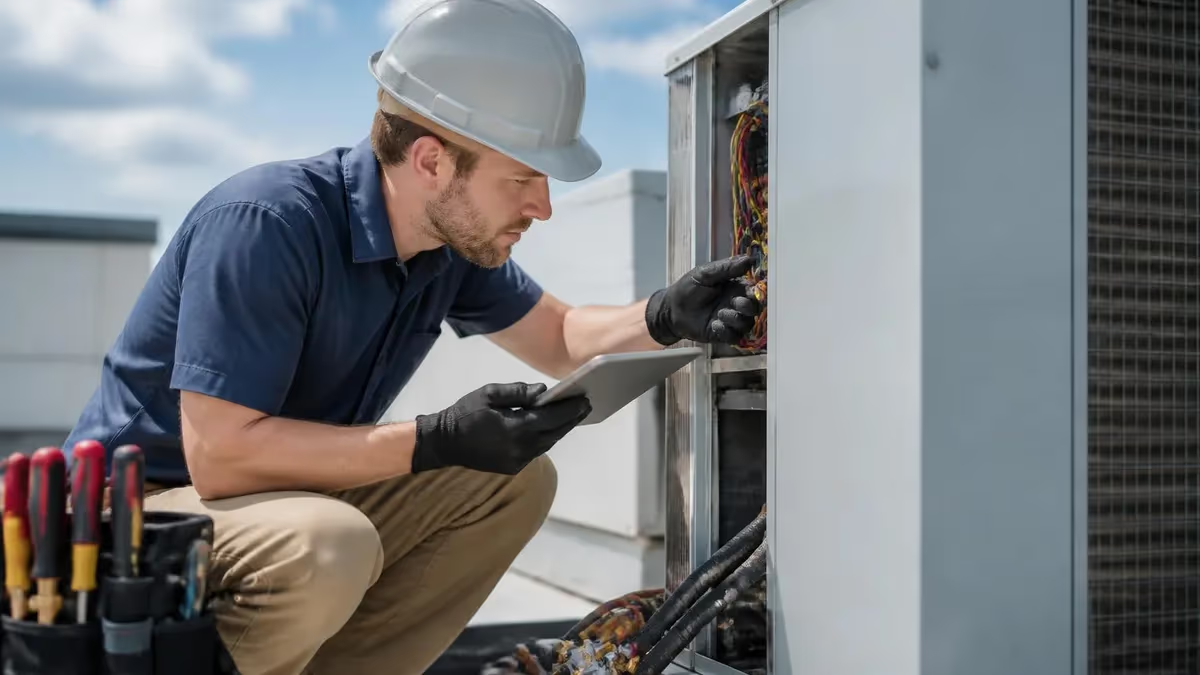
Enrolling in hvac courses is the single most important step you can take toward building a stable, well-paying career in the heating, ventilation, and air conditioning industry. The U.S. Bureau of Labor Statistics projects HVAC technician employment will grow 9 percent through 2033, faster than the national average for all occupations, which means qualified technicians are in high demand right now. Whether you are a recent high school graduate or someone making a mid-career change, understanding what courses are available, what they cover, and how they fit into licensing requirements will help you make a confident decision about your education. Practice with the free HVAC practice test on PracticeTestGeeks (35 questions with answer explanations).
HVAC training programs exist at multiple levels, from short certificate courses that last a few months to full two-year associate degree programs at community colleges. Each path has its own cost structure, time commitment, and payoff in terms of the jobs and licenses it unlocks. Choosing the right program requires you to weigh your budget, your timeline, and whether you want classroom instruction, hands-on lab work, or a blend of both. Many students also combine coursework with a registered apprenticeship, earning a paycheck while they learn on the job under the supervision of a licensed journeyman.
The core subject matter in any credible HVAC program will include refrigeration principles, electrical theory, sheet metal and ductwork fabrication, system installation and service, load calculations, and energy codes. Advanced courses may cover commercial refrigeration, building automation systems, or green energy certifications like LEED and NATE. The depth and breadth of what you study directly affects which EPA, state, and industry certifications you qualify for upon completion, so it pays to review a program's curriculum carefully before enrolling.
Costs for HVAC courses vary considerably. A trade school certificate program might cost between $1,200 and $15,000 depending on the institution and location, while a community college associate degree typically runs $3,000 to $20,000 for the full two-year program. Many states offer workforce development grants, Pell Grants apply to accredited programs, and some employers will reimburse tuition if you commit to working for them after graduation. Online HVAC theory courses have also expanded access, though hands-on lab hours are non-negotiable for most licensing boards.
Before you sign up anywhere, verify that the program is accredited by HVACR Excellence, PAHRA, or NCCER, and check whether the curriculum satisfies the hour requirements your state sets for contractor licensing. Some states require 2,000 or more field hours in addition to classroom credits, so knowing those rules upfront prevents costly surprises. If you are already considering related aspects of the trade, exploring hvac courses that focus on sales and customer communication can add significant earning potential once you are licensed.
Instructor quality and equipment matter as much as accreditation. The best programs feature working trainers who have current field experience, fully equipped labs with real split systems, furnaces, boilers, and refrigeration rigs, and relationships with local contractors who hire graduates. Ask schools about job placement rates and the names of employers who recruit from their programs. A school that cannot answer these questions confidently is a red flag worth heeding.
This guide walks you through everything you need to know about HVAC courses in the United States: the types of programs available, what each one costs, how to choose the right credential for your goals, what to expect in the classroom and the lab, and how to use practice tests to maximize your chances of passing licensing exams on the first attempt. By the end, you will have a clear roadmap for turning your interest in HVAC into a certified, job-ready skill set.
Free HVAC Study Tools
Interactive HVAC resources on PracticeTestGeeks, free to start:
- HVAC EPA 608 Refrigerant Certification — 35 questions with instant scoring and answer explanations
- HVAC flashcards — review key terms and concepts card by card
- HVAC study guide — topic-by-topic overview of what the exam covers
- HVAC cheat sheet — one-page printable summary for last-minute review
HVAC Training by the Numbers
Types of HVAC Training Programs
Typically 6 to 12 months at a trade school or vocational center. Covers core refrigeration, electrical, and installation skills. Fastest path to entry-level employment and often the most affordable option for career changers.
Two-year programs at community colleges that combine HVAC coursework with general education requirements. Graduates gain a broader technical foundation and are eligible for higher-level roles and some management tracks.
Registered apprenticeships through unions like UA or SMART run 4 to 5 years. Apprentices earn wages from day one while completing required classroom hours. Completion typically leads to journeyman status.
Theory-based modules delivered online, combined with in-person lab sessions. Ideal for working adults. Accredited hybrid programs satisfy most state hour requirements when paired with approved lab facilities.
Short courses offered by brands like Carrier, Trane, or Lennox covering specific equipment. Usually 1 to 5 days. Excellent for technicians seeking product certifications or continuing education credits.
Once you understand the program types available, the next step is examining exactly what content each HVAC course category covers and how that knowledge translates into real field skills. A well-structured certificate program will open with fundamentals: thermodynamics, heat transfer, psychrometrics, and the refrigeration cycle. These concepts underpin every piece of HVAC equipment you will ever work on, and instructors who rush past them do their students a disservice. Expect to spend at least three to four weeks on thermodynamics alone in a quality program, using diagrams, pressure-enthalpy charts, and lab work with actual refrigerants to cement your understanding.
Electrical coursework is the second pillar of HVAC education and often the subject students fear most. You will study Ohm's law, series and parallel circuits, transformers, contactors, capacitors, and motor controls. The best programs include wiring labs where students read schematic diagrams and trace live circuits in a controlled environment. This hands-on practice is essential because electrical faults account for a significant proportion of field service calls, and a technician who cannot read a wiring diagram confidently is at a serious disadvantage when diagnosing a failed control board or a tripped high-pressure switch.
Refrigeration systems form the third core module. You will learn how split systems, heat pumps, packaged units, and chillers work, how to braze copper tubing, how to perform a proper evacuation, and how to charge a system to manufacturer specifications using superheat and subcooling measurements. EPA Section 608 certification is the gateway credential in this area, and most schools schedule the 608 exam near the end of the refrigeration module so students can test while the material is fresh. Passing Section 608 is mandatory before you can legally purchase or handle regulated refrigerants.
Ductwork and air distribution represent a fourth major subject area. You will study duct sizing using Manual D, sheet metal fabrication techniques, fitting selection, and balancing methods. Lab exercises typically involve cutting and connecting duct sections, installing register boots, and sealing joints with mastic. This module feeds directly into residential installation work, where improper duct design can cause comfort complaints, humidity problems, and energy waste that no amount of equipment upgrading can fix. Understanding Manual J load calculations is closely related and often taught in the same module.
Advanced programs add modules on commercial refrigeration, building automation and controls, hydronics, combustion analysis, and energy efficiency measures. These topics matter for technicians who want to service larger commercial or industrial systems, and they align with specialty certifications from NATE, RSES, and ASHRAE. A technician holding a NATE certification in commercial refrigeration or building automation will command significantly higher hourly rates than one whose training stopped at basic residential systems, so the extra coursework has a clear return on investment.
Safety training is woven throughout every module rather than siloed into a single unit in reputable programs. You will cover EPA regulations, OSHA 10 or 30 requirements, proper refrigerant handling and recovery procedures, ladder safety, electrical lockout/tagout procedures, and hazard communication standards. Some state licensing boards require documented OSHA 10 or 30 hours, so confirm what your target state mandates and choose a program that delivers it. Safety violations are one of the leading causes of license suspension, so treating safety as a core competency from day one is not optional.
The final module in most programs addresses professional skills: customer communication, service writing, parts ordering, and basic business practices. Technicians who can explain a repair clearly, present options honestly, and write a legible service ticket are more valuable to employers and earn better tips. If you are considering the commercial side of the trade, understanding invoicing, maintenance agreements, and service contracts will serve you well, and some programs offer elective coursework that ties directly into topics covered in resources like the complete guide to selling heating and cooling systems.
HVAC Practice Test Questions
Prepare for the HVAC - Heating Ventilation and Air Conditioning exam with our free practice test modules. Each quiz covers key topics to help you pass on your first try.
HVAC Air Conditioning
HVAC Exam Questions covering Air Conditioning. Master HVAC Test concepts for certification prep.
HVAC Code Compliance
Free HVAC Practice Test featuring Code Compliance. Improve your HVAC Exam score with mock test prep.
HVAC Electrical Controls
HVAC Test Prep for Electrical Controls. Practice HVAC Quiz questions and boost your score.
HVAC Energy Efficiency
HVAC Questions and Answers on Energy Efficiency. Free HVAC practice for exam readiness.
HVAC Heating Systems
HVAC Mock Test covering Heating Systems. Online HVAC Test practice with instant feedback.
HVAC Load Calculations
Free HVAC Quiz on HVAC Load Calculations. HVAC Exam prep questions with detailed explanations.
HVAC Tools and Equipment
HVAC Practice Questions for HVAC Tools and Equipment. Build confidence for your HVAC certification exam.
HVAC Refrigeration
HVAC Test Online for Refrigeration. Free practice with instant results and feedback.
HVAC Safety Practices
HVAC Study Material on Safety Practices. Prepare effectively with real exam-style questions.
HVAC System Design
Free HVAC Test covering System Design. Practice and track your HVAC exam readiness.
HVAC Thermodynamics
HVAC Exam Questions covering Thermodynamics. Master HVAC Test concepts for certification prep.
HVAC Course Costs, Schedules, and Financial Aid
Certificate programs at private trade schools typically cost between $5,000 and $15,000 for the full program, including textbooks and lab fees. Community college associate degrees usually run $3,000 to $20,000 depending on in-state versus out-of-state tuition. Employer-sponsored or union apprenticeships often carry little to no direct cost to the apprentice, since tuition is funded through joint apprenticeship training committees supported by employer contributions.
Hidden costs catch many students off guard. Budget for EPA Section 608 exam fees ($20–$60), NATE exam fees ($100–$200 per specialty), required hand tools ($300–$800), steel-toed boots, and safety glasses. Some programs require students to purchase a digital manifold gauge set or a refrigerant scale before lab work begins. Adding these items to your total program cost gives you a more accurate picture of what you will spend before your first paycheck arrives.
Trade School Certificate vs. Community College Associate Degree
- +Certificate programs complete in 6–12 months, getting you to work faster
- +Lower total tuition cost compared to a two-year associate degree
- +Curriculum is tightly focused on hands-on HVAC skills with minimal general education
- +Many trade schools have direct hiring pipelines with local contractors
- +Flexible schedules including evenings and weekends at most campuses
- +Faster path to EPA Section 608 certification and first job income
- −Associate degree programs build broader technical and academic foundations
- −Some commercial and industrial employers prefer or require a two-year degree
- −Certificate alone may not satisfy all state contractor license hour requirements
- −Private trade school tuition can exceed community college costs significantly
- −Associate degree graduates are better positioned for supervisory roles
- −Two-year programs include business, math, and communication courses that improve long-term career mobility
Pros and Cons at a Glance
| Pros | Cons |
|---|---|
| Lower total tuition cost compared to a two-year associate degree | Associate degree programs build broader technical and academic foundations |
| Curriculum is tightly focused on hands-on HVAC skills with minimal general education | Some commercial and industrial employers prefer or require a two-year degree |
| Many trade schools have direct hiring pipelines with local contractors | Certificate alone may not satisfy all state contractor license hour requirements |
| Flexible schedules including evenings and weekends at most campuses | Private trade school tuition can exceed community college costs significantly |
How to Choose the Right HVAC Program
- ✓Verify the program is accredited by HVACR Excellence, NCCER, or PAHRA before applying.
- ✓Confirm the curriculum covers EPA Section 608 preparation and includes a proctored exam.
- ✓Ask about lab equipment — programs should have working split systems, furnaces, and refrigeration rigs.
- ✓Check that instructor credentials include current or recent field experience, not just academic backgrounds.
- ✓Request the graduate job placement rate and a list of employers who hire from the program.
- ✓Confirm classroom and lab hours satisfy your state's contractor license requirements.
- ✓Inquire whether the program includes OSHA 10 or OSHA 30 certification hours.
- ✓Compare total program costs including tools, uniforms, textbooks, and exam registration fees.
- ✓Look for programs that offer evening or hybrid scheduling if you need to work during training.
- ✓Ask whether financial aid, Pell Grants, or employer tuition reimbursement programs are available.
Accreditation Is Non-Negotiable
Graduating from a non-accredited HVAC program can disqualify you from sitting for state licensing exams and may make it impossible to use federal financial aid. Always verify accreditation status with the accrediting body directly — school websites are not always up to date, and a wasted tuition payment at an unaccredited school can set your career back by a full year.
After completing HVAC courses, most technicians pursue one or more certifications that validate their skills to employers and licensing boards. The most universally required credential is EPA Section 608, which covers refrigerant handling and is mandated by federal law for anyone who purchases, recovers, or works with regulated refrigerants.
The Section 608 exam is divided into four sections — Core, Type I (small appliances), Type II (high-pressure systems), and Type III (low-pressure systems) — and passing all four earns a Universal certification that covers every equipment category. Study for the Core and the Type most relevant to your specialization first, since many entry-level jobs require at minimum a Type II or Universal before they will let a new hire work unsupervised.
NATE, the North American Technician Excellence organization, administers the most widely respected voluntary certifications in the HVAC industry. NATE exams are available in residential air conditioning, residential heating, light commercial, commercial refrigeration, building automation, and several other specialties.
Employers increasingly list NATE certification as a preferred or required qualification in job postings, and certified technicians consistently report higher hourly wages than non-certified peers doing similar work. The exams are challenging — drawing on deep knowledge of system diagnostics, load calculations, and manufacturer specifications — and structured preparation using practice tests is the most reliable way to pass on the first attempt.
State contractor licensing is a separate requirement from industry certifications and varies enormously by state. Florida, for example, requires licensed HVAC contractors to pass a state-specific exam covering trade knowledge, business and finance, and Florida Building Code provisions. Texas does not have a statewide HVAC contractor license for mechanics but does require registration and in some cases licensing at the local municipality level.
California requires technicians to pass the C-20 HVAC exam administered by the Contractors State License Board. Understanding your state's specific pathway before you choose a program ensures your coursework and accumulated hours will count toward the license you actually need.
The RSES (Refrigerating Engineers and Service Technicians Society) offers a Certified Member program that focuses on refrigeration systems and is highly regarded in the commercial refrigeration sector. The ASHRAE Certified HVAC Designer credential targets engineers and designers rather than technicians but is relevant for those who move into design roles after gaining field experience. The Building Performance Institute (BPI) offers certifications in building analyst and envelope professional categories that complement HVAC skills for technicians pursuing energy auditing or weatherization work under utility rebate programs.
Continuing education is required to maintain most certifications and state licenses. NATE requires certified technicians to earn 16 hours of approved continuing education every two years, and most state licensing boards impose similar requirements. Manufacturers frequently offer approved continuing education through training centers and online portals, often at no cost to technicians who work with their equipment.
Staying current with continuing education also means staying current with new refrigerant regulations — the ongoing phase-down of R-410A and the transition to lower-GWP alternatives like R-32 and R-454B is reshaping refrigerant handling requirements, and technicians who understand the new rules will be far better positioned in the market than those who do not.
Specialty certifications increasingly differentiate top earners from average earners in the HVAC field. Technicians who hold NATE certifications in multiple specialties, a NATE Senior Efficiency Analyst credential, or an ASHRAE certification can realistically earn $80,000 to $100,000 per year or more in high-demand markets. Pairing technical credentials with soft skills training in customer service, sales, and building science creates a profile that service companies and mechanical contractors specifically recruit for when filling lead technician and service manager roles.
For technicians working toward their own contracting business, many states require both technical licensing and a separate business license. Some states also require proof of general liability insurance, workers' compensation coverage, and bonding before issuing a contractor license. Planning ahead for these requirements during your coursework phase — rather than discovering them when you are ready to pull your first permit — saves time and money. Your state's contractor licensing board website is the authoritative source for current requirements, and most boards provide a candidate handbook that spells out exactly what education, experience, and exam scores you need.

It is a federal violation under 40 CFR Part 82 to knowingly vent regulated refrigerants during service, maintenance, or disposal of HVAC equipment. Technicians who purchase refrigerants without a valid Section 608 certification risk fines of up to $44,539 per day per violation. Ensure your HVAC program includes structured 608 exam preparation and schedules the proctored exam before you complete your coursework so you are fully legal before your first field assignment.
Passing certification and licensing exams requires a dedicated study strategy that goes well beyond simply reviewing classroom notes. The most common reason HVAC students fail exams on the first attempt is overconfidence — they understand the concepts from lab work but underestimate how differently questions are phrased on a standardized exam compared to a classroom quiz. Exam questions are designed to test application and diagnostic reasoning, not just recall, which means you need to practice answering scenario-based questions under timed conditions if you want to perform well on test day.
The most effective study sequence for the EPA Section 608 Core exam begins with the refrigerant management regulations themselves — read 40 CFR Part 82, Subpart F, in full at least once, because exam questions are drawn directly from the regulatory text. Next, work through ESCO Institute or AHRI study materials systematically, paying close attention to the sections on recovery equipment, leak detection, and approved refrigerant disposal methods.
Then shift to practice exams and attempt at least 200 to 300 practice questions across all four exam sections before your scheduled test date. Track which question categories you miss most often and return to the source material for those areas.
For NATE exams, the recommended preparation timeline is six to eight weeks of focused study for each specialty area. NATE publishes detailed candidate study guides that list every knowledge domain covered on each exam, and working through those guides systematically ensures you do not miss an entire topic category.
Many experienced technicians find that their weakest areas are load calculations and psychrometrics rather than the hands-on skills they use daily, so do not skip those modules in your prep even if they feel abstract. Practice test platforms that simulate the NATE exam format and question difficulty are among the highest-value study tools available for this purpose.
State licensing exam preparation requires adding jurisdiction-specific knowledge on top of the trade knowledge exams. Florida's HVAC exam, for example, includes a full section on business and finance that covers contract law, lien rights, insurance requirements, and OSHA compliance from a contractor perspective. California's C-20 exam emphasizes California-specific energy codes and Title 24 requirements that are more stringent than federal minimums. Buying a state-specific exam prep book and taking state-specific practice tests is essential for these exams — generic HVAC study materials will not cover the local code provisions that account for 20 to 30 percent of state exam questions.
Time management during the exam itself is a skill that practice tests help you develop. The NATE exams allow approximately one minute per question, and the EPA 608 Universal exam must be completed in a specified window. Students who spend too long on difficult questions often run out of time before reaching questions they could answer easily. Practice under timed conditions consistently in the weeks before your exam so that pacing becomes automatic and you can flag difficult questions, move on, and return to them at the end without losing composure or burning through your allotted time.
Study groups and peer accountability are underrated tools for HVAC exam preparation. Finding two or three classmates who are also preparing for the same exam and scheduling weekly review sessions creates a low-stakes environment to ask questions, explain concepts to each other, and identify gaps in understanding before they become problems on exam day. Teaching a concept to someone else is one of the fastest ways to find out whether you actually understand it or just think you do, and the accountability of a scheduled group session keeps preparation consistent across the weeks leading up to the test.
One of the most practical ways to prepare is to use free and paid practice test platforms that mirror the actual exam format. PracticeTestGeeks offers practice quizzes covering air conditioning systems, code compliance, ductwork, electrical controls, energy efficiency, and heating systems — all of the domains that appear on real HVAC licensing and certification exams.
Working through these quizzes regularly builds the pattern recognition and question-reading discipline that separates candidates who pass on their first attempt from those who need to retest. Visit the full set of practice resources to identify your weakest areas and focus your remaining study time where it will have the greatest impact.
Building a long-term HVAC career after completing your initial coursework requires ongoing investment in skills, relationships, and business knowledge. The technicians who reach the top of the pay scale in this trade share several habits: they pursue new certifications proactively, they develop strong diagnostic skills by studying failure patterns rather than just fixing symptoms, and they treat every customer interaction as an opportunity to build a reputation. In a service business, referrals and repeat customers are the lifeblood of a full schedule, and those come from technicians who communicate clearly, show up on time, and explain repairs without condescension.
Specialization is one of the most reliable ways to increase earnings after your initial licensing. Commercial refrigeration, chiller service, building automation systems, and controls are all areas where qualified technicians are genuinely scarce and employers will pay premium rates. Moving from residential service into light commercial and then full commercial work typically requires additional coursework, time, and certifications, but the wage gap is substantial. A residential service technician in a mid-sized U.S. market might earn $55,000 to $70,000 per year while a chiller technician or BAS specialist in the same market earns $85,000 to $110,000 or more.
Starting your own HVAC contracting business is a path many experienced technicians consider after accumulating five to ten years of field experience and obtaining their contractor's license. The barrier to entry is manageable — a service van, a basic tool inventory, liability insurance, and a contractor license are the core requirements — but running a business sustainably demands skills that go far beyond technical competence.
Accounting, job costing, employee management, marketing, and customer retention all require attention from day one. Business development courses, SCORE mentorship, and small business administration resources can bridge the gap between excellent technician and viable business owner.
The refrigerant transition underway in the HVAC industry will significantly shape career opportunities over the next decade. The phase-down of R-410A under the AIM Act and the introduction of A2L mildly flammable refrigerants like R-32, R-454B, and R-466A require technicians to update their knowledge of flammability classifications, safe handling procedures, and recovery equipment compatibility.
Schools that are already incorporating A2L training into their curricula are giving students a head start on this transition, and technicians who become early experts in A2L systems will be sought after by manufacturers, distributors, and service companies as the industry completes its shift over the next several years.
Energy efficiency and green building skills represent another growth area for HVAC professionals. Utility rebate programs, federal tax credits under the Inflation Reduction Act, and state energy codes are all pushing homeowners and building owners toward higher-efficiency equipment and tighter building envelopes. HVAC technicians who understand Manual J load calculations, ACCA quality installation standards, and energy auditing principles are positioned to offer services that competitors without this training simply cannot. BPI building analyst certification is a logical complement to HVAC licensing for technicians who want to enter this space.
Mentorship, both receiving it and providing it, accelerates career development at every stage. New technicians who attach themselves to experienced mentors learn diagnostic shortcuts and professional habits in months rather than years. Experienced technicians who mentor apprentices reinforce their own knowledge, develop leadership skills, and often find that teaching identifies gaps in their own understanding that they had not previously recognized.
Formal mentorship programs through ACCA, ASHRAE, or local mechanical contractors associations are worth joining early in your career, and the relationships you build through these networks frequently produce job opportunities, business referrals, and career advancement that would not have materialized otherwise.
The HVAC industry is not standing still, and neither should you after finishing your initial coursework. Smart home integration, variable refrigerant flow systems, geothermal heat pumps, and dedicated outdoor air systems are all segments growing faster than the general HVAC market, each requiring specialized knowledge that separates technicians who command premium rates from those competing solely on price. Committing to continuous learning — through manufacturer training, industry conferences like AHR Expo, online course platforms, and practice exam tools that keep your technical knowledge sharp — is the single habit that distinguishes top earners in this trade across a full career.
Sample HVAC Practice Questions
Try these questions from our free HVAC practice tests. The correct answer and an explanation follow each question.
Which ASHRAE standard covers residential ventilation requirements, including whole-house mechanical ventilation?
- A. ASHRAE 62.1
- B. ASHRAE 62.2
- C. ASHRAE 90.2
- D. ASHRAE 55
Answer: B. ASHRAE 62.2
ASHRAE 62.2 specifically addresses ventilation and IAQ requirements for low-rise residential buildings, including whole-building and local exhaust strategies.
Which ASHRAE standard governs energy efficiency requirements for commercial building HVAC systems in the US?
- A. ASHRAE 15
- B. ASHRAE 62.1
- C. ASHRAE 90.1
- D. ASHRAE 55
Answer: C. ASHRAE 90.1
ASHRAE 90.1 (Energy Standard for Buildings Except Low-Rise Residential) sets minimum energy efficiency requirements for HVAC, lighting, and envelope in commercial buildings.
Which document typically outlines the compliance requirements for HVAC professionals?
- A. Employee handbook
- B. Marketing brochure
- C. Standards of practice and code of conduct
- D. Annual financial report
Answer: C. Standards of practice and code of conduct
Standards of practice and codes of conduct define the professional and ethical requirements practitioners must follow.
Under the International Mechanical Code, what ventilation requirement applies to a commercial kitchen exhaust hood?
- A. Exhaust must equal supply air volume
- B. Makeup air must be provided at 80-100% of exhaust volume
- C. No makeup air is required if exhaust is under 1,000 CFM
- D. Makeup air must be heated to room temperature before introduction
Answer: B. Makeup air must be provided at 80-100% of exhaust volume
The IMC requires that makeup air be provided at approximately 80 to 100 percent of the exhaust volume to maintain proper pressure balance in commercial kitchens.
HVAC Questions and Answers
HVAC Sales: The Complete Guide to Selling Heating and Cooling Systems, Building Customer Trust, and Closing More Deals

HVAC Air Duct Sealing: The Complete Homeowner and Contractor Guide to Sealing Ductwork for Efficiency, Comfort, and Indoor Air Quality
HVAC Solutions: The Complete Guide to Heating, Cooling, and Indoor Air Quality Systems for Homes and Buildings

Commercial HVAC Repair: Systems, Costs, and Service Strategies
HVAC Apprenticeship Programs: Your Complete Guide to Starting a Hands-On Career in Heating, Ventilation, and Air Conditioning
How this page was made: written with AI tools. We have not yet matched this exam's facts to an official source, so confirm fees, dates and rules with the exam body. Not reviewed by a subject-matter expert. Editorial policy