
Commercial HVAC Repair: Systems, Costs, and Service Strategies 2026 October
❓ Commercial HVAC repair guide: rooftop units, chillers, VAV systems, common problems, costs, contractor selection, and preventive maintenance.

Commercial HVAC repair differs substantially from residential HVAC service in scale, complexity, and consequences. Where residential systems typically have one furnace and one air conditioner serving a single dwelling, commercial buildings often have multiple rooftop units, complex chiller plants, variable air volume (VAV) systems, sophisticated control networks, and dedicated specialty equipment serving server rooms, kitchens, manufacturing processes, or laboratories. Commercial HVAC failures don't just inconvenience occupants — they can shut down businesses, damage products, and create legal liability when conditions become unacceptable for tenants, employees, or customers.
The economics of commercial HVAC repair reflect this complexity. Service rates for commercial work typically run $100-$200 per hour, with emergency service substantially higher. Major repairs to commercial equipment often run thousands to tens of thousands of dollars. Comprehensive equipment replacement in larger buildings can reach hundreds of thousands or millions of dollars. Building owners typically negotiate service contracts with HVAC companies that include preventive maintenance, priority response for emergencies, and discounted repair rates. Strategic management of commercial HVAC affects building operating costs, occupant comfort, and tenant retention.
Commercial HVAC Quick Facts
Service rates: $100-$200/hour standard; emergency rates 1.5-3x. Major repair costs: Compressor replacement $5,000-$50,000+; chiller repair $5,000-$200,000+; rooftop unit $8,000-$30,000+. Service contracts: Annual costs typically 1-3% of equipment value. Equipment lifespan: 15-25 years typical with proper maintenance. Common units: Rooftop units (RTUs), chillers, packaged units, VAV systems, split systems.
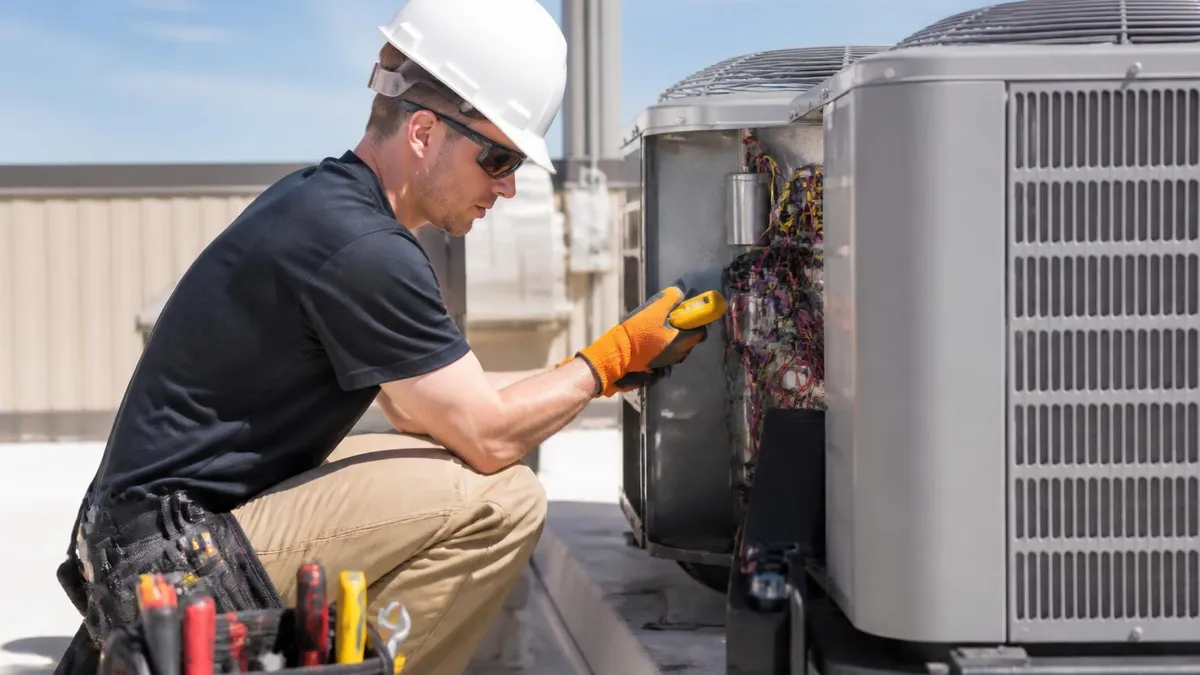
Rooftop units (RTUs) are the most common commercial HVAC equipment, serving small to medium commercial buildings (retail, restaurants, small offices, churches). Each RTU contains a complete heating and cooling system in a single package mounted on the building roof, with ductwork distributing conditioned air below.
RTU sizes range from 3-tons (small retail) to 50+ tons (larger buildings). Failures in RTUs commonly involve compressor problems, condenser fan issues, evaporator coil problems, ignition controls (gas heating), refrigerant leaks, and control system failures. Repair complexity depends on specific failure type — some repairs take hours, others days. RTU manufacturers include Carrier, Trane, York, Lennox, AAON, Daikin, and many others.
Common Commercial HVAC Equipment
All-in-one packaged systems on building roofs. Small to mid-size buildings. Most common commercial HVAC.
Outdoor units producing chilled water for distribution. Mid to large buildings. Common in commercial offices and institutions.
More efficient than air-cooled but require cooling towers. Large commercial and industrial applications.
Variable air volume distribution. Multi-zone control through VAV boxes regulating airflow per zone.
Large indoor air handlers in mechanical rooms serving distribution systems. Various sizes for different applications.
Smaller all-in-one units for specific applications — kitchens, garages, mechanical rooms. Self-contained heating/cooling.
Chiller systems serve larger commercial buildings — typically 100+ tons cooling capacity. Air-cooled chillers reject heat to outdoor air through condenser coils with fans; water-cooled chillers reject heat to cooling towers using water as intermediate medium. Water-cooled systems are more efficient but require additional infrastructure (cooling towers, water treatment, pumps, piping). Chiller types include screw chillers (mid-size), centrifugal chillers (large), and absorption chillers (using waste heat instead of electricity). Major repairs to chillers — compressor failures, refrigerant leaks, control system replacements — can cost tens to hundreds of thousands of dollars and require specialized technicians with chiller experience.
VAV (Variable Air Volume) systems represent the most common multi-zone commercial HVAC architecture. A central air handler produces conditioned air at constant temperature; VAV boxes throughout the building modulate airflow to each zone based on individual zone thermostat demand.
This approach efficiently serves buildings with diverse heating and cooling needs across different zones (north-facing offices need cooling while south-facing offices need heating, for example). VAV system complexity comes from the integration of central equipment, distribution, VAV boxes, control systems, and zone-level controls. Repairs may involve any layer of this stack, requiring technicians who understand the complete system rather than just individual components.
Building automation systems (BAS) — sometimes called energy management systems (EMS) or building management systems (BMS) — control commercial HVAC operation through networked digital controls. These systems schedule equipment operation, control setpoints, monitor performance, generate alarms for problems, and coordinate complex sequences. Major BAS manufacturers include Johnson Controls, Siemens, Honeywell, Schneider Electric, and others. Repair work involving BAS often combines mechanical HVAC issues with software/networking issues, requiring technicians cross-trained in both. Some BAS issues are purely software (programming errors, network problems) requiring specialized controls technicians rather than general HVAC mechanics.
Frequent commercial HVAC repairs: Compressor replacement (RTUs and chillers): expensive but routine for older equipment. Capacitor and contactor replacement: relatively inexpensive electrical repairs. Refrigerant leak repair and recharge: ongoing issue particularly in older systems. Control board failures: common in modern equipment. Belt and motor replacement on air handlers and fans: routine wear items. Coil cleaning and corrosion repair: maintenance issue affecting performance. Each repair has different cost and complexity.
Commercial HVAC service contracts are valuable both for cost predictability and for relationship continuity with qualified contractors. Buildings without service contracts call various contractors as problems arise, with no consistent technician knowledge of building systems. Buildings with established contracts benefit from contractor familiarity with the specific equipment, control systems, and operational patterns — diagnosis and repair happen faster when the contractor already knows the building.
Contract structures vary substantially: full coverage contracts cover all repairs and maintenance for fixed annual price; preventive maintenance contracts cover only scheduled inspections with separate repair charges; hybrid contracts combine PM with discounted repair rates and priority response.
Selecting commercial HVAC contractors requires careful evaluation beyond just price. Look for contractors with specific experience in your equipment types — chiller specialists for chiller plants, VAV system experience for buildings using VAV, BAS expertise if your building has automated controls. Verify state licensing for HVAC and refrigeration work. Confirm insurance coverage including general liability and workers compensation. Check Better Business Bureau ratings and recent customer references. Visit their facility if possible — well-organized shops with qualified technicians produce better service than disorganized operations. Ask specific questions about their approach to your equipment and operational requirements.
Cost predictability for commercial HVAC depends on systematic management. Annual budget should include preventive maintenance costs (1-3% of equipment value typical), expected repair costs (more variable but typically 0.5-2% of equipment value annually), and reserve funds for major equipment failures or replacement. Equipment lifespan tracking helps predict when major capital expenses will arrive — a 20-year-old chiller will likely need replacement within 5 years; budget accordingly. Energy costs for HVAC operation often exceed maintenance and repair costs — efficient operation through proper maintenance and operations minimizes total HVAC ownership costs over equipment lifecycle.
Don't accept estimates without scope details — commercial repairs vary 2-5x based on what's actually included. Don't sign service contracts without comparing alternatives — annual costs vary substantially across qualified contractors. Don't defer maintenance to save money — deferred maintenance produces premature failures that cost more than maintenance would have. Don't wait for failures to plan replacements — capital planning for major equipment replacement provides time for budgeting and competitive bidding.
Energy efficiency considerations for commercial HVAC affect operating costs substantially. Commercial buildings typically spend 30-40% of total energy budget on HVAC systems. Older equipment consumes substantially more energy than modern equipment for same comfort level — efficiency improvements over recent decades have dramatically reduced energy use of new equipment compared to equipment installed 20-30 years ago. Replacement decisions should consider not just current condition but operating cost of older equipment versus modern alternatives. Sometimes equipment that's still functional gets replaced for energy efficiency reasons, with operating cost savings paying back replacement investment over several years.
Refrigerant transitions affect commercial HVAC repair planning. R-22 (Freon) has been phased out of new equipment manufacturing since 2010 and now costs over $100/pound when available — repair costs on R-22 systems are increasingly prohibitive, often pushing replacement decisions earlier than anticipated. R-410A is the current dominant refrigerant in commercial systems but is being replaced by lower-global-warming-potential alternatives like R-32, R-454B, and R-1234ze. Equipment using newer refrigerants enters the market gradually, and repair work in coming years will involve increasing variety of refrigerants. Planning for these transitions affects capital planning and replacement strategies.
Indoor air quality (IAQ) increasingly drives commercial HVAC decisions. The COVID-19 pandemic raised awareness of how HVAC systems affect airborne disease transmission. Modern commercial HVAC includes attention to ventilation rates, filtration quality (high-MERV filters or HEPA), humidity control, and sometimes UV sterilization or other air quality enhancements. Building owners and tenants increasingly consider IAQ alongside basic thermal comfort. ASHRAE standards for acceptable IAQ provide guidance, and some local codes increasingly mandate specific IAQ measures. Commercial HVAC repair and replacement decisions now routinely include IAQ considerations beyond basic temperature control.
Commercial HVAC Management Best Practices
- ✓Maintain inventory of all HVAC equipment with model numbers and ages
- ✓Establish service contract with qualified contractor
- ✓Schedule preventive maintenance per manufacturer recommendations
- ✓Document all repairs and service in equipment records
- ✓Plan capital replacement for equipment approaching end of life
- ✓Monitor energy bills for unexplained increases suggesting equipment degradation
- ✓Maintain spare parts inventory for critical components
- ✓Review service contract performance annually
Equipment lifespan in commercial HVAC varies by equipment type and operating conditions. Rooftop units typically last 15-20 years with reasonable maintenance, sometimes longer with excellent maintenance. Chillers often last 20-25 years or longer due to heavy-duty construction. Air handlers can last 30 years or more with appropriate maintenance. Cooling towers typically last 15-25 years depending on water treatment quality.
Boilers can exceed 30 years with proper maintenance. Control systems may need updates every 10-15 years even when mechanical equipment continues functioning. Planning replacement timing involves equipment age, condition assessment, energy efficiency considerations, and operational reliability rather than simply waiting for catastrophic failure.
Capital planning for major HVAC replacements requires multi-year budget allocation. A typical commercial building's HVAC equipment portfolio includes equipment of various ages and types. Rolling replacement plans address equipment over time rather than facing all replacements simultaneously. For example, replacing one of three rooftop units annually over three years smooths capital expenditure compared to all three failing simultaneously. Energy savings from new equipment partially offset costs through reduced operating expenses. Tax incentives for energy-efficient equipment may further offset costs. Working with HVAC contractors and energy consultants on long-term plans optimizes timing and selection.
For owner-occupied commercial buildings, HVAC management is direct expense affecting operations. For leased buildings, HVAC responsibility varies by lease structure. Triple net leases typically pass HVAC costs through to tenants. Gross leases include HVAC in base rent. Building owners and property managers handle complete HVAC management in some lease types; tenants handle their own equipment in others. Understanding lease structure determines who pays for what HVAC expenses and who decides about repair versus replacement decisions. Communication between owners, managers, and tenants about HVAC issues affects tenant satisfaction and lease retention substantially.
Specific industry types have specialized HVAC requirements affecting repair decisions. Restaurants need substantial ventilation for kitchen equipment plus comfort cooling for dining areas. Manufacturing facilities may need precise temperature and humidity control for products and processes. Healthcare facilities have strict requirements for air quality, pressure relationships, and ventilation rates with substantial regulatory oversight. Data centers require precision cooling with high redundancy. Laboratories often need fume hoods and specialized exhaust. Each industry's specific requirements affect equipment selection, maintenance approach, and repair priorities differently from generic commercial HVAC.
For commercial HVAC technicians and contractors, this market segment offers strong career opportunities. Skilled commercial HVAC technicians earn substantially more than residential technicians, with experienced specialists earning $80,000-$150,000+ annually depending on location and specialization. Commercial work typically provides more challenging diagnostic work, larger tool inventories, complex equipment exposure, and steady demand. Specialization in chillers, controls, or specific industry types (healthcare, data centers) develops expertise commanding premium wages. Commercial HVAC business ownership represents another path with strong income potential for skilled technicians who develop business management capabilities.
Looking forward, commercial HVAC continues evolving with technology and sustainability pressures. Heat pump adoption is growing rapidly as buildings electrify and reduce natural gas use. Variable refrigerant flow (VRF) systems offer energy-efficient multi-zone capability. High-efficiency rooftop units and chillers continue improving efficiency ratings. Building automation systems become increasingly sophisticated with machine learning and predictive analytics. Integration with smart grid systems enables demand response and time-of-use optimization. Repair work in coming years will increasingly involve newer technology types alongside continued maintenance of traditional equipment that will continue operating for decades to come.
Commercial HVAC Quick Stats
Common Commercial HVAC Problems
Most expensive component to replace. Causes vary from overheat to electrical failure to mechanical wear. Often signals equipment near end of life.
Reduces capacity, requires repair to find and fix leak source plus recharge. Ongoing issue particularly in older systems.
Programming errors, network problems, sensor failures. Often confused with mechanical problems but require different diagnostic approach.
Dirty coils, refrigerant tube leaks, fin damage. Cleaning is preventive maintenance; replacement major repair.
Routine wear items requiring periodic replacement. Belts annually, motors every 5-15 years depending on application.
Condensate drain clogs cause water damage. Pan corrosion creates leaks. Generally manageable with regular maintenance.
Building owner relationships with commercial HVAC contractors develop over time through consistent service. Initial contracts establish baseline performance expectations. Quality contractors deliver on promises, build trust through professionalism, and develop deep familiarity with building systems. Long-term contractor relationships benefit both parties — contractors get steady revenue from satisfied clients, building owners get reliable service from contractors who understand their buildings. Switching contractors disrupts these relationships and creates learning curves for new contractors to understand specific buildings. Choose initial contractors carefully but recognize that established contractor relationships are valuable assets worth maintaining.
Performance metrics for commercial HVAC management include energy consumption per square foot, maintenance costs per square foot, comfort complaint frequency, equipment downtime, and repair vs. replacement decision quality. Tracking these metrics over time reveals whether HVAC management is improving or degrading. Industry benchmarks from organizations like ASHRAE, BOMA, and ENERGY STAR provide comparison data for evaluating your building's performance against similar buildings. Buildings performing significantly worse than benchmarks often have specific addressable issues; buildings performing better than benchmarks demonstrate effective management worth continuing.
Sustainability certifications and reporting increasingly drive commercial HVAC decisions. ENERGY STAR Certification, LEED certification, BOMA 360, and various other building performance certifications often require specific HVAC efficiency standards and ongoing performance documentation. Companies pursuing climate goals and ESG (Environmental, Social, Governance) reporting need accurate energy consumption data including HVAC. Some jurisdictions have building energy disclosure ordinances requiring public reporting of building energy performance, creating reputational stakes for poor-performing buildings. These pressures incentivize HVAC investments in efficient equipment and effective operations beyond pure cost-benefit analysis.
Predictive maintenance using IoT sensors and analytics is emerging as significant trend in commercial HVAC. Connected sensors monitor equipment vibration, temperature, electrical consumption, and operational patterns continuously. Machine learning algorithms identify performance changes suggesting impending failures weeks or months before catastrophic problems occur.
Maintenance work shifts from calendar-based scheduling to condition-based scheduling, addressing problems when they're emerging rather than at fixed intervals or after failure. Major HVAC equipment manufacturers increasingly include connectivity in new equipment, and retrofit sensor packages enable predictive maintenance on existing equipment. The investment is worthwhile for critical equipment in larger buildings; smaller buildings benefit less from the technology overhead.
Workforce challenges affect commercial HVAC service availability and pricing. The industry faces ongoing technician shortages as experienced workers retire faster than new technicians enter the field. Trade education programs produce fewer graduates than industry needs. Specialized expertise in chillers, BAS, and complex systems is particularly scarce. Commercial buildings face longer wait times for service in some markets, premium pricing for emergency or specialty work, and variable service quality.
These challenges drive trends including manufacturer-direct service for major equipment, consolidation of contractor companies, increased automation in routine tasks, and improved wages attracting more workers to the trade. Building owners benefit from establishing strong contractor relationships in good times to maintain service quality during industry stress periods. Long-term partnerships with reliable contractors provide stability that transactional relationships cannot match when service availability becomes constrained across the broader commercial HVAC service marketplace nationwide and especially during seasonal peak demand windows when service capacity is fully booked.
Commercial HVAC Service Contracts: Worth It?
- +Predictable annual cost vs. unpredictable repair expenses
- +Priority response during emergencies
- +Established contractor familiarity with your equipment
- +Preventive maintenance reduces unexpected failures
- +Often discounted repair rates beyond preventive maintenance
- +Equipment performance optimization through regular service
- −Annual cost may exceed actual repair needs in good years
- −Contract terms can be confusing with various coverage levels
- −Lock-in to specific contractor reduces use
- −Quality varies dramatically across contractors
- −Some contracts have exclusions that emerge during major failures
- −Renewal pricing increases over time without comparable competition
Pros and Cons at a Glance
| Pros | Cons |
|---|---|
| Predictable annual cost vs. unpredictable repair expenses | Annual cost may exceed actual repair needs in good years |
| Priority response during emergencies | Contract terms can be confusing with various coverage levels |
| Established contractor familiarity with your equipment | Lock-in to specific contractor reduces use |
| Preventive maintenance reduces unexpected failures | Quality varies dramatically across contractors |
| Often discounted repair rates beyond preventive maintenance | Some contracts have exclusions that emerge during major failures |
| Equipment performance optimization through regular service | Renewal pricing increases over time without comparable competition |
Sample HVAC Practice Questions
Try these questions from our free HVAC practice tests. The correct answer and an explanation follow each question.
What is 'fault detection and diagnostics' (FDD) in commercial HVAC systems?
- A. A manual inspection protocol performed by service technicians quarterly
- B. Automated software algorithms that continuously analyze sensor data from HVAC equipment to identify faults, degraded performance, and equipment failures before they cause major problems
- C. The process of diagnosing refrigerant leaks using electronic leak detectors
- D. A building code requirement for documenting HVAC failures and repairs
Answer: B. Automated software algorithms that continuously analyze sensor data from HVAC equipment to identify faults, degraded performance, and equipment failures before they cause major problems
FDD systems use continuous monitoring of temperature, pressure, flow, and power data from HVAC equipment, comparing actual performance to expected performance models to automatically identify faults and alert operators.
What communication protocol, standardized by ASHRAE, was specifically designed for building automation systems?
- A. Modbus
- B. BACnet
- C. LonWorks
- D. Profibus
Answer: B. BACnet
BACnet (Building Automation and Control Networks) is the ASHRAE standard 135 communication protocol designed specifically for HVAC and building automation interoperability.
Which ASHRAE standard specifically addresses the safety of refrigeration systems and specifies refrigerant classifications like A1, A2L, and B2?
- A. ASHRAE 62.1
- B. ASHRAE 90.1
- C. ASHRAE 34
- D. ASHRAE 15
Answer: C. ASHRAE 34
ASHRAE Standard 34 establishes a refrigerant designation system and safety classification, grouping refrigerants by toxicity (A/B) and flammability (1/2L/2/3).
What type of pipe fitting is used on hydronic systems to allow thermal expansion without stressing the pipe or boiler connections?
- A. Union fitting
- B. Dielectric union
- C. Expansion loop or offset
- D. Slip coupling
Answer: C. Expansion loop or offset
Expansion loops, offsets, or expansion joints are built into hydronic piping runs to absorb the linear expansion of pipes as they heat up, preventing stress on fittings and equipment.
HVAC Questions and Answers
About the Author

NATE Certified HVAC Technician & Licensing Exam Trainer
Universal Technical InstituteMike Johnson is a NATE-certified HVAC technician and EPA 608 universal-certified refrigerant handler with a Bachelor of Science in HVAC/R Technology. He has 19 years of commercial and residential HVAC installation and service experience and specializes in preparing technicians for NATE certification, EPA 608, A2L refrigerant safety, and state HVAC contractor licensing examinations.