
HVAC Service Technician: Career Guide 2026 September
✅ HVAC service technician guide — what they do, training pathways, EPA Section 608, NATE certification, compensation, and career advancement.
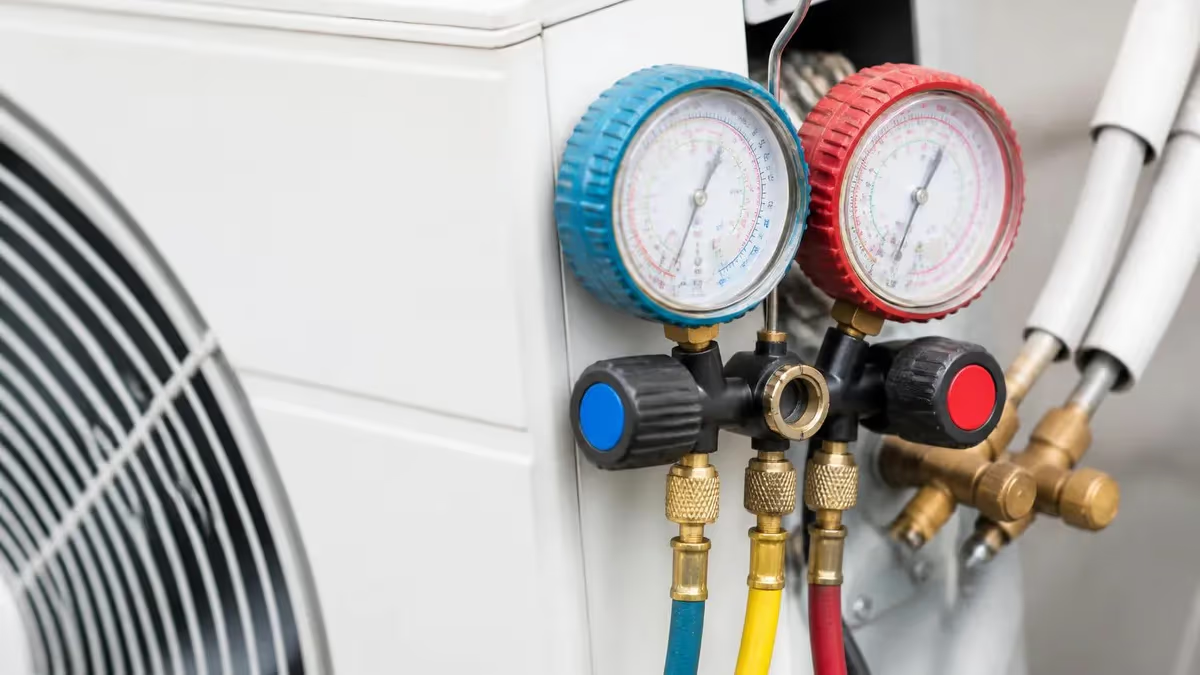
An HVAC service technician is a skilled trades professional who installs, maintains, repairs, and services heating, ventilation, air conditioning, and refrigeration systems in residential, commercial, and industrial settings. The HVAC trade combines mechanical, electrical, and refrigeration knowledge with practical hands-on skills to keep climate control systems operating reliably across the changing seasons. With buildings increasingly dependent on sophisticated HVAC systems for comfort, indoor air quality, and energy efficiency, demand for skilled HVAC service technicians remains strong across most regions of the United States.
This guide walks through what HVAC service technicians actually do, the educational and licensure pathways into the profession, typical compensation, career advancement opportunities, and the working conditions that characterize the trade. Information here applies broadly across the United States with notes where state-specific licensing requirements differ. Whether you're considering HVAC as a career direction, evaluating training programs, or simply curious about the profession that keeps your home comfortable, this overview covers the essentials of the HVAC service technician role across various practice contexts encountered today.
The Bureau of Labor Statistics projects continued strong employment growth for HVAC technicians — approximately 6% growth through 2032 — driven by aging existing systems requiring replacement, new construction adding HVAC infrastructure, increasing focus on energy efficiency requiring system upgrades, and ongoing demand for skilled tradespeople in a profession that cannot be outsourced overseas.
The combination of consistent demand, reasonable compensation, manageable training timeline, and the satisfaction of solving problems through technical work makes HVAC an attractive career path for many people considering skilled trades. The reliable demand and steady earning growth across years of practice provide career stability that many other professions today cannot easily match in modern economic conditions.
HVAC Service Technician Quick Facts
Daily activities: Installation, maintenance, diagnosis, repair of HVAC systems including furnaces, AC units, heat pumps, refrigeration. Education: Trade school (6-24 months), apprenticeship (3-5 years), or associate degree (2 years). Licensure: EPA Section 608 certification required for refrigerant work; state license varies. Median pay: Approximately $51,390 (BLS 2022). Top 10% earn $80,000+. Job growth: 6% through 2032 (faster than average). Settings: Residential service companies, commercial HVAC firms, building maintenance, manufacturing, refrigeration specialty.
The day-to-day work of an HVAC service technician varies by specialization and employer but generally includes a mix of installation, preventive maintenance, diagnostic work, and emergency repair calls. Residential service technicians typically respond to 4-8 service calls daily, traveling between customer homes performing maintenance on AC systems in summer, heating systems in winter, and various year-round work like duct cleaning, indoor air quality assessments, and equipment installations. Commercial technicians often spend longer at single sites working on larger more complex equipment with industrial-scale impact when systems fail.
Diagnostic skill is central to HVAC service work. When customers report system problems, technicians arrive without knowing the specific issue and must systematically work through possibilities. Modern HVAC equipment includes substantial electronic controls, sensors, and communication systems that require both mechanical and electrical troubleshooting. Refrigeration cycle problems involve refrigerant pressures, temperatures, and flow patterns that experienced technicians read like a story. Electrical problems involve voltage testing, circuit analysis, and component-level diagnosis. The combination of skills makes the work intellectually engaging beyond simple parts replacement.

Core HVAC Technician Responsibilities
New construction or replacement: ductwork, equipment placement, refrigerant lines, electrical, controls.
Scheduled service: filter changes, coil cleaning, refrigerant checks, electrical inspection, calibration.
Identifying causes of system problems: mechanical, electrical, refrigerant, control system issues.
Component replacement, refrigerant recovery and recharge, electrical repairs, control system fixes.
Explaining issues to homeowners, providing repair estimates, recommending preventive care.
Service tickets, equipment records, refrigerant tracking (EPA-required for environmental compliance).
The educational pathway to becoming an HVAC service technician offers several routes. Trade school programs typically run 6 to 24 months and cover HVAC fundamentals through hands-on lab work and classroom theory. Programs cost $2,500 to $25,000+ depending on length and institution, with shorter certificate programs costing less than longer associate degree programs. Most programs prepare students to enter entry-level HVAC technician positions. Some lead to associate degrees in HVAC technology that support faster career advancement and may be required for some technical specialty roles.
Apprenticeships provide an alternative path that pays during training. Apprenticeships typically run 3-5 years combining on-the-job training with classroom instruction. Apprentices earn 50-75% of journeyman wages during training, increasing toward full journeyman pay as they progress. Sponsored by union local chapters, employer associations, or individual contractors, apprenticeships provide structured learning alongside immediate income. Graduating apprentices typically earn higher initial pay than trade school graduates because they enter the workforce with substantial documented experience already accumulated.
Some technicians enter the field through community college associate degree programs in HVAC technology. These two-year programs combine general education with HVAC-specific coursework, providing broader educational foundation than certificate programs. Associate degrees support faster advancement to specialty roles, supervisory positions, or eventual ownership of HVAC service businesses. Cost typically runs $4,000-$12,000 over two years depending on whether you attend in-state or out-of-state college, with various financial aid options available to those who qualify based on income or other criteria.
Settings: Single-family homes, residential service companies. Activities: AC tune-ups, furnace repairs, refrigerant work, customer interaction. Schedule: Standard hours plus on-call rotation for emergencies. Travel: Significant — multiple homes per day. Pay: $40,000-$70,000 typical. Pros: Variety, customer relationships. Cons: Driving time, attic/crawl space work in extreme weather.
EPA Section 608 certification is required for any HVAC technician who works with refrigerants, which essentially means everyone in residential and commercial HVAC service. The certification ensures technicians understand refrigerant handling, recovery, and disposal in ways that protect the environment from ozone-depleting and high-global-warming-potential gases. Section 608 has four levels: Type I (small appliances), Type II (high-pressure refrigerants like residential AC), Type III (low-pressure refrigerants like centrifugal chillers), and Universal (covers all types). Most service technicians pursue Universal certification to avoid limitations.
Beyond EPA Section 608, individual states have varying licensing requirements for HVAC technicians and contractors. Some states require state-level technician licensing (e.g., Florida, Texas) while others delegate to local jurisdictions or have minimal state requirements. Contractor licensing (separate from technician licensing) is required in most states for those who run their own HVAC businesses or supervise other technicians. Verify your specific state's requirements through state contractor licensing boards or workforce development agencies before pursuing HVAC employment to ensure you obtain the correct credentials for your career direction.
NATE (North American Technician Excellence) certification provides voluntary credentialing recognized industry-wide as a mark of expert-level skill. NATE certifications are available across multiple specialty areas — air conditioning, heat pumps, gas heating, oil heating, light commercial, and more. While not required for employment, NATE certifications enhance employment prospects, support higher pay, and signal commitment to the profession. Many employers prefer NATE-certified technicians and pay premium rates for them. Pursuing NATE certification typically happens after a few years of working experience rather than during initial training.
EPA Section 608 enforcement is serious — improper refrigerant handling carries significant penalties. Common violations: Venting refrigerant to atmosphere, improper recovery during equipment service, falsified records of refrigerant disposal. Consequences: EPA fines up to $44,539 per violation per day, employer disciplinary action, potential criminal charges for willful violations. Best practice: Always follow proper recovery procedures, maintain accurate refrigerant tracking records, refuse to perform unauthorized refrigerant work even at customer or employer pressure. The certification protects you legally only when you actually follow the procedures.
Compensation for HVAC service technicians varies substantially by region, specialty, and experience level. The Bureau of Labor Statistics reports median annual pay of approximately $51,390 (2022) for HVAC mechanics and installers. Entry-level technicians typically earn $35,000-$45,000 in the first 1-2 years. Experienced journeyman technicians often earn $55,000-$75,000+ in standard residential service work. Specialty technicians (commercial, refrigeration, industrial) often earn $65,000-$95,000+ for senior roles. Location matters substantially — major metropolitan areas typically pay higher than rural areas, though cost-of-living adjustments narrow the actual purchasing power difference.
Beyond base pay, many HVAC technicians earn additional compensation through commissions on equipment sales, performance bonuses, on-call premiums, and tool allowances. Service technicians who recommend equipment replacements that customers purchase often receive 1-5% commissions on those sales, which can add substantial income for technicians serving older equipment markets. On-call rotations typically pay premium rates for emergency response work outside standard hours. Tool allowances of $500-$1,500 annually offset the substantial personal investment in HVAC tools required for the profession across the years of practice.
Career advancement in HVAC follows several typical paths. Entry-level technicians become journeyman technicians (requires apprenticeship completion in unionized contexts or equivalent experience in non-union). Experienced technicians may become lead technicians or supervisors managing teams of less-experienced technicians. Some pursue specialty certifications (commercial, refrigeration, industrial controls, energy management) commanding premium pay. Many eventually start their own HVAC service businesses, with the business ownership path supporting substantially higher income for those willing to take on the responsibilities of running a business including marketing, employee management, and financial oversight.
Becoming an HVAC Service Technician Pathway
- ✓Choose education path: trade school (6-24 mo), apprenticeship (3-5 yrs), or associate degree (2 yrs)
- ✓Complete chosen education program with hands-on lab work and theoretical foundation
- ✓Pass EPA Section 608 certification (Universal recommended)
- ✓Obtain any state-specific HVAC technician licensure required in your state
- ✓Begin entry-level work to build practical experience
- ✓Pursue NATE certifications after 1-3 years experience for career advancement
- ✓Consider specialty areas: commercial, refrigeration, controls, energy management
- ✓Build customer service skills alongside technical skills for residential work
- ✓Invest in personal tool collection ($1,500-$5,000 typical professional kit)
- ✓Plan career direction: lead technician, supervisor, specialty practitioner, or business ownership
The working conditions of HVAC service technicians involve substantial physical demands that warrant honest assessment before pursuing the career. Technicians work in attics during summer heat, crawl spaces in winter cold, and mechanical rooms with high ambient temperatures. Lifting and carrying equipment up to 75 pounds is routine — heat pumps, condenser units, and compressors all weigh significantly. Working at heights including rooftops, ladders, and lifts is common for commercial work. Confined space entry for some equipment access requires comfort with tight spaces and proper safety procedures throughout each work session.
Tool requirements for HVAC service technicians are substantial. Basic tools include refrigeration manifold gauges, vacuum pumps, leak detection equipment, multimeters, brazing torches, refrigerant scales, recovery machines, hand tools, and various specialty tools for specific equipment types. Initial tool investment typically runs $1,500-$3,000 for entry-level technicians, growing to $5,000-$10,000+ for experienced technicians with comprehensive tool collections. Some employers provide tools or tool allowances, while others require technicians to bring their own tools — verify expectations before accepting positions to understand the financial commitment involved upfront.
Customer service skills matter substantially in residential HVAC work. Technicians visit customers' homes, often during stressful situations (no AC during heat wave, no heat during cold snap), and must communicate professionally about equipment issues, repair options, and pricing. Building trust with customers leads to repeat business, referrals, and customer loyalty programs that support long-term career success. Technicians who excel at customer interaction often advance faster than those with only technical skills, since service businesses depend on customer satisfaction for ongoing revenue and word-of-mouth referrals which drive much of their business growth.
The technology landscape of HVAC continues evolving with substantial implications for technicians. Variable-speed compressors and ECM motors require different troubleshooting approaches than older fixed-speed equipment. Smart thermostats and connected home systems require comfort with networking and software diagnostics in addition to mechanical knowledge. Heat pumps gaining market share due to electrification trends require expertise different from gas furnace work. Refrigerant transitions to lower-global-warming-potential gases require ongoing learning as regulations evolve. Continuous learning is essential to remaining current with industry technology evolution throughout your career.
For HVAC technicians considering specialty paths, several options offer career growth and premium compensation. Refrigeration specialists work with industrial refrigeration systems including ammonia chillers, supermarket refrigeration racks, and food service equipment requiring specialized training and often hazardous-material handling certifications. Building automation specialists work with sophisticated control systems integrating HVAC with other building systems. Energy efficiency specialists focus on system optimization, retrocommissioning, and energy audits. Each specialty has distinct skill requirements and tends to pay premium rates compared to general residential service work.
For users wanting to maximize their HVAC career, several strategies help. Pursue NATE certifications progressively across multiple specialty areas to broaden expertise. Take continuing education courses through manufacturers (training on specific equipment lines), industry associations (ACCA, RSES), and trade schools as new technologies emerge. Build relationships with parts suppliers, equipment representatives, and other technicians for ongoing professional networking. Document your work through photos and detailed service records that build a portfolio of expertise. Consider eventually starting your own HVAC service business — many successful HVAC business owners began as service technicians and built substantial businesses over decades of disciplined practice.
The HVAC trade ultimately combines technical skill with practical problem-solving in ways that produce substantial career satisfaction for those who match the work demands. Each service call presents a different problem to diagnose and solve. Customers express genuine appreciation when technicians restore comfort to their homes during extreme weather. The trade isn't going to be replaced by software or outsourced overseas. The combination of consistent demand, manageable training timeline compared to college degrees, reasonable compensation that grows with experience, and the satisfaction of solving real problems makes HVAC an attractive career path for those drawn to skilled technical work.

HVAC Technician Quick Facts
Top HVAC Specialty Areas
Single-family homes, AC and heating service. Most common entry path. Customer-facing role.
Office buildings, retail, healthcare. Larger equipment, complex controls, fewer customer interactions.
Cold storage, food processing, supermarkets. Specialty refrigerants, premium pay, complex systems.
Sophisticated control systems integrating HVAC with other building systems. Software-heavy work.
Retrocommissioning, energy audits, system optimization. Engineering-adjacent work, growing demand.
HVAC installation in new buildings. More physical work, less diagnostic, project-based schedule.
For prospective HVAC students considering whether the field matches their interests, several factors warrant honest reflection. People who enjoy hands-on problem-solving, comfortable with physical work, attentive to detail, and willing to work in challenging environments typically thrive in HVAC. People who prefer office work, struggle with confined spaces or extreme temperatures, or dislike customer interaction often find HVAC work exhausting. Match the role to your physical capabilities, temperament, and career goals — for those who match, HVAC provides reliable career income; for those who don't match, it can be a difficult fit despite reasonable compensation that's available in the field.
For users transitioning to HVAC from other careers, several considerations apply. Existing electrical or mechanical experience transfers well — electricians, plumbers, automotive technicians, and military veterans with mechanical training often complete HVAC training quickly given their relevant background skills. Career changers from non-technical fields require longer training but can succeed with appropriate dedication. The training timeline is shorter than four-year college degrees, meaning faster career transition than many other professional paths. The growing earning potential after 5-10 years of experience makes mid-career transitions financially viable for those willing to invest in training.
For Hispanic and bilingual technicians, the HVAC trade offers particular career opportunities given the substantial Hispanic population growth in many U.S. markets and the value of bilingual customer service. Many HVAC service companies actively recruit bilingual technicians who can serve Spanish-speaking customers as primary speakers, supporting both customer satisfaction and business growth in markets with substantial Hispanic populations. The skill premium for bilingual capability in HVAC service is real and tangible in many regions, providing additional career advantage to bilingual technicians beyond the standard technical skills required for the work.
Looking forward, HVAC industry trends suggest continued strong demand for skilled technicians. Aging existing equipment requires replacement, with substantial volume of HVAC systems installed during 1990s-2000s reaching end-of-life and needing replacement throughout 2025-2035. Climate change and increasing temperatures drive AC adoption in regions historically without it (Pacific Northwest, parts of New England). Energy efficiency regulations and electrification policies drive heat pump adoption requiring different technician skills than gas furnace work. Each trend supports continued demand for HVAC service technicians who can keep current with evolving technology requirements throughout their careers.
Becoming an HVAC Service Technician: Pros and Cons
- +Strong projected job growth (6% through 2032)
- +Competitive compensation, especially with specialty certifications
- +Manageable training timeline (6 months to 5 years depending on path)
- +Cannot be outsourced — must be done locally
- +Multiple advancement paths (specialty, supervisory, business ownership)
- −Physically demanding (lifting, attics, crawl spaces, weather)
- −Tool investment significant ($1,500-$5,000+ typical)
- −On-call rotations affect work-life balance
- −Continuous learning required as technology evolves
- −Customer service stress in residential work during emergencies
HVAC Questions and Answers
About the Author

NATE Certified HVAC Technician & Licensing Exam Trainer
Universal Technical InstituteMike Johnson is a NATE-certified HVAC technician and EPA 608 universal-certified refrigerant handler with a Bachelor of Science in HVAC/R Technology. He has 19 years of commercial and residential HVAC installation and service experience and specializes in preparing technicians for NATE certification, EPA 608, A2L refrigerant safety, and state HVAC contractor licensing examinations.