
HVAC School -- Programs, Costs, and Career Paths in 2026
Prepare for the HVAC School certification. Practice questions with answer explanations covering all exam domains. 📗
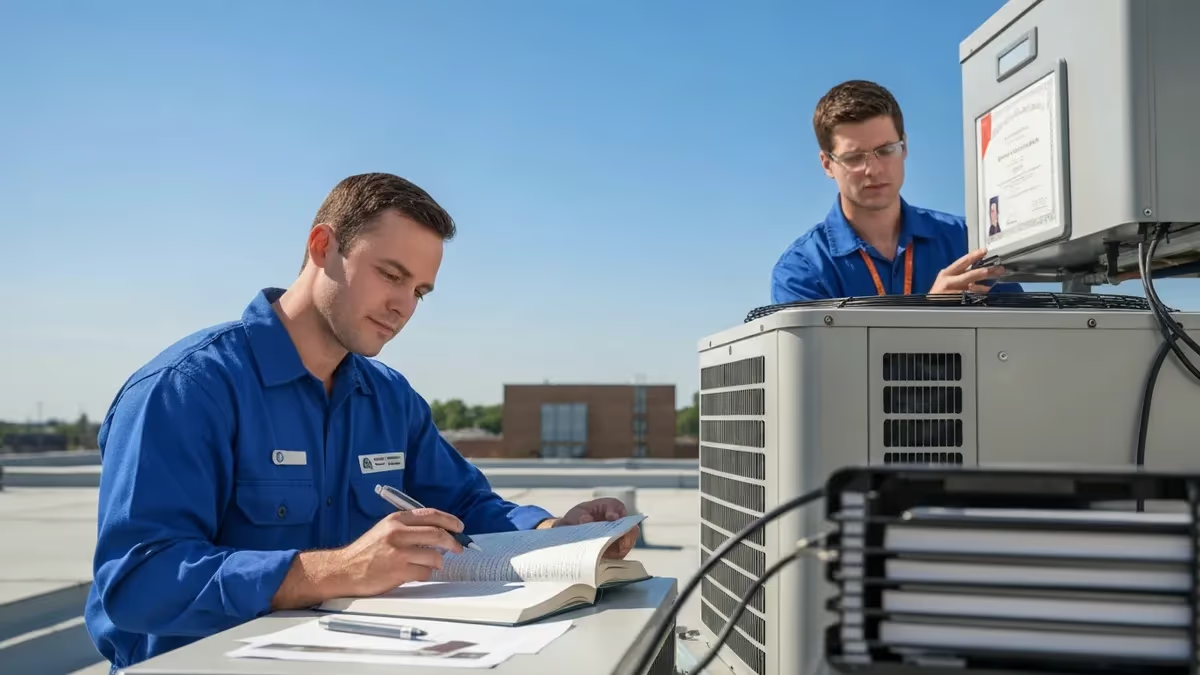
Picking the right HVAC school is one of the biggest decisions you'll make at the start of your career. Get it right, and you're earning solid money within months. Get it wrong, and you've burned thousands on a program that doesn't prepare you for the real world. This guide breaks down everything -- program types, actual costs, what the coursework looks like, and what happens after you graduate.
Trade school certificates run 6 to 12 months and cost between $1,200 and $15,000. Community college associate degrees take about two years and run $3,000 to $12,000. Apprenticeships? They last 3 to 5 years -- but they pay you while you train. Each path has trade-offs, and the best choice depends on your budget, your timeline, and whether you'd rather learn in a classroom or on the job. If you're already exploring the field, check out our HVAC technician career guide for a broader look at what the work actually involves.
The HVAC industry is projected to grow 9% through 2033. Median pay sits at $57,300 per year, with experienced technicians pulling $80,000 to $100,000 or more. You can't outsource this work -- every building needs someone local to install and maintain climate systems. That's why HVAC school enrollment across the country keeps climbing year after year.

Types of HVAC School Programs
You've got four main routes into the HVAC trade, and each one fits a different life situation. Trade school certificate programs are the fastest -- 6 to 12 months of full-time instruction focused purely on HVAC skills. You'll cover refrigeration, electrical systems, ductwork, and troubleshooting. When you finish, you're ready to sit for the EPA 608 exam and start working. These programs cost anywhere from $1,200 at a community-based center to $15,000 at a private technical college. Class sizes are usually small -- 15 to 25 students -- so you get plenty of hands-on time with equipment.
Community college programs stretch to 18-24 months and award an Associate of Applied Science in HVAC Technology. You'll take the same hands-on courses plus general education classes like technical writing and applied math. The upside? These programs qualify for Pell Grants and federal student loans. Tuition typically falls between $3,000 and $12,000 total -- often cheaper per credit hour than private trade schools. Many community colleges also have transfer agreements with four-year universities if you decide to pursue an engineering degree later.
Apprenticeships through unions like SMART or UA are the most popular path, lasting 3 to 5 years. They combine paid on-the-job training with evening classroom instruction -- usually one or two nights per week. You'll start at about 40-50% of journeyman wages and work your way up as your skills develop. The fourth option -- employer-provided on-the-job training -- is less structured but gets you earning immediately if you find a contractor willing to invest in your development. This path works best in areas where formal school programs aren't available nearby.
How Long Does HVAC School Take?
Timeline depends entirely on which path you pick. A full-time certificate program is the sprint version -- you're in and out in 6 to 12 months. Evening and weekend programs at the same school stretch that to 12-18 months, which works if you're holding down a day job while transitioning into the HVAC trade. Associate degree programs at community colleges run 18-24 months full-time, or up to 3 years if you go part-time. Some accelerated programs compress the associate degree into 15 months with summer sessions.
Apprenticeships are the marathon. You'll log 2,000 hours of on-the-job training per year plus at least 144 hours of classroom instruction annually. The total program runs 3 to 5 years depending on the sponsor. But here's the thing -- you're earning a paycheck the entire time, and your wages increase every six months. That changes the math significantly compared to paying tuition at a school and not working during the day.
After you finish any program, there's still a licensing timeline to consider. Most states require you to pass the EPA Section 608 exam, then a state-specific contractor or journeyman exam, and then accumulate 1 to 4 years of supervised work experience before you can operate independently. Some states like California and Texas have tiered license structures with separate permits for residential and commercial work. The school phase is just the starting line -- not the finish.
HVAC School Costs by Program Type
Tuition: $1,200-$15,000 total. Private technical colleges sit on the higher end ($8,000-$15,000), while community-based vocational centers can be under $5,000. Tools: $200-$1,000 for personal hand tools. Exams: EPA 608 costs $20-$60. NATE certification is $75-$225 per specialty. Financial aid: Schools accredited by ACCET or ACICS may qualify for federal aid. WIOA workforce grants can cover full tuition at approved programs.
What You'll Actually Study in HVAC School
HVAC school curriculum isn't just theory and textbooks -- it's a mix of classroom instruction and real-world application. You'll spend roughly half your time in labs working on real equipment alongside other students. That hands-on component is what separates a quality HVAC school from programs that waste your time and money. If a school doesn't have you wiring up systems and brazing copper by month two, it's not worth your money.
Core subjects include refrigeration fundamentals (the refrigeration cycle, refrigerant types like R-410A and R-454B, superheat and subcooling calculations), electrical systems (reading wiring diagrams, motor theory, contactors, thermostats, variable frequency drives), and heating systems (gas furnace operation, heat pumps, boilers, combustion analysis). You'll also cover air conditioning -- split systems, packaged units, ductless mini-splits, and commercial rooftop units.
Every accredited program includes EPA 608 prep, which covers refrigerant handling regulations, recovery procedures, leak detection, and proper disposal. This exam is required by federal law for anyone who purchases or handles refrigerants. Beyond that, you'll learn troubleshooting with manifold gauges, multimeters, clamp meters, and combustion analyzers. Indoor air quality modules cover filtration, humidity control, and ASHRAE 62.1 ventilation standards.
Choosing an Accredited HVAC School
Not every HVAC school is created equal. Accreditation matters because it determines whether your credits transfer, whether you qualify for financial aid, and whether employers take your credential seriously. Look for programs accredited by HVAC Excellence (formerly ARI) or PAHRA -- these are the industry gold standards. Schools without proper accreditation may still teach solid skills, but your credential won't carry the same weight on a resume.
Regional accreditation covers the institution as a whole. Community colleges carry this by default. Programmatic accreditation is specific to the HVAC department and signals that the curriculum meets industry skill standards. Both types count, but programmatic accreditation carries extra weight with hiring managers who understand the difference. It also means the program gets reviewed every few years, which keeps curriculum current with industry changes.
Ask about job placement rates before you enroll. A strong HVAC school will report that 85% or more of graduates land HVAC jobs within six months of completing the program. Ask about employer partnerships too. Many programs have relationships with local contractors who hire directly from the graduating class -- some even conduct interviews on campus during the final semester. Also verify lab-to-classroom ratios -- you want at least 50% of your hours spent working on actual equipment, not watching PowerPoints in a lecture hall.
HVAC School -- Pros and Cons
- +You can start earning $37,000-$50,000 within 6-12 months of enrollment
- +No four-year degree required -- trade school certificates get you working fast
- +HVAC jobs can't be outsourced or automated -- strong long-term security
- +Apprenticeships pay you while training, eliminating student debt entirely
- +9% projected growth means steady demand for new technicians through 2033
- +Multiple specializations (commercial, residential, refrigeration) keep the work varied
- −Physical demands are real -- crawl spaces, rooftops, extreme temperatures daily
- −On-call and weekend work is common, especially in residential service
- −Apprenticeship programs require a 3-5 year commitment before full pay
- −Licensing requirements vary by state and can add 1-4 years post-school
- −Private trade schools charge up to $15,000 and some have poor outcomes
- −Continuing education is required to maintain certifications long-term
Pros and Cons at a Glance
| Pros | Cons |
|---|---|
| No four-year degree required -- trade school certificates get you working fast | Physical demands are real -- crawl spaces, rooftops, extreme temperatures daily |
| HVAC jobs can't be outsourced or automated -- strong long-term security | On-call and weekend work is common, especially in residential service |
| Apprenticeships pay you while training, eliminating student debt entirely | Continuing education is required to maintain certifications long-term |
Financial Aid and Scholarships for HVAC School
Money shouldn't be the reason you skip HVAC school. Multiple funding sources exist, and many students don't even realize they qualify for substantial financial assistance. Community college HVAC programs are eligible for federal Pell Grants -- up to $7,395 per year in 2026 that you never have to repay. Federal student loans are available too, though grants are obviously preferable.
WIOA (Workforce Innovation and Opportunity Act) grants through your local American Job Center can cover full tuition, tools, and certification exam fees at approved schools. These grants target career changers, displaced workers, and underemployed adults. You don't need to be unemployed -- low-income workers qualify in most states. The application process takes 2-4 weeks.
Industry scholarships add another layer. The PHCC Educational Foundation, Women in HVACR, and the Refrigeration Service Engineers Society all offer annual awards ranging from $1,000 to $5,000. Your school's financial aid office will know about local options too. Between grants, scholarships, and the fact that apprenticeships pay you to train, there's a realistic path to HVAC school for almost any budget. Don't let tuition sticker shock scare you away before you explore these options.
HVAC School Enrollment Checklist
- ✓Research programs in your area -- compare trade schools, community colleges, and union apprenticeships
- ✓Verify accreditation (HVAC Excellence, PAHRA, or regional accreditation for community colleges)
- ✓Request job placement rates and employer partnership lists from each school
- ✓Tour the facilities and confirm hands-on lab equipment is modern and functional
- ✓Apply for FAFSA to determine Pell Grant and federal loan eligibility
- ✓Check WIOA eligibility through your local American Job Center
- ✓Budget for tools ($200-$1,000), EPA 608 exam ($20-$60), and state licensing fees ($50-$250)
- ✓Confirm the program covers EPA 608 prep and includes the certification exam
- ✓Ask about evening/weekend schedules if you need to work while attending school
- ✓Set a timeline for licensing -- map out state requirements for supervised work hours
Careers After HVAC School -- Salary and Growth
Finishing HVAC school opens the door, but where you go from there depends on the certifications you stack and the specialization you choose. The first credential every graduate needs is EPA Section 608 -- Universal type. This federal certification covers all refrigerant categories and is required by law. The exam costs $20 to $60 and most school programs include it in tuition.
NATE certification (North American Technician Excellence) is voluntary but powerful. It's the most recognized industry credential, covering specialties like air conditioning, heat pumps, gas heating, and commercial refrigeration. Each exam runs $75-$225. Employers regularly pay $1-$3 more per hour for NATE-certified technicians.
Salary progression after HVAC school is steep, which is why the investment pays off quickly. Entry-level apprentices earn $18-$24 per hour ($37,000-$50,000 annually). Journeyman technicians with 5+ years pull $25-$38 per hour ($52,000-$79,000). Master technicians and senior specialists hit $40-$55 per hour ($83,000-$115,000). The top earners? HVAC business owners clearing $150,000 or more annually. States with the highest pay include Alaska, Illinois, Hawaii, Oregon, and Washington. Overtime is common in this field -- many technicians boost their base salary by 15-25% through overtime hours during peak summer and winter seasons.
HVAC School Specializations Worth Pursuing
General HVAC training from school gets you hired. But specialization is what gets you promoted -- and paid significantly more. Heat pump technology is the hottest area right now (no pun intended). Federal energy efficiency mandates are driving a massive shift from gas furnaces to electric heat pumps, and contractors are scrambling for technicians who understand cold-climate heat pump installation and commissioning.
Commercial HVAC is another strong specialization path after school. Commercial systems -- rooftop units, chillers, cooling towers, building automation systems -- are more complex than residential equipment and pay accordingly. Technicians who can work on commercial controls and BAS (Building Automation Systems) command $5-$10 more per hour than residential-only techs.
Refrigeration is a third specialization that's often overlooked. Supermarket refrigeration, walk-in coolers, and industrial cold storage all need trained technicians. This work pays well and has less competition because fewer people pursue it. If you're in HVAC school right now, ask about elective courses in any of these three areas -- they'll pay for themselves within your first year on the job. Some school programs even offer specialized tracks in heat pump or commercial HVAC that prepare you for higher-paying roles from day one.
HVAC licensing requirements differ significantly by state. Some states (like Texas and Florida) require specific license types for residential vs. commercial work. Others (like Colorado) don't require state licensing at all but defer to local jurisdictions. Before choosing an HVAC school, check your state's contractor licensing board to confirm the program meets local requirements. Your school's admissions office should be able to confirm this -- if they can't, that's a red flag.
Can You Do HVAC School Online?
Sort of. Some HVAC school programs offer hybrid formats where you complete theory modules online and attend hands-on labs in person on weekends or during intensive multi-day sessions. Fully online HVAC training exists too, but it won't prepare you for the real work. You can't learn to braze copper, recover refrigerant, or troubleshoot a gas furnace from your laptop. Employers know this, and they'll ask about your lab hours in interviews.
That said, online components can genuinely help with the theory side. Courses on electrical theory, refrigeration cycles, EPA 608 prep, and code compliance translate well to digital formats. If you're working full-time and can't attend day classes, a hybrid HVAC school program that mixes online theory with weekend lab sessions is a practical compromise. Just confirm the program still includes enough hands-on hours to qualify you for certification exams and meet state licensing requirements.
One area where online really shines: continuing education after you're already working. After you finish school and get licensed, you'll need to renew certifications periodically. Many states accept online CE courses for license renewal, which saves time and money compared to sitting in a classroom again. But for your initial HVAC school training? You need to be in a lab, working on equipment, with an instructor watching your technique and correcting mistakes before they become habits.
HVAC Practice Test Questions
Prepare for the HVAC - Heating Ventilation and Air Conditioning exam with our free practice test modules. Each quiz covers key topics to help you pass on your first try.
HVAC Air Conditioning
HVAC Exam Questions covering Air Conditioning. Master HVAC Test concepts for certification prep.
HVAC Code Compliance
Free HVAC Practice Test featuring Code Compliance. Improve your HVAC Exam score with mock test prep.
HVAC Electrical Controls
HVAC Test Prep for Electrical Controls. Practice HVAC Quiz questions and boost your score.
HVAC Energy Efficiency
HVAC Questions and Answers on Energy Efficiency. Free HVAC practice for exam readiness.
HVAC Heating Systems
HVAC Mock Test covering Heating Systems. Online HVAC Test practice with instant feedback.
HVAC Load Calculations
Free HVAC Quiz on HVAC Load Calculations. HVAC Exam prep questions with detailed explanations.
HVAC Tools and Equipment
HVAC Practice Questions for HVAC Tools and Equipment. Build confidence for your HVAC certification exam.
HVAC Refrigeration
HVAC Test Online for Refrigeration. Free practice with instant results and feedback.
HVAC Safety Practices
HVAC Study Material on Safety Practices. Prepare effectively with real exam-style questions.
HVAC System Design
Free HVAC Test covering System Design. Practice and track your HVAC exam readiness.
HVAC Thermodynamics
HVAC Exam Questions covering Thermodynamics. Master HVAC Test concepts for certification prep.
Tips for Getting the Most from HVAC School
The students who get the most out of HVAC school are the ones who treat it like a job, not just a class. Show up early. Ask questions. Volunteer for extra lab time. The instructors at these programs are typically retired technicians with decades of field experience -- their stories and shortcuts are worth more than the textbook.
Start networking before you graduate. Attend local HVAC contractor association meetings. Join ASHRAE or RSES student chapters if your school has them. These connections turn into job offers faster than any online application. Many students line up their first job months before they finish school simply by talking to contractors at industry events.
Don't wait until graduation to pursue certifications either. Take the EPA 608 exam as soon as your HVAC school covers that material -- don't let it sit. Study for NATE certification in your strongest area and schedule it shortly after you finish your program. Walking into job interviews with certifications already in hand puts you ahead of 90% of other new graduates from the same school.
That preparation makes the difference between a $18/hour starting offer and a $22/hour one. Keep a portfolio of projects you completed during training too -- photos of installations, wiring jobs, and system diagnostics show employers what you can actually do, not just what you studied.
Sample HVAC Practice Questions
Try these questions from our free HVAC practice tests. The correct answer and an explanation follow each question.
In commercial HVAC, what does the term 'tons of refrigeration' mean?
- A. The weight of refrigerant in the system in tons
- B. A unit of cooling capacity equal to 12,000 BTU/hr (the heat needed to melt one ton of ice per day)
- C. The cooling capacity rated in metric tonnes
- D. A measure of the chiller's physical weight
Answer: B. A unit of cooling capacity equal to 12,000 BTU/hr (the heat needed to melt one ton of ice per day)
One ton of refrigeration equals 12,000 BTU/hr of cooling capacity—derived from the heat required to melt one ton (2,000 lbs) of ice in 24 hours.
What role does documentation play in HVAC compliance?
- A. It is optional
- B. It provides evidence of adherence to standards
- C. It is only needed for audits
- D. It replaces practical competency
Answer: B. It provides evidence of adherence to standards
Documentation provides verifiable evidence that standards and regulations are being followed, serving as proof of compliance.
What is the most important professional competency for HVAC certification in thermodynamics?
- A. Speed of task completion
- B. Deep knowledge combined with practical application skills
- C. Ability to work alone exclusively
- D. Memorization of all reference materials
Answer: B. Deep knowledge combined with practical application skills
Professional competency requires both deep knowledge of the subject matter and the ability to apply that knowledge in practical situations.
What is the value of continuing education in energy efficiency for HVAC professionals?
- A. It is only needed for recertification
- B. It keeps professionals current with evolving standards and practices
- C. It is primarily a social activity
- D. It replaces workplace experience
Answer: B. It keeps professionals current with evolving standards and practices
Continuing education ensures professionals stay current with the latest developments, standards, and best practices in their field.
HVAC Questions and Answers
How this page was made: written with AI tools and published by Nathan Beja, founder of Practice Test Geeks, who is responsible for its content. We have not yet matched this exam's facts to an official source, so confirm fees, dates and rules with the exam body. Not reviewed by a subject-matter expert. Editorial policy