
Car Theory Test: UK Guide, Format, and How to Pass 2026 September
✍🏼 Learn everything about the UK car theory test — multiple choice questions, hazard perception, pass marks, booking, and the best ways to prepare and pass...
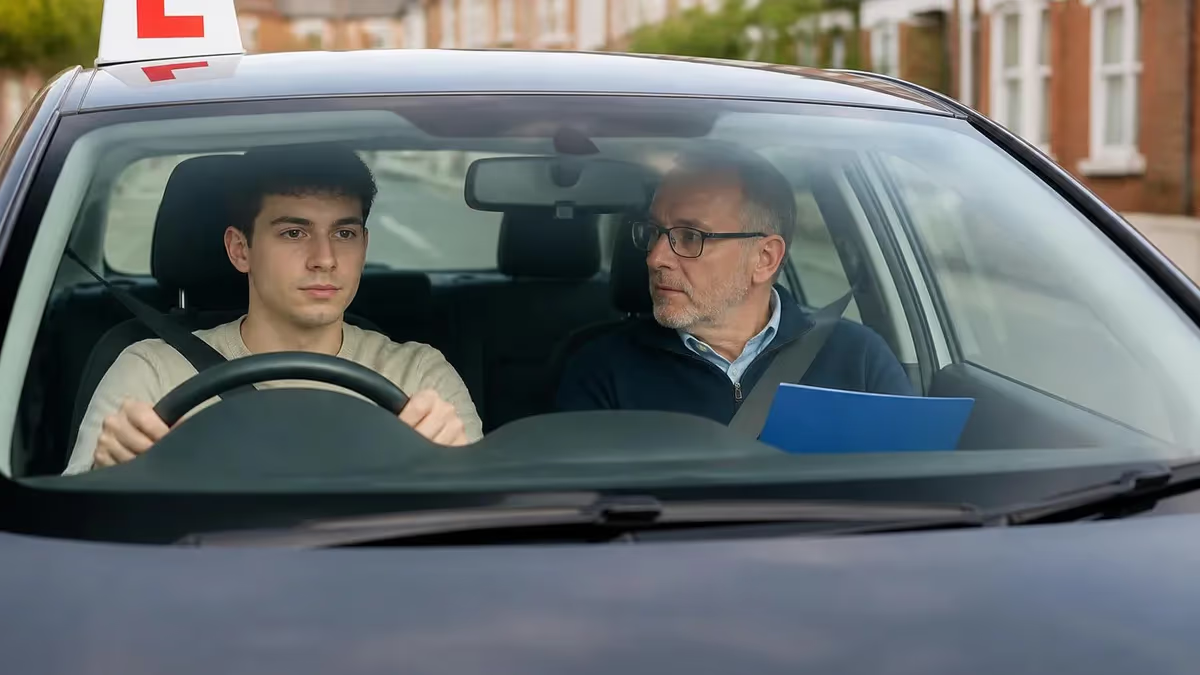
The UK car theory test is the first formal hurdle in obtaining a full driving licence. Every learner driver must pass it before booking their practical driving test, regardless of how much time they've spent behind the wheel. Administered by the Driver and Vehicle Standards Agency (DVSA), the theory test assesses whether you understand the rules of the road, road signs, and safe driving practices before you're assessed on your practical skills.
The test has two distinct sections: a multiple choice section and a hazard perception section. Both are completed in the same sitting at a DVSA test centre, and you must pass both parts in the same session — you cannot pass one section today and sit the other at a different date. If you fail either section, you must rebook and retake the entire test, including the section you previously passed. This structure means preparation must cover both components thoroughly rather than focusing exclusively on whichever seems more challenging.
The car theory test multiple choice section presents 50 questions drawn from the Official DVSA Revision Question Bank, which contains over 700 questions covering all topics from the Highway Code. Questions cover traffic signs, road markings, speed limits, stopping distances, vehicle safety, motorway driving, rules for vulnerable road users, and environmental awareness.
The pass mark is 43 out of 50. Questions are presented one at a time on a touchscreen computer, and you can flag questions for review and return to them before the section timer expires. The time allowed is 57 minutes for the standard test; candidates who qualify for a reader/recorder or additional time receive extra accommodation.
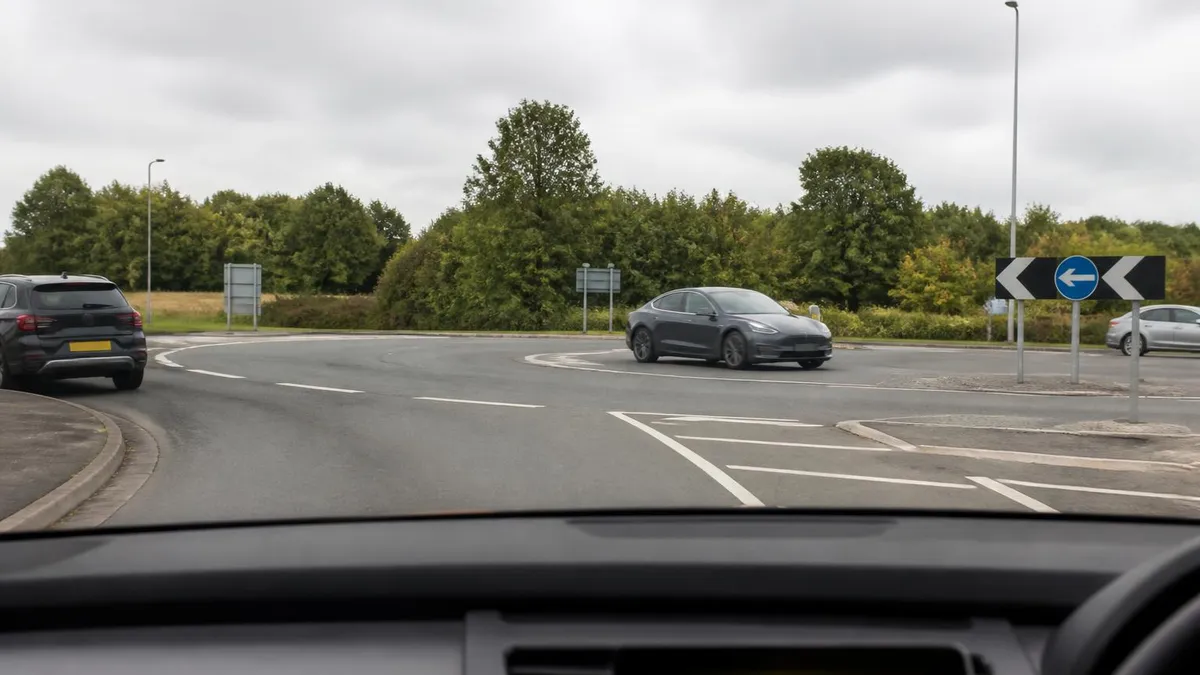
The hazard perception section follows immediately after a short break. You watch 14 video clips filmed from a driver's perspective and must click whenever you identify a developing hazard — a situation that causes you to take action like slowing, swerving, or stopping. One clip contains two developing hazards; the others each contain one.
Hazards are scored on a sliding scale from 0 to 5 based on how early you click after the hazard begins developing. Early responders score higher; clicking too late scores 0 for that hazard. The maximum score is 75; the pass mark is 44. Clicking randomly to guarantee a hit triggers an anti-cheat algorithm that scores the entire clip at zero, so attempts to game the system by clicking continuously are penalized rather than rewarded.
Hazard perception: 44 out of 75 points (59%)
Must pass both sections in the same sitting. Failing either section means rebooking the full test. Certificate valid for 2 years — practical test must be passed before it expires.
Booking the car theory test is done through the official DVSA service at gov.uk/book-theory-test, or by phone via the DVSA theory test booking line. You'll need your UK driving licence number (the provisional licence issued by the DVLA) and a debit or credit card. The fee is currently set by DVSA and must be checked on the official booking page as it's subject to change.
Test centres are spread across the UK, and booking slots are generally available within one to three weeks in most areas, though busy urban centres and popular exam periods may have longer waits. You can change your booking up to three clear working days before your test without charge; cancellations or changes within three working days forfeit the fee.
The minimum age for the car theory test is 17. Learner drivers can sit the theory test before they have started driving lessons if they choose — some preparation courses encourage early theory preparation. However, the theory test certificate is only valid for two years, so if you wait more than two years after passing the theory test to pass your practical test, you'll need to resit the theory.
Many learners time their theory test preparation to coincide with the middle of their practical driving lessons, when they have enough road experience to make hazard perception feel intuitive rather than abstract.
Official preparation materials published by the DVSA are the most reliable study resources for the car theory test. The Official DVSA Highway Code is the primary reference document, covering all the rules, signs, and guidance that multiple choice questions draw from.
The Official DVSA Theory Test Kit app (iOS and Android) provides access to the official question bank, practice tests, and hazard perception clips produced by the DVSA using the same format as the real test. Third-party apps and websites that don't use the official DVSA question bank may present similar but not identical questions, and any question they include that doesn't appear in the official bank won't appear on your actual test.
Many learner drivers underestimate hazard perception and overprepare for multiple choice. The pass rate for hazard perception is lower than for multiple choice in most test cycles, partly because the skill it tests — anticipating developing hazards from a driver's perspective — doesn't come naturally from reading theory materials alone.
Watching real driving video and practising the click-when-you-see-it response is essential for building the pattern recognition that hazard perception rewards. The Official DVSA Hazard Perception Practice app provides clips in the same format as the real test, including the anti-cheat system, so practice in that environment is the most transferable preparation possible.
Car Theory Test Format
| Section | Questions | Time |
|---|---|---|
| Multiple Choice | 50 | — |
| Hazard Perception | 14 | — |
| Total | 64 | ~77 minutes (plus instructions and breaks) |
Theory Test Key Topics
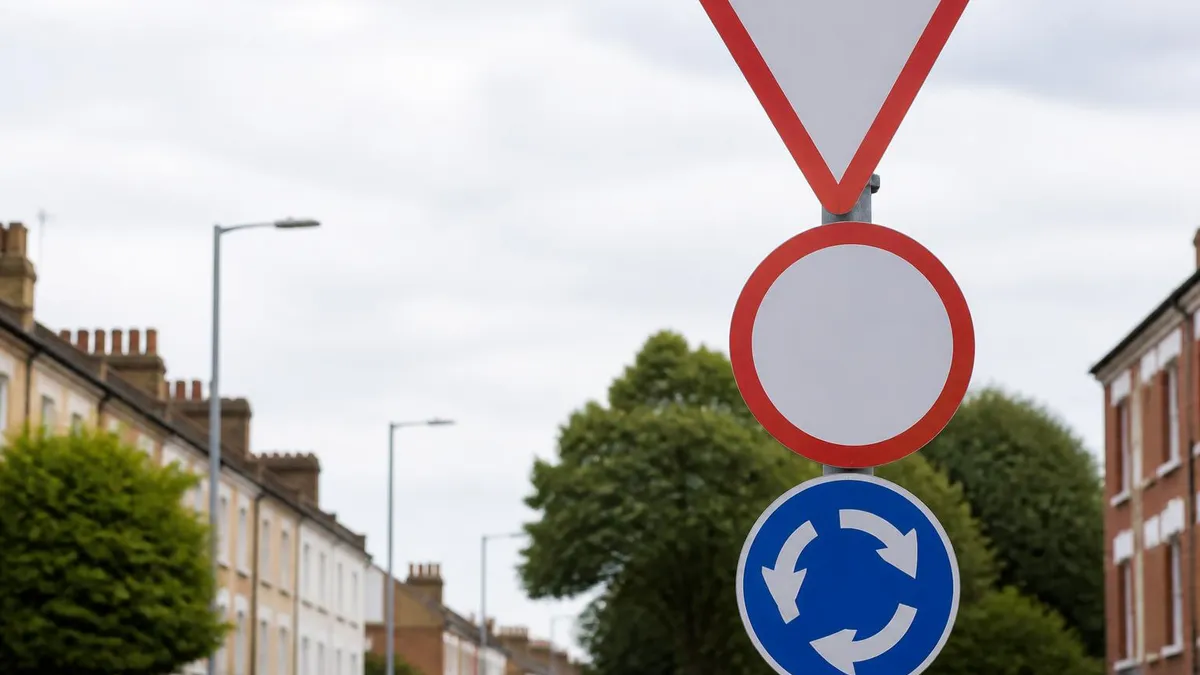
Road signs (mandatory, warning, informational), road markings, speed limits, stopping distances, priority rules at junctions, overtaking, and rules at level crossings. The Highway Code is the primary source for all multiple choice questions.
Lane discipline, joining and leaving, minimum speeds, smart motorways, breakdown procedures, overhead gantry signals, and rules for learner drivers on motorways. Motorway questions appear in every test session.
Rules for cyclists, motorcyclists, pedestrians, horse riders, and children. Hazard perception clips frequently feature vulnerable road users. Understanding their behaviour helps both sections of the test.
Daily safety checks (tyres, lights, oil, screen wash), towing rules, loading limits, tyre tread depth requirements, and eco-friendly driving techniques. These topics appear in the vehicle safety section of the test.
Preparation strategy for the multiple choice section should follow the DVSA's own recommended approach: study the Highway Code thoroughly, then practice questions from the official bank. Don't skip sections of the Highway Code on the assumption they won't be tested — the question bank covers all chapters, including motorway rules, driving in adverse weather, towing rules, and road user categories that new drivers rarely encounter. Questions about motorcyclists, horse riders, cyclists, and pedestrians appear regularly, and candidates who've only read the car-specific sections are often caught out.
Stopping distances are a commonly tested and commonly memorized topic. The Highway Code provides stopping distances in both feet and metres at speeds from 20 mph to 70 mph. The overall stopping distance includes both thinking distance (the distance covered before braking begins, based on reaction time) and braking distance (the distance covered while braking). At 60 mph, the total stopping distance is 73 metres — the length of six full-size cars.
Questions about stopping distances often present the speed and ask for the overall stopping distance, so memorizing the table from the Highway Code is worth the investment. A useful mnemonic: double the speed and double the stopping distance doesn't hold precisely; stopping distances increase approximately with the square of speed, not linearly.
For the hazard perception section, practice volume matters more than any specific strategy. The DVSA recommends completing at least 30 practice clips before sitting the test. The skill being assessed — identifying a developing hazard as early as possible after it begins to develop — becomes more automatic with repeated exposure to different clip types.
Common hazard scenarios include vehicles emerging from side roads or junctions, pedestrians stepping into the road, cyclists' path changes, and vehicles slowing unexpectedly. Each clip has exactly one moment when clicking scores the maximum 5 points; clicking earlier scores progressively less; clicking after the hazard is fully developed scores 0.
On test day, arrive at the test centre with your valid photo driving licence and any confirmation details. The test centre staff check your identity before admitting you. You're not permitted to bring mobile phones, notes, or revision materials into the testing room. The testing terminal provides on-screen instructions before each section and time remaining throughout.
After completing both sections, you receive your result immediately — a printed summary showing your score on each section and whether you passed or failed. Results are also recorded on the DVSA system, so your driving instructor and the DVLA can verify your pass status when you book your practical test.
Some learner drivers benefit from structured preparation courses that combine theory study with practical lessons. Some driving schools provide theory preparation materials and mock tests as part of their tuition package, or recommend specific preparation apps. Independent learners who study without a driving school should ensure they're using official DVSA materials rather than relying solely on third-party apps, which may include outdated or inaccurate questions. The official question bank is updated periodically, and questions that were accurate in previous years may have been revised or removed. Checking the publication date of any revision guide is good practice. Understanding the scoring system for hazard perception helps calibrate your clicking strategy. Each developing hazard has a response window — usually about 5 seconds — during which clicking earns between 1 and 5 points depending on when within that window you click. The earliest you can click (and still score) is when the hazard first starts developing; the latest is just before the hazard is fully resolved. Clicking before the hazard window opens doesn't score but also doesn't trigger the anti-cheat system unless you click more than 10 times in a 10-second period. A reasonable strategy is to click once when you first notice a potential hazard developing, and again if it continues to develop — two measured clicks rather than a rapid-fire series.4-Week Theory Test Study Plan
- ▸Read Highway Code sections 1-60 (road users and pedestrians)
- ▸Learn all road sign categories: mandatory, warning, informational, regulatory
- ▸Complete 50 practice MCQ questions from the official bank
- ▸Read Highway Code sections 61-160 (driving rules, junctions, motorways)
- ▸Memorize stopping distances at 20, 30, 40, 50, 60, and 70 mph
- ▸Complete 100 practice MCQ questions, review all wrong answers
- ▸Watch and practice 30+ official DVSA hazard perception clips
- ▸Learn to identify developing hazards vs. potential hazards
- ▸Practice full mock theory tests (MCQ + hazard perception combined)
- ▸Complete 3 full mock theory tests under timed conditions
- ▸Target any MCQ topics where score is below 86% pass rate
- ▸Light hazard perception review — 10 clips per day to maintain timing
Preparation Strategies
The most effective strategy for the multiple choice section combines comprehensive reading of the Highway Code with systematic practice from the official DVSA question bank. Don't attempt to memorize individual answers — understand the principle behind each question so you can apply it to slightly different phrasing. The question bank contains over 700 questions, and any 50 of them might appear on your test. Questions about road signs are often answered correctly by candidates who understand what each sign category means (red circle = prohibition, triangular = warning, blue circle = mandatory) rather than memorizing each sign individually. Stopping distances are worth memorizing directly from the Highway Code table, as questions about them are common and the numbers must be precise. For case studies (groups of 3-5 questions based on a scenario), read the scenario carefully and answer each question based on the information provided rather than making assumptions.
The overall first-attempt pass rate for the car theory test is approximately 47-50%, meaning roughly half of test-takers fail on their first attempt. Most failures occur on the hazard perception section rather than the multiple choice — a pattern that suggests many candidates spend too much time memorizing Highway Code facts and too little time developing the perception skill the second section tests. Candidates who complete 30 or more hazard perception practice clips from official DVSA materials before their test have substantially higher pass rates than those who rely on reading materials alone.
After passing, your theory test certificate is valid for two years. If your practical driving test isn't booked and passed within that window, you must resit the theory test from scratch. Most learners complete their practical test within six to twelve months of passing the theory test, but delays caused by test centre availability, instructor scheduling, or personal circumstances can push some candidates close to the two-year limit.
If you're approaching the expiry, book your practical test immediately rather than waiting until your certificate has lapsed — rescheduling a practical test is far cheaper than paying the theory test fee again and resitting both sections.
Some learners use the theory test pass as a motivational milestone during the learning process, particularly for those who started lessons with no prior driving experience. Passing the theory test confirms that you understand the rules of the road at a conceptual level, which often builds confidence before the practical lessons that follow. Using the car theory test preparation process to deeply understand the Highway Code — rather than simply memorizing questions — also makes practical lessons more productive, because you arrive at each lesson already understanding the rules that govern what your instructor is teaching you to do.
Car Theory Test Pass Rate
UK Pros and Cons
- +UK has a publicly available content blueprint — you know exactly what to prepare for
- +Multiple preparation pathways accommodate different schedules and budgets
- +Clear score reporting shows specific strengths and weaknesses
- +Study communities share current insights from recent test-takers
- +Retake policies allow recovery from a difficult first attempt
- −Tested content scope requires substantial preparation time
- −No single resource covers everything optimally
- −Exam-day performance can differ from practice test performance
- −Registration, prep, and retake costs accumulate significantly
- −Content changes between versions can make older materials less reliable
DVSA Questions and Answers
About the Author

Licensed Driving Instructor & DMV Test Specialist
Penn State UniversityRobert J. Williams graduated from Penn State University with a degree in Transportation Management and has spent 20 years as a certified driving instructor and DMV examiner consultant. He has personally coached thousands of applicants through written knowledge tests, skills assessments, and commercial driver licensing programs across more than 30 states.