
Hazard Perception Test: Complete DVSA Guide to Passing First Time 2026 October
Hazard perception test tips, scoring, and practice strategies. Learn what the DVSA test looks like and how to pass it first time. 🔎
What Is the Hazard Perception Test?
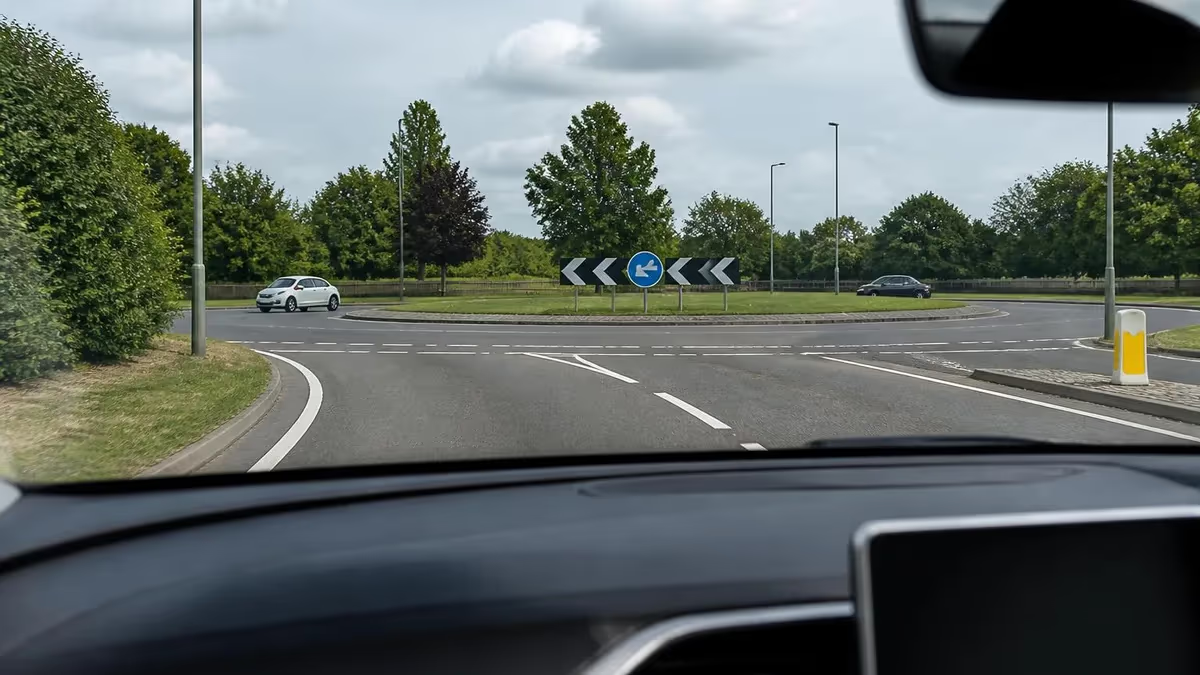
The hazard perception test is the second half of your DVSA theory test — and it trips up more candidates than most people expect. You've just answered 50 multiple-choice questions, you're feeling reasonably confident, and then 14 video clips appear on screen. Each one shows a real road scene filmed from a driver's perspective. Your job? Click the mouse every time you spot a developing hazard.
Sounds simple. It isn't. The test measures not just whether you see a hazard, but how early you see it. That timing window is everything — click too late and you score zero on that clip. Click too early or in a suspicious pattern, and the system flags you for cheating. One developing hazard per clip scores up to 5 points. One special clip hides two developing hazards and scores up to 10. There are 14 clips total, so the maximum score is 75.
You need 44 out of 75 to pass. That's 58.7% — but don't let the low pass mark fool you into thinking you can wing it. Plenty of candidates fail because they don't understand the scoring window, or they click on hazards that haven't developed yet.
How the Scoring Window Actually Works
The DVSA scores your response based on a hidden time window that opens when the hazard begins to develop. If you click during the early part of that window, you score 5 points. Click a little later — 4 points. Keep clicking later and the score drops: 3, 2, 1. After the window closes, no points at all regardless of how many times you click.
Here's where candidates go wrong: they click the moment they see anything slightly interesting on screen — a car pulling out from a side road that's 200 metres ahead, a pedestrian standing on the pavement doing nothing, a cyclist who's currently riding in a straight line with no apparent issue. These aren't developing hazards yet. They might become one, but the scoring window hasn't opened.
A developing hazard is something that requires you, as the driver, to take action — slow down, steer, stop, or give way. The hazard needs to be actively unfolding, not just potentially risky. Watch for:
- Vehicles emerging from junctions or driveways
- Pedestrians stepping into or moving towards the road
- Cyclists wobbling or moving toward the centre of the lane
- Vehicles braking sharply ahead
- Animals on or approaching the road
- Vehicles overtaking and cutting back in
The dual-hazard clip — the one worth up to 10 points — usually involves two separate events in the same scene. Both need your response. Missing one means losing 5 points in a single clip, which can easily be the difference between pass and fail.
The Cheating Detection System
DVSA's test software monitors your clicking pattern throughout each clip. If you click more than a certain number of times in a short space of time, the software interprets this as a "drumming" strategy — clicking repeatedly in the hope of hitting the scoring window by chance. If it detects this on a clip, you automatically score zero for that clip regardless of when you actually spotted the hazard.
Some candidates try to click roughly every two seconds throughout the clip. Don't. This almost certainly triggers the anti-cheating filter. Instead, watch the scene properly, identify when something starts to develop, then click once or twice at that moment. Two or three clicks when you see a hazard developing is fine. A constant stream of clicks is not.
The irony is that the "safe" cheating strategy of constant clicking is actually less effective than simply understanding what you're looking for. If you know the difference between a static risk and a developing hazard, you don't need to click constantly — you click confidently when it counts.
How to Practise Effectively
Most people do too little hazard perception practice and spend too much time on the multiple-choice questions. Both parts of the theory test are equally important — failing either one means failing the whole thing. You'd have to retake and pay again, including the booking fee.
Start with the official DVSA practice materials. The theory test practice resources include genuine hazard perception clips in the same format as the real test. These are worth using because the actual test clips are drawn from the same pool. Getting used to the video quality, the on-screen interface, and the response mechanics before test day removes a lot of uncertainty.
When you practise, focus on identifying the hazard type first. Ask yourself: what is this hazard? When does it start developing? This trains you to think like the scoring algorithm rather than just react to movement. Over time, you'll develop an instinct for the exact moment a situation tips from "potential risk" into "developing hazard."
Try to practise in blocks of 14 clips at a time — the same number as the real test. Doing one or two clips in isolation doesn't replicate the mental effort of sustaining concentration across a full set. By clip 10 or 11, your attention will start to drift unless you've trained for that duration.
Common Mistakes and How to Avoid Them
The most common failure reason is simple: misunderstanding what counts as a developing hazard. Candidates often click for:
- Parked cars (static, not developing)
- Vehicles approaching from a long distance with no change in direction
- Wet roads or poor weather conditions by themselves
- Pedestrians on the pavement who aren't moving toward the road
None of these score points because none of them require the driver to take immediate action. Weather and road conditions are general hazards, not developing hazards in the test sense — unless combined with a specific event like a vehicle skidding or a cyclist losing control.
Another common mistake is assuming that high scores on practice clips mean you're ready. Practice scores tend to be inflated because you start expecting hazards rather than looking for them naturally. The real test clips may look slightly different to anything you've seen before. The skill you're building isn't pattern recognition — it's genuine hazard awareness. That only comes from understanding the principles, not from memorising specific clips.
Speed matters too. Some candidates think deliberate, slow clicking shows confidence and avoids the cheating filter. Actually, the window can open and close quite quickly for fast-moving hazards. Don't hesitate when you see something developing. Trust your assessment and click.
On Test Day: What to Expect
You'll sit the hazard perception test immediately after completing the multiple-choice section. There's a brief break where you can read the instructions for the hazard perception part — read them, even if you think you know what's coming. The wording occasionally surprises people who assumed the format was identical to their practice materials.
The test is delivered on a touchscreen in some test centres and with a mouse in others. The interface is the same either way — you tap or click on the screen when you see a developing hazard. There's no keyboard option.
You'll see a practice clip before the scored test begins. Use it properly. It's there to help you calibrate your response timing on that specific hardware. Some touchscreens have a slight lag. Some mice have stiffer clicks. Find out during the practice clip, not during clip one of your scored test.
After all 14 clips, your score appears immediately. If you've passed, you'll know straight away. If you've failed the hazard perception part but passed the multiple-choice section — or vice versa — you'll need to retake the entire theory test, both parts. Neither result carries over.
Hazard Perception vs Practical Driving Test
There's a direct link between what the hazard perception test measures and what examiners look for during your practical driving test. Responding early to developing hazards — giving yourself time and space to act — is one of the fundamentals of safe driving. It's not just an exam technique. Examiners credit candidates who spot hazards early and adjust their speed proactively, well before a situation becomes urgent.
The cognitive habit you build by preparing for hazard perception genuinely carries into how you drive. That's the point of the test — not to catch you out, but to make sure new drivers have trained their eye to see risk before it arrives.
If you're also working through the multiple-choice section of the theory test, start with the theory test booking process so you have a date to work toward. Having a deadline changes how seriously most people prepare.
Practice Resources Worth Using
Beyond the official DVSA resources, there are several approaches worth layering into your preparation:
- Dashcam footage: YouTube has hours of dashcam clips from UK roads. Watch them with the sound off and try to identify developing hazards as they appear. This trains your eye on real footage rather than the stylised clips used in practice materials.
- Reading from the driver's seat: Even as a passenger, you can practise hazard scanning. Identify developing situations before the driver reacts. If you're right consistently, your eye is calibrated correctly.
- Timed review sessions: After each practice set, review every clip — both those you scored on and those you missed. Understand why a hazard started developing at the moment it did, not just that you missed it.
The hazard perception test doesn't require natural talent or driving experience. It requires understanding the scoring system and practising the right way. Most candidates who fail on their first attempt pass comfortably on their second — not because the test got easier, but because they know what they're actually being tested on.
Scores, Results, and What Happens Next
You need 44 out of 75 to pass. The DVSA publishes the pass mark — it's not a secret. What most candidates don't realise is that the pass mark has been stable for years, which means it's been deliberately set at a level where prepared candidates pass and unprepared ones don't. It's not designed to be difficult; it's designed to be meaningful.
Your hazard perception score is part of your theory test certificate, which is valid for two years. If you don't pass your practical driving test within those two years, your theory test certificate expires and you'll need to take the theory test again from scratch. This is worth keeping in mind if you're booking lessons — getting your theory test done early gives you more runway, but leaving too long a gap between theory pass and practical booking wastes that runway quickly.
For motorcycle riders, the hazard perception test is the same format and the same pass mark. The clips used in the test include footage relevant to all vehicle types, and the scoring works identically. Motorcycle candidates sit the same theory test as car drivers — separate hazard perception tests don't exist for different licence categories at the standard level.

Building Real Hazard Awareness
The best candidates don't approach hazard perception as a test to pass — they approach it as a skill to build. There's a real difference. Someone trying to game the scoring system will click every time they see movement and hope for the best. Someone who's actually developed hazard awareness reads the road like a story: setup, development, consequence. They see the cyclist glance over their shoulder and know — before the cyclist even moves — that a turn is coming.
That kind of anticipation is what the test is trying to measure. It's also what keeps drivers safe for the next 40 years. You're not just sitting a 20-minute test. You're building a mental model of how roads work that will run in the background every time you drive.
If you haven't booked your theory test yet, take a look at the book driving test theory test guide to walk through the DVSA booking system. Once you have a date, set a preparation schedule — give hazard perception at least two weeks of dedicated practice, separate from your multiple-choice revision. They use different parts of your brain. Treat them as different subjects.
Good luck — and remember, 44 is the number. Know what you're clicking for, click when it counts, and you'll get there.
About the Author

Licensed Driving Instructor & DMV Test Specialist
Penn State UniversityRobert J. Williams graduated from Penn State University with a degree in Transportation Management and has spent 20 years as a certified driving instructor and DMV examiner consultant. He has personally coached thousands of applicants through written knowledge tests, skills assessments, and commercial driver licensing programs across more than 30 states.