
Hazard Perception Test Practice: Tips, Scoring, and Sample Tests 2026
✏️ Master the DVSA hazard perception test with practice techniques, scoring breakdown, and strategies to spot developing hazards before they catch you out.
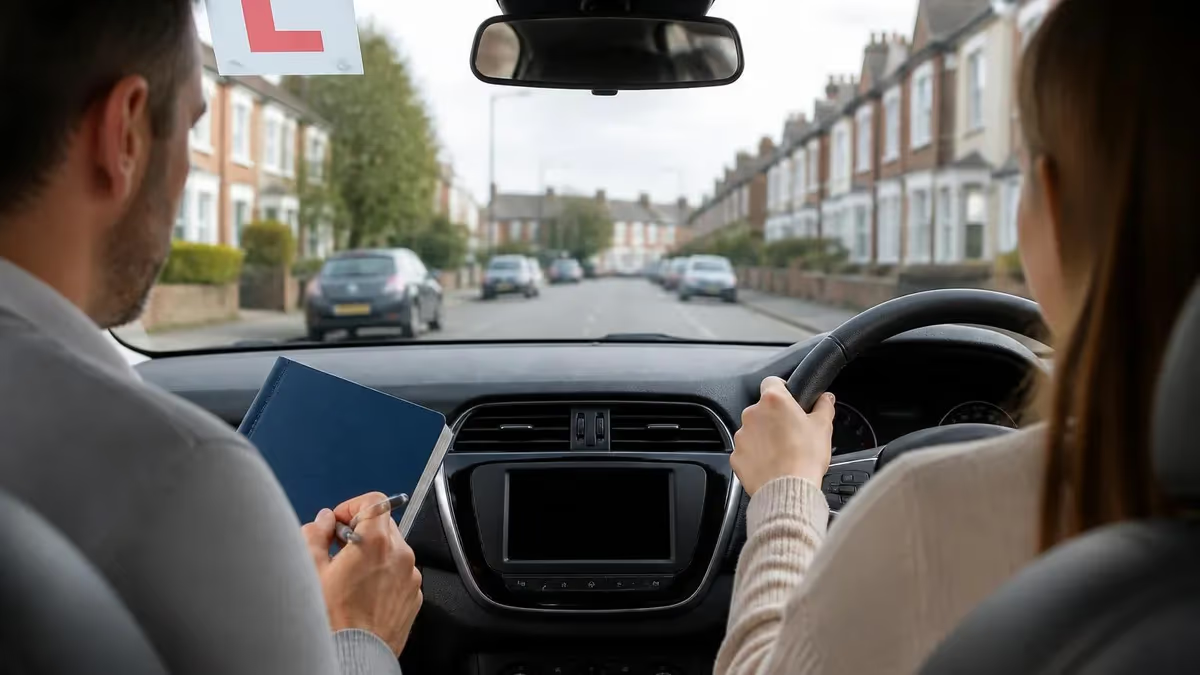
The hazard perception test is the second part of the DVSA theory test and the section that surprises candidates who think preparation means memorizing Highway Code rules. It's entirely video-based. You watch fourteen clips of real UK driving situations, and you click your mouse or touchscreen when you see a developing hazard — a situation that might cause you to change speed or direction. One clip contains two developing hazards. Your score depends not just on whether you click but on how quickly you respond once the hazard starts to develop. Slower responses score lower; fast, accurate responses score higher.
The hazard perception test sits alongside the multiple-choice question section within the theory test appointment. You complete the MCQ section first, then move to the hazard perception section. There's a practice clip before the scored clips begin, so you can get a feel for the clicking interface. The whole section takes about 20 minutes. You can't go back and re-watch clips once you've moved past them, and you can't pause. It's designed to replicate the real-time nature of driving — hazards don't wait for you to decide whether to react.
What the test is really measuring is hazard perception as a cognitive skill: the ability to scan the driving environment, identify situations that are becoming dangerous, and respond early. Research by the Transport Research Laboratory established that this skill — early hazard response — is a meaningful predictor of collision risk. Drivers who spot hazards early have more time to respond and are statistically less likely to be involved in accidents. The test targets this skill specifically because it's trainable: candidates who practice identifying developing hazards in video clips do measurably better at recognizing them in real traffic.
For complete DVSA theory test preparation, the hazard perception test practice component works best when combined with thorough multiple-choice question study. Both sections must be passed at the same sitting — a perfect hazard perception score doesn't compensate for a failed MCQ section, and vice versa.
A critical thing to understand early: the hazard perception test is not about identifying everything unusual in a clip. It's specifically about developing hazards — situations where something is beginning to change in a way that requires a driver to respond. A stationary dog sitting on the pavement is present but not developing. That same dog beginning to run toward the road — that's a developing hazard. The word "developing" is the key. You're looking for the moment something transitions from a static background feature to an active threat that demands a driving response.
This framing changes how you watch the clips. Instead of treating the video as a hazard-spotting game where you click everything that looks risky, you watch for change. Scanning the scene for movement, trajectory shifts, and emerging conflicts gives you a better response pattern than trying to click all potential hazards. The early movers in a clip — the pedestrian just starting to step off the kerb, the cyclist who has just begun to drift — are the clicking opportunities. The same pedestrian already in the road is a background hazard you've already passed the window for.
One thing that will help your results immediately: understand that "hazard perception" in the DVSA context means a very specific category of event. Not every unexpected thing in the clip is a scoreable hazard. A lorry that's been parked on the verge throughout the clip is not a developing hazard. A lorry that begins to pull out from that verge as you approach — that's a developing hazard.
The test distinguishes rigorously between features that are already present and features that are actively developing into a conflict. Only the developing ones are scored. Training your attention to spot the transition from passive presence to active development is the exact skill the test is measuring.
Total clips: 14 (15 hazards — one clip has two). Maximum score: 75 points. Pass mark: 44 out of 75. Scoring range: 0–5 points per hazard based on how quickly you click after the hazard starts developing. Auto-zero: Clicking in regular patterns (e.g., clicking every few seconds) is detected and scores zero for that clip.
Each hazard in the test is scored on a five-point scale based on timing. When a hazard starts to develop, a scoring window opens invisibly. Click within the earliest part of that window and you earn 5 points. Click a fraction later and you earn 4, then 3, 2, 1, and eventually zero if you click after the window has closed. You don't know exactly where the scoring window opens — it's concealed. This is intentional: the test is designed to reward genuine perception of developing hazards, not clicking at moments you can predict in advance.
The key practical implication is that you should click when you first notice something that might become a hazard — a pedestrian stepping off the pavement, a cyclist beginning to wobble, a vehicle emerging from a junction — rather than waiting for it to become an obvious problem. Waiting for certainty means you're already late. The scoring system rewards the instinct to react early to potential hazards, which is exactly what experienced drivers do. New drivers tend to wait longer before responding; hazard perception practice develops the earlier-response instinct.
The dual-hazard clip — the one clip in the test that contains two developing hazards — is scored the same way as single-hazard clips. Both hazards have their own scoring windows. Candidates who click when they see the first hazard and relax may miss the second entirely. One strategy is to maintain alert, active scanning throughout every clip rather than relaxing after clicking once. Clips are typically 45–90 seconds long, and hazards can appear at any point.
Practice through the official DVSA resources is strongly recommended. The DVSA sells official theory test practice that includes real hazard perception clips equivalent to those in the actual test. Third-party apps and websites also offer practice clips; quality varies widely. The single most important criterion for practice material is that it uses real-life driving video rather than animated clips — animated clips don't train the same visual attention skills as video of actual UK roads and traffic. Official DVSA practice material always uses real footage.
For background on what to expect on test day and how to book the theory test that includes hazard perception, the hazard perception test practice guides walk through the complete DVSA test booking process and what to expect at the test centre.
Mental preparation matters alongside practical practice. Candidates who arrive at the hazard perception section anxious or fatigued — often because the MCQ section was stressful — tend to over-think rather than react naturally. The instinct you've developed through practice is your best tool in the test. Trusting it, rather than second-guessing each click, produces better scores. If you see something that makes you think "that could be a hazard," click now — don't wait to decide whether it definitely is one.
The legal requirement to carry a valid theory test pass certificate before booking a practical test means passing the hazard perception section is a prerequisite for getting on the road as a full licence holder. Many candidates who fail the hazard perception section are surprised, because they felt they watched the clips carefully. The difference between careful watching and active hazard scanning is specific — it requires training, not just attention. That's what a structured practice programme develops.
Unlike the multiple-choice section where there's a clear right answer, hazard perception operates on a continuous spectrum of response timing. A borderline-late click might score 2; a slightly earlier click scores 5. This means small improvements in response time make a real difference to your total score.
Moving from an average of 2 points per hazard to an average of 3 points turns a fail into a pass. This marginal sensitivity is why practice specifically focused on clicking earlier — rather than just more accurately — drives score improvement. The question to ask in every practice clip isn't "was that a hazard?" but "when did it start becoming one?"
If you want more targeted practice, the hazard perception sample tests page covers the same material with additional questions and explanations.
4 Things That Determine Your Score
The earlier you click after a hazard starts developing, the higher you score (5 points max per hazard). Clicking after the scoring window closes = 0 points. The invisible window opens when the situation begins to develop — not when it's obvious.
Clicking in regular intervals is detected as cheating and scores the whole clip zero. Click meaningfully — 1 to 3 times when you genuinely perceive a hazard developing. Spread-out, purposeful clicks are normal; mechanical regular patterns are flagged.
14 clips total — 13 with one hazard, 1 with two. Missing the second hazard in the dual-hazard clip is common. Stay actively scanning throughout every clip, even after your first click. The dual-hazard clip isn't marked in advance.
Watching passively misses hazards developing at the edges of the frame. Sweep your attention across the scene — junctions to the left, pedestrians to the right, cyclists at the edges. Peripheral developing hazards score as well as centre-frame ones.
Hazard Perception Test Structure
| Section | Questions | Time |
|---|---|---|
| Practice Clip | N/A | — |
| Scored Clips (1–14) | 14 clips | — |
| Dual Hazard Clip | 2 hazards | — |
Developing hazards — the ones scored in the test — are distinct from background hazards that merely exist in the clip. A parked car on the road is not a developing hazard. A parked car with its door beginning to open and a person about to step out — that's a developing hazard. A clear junction is not a hazard.
A vehicle beginning to pull out from a junction ahead of you — that's a developing hazard. The distinction is movement and change: something in the scene begins to change in a way that requires a driving response. This is the cognitive frame that makes hazard perception practice effective: you're training yourself to notice change, not just presence.
Common types of developing hazards in DVSA test clips include: pedestrians stepping off the pavement into the road or crossing unexpectedly; cyclists moving into the primary position or wobbling toward the centre of the lane; vehicles reversing from driveways or emerging from side roads; slow-moving vehicles ahead requiring braking; roadworks causing lane changes; animals in or approaching the road; and vehicles performing unexpected manoeuvres like U-turns. These scenarios cover the typical high-risk situations real drivers encounter. Practising across a wide variety of clip types builds a broader recognition base than repeating the same few clip types.
Rural and urban clips present different hazard profiles. Urban clips typically feature pedestrians, cyclists, junctions, and complex traffic interactions. Rural clips feature bends with limited sight lines, farm vehicles joining from field gates, cyclists in the carriageway, and animals crossing. Both appear in the test, and candidates who have only practised urban clip types are sometimes caught out by the different hazard signatures in rural environments.
Broad practice across a variety of clip settings strengthens overall hazard recognition rather than pattern-matching to a narrow clip type. Official DVSA practice material includes both urban and rural clips — another reason to use it as your primary resource rather than relying solely on third-party alternatives.
Hazard Perception Pass Rate
Hazard Perception Scoring Scale
Hazard Perception Practice Strategies
The fastest way to improve hazard recognition is structured practice with high-quality video clips. Aim for at least 50–100 practice clips before your test date. The DVSA official practice DVD or app provides the closest equivalent to actual test clips. As you practice, narrate what you see — talking through the clip ('car pulling out from left, cyclist moving right, pedestrian crossing ahead') activates the scanning behavior you need rather than passive watching.
Don't treat a missed hazard as simply a wrong answer. When you miss a developing hazard, rewind and watch it again, identifying exactly when the change in the scene began. This retrospective analysis builds awareness of the early warning signals you missed in real time. Over multiple practice sessions, you'll notice patterns — the types of changes that consistently precede scored hazards — and your response time will improve.
DVSA Hazard Perception Facts
Key Facts at a Glance
| Item | Value | Details |
|---|---|---|
| Pass mark | 44 / 75 | |
| Test duration | ~20 min | |
| Minimum score per hazard | 0–5 pts |

The hazard perception test changed in 2020 when DVSA moved away from DVD-based clips toward computer-generated hazard clips for some of the test content. The change was prompted by candidates memorizing specific clip sequences and clicking patterns from leaked test content. The current test uses a combination of real-video clips and CGI clips. Both work the same way from the candidate's perspective — the scoring mechanism and the developing-hazard concept are identical. But memorizing the timing of specific clips from practice material is no longer a reliable strategy, which makes genuine perceptual skill development more important than ever.
Candidates who fail the hazard perception section must retake the entire theory test — both the MCQ section and the hazard perception section. You cannot retake just the hazard perception section independently. This means a hazard perception fail requires another test booking fee (currently £23) and another test appointment. Given the cost and inconvenience, dedicated practice before the test is a clear return on investment. Most candidates who fail the hazard perception section underestimated how specific the skill is and how different it feels from watching video casually versus watching for early-stage hazard signals.
Combining hazard perception practice with real driving experience accelerates skill development faster than either alone. Real-world driving activates the same hazard recognition systems and builds physical driving intuition that makes the test clips feel more natural.
Candidates who've had driving lessons regularly — not just studied for the theory test — tend to score higher on hazard perception because their perceptual systems are already tuned to driving environments. If you haven't started lessons yet, the hazard perception test practice resources can help you develop the visual attention habits that will serve you both in the test and in your actual driving from day one.
Parents and driving instructors should know that the hazard perception test is specifically designed to be hard to prepare for through memorization. The DVSA's research showed that candidates who performed well on the hazard perception test had genuinely better hazard recognition when they started driving — the skill transferred from the test to the road.
This is a rare case where a certification test is actually measuring what it claims to measure, and where passing it corresponds to being safer on the road. Taking the practice seriously, not just as an obstacle to your licence, pays dividends beyond the test day itself.
Additional study materials for the full DVSA theory test — covering all Highway Code topics, road signs, and MCQ question banks — are available at the hazard perception test practice study hub. Combining hazard perception practice with thorough MCQ preparation gives you the best chance of passing both sections on the same sitting and qualifying to book your practical test without delay.
Experienced driving instructors consistently report that students who studied hazard perception seriously before lessons showed faster on-road hazard recognition from the start. The test's design — catching early-stage hazards rather than obvious late-stage ones — trains the same forward-thinking scanning that good drivers use automatically. If you invest real effort in hazard perception practice rather than treating it as a box to tick, you're developing a genuine driving skill that makes you a safer driver from your very first lesson. That's a better reason to take it seriously than the pass mark alone.
The 24-point scoring window structure rewards progressive engagement with every scene. Candidates who maintain consistent active scanning throughout all 14 clips — not just the ones where hazards appear early — build the rhythm that produces reliable high scores. Set your expectation before the test begins: every clip has something developing. Your job is simply to find it first.
Hazard Perception Study Plan
- ▸Watch 20 practice clips — focus on identifying what makes a hazard 'developing'
- ▸Note which types of hazards you miss most often
- ▸Review the DVSA guide on what the hazard perception test measures
- ▸Complete 30+ practice clips — focus on clicking earlier on first perception of change
- ▸Practice narrating clips aloud to build active scanning habits
- ▸Watch real dashcam footage to train hazard spotting in real-world conditions
- ▸Take 3 full mock hazard perception tests (14 clips each) — target 50+ each time
- ▸Review missed hazards frame-by-frame to identify early warning signals
- ▸Practice test-day clicking rhythm — one meaningful click per perceived hazard
- ▸One light practice session the day before — don't overdo it
- ▸On test day: active scanning from clip one, click on first sign of change
- ▸Target 55+ score — build in margin above the 44 pass mark
Official DVSA Practice vs. Third-Party Apps
- +Official DVSA clips most accurately represent the actual test content and clip style
- +Real-video clips in official material train visual attention more effectively than animated clips
- +Third-party apps often provide more clips at lower cost, useful for volume practice
- +Using both official material (quality) and third-party apps (volume) is the strongest approach
- +Free DVSA sample clips are available online as a starting point before purchasing practice material
- −Official DVSA practice material costs extra beyond the test fee itself
- −Third-party animated clips don't replicate the visual realism of real UK road footage
- −Memorized clip sequences are less useful since 2020 CGI clip introduction
- −Volume of practice clips online varies — some apps include far too few for meaningful preparation
- −No practice material fully replicates the stress and time pressure of the real test appointment
Sample DVSA UK Driving Theory Practice Questions
Try these questions from our free DVSA UK Driving Theory practice tests. The correct answer and an explanation follow each question.
What is the main hazard of driving through a ford or flood water?
- A. Your brakes may become less effective afterwards
- B. The water may damage your exhaust pipe
- C. Other vehicles may splash water onto your windscreen
- D. Your sat-nav may stop working
Answer: A. Your brakes may become less effective afterwards
After driving through water, your brakes may be wet and less effective. You should test your brakes gently after passing through water and dry them out by applying light pressure while driving slowly.
When may you use your vehicle's hazard warning lights while moving?
- A. When you are double-parked for a short period.
- B. To thank a driver who has let you out of a junction.
- C. When driving on a motorway or unrestricted dual carriageway to warn traffic behind of a hazard ahead.
- D. If you are driving slowly because you are lost.
Answer: C. When driving on a motorway or unrestricted dual carriageway to warn traffic behind of a hazard ahead.
The Highway Code states that you must not use hazard warning lights while driving unless you are on a motorway or unrestricted dual carriageway and you need to warn drivers behind you of a hazard or obstruction ahead. Using them for other reasons, such as thanking drivers or for illegal parking, is incorrect.
When are you permitted to use the hard shoulder on a motorway for driving?
- A. During peak traffic hours
- B. When directed to by overhead gantry signs on a smart motorway
- C. Whenever the motorway is congested
- D. When overtaking a slow-moving vehicle
Answer: B. When directed to by overhead gantry signs on a smart motorway
On certain smart motorways (All Lane Running or controlled motorways), the hard shoulder may be opened as a running lane during busy periods. This is indicated by speed limit signs displayed above the hard shoulder on overhead gantries. You must only use it when signs indicate it is open.
What is the national speed limit for a car on a single carriageway?
- A. 50 mph
- B. 60 mph
- C. 70 mph
- D. 80 mph
Answer: B. 60 mph
The national speed limit for cars on a single carriageway is 60 mph. On dual carriageways and motorways, the national speed limit for cars is 70 mph.
Hazard Perception Test Questions and Answers
About the Author

Licensed Driving Instructor & DMV Test Specialist
Penn State UniversityRobert J. Williams graduated from Penn State University with a degree in Transportation Management and has spent 20 years as a certified driving instructor and DMV examiner consultant. He has personally coached thousands of applicants through written knowledge tests, skills assessments, and commercial driver licensing programs across more than 30 states.