
Intensive Driving Course: What to Expect and How to Pass 2026 September
Intensive driving course guide: 🟢 costs, what's included, pass rates, and tips to pass your DVSA theory and practical tests fast.
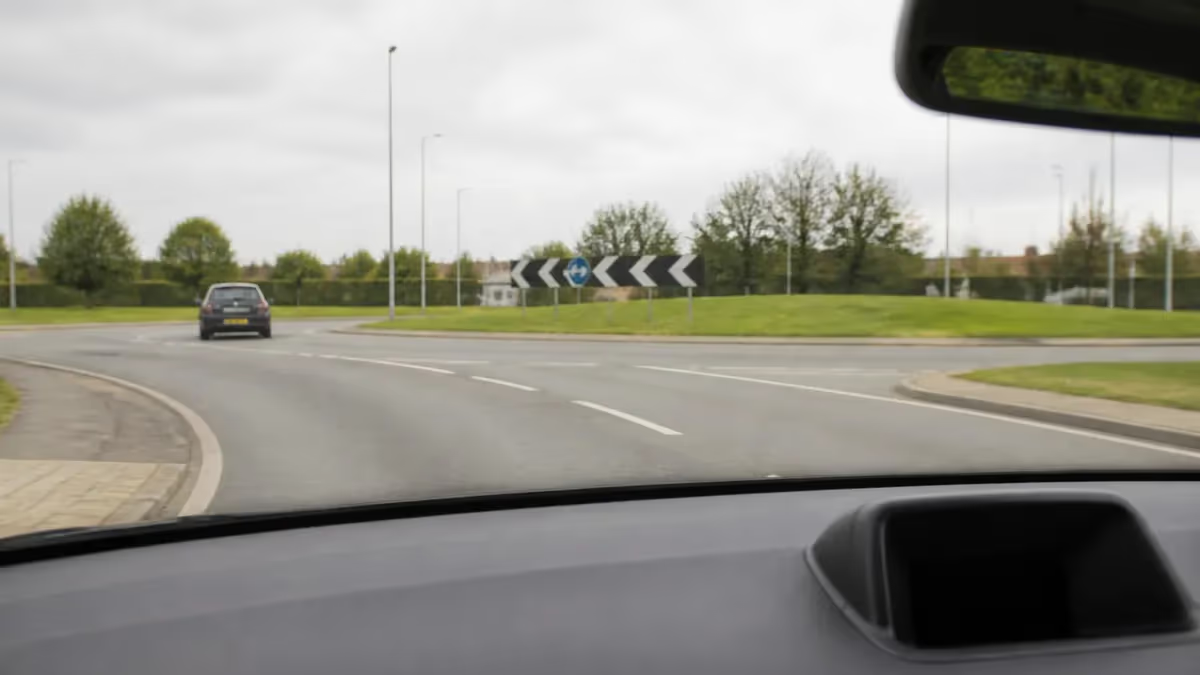
What Is an Intensive Driving Course?
An intensive driving course — sometimes called a crash course — packs all your driving lessons into one or two weeks instead of spreading them over several months. You're looking at roughly 30–40 hours of tuition delivered in daily blocks, usually 4–6 hours per day. At the end, you sit your practical test.
It sounds gruelling, and honestly, it can be. But for plenty of learners, it's the fastest legal route to a full UK driving licence. Students, career changers, and anyone who's already spent time in the passenger seat watching friends drive tend to do particularly well. If you've got the focus and the free time, an intensive course can get you from zero to licence in under two weeks.
That said, it's not a shortcut around the rules. You still need to pass the DVSA theory test before you can book your practical, and the examiner on the day won't cut you any slack just because you crammed. Preparation still matters — a lot.
How Does It Work in Practice?
Most intensive driving courses follow the same basic structure. You book a package with a school or instructor, agree on the week, and show up on day one. Lessons run back-to-back with short breaks. By mid-week you'll be covering dual carriageways, roundabouts, and independent driving. The practical test is usually booked for the Friday or Saturday of that week.
The main stages look like this:
- Day 1–2: Controls, moving off, stopping, basic manoeuvres in quiet roads
- Day 3–4: Town driving, junctions, roundabouts, emerging at busy crossroads
- Day 5–6: Dual carriageways, rural roads, independent driving with a sat-nav
- Day 7+: Mock tests, consolidation, booking the real DVSA practical test
Some providers build in theory test preparation too, though many assume you've already passed it. Check this when you book — if your theory is still outstanding, you'll need to pass it first or your practical test date means nothing.
How Much Does an Intensive Driving Course Cost?
Prices vary quite a bit. A full intensive course — say 30 hours plus a test — typically runs between £800 and £1,500 in the UK. London and the South East sit toward the top of that range. Smaller towns and Northern cities tend to be cheaper.
Here's roughly what you're paying for:
- Instructor time (the biggest cost)
- Use of the instructor's car for the test
- Theory test preparation materials (sometimes)
- Mock test sessions
Booking the DVSA practical test itself costs £62 (weekdays) or £75 (evenings and weekends) — that's on top of your course fee. If you fail and need a retest, you pay again, which is worth factoring into your budget.
Spread over weekly lessons, learning to drive typically costs between £1,200 and £2,000 in total once you add up all the hours. An intensive course isn't necessarily cheaper — but it is faster, and for some people, faster is worth every penny.
Do Intensive Courses Have Lower Pass Rates?
This is the question everyone asks. The honest answer is: it depends on the learner, not just the format.
DVSA doesn't publish pass rate data broken down by lesson format, so there's no definitive national figure. What driving instructors generally report is that intensive learners who've had some prior experience — even informal practice with a parent — tend to do just as well as traditional learners. Complete beginners with no prior road exposure can struggle because muscle memory takes time to build, and two weeks doesn't always give the brain enough consolidation time.
A few things that genuinely affect your chances:
- Prior experience: Even informal practice in a car park helps enormously
- Your theory: Passing the theory test before you start means you're already thinking about road rules, hazard perception, and stopping distances — all of which make you a better learner behind the wheel
- Instructor quality: Check reviews, not just price. A patient, structured instructor makes a massive difference in a compressed timeframe
- Your schedule: Arriving exhausted each day kills retention. Build in sleep and recovery time
One practical tip: if you can take a few weeks to study the Highway Code and use a DVSA driving theory practice test before your course starts, you'll be noticeably more confident on the road. Instructors consistently say theory-prepared students progress faster — you're not learning road rules and physical skills simultaneously.
Theory Test: You Can't Skip It
Before you can sit your practical driving test, you must pass the DVSA theory test. It has two parts:
- Multiple choice: 50 questions, pass mark is 43. You've got 57 minutes. Questions cover the Highway Code, road signs, vehicle safety, and eco-friendly driving.
- Hazard perception: 14 video clips. You click when you spot a developing hazard. Pass mark is 44 out of 75.
The theory test costs £23 and must be passed before DVSA will let you book a practical test. Your certificate is valid for two years — if your practical test date falls outside that window, you'll need to retake the theory.
If you're booking an intensive course, get your theory done first. Most providers won't even schedule your practical test date until they've seen proof you've passed. Don't leave it until the last minute — test centre slots fill up, especially in busy areas.
Finding a Good Intensive Course Provider
There are dozens of national chains and hundreds of independent instructors offering intensive courses. Here's what to look for:
- DVSA-approved driving instructors (ADIs): Every legitimate instructor must be on the ADI register. You can check on the DVSA website. Don't hand money to anyone who isn't registered.
- Clear refund policy: Intensive courses are paid up front. If you fail and need more hours, what happens? Check the terms before you pay.
- Local knowledge: An instructor who knows your local test routes is a real asset. Ask which test centre they typically use and whether they do mock tests on actual test routes.
- Reviews on Google and driving forums: Look for patterns, not just star ratings. Repeated complaints about distracted instructors or poor communication are red flags.
Intensive vs Semi-Intensive: Which Is Right for You?
Not everyone needs to go full throttle. A semi-intensive course — say 2–3 hours per day over three to four weeks — gives you more consolidation time while still getting you to test faster than weekly lessons. If you've got a flexible schedule but can't commit to a full week of solid driving, this middle path often delivers the best of both worlds.
Full intensive works best if you:
- Have a deadline (visa expiry, job start date, university term)
- Already have some road experience
- Can fully commit — no distracting work or social obligations that week
- Learn quickly under pressure and don't freeze under stress
Weekly lessons work better if you:
- Have a tight budget and need to spread costs
- Are a complete beginner with zero road experience
- Need longer to build physical confidence behind the wheel
- Have anxiety about driving that needs gradual exposure to manage
Either way, the end goal is the same: passing the DVSA practical test to the required standard. The route is flexible — the destination isn't.

Preparing Your Theory Alongside Your Course
Even if your intensive course provider handles some theory prep, don't rely on that alone. The theory test catches people out — especially the hazard perception section, which requires a specific clicking rhythm that takes practice to get right. Clicking too early, too late, or too rapidly (the system flags rapid-clicking as cheating) can cost you marks even when you've spotted the hazard correctly.
Here's a simple prep plan you can run alongside booking your course:
- Week before your course: Read the Highway Code cover to cover. Don't skim it — actual test questions are lifted directly from it.
- Every evening during the course: Do 20–30 practice multiple choice questions. Working through real-format questions by topic helps lock in the rules you're applying on the road each day.
- Hazard perception practice: Do at least 5–10 video clips a day. Focus on clicking once when the hazard starts to develop, not when it's fully obvious. The scoring window is often earlier than you expect.
Most people need 10–20 hours of focused theory study to feel genuinely ready. It's not something you can cram the night before — the hazard perception clips in particular need repetition to build reliable pattern recognition.
What the DVSA Practical Test Actually Involves
Knowing exactly what you're being tested on removes a lot of the anxiety. Here's what the examiner assesses:
- Eyesight check: Reading a number plate from 20 metres. Fail this and the test ends immediately.
- Show me, tell me questions: One question while stationary (e.g. how to check tyre pressure), one while driving (e.g. how to demist the rear windscreen).
- General driving ability: Around 40 minutes covering a variety of road types — residential streets, main roads, dual carriageways if available locally.
- Independent driving: Following a sat-nav for about 20 minutes. You won't fail for taking a wrong turn — the examiner wants to see you drive safely, not navigate perfectly.
- A reversing manoeuvre: One of four options — parallel park, bay park (forward or reverse), or pulling up on the right and reversing back two car lengths.
You're allowed up to 15 minor faults. One serious or dangerous fault means an automatic fail. The most common reasons people fail are not checking mirrors effectively, hesitating at junctions when it was safe to go, and misjudging speed on approach to hazards. These are all fixable with practice — which is exactly what your intensive course is designed to deliver.
Good luck. With the right preparation and a decent instructor, an intensive driving course is one of the most efficient routes to getting your licence — and there's nothing quite like that moment when the examiner says you've passed.
About the Author

Licensed Driving Instructor & DMV Test Specialist
Penn State UniversityRobert J. Williams graduated from Penn State University with a degree in Transportation Management and has spent 20 years as a certified driving instructor and DMV examiner consultant. He has personally coached thousands of applicants through written knowledge tests, skills assessments, and commercial driver licensing programs across more than 30 states.