
Driving Crash Course: Cost, Pass Rates & What to Expect 2026 September
🔎 Is a driving crash course right for you? Learn what intensive driving courses cost, how they work, pass rates, and how to choose a provider in the UK.
What Is a Driving Crash Course?
A driving crash course — sometimes called an intensive driving course — is exactly what it sounds like: a concentrated block of lessons designed to get you from learner to test-ready in days or weeks rather than months.
Standard driving lessons typically run one to two hours a week over six months or more. A crash course flips that model. Instead of spreading your learning thin, you drive every day — or close to it — building skills rapidly through repetition and immersion.
You'll still need to pass the same theory test that every learner must take before sitting the practical. The crash course covers the practical element only: vehicle control, manoeuvres, hazard perception on the road, and independent driving.
These courses are offered by driving schools across the UK — some large national providers, some local independents. All legitimate instructors must be approved driving instructors (ADIs) registered with the DVSA.
Crash courses aren't a shortcut around the standard test — you sit the same DVSA practical exam at the end. What changes is the preparation method. Rather than drip-feeding your hours over months, you front-load the work into a defined window. For some learners that's transformative; for others it's overwhelming. Knowing which camp you're in before you book matters more than the price per hour.
The term "crash course" is sometimes used interchangeably with "intensive course" or "fast-track lessons". Providers use all three. What they share: a structured daily schedule, a pre-booked test slot, and the promise of a driving licence faster than the conventional route allows.
How Do Crash Courses Actually Work?
Most crash courses follow a similar structure: an intensive block of driving hours spread across consecutive days, finishing with a practical test date already booked into the schedule.
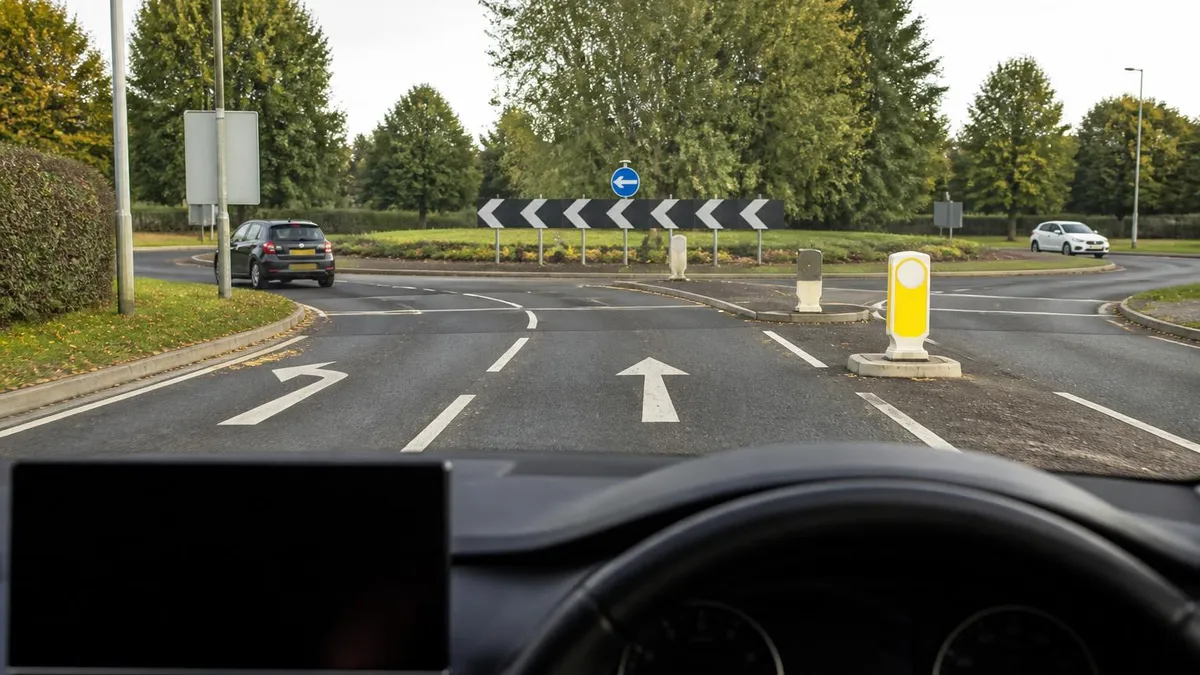
The typical package looks like this — 30 to 40 hours of tuition delivered over one to two weeks, Monday to Friday, sometimes including a Saturday. Each day you'll drive for five to seven hours, broken into sessions with short breaks. You'll cover everything from basic controls through to dual-carriageway driving, roundabouts, and reverse manoeuvres.
When you book driving test slots through a crash course provider, the test date is usually pre-arranged as part of the package. This removes the uncertainty of hunting for an available slot — though it does mean the timeline is fixed from the start.
Before the course begins, most providers will ask you to complete a pre-assessment drive. This helps the instructor gauge your starting level so they can tailor the week accordingly. If you've driven before — even informally — that experience counts.
Reputable schools are honest about what the assessment reveals. If you need more hours than the standard package, they'll tell you upfront rather than letting you head into test week unprepared.
Rest days matter. Most providers build in a day off mid-week — not as a luxury, but because learning consolidates during sleep. Driving for seven hours straight every single day without any mental recovery can actually slow your progress in the final days before the test. A good schedule balances intensity with rest.
Driving Crash Course — Key Numbers
How Much Does a Driving Crash Course Cost?
Cost is one of the first things people ask — and it's worth understanding what you're actually paying for. A full crash course package typically includes all tuition hours, an instructor's car for the test, and the practical test fee itself (currently £62 for weekday tests).
Expect to pay £800 to £1,200 for a standard 30-hour course with a weekday test. Intensive packages with 40 hours or more — common for complete beginners — can reach £1,300 to £1,500 or beyond.
That sounds expensive compared to weekly lessons, but the arithmetic is closer than it appears. At £35 to £40 per hour for standard lessons, 45 hours of tuition alone costs £1,575 to £1,800 before you even factor in the test fee. Crash courses are often priced at a lower per-hour rate because instructors can plan their diary efficiently.
What the headline price doesn't always include: the theory test fee (£23), any pre-course practice, or additional hours if your assessment reveals you need more preparation. Always check the small print before paying a deposit.
Weekend and evening availability costs more — typically an additional £3 to £5 per hour. If your crash course spans a Saturday test, that premium applies to both tuition and the test fee itself. Factor those extras in early rather than being surprised at the invoice stage.
Deposits vary widely between providers. Some ask for 20% upfront and balance on the day. Others take full payment in advance. Check the cancellation terms carefully — a good provider will offer a partial refund if you need to pull out before the course starts, and a flexible rescheduling option if illness strikes mid-week.
What's Included in a Crash Course Package
- Tuition hours: 30 hours over 5–6 days
- Test included: Yes — weekday practical test
- Typical cost: £800–£1,100
- Best for: Learners with some prior experience
- Tuition hours: 40 hours over 7–10 days
- Test included: Yes — weekday or Saturday test
- Typical cost: £1,100–£1,500
- Best for: Complete beginners or nervous drivers
- Tuition hours: 20 hours over 2–3 weeks
- Test included: Sometimes — check with provider
- Typical cost: £550–£800
- Best for: Learners with solid foundations already
Pros and Cons of Crash Courses
Crash courses aren't the right choice for everyone. Understanding where they excel — and where they fall short — helps you make a clear-headed decision before spending over a thousand pounds.
The strongest argument in favour is speed. If you need a licence quickly for a new job, a move abroad, or a personal deadline, a crash course is the most direct route. You're not waiting months to accumulate hours one lesson at a time.
There's also a genuine learning advantage for some people. Spacing lessons weeks apart means constantly relearning habits that faded between sessions. Daily driving keeps your skills fresh and builds confidence faster through sheer repetition.
Driving Crash Course Pros and Cons
- +Pass quickly — get licence in weeks rather than months
- +No skill fade between sessions — daily practice builds confidence fast
- +Good for nervous drivers who benefit from immersive, continuous learning
- +Test date booked upfront — removes the uncertainty of finding a slot
- +Often cheaper per hour than spread-out weekly lessons
- +Works well for candidates with some prior driving experience
- −Higher upfront cost — £800–£1,500 in one go versus smaller weekly payments
- −Mentally and physically exhausting — driving all day every day is demanding
- −Pass rates are lower on average than traditional lesson candidates
- −You must still pass the theory test first — it's not included in practical packages
- −Limited time to consolidate complex skills like motorway driving or night driving
- −Inflexible schedule — illness or poor conditions can derail your test date
How to Choose a Crash Course Provider
The quality of crash course providers varies enormously. Some are exceptional — experienced ADIs who tailor each day to your progress and give honest feedback. Others prioritise volume over results, taking your money without caring whether you actually pass.
The first thing to check: is every instructor an approved driving instructor? ADIs are registered with the DVSA, hold a green badge, and are legally authorised to take payment for lessons. Trainee instructors hold a pink licence and can teach — but they're supervised. For a crash course, you ideally want a fully qualified ADI with specific crash-course experience.
Before you commit to a driving test package, ask the provider directly about their pass rate. Reputable schools track this and will share it. Be wary of vague answers or promises that sound too good — first-time pass rates above 70% for crash courses are genuinely rare.
Look at independent reviews on Google, Trustpilot, or the DVSA's Find a driving school tool. Pay attention to reviews mentioning communication and transparency rather than just the pass/fail outcome — a school that handles difficult news well is worth more than one that only posts success stories.
Ask how many hours they recommend for your starting level. A school that books you onto a 30-hour course without a pre-assessment is cutting corners. Your actual needs depend on your starting ability, not a one-size-fits-all package.
Geography matters too. A crash course with a national provider sounds reassuring, but you want an instructor who knows the specific roads, junctions, and test routes around your local test centre. A local independent with a strong regional reputation often outperforms a national chain on that front. Ask whether your instructor has personally accompanied candidates at the same test centre your practical will use.
What to Ask a Crash Course Provider Before Booking
- ✓Are all instructors fully qualified ADIs with green badges?
- ✓What is your first-time pass rate for crash course students specifically?
- ✓Do you carry out a pre-assessment before the course starts?
- ✓What happens if I need more hours — is there a top-up option?
- ✓Is the practical test fee included or charged separately?
- ✓What is your cancellation and refund policy if I fall ill?
- ✓Will I have the same instructor throughout the course?
- ✓How do you handle it if the test date needs to change?
Pass Rates and Realistic Expectations
This is where many learners get a shock. Crash course providers sometimes advertise impressive pass rates, but the national picture is more sobering.
The UK's overall first-time practical test pass rate sits at around 47%. For intensive course candidates, independent research and driving school data consistently puts first-attempt rates lower — typically 35% to 45% depending on the provider and region.
Why the gap? Crash courses compress learning, but they can't compress the depth of experience. Motorway driving, driving at night, handling unexpected hazards in unfamiliar areas — these things develop naturally over months of varied driving. A two-week crash course simply can't replicate all of that.
That doesn't mean crash courses produce bad drivers. Many crash course candidates go on to become safe, confident drivers. It just means you should plan for the possibility of a first-time fail — and factor that into your budget. A resit test costs £62, and you may want a top-up lesson or two before going again.
The factors that most reliably predict crash course success: prior driving experience (even informal), age 25 and under (young learners tend to adapt fast), a calm approach to pressure, and choosing a high-quality provider with a trackable pass rate.
One underappreciated factor is test centre difficulty. Some centres are notoriously harder than others — more complex junctions, busier traffic, higher local fail rates. Your crash course provider should know which local centre is being used and can brief you on its specific quirks. Always ask which test centre your package is booked at and whether they've taught there before.
Don't be discouraged if you don't pass first time. A focused top-up session with the same instructor who knows your weaknesses — followed by a resit — often produces a clean result. Many drivers who struggle on their crash course test go on to pass comfortably on the second attempt once the initial pressure lifts.
Crash Course Pass Rates by Candidate Profile
First-time drivers with zero experience face the steepest challenge on a crash course. The sheer volume of new information — controls, road positioning, hazard responses — is a lot to absorb in a week. Pass rates for complete beginners on 30-hour courses typically fall in the 30–40% range on the first attempt.
If you're a complete beginner, consider a longer 40-hour package or a semi-intensive course spread over three weeks rather than one. That extra consolidation time makes a meaningful difference.
Crash Course vs Traditional Lessons — Which Is Right for You?
There's no universal answer. The right choice depends on your learning style, budget, timeline, and starting ability.
Traditional lessons — one or two hours a week over several months — give you time to consolidate each skill before the next lesson. You develop a natural familiarity with driving in different conditions: early morning school runs, wet evenings, busy town centres. That variety is hard to replicate in a week.
Crash courses win on speed and focus. If you can commit to full days of driving and your schedule allows a dedicated week or two, the immersive nature accelerates certain skills remarkably fast. You won't be starting from scratch every lesson, trying to remember what you did two weeks ago.
Consider a semi-intensive approach if neither extreme fits: a block of lessons over two to three weeks, perhaps two to three hours per day, with a driving theory test already in your back pocket. This gives you the intensity benefits without the all-or-nothing pressure of a single test week.
If cost is the deciding factor, do the full calculation. At £38 per hour for standard lessons, 45 hours costs £1,710 — more than most crash course packages. But if you need 60+ hours (common for anxious or slow-progress learners), traditional lessons can work out cheaper per qualification.
One thing that remains constant regardless of which route you take: you'll need to sort out your driving test booking in advance, since test centre slots can be weeks or months away in busy areas.
People who tend to do well on crash courses share some common traits — they're self-motivated, they don't freeze under pressure, they can absorb feedback quickly without getting discouraged, and they've done some background reading on the Highway Code before turning up. If that sounds like you, the intensive format suits your learning style. If you know you need time to let things sink in before moving forward, weekly lessons will serve you better.
Think honestly too about your practical situation. A crash course demands your full attention for an entire working week — no afternoon commitments, no distractions. If you're juggling a demanding job, young children, or a difficult commute, the traditional weekly lesson structure is more sustainable even if it takes longer overall.
Typical Crash Course Week — What to Expect Day by Day
Day 1 — Assessment & Fundamentals
Day 2 — Town Driving & Junctions
Day 3 — Manoeuvres & Bay Parking
Day 4 — Rural Roads & Dual Carriageways
Day 5 — Mock Tests & Consolidation
Test Day — Practical Exam
Theory Test — Don't Leave It Until the Last Minute
One thing catches people off guard: you cannot sit your practical driving test until you've passed the theory test. This isn't something crash courses can work around.
The theory test has two parts — a multiple-choice section (50 questions, need 43 to pass) and a hazard perception section (14 video clips). You need to pass both in the same sitting. Most candidates take two to four weeks of focused preparation before attempting it.
If you're planning a crash course, book your theory test first. You need the theory test pass certificate number to book a practical test date. Providers can't lock in a test slot without it — so leaving it until after you've signed up for the course means potentially paying for a course with no test at the end.
Prepare for the theory element separately using official DVSA materials, mock tests, and hazard perception practice. The more thoroughly you know the Highway Code before your crash course begins, the better you'll drive — theory knowledge directly supports practical awareness on the road.
Your theory pass is valid for two years from the date you pass it. If you passed the theory test ages ago but kept putting off lessons, check your certificate date. If it's expired, you'll need to resit before any practical test can be booked — crash course included. Don't assume an old pass is still current.
The good news: theory test preparation is straightforward with consistent daily practice. Apps, official DVSA mock tests, and the Highway Code itself are the core tools. Get this sorted before you spend a penny on practical training — it removes one major variable from your crash course timeline.
Driving Crash Course Questions and Answers
About the Author

Licensed Driving Instructor & DMV Test Specialist
Penn State UniversityRobert J. Williams graduated from Penn State University with a degree in Transportation Management and has spent 20 years as a certified driving instructor and DMV examiner consultant. He has personally coached thousands of applicants through written knowledge tests, skills assessments, and commercial driver licensing programs across more than 30 states.