
How to Become CPR Certified: Steps, Costs, and What to Expect 2026 October
📝 Learn how to become CPR certified through the American Red Cross, AHA, or online providers. Covers class types, costs, what to expect, and renewal.
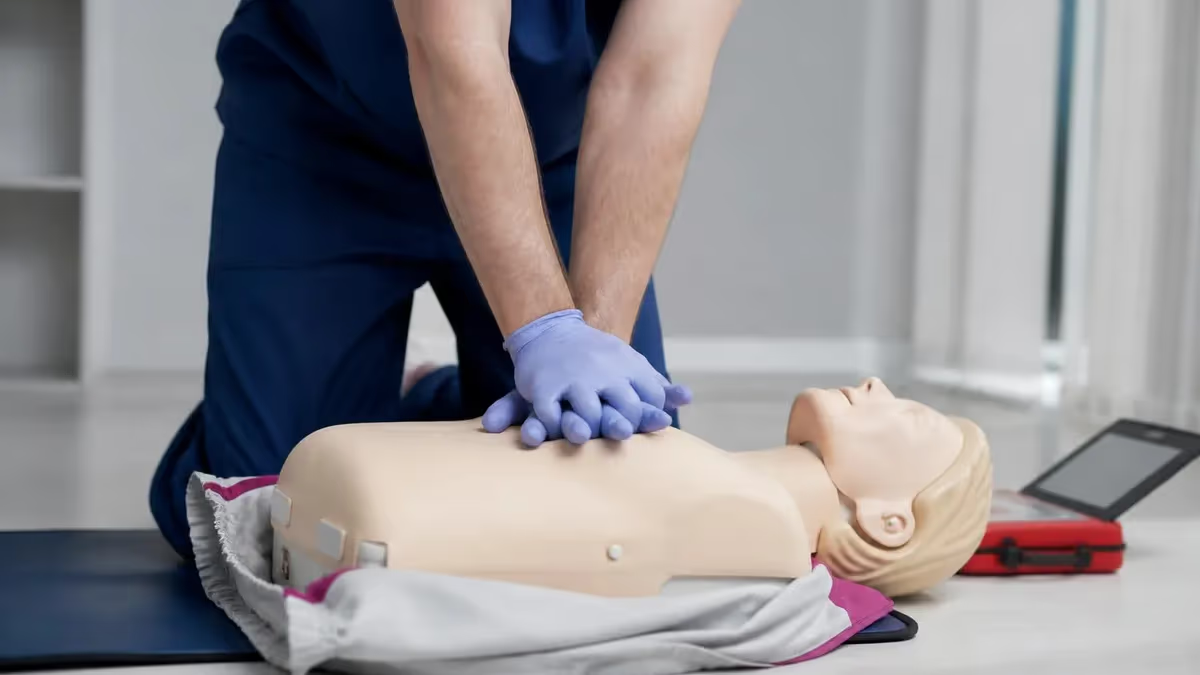
How to Become CPR Certified
You don't need a medical degree, a healthcare background, or even any first aid experience to become CPR certified. Most people put it off because they assume it's a complicated or time-consuming process, but the reality is that you can walk into a class as a complete beginner and walk out a few hours later with a certification card and the ability to save someone's life.
The skills involved — chest compressions at the right depth and rate, rescue breathing, and using an automated external defibrillator — are physical and practical rather than academic. If you can kneel on the floor and press your hands on a manikin's chest, you can learn CPR.
Getting CPR certified is simpler than most people expect — the process typically takes one day or less, costs between $25 and $100, and doesn't require any medical background or prior training. You attend a course offered by a recognised provider (the American Red Cross, the American Heart Association, or another accredited organisation), learn the techniques through a combination of instruction and hands-on practice, demonstrate competence in a skills assessment, and receive a certification card that's valid for two years.
The reason so many people seek CPR certification goes beyond professional requirements, though workplace mandates are a common motivator. Cardiac arrest happens without warning — roughly 350,000 out-of-hospital cardiac arrests occur in the United States each year, and bystander CPR can double or triple a victim's chance of survival. Knowing CPR means being able to act in those critical minutes before emergency medical services arrive. It's a skill with an unusually direct connection between training and real-world impact.
Several types of CPR certification exist, and the one you need depends on your situation. Healthcare providers (nurses, paramedics, doctors, dental staff) need BLS (Basic Life Support) certification, which covers adult, child, and infant CPR plus the use of bag-mask devices and teamwork in clinical settings. Non-healthcare professionals typically take the Heartsaver CPR/AED course, which covers adult CPR and AED (automated external defibrillator) use, with optional child and infant modules. Community-level courses cover the basics for anyone who simply wants to be prepared.
This guide walks through the full process: choosing a provider and course type, what happens during the class, what the skills test involves, how much it costs, and how long does cpr certification last once you've earned it. Whether you're getting certified for the first time or renewing an existing certification, the steps are essentially the same.
- Time to complete: Most CPR courses take 2–5 hours (Heartsaver CPR/AED is typically 3–4 hours; BLS for healthcare providers is 4–5 hours)
- Cost: $25–$100 depending on provider, course type, and location — some employers and community organisations offer free courses
- Prerequisites: None — no medical background, education, or prior training required for standard CPR courses
- Certification valid for: 2 years from the date of completion for most providers (AHA and Red Cross both use 2-year cycles)
- Major providers: American Heart Association (AHA), American Red Cross, National CPR Foundation, ASHI (American Safety & Health Institute)
- Online option: Blended courses (online learning + in-person skills session) are available; fully online courses exist but may not be accepted by all employers
- What you learn: Chest compressions, rescue breathing, AED use, choking relief — adult, child, and/or infant depending on the course
Steps to Get CPR Certified
Step 1: Choose Your CPR Course Type
Step 2: Select a Provider
Step 3: Register and Attend the Course
Step 4: Complete the Skills Assessment
Step 5: Receive Your Certification Card
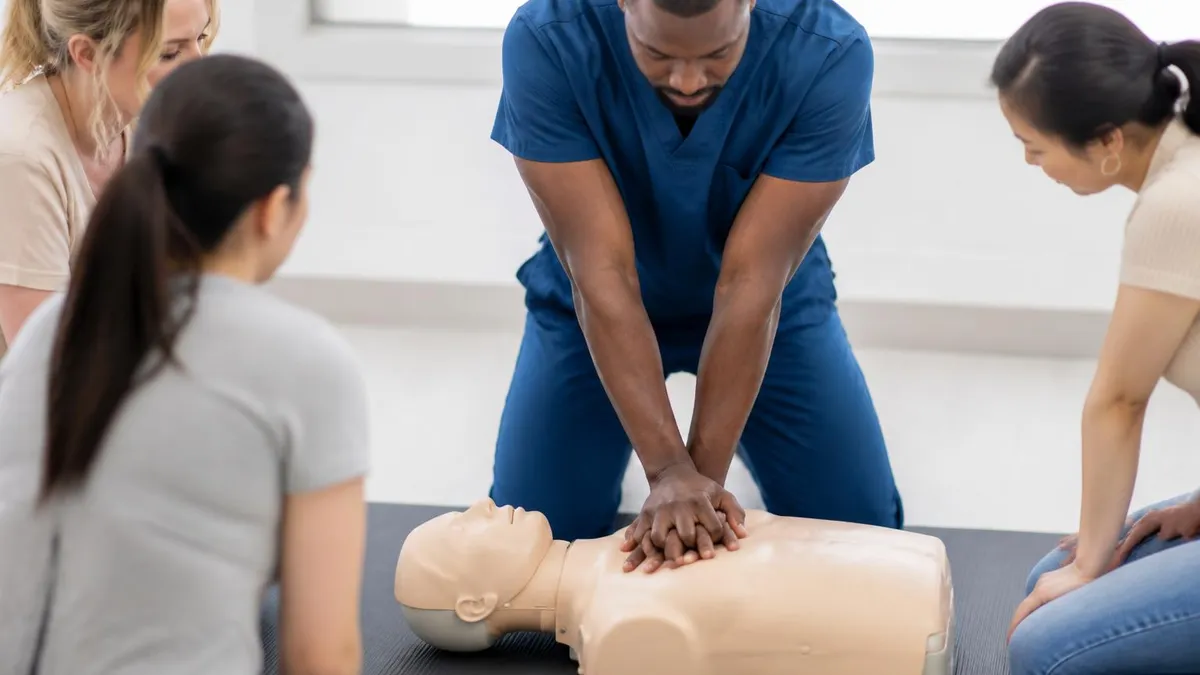
Choosing Between CPR Providers: AHA vs Red Cross vs Others
The American Heart Association (AHA) and the American Red Cross are the two largest and most widely recognised CPR certification providers in the United States. Both offer high-quality training, both are accepted by virtually all employers and licensing bodies, and both issue certifications valid for two years. The choice between them often comes down to class availability in your area, scheduling convenience, and whether your employer specifies a preference.
The AHA's BLS course is the standard for healthcare professionals — hospitals, medical schools, nursing programmes, and dental offices overwhelmingly require AHA BLS certification specifically. If you're entering a healthcare field, AHA is almost always the right choice. The AHA's Heartsaver line serves non-healthcare workers and is widely accepted in corporate, educational, and recreational settings. You can find heart association cpr classes through the AHA website's class locator tool by entering your ZIP code.
The American Red Cross offers equivalent courses under different names — Adult and Pediatric First Aid/CPR/AED is their flagship non-healthcare course, and BLS for Healthcare Providers is their healthcare equivalent. Red Cross classes tend to be slightly more available in rural areas and community settings, and the Red Cross brand is particularly strong in workplace and volunteer contexts. Red Cross also offers a strong blended learning platform where you complete the classroom portion online before attending a shorter in-person skills session.
The national cpr foundation and other providers like ASHI offer certifications that are generally accepted by most employers, though some healthcare employers may specifically require AHA or Red Cross. These alternative providers often offer lower prices and more flexible scheduling, including fully online courses. If your certification is for personal preparedness rather than a specific employer requirement, any accredited provider is suitable. If it's for work, confirm with your employer which providers they accept before paying for a course.
One factor worth considering when choosing a provider is the renewal experience. Since CPR certification expires every two years, you'll be taking renewal courses repeatedly throughout your career. Providers that offer convenient scheduling, nearby locations, and blended renewal options make the ongoing commitment easier to manage. Building a relationship with a local training centre — or sticking with the same provider's platform for renewals — creates consistency that simplifies the process each time your certification comes due.
CPR Course Types Explained
Designed for anyone who wants or needs CPR training but doesn't work in healthcare: teachers, coaches, personal trainers, office workers, parents, daycare staff, lifeguards. Covers adult CPR and AED use, with optional child and infant modules. Typically 3–4 hours for the full course. This is the right course for most workplace CPR requirements outside of healthcare settings. The skills test involves demonstrating adult CPR on a manikin and using a training AED.
Required for healthcare professionals and students in nursing, medical, dental, and allied health programmes. Covers adult, child, and infant CPR, 2-rescuer CPR, bag-mask ventilation, AED use, and team dynamics. More intensive than Heartsaver — typically 4–5 hours with more rigorous skills assessment. The written test covers algorithms and clinical decision-making. If you work in a hospital, clinic, dental office, or EMS setting, this is the certification you need.
Combines CPR and AED training with first aid skills — wound care, burns, allergic reactions (epinephrine auto-injector use), poisoning, heat and cold emergencies, and musculoskeletal injuries. Takes 5–7 hours for the full course. Many schools, daycare centres, and youth organisations require this combination certification for staff. The CPR component is identical to the standalone CPR/AED course; the first aid component adds breadth.
Both AHA and Red Cross offer blended courses: complete the knowledge portion online at your own pace (usually 1–2 hours of video instruction and quizzes), then attend a shorter in-person session (1–2 hours) for hands-on skills practice and assessment. The in-person component is mandatory — CPR certification requires demonstrating physical skills on a manikin. Blended learning reduces the in-person time commitment while still ensuring you can perform CPR correctly.
What to Expect During a CPR Class
CPR classes typically begin with video-based instruction showing the correct techniques, followed by instructor-led discussion and demonstration.
- Chest compressions: Correct hand placement on the centre of the chest (lower half of the sternum), compression depth (at least 2 inches for adults), compression rate (100–120 per minute), and allowing full chest recoil between compressions
- Rescue breathing: Head tilt-chin lift to open the airway, mouth-to-mouth or mouth-to-mask ventilation, the 30:2 compression-to-breath ratio for adult CPR
- AED use: How to turn on an AED, apply the pads correctly, clear the victim before shock delivery, and resume CPR after a shock
- Choking relief: Abdominal thrusts (Heimlich manoeuvre) for conscious adults and children; back blows and chest thrusts for infants
- Child and infant differences: Smaller compression depth, modified hand position, adjusted ventilation volume
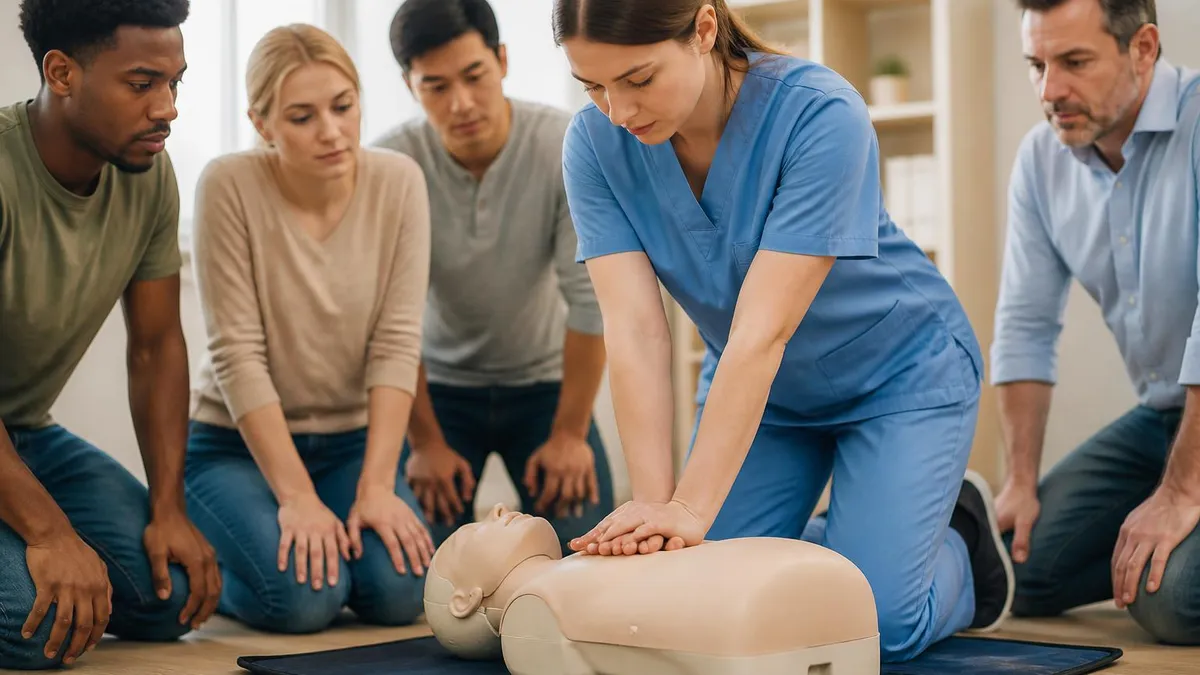
CPR Certification Costs and Where to Find Free Classes
CPR certification costs range from about $25 to $100 for standard courses, with variation based on the provider, course type, location, and whether materials are included. AHA Heartsaver courses typically cost $40–$75. AHA BLS courses are usually $50–$85. Red Cross courses fall in a similar range. These prices usually include the certification card and access to any online materials or study guides.
Free CPR classes are available through several channels. Many fire departments offer free community CPR classes — call your local fire station to ask about upcoming sessions. Some employers pay for employee CPR certification as part of workplace safety programmes. Community organisations, YMCAs, and public libraries occasionally host free CPR events, particularly during Heart Month (February) and Cardiac Arrest Awareness Month (October). If cost is a barrier, these community options make certification accessible without any out-of-pocket expense.
Some local chapters of the American Red Cross also offer reduced-rate classes for students, military families, and low-income residents — ask about financial assistance when contacting a training centre. CPR certification shouldn't be something people skip because of a $50 fee when free or discounted options are widely available.
Wondering how long is cpr training? Standard in-person courses run 3–5 hours depending on the type. Blended courses reduce the in-person component to 1–2 hours after completing the online portion at home. The time investment is minimal relative to the value of the skill — and the certification is valid for two years, so you're committing to one session every 24 months.
Group rates are another way to reduce costs. If your workplace needs multiple employees certified, most providers offer discounts for group bookings — and many will send an instructor to your location rather than requiring employees to travel to a training centre. For organisations with 10 or more employees needing certification, on-site group training is often the most cost-effective approach and minimises the disruption of sending staff to external classes during work hours. Ask providers about group pricing when booking for teams.
Before Your CPR Class: What to Bring and Know
- ✓Bring a government-issued photo ID — most providers require identity verification before issuing certification
- ✓Wear comfortable clothing that allows you to kneel on the floor — CPR practice involves kneeling beside a manikin for extended periods
- ✓Arrive 10–15 minutes early to complete any registration or paperwork before the class starts
- ✓If you booked a blended course, complete the entire online portion BEFORE your in-person session — you won't be able to participate in the skills session if the online component isn't done
- ✓No medical background or prior training is required — CPR courses are designed for complete beginners
- ✓If you have physical limitations (knee or back problems), let the instructor know at the start — accommodations are available
- ✓Bring a pen or pencil if a written knowledge test is part of your course — some providers use paper tests rather than digital
- ✓Know which specific certification your employer requires (if applicable) — confirm the course name and provider before registering
In-Person vs Online CPR Certification
- +In-person classes provide hands-on practice with manikins and AED trainers under direct instructor guidance — this is the gold standard for learning physical skills like chest compressions
- +Blended courses (online + in-person) offer the best of both: flexible self-paced learning for knowledge content, with the essential hands-on component for skills verification
- +Fully online CPR courses are the most flexible and typically the cheapest — useful for personal awareness, though not all employers accept them
- +Group classes in a workplace setting can be cost-effective for employers and build team confidence — training together means coworkers can support each other in a real emergency
- −Fully online CPR courses don't include hands-on skills practice, which means you've never actually performed compressions on a manikin — and this matters when real technique is needed in an emergency
- −In-person classes require scheduling and travel — finding a class at a convenient time and location can be challenging in some areas
- −Some employers, licensing boards, and educational institutions specifically reject fully online certifications — always verify acceptance before paying for a course
- −Renewal every two years means repeating the process regularly — if convenience drives your choice, consider whether the same provider offers easy renewal scheduling
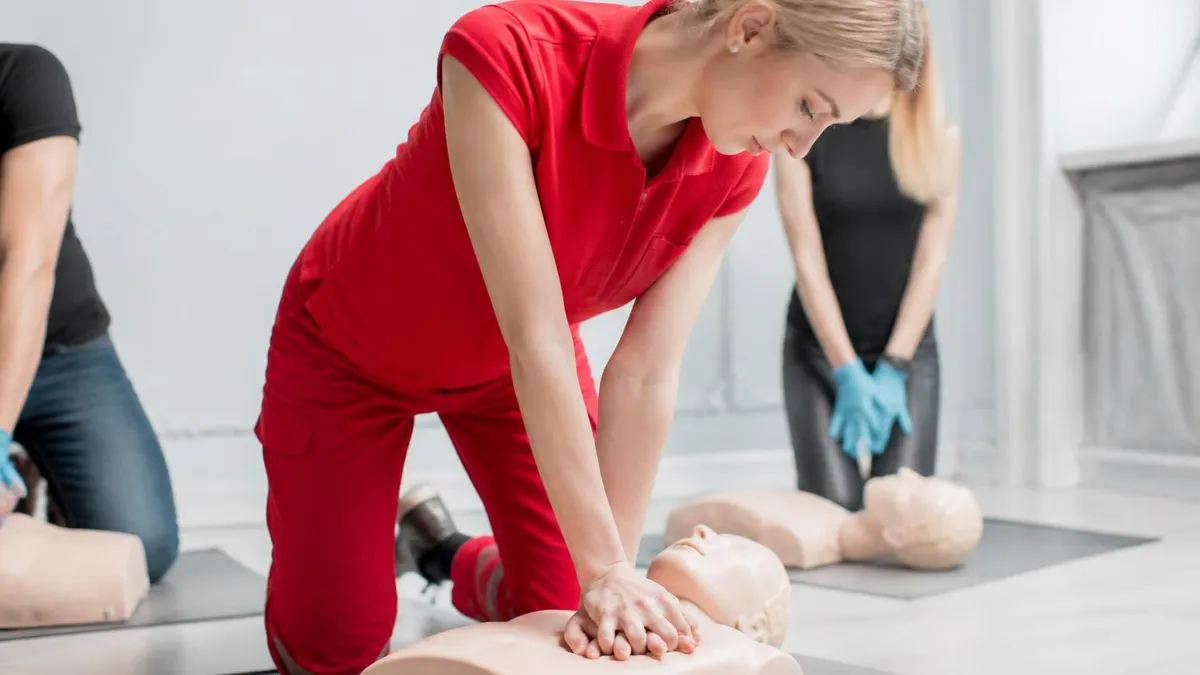
Renewing Your CPR Certification
CPR certifications from the AHA, Red Cross, and most other providers expire after two years. Renewal isn't automatic — you need to take a renewal course (sometimes called a refresher or recertification course) before your current certification expires. Renewal courses are shorter than initial certification courses because they assume you already have foundational knowledge and are refreshing your skills and learning any updated guidelines.
AHA renewal courses typically take 2–3 hours (compared to 4–5 for initial BLS certification). Red Cross renewal courses are similarly abbreviated. Renewal costs are usually slightly less than initial certification — expect to pay $30–$60 for a renewal class. Both providers offer blended renewal options with an online knowledge refresher followed by a brief in-person skills check.
If your certification has already expired, you can still renew — but some providers treat expired certifications as new enrollments, meaning you take the full initial course rather than the shorter renewal. The AHA allows renewal up to 30 days after expiration without penalty. Beyond that, policies vary by provider and by the specific training centre.
To avoid complications, set a calendar reminder for 1–2 months before expiration and book your renewal class early. For healthcare workers whose employment depends on current certification, letting it lapse even briefly can mean being pulled from clinical duties until the renewal is complete — a disruption that's entirely avoidable with basic calendar management.
If you're considering cpr renewal online, blended renewal courses are widely available and accepted by most employers. Fully online renewal courses exist but carry the same acceptance limitations as fully online initial certifications — verify with your employer before choosing this route.
The in-person skills component of a blended renewal is typically just 30–60 minutes, making it a minimal time commitment. CPR guidelines are updated periodically by the AHA — most recently in 2020 — so renewal courses also serve to keep you current on any changes to compression ratios, ventilation techniques, or AED protocols that have been revised since your last certification.
CPR Certification: Key Numbers
Key Facts at a Glance
| Item | Value | Details |
|---|---|---|
| Standard CPR certification validity period — both AHA and Red Cross certifications expire after 2 years and require a renewal course to maintain | 2 years | |
| Typical duration of a standard in-person CPR certification course — Heartsaver CPR/AED is 3–4 hours; BLS for Healthcare Providers is 4–5 hours | 3–5 hours | |
| Cost range for CPR certification courses — varies by provider, course type, and location. Free classes available through fire departments, employers, and community events | $25–$100 | |
| Minimum chest compression depth for adult CPR — at least 2 inches (5 cm) but no more than 2.4 inches (6 cm). Adequate depth is a key skill assessed during the certification skills check | 2 inches |
Who Needs CPR Certification?
CPR certification is required for a wide range of professions and situations — and it's valuable for many more where it isn't strictly mandatory. Understanding whether you need it (and which specific type) helps you choose the right course without overpaying or under-qualifying.
Healthcare professionals almost universally require BLS certification: nurses, doctors, paramedics, EMTs, dental hygienists, medical assistants, physical therapists, and pharmacy technicians are typically required to maintain current BLS certification as a condition of employment or licensure. Healthcare students (nursing, medical, dental, PT, OT programmes) must obtain BLS certification before clinical rotations begin — most programmes specify AHA BLS specifically.
Outside healthcare, CPR certification is required or strongly expected for teachers and school staff (many states mandate it), daycare and childcare workers, personal trainers and fitness instructors (most certifying bodies require it), lifeguards (along with additional water rescue training), coaches and sports officials, construction and manufacturing workers (OSHA encourages it), flight attendants, and law enforcement officers.
Many of these roles require the Heartsaver CPR/AED or First Aid/CPR/AED combination rather than the more intensive BLS. Some industries have additional CPR-adjacent requirements: lifeguards need waterfront or waterpark rescue modules alongside standard CPR, and childcare workers in some states need paediatric-specific certification covering infant CPR and choking relief at a greater depth than standard adult-focused courses. Check your state's specific licensing requirements for your role to ensure you take the correct course variant.
For parents, caregivers, and anyone who simply wants to be prepared, CPR certification is purely voluntary but highly recommended. Cardiac arrest can happen to family members, colleagues, strangers on the street, or neighbours. Having the confidence and skill to act — rather than standing by waiting for paramedics — can be the difference between life and death. Community CPR courses and the heart association cpr classes specifically designed for non-professionals make this accessible to everyone.
There's a practical distinction between being CPR trained and being CPR certified. Training means you've learned the skills but don't hold a formal credential. Certification means you've completed an evaluated course and hold a card from a recognised provider proving your competence. For workplace requirements, the certification card matters — your employer needs proof. For personal readiness, training is what counts. That said, going through the certification process rather than just watching instructional videos ensures you've actually practised the physical skills under guidance, which makes a genuine difference when you need to perform CPR for real.
Before paying for a fully online CPR course, verify that your employer, school, or licensing body accepts online-only certification. Many employers and healthcare regulatory bodies require hands-on skills demonstration on a manikin as part of CPR certification — which fully online courses don't include. Blended courses (online knowledge + in-person skills) are widely accepted and are a legitimate time-saving option. Fully online courses with no in-person component are appropriate for personal awareness but may be rejected for professional requirements. Always confirm acceptance BEFORE registering to avoid wasting money on a certification your employer won't honour.
What Happens After You're CPR Certified
With your CPR certification card in hand, you're now qualified to perform CPR and use an AED in an emergency. But certification is a starting point, not an endpoint. The skills you learned in class are perishable — research shows that CPR skills begin to degrade within a few months if not practised. Occasional mental rehearsal (reviewing the steps in your head), watching refresher videos, or practising hand placement and compression rhythm can help maintain your readiness between certification renewals.
Good Samaritan laws in all 50 U.S. states provide legal protection to bystanders who provide emergency CPR assistance in good faith. You can't be sued for performing CPR on someone who's in cardiac arrest, even if they sustain an injury during the process (broken ribs are common during proper CPR and are expected). This legal protection is specifically designed to encourage trained bystanders to act rather than hesitate out of fear of liability.
Consider keeping an AED accessible if you're responsible for a facility, workplace, or community space. AEDs are designed for use by trained laypersons — and your CPR certification includes AED training. Many public places now have wall-mounted AEDs, and portable AEDs for home use are available for purchase. An AED combined with CPR dramatically increases the chance of survival from sudden cardiac arrest compared to CPR alone.
Beyond the practical skills, CPR certification changes your relationship with emergencies. Before training, most people freeze when they witness a cardiac arrest or choking emergency — the uncertainty about what to do creates paralysis. After certification, you have a mental framework: check responsiveness, call 911, start compressions, use the AED, continue until help arrives. That structured response replaces panic with action. It doesn't make you a paramedic, but it makes you capable of doing the one thing that matters most in those first few minutes — keeping blood flowing to the brain until professional help takes over.
How to Become CPR Certified Questions and Answers
About the Author

Registered Nurse & Healthcare Educator
Johns Hopkins University School of NursingDr. Sarah Mitchell is a board-certified registered nurse with over 15 years of clinical and academic experience. She completed her PhD in Nursing Science at Johns Hopkins University and has taught NCLEX preparation and clinical skills courses for nursing students across the United States. Her research focuses on evidence-based exam preparation strategies for healthcare certification candidates.