
CPR and AED: The Complete Guide to Saving Lives in Cardiac Emergencies
Learn how CPR and AED work together to restart a stopped heart. ❓ Step-by-step guide, ratios, pad placement, and survival rates explained clearly.
Why CPR and AED Together Beat Either Alone
Sudden cardiac arrest kills roughly 350,000 people outside hospitals in the United States every year. The grim truth? Survival drops about 10 percent for every minute that passes without help. But here is the part most folks miss: chest compressions alone rarely restart a chaotic heart rhythm. You need electricity for that, and the AED delivers it.
Think of CPR and AED as two halves of the same rescue. CPR keeps oxygen-rich blood moving to the brain. The AED reads the heart and, if needed, shocks it back into rhythm. Skip one, and the other loses much of its power. Combine them inside the first five minutes, and survival rates can climb above 40 percent in some communities. That is a staggering difference.
You do not need a medical license. You do not need years of training. What you need is the willingness to act, a basic grasp of the steps, and the confidence to push hard on a stranger chest while someone else fetches the nearest defibrillator. This guide walks you through every piece, plain and simple, so you can step in when it matters.
Cardiac Arrest by the Numbers
What Cardiac Arrest Actually Is
People mix up cardiac arrest and heart attack constantly, and the confusion can cost lives. A heart attack is a plumbing problem: a blocked artery starves heart muscle of blood. The person is usually awake, in pain, sweating, scared. A cardiac arrest is an electrical problem. The heart stops pumping. The person collapses, stops breathing normally, and within seconds becomes unresponsive.
Heart attacks can trigger cardiac arrest, but they are not the same event. You can have one without the other. The reason this matters is simple. CPR and an AED are useless during a typical heart attack where someone is conscious. They are everything during cardiac arrest. Knowing the difference tells you when to start compressions and when to call 911 and keep the person calm.
Signs of arrest are blunt. The person drops. They do not respond when you shake or shout. Breathing is absent or comes as gasping, jerky sounds called agonal respirations. Do not wait for textbook signs. If you are unsure, treat it as arrest and start CPR. The worst case is a bruised chest on someone who turned out fine. The best case is a life saved.
The American Heart Association built a five-link chain to describe what gives someone the best shot at walking out of the hospital after cardiac arrest. Each link depends on the one before it.
- Link 1: Recognize the emergency and call 911 immediately
- Link 2: Start high-quality CPR within seconds
- Link 3: Rapid defibrillation with an AED
- Link 4: Advanced care from paramedics and the hospital
- Link 5: Post-arrest recovery and rehabilitation
Bystanders own the first three links. That is why your training matters more than any expensive equipment a hospital owns.
The First 60 Seconds: A Step-by-Step Response
Speed and order win here. When you find someone collapsed, your brain wants to freeze. Fight it. Walk through these checks in roughly ten seconds, no more. Tap the shoulder hard. Shout, are you okay? Look at the chest. Is it rising? If you get nothing back, you have your answer.
Yell for help and tell someone specific to call 911 and grab the AED. Pointing matters. Saying, you in the blue shirt, call 911 now, gets results. A general shout into the crowd often gets nothing. If you are alone with a phone, call on speaker so you can talk and start compressions at the same time. Dispatchers can coach you through compressions if you have never done it before.
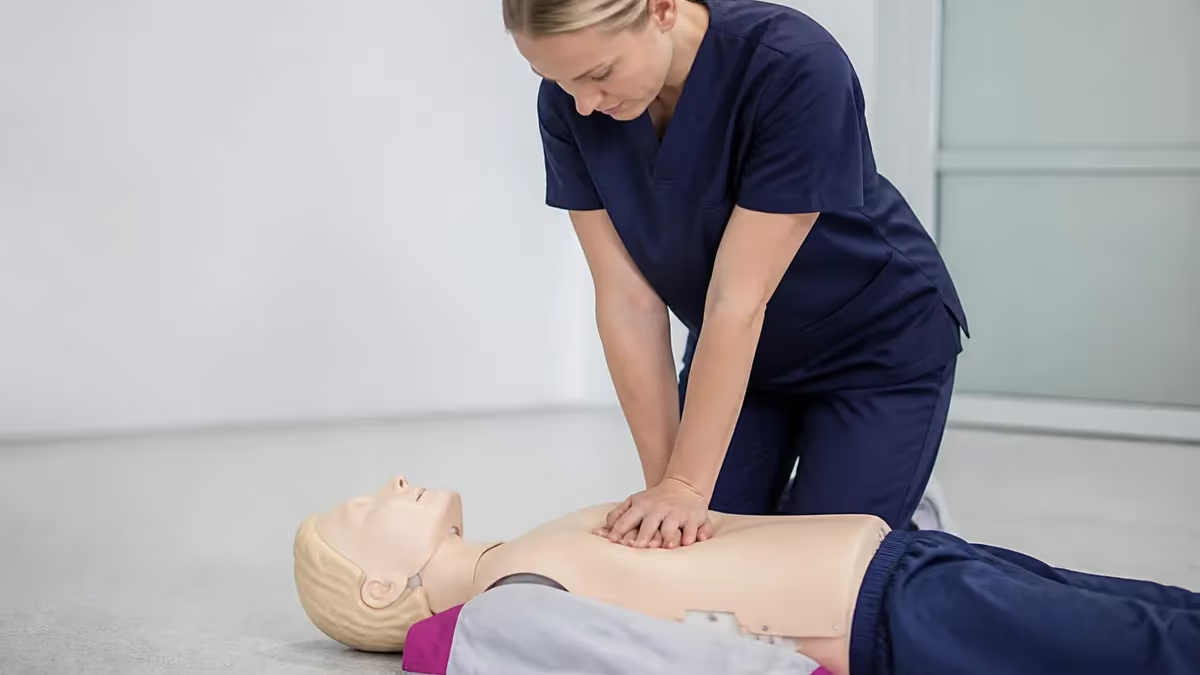
Get the person flat on their back on a firm surface. A bed is too soft. Move them gently to the floor if you must. Expose the chest. Buttons, bra, layers, none of it matters once a heart has stopped. Place the heel of one hand on the center of the chest at the nipple line, second hand on top with fingers laced, and lock your elbows. Now push.
The Phases of a CPR-AED Rescue
Tap, shout, scan for breathing. Ten seconds maximum. If unresponsive and not breathing normally, you have arrest. Do not waste time looking for a pulse, since untrained hands often misread weak or normal beats under stress.
Call 911 and assign someone to fetch the nearest AED. Speakerphone lets dispatch guide you while you work. If you are alone, put the call on speaker so you can start compressions while dispatch listens and coaches.
Center of chest, 100 to 120 per minute, two inches deep on adults. Full recoil between pushes. Switch rescuers every two minutes. Lock your elbows, position shoulders directly over your hands, and let the chest fully recoil between each downstroke.
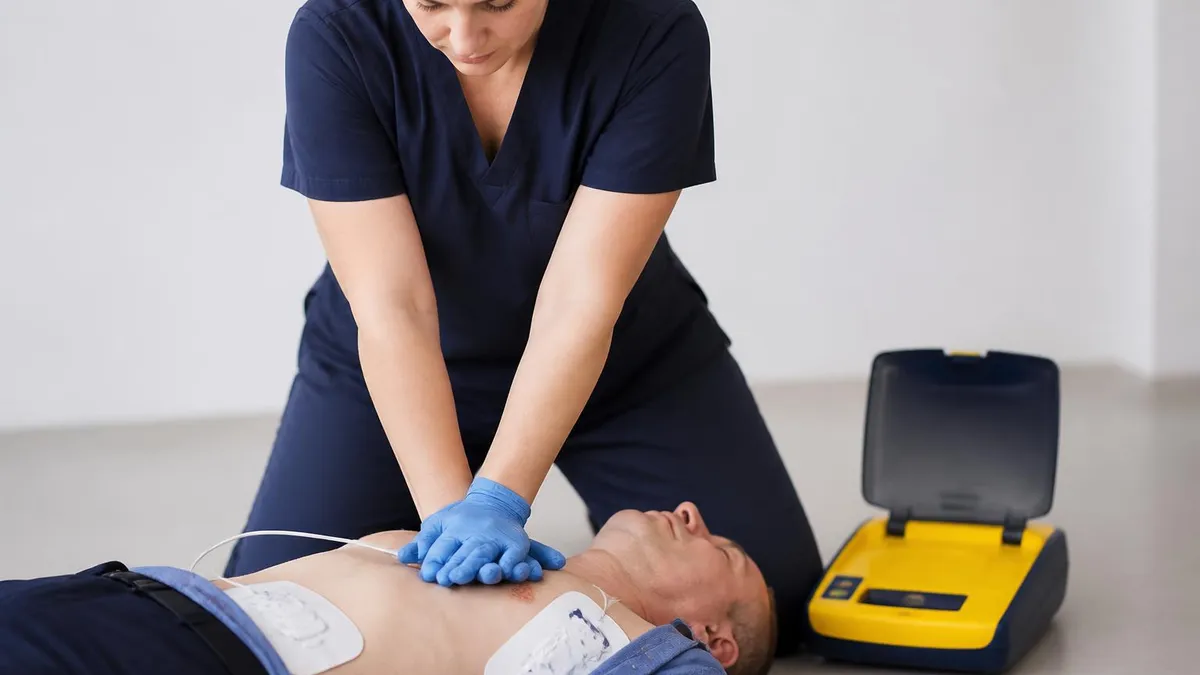
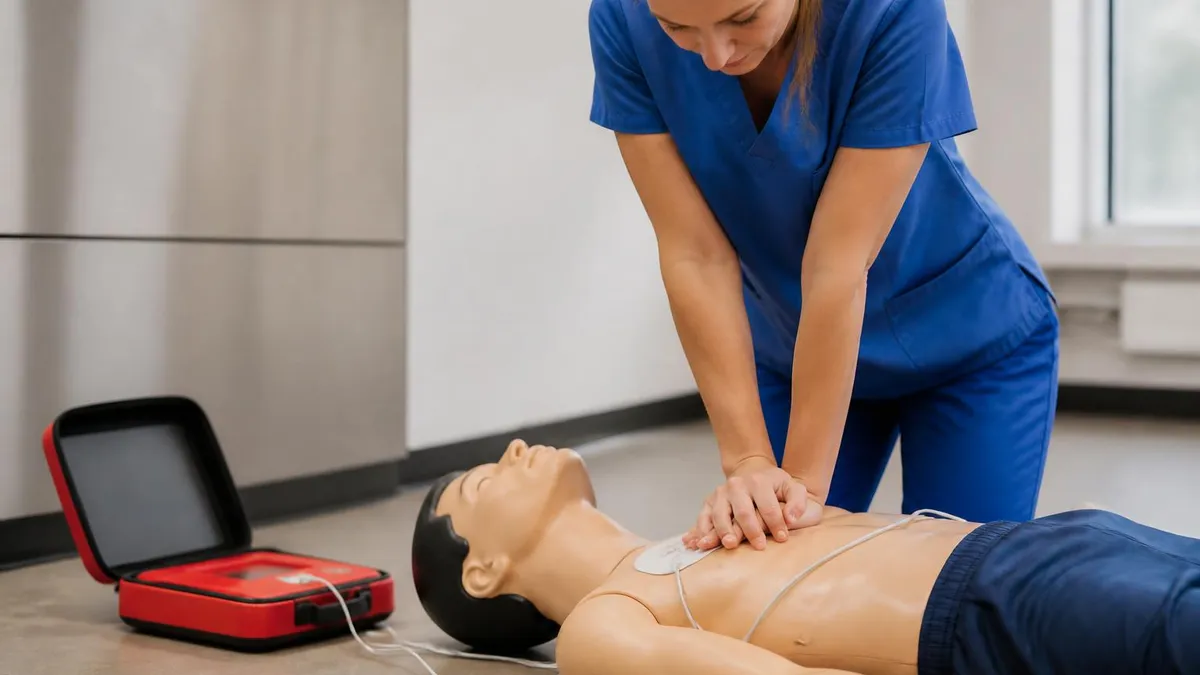
Turn on the AED. Follow voice prompts. Bare and dry the chest. Place pads, stand clear, shock if advised, resume CPR immediately. The pads will tell you where to place them with clear pictures, so do not waste time second-guessing the diagram.
Continue cycles until the person moves, breathes normally, or trained help takes over. Do not stop. Trade off with another rescuer every two minutes, since compression depth drops measurably after roughly that interval.
Brief paramedics on time of collapse, shocks delivered, and any medications nearby. Then step back and breathe. Paramedics will ask for specific data: collapse time, shocks delivered, and known medical history if you have it.
High-Quality Compressions: Depth, Rate, and Rhythm
Most bystander CPR is too shallow and too slow. That is the uncomfortable finding from decades of monitor data. People worry about cracking ribs. Cracked ribs heal. A dead brain does not. Push two inches deep on an adult, no less. For kids, about two inches. For infants, one and a half inches using two fingers or two thumbs encircling.
Rate matters too. Aim for 100 to 120 compressions per minute. That is the tempo of the song Stayin Alive by the Bee Gees, which has become a slightly dark but useful CPR meme. Hum it in your head. Other tracks at the same tempo include Crazy in Love by Beyonce and Cecilia by Simon and Garfunkel. Pick whichever keeps you steady.
Full recoil between compressions is the part most rescuers forget. Let the chest spring back completely before the next push. Half-recoiled compressions cut blood flow dramatically because the heart cannot refill. Lean off, then push down. Lean off, then push down. Your shoulders should sit directly over your hands, arms locked, hips as the hinge.
If you are trained and willing, give two rescue breaths after every 30 compressions. If you are not trained or the idea makes you hesitate, do hands-only CPR. Continuous compressions without breaths still save lives, especially in the first few minutes. Doing nothing because you are scared of mouth-to-mouth is the worst possible choice.
CPR by Age Group
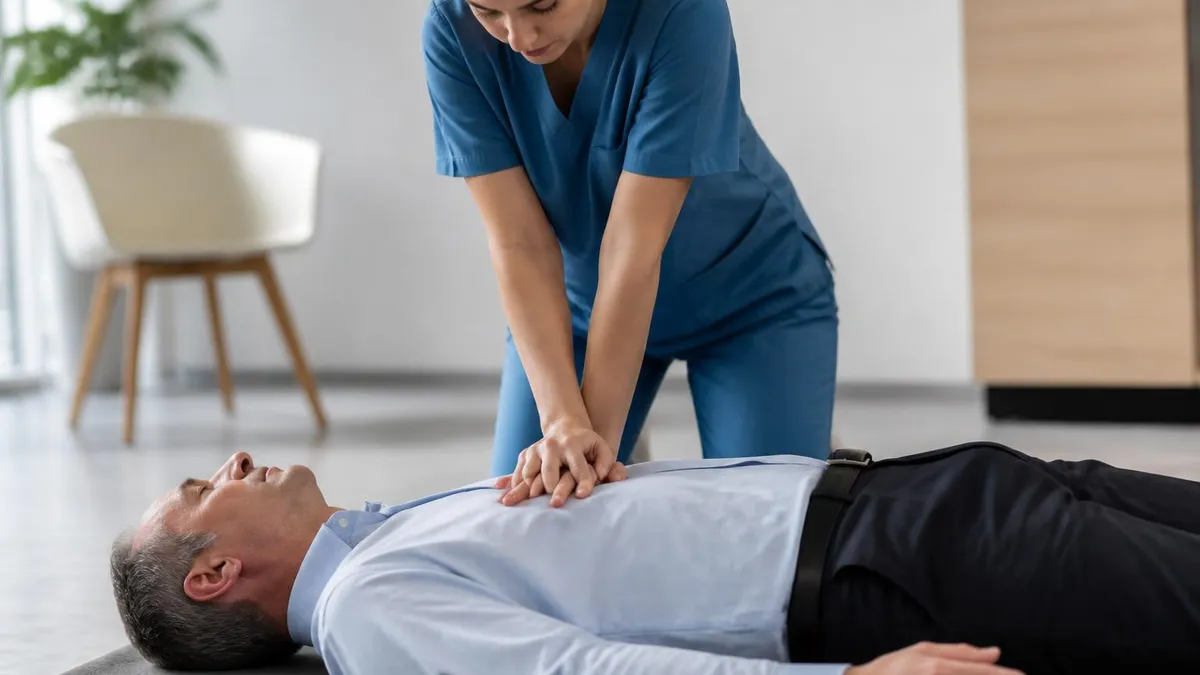
Adults are anyone past puberty. Use two hands, heel on the lower half of the sternum. Compress two inches deep, 100 to 120 per minute. Ratio of 30 compressions to 2 breaths if you are trained. AED pads go on the upper right chest and lower left side, just below the armpit.
The ratio of compressions to breaths is 30 to 2 whether one rescuer or two are present, since adult arrests are most often caused by primary cardiac problems that respond well to chest compression alone.
How an AED Works and What to Expect
An automated external defibrillator is not the dramatic paddles you see on television. It is a small box, usually red, white, or yellow, mounted in a wall cabinet or carried in a shoulder bag. Inside are two sticky pads with wires, a battery, and a computer. Turn it on, and the computer talks you through every step. There are no buttons to puzzle over. There is no chance of shocking someone who does not need it. The AED reads the rhythm first and refuses to shock if the heart does not need one.
Once the device is open, pull out the pads and peel off the backing. Stick one pad on the upper right chest, below the collarbone. Stick the other on the lower left side, a few inches below the armpit. Pictures on the pads show exactly where they go. If the chest is hairy, the AED kit usually contains a razor or a roll of tape to rip the hair off quickly. If the chest is wet, wipe it dry first. Sweat or water can cause shock to arc across the skin.
Stand clear once pads are placed. The AED will analyze for about ten seconds. Then it will either say shock advised or no shock advised. If shock is advised, make sure no one is touching the patient, including you, and press the flashing button. The shock is loud and the body will jerk visibly. Immediately resume chest compressions. Do not stop to check pulse or watch the screen. Compress, compress, compress.
Common AED Mistakes to Avoid
Rescuers make a handful of preventable errors under pressure. Knowing them in advance saves seconds when seconds count.
- Placing pads on top of clothing or a medication patch. Strip and clean first.
- Touching the patient during analysis or shock. The computer cannot read or deliver properly if you do.
- Stopping compressions to watch the screen. Resume immediately after every shock or no-shock decision.
- Skipping the AED because the person is wet or pregnant. Both situations still need defibrillation.
- Worrying about the battery or expiration. A late AED beats no AED, every time.
When to Stop and What to Do After
You stop CPR for only a few reasons. The person starts breathing normally and shows signs of life. A trained provider takes over. The scene becomes unsafe. You are physically unable to continue. None of those should happen quickly. Most rescues last between five and fifteen minutes before paramedics arrive, and switching rescuers every two minutes prevents the fatigue that wrecks compression quality.
If a second person is around, trade off. Count down the last ten compressions out loud so the swap is smooth. The incoming rescuer takes over the moment the outgoing rescuer pulls their hands away. No long gaps. Pauses kill perfusion. Even a few seconds of stopped flow drops the blood pressure to near zero, and it takes another ten seconds of compressions to build it back.
After the rescue ends, however it ends, the emotional weight will hit. Bystanders who do CPR often describe shaking hands, racing thoughts, sleep trouble, and sometimes guilt even when they did everything right. This is normal. Talk to someone. Many fire departments and EMS agencies offer post-event debriefs. Take it. You did something most people are too scared to do.
Your Rescue Checklist
- ✓Confirm the scene is safe before approaching — check for traffic, electrical hazards, fire, or violent threats
- ✓Tap and shout to check responsiveness — use a firm shoulder tap and call out clearly
- ✓Scan chest for normal breathing for up to ten seconds — gasping or jerky sounds count as not breathing
- ✓Call 911 and assign someone to fetch the AED — point and direct specific people by description
- ✓Place patient flat on a firm surface and bare the chest — remove clothing barriers, cut bras if needed
- ✓Start compressions at 100 to 120 per minute, two inches deep — use the song Stayin Alive as a tempo guide
- ✓Switch rescuers every two minutes to keep quality high — count down the last ten pushes to coordinate the swap
- ✓Turn on the AED and follow every spoken prompt — the device will guide you through each decision step
- ✓Resume compressions immediately after every shock or analysis — no pulse check, no pause, just continuous flow
- ✓Continue until help arrives or the person breathes on their own — do not stop because you feel tired
Training, Certification, and Staying Current
Reading is a start. Practice is what gets your hands moving without thought. Most communities offer CPR and AED classes through the American Heart Association, the Red Cross, or local fire departments. A standard course runs about three to four hours and includes hands-on time with a mannequin and a training AED. The fee is usually between 50 and 100 dollars, and many employers reimburse it.
Certifications generally expire every two years. Skills decay even faster than that. Studies show that compression depth and rate slip within months if you do not practice. Some agencies now recommend short refresher drills every quarter, even just five minutes pushing on a couch cushion to a metronome. Muscle memory needs maintenance, like any other skill that has to work under panic.
Workplaces, schools, gyms, and houses of worship that buy an AED should also build a response plan. Where is the device mounted? Who is trained? Who calls 911 while another grabs the unit? A device locked in an unlabeled cabinet that no one can find is just expensive plastic. Run drills. Mark the cabinet clearly. Make sure pads and battery have not expired. Train rotating staff so coverage stays current as people come and go.
Bystander CPR With AED: Tradeoffs
- + —
- + —
- + —
- + —
- + —
- + —
- + —
- + —
- − —
- − —
- − —
- − —
- − —
- − —
Special Situations You Should Know About
Drowning, drug overdose, and electrocution all cause cardiac arrest through slightly different routes. For drowning, give two rescue breaths first if you are trained, then start the standard cycle. The cause is oxygen deprivation, so breaths matter more than usual. For overdose, especially opioids, naloxone if available comes alongside CPR. For electrocution, make absolutely sure the power is off before touching the victim. You become victim number two if you skip that step.
Pacemakers and implanted defibrillators show as a hard lump under the skin, usually below the left collarbone. Place AED pads at least an inch away from the device. The shock still works, the implant is fine, and you can save the patient. Same goes for medication patches. Peel them off, wipe the skin, then place pads. Skin metals and tattoos do not interfere with AED function despite occasional myths.
Hypothermia changes the rules a bit. Severely cold patients can appear dead but still be revivable. Start CPR, attach the AED, and continue compressions for longer than usual while warming the patient. The saying in wilderness medicine is, no one is dead until warm and dead. Do not give up too soon on someone pulled from cold water or a snowbank. Continue until trained help can rewarm the core.
CPR Questions and Answers
Final Thoughts on Stepping In
The hardest part of CPR and AED rescue is not the technique. It is the decision to start. Most bystanders freeze. They worry about doing it wrong, about hurting the person, about being judged. Meanwhile, the clock is the only thing in the room that does not care about feelings. Every minute you hesitate, the survival rate drops another ten percent.
Train once. Practice every few months. Carry the willingness to step up. The person on the floor cannot choose. You can. And if you ever wonder whether your effort mattered, remember this: surviving adults who walk out of the hospital after cardiac arrest almost always credit two things. A fast bystander who started CPR. An AED that arrived in time. Both came from regular people who decided to help.
So learn the steps. Talk about them at the dinner table. Take your kids to a CPR class. Put a sticker on the AED cabinet at your office. Push hard, push fast, let the chest spring back, follow the AED prompts, and keep going. That is the whole job. It is enough. You can do this, and one day, you might be the reason someone goes home to their family.
Building a Community That Saves Lives
Across the United States, certain cities have pushed bystander CPR rates above 50 percent. Seattle leads the pack, with decades of public training campaigns and dispatcher-assisted CPR programs. Rochester, Minnesota and parts of Arizona follow close behind. What separates these places is not technology. It is culture. Kids learn CPR in middle school. AEDs sit in every coffee shop and gym. Neighbors know what to do because the topic comes up at PTA meetings and on local news segments.
Contrast that with regions where bystander CPR rates hover around 20 percent. In those communities, survival from out-of-hospital cardiac arrest is half what it is in Seattle. The gap is not genetics or hospital quality. It is whether the person next to you on the sidewalk has been trained and is willing to push down hard on your chest. That gap is closable, one classroom and one workplace at a time.
The Cost of Inaction
Doing nothing has a price that gets paid in the days that follow. Family members of arrest victims often replay the moment, wondering whether anything could have changed the outcome. Untrained witnesses describe lasting regret. Trained ones who acted, even imperfectly, almost always say the same thing: the work was hard, the outcome was uncertain, but they would do it again. Action lets you live with yourself afterward in a way that hesitation does not.
On a national scale, the math is brutal. Improving bystander CPR rates by even 10 percentage points across the country would save tens of thousands of lives annually. That is more lives than many cancer screening programs, more than seatbelt enforcement campaigns, more than countless other public health efforts combined. The bottleneck is not science. It is the willingness of ordinary people to learn, practice, and act.
Closing the Knowledge Gap
Practice tests like ours exist for exactly this reason. Reading a guide once builds vocabulary. Quizzing yourself drills the response into long-term memory. The questions force you to think under simulated pressure, the same kind of pressure you might face one day in a grocery aisle or at a family barbecue. Use the quiz. Take it more than once. Take it before your certification expires. Take it after a long break. Each pass refreshes the chain of survival in your mind so the steps come automatically when they have to.
The takeaway is simple. CPR and AED training is not just for nurses and lifeguards. It is for anyone who wants to be useful in a moment that does not announce itself. You will not get a warning. The collapse will happen mid-conversation, mid-meal, mid-meeting. You will have seconds to decide whether to step forward or back away. Train now so that decision is already made.
About the Author

Registered Nurse & Healthcare Educator
Johns Hopkins University School of NursingDr. Sarah Mitchell is a board-certified registered nurse with over 15 years of clinical and academic experience. She completed her PhD in Nursing Science at Johns Hopkins University and has taught NCLEX preparation and clinical skills courses for nursing students across the United States. Her research focuses on evidence-based exam preparation strategies for healthcare certification candidates.