
CPR and First Aid Training: Complete Guide to Certification and Skills
🎯 CPR and first aid training guide. Learn certification options, course formats, costs, skills covered, and how to prepare for your exam with confidence.
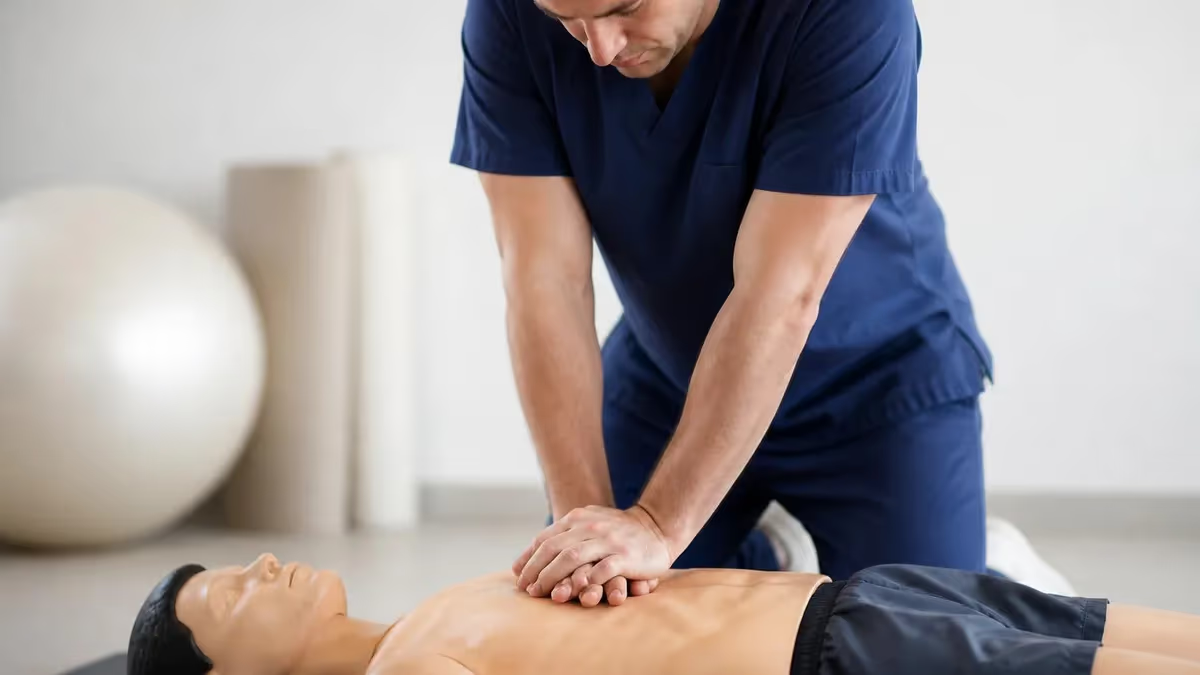
CPR and first aid training prepares you to act in the seconds that matter most. Whether the emergency is a sudden cardiac arrest at the gym, a child choking on a grape, or a coworker bleeding from a kitchen accident, the people closest to the victim are the ones who decide what happens next. Bystanders who can push hard and fast on a chest, clear an airway, or apply pressure to a wound buy time that paramedics simply cannot manufacture once they arrive.
You do not need to be a nurse or a firefighter to learn these skills. Parents, teachers, gym staff, construction workers, babysitters, dental hygienists, lifeguards, restaurant managers, and office volunteers all sit in CPR and first aid classes every week. Many are nervous on the way in and surprised at how confident they feel on the way out. The training is hands-on, short, and graded on competence rather than memorization.
This guide explains what a modern combined course covers, how certification works in 2026, what providers actually teach, how much you should expect to pay, and what to do the morning of class so you pass on the first try. We will walk through skill checks, written exams, blended online formats, recertification windows, employer requirements, and the differences between adult, child, and infant techniques.
If you are taking the class because your boss told you to, because a state license requires it, or because a scary moment at home convinced you that you need to be ready, the path forward is the same. Pick a recognized provider, finish the coursework, pass the skills demonstration, keep the card in your wallet, and refresh every two years. Read on and you will know exactly how each of those pieces fits together.
CPR and First Aid Training by the Numbers
What CPR and First Aid Training Actually Covers
A combined course bundles two related but distinct disciplines. CPR, short for cardiopulmonary resuscitation, teaches you how to keep blood and oxygen moving when a victim is not breathing or has no pulse. First aid teaches you how to manage everything else that goes wrong before professional help arrives: bleeding, burns, broken bones, allergic reactions, seizures, diabetic emergencies, poisoning, and shock. Together they form a complete bystander toolkit.
On the CPR side, you will rehearse high-quality chest compressions at the correct rate and depth, rescue breaths using a barrier device or pocket mask, and the use of an automated external defibrillator. You will practice on adult manikins first, then move to child and infant manikins because the technique changes with body size. Many programs now include hands-only CPR for untrained or unwilling rescuers and team-based resuscitation for workplaces with multiple responders.
The first aid block tends to follow a head-to-toe survey approach. You learn to check responsiveness, scan for life threats, control severe bleeding with direct pressure or a tourniquet, splint suspected fractures, cool burns appropriately, recognize stroke using FAST signs, manage anaphylaxis with an epinephrine auto-injector, and respond to opioid overdose with naloxone where available. Scenario practice is the secret ingredient. Reading about a seizure is nothing like rolling a manikin onto its side while a timer ticks.
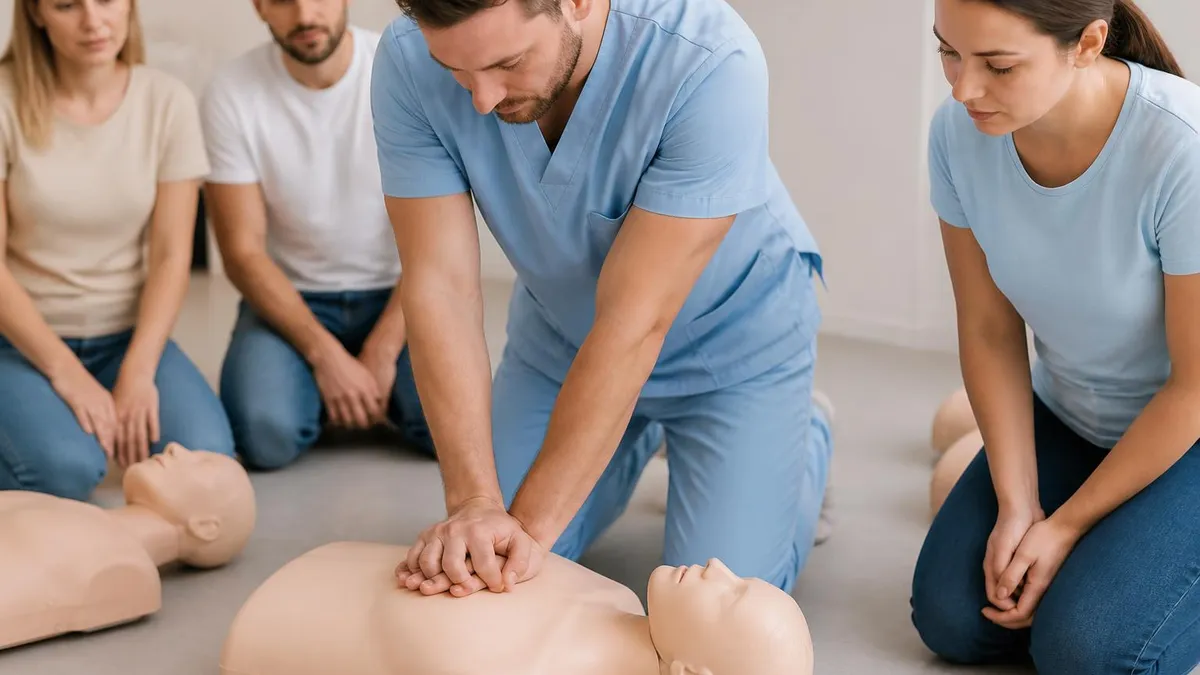
Some learners walk in because a job demands a current card. Others come because a close call made the abstract feel suddenly real. Both are valid reasons and both groups end up with the same skills. The most common required-by-policy roles include healthcare providers, daycare and school staff, personal trainers, lifeguards, coaches, dental assistants, flight attendants, electrical apprentices, and anyone in a workplace covered by an OSHA medical services standard. Volunteer responders such as ski patrollers, search and rescue members, and disaster response teams almost always carry both certifications. Parents of newborns, grandparents who babysit, and anyone caring for an aging relative also benefit enormously, even when no card is required.
Choosing the Right Training Provider
Three large nonprofits dominate CPR and first aid education in the United States: the American Heart Association, the American Red Cross, and the National Safety Council. A handful of smaller providers, including the American Safety and Health Institute and the Emergency Care and Safety Institute, are also widely accepted. Each follows the same scientific consensus published by ILCOR every five years, so the actual skills you learn are nearly identical across brands.
Where they differ is in audience focus, paperwork, and cost. The American Heart Association is the gold standard for hospital staff and most clinical board exams. The Red Cross is popular with schools, summer camps, and community groups, and offers a free digital wallet card. The National Safety Council leans toward workplaces and industrial settings. Before you sign up, ask the agency that requires your card which brand they accept. A boss who insists on AHA will not honor a Red Cross card and vice versa, even though both are excellent.
Format matters as much as brand. You can take a classroom-only course, a blended course where lectures are online and skills are in-person, or a fully in-person bootcamp that compresses everything into a single morning. Blended formats save time and let you replay tricky modules, but you still must complete a live skills test. Fully online courses with no in-person check generally do not qualify for jobs that require hands-on certification.
Six Pillars of a Quality Course
Real manikins, real AED trainers, real bandage rolls. You should compress, breathe, shock, and bandage many times, not just watch a video.
Look for one instructor per six to ten students. Larger ratios mean less feedback and slower skill mastery for everyone in the room.
The 2025 ILCOR update is the basis for 2026 classes. Ask if your provider has refreshed slides, compression rates, and AED logic since then.
A real course ends with a competency check, not a participation sticker. Expect to be observed performing compressions and basic bandaging.
Most providers use a short multiple choice exam covering decision points, ratios, and scene safety. Pass marks are typically seventy or eighty percent.
You should leave class with a serial-numbered digital or plastic card from a brand your employer or licensing board accepts.
Course Formats Compared
Adult learners juggle jobs, kids, and commutes, so providers offer several paths to the same certification. Each has trade-offs. The right pick depends on how you learn, how much time you have, and whether your employer will reimburse the fee.
In-person classroom courses are the traditional route. You sit through a video-led lecture in the morning and rotate through manikin stations in the afternoon. The pace is steady, the instructor can correct subtle errors in real time, and your card is in your hand the same day. The downside is the seat time, which can be six to eight hours.
Blended learning splits the cognitive portion online and the psychomotor portion in person. You watch interactive modules, answer quizzes, and pass a knowledge test from your kitchen table. Then you book a one to two hour skills session at a local training center. Many busy professionals prefer this route because the online block can be done in chunks over a week.
Onsite group training brings the instructor to your workplace or community center. Employers like the efficiency. Staff like skipping the commute. This format usually requires a minimum head count, typically six to ten people, and works best for refresher classes where everyone is at similar baseline.
Compare Training Formats Side by Side
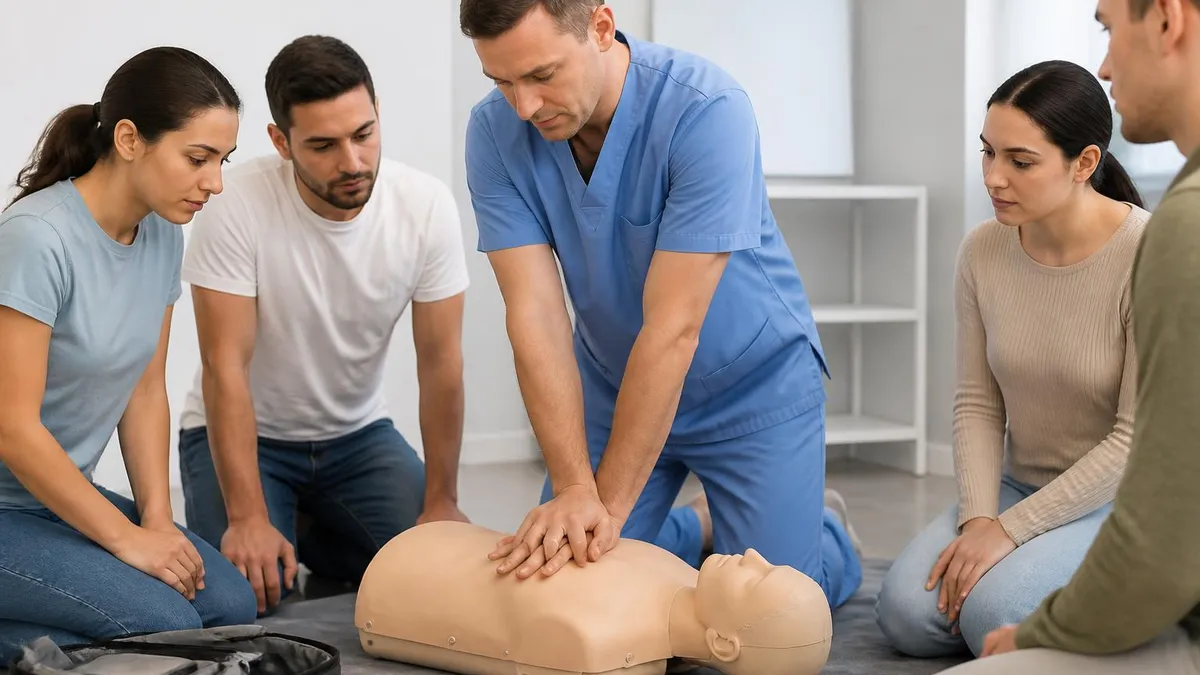
A traditional six to eight hour day spent in a training room with an instructor, manikins, and AED trainers. You watch video segments, then practice each skill until the instructor signs you off. Best if you need structure, prefer to ask questions out loud, and want to leave with both pieces of certification on the same day. Cost typically runs eighty to one hundred fifty dollars at retail, less at community programs.
Skills You Will Be Tested On
Every recognized provider ends class with a competency check. Knowing what the instructor is looking for removes most of the test-day anxiety. Compressions are evaluated for depth, rate, and recoil. Adult depth target is at least two inches but no more than 2.4 inches. Rate is one hundred to one hundred twenty per minute, often paced to a song like Stayin Alive. You will be coached to keep your shoulders directly over your hands and to let the chest rise fully between each push.
Rescue breaths are evaluated for seal and volume. Pinch the nose, tilt the head, lift the chin, and deliver each breath over about one second. Watch for the chest to rise. Avoid blowing too hard or too long because excess air goes into the stomach and can trigger vomiting. The ratio is thirty compressions to two breaths for adult and child single-rescuer CPR and fifteen to two for child or infant two-rescuer CPR.
AED use is evaluated for safety and confidence. Turn it on, expose the chest, attach the pads in the diagrammed positions, clear the patient before analysis, and clear again before delivering a shock. The first aid block adds bleeding control, splinting, burn management, recovery position, and recognition of common medical emergencies. A practical scenario brings two or three of these together so you can show that you think in priorities rather than reciting steps.
A wallet card from an unaccredited online-only vendor may not satisfy your job, your state license board, or your insurance provider. Before you pay, confirm in writing which brand and which format the requirement names. If a course advertises certification without a live in-person skills test, treat it as personal education only. Spending sixty dollars twice because the first card is rejected is a common and avoidable mistake.
How to Prepare Before Class
Most students who fail their first attempt do so not because of poor skill but because of poor logistics. Showing up tired, unfamiliar with the basic ratios, or wearing clothes that make kneeling impossible is a recipe for a frustrating afternoon. A small amount of preparation makes the class feel easy and short.
Read your provider materials at least twice. Both the American Heart Association and the Red Cross publish concise PDFs with the chains of survival, compression metrics, AED steps, and key first aid algorithms. Watch the videos linked in the registration email. Take a free practice quiz. The questions are not meant to trick you; they are meant to confirm that you noticed the numbers and decision points the instructor will assess.
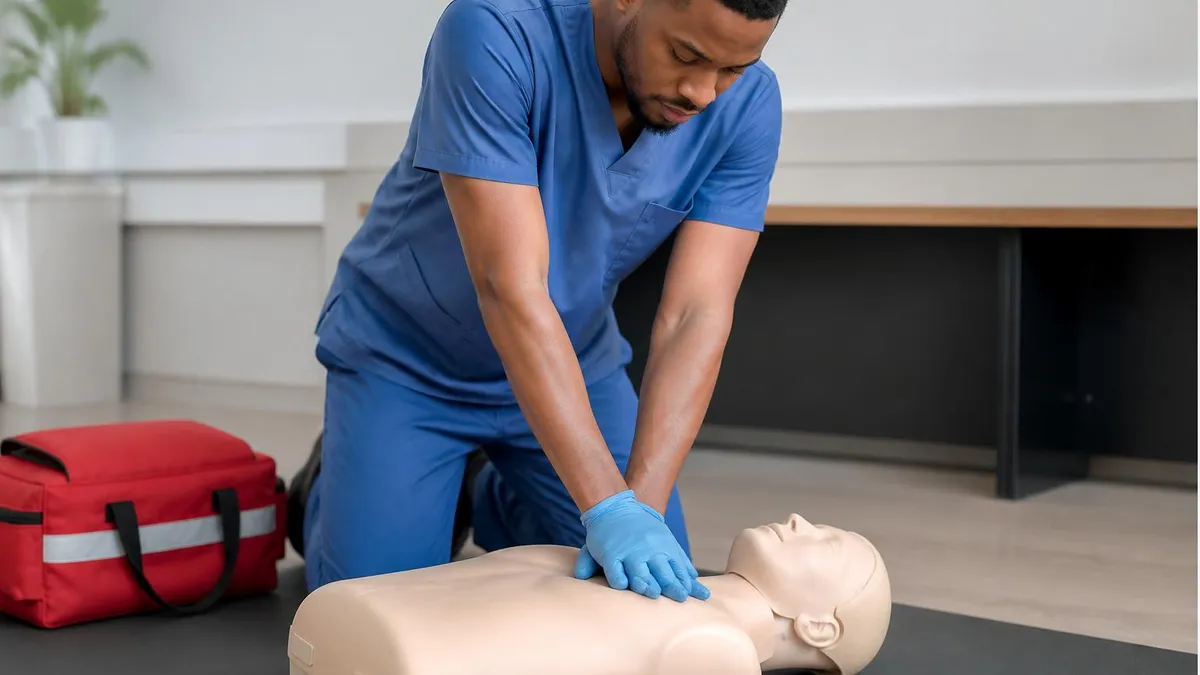
Wear loose clothing and athletic shoes. You will spend significant time on your knees. Bring a water bottle, a snack, and a list of three or four real questions about your home or workplace. Instructors love specific questions because they let the class connect skills to real environments.
Day Before Class Checklist
- ✓Print or save your online completion certificate if you took a blended course.
- ✓Review the chains of survival for adult and pediatric cardiac arrest.
- ✓Memorize the adult compression depth of at least two inches and rate of one hundred to one hundred twenty per minute.
- ✓Practice counting out loud to thirty quickly so the rhythm feels automatic.
- ✓Watch a short video of AED pad placement and clearing the patient before analysis and shock.
- ✓Re-read the FAST stroke signs and the signs of anaphylaxis.
- ✓Pick clothes you can kneel and bend in for several hours.
- ✓Charge your phone and bring it to access the digital course manual.
- ✓Eat a real breakfast and bring water and a small snack.
- ✓Plan to arrive fifteen minutes early to settle in without rushing.
Recertification and Keeping Your Card Current
Most CPR and first aid cards are valid for two years from the issue month. Recertification courses are shorter than the original class, usually three to four hours, because you are demonstrating retained competence rather than learning from scratch. Some employers offer a grace window of thirty or sixty days, but waiting until your card expires can mean losing access to your worksite or being pulled from a clinical rotation.
Set a calendar reminder six months before the expiration date. That window gives you time to find a class that fits your schedule, settle any reimbursement paperwork with your employer, and refresh quietly without a last-minute scramble. Many providers offer free or discounted recertification for instructors and frequent learners, so it pays to stay loyal to one brand.
If you let your card lapse for more than a few months, expect to retake the full original course rather than the simplified renewal. The actual material is identical, but the assumption is that retained skill decays without practice. Several large studies have shown noticeable drops in compression depth and AED confidence as early as six months after a class, which is why many high-performing teams now build in quarterly low-dose drills between formal certifications.
Pros and Cons of Combined CPR and First Aid Training
- + —
- + —
- + —
- + —
- + —
- + —
- + —
- + —
- − —
- − —
- − —
- − —
- − —
- − —
Cost, Reimbursement, and Free or Low-Cost Options
Retail pricing for a combined adult-child-infant CPR and first aid course usually lands between sixty and one hundred fifty dollars in 2026. Group rates of forty to seventy dollars per student are common when an employer or community organization books six or more seats. Pediatric-only or healthcare provider-level classes cost a little more because they spend extra time on advanced topics.
Look for free or subsidized seats before you pay full freight. Local fire departments, public libraries, community colleges, hospital outreach programs, and Red Cross chapters regularly run no-cost classes. Some states offer a tax credit for first aid training for licensed childcare providers. Many employers reimburse the full course fee for any role that requires a valid card, and several reimburse for any employee who wants the skills, treating it as a wellness benefit. Ask human resources or your union representative before you book.
If you are paying out of pocket, compare two or three nearby providers on three dimensions: brand acceptance with whoever requires your card, total time including travel, and instructor reputation in local reviews. The cheapest option is rarely the best use of an afternoon, and the most expensive is sometimes a brand-name boutique that adds little beyond a fancy folder. Aim for the middle of the local range with strong reviews from past students in roles similar to yours.
CPR Questions and Answers
From Class to Confidence in Real Emergencies
Walking out with a wallet card is the start, not the finish. The goal is to make the right move under pressure, when sirens are still minutes away and you are the only person in the room who has held a manikin in the last year. Confidence under stress comes from low-dose practice.
Replay your AED steps in your head every time you walk past one in an airport. Run a mental scenario when you see someone slumped on a park bench. Bring up the skills with family at dinner so they know what to do if something happens to you.
Many employers, especially in healthcare, athletics, and aviation, now run short refreshers every quarter using a manikin in a break room. Even five minutes of compressions twice a month keeps the muscle memory sharp. Apps with metronomes and depth sensors are inexpensive and useful for solo refreshers at home, particularly if you live alone or with elderly relatives.
The hardest part of any rescue is the first ten seconds. Most bystanders freeze, scan for someone more qualified, or wait for the situation to clarify itself. A trained rescuer compresses that hesitation into a quick check, a call to nine one one, and the start of compressions. That is the gift of CPR and first aid training, and it is worth far more than the modest fee and the few hours it takes to earn.
Pair this guide with the linked practice test so you can spot the questions where you hesitated and review only those sections before class. Recognized providers update their materials every five years to match new science, and your instructor will flag the recent changes. With one solid class and a small habit of refreshers, you will become the person the people you love are lucky to have in the room.
Building a Culture of Readiness at Home and at Work
A single class can plant the seed for a much bigger habit. Families who attend training together start to share a vocabulary about emergencies and stop assuming someone else will act. They map the nearest AED at the grocery store, label the medicine cabinet so a babysitter can find an epinephrine auto-injector, and write down medications and allergies in one easy place. Small changes like these turn a one-day class into a permanent layer of safety.
Workplaces that take training seriously do similar things on a larger scale. They run quarterly five-minute drills, post a simple cardiac arrest flowchart near every break room, and assign one staff member per floor to check the AED battery and pads on the first of every month. None of these moves require fancy equipment or expensive consultants. They require leadership that treats readiness as part of the job rather than an annual compliance box. After a few quarters, employees stop asking whether a refresher is required and start asking when the next one is scheduled.
Schools, gyms, and houses of worship benefit from the same approach. A youth coach who completed combined training last spring is the natural person to introduce a short refresher at the start of each season. A worship leader who has seen a real cardiac arrest in a sanctuary is the right voice to push for a parish AED. Personal stories carry more weight than any poster, and they spread the habit further than any single class.
If you are reading this guide because you want to be the one who acts, the path is straightforward. Pick a recognized provider, finish the course, take the practice test linked above, and put a six-month reminder on your phone to run a quick refresher at home. Multiply that habit across a family, a team, or a workplace and the bystander problem starts to look very different. Real lives turn on those few prepared minutes, and you can be one of the people who shows up ready.
You can continue preparing with the cpr practice test, which includes answer explanations for every question.
About the Author

Registered Nurse & Healthcare Educator
Johns Hopkins University School of NursingDr. Sarah Mitchell is a board-certified registered nurse with over 15 years of clinical and academic experience. She completed her PhD in Nursing Science at Johns Hopkins University and has taught NCLEX preparation and clinical skills courses for nursing students across the United States. Her research focuses on evidence-based exam preparation strategies for healthcare certification candidates.