
BLS CPR Classes Near Me: Complete 2026 September Guide to Certification, Training & Exam Prep
Find BLS CPR classes near me, learn what a BLS certification covers, compare AHA vs Red Cross programs, and prepare for your basic life support exam 🏆
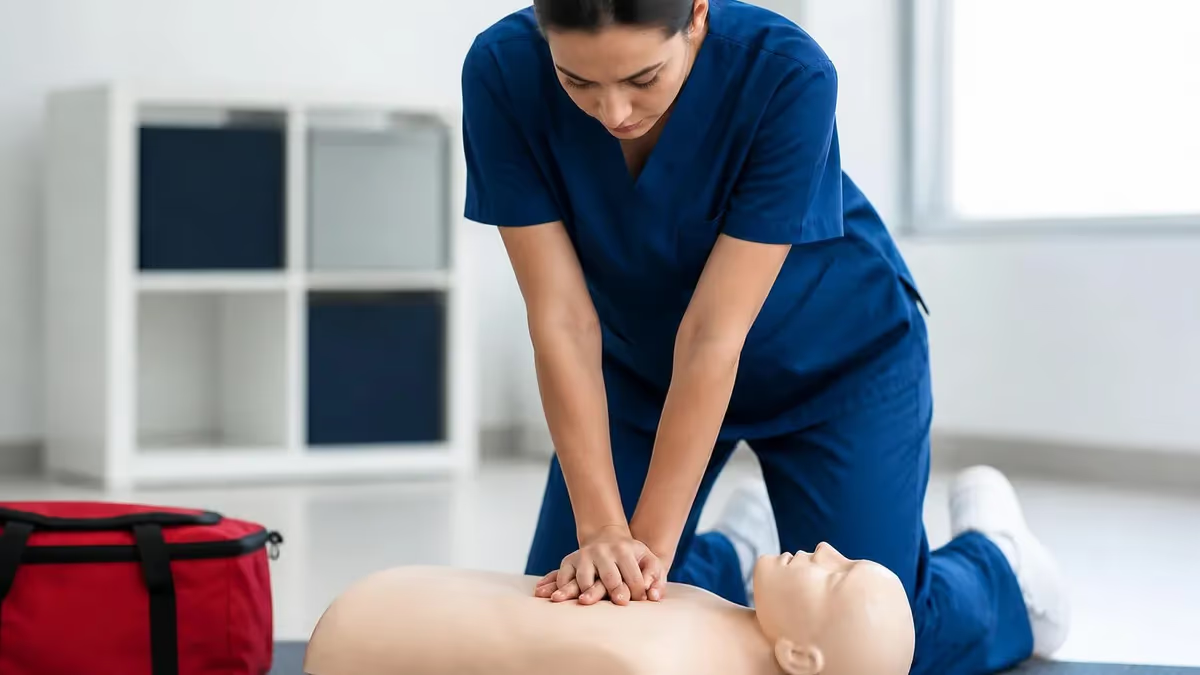
If you have been searching for BLS CPR classes near me, understanding what is a BLS certification is the essential first step toward building your emergency response skills. Basic Life Support certification validates your ability to perform high-quality CPR, use an automated external defibrillator, and relieve choking in adults, children, and infants. Whether you are a healthcare professional seeking initial certification or a layperson committed to saving lives, finding the right class in your area can make all the difference in your training journey and professional readiness.
So what does BLS stand for? BLS stands for Basic Life Support, a structured set of medical protocols and clinical interventions designed to sustain life during cardiac arrest, respiratory failure, and airway obstruction. Unlike basic first aid courses, BLS training follows evidence-based guidelines established by organizations such as the American Heart Association and the American Red Cross. These protocols are updated regularly based on the latest resuscitation science, ensuring that every certified provider delivers care aligned with current best practices and published survival data.
A common question among prospective students is whether is basic life support the same as cpr. While CPR is a core component of BLS training, a full BLS certification covers significantly more ground than standard CPR alone. BLS courses teach team dynamics during resuscitation, proper use of bag-valve masks, recognition of life-threatening emergencies, and multi-rescuer coordination. CPR certification alone typically focuses on chest compressions and rescue breaths, whereas BLS equips providers with a comprehensive emergency response toolkit suitable for clinical environments.
BLS certification is required across a wide range of healthcare settings, making BLS CPR classes near me one of the most searched training topics in the medical education field. Nurses, physicians, paramedics, dental hygienists, physical therapists, and medical students all need current BLS credentials to maintain employment or meet licensing requirements. Many non-clinical professionals such as lifeguards, personal trainers, and school staff also pursue BLS training to enhance workplace safety and comply with organizational mandates prioritizing emergency preparedness.
When searching for BLS CPR classes in your area, you will discover several format options designed to accommodate different learning preferences and busy schedules. Traditional in-person classes provide hands-on practice with manikins and direct instructor feedback over a single day. Blended learning courses combine online modules with abbreviated skills sessions, reducing the time spent in a physical classroom. Some providers also offer fully online knowledge assessments, though most accredited certifications require an in-person skills evaluation to verify physical competency.
The two dominant certification providers in the United States are the American Heart Association and the American Red Cross basic life support programs. Both organizations maintain extensive networks of authorized training centers across every state, making it convenient to locate classes regardless of your geographic location. AHA BLS courses follow the Provider Manual curriculum, while Red Cross courses align with their own proprietary training standards. Employers generally accept both certifications, though some healthcare systems specify a preference for one provider over the other.
This comprehensive guide will walk you through everything you need to know about finding and completing BLS CPR classes near you in 2026. From understanding exam formats and costs to preparing for certification day, we cover each step of the process in detail. You will learn how to evaluate training providers, what to expect during your skills assessment, and how to maintain your certification through timely renewal. Use the navigation sidebar to jump directly to the sections most relevant to your certification goals and timeline.
BLS Certification by the Numbers

How to Find and Enroll in BLS CPR Classes Near You
Visit the American Heart Association or American Red Cross websites and enter your zip code to locate certified training centers within your preferred travel radius. Filter results by class format, available dates, and instructor ratings to find the best match.
Select between traditional in-person classes for full hands-on experience, blended learning courses that combine online study with abbreviated skills sessions, or employer-hosted group training. Each format leads to the same certification upon successful completion.
Confirm that your chosen training center is officially authorized by the AHA or Red Cross to issue BLS provider cards. Unaccredited courses may not satisfy employer or licensing requirements, wasting both your time and money on invalid credentials.
Complete online registration, pay course fees, obtain the BLS Provider Manual if required, and review prerequisite materials before your scheduled class date. Arriving prepared maximizes classroom learning time and increases your likelihood of passing on the first attempt.
The basic life support exam American Heart Association administers is the gold standard for healthcare provider certification across the United States. Understanding the exam structure before you walk into class gives you a significant advantage and reduces test-day anxiety considerably. The AHA basic life support exam consists of both a written cognitive assessment and a hands-on skills evaluation that must be completed during your training session. Most students who prepare in advance pass on their first attempt, making thorough study an investment that pays immediate dividends for your career.
The written portion of the AHA basic life support exam contains 25 multiple-choice questions covering topics such as high-quality CPR techniques, AED usage protocols, team communication during resuscitation, and recognition of respiratory and cardiac emergencies. You need to score at least 84 percent to pass, which means correctly answering a minimum of 21 out of 25 questions. Questions are drawn directly from the BLS Provider Manual, and the exam is typically administered as a closed-book assessment at the conclusion of your classroom or blended learning session.
The skills evaluation component tests your ability to physically demonstrate critical BLS interventions under direct instructor observation. You will perform adult CPR with an AED on a manikin, demonstrate infant CPR techniques, show proficiency with bag-valve mask ventilation, and execute proper choking relief procedures for both conscious and unconscious victims. Understanding the basic life support algorithm is essential because the skills test follows the exact sequence of assessment, activation, compressions, airway management, and defibrillation outlined in current AHA guidelines.
Basic life support for healthcare providers goes beyond what community CPR courses cover because clinical environments demand higher precision and team-based coordination skills. During your BLS class, you will practice multi-rescuer CPR scenarios where providers rotate compressor roles every two minutes to prevent fatigue and maintain chest compression quality. These exercises simulate real hospital code situations where effective communication, clear role assignments, and seamless transitions between team members directly impact patient survival rates during cardiac arrest events.
One detail that surprises many first-time students is the emphasis on compression quality metrics during the hands-on skills evaluation. Instructors evaluate compression depth, which must reach at least two inches for adult patients, compression rate of 100 to 120 per minute, complete chest recoil between compressions, and minimal interruption time during provider transitions. Modern training manikins provide real-time feedback on these metrics, displaying your performance data on connected screens so you can adjust your technique immediately rather than waiting for post-evaluation corrections from instructors.
The American Red Cross basic life support program offers a comparable certification pathway with slightly different curriculum organization and materials. Red Cross BLS courses emphasize the same core competencies but use their own proprietary training materials and assessment tools for evaluation. Both AHA and Red Cross certifications satisfy employer requirements at the vast majority of healthcare institutions nationwide. When selecting between providers, consider which organization your employer prefers, the class schedules available in your area, and whether you plan to pursue additional advanced certifications within the same training ecosystem.
Test preparation is where many candidates either build lasting confidence or develop unnecessary anxiety about the entire certification process. The most effective study strategy combines reading the BLS Provider Manual thoroughly, practicing skills with a study partner whenever possible, and completing multiple rounds of practice questions to identify knowledge gaps before class day. Simulated exam questions help you become familiar with the question format and highlight specific areas where additional review is needed, ensuring you walk into your scheduled class prepared and ready to demonstrate full competence.

BLS Practice Test Questions
Prepare for the BLS - Basic Life Support exam with our free practice test modules. Each quiz covers key topics to help you pass on your first try.
BLS High-Quality CPR & Provider Skills
BLS Exam Questions covering BLS High-Quality CPR & Provider Skills. Master BLS Test concepts for certification prep.
BLS Special Situations & Scenarios
Free BLS Practice Test featuring BLS Special Situations & Scenarios. Improve your BLS Exam score with mock test prep.
BLS Adult, Child & Infant Resuscitation
BLS Mock Exam on Adult, Child & Infant Resuscitation. BLS Study Guide questions to pass on your first try.
BLS Airway Management & Ventilation
BLS Test Prep for Airway Management & Ventilation. Practice BLS Quiz questions and boost your score.
BLS Automated External Defibrillator (AED)...
BLS Questions and Answers on Automated External Defibrillator (AED) Use. Free BLS practice for exam readiness.
BLS Certification: Cardiac Arrest
BLS Mock Test covering Certification: Cardiac Arrest. Online BLS Test practice with instant feedback.
BLS Certification: Choking
Free BLS Quiz on Certification: Choking. BLS Exam prep questions with detailed explanations.
BLS Certification: Respiratory Arrest
BLS Practice Questions for Certification: Respiratory Arrest. Build confidence for your BLS certification exam.
BLS Chain of Survival
BLS Test Online for Chain of Survival. Free practice with instant results and feedback.
BLS CPR Techniques & Procedures
BLS Study Material on CPR Techniques & Procedures. Prepare effectively with real exam-style questions.
BLS Legal & Ethical Considerations
Free BLS Test covering Legal & Ethical Considerations. Practice and track your BLS exam readiness.
BLS Post-Resuscitation Care
BLS Exam Questions covering Post-Resuscitation Care. Master BLS Test concepts for certification prep.
Is BLS the Same as CPR? Key Differences Explained
Many people wonder is BLS the same as CPR, and the answer involves understanding the scope of each certification type. Standard CPR training teaches chest compressions and rescue breathing for adult victims, typically in community or workplace settings. BLS training encompasses all CPR techniques plus advanced airway management, AED operation protocols, multi-rescuer coordination, and specialized procedures for pediatric and infant patients requiring emergency intervention during life-threatening situations.
The depth of BLS training reflects its design for healthcare environments where providers must respond to complex emergencies with precision and confidence. BLS students learn to assess patient responsiveness systematically, activate emergency response systems using standardized communication protocols, and deliver interventions following evidence-based algorithms. CPR courses, while valuable for general public readiness, do not cover the team dynamics or clinical decision-making frameworks that BLS programs specifically teach to medical professionals and healthcare providers.
In-Person vs Online BLS CPR Classes: Pros and Cons
- +Hands-on manikin practice with immediate instructor feedback improves skill retention
- +Real-time team CPR scenarios build confidence for actual clinical situations
- +Complete certification in a single day without scheduling a separate skills session
- +Direct interaction with experienced instructors who answer questions on the spot
- +Access to professional-grade training equipment including real-time feedback manikins
- +Networking opportunities with other healthcare professionals in your local area
- −Fixed class schedules may conflict with work shifts or personal commitments
- −Travel time and transportation costs to reach training center locations
- −Full-day time commitment of four to five hours for initial certification courses
- −Limited class sizes may require booking several weeks in advance during peak periods
- −Pace is set by the group rather than your individual learning speed and preferences
- −Higher course fees compared to blended or online-only learning format options

BLS Certification Preparation Checklist
- ✓Obtain the current BLS Provider Manual from AHA or Red Cross at least two weeks before class
- ✓Complete at least two full read-throughs of the Provider Manual focusing on algorithms and ratios
- ✓Practice chest compressions on a firm surface to build endurance and proper hand placement technique
- ✓Take multiple rounds of online BLS practice questions to identify knowledge gaps before class day
- ✓Review the BLS algorithm sequence including assessment, activation, compressions, airway, and defibrillation
- ✓Study compression depth, rate, and ventilation ratio specifications for adults, children, and infants
- ✓Practice two-rescuer CPR scenarios with a study partner to rehearse team communication and role switching
- ✓Confirm your class registration details including date, time, location, and any required materials to bring
- ✓Prepare comfortable clothing and flat shoes suitable for kneeling during hands-on manikin practice stations
- ✓Set a reminder to arrive at least fifteen minutes early to complete registration paperwork and orientation
First-Attempt Pass Rates Exceed 90% With Proper Preparation
Students who read the BLS Provider Manual at least once and complete practice questions before attending class pass the written exam and skills evaluation on their first attempt over 90 percent of the time. The most common reason for failing is skipping pre-course preparation entirely. Investing just three to five hours of study time before your scheduled class dramatically reduces stress and virtually guarantees successful certification on your first try.
Understanding the basic life support renewal class process is critical for maintaining uninterrupted certification throughout your entire healthcare career. BLS certifications from both the American Heart Association and the American Red Cross are valid for exactly two years from the date of issue printed on your provider card. Allowing your certification to expire can create serious professional consequences, including temporary suspension from clinical duties, inability to begin new employment, and potential delays in licensing applications that require current BLS provider status as a mandatory prerequisite.
How long does BLS certification last is among the most frequently asked questions by both new and experienced healthcare providers across every specialty. The standard two-year validity period applies regardless of whether you completed initial certification or a renewal course at your training center. Your expiration date is printed directly on your provider card, and most organizations recommend beginning the renewal process at least one to two months before that date to account for scheduling availability and any processing time required by your chosen training center or employer.
The renewal course itself is shorter than the initial certification class, typically lasting two to three hours compared to the four to five hours required for first-time students completing full BLS training. Renewal courses assume you already possess foundational BLS knowledge and focus primarily on skills reinforcement, updated protocol review, and any guideline changes published since your last certification cycle. You will still need to pass both a written assessment and a hands-on skills evaluation during the renewal session, though the overall pace is generally faster than an initial certification course.
Blended renewal options have become increasingly popular among busy healthcare professionals seeking maximum convenience without sacrificing certification quality or accreditation standards. These programs allow you to complete the cognitive portion online at your own pace, studying updated materials and passing the written exam component from home or any location with reliable internet access. After passing the online component, you schedule a brief in-person skills session lasting approximately 45 minutes to one hour, where a certified instructor verifies your hands-on competency before issuing your renewed certification card.
Cost considerations for BLS renewal vary by provider, geographic location, and the format you select for your recertification course. American Heart Association renewal courses typically range from 40 to 80 dollars depending on the training center, while American Red Cross renewal fees fall within a similar price range. Blended learning renewals sometimes cost slightly less because the reduced classroom time decreases overhead for training centers and instructors. Some employers cover the full cost of BLS renewal as part of their continuing education benefits, so check with your human resources department before paying out of pocket.
Planning your renewal strategically can prevent the last-minute scramble that many healthcare workers experience when their certifications approach expiration without warning. Set calendar reminders at six months, three months, and one month before your expiration date to ensure you have adequate time to compare course options, register for a convenient class, and complete any required pre-course study materials. Many training centers offer weekend and evening renewal classes specifically designed to accommodate the irregular shift schedules common among healthcare professionals working in hospitals and clinics.
If your BLS certification has already expired, you may still be able to complete a renewal course rather than retaking the full initial certification, depending on how long ago your credentials lapsed. The American Heart Association allows renewal within 30 days of expiration without any penalty or additional requirements. Beyond that window, policies vary by individual training center and some may require you to enroll in the full initial BLS provider course regardless of your prior experience level. Checking with your local training center about their specific lapse policies before registering will save you both time and potential frustration.
Many healthcare employers require active BLS certification as a condition of employment, and an expired card can result in immediate removal from clinical duties until recertification is completed. Begin your renewal process at least 60 days before your expiration date to avoid gaps in coverage. Some licensing boards also require proof of current BLS status during renewal cycles, and an expired certification could delay your professional license renewal.
Choosing the right BLS CPR class near you requires evaluating several factors beyond simple geographic proximity to a training center. The quality of instruction, accreditation status of the training center, class size limitations, and student satisfaction ratings all influence your learning experience and certification outcome significantly. Start your search by visiting the American Heart Association or American Red Cross websites, where you can enter your zip code to locate authorized training centers within a specific radius of your home or workplace location.
Class costs for BLS CPR courses vary significantly across different regions and training providers throughout the country. Initial BLS certification classes typically range from 50 to 100 dollars for in-person courses and 40 to 75 dollars for blended learning options depending on location. Premium training centers affiliated with hospitals or universities may charge slightly more but often provide superior equipment and more experienced instructors with clinical backgrounds. Always verify that the quoted price includes all materials, the provider manual, and your certification card to avoid unexpected additional fees after course completion.
Understanding how long does basic life support certification last helps you plan both the financial and time investment of maintaining your credentials over a multi-year healthcare career. With a two-year certification cycle, you will complete approximately 20 renewal courses over a 40-year healthcare career span. This long-term perspective makes selecting a reliable, conveniently located training center even more important because you will return to that provider repeatedly throughout your professional life. Building a relationship with a specific training center can also streamline your renewal process considerably over time.
When you arrive at your BLS class, expect to spend the first portion reviewing key concepts through instructor-led presentation or video-based learning modules covering essential material. The classroom environment is interactive, with frequent opportunities to ask questions and discuss real-world application scenarios with your instructor and fellow students. Instructors typically encourage active participation and share their own clinical experiences that bring the training material to life in meaningful ways. Wearing comfortable clothing that allows you to kneel on the floor during manikin practice is strongly recommended because performing chest compressions requires sustained physical exertion.
The hands-on practice segment occupies the majority of class time and represents the single most valuable component of in-person BLS training. You will rotate through stations covering adult CPR with AED application, child CPR techniques with modified compression depth, infant CPR and choking relief procedures, and multi-rescuer scenarios with bag-valve mask ventilation. Each station provides graduated practice time where you perform individual skills independently and then integrate them into full rescue sequences under direct instructor supervision, receiving real-time feedback and correction as needed.
Group dynamics during BLS classes can significantly enhance your learning experience when participants actively engage with the material and support each other during practice sessions and evaluations. Most classes include between six and twelve students, creating small enough groups for individualized attention from the instructor while providing enough participants for realistic team-based scenarios. If you have specific learning needs or physical limitations that might affect your ability to perform certain skills, communicate these concerns to your instructor at the beginning of class so appropriate accommodations can be arranged promptly.
After successfully completing both the written exam and skills evaluation, you will receive your BLS provider card either immediately as a printed card or within a few business days as an electronic credential through the eCard system. The eCard system used by the American Heart Association allows you to access your certification digitally from any device, which is convenient for employer verification and eliminates the risk of losing a physical card entirely. Keep a digital copy of your certification stored in a secure location alongside other professional credentials for easy access during employment applications, onboarding processes, and professional license renewals.
Preparing effectively for your BLS certification exam begins well before you step into the classroom, and a structured study approach dramatically increases your likelihood of passing on the very first attempt. Start by obtaining the current BLS Provider Manual from the American Heart Association or the equivalent Red Cross training materials at least two weeks before your scheduled class date. Reading through the manual twice, first for overall comprehension and then for focused retention of key details, builds the knowledge foundation that makes classroom time significantly more productive and considerably less stressful.
Practice questions represent one of the most effective study tools available for BLS certification preparation and exam readiness. Working through realistic multiple-choice questions exposes you to the exact format and difficulty level you will encounter on the official written exam during your class. Focus specifically on questions covering compression-to-ventilation ratios, correct compression depth and rate specifications, AED operation procedures, and the proper sequence of actions when encountering an unresponsive victim. Identifying weak areas through practice testing allows you to target your remaining study time with maximum efficiency.
Physical preparation matters more than many candidates initially realize when it comes to performing well during the hands-on skills evaluation portion of your BLS class. Chest compressions are physically demanding, requiring sustained effort that engages your core muscles, shoulders, and arms for extended periods. Practicing compressions on a firm surface such as a thick pillow placed on the floor helps condition your body for the sustained effort required during both practice rotations and the final testing segments. Arriving well-rested, properly nourished, and well-hydrated on class day ensures you maintain proper compression quality throughout the entire evaluation.
Time management during the written exam is rarely a significant issue because most candidates finish well within the allotted time period without feeling rushed. However, reading each question carefully and systematically eliminating obviously incorrect answer choices before selecting your final response improves accuracy significantly on borderline questions. The BLS written exam does not penalize for guessing, so you should never leave a question unanswered even if you are genuinely uncertain about the correct response. Questions about specific numbers, such as compression depth measurements or ventilation volumes, appear frequently and specifically reward precise memorization of key values.
Creating a study group with classmates or colleagues who are also preparing for BLS certification adds valuable accountability and provides essential opportunities for skills practice that solo study simply cannot replicate effectively. Partner practice allows you to rehearse two-rescuer CPR scenarios realistically, practice giving and receiving clear team communication commands, and build the muscle memory needed for smooth skill demonstration during your formal evaluation. Even just one or two focused practice sessions with a dedicated partner can dramatically improve your overall confidence and physical readiness for certification day.
On the day of your BLS class, arrive at least fifteen minutes early to complete any registration paperwork and familiarize yourself with the training facility layout and equipment stations. Bring a valid photo identification document, your course confirmation email or payment receipt, and the BLS Provider Manual if your specific training center requires students to supply their own materials for the session. Dress in comfortable layers because classroom temperatures can vary throughout the day, and choose flat footwear that allows comfortable kneeling on hard floor surfaces. Silence all electronic devices to minimize distractions during instruction and evaluation periods.
After earning your BLS certification, maintain your skills actively between renewal cycles by periodically reviewing key protocols and practicing compressions whenever appropriate opportunities arise in your workplace. Many hospitals and clinics offer monthly or quarterly skills refresher stations where clinical staff can practice on manikins without formal enrollment in a paid certification course.
Staying current with guideline updates published by the American Heart Association ensures your knowledge remains fully aligned with best practices even during the months between formal training sessions. Consistent ongoing practice transforms BLS certification from merely a credential checkbox into genuine, reliable lifesaving capability that you can deploy with confidence.
BLS Questions and Answers
Pediatric BLS Algorithm: Complete 2026 Guide for Healthcare Providers
American Heart Association BLS: Certification, Renewal, Cost & What to Expect
Online BLS Renewal: Complete 2026 Guide to Recertifying Your Basic Life Support Card
Are CPR and BLS the Same? Complete 2026 Guide to Differences, Certification & Training
How to Renew BLS Certification: Complete 2026 Guide to Recertifying Your Card
About the Author

Registered Nurse & Healthcare Educator
Johns Hopkins University School of NursingDr. Sarah Mitchell is a board-certified registered nurse with over 15 years of clinical and academic experience. She completed her PhD in Nursing Science at Johns Hopkins University and has taught NCLEX preparation and clinical skills courses for nursing students across the United States. Her research focuses on evidence-based exam preparation strategies for healthcare certification candidates.
Join the Discussion
Connect with other students preparing for this exam. Share tips, ask questions, and get advice from people who have been there.
View discussion (8 replies)