
BLS Chain of Survival: Complete 2026 October Guide to the 6 Links Every Provider Must Master
Master the BLS chain of survival with our complete 2026 October guide. Learn all 6 links, AHA standards, and pass your basic life support exam with confidence. 🎯
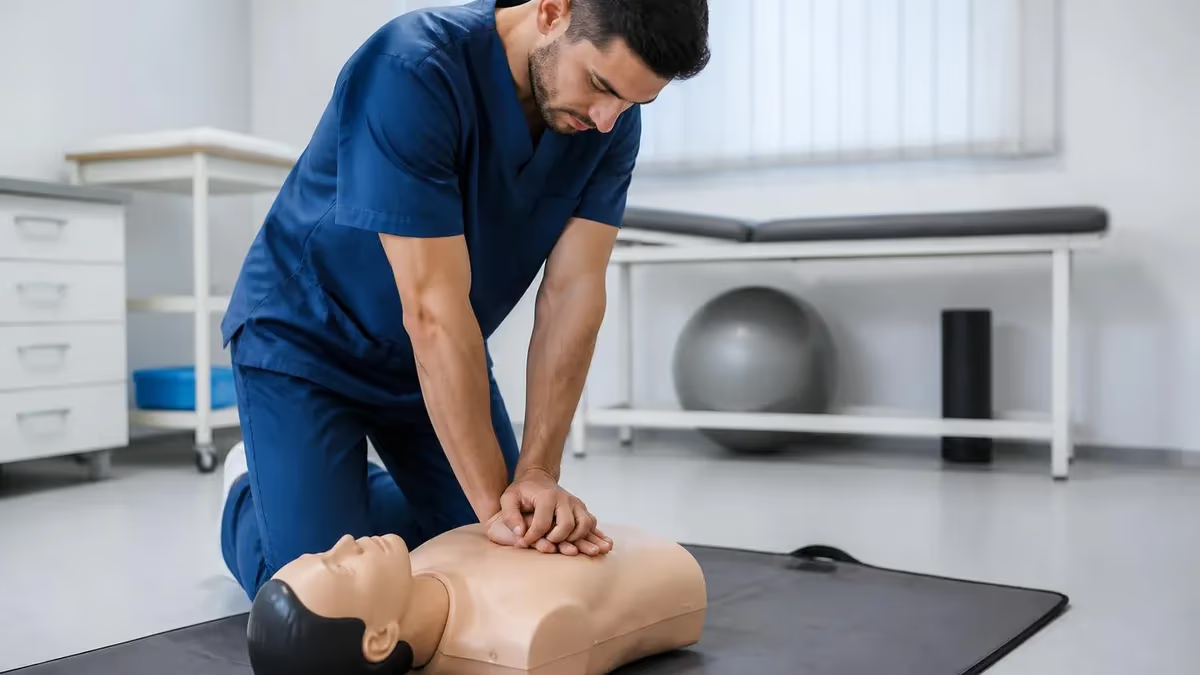
The bls chain of survival represents the single most important framework you will learn during basic life support training, and understanding it deeply is the difference between passing your certification exam and truly being prepared to save a life. If you have been asking what is a bls certification, the answer starts here: it is a credential built around your ability to execute every link in this chain with precision, speed, and confidence. The American Heart Association updates these links roughly every five years, with the most recent revisions emphasizing high-quality compressions and faster recognition.
Whether you are a new nursing student, an experienced paramedic preparing for renewal, or a lifeguard sitting for your first basic life support exam american heart association certification, the chain of survival is your operational blueprint. It defines what happens in the first ten minutes after a cardiac arrest, who does what, and in what order. Mastering this sequence is what separates a panicked bystander from a competent provider who saves a life on a Tuesday afternoon shift.
This guide breaks down all six links of the modern in-hospital and out-of-hospital chains, explains the science behind each intervention, and shows you exactly how the aha basic life support exam tests your knowledge of them. We will cover the differences between adult, pediatric, and infant chains, address the common question of whether is bls and cpr the same, and give you concrete drills you can practice today.
You will also find ten realistic exam-style scenarios, a printable checklist for your clinical bag, and a comparison of how the American Red Cross and AHA teach the chain differently. By the end, you will be able to explain to a colleague why early defibrillation matters more than perfect ventilation, and why the new sixth link, recovery, fundamentally changed how we think about cardiac arrest survival.
If you are pressed for time and only have a weekend before your test, skip directly to section five for the rapid-review summary and section six for the most-missed exam questions. But if you genuinely want to master this material, read the full guide. The investment of ninety minutes here can shave weeks off your study timeline and dramatically improve your retention of every other BLS skill you learn, from compression depth to the two-thumb infant technique covered in our detailed walkthrough of the pediatric algorithm and is bls and cpr the same comparison.
One more orientation point before we dive in: the chain of survival is not a checklist you memorize and forget. It is a mental model that should fire automatically the moment you see someone collapse. Every section below is designed to build that automaticity, with real numbers, real timing, and the same scenario framing the AHA uses in its instructor manuals.
Let us start with the foundation: what each link is, why it exists, and how the chain has evolved from its original four-link version in 1991 to today's six-link in-hospital model. The history matters because it explains why some textbooks still show four links while your exam will test six.
The BLS Chain of Survival by the Numbers

The 6 Links of the BLS Chain of Survival
Recognize cardiac arrest by checking responsiveness and breathing simultaneously in under 10 seconds. Activate emergency response by calling 911 or pushing the in-hospital code button, and send for an AED immediately.
Begin chest compressions within 10 seconds of recognition. Push hard (at least 2 inches), push fast (100-120/min), allow full recoil, minimize interruptions to under 10 seconds, and avoid excessive ventilation.
Attach the AED as soon as it arrives and follow voice prompts. Defibrillation within 3-5 minutes of collapse can produce survival rates as high as 50-70% for witnessed shockable arrests.
EMS or hospital teams take over with advanced airway management, IV/IO access, epinephrine, and rhythm-specific interventions. BLS providers continue compressions while ALS team prepares.
After return of spontaneous circulation, focus shifts to targeted temperature management, hemodynamic optimization, and identifying the underlying cause to prevent re-arrest.
The newest link added in 2020. Includes rehabilitation, psychological support for survivors and families, and structured follow-up to address cognitive, physical, and emotional sequelae.
If you are still wondering what is a bls certification and how it relates to the chain of survival, the simple answer is that BLS certification is the formal credential proving you can execute every link of the out-of-hospital and in-hospital chains to the standard set by either the American Heart Association or the American Red Cross. The certification is valid for two years and is required for nurses, doctors, EMTs, dental staff, respiratory therapists, lifeguards, and many allied health professionals across all fifty states.
The basic life support for healthcare providers course is the version most clinicians take. It runs roughly four to four and a half hours, includes hands-on skills practice on adult, child, and infant manikins, and ends with a written exam and a skills check-off. The aha basic life support exam typically contains 25 multiple-choice questions, and you need 84% or higher to pass. Most students who study the chain of survival cold pass on the first attempt.
A common question is whether is bls the same as cpr. The short answer is no, though the two overlap heavily. CPR is one component of BLS, while BLS encompasses CPR plus AED operation, two-rescuer dynamics, choking relief for all ages, opioid overdose response, and team communication. Layperson CPR courses do not cover two-rescuer compression-to-ventilation ratios of 15:2 for pediatrics, nor do they teach the structured handoff communication that healthcare BLS requires.
The basic life support exam american heart association uses tests scenario recognition heavily. You will see questions like "a 58-year-old man collapses in the waiting room, is unresponsive, and has agonal gasps; what is your first action?" The correct answer is always anchored to the chain of survival: recognize, activate, compress, defibrillate. If you can think in terms of links, you will not get tripped up by elaborate question stems designed to make you second-guess the basics.
Renewal works differently from initial certification. A basic life support renewal class is shorter, usually two to three hours, and assumes you already know the algorithms. Renewal students often struggle more than first-timers because they have developed habits that drift from current guidelines, particularly around compression depth and the elimination of pulse checks between cycles. Always review the most recent guideline update before your renewal class.
Cost varies by provider, location, and whether you take an instructor-led course, a blended online plus skills session, or a fully online renewal. AHA classroom courses typically run $60 to $120, while the equivalent American Red Cross basic life support course costs roughly the same. Both credentials are accepted by virtually all U.S. employers, though some hospital systems specifically require AHA. Always confirm with your employer or program before registering.
One final note on certification scope: a BLS card does not authorize you to administer medications, intubate, or interpret 12-lead ECGs. Those skills belong to ACLS, PALS, or paramedic scope. BLS is the foundation every other resuscitation credential builds on, which is why mastering the chain of survival pays dividends throughout your entire clinical career.
BLS Practice Test Questions
Prepare for the BLS - Basic Life Support exam with our free practice test modules. Each quiz covers key topics to help you pass on your first try.
BLS High-Quality CPR & Provider Skills
BLS Exam Questions covering BLS High-Quality CPR & Provider Skills. Master BLS Test concepts for certification prep.
BLS Special Situations & Scenarios
Free BLS Practice Test featuring BLS Special Situations & Scenarios. Improve your BLS Exam score with mock test prep.
BLS Adult, Child & Infant Resuscitation
BLS Mock Exam on Adult, Child & Infant Resuscitation. BLS Study Guide questions to pass on your first try.
BLS Airway Management & Ventilation
BLS Test Prep for Airway Management & Ventilation. Practice BLS Quiz questions and boost your score.
BLS Automated External Defibrillator (AED)...
BLS Questions and Answers on Automated External Defibrillator (AED) Use. Free BLS practice for exam readiness.
BLS Certification: Cardiac Arrest
BLS Mock Test covering Certification: Cardiac Arrest. Online BLS Test practice with instant feedback.
BLS Certification: Choking
Free BLS Quiz on Certification: Choking. BLS Exam prep questions with detailed explanations.
BLS Certification: Respiratory Arrest
BLS Practice Questions for Certification: Respiratory Arrest. Build confidence for your BLS certification exam.
BLS Chain of Survival
BLS Test Online for Chain of Survival. Free practice with instant results and feedback.
BLS CPR Techniques & Procedures
BLS Study Material on CPR Techniques & Procedures. Prepare effectively with real exam-style questions.
BLS Legal & Ethical Considerations
Free BLS Test covering Legal & Ethical Considerations. Practice and track your BLS exam readiness.
BLS Post-Resuscitation Care
BLS Exam Questions covering Post-Resuscitation Care. Master BLS Test concepts for certification prep.
AHA vs Red Cross: How Each Teaches the Chain
The American Heart Association teaches the chain of survival as two distinct sequences: out-of-hospital cardiac arrest and in-hospital cardiac arrest. Both have six links since the 2020 guideline update, but the order and emphasis differ. Out-of-hospital chains begin with recognition by a bystander and activation of 911, while in-hospital chains begin with surveillance and prevention through rapid response teams.
The aha basic life support exam emphasizes scenario recognition and timing. You will be tested on compression fraction, the percentage of resuscitation time spent actively compressing, with a target of at least 60%. AHA materials use the mnemonic CAB (Compressions, Airway, Breathing) and stress that any delay in compressions for airway management is unacceptable in adult cardiac arrest scenarios.

Should You Take Initial BLS or Just Renewal?
- +Initial course covers every link of the chain in detail with extended skills practice
- +Better foundation for advancing to ACLS or PALS within the next year
- +Required if your card has been expired for more than 30 days at most institutions
- +Includes detailed instruction on opioid overdose response and the latest naloxone protocols
- +Provides more time on team dynamics, which is the most-failed skills station for new providers
- +Builds confidence for clinicians who have not actively performed CPR in over two years
- −Longer time commitment of 4-5 hours versus 2-3 hours for renewal
- −Higher cost, typically $80-$120 versus $60-$90 for renewal
- −Repetition of basic content that experienced providers may find tedious
- −Skills check is identical to renewal so there is no practical advantage at the testing station
- −Most employers accept renewal indefinitely as long as you maintain continuous certification
- −Online renewal options are not available for first-time learners, limiting scheduling flexibility
Pros and Cons at a Glance
| Pros | Cons |
|---|---|
| Initial course covers every link of the chain in detail with extended skills practice | Repetition of basic content that experienced providers may find tedious |
| Better foundation for advancing to ACLS or PALS within the next year | Skills check is identical to renewal so there is no practical advantage at the testing station |
| Includes detailed instruction on opioid overdose response and the latest naloxone protocols | Most employers accept renewal indefinitely as long as you maintain continuous certification |
| Provides more time on team dynamics, which is the most-failed skills station for new providers | Online renewal options are not available for first-time learners, limiting scheduling flexibility |
BLS Provider Skills Checklist for Every Shift
- ✓Verify the location of the nearest AED before your shift begins
- ✓Confirm crash cart oxygen tank pressure is above 1500 PSI
- ✓Test bag-mask ventilation seal on the manikin in your unit's break room monthly
- ✓Review your facility's code blue activation procedure and overhead page wording
- ✓Practice the two-finger and two-thumb infant compression techniques quarterly
- ✓Memorize the 30:2 single-rescuer and 15:2 two-rescuer pediatric ratios
- ✓Know where the pediatric AED pads or attenuator are stored separately from adult pads
- ✓Confirm your BLS card expiration date and schedule renewal at least 60 days early
- ✓Practice closed-loop communication phrases like 'compressions on you, switch in 30'
- ✓Review the latest opioid overdose response algorithm including naloxone administration
Time-to-Defibrillation Is the Single Strongest Predictor of Survival
For witnessed cardiac arrest with a shockable rhythm, every minute that defibrillation is delayed reduces survival by approximately 7-10%. After 10 minutes without shock, survival approaches zero. This is why early defibrillation, link three, is statistically more impactful than perfect compression depth or ventilation technique. If you can only do one thing well, get the AED on the chest fast.
Now let us go deeper on the most-tested topics in exam prep. The basic life support exam american heart association uses follows a predictable pattern: scenario stem, distractor about ventilation or pulse checking, and one clearly correct answer rooted in the chain of survival. If you train yourself to mentally label each scenario by which link is being tested, you will score significantly higher than students who memorize discrete facts.
The single most-missed question on the aha basic life support exam involves compression-to-ventilation ratios in two-rescuer pediatric CPR. The correct ratio is 15:2 for children and infants with two trained rescuers, versus 30:2 for one rescuer or any adult resuscitation. Students often default to 30:2 universally, which is wrong. Memorize this distinction and you will avoid the most common test failure.
The second most-missed question involves pulse check timing. The maximum pulse check duration is 10 seconds. If you are not certain you feel a pulse within 10 seconds, you start compressions. Hesitation costs lives and exam points. The AHA explicitly prefers a brief, potentially unnecessary cycle of compressions over a delayed start due to prolonged pulse assessment.
Third on the most-missed list is the recovery position and when to use it. The recovery position applies only to unresponsive patients who have adequate breathing and a definite pulse. If you are unsure about breathing quality or pulse presence, do not place the patient in recovery position; begin resuscitation instead. This is tested heavily because it directly contradicts older training many providers received.
Compression fraction is another exam favorite. Compression fraction is the percentage of total resuscitation time during which active compressions are occurring. The target is at least 60%, with 80% being considered excellent. This metric is why minimizing interruptions for pulse checks, rhythm analysis, and provider switches is emphasized so heavily in modern BLS training.
Switch compressors every two minutes or sooner if fatigue is evident. Fatigue degrades compression quality far faster than most providers realize, typically within 90 seconds, even though the provider feels fine. Trust the timer, not your perception of fatigue. The switch should take less than five seconds and ideally happen during the AED rhythm analysis pause to maximize compression fraction.
Finally, the chain of survival concept itself is tested directly. Expect questions like "which link of the in-hospital cardiac arrest chain of survival comes immediately after high-quality CPR?" The answer for in-hospital is rapid defibrillation, identical to out-of-hospital. The chain order does not change between settings; what changes is who performs each link and how quickly resources arrive.

Agonal gasping is a brainstem reflex that occurs in roughly 40% of cardiac arrest victims during the first minutes. It can look like slow, irregular, snoring breaths and is frequently mistaken for normal breathing by bystanders and even trained providers. If breathing is not normal and the patient is unresponsive, start compressions immediately. Delaying CPR because of agonal breathing is a leading cause of preventable death and a frequent exam question.
The sixth link in the modern chain of survival, recovery, deserves dedicated attention because it is both the newest addition and the most frequently overlooked. Added in the 2020 AHA guideline update, recovery acknowledges that surviving cardiac arrest is not the endpoint; the patient and family face weeks to years of physical, cognitive, and emotional recovery that demands structured support.
Survivors of cardiac arrest commonly experience cognitive impairment, post-traumatic stress symptoms, anxiety, depression, and reduced quality of life even when neurologic recovery appears complete on initial discharge assessment. Approximately 50% of survivors report some form of cognitive deficit at six months post-arrest, and many require formal neurorehabilitation services to return to prior baseline function.
Family members and bystander rescuers also experience significant psychological impact. PTSD rates among bystander CPR providers can reach 25% in cases involving children or failed resuscitation. The recovery link explicitly includes psychological support for everyone involved, not just the patient. This is a major change from the older view that resuscitation success was binary, measured solely by return of spontaneous circulation.
For BLS providers, the recovery link translates to specific actions: thorough handoff documentation including the timeline of arrest and interventions, family-centered communication that acknowledges the emotional intensity of what just happened, and follow-up with team members through structured debriefs after every code. Hot debriefs immediately after the event and cold debriefs within 72 hours are increasingly standard practice.
Post-cardiac arrest care, link five, transitions directly into recovery. Targeted temperature management, traditionally called therapeutic hypothermia, is used for unconscious post-arrest patients to protect neurologic function. The target temperature range and duration have evolved significantly; current guidelines support constant temperature between 32 and 37.5 degrees Celsius for at least 24 hours, with strict avoidance of fever for at least 72 hours.
For renewal candidates returning after a few years away from acute care, much of the recovery link content will be new. If you are looking for the most updated coverage, the red cross basic life support course online renewal modules include detailed videos on the recovery link and post-arrest care that are worth watching even if you certify through AHA. Many providers find the visual learning particularly helpful for understanding how the six links connect into a continuous care pathway.
Finally, do not underestimate how often the recovery link appears on current exams. Questions about psychological support for survivors, the duration of targeted temperature management, and the importance of structured rehabilitation are increasingly common since the 2020 guideline update. If your study materials are more than three years old, they likely do not cover this content adequately, and you should supplement with current AHA or Red Cross course materials before sitting for your exam.
Practical preparation for your BLS exam comes down to three habits: scenario-based practice, hands-on skills repetition, and timed quiz drills. Reading the manual is necessary but not sufficient. The brain stores procedural knowledge differently from declarative knowledge, and you need both encoded before you walk into the testing room. Most students who fail simply did not practice scenarios out loud or on a manikin.
Start your prep at least two weeks before your scheduled class if you are taking initial certification, or one week before for renewal. Do not try to cram the night before; the skills station requires muscle memory that develops through repetition over multiple days, not consecutive hours. A 45-minute daily practice block is far more effective than a six-hour weekend session.
Use the talk-out-loud method during practice. Stand next to a chair, imagine the patient collapsed in front of you, and verbally narrate every step: "Patient is unresponsive, breathing is absent, calling for help and an AED, beginning compressions at the lower half of the sternum, depth at least two inches, rate 100 to 120, allowing full recoil, switching at two minutes." This verbalization activates the same neural pathways that fire during real resuscitation.
For the written exam, take at least three full-length practice tests under timed conditions. Aim for 84% or higher consistently on practice tests before sitting for the real exam, since exam-day anxiety typically reduces scores by 5-10% from practice baseline. Review every missed question and identify which link of the chain of survival the question was testing. This pattern recognition will help you decode similar question structures on test day.
The hands-on skills station is graded on specific criteria: compression depth at least two inches, rate 100 to 120 per minute, full chest recoil, minimal interruptions, correct hand placement, and effective bag-mask ventilation with visible chest rise. The instructor will use a checklist; if you miss any critical action, you must remediate. Practice on a manikin with a feedback device if at all possible.
If you are struggling to find time for adequate preparation, consider whether you should learn how long does bls certification last and how that timeline fits your professional development plan. For most providers, the answer is two years from issue date, and planning your renewal during a less hectic period of the year significantly improves outcomes. Pairing renewal with your annual competency review week, when other clinical training is already scheduled, often works well.
One final tip: do not skip the team dynamics portion of the curriculum. The most common reason experienced providers fail their renewal skills check is not compression quality, it is failure to verbalize closed-loop communication, role assignment, and clear leadership. Practice phrases like "Maria, you take compressions; John, you bag; I have leadership; switch in two minutes," until they feel natural. Effective team communication is the connective tissue holding every link of the chain of survival together.
Sample BLS - Basic Life Support Practice Questions
Try these questions from our free BLS - Basic Life Support practice tests. The correct answer and an explanation follow each question.
Why is the 'recognition and activation' link considered the first critical step in the Chain of Survival?
- A. It starts the 911 dispatch process that brings AED and advanced care
- B. It directly restores normal heart rhythm
- C. It eliminates the need for CPR in most cases
- D. It replaces the role of trained bystanders
Answer: A. It starts the 911 dispatch process that brings AED and advanced care
Without recognition and activation, no subsequent links in the chain can begin, making it the trigger for all downstream interventions.
How many links are in the adult Chain of Survival?
- A. Four
- B. Five
- C. Six
- D. Seven
Answer: B. Five
The adult Chain of Survival, as defined by organizations like the American Heart Association, consists of five critical links. These are: 1) Recognition and activation of emergency response, 2) Early CPR, 3) Rapid defibrillation, 4) Advanced life support, and 5) Post-cardiac arrest care. Each link is vital for improving outcomes and represents a sequential step in effective cardiac arrest management.
Which community-level intervention has been shown to MOST effectively improve outcomes by strengthening multiple links in the out-of-hospital Chain of Survival simultaneously?
- A. Public access defibrillation (PAD) programs combined with CPR training
- B. Increasing the number of hospital beds
- C. Reducing the number of 911 call centers to streamline dispatch
- D. Restricting AED use to licensed healthcare providers
Answer: A. Public access defibrillation (PAD) programs combined with CPR training
PAD programs place AEDs in public locations and pair them with CPR training, simultaneously strengthening the early CPR and rapid defibrillation links.
Which Chain of Survival link is most often performed by bystanders before EMS arrives?
- A. Early CPR
- B. Rapid defibrillation
- C. Advanced life support
- D. Post-cardiac arrest care
Answer: A. Early CPR
Bystanders are typically the first on scene and can begin CPR before EMS or AED resources arrive.
BLS Questions and Answers
Pediatric BLS Algorithm: Complete 2026 Guide for Healthcare Providers
American Heart Association BLS: Certification, Renewal, Cost & What to Expect
Online BLS Renewal: Complete 2026 Guide to Recertifying Your Basic Life Support Card
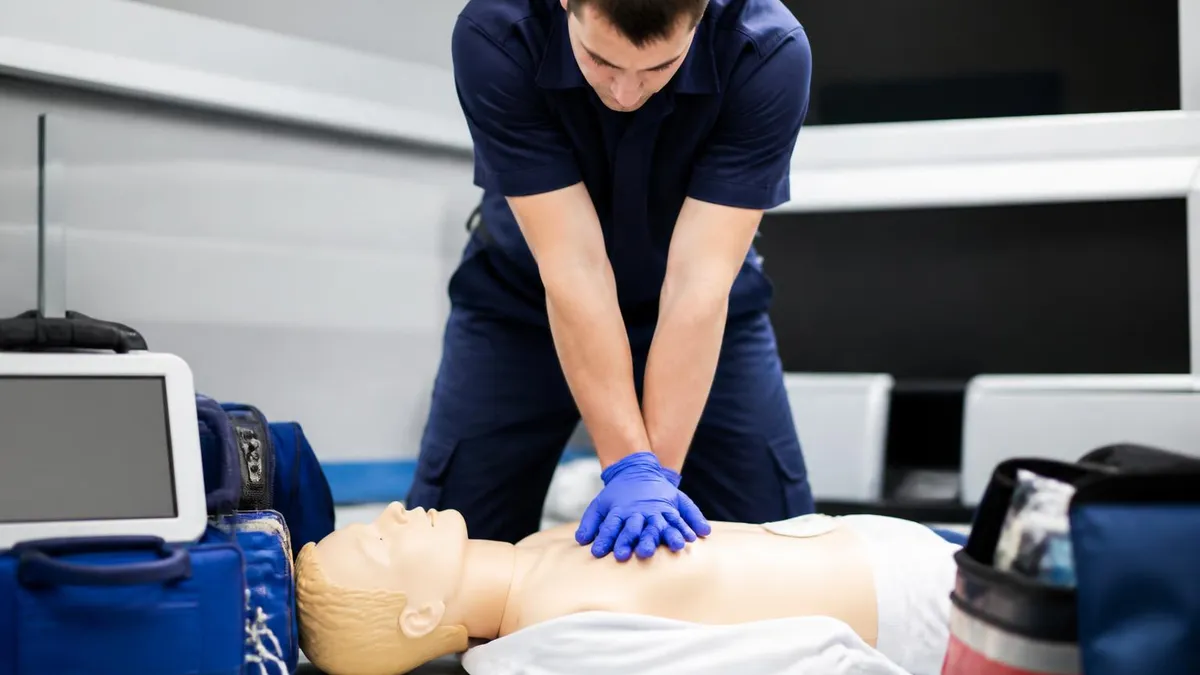
BLS vs ALS: Complete Comparison of Basic and Advanced Life Support
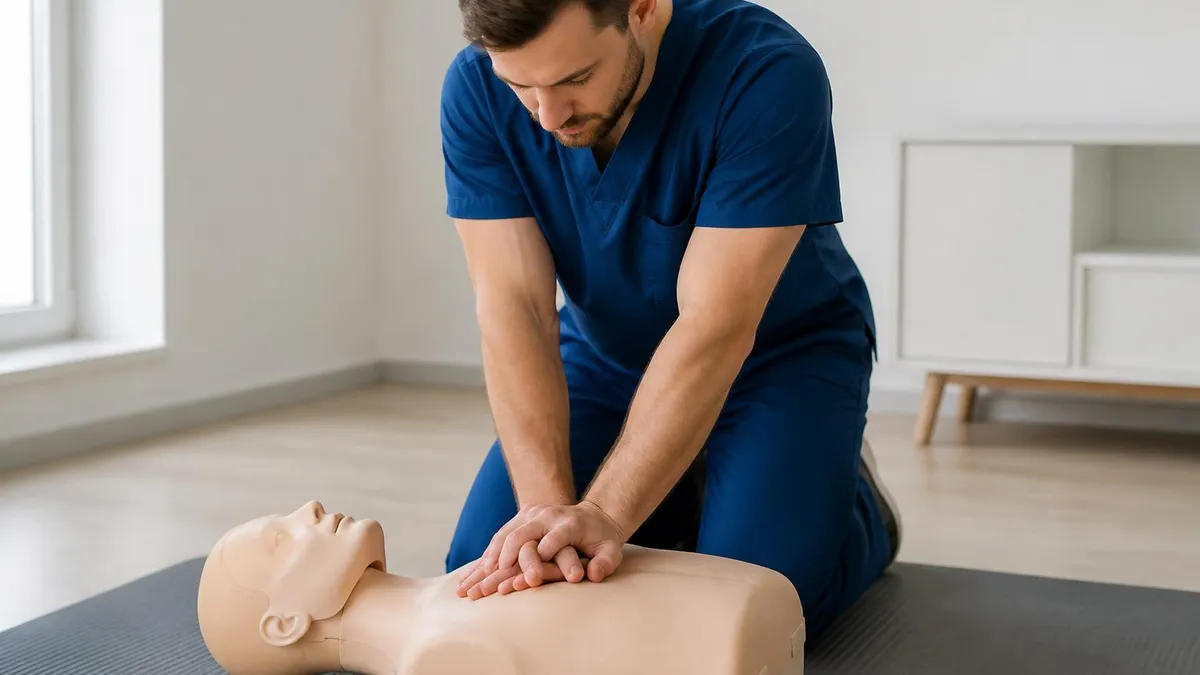
Are CPR and BLS the Same? Complete 2026 Guide to Differences, Certification & Training
About the Author

Registered Nurse & Healthcare Educator
Johns Hopkins University School of NursingDr. Sarah Mitchell is a board-certified registered nurse with over 15 years of clinical and academic experience. She completed her PhD in Nursing Science at Johns Hopkins University and has taught NCLEX preparation and clinical skills courses for nursing students across the United States. Her research focuses on evidence-based exam preparation strategies for healthcare certification candidates.
Join the Discussion
Connect with other students preparing for this exam. Share tips, ask questions, and get advice from people who have been there.
View discussion (8 replies)