
BLS Certification Cost: 2026 Pricing, What's Included & How to Save
Compare BLS certification cost in 2026 — AHA and Red Cross pricing, renewal fees, online vs. in-person, and proven ways to save on your card. 🗨️
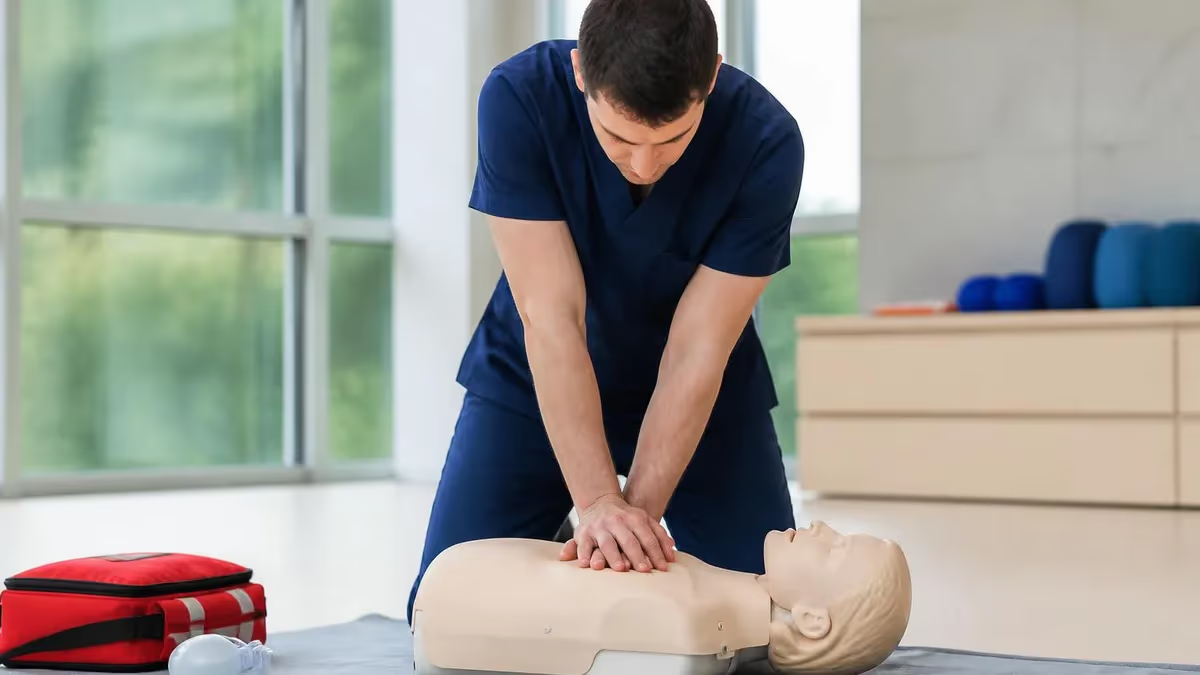
Understanding BLS certification cost is the first step for any healthcare worker, student, or first responder who needs a current provider card. So what is a BLS certification, and why does the price vary so much? Basic Life Support is the foundational emergency-care credential that proves you can recognize cardiac arrest, perform high-quality CPR, use an AED, and clear an obstructed airway. In 2026, prices typically run from $50 to $150 depending on provider, format, and your location across the United States. Practice with the free BLS - Basic Life Support practice test on PracticeTestGeeks (450+ questions with answer explanations).
The phrase "what does BLS stand for" trips up many newcomers, so let's clear it up: BLS means Basic Life Support, a standardized course built around the chain of survival. It is the entry-level certification most hospitals, nursing schools, dental offices, and EMS agencies require before you ever touch a patient. Because the credential is so widely mandated, dozens of training centers compete on price, and that competition is exactly why the cost range feels so wide and occasionally confusing to first-time buyers.
Pricing depends on three big levers: the issuing organization, the delivery format, and whether you are certifying for the first time or renewing. A brand-new in-person classroom course with a certified instructor usually costs more than an online or blended option. Renewal courses are frequently cheaper because they are shorter. Knowing exactly which bucket you fall into helps you avoid overpaying or, worse, paying for a card your employer will not accept.
Many shoppers also wonder how long does basic life support certification last before they commit any money, since a card that expires quickly changes the true annual cost. Most BLS cards are valid for two years, which means the price you pay today should be divided across 24 months when you compare options. A $120 two-year card costs $5 per month, while a suspiciously cheap $30 card from an unaccredited site may cost you a rejected application and a second purchase.
It also helps to recognize the two dominant brands. The American Heart Association (AHA) and the American Red Cross both issue nationally recognized BLS credentials, and their pricing structures differ slightly. AHA cards are the gold standard most hospitals demand, while Red Cross cards are equally valid and sometimes bundled with first-aid training. Throughout this guide we compare both so you can match the credential to your employer's exact requirement before you spend a dollar.
This article walks you through every cost component: course tuition, skills-testing fees, card-replacement charges, and the hidden add-ons that surprise buyers. We will also explain who needs BLS, how the exam works, how renewal differs from initial certification, and the legitimate ways to lower your bill. By the end, you will know precisely what a fair price looks like in 2026 and how to verify that any course you buy will actually be honored by the organization that asked you to get certified.
Free BLS - Basic Life Support Study Tools
Interactive BLS - Basic Life Support resources on PracticeTestGeeks, free to start:
- BLS - Basic Life Support practice test — 450+ questions with instant scoring and answer explanations
- BLS - Basic Life Support flashcards — review key terms and concepts card by card
- BLS - Basic Life Support study guide — topic-by-topic overview of what the exam covers
- BLS - Basic Life Support cheat sheet — one-page printable summary for last-minute review
BLS Certification Cost by the Numbers
Key Facts at a Glance
| Item | Value | Details |
|---|---|---|
| Typical Cost Range | $50–$150 | Initial certification, 2026 |
| Renewal Course | $30–$90 | Shorter, lower-priced |
| Card Validity | 2 Years | AHA & Red Cross |

BLS Certification Cost Breakdown by Provider
So what is a BLS certification at its core? It is formal proof that you completed a standardized Basic Life Support course and passed both a written knowledge check and a hands-on skills evaluation. The credential confirms you can deliver chest compressions at the correct rate and depth, ventilate with a bag-mask, operate an automated external defibrillator, and respond to choking in adults, children, and infants. Employers treat the card as evidence that you meet a baseline safety standard before working near patients.
A common search is "is BLS the same as CPR," and the honest answer is no, though they overlap heavily. CPR is a single skill — manual chest compressions and rescue breaths. BLS is a broader, provider-level course that includes CPR but adds team dynamics, AED use, airway management, and rescue techniques for multiple age groups. If you have ever wondered whether is basic life support the same as cpr, the distinction matters because employers usually specify BLS, not generic CPR, on job postings.
The acronym question — "what does BLS stand for" — comes up constantly, and the answer is simply Basic Life Support. It sits one tier above community CPR and one tier below Advanced Cardiovascular Life Support (ACLS) and Pediatric Advanced Life Support (PALS). Understanding this hierarchy helps you avoid buying the wrong course. Paying for ACLS when your employer only requires BLS wastes both money and study time, since ACLS courses cost two to three times more and assume you already hold a current BLS card.
Basic life support for healthcare providers is the specific course title most clinical employers require. It is more rigorous than the layperson "heartsaver" version because it assumes you will respond as part of a coordinated resuscitation team. Nurses, respiratory therapists, medical assistants, paramedics, dental staff, physical therapists, and nursing students all typically need this provider-level credential. The course teaches role assignment, closed-loop communication, and switching compressors every two minutes to prevent fatigue and preserve compression quality.
Both the American Heart Association and American Red Cross basic life support programs teach the same evidence-based science, drawn from the International Liaison Committee on Resuscitation guidelines. The differences are administrative, not clinical: card design, renewal portals, instructor networks, and bundling options. Some hospitals contractually require an AHA card specifically, so always confirm with your employer or school before enrolling. Spending $90 on a perfectly valid card your facility will not accept is the single most common and avoidable mistake.
Cost ties directly to format. A fully instructor-led classroom course includes the instructor's time, facility rental, manikins, and AED trainers, which is why it sits at the top of the price range. A blended course shifts the lecture portion online, shortening the in-person session to a focused skills check and lowering the price. Pure self-study options exist but are not accepted for the provider credential because BLS legally requires a hands-on skills evaluation by a certified instructor.
BLS Practice Test Questions
Prepare for the BLS - Basic Life Support exam with our free practice test modules. Each quiz covers key topics to help you pass on your first try.
BLS High-Quality CPR & Provider Skills
BLS Exam Questions covering BLS High-Quality CPR & Provider Skills. Master BLS Test concepts for certification prep.
BLS Special Situations & Scenarios
Free BLS Practice Test featuring BLS Special Situations & Scenarios. Improve your BLS Exam score with mock test prep.
BLS Adult, Child & Infant Resuscitation
BLS Mock Exam on Adult, Child & Infant Resuscitation. BLS Study Guide questions to pass on your first try.
BLS Airway Management & Ventilation
BLS Test Prep for Airway Management & Ventilation. Practice BLS Quiz questions and boost your score.
BLS Automated External Defibrillator (AED)...
BLS Questions and Answers on Automated External Defibrillator (AED) Use. Free BLS practice for exam readiness.
BLS Certification: Cardiac Arrest
BLS Mock Test covering Certification: Cardiac Arrest. Online BLS Test practice with instant feedback.
BLS Certification: Choking
Free BLS Quiz on Certification: Choking. BLS Exam prep questions with detailed explanations.
BLS Certification: Respiratory Arrest
BLS Practice Questions for Certification: Respiratory Arrest. Build confidence for your BLS certification exam.
BLS Chain of Survival
BLS Test Online for Chain of Survival. Free practice with instant results and feedback.
BLS CPR Techniques & Procedures
BLS Study Material on CPR Techniques & Procedures. Prepare effectively with real exam-style questions.
BLS Legal & Ethical Considerations
Free BLS Test covering Legal & Ethical Considerations. Practice and track your BLS exam readiness.
BLS Post-Resuscitation Care
BLS Exam Questions covering Post-Resuscitation Care. Master BLS Test concepts for certification prep.
Basic Life Support Exam: American Heart Association vs. Red Cross
The AHA basic life support exam combines a written multiple-choice test, usually around 25 questions, with a hands-on skills check scored against a standardized checklist. You must demonstrate adult, child, and infant CPR, plus correct AED operation. The passing score on the written portion is at least 84%, and the skills test is pass or fail with no partial credit.
The American Heart Association exam emphasizes high-quality compressions: a rate of 100–120 per minute, a depth of at least two inches in adults, full chest recoil, and minimal interruptions. Instructors observe in real time and may require a retest if you miss a critical step. Most blended courses let you retake the written test once at no extra charge.

Online/Blended BLS Courses: Worth the Cost?
- +Lower price than fully instructor-led classroom courses
- +Complete the lecture portion on your own schedule
- +Shorter in-person session — usually under two hours
- +Same nationally recognized card upon completion
- +Ideal for renewals when you already know the material
- +Reduces time off work and travel expenses
- −Still requires an in-person skills check — never fully online
- −Beware unaccredited sites selling 'instant' cards employers reject
- −Less hands-on practice time than a full classroom course
- −Self-paced study demands discipline to finish
- −Skills-session scheduling can fill up in busy areas
- −Some employers specifically require fully in-person training
How to Lower Your BLS Certification Cost
- ✓Confirm whether your employer reimburses certification fees.
- ✓Ask if your school or hospital offers free on-site BLS classes.
- ✓Choose a blended course to cut tuition versus full classroom.
- ✓Verify the provider is AHA- or Red Cross-accredited before paying.
- ✓Renew on time to qualify for cheaper recertification pricing.
- ✓Avoid 'instant card' sites that skip the required skills test.
- ✓Bundle BLS with first aid only if you genuinely need both.
- ✓Check for student, military, or group discounts.
- ✓Compare at least three local training centers on price.
- ✓Opt for a free digital card instead of a paid plastic reprint.
A rejected certificate costs more than a real one
The cheapest 'fully online' BLS cards often skip the mandatory hands-on skills evaluation, which means most hospitals and schools will reject them. Paying $30 for an invalid card and then $90 for a real one means you spent $120 — more than if you had bought the legitimate course first. Always verify accreditation before you enter a credit card number.
One of the most searched questions is how long does BLS certification last, and the answer directly affects your true cost. Both AHA and Red Cross BLS cards are valid for two years from the date you pass. That two-year window is why dividing your tuition across 24 months gives the fairest cost comparison. A $120 card works out to roughly $5 per month, which puts the credential among the most affordable professional requirements in healthcare.
A basic life support renewal class is almost always cheaper than initial certification because it is shorter and assumes you already understand the fundamentals. Renewal tuition commonly falls between $30 and $90, compared with $50 to $150 for first-time certification. The renewal still includes a written assessment and an in-person skills check, but the lecture content is condensed. Renewing before your card expires keeps you eligible for this lower pricing and avoids gaps in employment eligibility.
Timing matters enormously. If you let your card lapse, some training centers require you to retake the full initial course at the higher price rather than the discounted renewal. Most providers let you renew within a window — often up to 30 days before expiration — without losing time on your new card. Mark your expiration date in a calendar the day you certify so the cheaper renewal option stays available to you when the time comes.
Blended renewal is the sweet spot for cost and convenience. You complete updated coursework online, then attend a brief skills session to demonstrate current technique. Because experienced providers move through the skills check quickly, these sessions are short and inexpensive. If you certify in a high-volume area, you can often find same-week skills appointments, which means renewal need not disrupt your work schedule or require a full day off.
Some employers pay for renewal entirely, treating it as a condition of continued employment. Hospitals frequently host in-house renewal classes taught by staff instructors at no charge to employees, which can drop your out-of-pocket cost to zero. Before paying for an outside course, always ask your supervisor or education department whether internal training is available. Many nurses go their entire careers without personally paying for a single BLS renewal because their employer absorbs the expense.
If you prefer studying at home, an basic trauma life support option may appeal, but remember the skills check still happens in person for provider-level cards. Pure online completion certificates are acceptable only for awareness-level training, not the clinical BLS credential employers require. The two-year cycle, the discounted renewal pricing, and the in-person skills requirement together define what you should realistically budget across your career rather than just for a single course.

If your BLS card expires before you renew, many training centers will charge full initial-certification pricing instead of the discounted renewal rate. Renew within your provider's early window — often up to 30 days before expiration — to lock in the lower cost and avoid a gap that could affect your job eligibility.
Protecting yourself from fraudulent certificates is essential, because the BLS market is crowded with sites that promise an instant card for a tiny fee. The simplest safeguard is to confirm the course issues an American Heart Association or American Red Cross basic life support card, and that it includes a mandatory in-person skills evaluation. Any provider claiming you can complete the entire provider-level course online in fifteen minutes is not delivering an employer-accepted credential, regardless of how official the certificate looks.
Verify accreditation directly. AHA Training Centers and Red Cross authorized providers appear in official directories, and your card carries verification details an employer can check online. If a website cannot tell you which Training Center backs its course, or hides the name of the certified instructor, treat that as a red flag. Legitimate programs are transparent about their accreditation because that transparency is exactly what makes the card worth buying in the first place.
Watch for pricing that is too good to be true. A genuine provider course requires a paid certified instructor, manikins, AED trainers, and facility time, so prices below roughly $40 for initial certification should make you suspicious. Scammers profit by selling worthless PDFs that employers reject on sight. The few dollars you appear to save evaporate the moment your hospital's education department runs your verification number and finds no valid record behind it.
Understand the difference between the credential you need and adjacent courses. Knowing whether basic life support algorithm material matches your role prevents you from buying the wrong level. Layperson CPR, BLS provider, ACLS, and PALS are distinct products at distinct prices. If your employer's paperwork says "BLS Provider," a community heartsaver certificate will not satisfy it, even though it is cheaper and covers some overlapping content.
Keep digital proof of completion. Both major organizations now issue verifiable electronic cards, often included free with tuition, while a physical plastic card may carry a small reprint fee. Save the digital version to your phone and email so you can produce it instantly during onboarding or a compliance audit. Losing your only copy and paying for a reprint is an avoidable expense that proper record-keeping eliminates entirely from your certification budget.
Finally, document your expiration date and set a reminder 60 days out. That lead time lets you shop for the best renewal price, schedule a skills session before your card lapses, and confirm employer reimbursement. A little planning turns BLS certification from an annoying recurring expense into a predictable, low-cost line item you manage on your own terms rather than scrambling at the last minute and paying a premium for a rushed seat.
With the costs and pitfalls covered, here is how to get the most value from your BLS dollar in 2026. Start by asking your employer or school three questions: which organization's card they require, whether they reimburse the fee, and whether they offer in-house classes. The answers can reduce your out-of-pocket cost to nothing and instantly eliminate the risk of buying an unaccepted credential. This single conversation is the highest-return step in the entire process.
Next, gather pricing from at least three accredited local providers and one reputable blended program. Compare not just the sticker price but what is included: the digital card, free retests, skills-session scheduling, and any bundled first aid. A slightly higher tuition that includes a free retake and a same-week skills appointment often beats a cheaper course that charges extra for both. Read the fine print before you commit, especially the refund and rescheduling policy.
Prepare for the exam so you pass on the first attempt and avoid retest fees or a second course. Free practice questions covering compression rate, ventilation ratios, AED operation, and team dynamics build the confidence that makes the in-person skills check fast and stress-free. Candidates who walk in cold are more likely to stumble on a critical step, and a failed skills test can mean rescheduling, extra travel, and additional cost you could have avoided with an hour of review.
On the day of your course, arrive early, bring a photo ID, and wear comfortable clothing you can kneel in for compressions. Manikin work is physical, and being able to move freely helps you demonstrate correct depth and recoil. Bring any prerequisite completion certificate if you took a blended online module, because instructors cannot run your skills check without proof that you finished the required coursework first.
After you pass, immediately save your digital card to your phone, your email, and a cloud folder. Add a calendar reminder set 60 days before the two-year expiration. That buffer gives you time to qualify for discounted renewal pricing, confirm reimbursement again, and book a skills slot before your card lapses. Treating renewal as a scheduled, planned event rather than an emergency is the simplest way to keep your lifetime BLS cost low.
Finally, keep your skills fresh between certifications. Periodically reviewing the chain of survival, the compression-to-ventilation ratio, and AED steps means your renewal skills check is a formality rather than a hurdle. Strong retention also makes you genuinely better at responding to a real emergency, which is, after all, the actual point of the credential. The money you spend on BLS protects patients — and steady practice ensures you get full value from every dollar invested.
Sample BLS - Basic Life Support Practice Questions
Try these questions from our free BLS - Basic Life Support practice tests. The correct answer and an explanation follow each question.
Before approaching a victim of electrocution, what must the rescuer confirm?
- A. That the victim's blood pressure is measurable
- B. That the scene is safe and the electrical power source has been de-energized
- C. That the AED is fully charged and ready to use
- D. That the victim is showing signs of breathing
Answer: B. That the scene is safe and the electrical power source has been de-energized
Rescuer safety is the top priority; approaching an electrocution victim without confirming the power is off can electrocute the rescuer.
A patient in respiratory arrest from suspected opioid overdose regains breathing after naloxone. What should you do next?
- A. Keep the patient on their side and monitor closely because the naloxone may wear off
- B. Discharge the patient home once breathing normalizes
- C. Administer a second dose of naloxone immediately regardless of response
- D. Stop monitoring — the emergency is resolved
Answer: A. Keep the patient on their side and monitor closely because the naloxone may wear off
Naloxone has a shorter duration than most opioids, so respiratory depression can recur; continued monitoring is essential.
What is the most critical factor in effective team-based BLS?
- A. Performing compressions quickly
- B. Minimizing oxygen use
- C. Clear communication among team members
- D. All members giving commands
Answer: C. Clear communication among team members
In team-based BLS, clear communication is paramount for effective resuscitation. It ensures that tasks are assigned efficiently, roles are understood, and interventions are coordinated without delay or duplication. Effective communication minimizes errors, optimizes performance, and ultimately improves patient outcomes by creating a cohesive and well-organized response.
What is the first step in post-resuscitation care?
- A. Administering medications
- B. Assessing the patient’s responsiveness
- C. Ensuring airway and ventilation
- D. Performing CPR
Answer: C. Ensuring airway and ventilation
After successful resuscitation, the immediate priority is to secure a patent airway and ensure adequate breathing. This is critical because oxygen delivery to the brain and other vital organs is paramount to prevent secondary injury and stabilize the patient's condition. Without proper airway and ventilation, all other interventions would be ineffective.
BLS Questions and Answers
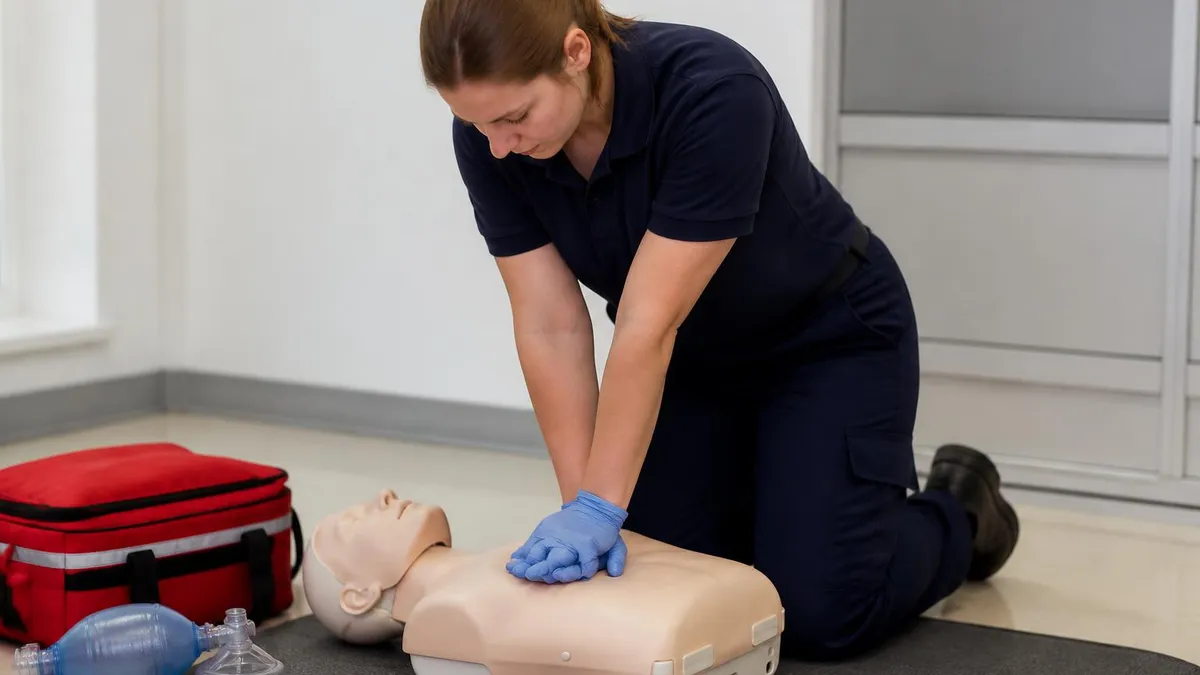
Pediatric BLS Algorithm: Complete 2026 Guide for Healthcare Providers
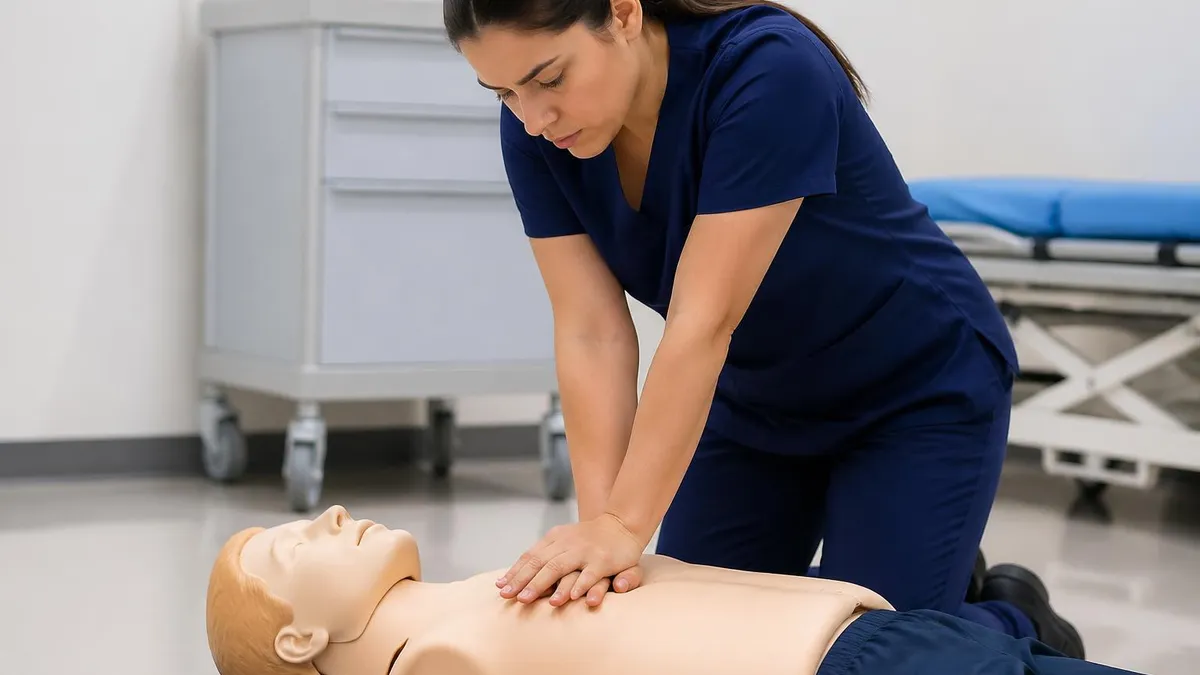
American Heart Association BLS: Certification, Renewal, Cost & What to Expect
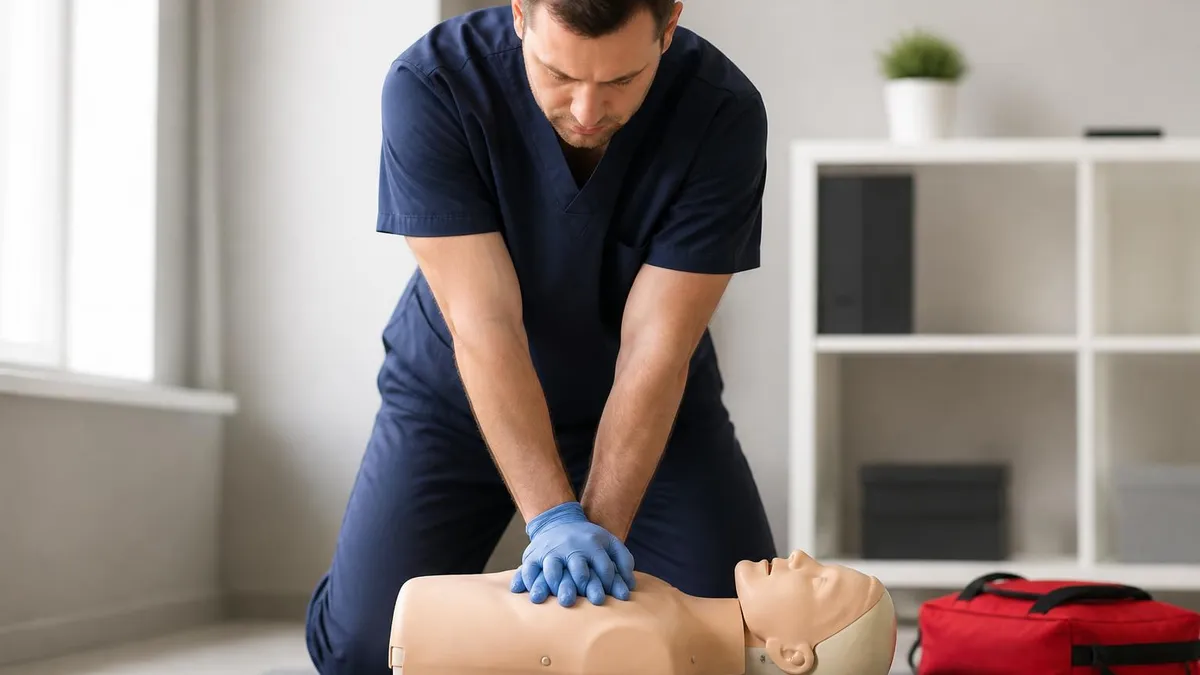
Online BLS Renewal: Complete 2026 Guide to Recertifying Your Basic Life Support Card
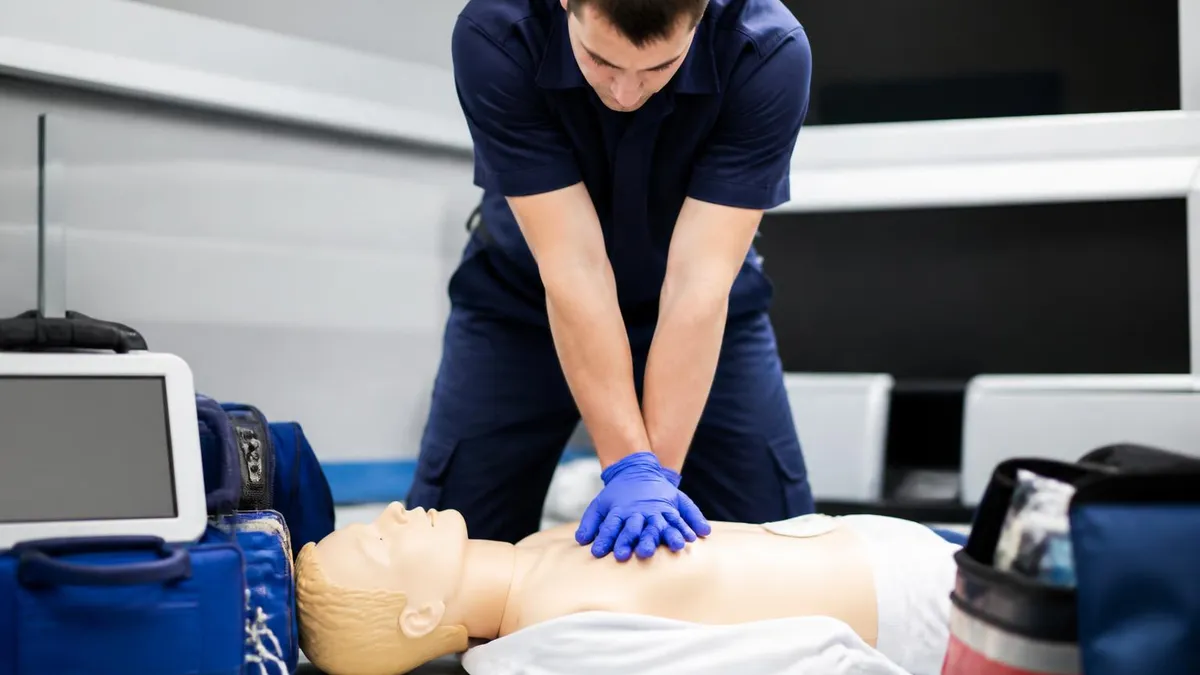
Are CPR and BLS the Same? Complete 2026 Guide to Differences, Certification & Training
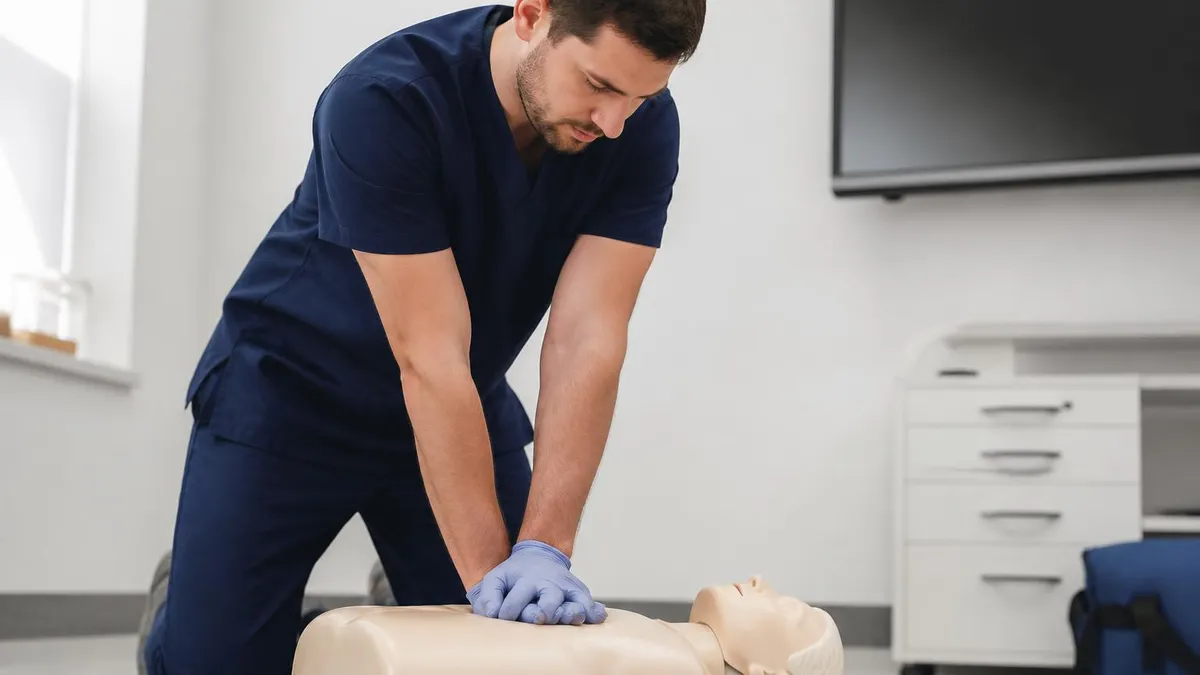
How to Renew BLS Certification: Complete 2026 Guide to Recertifying Your Card
About the Author

Registered Nurse & Healthcare Educator
Johns Hopkins University School of NursingDr. Sarah Mitchell is a board-certified registered nurse with over 15 years of clinical and academic experience. She completed her PhD in Nursing Science at Johns Hopkins University and has taught NCLEX preparation and clinical skills courses for nursing students across the United States. Her research focuses on evidence-based exam preparation strategies for healthcare certification candidates.