
BLS Course Online: What Is a BLS Certification, Requirements, Renewal, and How to Pass
Take a BLS course online: ✏️ learn what a BLS certification is, AHA exam format, renewal, cost, and how to pass on your first attempt.
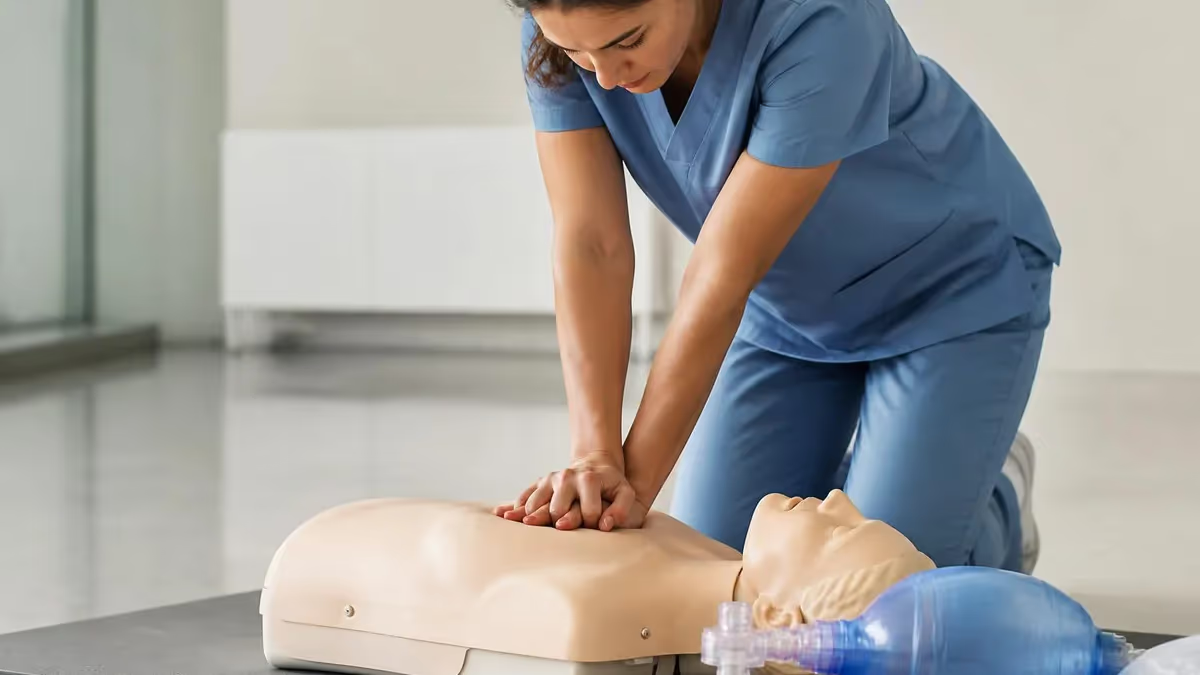
A bls course online is the fastest, most flexible way for healthcare workers and aspiring providers to earn or renew the credential that hospitals, clinics, and EMS agencies require. If you are asking what is a bls certification, the short answer is that it is proof you can recognize cardiac arrest, deliver high-quality chest compressions, use an AED, and work as part of a resuscitation team. Online and blended formats now make that training accessible from any device, on your own schedule, without losing the hands-on rigor that makes the credential trustworthy.
Many people first encounter Basic Life Support when an employer hands them a hire packet listing it as a condition of employment. Nurses, medical assistants, respiratory therapists, dental staff, EMTs, paramedics, lifeguards, and even fitness instructors are commonly required to hold a current card. Because the stakes are literally life and death, the certification is taken seriously by regulators, and the curriculum is standardized so that a provider trained in Ohio performs compressions exactly the way a provider trained in Texas does.
So what does bls stand for? BLS stands for Basic Life Support, a defined level of pre-hospital and in-hospital care focused on circulation, airway, and breathing for victims of cardiac arrest, choking, or respiratory failure. It sits below Advanced Cardiovascular Life Support and Pediatric Advanced Life Support but forms the foundation everything else builds on. Without solid BLS skills, the advanced interventions taught later simply will not work, which is why every higher course assumes you already have them.
A frequent point of confusion is whether is bls the same as cpr. The two overlap heavily but are not identical. CPR, cardiopulmonary resuscitation, is the core technique of compressions and ventilations that anyone can learn, including the public. BLS is a professional-level certification that includes CPR plus AED use, airway management, team dynamics, and assessment skills tailored for people who respond to emergencies as part of their job. Every BLS provider knows CPR, but not every CPR-trained person holds a BLS certification.
The two dominant providers in the United States are the American Heart Association and the American Red Cross. Both issue cards accepted nationwide, both follow the same scientific consensus guidelines updated every five years, and both offer online or blended pathways. Employers occasionally specify one provider, so it is worth confirming before you register. If you need to find an in-person skills site, searching for a basic life support course near me will surface authorized training centers in your area quickly.
This guide walks through everything you need to make an informed decision: exactly what the credential covers, how the AHA exam works, how long it lasts, what renewal looks like, realistic costs, and proven tactics for passing the written and skills portions on your first try. Whether you are certifying for the first time or coming back for a basic life support renewal class, the sections below give you a clear, no-nonsense roadmap so you can register with confidence and walk into your skills check fully prepared.
BLS Certification by the Numbers
Key Facts at a Glance
| Item | Value | Details |
|---|---|---|
| Card Validity | 2 yr | AHA and Red Cross alike |
| Typical Cost | $60–$140 | Online plus skills check |
| Written Pass Mark | 84% | Common AHA threshold |
What a BLS Course Online Actually Covers
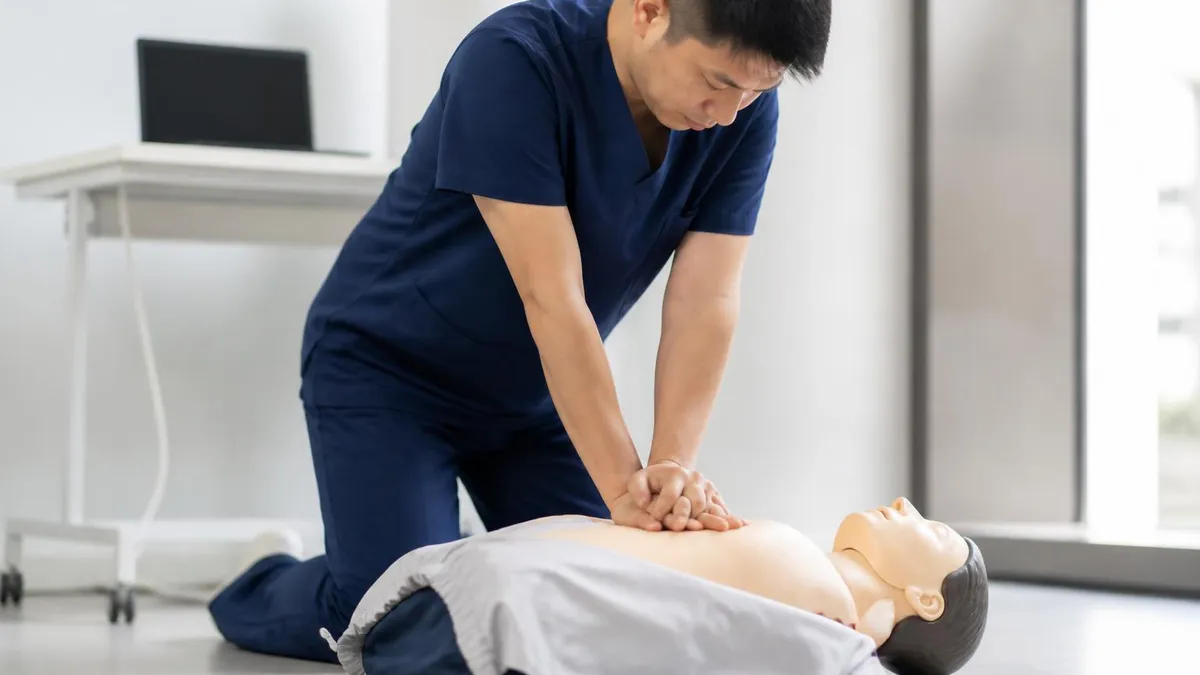
Compression depth of at least 2 inches, a rate of 100 to 120 per minute, full chest recoil, and minimizing interruptions are the core measurable skills you practice and are tested on.
You learn to power on an automated external defibrillator, attach pads correctly for adults and children, follow the voice prompts, and clear the patient before delivering a shock safely.
Bag-mask technique, the head-tilt chin-lift, rescue breaths, and proper compression-to-ventilation ratios for one- and two-rescuer scenarios are demonstrated and assessed during the course.
Managing foreign-body airway obstruction in responsive and unresponsive adults, children, and infants, including abdominal thrusts and back slaps, is a required competency for every provider.
BLS for healthcare providers emphasizes closed-loop communication, clear role assignment, and smooth rescuer transitions so a multi-rescuer team delivers compressions without dangerous pauses.
Choosing between the two major issuers is the first real decision after you commit to certifying. The basic life support exam american heart association version is the most widely recognized credential in clinical settings, and many hospital systems list the AHA card by name in their policies. The aha basic life support exam combines a self-paced online knowledge component with an in-person or virtual hands-on skills session, and it follows the most current emergency cardiovascular care guidelines that the AHA publishes and updates on a rolling scientific cycle.
The american red cross basic life support program is equally legitimate and is accepted by the overwhelming majority of employers, licensing boards, and accreditation bodies. The Red Cross curriculum mirrors the same underlying science, uses the same compression metrics, and issues a two-year digital certificate with a verifiable QR code. The differences between the two come down to course interface, instructor network, regional availability, and sometimes price rather than the substance of what you learn or how the skills are actually evaluated at the very end.
For clinical roles, the phrase basic life support for healthcare providers signals the specific track you want. This version goes beyond layperson CPR by adding pulse checks, advanced airway considerations, multi-rescuer choreography, and scenario-based judgment. If your employer simply says BLS is required, they almost always mean this provider-level course, not the general community CPR class. Registering for the wrong tier is a common and frustrating mistake that wastes both time and money, so confirm the exact course name in writing first.
Cost is a practical factor that varies by provider and region. An AHA blended course commonly runs between sixty and one hundred forty dollars once you add the skills-session fee, while Red Cross pricing falls in a similar band. Group rates arranged through an employer can lower the per-person cost substantially. Always verify whether the advertised price includes the mandatory hands-on check, because some online-only listings quote the knowledge module alone and then surprise you with a separate skills fee later in the process.
If your card is current and you only need to refresh, an basic life support online renewal can save significant time compared with sitting a full initial course. Renewal candidates already understand the fundamentals, so the coursework is streamlined and the skills check is shorter. The key requirement is that you renew before your existing card expires; letting it lapse usually forces you back into the full initial pathway, which costs more and takes considerably longer to complete from scratch.
Whichever provider you choose, the credential you earn is portable. A card issued in one state is honored in another, and digital certificates can be emailed to a new employer within seconds of completion. That portability is one of the strongest arguments for completing a recognized course rather than an unaccredited certificate that may not survive an employer audit. When in doubt, ask your human resources department which providers they accept before you spend a single dollar on registration.
Is BLS the Same as CPR? Online, Blended, and In-Person Compared
A fully online pathway works only for renewals in select jurisdictions or for non-clinical roles, because most accrediting bodies still require a hands-on skills demonstration. The online portion delivers video lessons, interactive scenarios, and a knowledge test you can complete in roughly one to two hours at your own pace, pausing and resuming whenever your busy schedule actually allows you to sit down.
The catch is verification. Answering whether is bls and cpr the same correctly on a screen does not prove you can compress a chest to the right depth. That is why purely online cards are often viewed skeptically by hospital HR departments during credential audits. If your employer audits credentials, confirm a fully online certificate will actually be accepted before you pay for one and risk wasting the fee.
Should You Take Your BLS Course Online?
- +Complete the knowledge portion on your own schedule, around shifts and family obligations
- +Self-paced video lets you rewind difficult concepts as many times as you need
- +Lower travel burden than a full-day in-person classroom course
- +Blended format still delivers an employer-accepted, audit-proof certification card
- +Faster renewal path for providers who already hold a current credential
- +Digital certificate is emailed instantly and easy to share with new employers
- −Most clinical roles still require an in-person skills check you cannot skip
- −Purely online-only cards may be rejected by hospital HR audits
- −Self-discipline is required to actually finish the self-paced modules
- −Some listings hide a separate skills-session fee not shown in the online price
- −Less live instructor interaction for asking nuanced questions in real time
- −Unreliable internet or an old device can interrupt the online module mid-test
BLS Course Online Registration Checklist
- ✓Confirm with your employer which provider they accept: AHA or American Red Cross.
- ✓Verify you need the provider-level course, not community CPR.
- ✓Check whether the listed price includes the mandatory hands-on skills check.
- ✓Confirm the format: fully online, blended, or in-person.
- ✓Make sure you are registering for initial certification or renewal as appropriate.
- ✓Test your device and internet connection before starting the online module.
- ✓Schedule your in-person skills session date and location in advance.
- ✓Block uninterrupted time for the one-to-two-hour knowledge component.
- ✓Review compression rate, depth, and ratio facts before the written test.
- ✓Save the confirmation email and bring photo ID to your skills check.
Renew before the expiration date on your card
Renewing while your certification is still valid lets you use the shorter, cheaper renewal course. If it expires, most providers require you to retake the full initial course. Set a calendar reminder for 60 days before your two-year expiration so you always have time to schedule a skills session.
One of the most common questions learners ask is how long does bls certification last. The answer is consistent across both major providers: a BLS card is valid for two years from the date you complete your course, including the hands-on skills check. The expiration date is printed on the physical or digital card, and it is your responsibility to track it. Most employers run periodic credential audits, and an expired card can pull you off the schedule until you recertify, so the date matters more than people realize.
The two-year cycle exists for good reason. Resuscitation science evolves, and the hands-on muscle memory required for high-quality compressions degrades measurably over time. Studies of compression skill retention show meaningful decline within months of training, which is part of why some institutions encourage more frequent low-dose practice between formal renewals. The biennial recertification is the regulatory floor, not necessarily the ideal refresh interval for someone who rarely performs CPR in their day-to-day clinical role.
When your two years are nearly up, you have two paths. The first is a basic life support renewal class, a streamlined course designed for providers who already hold a current credential. Because you have demonstrated competency before, the renewal compresses the theory and focuses the skills check on confirming you still meet the metrics. It costs less and takes less time than starting from scratch, which is the single biggest reason to never let your card lapse in the first place.
The second path applies if you missed the deadline. Once a card expires, most providers no longer offer the renewal shortcut and require the full initial course. There is sometimes a short grace window, but policies vary by training center and by employer, so never count on one. The financial and scheduling penalty for lapsing is entirely avoidable with a simple calendar reminder set a couple of months ahead of your printed expiration date.
Renewal format mirrors initial certification. You can complete a blended renewal where the knowledge refresher is online and the skills check is in person, or in some cases a fully remote skills verification using a feedback-enabled manikin shipped to you, depending on the provider and your role. If you want the fastest route and your card is still current, a focused renewal through a recognized program is almost always the smart financial and time choice for busy working professionals.
Keep documentation organized. Save your digital certificate as a PDF, photograph the QR code, and note the verification URL so a new employer can confirm authenticity instantly. If you change jobs, having that proof ready prevents delays in onboarding. Some providers also let you add the credential to professional profiles with a shareable badge. Treating your certification as a managed credential rather than a forgotten card is the habit that keeps you continuously compliant across your entire career.
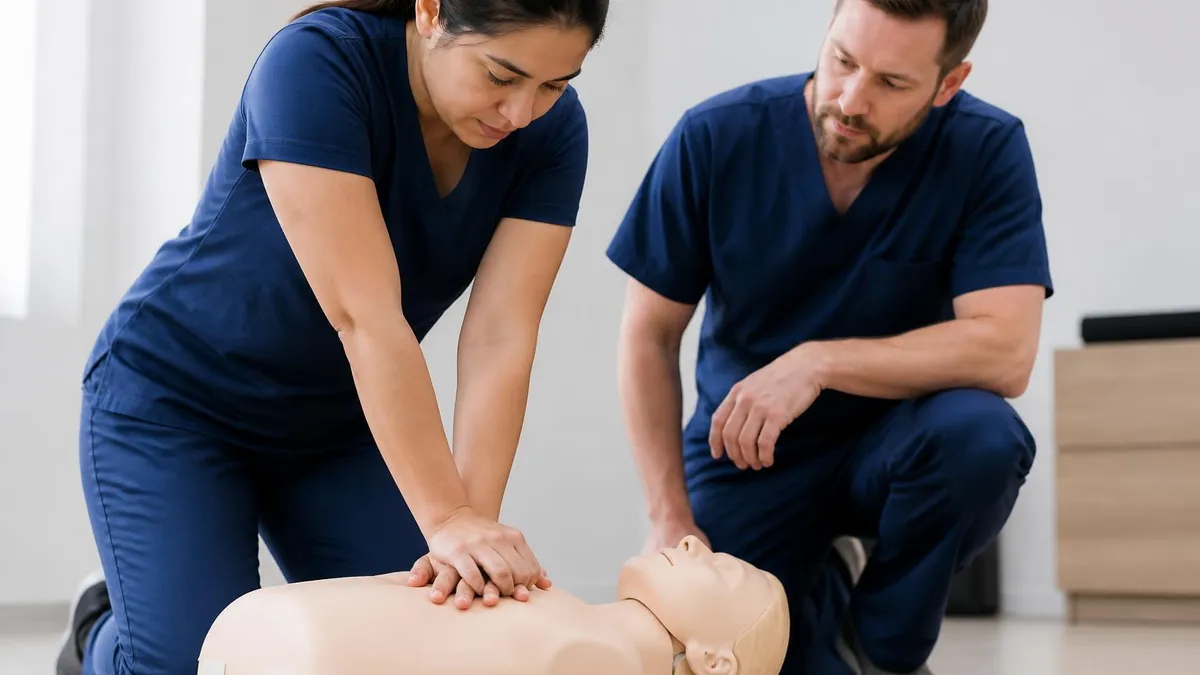
A certificate earned without any verified hands-on skills check may not satisfy hospital or clinical employers, even if it looks official. Before purchasing a fully online course, confirm in writing that your employer or licensing board accepts that format. When in doubt, choose a blended course with an in-person skills verification.
Passing your BLS course online comes down to mastering a small set of measurable facts and then proving them with your hands. The written portion of the basic life support exam american heart association track is built around recall of specific numbers and sequences, so the highest-yield study strategy is to memorize the core metrics cold. Know that the compression rate is 100 to 120 per minute, the adult depth is at least 2 inches but no more than 2.4 inches, and the single-rescuer adult ratio is 30 compressions to 2 breaths.
The skills check is where many first-timers stumble, not because the test is hard but because nerves disrupt their rhythm. Instructors evaluate depth, rate, full recoil, and minimal interruptions using a feedback manikin that displays your performance in real time. Practicing the cadence beforehand, even by tapping the rhythm of a 110-beats-per-minute song, builds the muscle memory that holds up under pressure. The evaluator wants to see consistency across a full cycle, not perfection on a single isolated compression.
Sequence matters as much as technique. For an unresponsive adult, the expected order is to ensure scene safety, check responsiveness and breathing while simultaneously checking a pulse for no more than ten seconds, call for help and an AED, and begin compressions immediately if there is no pulse. Examiners watch for hesitation and for skipped steps. Rehearsing the full assessment-to-compression flow until it is automatic is the single best preparation for the hands-on station you will face.
Team-based questions trip up people who studied only solo CPR. Basic life support for healthcare providers emphasizes two-rescuer choreography: one performs compressions while the other manages the airway, and they switch roughly every two minutes to prevent fatigue-related quality loss. The switch should take less than five seconds. Closed-loop communication, where you confirm orders out loud, is also tested, so practice verbalizing each action as if narrating to a partner during your actual skills session.
Special situations appear on most exams and reward broad reading. You should understand modifications for infants and children, choking relief for responsive and unresponsive victims, and considerations for pregnancy, drowning, and opioid overdose where naloxone may be relevant. These scenario questions test judgment rather than rote recall, so reading through case examples and explaining your reasoning aloud prepares you far better than passively rereading the manual. Free bls course online practice tests are an efficient way to surface gaps in this scenario knowledge fast.
Finally, manage exam logistics. Get a full night of sleep, eat beforehand, and arrive early to your skills site with photo identification and your registration confirmation. Wear clothing that lets you kneel and perform compressions comfortably. If you complete the online module the night before, the facts stay fresh for the written portion. Treating the exam as a routine demonstration of skills you have already drilled, rather than a high-stakes ordeal, keeps your hands steady and your sequence clean throughout.
With your fundamentals locked in, a few practical habits separate candidates who pass comfortably from those who scrape by or have to retest. Start by building a simple study plan across the week before your course rather than cramming the night before. Spend the first sessions memorizing the numeric metrics, then shift to sequencing, and finish with full-scenario walkthroughs. Spacing the material this way leverages how memory consolidates and means the facts are still sharp when you sit the written portion.
Use active recall instead of passive review. Rereading the provider manual feels productive but produces weak retention. Instead, close the book and write out the adult, child, and infant compression ratios from memory, then check yourself against the source. Quiz apps and free practice tests force this retrieval and reveal exactly which facts have not stuck. Every question you get wrong is a precise pointer to what to restudy, which is far more efficient than rereading material you already know well.
Rehearse the physical skills, not just the theory. If you have access to a manikin through your training center or workplace, practice compressions to a metronome set at 110 beats per minute until the rhythm feels automatic. If you do not, you can still practice hand placement, the head-tilt chin-lift motion, and the rescue-breath seal on a firm pillow. The goal is to remove every avoidable hesitation so that on test day your body executes while your mind simply confirms each step.
Simulate the real conditions of your skills check. Run through the entire sequence out loud, from scene safety to pulse check to compressions to AED, narrating each step as the examiner expects to hear it. Recruit a friend or colleague to play the second rescuer so you can practice the two-minute switch and closed-loop communication. Performing the choreography with another person exposes timing problems that solo practice hides and builds the calm confidence evaluators are genuinely looking for.
Plan for the logistics that derail people. Confirm your skills-session address and arrival time the day before, charge your phone, and screenshot your registration confirmation so a dead signal at the site cannot lock you out. Bring photo identification, wear flexible clothing, and arrive at least fifteen minutes early to settle your nerves. Small operational failures, not knowledge gaps, are a surprisingly common reason candidates have to reschedule, and every one of them is entirely preventable with a short checklist.
Finally, keep your perspective grounded in why the credential exists. The metrics you are memorizing translate directly into survival odds for a real person someday. High-quality compressions delivered without interruption can double or triple the chance of survival from out-of-hospital cardiac arrest. Approaching the course as genuine preparation to save a life, rather than a box to check for HR, naturally improves your focus and retention, and it makes the recertification cycle feel like maintenance of a real, valuable skill.
Sample BLS - Basic Life Support Practice Questions
Try these questions from our free BLS - Basic Life Support practice tests. The correct answer and an explanation follow each question.
A rescuer is performing CPR alone and is too fatigued to continue effective compressions. What is the best course of action?
- A. Switch to rescue breaths only and rest the arms
- B. Continue at a slower rate to conserve energy
- C. Call out for anyone nearby to take over compressions and continue until help arrives
- D. Stop CPR and wait for EMS
Answer: C. Call out for anyone nearby to take over compressions and continue until help arrives
The rescuer should call for someone else to take over while continuing CPR as best they can — stopping CPR significantly reduces survival chances.
Although you can tell that the patient DOES have a pulse, you cannot observe any chest movement. The patient doesn't seem to be breathing, unfortunately. What should be the next course of action?
- A. begin rescue breathing 1 breath every 6 seconds
- B. place on the left side in rescue position
- C. begin chest compressions
- D. begin rescue breathing 1 breath every 3-5 seconds
Answer: A. begin rescue breathing 1 breath every 6 seconds
If an adult patient has a pulse but is not breathing, the immediate intervention is to begin rescue breathing. The recommended frequency for rescue breaths in adults is one breath every 5-6 seconds, which equates to about 10-12 breaths per minute. This rate provides adequate oxygenation without causing hyperventilation, which can have negative effects.
You see a teen kid lying on the ground in the hallway where you work at a high school. What is your initial course of action after establishing the safety of the situation?
- A. check for a pulse by palpating a carotid pulse
- B. check for breathing by scanning the victim's chest
- C. begin CPR with chest compressions using two hand technique
- D. check responsiveness by tapping the victim's shoulder and shouting "are you OK?"
Answer: D. check responsiveness by tapping the victim's shoulder and shouting "are you OK?"
After ensuring scene safety, the very first step in assessing an unresponsive person is to check for responsiveness. Tapping the victim's shoulder and shouting 'Are you OK?' helps determine if the person is conscious or unconscious. This initial assessment guides subsequent actions, such as calling for help or initiating CPR.
You see a middle-aged man collapse and hold his chest as you prepare to go into the elevator to go to the lunch room while you are alone and on your lunch break. Currently, the man is lying on the ground. What should your initial course of action be in cases of cardiac arrest emergencies like this one?
- A. verify scene safety
- B. get a defibrillator
- C. begin CPR
- D. verify unresponsiveness
Answer: A. verify scene safety
In any emergency situation, the absolute first step is always to ensure scene safety for yourself and the victim. You cannot effectively help someone if you become injured or put yourself in danger. Only after confirming the scene is safe should you proceed to check for unresponsiveness, call for help, and initiate further emergency actions like CPR or retrieving a defibrillator.
Take the full BLS - Basic Life Support practice test
For a deeper look at this topic, see our guide to bls course online.
For a deeper look at this topic, see our guide to bls course online.
If you want the full picture, the bls course online guide walks through it step by step.
BLS Questions and Answers
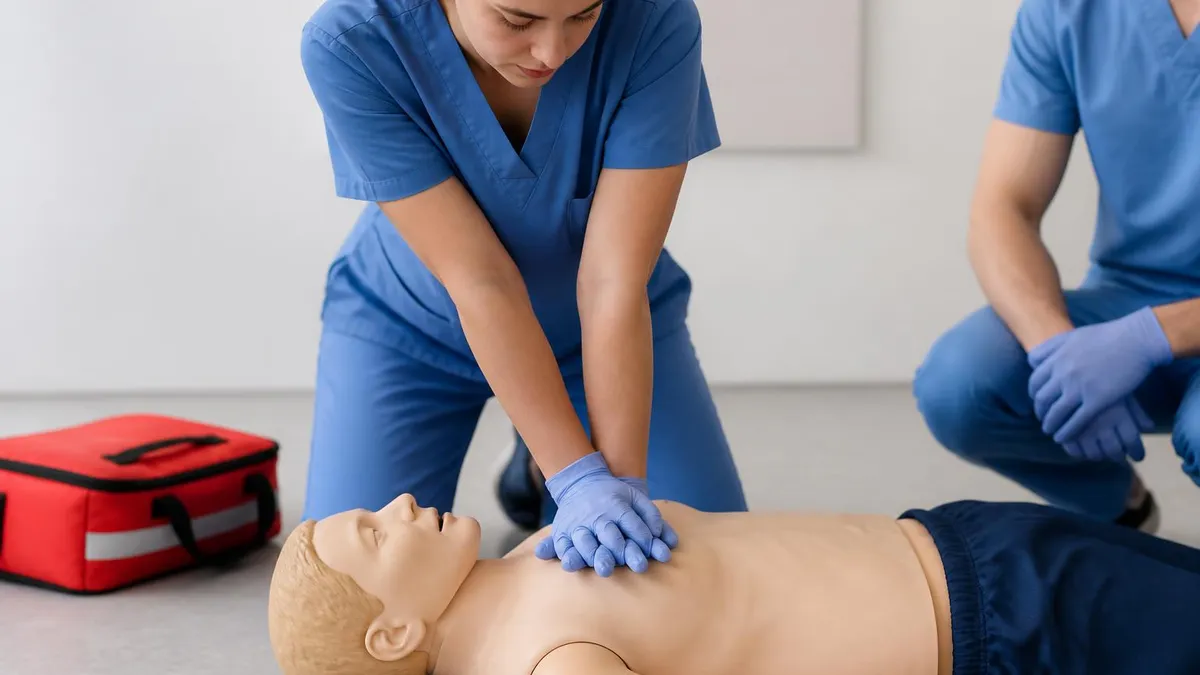
BLS CPR Training: Complete Guide to Certification, Requirements, and What to Expect
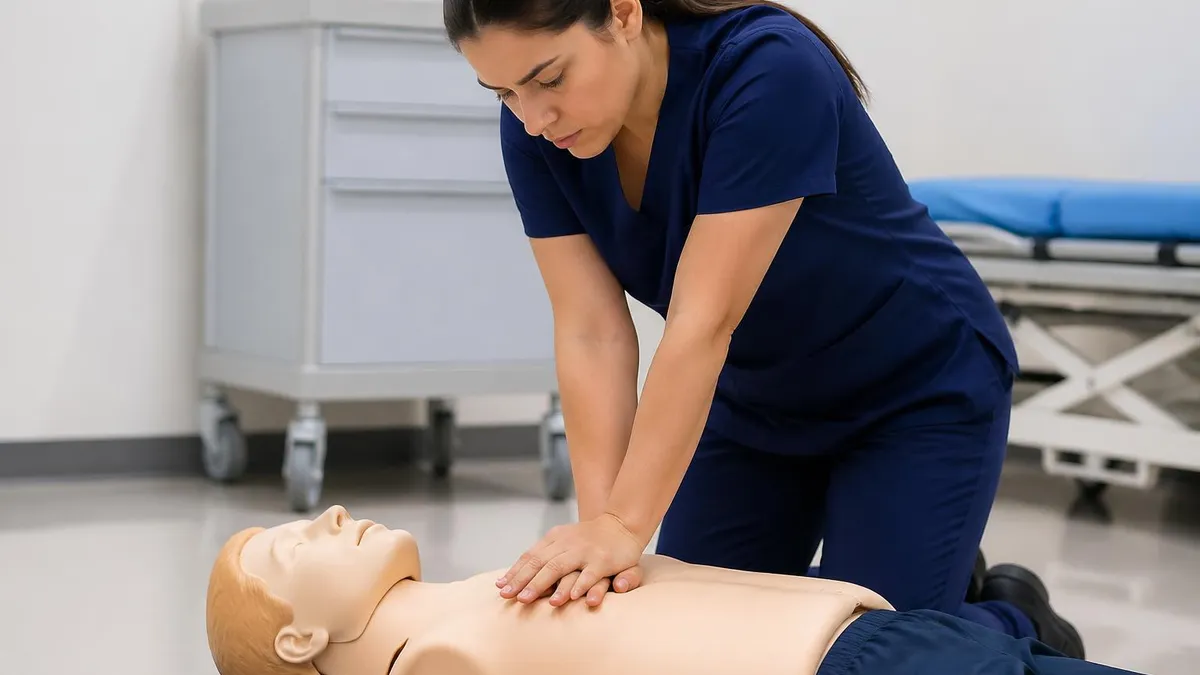
American Heart Association BLS: Certification, Renewal, Cost & What to Expect
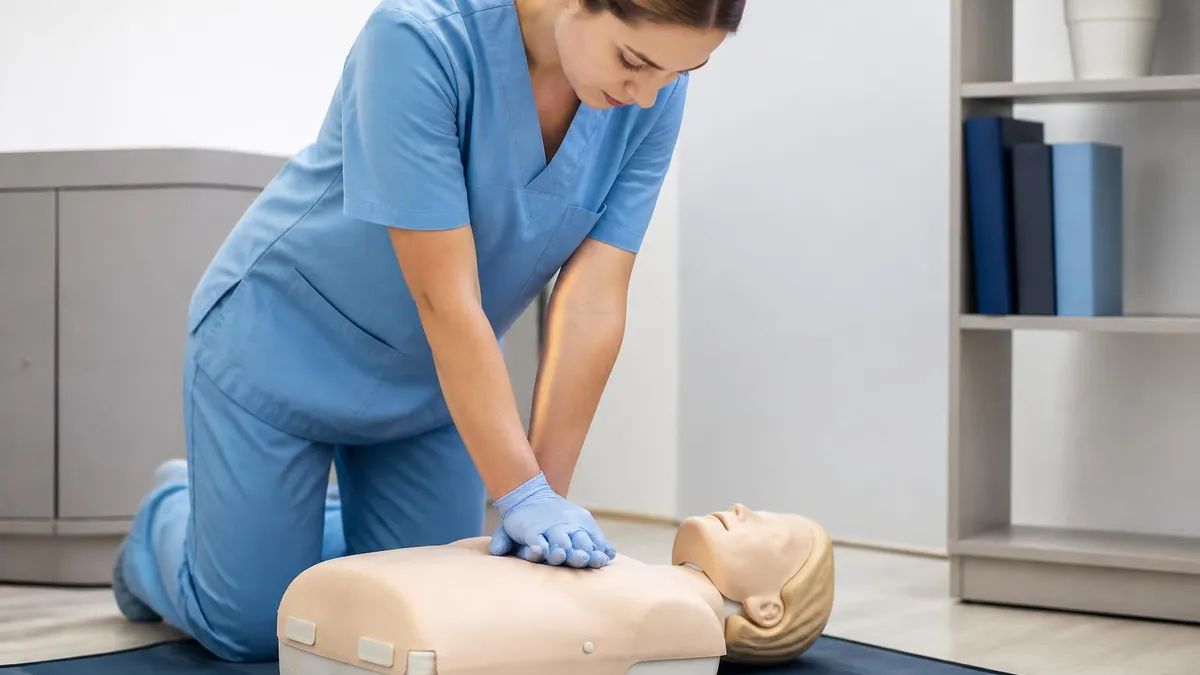
Red Cross BLS Certification: Course, Cost, and Renewal Guide

Basic Life Support 2026
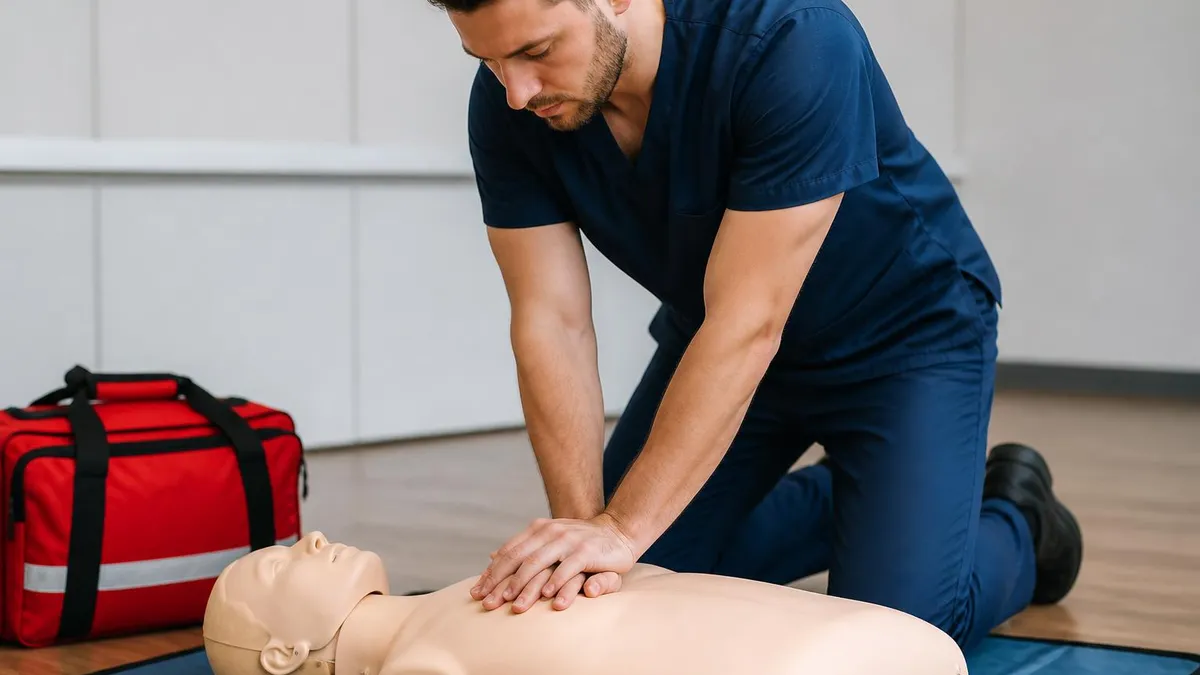
BLS Recertification Guide: Course Options, Online Renewal, Cost, Validity, and How to Maintain Your Certification
About the Author

Registered Nurse & Healthcare Educator
Johns Hopkins University School of NursingDr. Sarah Mitchell is a board-certified registered nurse with over 15 years of clinical and academic experience. She completed her PhD in Nursing Science at Johns Hopkins University and has taught NCLEX preparation and clinical skills courses for nursing students across the United States. Her research focuses on evidence-based exam preparation strategies for healthcare certification candidates.