
BLS Recertification Guide: Course Options, Online Renewal, Cost, Validity, and How to Maintain Your Certification
⏳ BLS recertification guide: 2-year validity, online and in-person renewal options, cost ($40-90), course duration, AHA vs ARC, what to expect for
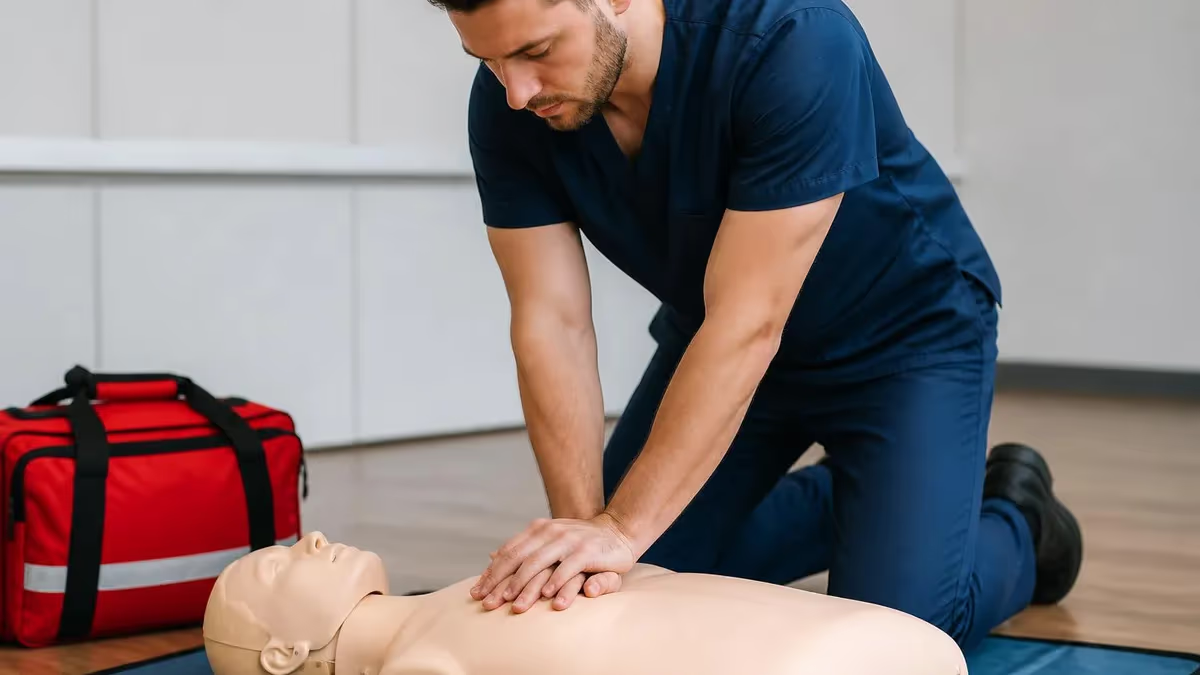
BLS (Basic Life Support) recertification is required every 2 years for healthcare workers maintaining their qualification. The certification, issued by the American Heart Association (AHA) or American Red Cross (ARC), validates skills in CPR, AED use, choking response, and basic life support techniques. For most healthcare workers — nurses, physicians, EMTs, paramedics, dental hygienists, and many other roles — BLS certification is a job requirement that must be kept current.
The recertification process involves completing a renewal course (typically 4 hours), passing a skills test on key procedures, and passing a written exam (or completing online-equivalent assessment). The new certification card is valid for 2 more years from the date of completion. Most healthcare employers require workers to recertify before the current card expires; allowing certification to lapse can have employment consequences.
There are three main recertification formats available. In-person renewal courses are the traditional format — 4 hours of refresher training plus skills demonstration plus written exam, all completed at a single in-person session. HeartCode BLS combines self-paced online training with an in-person skills practice and demonstration session. Online-only renewal exists but isn't accepted everywhere — verify with your employer before choosing this option.
Cost varies by training provider and format. AHA-affiliated training centers typically charge $50-90 for in-person renewal. HeartCode BLS (blended) is similar. Online-only options range $40-60. Free renewal options exist for some workplaces (employer-sponsored training) or community programs (often available through community colleges, libraries, or hospital outreach). For healthcare workers, employer typically covers or reimburses certification costs.
The content of the recertification course covers updates since the previous certification (which AHA updates annually), refresher on core skills, and any new techniques or evidence. The 2020 AHA guidelines remain the current standard as of this writing. Skills tested include adult CPR, child CPR, infant CPR, choking response in all age groups, two-rescuer CPR, and AED use.
Skills demonstration: This is the practical exam portion of recertification. You'll perform chest compressions on a manikin (proper rate 100-120/min, depth 2-2.4 inches, full chest recoil between compressions, minimal interruptions). You'll demonstrate ventilation technique (proper head position, mask seal, ventilation volume). You'll demonstrate AED use (proper electrode placement, voice prompts compliance). Failures in any area require additional practice and may extend the session.
Written exam: Multiple choice format. Typically 25 questions covering CPR sequences, response timing, AED indications and contraindications, choking algorithms, and special situations (drowning, drug overdose, pregnancy). Passing score is typically 84% (21 of 25 correct).
This guide covers everything healthcare workers need for BLS recertification — the three renewal formats compared, cost analysis, what to expect in each format, the actual recertification process step-by-step, current AHA guidelines content, and how to avoid certification lapse. It's intended for healthcare workers preparing for renewal, those returning to clinical work after a break, and supervisors planning team recertification.

Key BLS Renewal Information
- Validity: 2 years from completion date
- Certifying bodies: American Heart Association (AHA), American Red Cross (ARC)
- Renewal formats: In-person, HeartCode BLS (blended), online-only
- In-person duration: 4 hours typical
- Cost: $40-90 typical (employer often covers)
- Passing score: Skills demonstration + 84% (21/25) on written exam
- Renewal before expiration: Required to avoid lapse
- Lapse consequences: Possible employment restrictions, may require full course
- Course content: CPR (adult/child/infant), AED, choking, 2-rescuer CPR
- Current guidelines: 2020 AHA Guidelines
The three BLS recertification formats compared. Choosing the right format depends on your learning preferences, schedule, and your employer's acceptance criteria.
Format 1: In-person renewal. The traditional format. A 4-hour session at a local AHA-affiliated training center. Refresher content delivered by an instructor, hands-on practice on manikins, skills demonstration test, written exam, certification card issued same day if passing. Cost: $50-90. Best for: those who prefer structured group learning, who don't enjoy independent online study, or whose employer specifically requires in-person.
Format 2: HeartCode BLS (blended online + in-person). The most popular modern format. Online portion (1-2 hours) is self-paced — videos, quizzes, scenario simulations covering all BLS content. After completing online portion, you attend an in-person skills practice session (typically 30-60 minutes) at a training center to demonstrate skills. Cost: $50-80. Best for: busy professionals who want flexibility for the theory but need hands-on validation for skills.
Format 3: Online-only renewal. Self-paced video and quiz format with no in-person component. Various providers (some AHA-approved, some not). Cost: $40-60. Best for: those whose employer accepts online-only, who have prior recent experience with skills, who can't make in-person sessions.
Important caveat: Not all healthcare employers accept all formats. Many hospitals, EMS services, and dental practices specifically require in-person or HeartCode (with in-person skills component). Online-only certifications may be rejected. Always verify with your supervisor or HR department which formats are accepted before booking.
For BLS providers in clinical roles where skills are exercised regularly (ER nurses, paramedics, code-team members), HeartCode is often optimal — flexible theory completion plus hands-on validation. For administrative roles where BLS is required but skills aren't regularly used, in-person renewal with structured group practice may be more valuable (you get more practice time).
Renewal vs. initial certification: Renewal courses are shorter than initial BLS certification courses. Initial certification is typically 6-8 hours and includes more depth on foundational concepts. Renewal assumes you already know fundamentals and focuses on refresher and updates. If you've let your certification lapse for more than 30 days past expiration, some providers require full initial course rather than renewal — check with your provider's specific policy.
Recertification Format Comparison
4-hour session. $50-90. Structured group learning. Most widely accepted. Same-day cert card.
Online theory + in-person skills. $50-80. Flexible scheduling. Most popular format.
$40-60. Self-paced video + quiz. NOT accepted by all employers. Verify before choosing.
Many hospitals run on-site training. Often free or low-cost for employees. Check with HR.
Community colleges, libraries, hospital outreach. Sometimes free or reduced cost. Schedule less flexible.
Departments can schedule group sessions. Bulk discounts. Convenient for entire team renewal.
What's tested during BLS recertification. Understanding the test components helps with preparation and reduces anxiety.
Adult CPR skills demonstration. You'll perform chest compressions on a manikin showing: proper hand placement on lower sternum, vertical compressions with locked arms, depth of 2-2.4 inches (5-6 cm) for adults, rate of 100-120 compressions per minute, full chest recoil between compressions, minimal interruptions (less than 10 seconds), proper compression-to-ventilation ratio of 30:2 for single-rescuer.
Adult AED use. You'll demonstrate: assess the scene (safety), check for response (tap and shout), call for help (911/code blue), retrieve AED. Begin chest compressions immediately. When AED arrives: open it, follow voice prompts, attach electrode pads (one on upper right chest, one on lower left side), pause compressions while AED analyzes rhythm. Deliver shock if advised. Resume compressions immediately. Continue cycle until EMS arrives or patient recovers.
Child CPR (ages 1 to puberty). Similar to adult but with adjustments: depth of about 2 inches (5 cm) — about 1/3 the depth of chest. Single-rescuer ratio 30:2. Two-rescuer ratio also 30:2 (some sources say 15:2 — clarify with current guidelines). Compression rate same 100-120/min. AED pads for child use special pediatric pads if available, otherwise adult pads positioned anterior-posterior (one in front, one in back).
Infant CPR (under 1 year). Compress with two fingers (lone rescuer) or two-thumb encircling hands (two-rescuer). Depth 1.5 inches (4 cm). Single-rescuer ratio 30:2. AED use with pediatric pads if available; for infants without pediatric pads, manual chest compressions are preferred over adult AED.
Choking response (adult). Recognize choking (universal sign of choking — clutching neck). Ask 'are you choking?' If yes and unable to speak/cough: stand behind, place hand below sternum, perform abdominal thrusts (Heimlich). Continue until object dislodges or person becomes unresponsive. If unresponsive: lower to floor, start CPR, check mouth for visible objects before ventilations.
Choking response (infant). Don't use abdominal thrusts on infants. Use 5 back blows (between shoulder blades, with infant face-down on your arm/thigh) followed by 5 chest thrusts (with infant face-up). Alternate 5 back blows and 5 chest thrusts. Begin infant CPR if infant becomes unresponsive.
Two-rescuer CPR (adult). Compression-to-ventilation ratio of 30:2 (different from single-rescuer). Switch compressors every 2 minutes (5 cycles) to maintain quality. Minimize interruptions for switches. Communicate clearly during transitions.
Ventilation technique. Without advanced airway: bag-mask ventilation. Maintain proper head position (head-tilt chin-lift unless trauma suspected — then jaw-thrust). Achieve good mask seal. Deliver each breath over 1 second. Watch for chest rise. Avoid excessive ventilation (don't exceed 8-10 breaths per minute when advanced airway is in place).
BLS Skills Required Standards

The written exam portion. A 25-question multiple-choice test covering the same content as skills demonstration but in conceptual form.
Topics typically covered: CPR sequences and ratios for each age group. AED use protocols, indications, contraindications. Choking response algorithms. Special situations (drowning, drug overdose, hypothermia, pregnancy). Recognition of cardiac arrest vs other emergencies. When to start CPR. When to stop CPR. Team dynamics for in-hospital resuscitation.
Sample questions you might see:
'A 60-year-old male collapses in front of you. He has no pulse and is not breathing. What is your immediate first action?' Options: A) Call 911, B) Start CPR with chest compressions, C) Open airway, D) Look for AED. Correct: B) Start CPR with chest compressions (preceded by checking for response and calling for help in a hospital setting — but the immediate action sequence starts with chest compressions).
'What is the depth and rate for adult chest compressions?' Options: A) 1.5 inches, 80/min, B) 2-2.4 inches, 100-120/min, C) 3 inches, 60/min, D) 2 inches, 150/min. Correct: B.
'When using an AED on an infant under 1 year, if pediatric pads aren't available, what should you do?' Options: A) Use adult pads as normal, B) Don't use the AED — manual compressions only, C) Use adult pads but positioned anterior-posterior, D) Use one adult pad and one pediatric pad. Correct: C) Use adult pads but positioned anterior-posterior (newer guidelines accept this).
'A choking adult becomes unresponsive. What is your next action?' Options: A) Continue abdominal thrusts, B) Begin chest compressions, C) Check mouth for object then ventilate, D) Call 911. Correct: B) Begin chest compressions (with check for visible object before ventilations).
Passing score: 84% — 21 of 25 questions correct. If you fail the written exam, you typically have one opportunity to retake at the same session. Failure of both attempts requires rescheduling for another session.
For most healthcare workers with current clinical practice, the written exam is passed easily. Hands-on skills demonstration is more variable — some who haven't practiced recently make minor errors that require correction during the session. The instructor provides feedback and allows correction during the practice portion before the formal test.
Common Exam Question Topics
CPR sequence for adult: assess → call for help → start compressions → ventilate. Rates and depths for adult/child/infant. Single-rescuer vs two-rescuer differences. Switching compressors every 2 minutes. Minimizing interruptions.
Step-by-step recertification process. Following this sequence prevents lapses and ensures smooth renewal.
Step 1: Track your expiration date. Your current BLS card shows the expiration date — typically 2 years from issue date. Mark it on your calendar 60-90 days before expiration to remind yourself to renew.
Step 2: Check employer requirements. Some employers require specific provider (AHA only, not ARC). Some require specific format (in-person, not online). Some have approved providers list. Confirm with HR or your manager before booking.
Step 3: Choose your format and schedule. Decide between in-person, HeartCode (blended), or online-only based on your preferences and employer acceptance. Find a session through AHA's training site search (atlasenglish.com), local hospitals' continuing education departments, ARC's website, or training company sites.
Step 4: Complete pre-course materials. For HeartCode and online-only formats, complete the online portion before the in-person session (HeartCode) or before taking the test (online-only). Allow 1-2 hours for the online portion.
Step 5: Attend the session (in-person or HeartCode skills practice). Bring photo ID. Bring proof of previous BLS certification (current card or expired card). Wear comfortable clothes — you'll be on the floor for compressions. The session typically takes 1-4 hours depending on format.
Step 6: Take the skills demonstration test. The instructor will provide manikins and AED simulators. Demonstrate adult CPR, child CPR, infant CPR, AED use, and choking response. The instructor will provide feedback during practice; the test demonstrates competency.
Step 7: Take the written exam. 25 multiple-choice questions, typically 20-30 minutes to complete. Passing score 84%. If you fail, retake immediately (usually allowed once per session).
Step 8: Receive your new certification card. Most providers issue cards on the day of the session (in-person) or within 24-48 hours (HeartCode). The card shows your new expiration date — 2 years from completion.
Step 9: Submit to employer. Provide your new card to HR or your manager for records. Some employers automatically receive notification through their training partnership; others require manual submission.
Recertification Timeline
60 Days Out: Verify Requirements
45 Days Out: Schedule Session
30 Days Out: Complete Online Portion
Session Day: Skills Practice + Tests
Day After: Receive Card
Within 1 Week: Submit to Employer
Day 30: Confirmed in System
What to do if your BLS certification lapses. Lapses happen — whether due to forgetting, schedule conflicts, or extended leave. The path forward depends on how long it's been.
Up to 30 days past expiration: Most providers allow renewal courses for short lapses without requiring the full initial course. Verify your specific provider's policy. Some employers tighten this — they may consider you 'lapsed' immediately at the expiration date for work purposes.
30 to 90 days past expiration: Renewal courses may still be available but with extra documentation or additional questions on the renewal exam. Some providers require an initial course for lapses over 30 days.
90+ days past expiration: Most providers require completing the full initial BLS course (6-8 hours) rather than renewal. The initial course covers everything from foundations and is more time-consuming.
Employment impact during lapse: Most healthcare employers prohibit working in clinical roles without current BLS. If your certification lapses while employed, you may be placed on administrative leave or assigned to non-clinical duties until renewed. Plan ahead to avoid this.
Re-entering clinical work after extended lapse: If you've been out of clinical work for several years, BLS recertification alone may not be sufficient. Some employers require additional training (refresher modules, supervised practice) before returning to full clinical duties. Discuss with your supervisor.
Lapsed and unsure where to renew: Search 'BLS recertification near me' on Google, check AHA's training site (atlas.heart.org/find-bls), or contact your local hospital's continuing education department. Most major cities have multiple BLS courses available weekly.
Documentation strategy: Keep digital copies of your BLS cards in a folder or cloud storage (Google Drive, OneDrive, Dropbox). Set calendar reminders at 90, 60, and 30 days before expiration. Email yourself a reminder when you obtain a new card. This prevents inadvertent lapses.
Most healthcare employers strictly prohibit working in clinical roles without current BLS certification. If your certification lapses while employed in clinical work, you may face: immediate restriction from clinical duties, placement on administrative leave (often unpaid), required completion of full initial course (not just renewal), and possible disciplinary documentation in your HR record. The 5-10 hour time investment to renew on time vastly outweighs the consequences of letting it lapse. Set calendar reminders at 90, 60, and 30 days before your expiration date. Don't rely on memory alone.
Tips for passing the recertification successfully on first attempt. Most healthcare workers pass without difficulty, but preparation helps avoid surprises.
Refresh on guidelines updates. The 2020 AHA Guidelines remain the current standard. Review key updates from your previous certification: compression rate of 100-120/min (formerly 100/min), compression depth 2-2.4 inches for adults (some changes from previous), emphasis on chest recoil between compressions, minimizing interruptions, team dynamics in resuscitation.
Practice skills if you haven't recently. If you don't do CPR regularly in your role, your muscle memory has likely degraded since your last certification. Practice on a manikin if possible (some employers have manikins available). YouTube videos of proper technique help refresh the mental model.
Review the algorithms. Memorize the standard CPR algorithm and the choking response algorithm. The exam may have algorithmic questions that test sequence knowledge specifically.
Don't overthink. The written exam covers fundamentals. Most questions have clearly correct answers. Don't second-guess yourself or read questions paranoidly looking for tricks. Most questions are exactly what they appear.
Ask questions during practice. The skills practice portion before the test is your opportunity to ask the instructor about anything you're unsure of. Don't be embarrassed to ask 'what if X happens' or 'is this correct.' The instructor wants you to succeed.
Test-day mindset. Arrive early, eat something beforehand, hydrate. The session can be 2-4 hours of standing, kneeling, and using your hands. Wear comfortable clothes. Bring a water bottle.
If you fail any portion: Most providers allow one retest at the same session. If you fail the skills demonstration, the instructor will identify what to improve and let you retry. If you fail the written exam, you typically get one retake. If you fail both retests, you need to reschedule for another session (no additional charge typically).
For very rusty providers: Consider taking the full initial BLS course rather than renewal. The initial course is longer (6-8 hours vs 4) and covers more depth. If you haven't practiced CPR in years, the initial course better refreshes your skills.
Renewal Success Tips
Check 2020 AHA Guidelines updates from your previous certification. Note any compression rate/depth changes.
If you don't do CPR regularly, practice on manikin or watch videos. Refresh muscle memory before session.
Standard CPR algorithm and choking response algorithm. Sequence knowledge gets tested directly.
Most questions have clear correct answers. Avoid second-guessing or paranoid reading.
Use practice portion before test. Ask about anything unsure. Instructors help students pass.
Arrive early. Eat beforehand. Hydrate. Comfortable clothes. Bring water for the long session.
BLS recertification is one of the most common healthcare credentialing tasks. Done efficiently, the entire process — from scheduling to receiving new card — takes about 1 week. The 4-hour session investment every 2 years maintains both your professional credential and your ability to respond effectively in real emergencies. Most healthcare workers complete the process without difficulty, particularly when using the HeartCode blended format that combines convenience with hands-on validation.
For healthcare workers maintaining BLS as part of professional licensing: build a sustainable system. Calendar reminders 60-90 days before each expiration. Knowing your employer's preferred providers and accepted formats. Keeping digital copies of current and previous cards. Establishing a routine renewal process every 2 years. With these practices, BLS recertification becomes a minor administrative task rather than a stressful event. Stay current; stay practicing the skills regularly; respond effectively when emergencies happen.
BLS Pros and Cons
- +BLS certification is recognized by employers as verified competency
- +Provides a structured knowledge framework beyond just the credential
- +Certified professionals report 10–20% salary increases on average
- +Maintenance requirements create ongoing professional development
- +Differentiates candidates in competitive hiring and promotion decisions
- −Certification fees, materials, and renewal costs add up over a career
- −Requirements change — delaying may mean facing updated content
- −Salary ROI varies significantly by geography and industry
- −Preparation requires significant time alongside existing responsibilities
- −Validates knowledge at a point in time, not ongoing real-world performance
Pros and Cons at a Glance
| Pros | Cons |
|---|---|
| BLS certification is recognized by employers as verified competency | Certification fees, materials, and renewal costs add up over a career |
| Provides a structured knowledge framework beyond just the credential | Requirements change — delaying may mean facing updated content |
| Maintenance requirements create ongoing professional development | Salary ROI varies significantly by geography and industry |
| Differentiates candidates in competitive hiring and promotion decisions | Preparation requires significant time alongside existing responsibilities |
Sample BLS - Basic Life Support Practice Questions
Try these questions from our free BLS - Basic Life Support practice tests. The correct answer and an explanation follow each question.
A rescuer is providing CPR to an adult and becomes fatigued. How often should rescuers switch roles to maintain compression quality?
- A. Every 5 minutes
- B. Every 10 minutes
- C. Every 2 minutes (approximately 5 cycles)
- D. Only when the primary rescuer requests a switch
Answer: C. Every 2 minutes (approximately 5 cycles)
Rescuers should switch the compressor role every 2 minutes (5 cycles) to prevent fatigue and maintain high-quality compressions.
After determining that the kid is not breathing, you call for help in finding an AED and calling 911. While one man starts to call 911, another woman is rushing to find an AED. There are those who are willing to help. What is your next course of action?
- A. begin CPR with chest compressions
- B. give two rescue breaths
- C. check for a pulse and breathing simultaneously
- D. wait for the defibrillator
Answer: C. check for a pulse and breathing simultaneously
After determining unresponsiveness and sending someone to activate emergency services and retrieve an AED, the next immediate action is to assess the victim's condition. This involves simultaneously checking for both breathing and a pulse for no more than 10 seconds. This assessment guides whether to start CPR or provide rescue breaths.
You release the baby's airway after 30 chest compressions, then search the child's mouth for the obstruction. You are able to take out a small toy that you see. (True or False) You'll perform a brachial pulse check as your next course of action.
- A. False
- B. True
Answer: A. False
False. After successfully removing an obstruction and providing rescue breaths, if the child is still unresponsive and not breathing normally, you should continue CPR. A pulse check is only performed if the child shows signs of life (e.g., starts breathing normally, moving, or responding). If the child remains unresponsive, CPR should continue until EMS arrives or the child recovers.
Which device is commonly used to maintain a patent airway in an unconscious patient?
- A. Nasogastric tube
- B. Endotracheal tube
- C. Oropharyngeal airway
- D. Nasal cannula
Answer: C. Oropharyngeal airway
An Oropharyngeal Airway (OPA) is a device commonly used in unconscious patients to maintain a patent airway by preventing the tongue from obstructing the pharynx. It is inserted into the mouth and extends to the pharynx, holding the tongue forward. OPAs are suitable for patients without a gag reflex.
BLS Questions and Answers
BLS recertification is a routine but important credential maintenance task for healthcare workers. The 4-hour session every 2 years maintains your professional credential and your competence in life-saving skills. For most healthcare workers, the HeartCode BLS blended format offers the best combination of flexibility and hands-on validation. Whatever format you choose, plan ahead — schedule before expiration, complete on time, and submit to employer promptly. Done as a sustainable routine, BLS recertification becomes a minor administrative task supporting the much more important work of patient care.
About the Author

Registered Nurse & Healthcare Educator
Johns Hopkins University School of NursingDr. Sarah Mitchell is a board-certified registered nurse with over 15 years of clinical and academic experience. She completed her PhD in Nursing Science at Johns Hopkins University and has taught NCLEX preparation and clinical skills courses for nursing students across the United States. Her research focuses on evidence-based exam preparation strategies for healthcare certification candidates.
Join the Discussion
Connect with other students preparing for this exam. Share tips, ask questions, and get advice from people who have been there.
View discussion (8 replies)