
BLS Certification Classes Near Me: Your Complete 2026 Guide to Training, Testing & Renewal
🔎 Learn what a BLS certification is, find classes near you, compare AHA vs Red Cross programs, and prepare for the basic life support exam with free
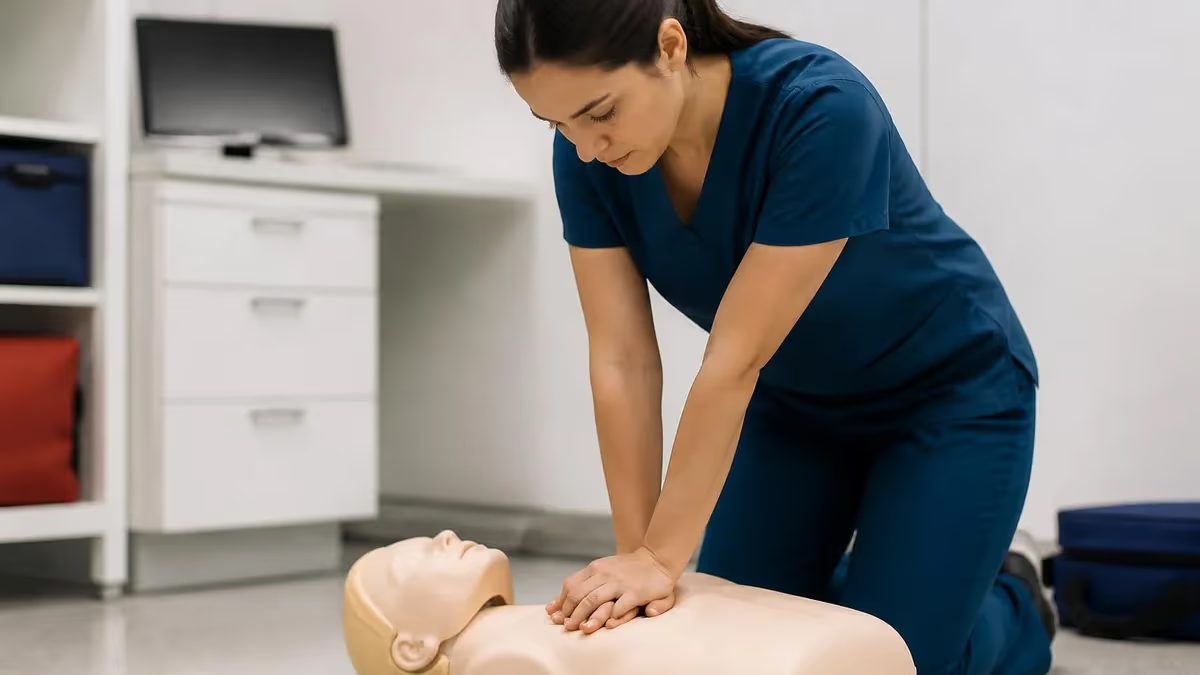
What is a BLS certification, and why does it matter so much for healthcare professionals across the United States? If you have been searching for BLS certification classes near you, understanding the fundamentals behind this credential is the critical first step toward making an informed decision. A BLS certification validates that you possess the knowledge and hands-on skills to perform high-quality cardiopulmonary resuscitation, operate an automated external defibrillator, and manage airway obstructions in patients of all ages. Every year, millions of healthcare workers, first responders, and allied health professionals earn or renew this essential credential.
Understanding what does BLS stand for helps clarify what separates this training from standard first aid courses. BLS stands for Basic Life Support, a structured set of emergency medical interventions designed to maintain circulation and oxygenation until advanced care teams arrive. Unlike community CPR classes aimed at laypersons, BLS courses are built specifically for healthcare providers who must respond to cardiac arrest, respiratory failure, and choking emergencies in clinical environments where seconds determine patient survival and long-term neurological outcomes for every victim encountered.
One of the most frequent questions prospective students ask is whether is BLS the same as CPR. While CPR forms the foundation of every BLS curriculum, a full BLS certification encompasses significantly more advanced competencies. These include multi-rescuer team dynamics, bag-mask ventilation techniques, recognition of stroke and heart attack symptoms, and coordinated resuscitation workflows that mirror real hospital code scenarios. Standard CPR courses for laypersons typically cover compression-only techniques and basic AED operation for adults, making BLS the more comprehensive and professionally recognized credential.
Finding reliable BLS certification classes near your location requires evaluating several important factors including the certifying organization, course format, scheduling flexibility, instructor qualifications, and whether your employer has specific provider requirements. The two most widely recognized certification bodies in the United States are the American Heart Association and the American Red Cross. Both organizations offer classroom-based instruction, blended online-and-skills formats, and renewal pathways that meet the needs of busy healthcare professionals balancing demanding work schedules with continuing education obligations.
The red cross basic life support course and the AHA BLS Provider course share similar core learning objectives but differ in their delivery methods, testing approaches, and supplemental resources. The AHA curriculum follows evidence-based resuscitation science updated with the latest International Liaison Committee on Resuscitation guidelines, while the Red Cross program leverages adaptive learning technology and scenario-based assessments. Both certifications remain valid for two years and require a hands-on skills evaluation, ensuring that graduates demonstrate practical competence rather than merely passing a written knowledge check.
Whether you are a nursing student preparing for your first clinical rotation, a paramedic maintaining active licensure, a dental hygienist meeting state board requirements, or a medical assistant fulfilling employer mandates, choosing the right BLS class directly impacts your career trajectory. Course quality varies substantially between training centers, and selecting a nationally accredited provider ensures your certification will be recognized by licensing boards, hospital credentialing committees, and healthcare systems across every state in the country without additional verification.
Throughout this comprehensive guide, you will discover how to compare certification providers side by side, prepare effectively for both the written and skills examinations, understand renewal timelines and requirements, and maximize your chances of passing on the first attempt. We have assembled practical study strategies, detailed cost breakdowns, and insider tips drawn from experienced BLS instructors. Use the free practice quizzes linked throughout this page to test your knowledge and build the confidence you need before stepping into the classroom on exam day.
BLS: upcoming dates and official changes
- Mar 1, 2026: AHA required US BLS courses to use the 2025 course materials starting March 1, 2026. (American Heart Association)
Facts verified Oct 15, 2026 against American Heart Association. Dates that have passed are removed automatically.
- The AHA BLS Provider instructor-led course exam contains 25 questions. (American Heart Association)
- The AHA BLS Provider course requires an exam score of at least 84%, alongside successful completion of its practical requirements. (American Heart Association)
- AHA BLS course fees are set by the Training Center offering the training. (American Heart Association)
- American Red Cross BLS course costs vary by course format and location. (redcross.org)
- AHA BLS students are allowed no more than two attempts to pass the online exam administered for the instructor-led course. (American Heart Association)
- The AHA BLS Provider Course Completion Card is valid for two years after all course requirements are completed. (American Heart Association)
- American Red Cross BLS certification is valid for two years. (redcross.org)
- American Red Cross BLS certification is renewed through a BLS recertification course. (redcross.org)
- American Red Cross blended BLS certification combines online coursework with a required in-person skills session. (redcross.org)
Facts verified Oct 15, 2026 against American Heart Association. Dates that have passed are removed automatically.
BLS Exam at a Glance
| Item | Detail | Official source |
|---|---|---|
| Number of questions (AHA BLS Provider — instructor-led) | 25 questions | American Heart Association |
| Passing score (AHA BLS Provider — instructor-led) | At least 84% | American Heart Association |
| Exam fee (AHA BLS Provider) | Set by the Training Center | American Heart Association |
| Exam fee (American Red Cross BLS) | Varies by format and location | redcross.org |
| Retake policy (AHA BLS Provider — instructor-led) | Maximum two attempts for the online exam | American Heart Association |
| Validity (AHA BLS Provider) | Two years | American Heart Association |
| Validity (American Red Cross BLS) | Two years | redcross.org |
| Renewal (American Red Cross BLS) | Complete a BLS recertification course | redcross.org |
| Delivery (American Red Cross BLS — blended learning) | Online coursework plus required in-person skills session | redcross.org |
Facts verified Oct 15, 2026 against American Heart Association. Dates that have passed are removed automatically.
BLS Certification by the Numbers
Types of BLS Certification Classes Near You
Designed for first-time students, this classroom-based course covers adult, child, and infant CPR, AED operation, choking relief, and team-based resuscitation over approximately four to five hours of hands-on instruction and testing.
Streamlined refresher for currently certified providers, the basic life support renewal class covers updated guidelines, reinforces core skills, and includes a written exam and skills check in approximately three hours of focused training.
Combines self-paced online coursework with an in-person skills session, allowing healthcare professionals to complete cognitive learning on their own schedule before attending a shorter hands-on evaluation at a local training center.
Advanced training pathway for experienced BLS providers who want to teach certification classes themselves, covering instructional methodology, course facilitation techniques, and AHA or Red Cross teaching standards and requirements.
Many hospitals and healthcare systems arrange on-site BLS classes for their staff, often at reduced cost or free of charge, with scheduling designed around shift patterns and departmental needs for maximum convenience.
The basic life support exam American Heart Association administers remains the most widely recognized BLS assessment in American healthcare. The AHA BLS Provider course follows a structured curriculum built on the latest resuscitation science, incorporating evidence from the International Liaison Committee on Resuscitation and the AHA's own Guidelines for CPR and Emergency Cardiovascular Care. Students work through video-guided practice sessions, instructor-led demonstrations, and hands-on manikin practice before completing a twenty-five question multiple-choice written exam and a multi-station skills evaluation covering adult, child, and infant scenarios.
The american red cross basic life support program offers an equally rigorous alternative with some notable differences in instructional design and assessment methodology. Red Cross courses emphasize scenario-based learning where students work through realistic emergency situations rather than following a strict step-by-step demonstration model. The Red Cross also integrates adaptive pre-learning technology that adjusts content difficulty based on individual student performance, helping learners focus additional time on concepts they find most challenging before arriving for their in-person skills session.
When comparing the aha basic life support exam to the Red Cross assessment, several structural differences emerge that students should understand before enrolling. The AHA written exam consists of twenty-five multiple-choice questions with a minimum passing score of eighty-four percent, meaning students must answer at least twenty-one questions correctly. The Red Cross written assessment uses a similar format but may include scenario-based questions that require students to apply knowledge to specific patient situations rather than simply recalling isolated facts from the training manual.
Cost differences between providers can influence your decision, especially when paying out of pocket rather than relying on employer reimbursement. AHA BLS Provider courses typically range from sixty to eighty-five dollars depending on your geographic location and training center, while Red Cross courses often fall in a similar price range but may include digital certification cards at no additional charge. Some independent training centers offer competitive pricing below these ranges, but you should always verify that the instructor holds current credentials from the certifying organization before enrolling.
Employer preferences play a significant role in which certification you should pursue. Most hospitals and healthcare systems accept both AHA and Red Cross certifications interchangeably, but some institutions maintain exclusive agreements with one provider. Before enrolling in any BLS class, contact your employer's human resources or education department to confirm which certifications they recognize. Military medical facilities, certain federal agencies, and some state licensing boards may specify the AHA BLS Provider course exclusively, making this verification step essential before investing your time and money.
The skills testing component remains remarkably consistent across both organizations, reflecting the universal nature of high-quality CPR standards. Students at both AHA and Red Cross testing stations must demonstrate proper hand placement, adequate compression depth of at least two inches for adults, appropriate compression rate of one hundred to one hundred twenty per minute, full chest recoil between compressions, and correct ventilation volumes. Both organizations also test multi-rescuer CPR scenarios, requiring students to demonstrate effective communication and seamless role-switching during simulated cardiac arrest situations.
Deciding between providers ultimately depends on your specific circumstances, employer requirements, and learning style preferences. If your workplace mandates a particular certification, that decision is already made for you. If you have flexibility, consider whether you prefer the AHA's structured video-based instruction or the Red Cross's adaptive scenario-driven approach. Both organizations maintain rigorous quality standards, employ certified instructors, and produce graduates who are fully prepared to deliver high-quality basic life support in real emergency situations across any clinical setting.

BLS Practice Test Questions
Prepare for the BLS - Basic Life Support exam with our free practice test modules. Each quiz covers key topics to help you pass on your first try.
BLS High-Quality CPR & Provider Skills
BLS Exam Questions covering BLS High-Quality CPR & Provider Skills. Master BLS Test concepts for certification prep.
BLS Special Situations & Scenarios
Free BLS Practice Test featuring BLS Special Situations & Scenarios. Improve your BLS Exam score with mock test prep.
BLS Adult, Child & Infant Resuscitation
BLS Mock Exam on Adult, Child & Infant Resuscitation. BLS Study Guide questions to pass on your first try.
BLS Airway Management & Ventilation
BLS Test Prep for Airway Management & Ventilation. Practice BLS Quiz questions and boost your score.
BLS Automated External Defibrillator (AED)...
BLS Questions and Answers on Automated External Defibrillator (AED) Use. Free BLS practice for exam readiness.
BLS Certification: Cardiac Arrest
BLS Mock Test covering Certification: Cardiac Arrest. Online BLS Test practice with instant feedback.
BLS Certification: Choking
Free BLS Quiz on Certification: Choking. BLS Exam prep questions with detailed explanations.
BLS Certification: Respiratory Arrest
BLS Practice Questions for Certification: Respiratory Arrest. Build confidence for your BLS certification exam.
BLS Chain of Survival
BLS Test Online for Chain of Survival. Free practice with instant results and feedback.
BLS CPR Techniques & Procedures
BLS Study Material on CPR Techniques & Procedures. Prepare effectively with real exam-style questions.
BLS Legal & Ethical Considerations
Free BLS Test covering Legal & Ethical Considerations. Practice and track your BLS exam readiness.
BLS Post-Resuscitation Care
BLS Exam Questions covering Post-Resuscitation Care. Master BLS Test concepts for certification prep.
Is BLS and CPR the Same? Understanding Your Training Options
Traditional in-person BLS certification classes remain the gold standard for hands-on learning and are offered at hospitals, community colleges, fire stations, and dedicated training centers across the country. These courses typically run four to five hours for initial certification and include both didactic instruction and extensive manikin practice. Students benefit from real-time instructor feedback on compression depth, rate, and technique, which helps correct common errors before they become ingrained habits that could compromise patient outcomes during actual emergencies.
In-person classes also provide valuable opportunities to practice team-based resuscitation scenarios with other students, simulating the high-pressure dynamics of a real cardiac arrest response. Many healthcare employers specifically require classroom-based training because the collaborative environment more closely mirrors clinical practice. When searching for in-person BLS certification classes near your location, look for training centers that maintain low student-to-instructor ratios, typically no more than six students per instructor, ensuring each participant receives adequate individual attention during skills practice and testing stations.
In-Person vs Blended BLS Classes: Which Format Is Right for You?
- +Full hands-on practice time with immediate instructor corrections on technique
- +Team-based resuscitation scenarios simulate real clinical emergency conditions
- +Complete certification in a single session without managing online deadlines
- +Higher first-time pass rates due to extensive guided manikin practice
- +Networking opportunities with other healthcare professionals in your area
- +No technology requirements or concerns about internet connectivity issues
- −Fixed class schedules may conflict with rotating shifts or personal obligations
- −Requires travel to a physical training center which adds time and transportation costs
- −Longer time commitment of four to five hours compared to blended format
- −Limited class availability in rural areas may require significant travel distance
- −May need to wait weeks for an open seat during peak enrollment periods
- −Less flexibility to review cognitive material at your own preferred learning pace
Pros and Cons at a Glance
| Pros | Cons |
|---|---|
| Full hands-on practice time with immediate instructor corrections on technique | Fixed class schedules may conflict with rotating shifts or personal obligations |
| Team-based resuscitation scenarios simulate real clinical emergency conditions | Requires travel to a physical training center which adds time and transportation costs |
| Complete certification in a single session without managing online deadlines | Longer time commitment of four to five hours compared to blended format |
| Higher first-time pass rates due to extensive guided manikin practice | Limited class availability in rural areas may require significant travel distance |
| Networking opportunities with other healthcare professionals in your area | May need to wait weeks for an open seat during peak enrollment periods |
| No technology requirements or concerns about internet connectivity issues | Less flexibility to review cognitive material at your own preferred learning pace |

Basic Life Support for Healthcare Providers: Pre-Class Preparation Checklist
- ✓Review the current AHA or Red Cross BLS provider manual before attending class
- ✓Watch free CPR technique videos on the AHA or Red Cross YouTube channels
- ✓Practice finding the correct hand placement position on a family member or pillow
- ✓Memorize the universal compression-to-ventilation ratio of 30:2 for single-rescuer adult CPR
- ✓Learn the five links in the AHA Chain of Survival and understand each component
- ✓Study the differences between adult, child, and infant CPR compression depths and techniques
- ✓Review AED operation steps including pad placement for adults and pediatric patients
- ✓Understand the recovery position and when it is appropriate to use in emergency situations
- ✓Bring a valid photo ID and any required prerequisite documentation to your class session
- ✓Wear comfortable clothing that allows you to kneel on the floor during manikin practice
High-Quality CPR Is the Single Most Tested Concept
According to AHA instructor surveys, over sixty percent of BLS exam questions directly relate to high-quality CPR metrics: compression depth of at least two inches for adults, rate of 100-120 compressions per minute, full chest recoil, and minimizing interruptions to under ten seconds. Mastering these four metrics gives you the strongest foundation for passing both the written exam and skills evaluation on your first attempt.
Understanding what to expect during the BLS examination helps reduce test anxiety and allows you to focus your preparation on the competencies that matter most. The BLS certification exam consists of two distinct components: a written knowledge assessment and a hands-on skills evaluation. Both components must be passed during the same class session, and students who fail either portion are typically offered one immediate remediation attempt before needing to retake the entire course at a later date with full tuition payment required.
The written examination for the AHA BLS Provider course contains twenty-five multiple-choice questions drawn from the official BLS Provider Manual. Questions cover topics including the Chain of Survival, high-quality CPR components, AED usage protocols, choking management for conscious and unconscious victims, and multi-rescuer team dynamics. You need to score at least eighty-four percent, which translates to answering twenty-one of twenty-five questions correctly. The exam is open-resource at many training centers, meaning you can reference your provider manual during testing, though time constraints make thorough familiarity with the material essential.
Skills testing stations represent the most challenging portion for many students because they require physical demonstration of proper technique under direct instructor observation. The adult CPR and AED station requires you to perform single-rescuer CPR on an adult manikin, demonstrating correct hand placement on the lower half of the sternum, compression depth of at least two inches but no more than two point four inches, a rate between one hundred and one hundred twenty compressions per minute, and full chest recoil between each compression. You must also demonstrate proper AED pad placement and follow voice prompts correctly.
The infant CPR station tests your ability to adapt your technique for the smallest and most vulnerable patients. Using an infant manikin, you must demonstrate the two-finger compression technique for single rescuers and the two-thumb encircling technique for two-rescuer scenarios. Compression depth for infants is approximately one and a half inches, and the compression-to-ventilation ratio remains thirty to two for single rescuers but changes to fifteen to two when a second rescuer is present. Ventilation volumes must be just enough to produce visible chest rise without overinflation.
The multi-rescuer mega code station evaluates your ability to function as part of a coordinated resuscitation team. In this scenario, you work with one or two other students to manage a simulated cardiac arrest, switching between compressor and ventilator roles every two minutes while maintaining high-quality CPR metrics throughout. The instructor evaluates your communication clarity, role-switching efficiency, and ability to minimize interruptions in chest compressions during transitions. This station most closely simulates the teamwork required during actual hospital code blue responses and emergency department resuscitations.
Scoring during the skills evaluation follows a pass-fail model based on critical criteria checklists. Each station has specific required elements that must be demonstrated correctly, and missing any single critical criterion results in failure of that station. Common reasons students fail include inadequate compression depth, excessive compression rate, failure to allow full chest recoil, ventilation volumes that are too large causing gastric inflation, and pausing compressions for longer than ten seconds during AED analysis or role switches. Instructors provide feedback and typically allow one immediate reattempt.
Students who do not pass after remediation will need to register for a new class session and pay the full course fee again. However, the overall pass rate for the BLS Provider course remains high, with most training centers reporting that approximately eighty to ninety percent of students pass all components on their first attempt. Students who prepare by reviewing the provider manual, practicing compression technique beforehand, and completing online practice exams consistently perform better than those who arrive without any prior preparation or review of the current guidelines.
Your BLS certification expires exactly two years from the issue date printed on your provider card. Most employers require active certification at all times, and working with an expired credential can result in suspension from clinical duties. Begin your renewal process at least two to three months before expiration to ensure you secure a class seat and avoid any gaps in your certification status that could affect your employment.
Understanding how long does bls certification last is essential for maintaining your professional credentials without interruption. Both AHA and Red Cross BLS certifications are valid for exactly two years from the date of issue, and there is no grace period once your card expires. Healthcare employers typically track certification expiration dates through credentialing software and will notify you when renewal is approaching, but the responsibility for maintaining current certification ultimately rests with you as the individual provider.
The basic life support renewal class is designed specifically for currently certified providers who need to extend their credentials for another two-year cycle. Renewal courses are significantly shorter than initial certification classes, typically lasting approximately three hours compared to the four to five hours required for first-time students. The abbreviated format assumes that students already possess foundational knowledge and focuses primarily on reviewing updated guidelines, reinforcing proper technique, and conducting the required written exam and skills evaluation to verify continued competency.
Several renewal format options exist to accommodate different schedules and learning preferences. The traditional classroom renewal brings students together for a half-day session that includes brief instruction, practice time, and testing. The HeartCode BLS renewal option allows providers to complete the cognitive portion online at their own pace before attending a thirty to sixty minute in-person skills check. This blended approach minimizes time away from work while still ensuring that every renewal candidate demonstrates hands-on CPR competence to a certified instructor.
Timing your renewal strategically can prevent stressful last-minute scrambles for available class seats. Most BLS instructors recommend beginning the renewal process at least sixty to ninety days before your current certification expires. This buffer provides adequate time to find a conveniently located class, accommodate potential scheduling conflicts, and allow for remediation if you do not pass on your first attempt. Renewing early does not penalize you because your new two-year certification period begins from the date of your renewal class, not from the expiration date of your previous card.
Allowing your BLS certification to lapse creates several professional complications that extend beyond simply losing your credential. Many healthcare employers will immediately suspend employees from patient care duties until certification is restored, which can result in lost wages, schedule disruptions, and potential disciplinary documentation in your personnel file. Additionally, if your certification expires, you must complete the full initial certification course rather than the shorter renewal class, which means more time commitment and potentially higher costs to regain your active status.
Beyond basic BLS renewal, many healthcare professionals choose to expand their emergency response capabilities by pursuing advanced certifications that build upon their BLS foundation. Advanced Cardiovascular Life Support, Pediatric Advanced Life Support, and Neonatal Resuscitation Program certifications all require active BLS certification as a prerequisite. Maintaining your BLS credential ensures you remain eligible for these advanced courses, which are often required for nurses, paramedics, respiratory therapists, and physicians working in critical care, emergency, and perioperative settings across the healthcare system.
The renewal process also serves as an important opportunity to update your skills and knowledge based on the latest resuscitation science. Guidelines are reviewed and updated on a five-year cycle by the AHA and ILCOR, with interim updates published as new evidence emerges. Your renewal class will incorporate any guideline changes that have occurred since your last certification, ensuring that the techniques you practice in the field reflect current best practices rather than outdated protocols that may be less effective for patient outcomes.
Maximizing your chances of passing the BLS certification exam on your first attempt requires a strategic approach that combines knowledge review with physical skills practice. Begin your preparation at least one to two weeks before your scheduled class date by reading through the official BLS Provider Manual from cover to cover. Focus particular attention on the chapters covering high-quality CPR metrics, the AHA Chain of Survival, and the systematic approach to emergency response, as these topics form the foundation of both the written examination and hands-on skills evaluation.
Physical practice is equally important as cognitive preparation, especially for students who have not performed CPR since their last certification cycle. If you have access to a CPR manikin through your employer or local training center, spend at least thirty minutes practicing compression technique on adult and infant models.
Focus on achieving the correct depth of at least two inches for adults while maintaining a rate between one hundred and one hundred twenty compressions per minute. Use a metronome application on your smartphone set to one hundred ten beats per minute to develop consistent rhythm and pacing during your practice sessions.
Online practice exams provide one of the most effective study tools available for BLS certification preparation. These practice tests expose you to the question formats and content areas you will encounter on the actual written exam, helping you identify knowledge gaps while building familiarity with how questions are structured. Take multiple practice exams under timed conditions to simulate the pressure of test day, and carefully review the rationale for every question you answer incorrectly to strengthen your understanding of the underlying concepts rather than simply memorizing correct answers.
Understanding the most commonly tested topics gives you a significant advantage when prioritizing your study time. High-quality CPR components, including compression depth, rate, recoil, and fraction, appear on virtually every BLS exam. AED operation sequences, the difference between shockable and non-shockable rhythms, and proper pad placement for adults and children are also heavily tested. Additionally, expect questions about choking management for conscious and unconscious victims of all ages, the appropriate use of naloxone for suspected opioid overdoses, and when to activate the emergency response system.
On the day of your BLS class, arrive at least fifteen minutes early wearing comfortable clothing that allows unrestricted movement. You will spend significant time kneeling on the floor performing compressions on manikins, so avoid restrictive pants, skirts, or shoes that limit your mobility. Bring your provider manual, a valid photo identification, and any prerequisite documentation required by your training center. Eat a balanced meal before class because the physical demands of repeated CPR practice can be surprisingly tiring, and low energy levels can negatively impact your performance during skills testing.
During the class itself, actively participate in every practice opportunity rather than passively observing demonstrations. Students who engage fully with manikin practice, ask clarifying questions, and volunteer for scenario demonstrations consistently outperform those who remain disengaged. Pay close attention to instructor feedback on your technique during practice rounds, as the corrections provided during these sessions directly address the criteria that will be evaluated during your formal skills test. Take notes on any areas where your instructor identifies room for improvement.
After earning your BLS certification, maintain your skills by periodically reviewing key concepts and practicing technique throughout your two-year certification period rather than waiting until renewal time to refresh your knowledge. Many healthcare facilities offer simulation lab access where employees can practice on manikins during downtime, and several free smartphone applications provide CPR coaching with real-time feedback on compression quality. Consistent practice between certification cycles ensures that you are always prepared to deliver high-quality resuscitation when a real emergency occurs in your workplace or community.
Sample BLS - Basic Life Support Practice Questions
Try these questions from our free BLS - Basic Life Support practice tests. The correct answer and an explanation follow each question.
A bystander with no CPR training is present at a cardiac arrest scene. The BEST use of this person is to:
- A. Ask them to leave to reduce confusion
- B. Have them perform chest compressions immediately
- C. Assign them a simple task such as calling 911 or retrieving the AED
- D. Allow them to observe so they can learn
Answer: C. Assign them a simple task such as calling 911 or retrieving the AED
Untrained bystanders can perform simple tasks like calling EMS or fetching equipment, freeing trained rescuers for clinical tasks.
What is the main reason BLS courses emphasize simulation and team scenarios during training?
- A. To reduce the number of written tests required for certification
- B. To allow students to practice technical skills only
- C. To build muscle memory and communication habits under realistic stress before real events
- D. To satisfy regulatory requirements for hands-on training hours
Answer: C. To build muscle memory and communication habits under realistic stress before real events
Simulation allows learners to practice both technical skills and team communication under controlled stress, building automatic behaviors that transfer to real emergencies.
When performing CPR on a near-term pregnant patient, how should her body be positioned?
- A. Flat on her back with no modifications
- B. Tilted 15–30 degrees to the left using a wedge or manual left uterine displacement
- C. Tilted 45 degrees to the right side
- D. Seated upright at 90 degrees
Answer: B. Tilted 15–30 degrees to the left using a wedge or manual left uterine displacement
Left lateral tilt or manual uterine displacement relieves aortocaval compression from the gravid uterus, improving cardiac output during CPR.
Which behavior MOST disrupts effective team dynamics during cardiac arrest?
- A. Rotating compressors every 2 minutes
- B. Multiple team members giving simultaneous orders
- C. Using a checklist for medication timing
- D. Verbalizing when an AED is analyzing rhythm
Answer: B. Multiple team members giving simultaneous orders
Multiple simultaneous orders create confusion, divide attention, and undermine the team leader's authority, leading to errors.
BLS Questions and Answers
Pediatric BLS Algorithm: Complete 2026 Guide for Healthcare Providers
American Heart Association BLS: Certification, Renewal, Cost & What to Expect
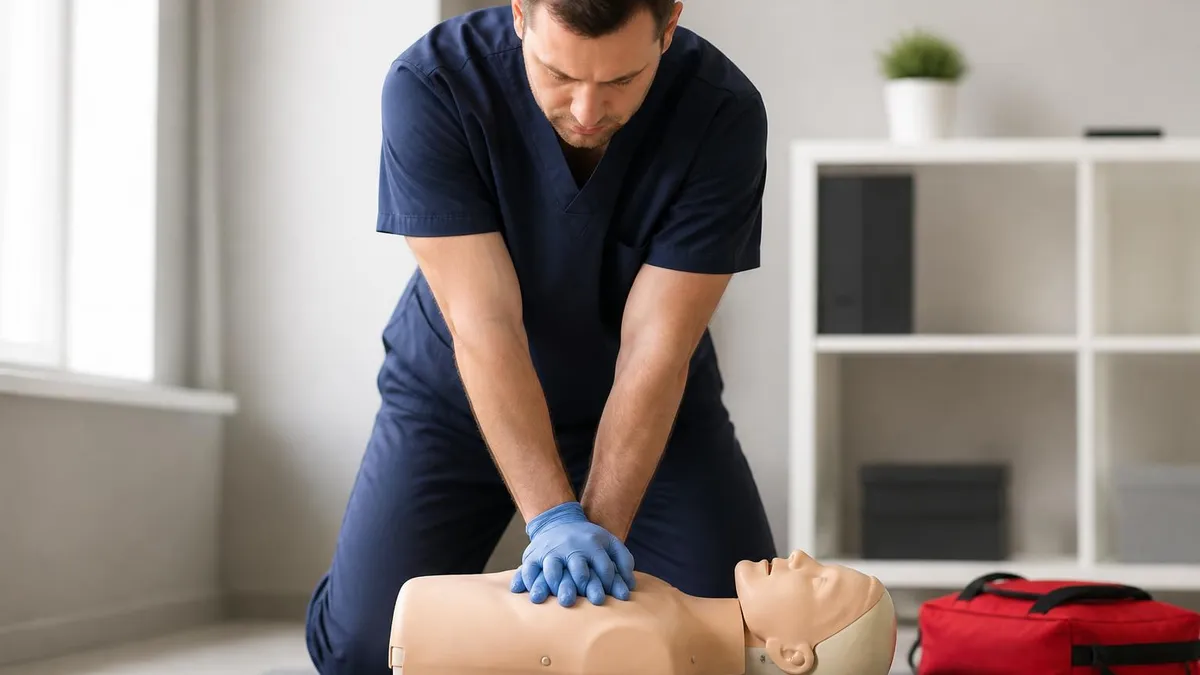
Online BLS Renewal: Complete 2026 Guide to Recertifying Your Basic Life Support Card
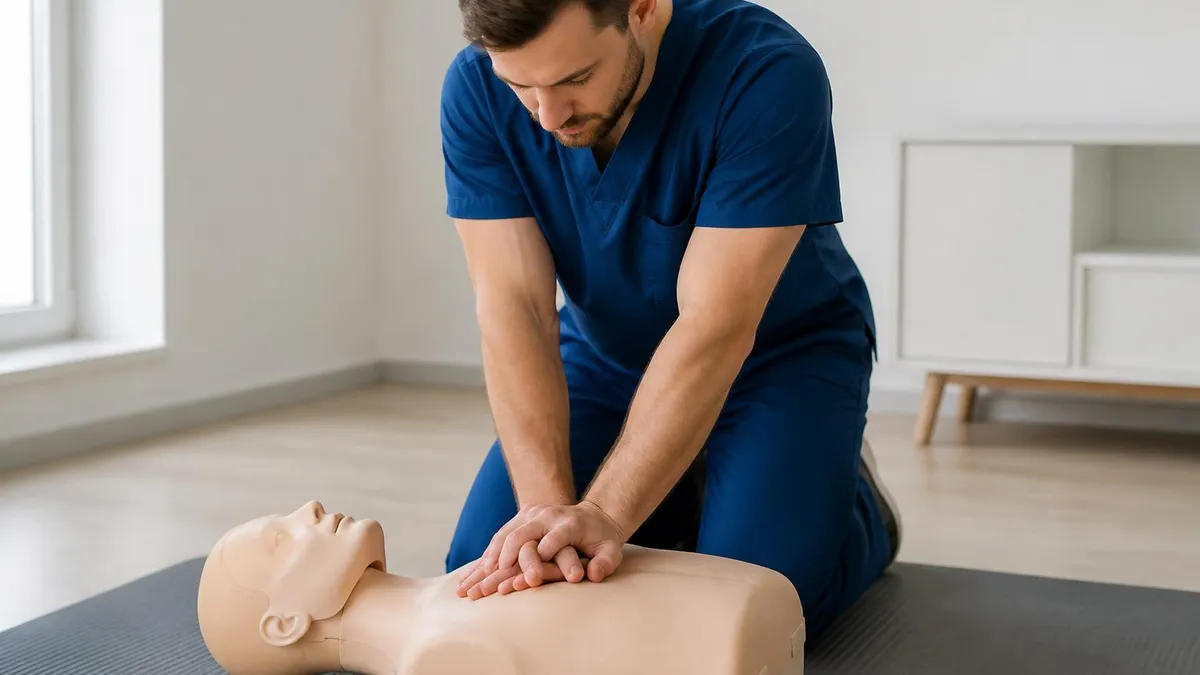
BLS vs ALS: Complete Comparison of Basic and Advanced Life Support
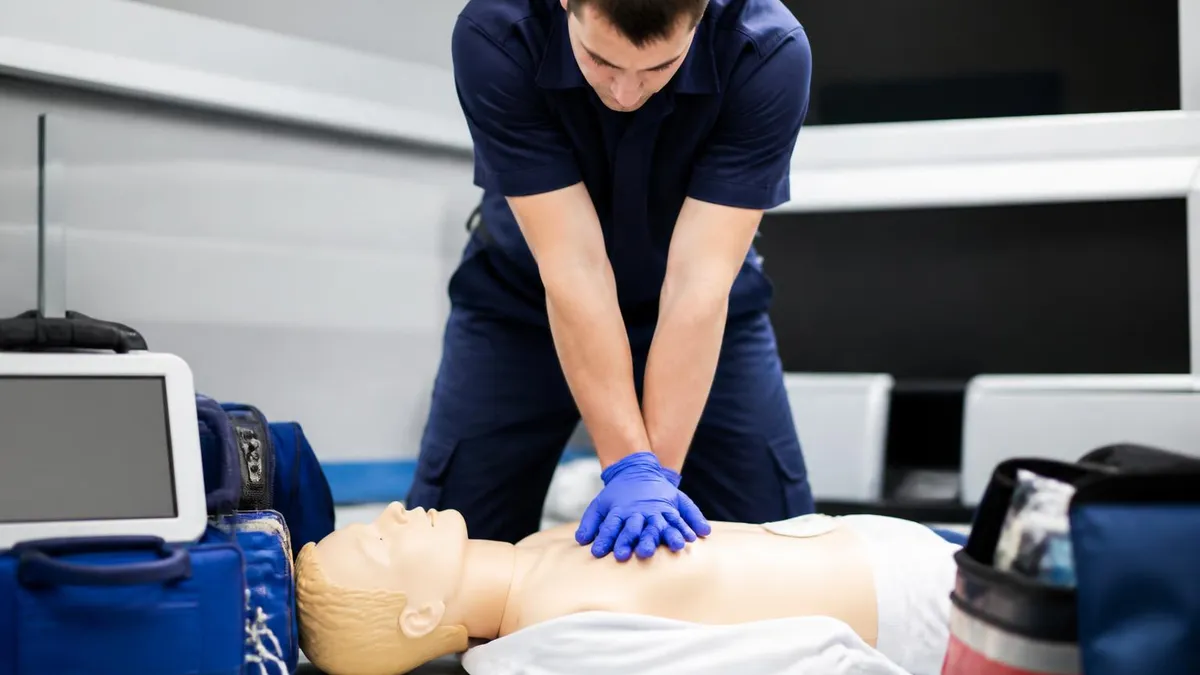
Are CPR and BLS the Same? Complete 2026 Guide to Differences, Certification & Training
How this page was made: written with AI tools. Exam facts are checked against the official sources listed below. Not reviewed by a subject-matter expert. Editorial policy
Sources & references
Exam facts on this page (fees, format, dates, passing scores) are checked against these official sources; the date is our last check. Editorial policy
- cpr.heart.org — Score validity, fees, exam format, retake policy, exam information · verified Oct 2026
- redcross.org — Renewal, test delivery, fees, score validity · verified Oct 2026
- heart.org — Passing score · verified Oct 2026