
Air Brake Training for Heavy Duty Truck Drivers: Complete CDL Guide 2026 October
Master air brake training for heavy duty truck drivers. CDL air brake test tips, endorsement steps, and free practice tests. 🎯 Pass on your first try.

Air brake training for heavy duty truck drivers is one of the most critical components of earning your Commercial Driver's License in the United States. Unlike the standard hydraulic braking systems found on passenger vehicles, air brakes use compressed air to generate the clamping force that stops massive loads weighing up to 80,000 pounds. Understanding how these systems work — and how to operate them correctly — is not just a licensing requirement; it is a matter of life and safety on every road you travel.
The Federal Motor Carrier Safety Administration (FMCSA) mandates that any driver operating a vehicle equipped with air brakes must demonstrate proficiency through both a written knowledge test and a pre-trip inspection skills evaluation. This requirement applies whether you are driving a Class A combination vehicle, a Class B single vehicle, or any heavy-duty truck equipped with an air brake system. Failing the air brake portion of the CDL exam results in an air brake restriction (marked as "L" on your license), which severely limits the types of vehicles you can legally operate.
The CDL air brake test covers a broad range of topics, from basic system components like the compressor, governor, and reservoirs, to more advanced concepts like dual-circuit protection, spring brakes, and brake fade under prolonged use. Many first-time CDL candidates underestimate the depth of knowledge required, which is why structured training programs and consistent practice with a f-750 air brake treadle valve resource are essential tools in your preparation arsenal.
Air brake endorsement requirements vary slightly by state, but the core federal knowledge standards remain consistent across all 50 states and the District of Columbia. In addition to the written test, drivers must demonstrate the ability to perform a proper pre-trip inspection of the air brake system, including checking air pressure build-up time, testing the low-air warning device, and verifying spring brake operation. These hands-on skills are evaluated by a licensed CDL examiner during the skills test portion of your road test.
One aspect of air brake training that many drivers overlook is emergency procedure knowledge. Knowing how to handle a sudden air loss, what to do when the brake pedal travels unusually far, or how to safely bring a vehicle to a stop when the primary circuit fails can mean the difference between a close call and a catastrophic accident. The FMCSA reports that brake-related issues are among the top cited violations during roadside inspections, making this knowledge critically important even for experienced drivers.
Modern heavy-duty trucks, including popular models like the Freightliner Cascadia, Kenworth T680, and Peterbilt 579, use sophisticated electronic air brake management systems that integrate with Anti-Lock Braking Systems (ABS) and Automatic Traction Control (ATC). While these technologies improve safety, they also require drivers to understand both the mechanical and electronic aspects of their braking systems. Training programs that cover only the basics may leave gaps in your knowledge when dealing with today's advanced commercial vehicles.
This comprehensive guide is designed to walk you through every aspect of air brake training, from the foundational concepts you need for the written CDL exam to the practical skills required for real-world operation. Whether you are a first-time CDL candidate, a driver looking to remove the air brake restriction from your license, or an experienced professional refreshing your knowledge, this resource will provide the structured, detailed information you need to succeed.
Air Brake Training by the Numbers

CDL Air Brake Test Requirements by Vehicle Class
Drivers operating tractor-trailers and other combination vehicles must pass the full air brake knowledge test. Class A vehicles are the most common air-brake-equipped commercial vehicles on American highways, and operators face the strictest training requirements.
Straight trucks, buses, and heavy dump trucks over 26,001 pounds frequently use air brake systems. Class B candidates must also clear the air brake written exam and demonstrate pre-trip inspection skills to avoid the restrictive 'L' endorsement limitation.
Drivers who originally tested without air brakes can return to a DMV or testing center to take just the air brake written exam and skills test. Passing removes the 'L' restriction and opens up a much wider range of commercial driving opportunities.
While federal FMCSA standards set the baseline, some states — including California, Texas, and New York — have additional requirements or testing procedures. Always verify your specific state's air brake testing rules before scheduling your CDL exam appointment.
Understanding how an air brake system functions from the ground up is the foundation of all effective training. The system begins with the air compressor, which is belt-driven or gear-driven off the engine and continuously supplies compressed air to the system. The governor controls the compressor by cutting it out when the system reaches approximately 125 PSI and cutting it back in when pressure drops to around 100 PSI. This automatic cycling ensures a consistent air supply is always available for braking.
The compressed air flows from the compressor into the air dryer, which removes moisture and contaminants before the air enters the storage tanks. Moisture in the system is a significant concern, especially in cold weather, because water can freeze inside valves and lines, causing brake failure. This is where air brake antifreeze plays a critical role during winter months — methanol-based antifreeze is injected into the system to lower the freezing point of any remaining moisture and prevent dangerous ice formation in critical components.
The air tanks, also called reservoirs, store the compressed air that powers the brakes. A typical dual-circuit system has at least two primary tanks: one for the primary (rear) brake circuit and one for the secondary (front) brake circuit. This redundancy is mandated by FMCSA regulations because it ensures that if one circuit fails, the driver still has braking capacity on the remaining axles. Many vehicles also have a wet tank (supply tank) that collects moisture before air reaches the main reservoirs.
When the driver presses the brake pedal — technically called the foot valve or treadle valve — it controls the amount of air pressure applied to the service brake chambers on each axle. The harder you press, the more air is released to the chambers, and the greater the clamping force on the brake shoes or pads. Unlike hydraulic systems where the pedal directly moves fluid, in an air brake system the pedal is a control valve that modulates airflow. This distinction is critical for new drivers to internalize because it fundamentally changes braking technique.
Spring brakes, also known as parking brakes or emergency brakes, operate on the opposite principle from service brakes. They are applied by spring pressure and released by air pressure. The yellow diamond-shaped knob in the cab controls the parking brake — pushing it in releases the brakes by supplying air to hold back powerful springs, while pulling it out exhausts the air and allows the springs to clamp the brakes firmly. If the air supply drops below approximately 20–45 PSI (varies by manufacturer), the spring brakes automatically apply as a failsafe.
Brake fade is one of the most dangerous phenomena associated with air brakes, particularly on long downhill grades. When brakes are applied repeatedly or continuously, friction generates heat in the drums or rotors. As temperature rises, the braking efficiency decreases — sometimes dramatically. Professional training programs spend considerable time teaching drivers to use engine braking (downshifting or using engine retarders) to control speed on grades, reserving the service brakes for final speed adjustments. This technique protects brake integrity and is emphasized heavily on the CDL knowledge exam.
The dual-circuit system is protected by a device called the dual-circuit protection valve or double check valve, which ensures that a pressure loss in one circuit does not drain the other. Additionally, automatic slack adjusters continuously maintain proper clearance between the brake shoes and drum as components wear over time. Manual slack adjusters, found on older vehicles, require periodic manual adjustment — a skill that is tested during pre-trip inspections and is covered in advanced air brake endorsement training programs.
CDL Air Brake Test Training Methods Compared
Commercial driving schools offer the most structured path to air brake certification. Most accredited CDL programs include 160 to 400 hours of combined classroom and behind-the-wheel training, with dedicated modules on air brake system theory, hands-on component identification, and pre-trip inspection practice. Students work directly with real vehicles and can ask instructors questions in real time, making this the highest-quality preparation method for the cdl air brake test.
The cost of CDL school ranges from $3,000 to $10,000 depending on program length and location. Many trucking companies offer tuition reimbursement or company-sponsored training, where you attend school at little or no upfront cost in exchange for a 12-to-24-month employment commitment. For drivers serious about a long-term commercial driving career, the investment in a full CDL program covering all air brake endorsement requirements typically pays off within the first year of driving.

Air Brake Endorsement: Benefits vs. Challenges
- +Removes the 'L' restriction and dramatically expands the number of vehicles you can legally operate
- +Opens access to higher-paying driving positions requiring Class A vehicles with air brakes
- +Demonstrates mechanical competency to employers, making you a more attractive candidate
- +Air brake knowledge improves overall driving safety and reduces your risk of brake-related violations
- +Qualifies you for specialty endorsements and positions like tanker or flatbed hauling
- +Understanding air brakes helps you perform faster, more accurate pre-trip inspections on the job
- −Requires passing an additional written knowledge test beyond the general CDL exam sections
- −Hands-on pre-trip inspection skills must be learned and memorized, adding preparation time
- −Air brake systems vary by vehicle manufacturer, requiring ongoing adaptation as you change trucks
- −Cold-weather operation demands extra knowledge about freeze protection and antifreeze systems
- −Brake adjustment requirements (slack adjusters) add complexity to daily vehicle maintenance duties
- −Failure to maintain air brake knowledge can result in out-of-service violations during roadside inspections
Pros and Cons at a Glance
| Pros | Cons |
|---|---|
| Removes the 'L' restriction and dramatically expands the number of vehicles you can legally operate | Requires passing an additional written knowledge test beyond the general CDL exam sections |
| Opens access to higher-paying driving positions requiring Class A vehicles with air brakes | Hands-on pre-trip inspection skills must be learned and memorized, adding preparation time |
| Demonstrates mechanical competency to employers, making you a more attractive candidate | Air brake systems vary by vehicle manufacturer, requiring ongoing adaptation as you change trucks |
| Air brake knowledge improves overall driving safety and reduces your risk of brake-related violations | Cold-weather operation demands extra knowledge about freeze protection and antifreeze systems |
| Qualifies you for specialty endorsements and positions like tanker or flatbed hauling | Brake adjustment requirements (slack adjusters) add complexity to daily vehicle maintenance duties |
| Understanding air brakes helps you perform faster, more accurate pre-trip inspections on the job | Failure to maintain air brake knowledge can result in out-of-service violations during roadside inspections |
Air Brake Pre-Trip Inspection Checklist for CDL Drivers
- ✓Build system pressure to at least 100 PSI before beginning any brake inspection steps
- ✓Test the low-air warning device by fanning the brakes down to verify the warning activates at or above 60 PSI
- ✓Verify spring brakes activate automatically when pressure drops to 20–45 PSI range
- ✓Check air pressure build-up time — pressure should rise from 85 to 100 PSI within 45 seconds at governed RPM
- ✓Perform the static air leak test — with brakes applied, pressure should not drop more than 3 PSI per minute
- ✓Test the parking brake by applying it and attempting to move the vehicle forward in low gear
- ✓Inspect all air lines and hoses for cracks, chafing, and secure connections at both ends
- ✓Check brake drums and shoes for visible wear, cracks, or contamination by oil or grease
- ✓Test the service brake by applying firm pedal pressure and checking that the vehicle stops in a straight line
- ✓Verify all slack adjusters are within the correct pushrod travel range (typically under 2 inches at 90 PSI)
The 3 PSI Rule Is a Guaranteed Exam Question
On virtually every CDL air brake test administered in the United States, you will encounter a question about the maximum allowable air pressure drop during a static leak test. The correct answer is 3 PSI per minute for combination vehicles and 4 PSI per minute for single vehicles. Memorize these numbers with a concrete association — three fingers for combination, four fingers for single — and you will never miss this question.
Passing the CDL air brake test on your first attempt requires a strategic approach to studying that goes beyond simply reading the manual cover to cover. The most effective candidates approach the exam like a structured project: they identify the specific knowledge domains tested, allocate study time proportionally to the weight of each domain, and use active recall techniques like practice quizzes to reinforce retention. Passive reading alone produces poor results on the air brake test because the exam requires applied knowledge, not just familiarity.
The CDL air brake knowledge exam typically draws questions from five core domains: system components and their functions, air pressure management, pre-trip inspection procedures, emergency situations, and brake adjustment standards. Of these, candidates consistently struggle most with brake adjustment specifications and emergency scenario questions. Dedicating extra study sessions to these two areas yields the greatest improvement in practice test scores and translates directly to better performance on exam day.
Practice testing is the single most effective preparation tool available to CDL candidates. Studies in educational psychology consistently show that retrieval practice — actively recalling information through testing — produces stronger long-term retention than re-reading or note-taking. Aim to complete at least 200 to 300 unique air brake practice questions before your exam, spread across multiple sessions. This volume ensures you encounter the full range of question types and phrasings that may appear on the actual test, including the particularly tricky multiple-select questions some states include.
Time management during the actual exam matters more than many candidates realize. The CDL written test is not typically time-pressured in a way that catches people off guard, but anxiety can cause test-takers to rush through questions or second-guess correct answers. A proven strategy is to answer all questions you are confident about first, mark any uncertain questions for review, and then return to those with a fresh perspective. On air brake-specific questions, pay careful attention to whether the question asks about combination vehicles or single vehicles, as the correct pressure thresholds and specifications differ between them.
Understanding the structure of the exam in your specific state is also important. Most states administer the CDL air brake knowledge test as a standalone section within the general CDL knowledge test, requiring a score of 80% or higher to pass. Some states offer the air brake exam separately from the general knowledge portion, allowing you to retake just the air brake section if you fail it without retesting on other material. Check with your state DMV to confirm the exact testing format before your appointment.
On the day of your CDL air brake test, arrive at the testing center early and bring all required identification documents. Most states require a valid driver's license, your commercial learner's permit (CLP), and any applicable state-specific forms. Some testing centers prohibit phones and electronic devices in the testing room, so review your state's rules in advance. A good night's sleep and a solid meal before the test will do more for your performance than last-minute cramming, which tends to increase anxiety without meaningfully improving recall.
After passing the written knowledge test, you will need to schedule the CDL skills test, which includes the pre-trip vehicle inspection, basic vehicle control maneuvers, and an on-road driving evaluation. The air brake pre-trip inspection is a graded portion of the vehicle inspection section. Examiners follow a standardized scoring rubric, and failing to verbally announce each inspection step — even if you perform it correctly — can result in point deductions. Practice narrating your inspection aloud until it becomes natural and automatic.

Many CDL candidates focus so heavily on the written knowledge test that they neglect preparation for the air brake portions of the skills exam. The pre-trip inspection is evaluated in real time by a CDL examiner, and specific air brake steps — including demonstrating the low-air warning test and spring brake activation — are required. Missing these steps, even if you know the theory, results in automatic point deductions that can cause you to fail the overall skills test.
Obtaining your air brake endorsement is a career milestone that significantly expands your professional opportunities in the commercial trucking industry. The process begins at the state level, where you submit an application for a Commercial Learner's Permit that includes authorization to take the air brake knowledge test. Most states charge a nominal fee between $10 and $50 for the knowledge test itself, separate from the CLP application fee. Once you pass the written exam, the air brake restriction is lifted from your learner's permit, allowing you to practice driving air-brake-equipped vehicles under the supervision of a licensed CDL holder.
The timeline from starting your air brake training to receiving your full CDL typically ranges from four weeks to several months, depending on your training path and testing availability. CDL school students often complete the process in eight to twelve weeks because their training schedule is structured and testing appointments are arranged by the school. Self-study candidates may take longer because they must independently schedule DMV appointments, which in some high-demand states like California, Texas, and Florida can have wait times of four to eight weeks.
Once you have passed both the written knowledge test and the skills test with the air brake pre-trip inspection component, your state DMV will issue your CDL without the air brake restriction. At this point, you are legally authorized to drive any air-brake-equipped vehicle within your license class. It is important to understand that this authorization comes with ongoing responsibilities — you are now expected to perform proper pre-trip and post-trip inspections of air brake systems every day you drive a commercial vehicle, as mandated by FMCSA regulations 49 CFR Part 392.7.
For drivers who already hold a CDL with the air brake restriction (the L restriction), removing it requires returning to the DMV, passing the air brake knowledge test, and demonstrating the air brake pre-trip inspection skills. The good news is that you do not need to retake the general CDL knowledge test or the full road test — only the air brake-specific components. Many experienced drivers are surprised by how much the industry knowledge base has evolved, particularly around electronic air brake management systems, automatic slack adjusters, and ABS integration, so some supplemental study is always recommended even for veterans.
Continuing education after earning your air brake endorsement is strongly encouraged. The trucking industry regularly updates best practices for brake maintenance and adjustment, and FMCSA periodically revises its regulations affecting air brake systems. Many professional associations, including the Commercial Vehicle Safety Alliance (CVSA), publish annual inspection bulletins that highlight common brake violations found during roadside inspections. Reviewing these bulletins annually keeps your knowledge current and helps you avoid violations that could result in an out-of-service order during a roadside inspection.
Employer-sponsored recurrent training programs are another valuable resource for maintaining and expanding your air brake expertise. Many large carriers conduct annual safety meetings where brake system updates, new vehicle technology, and inspection technique refinements are reviewed. Participating actively in these sessions — asking questions, taking notes, and practicing the updated inspection steps — demonstrates professional commitment and helps you stay ahead of regulatory changes that could affect your operating authority.
Finally, remember that your air brake knowledge is an asset that grows with experience. Every pre-trip inspection you perform, every brake adjustment you oversee, and every emergency situation you successfully manage adds to your practical expertise. The most competent commercial drivers are those who treat their air brake systems not as a checkbox requirement but as a critical safety system deserving ongoing attention and respect. This professional mindset is what separates truly excellent drivers from those who merely meet the minimum licensing standards.
Practical air brake operation skills develop through deliberate, supervised practice behind the wheel of a real commercial vehicle. No amount of reading or quiz-taking can fully substitute for the tactile experience of feeling how a loaded air brake system responds under different road conditions.
When you first begin driving with air brakes, pay close attention to the distance required to bring the vehicle to a complete stop — fully loaded vehicles at highway speeds can require 400 feet or more to stop, which is roughly the length of a football field. This stopping distance reality must inform every following distance decision you make on the road.
One of the most common mistakes new air brake drivers make is "riding the brakes" — maintaining partial pressure on the brake pedal while driving, which causes excessive heat buildup, premature lining wear, and potential brake fade on downgrades. Professional drivers use controlled, firm applications of the brakes followed by complete release, allowing the drums to cool between applications. On mountain grades, the correct technique is to select the appropriate lower gear before beginning the descent, use engine braking as the primary speed control, and apply the service brakes in brief, firm applications only when additional speed reduction is needed.
Understanding how weather affects air brake performance is another area where practical experience builds on classroom knowledge. In cold weather below 32 degrees Fahrenheit, any moisture in the air lines or chambers can freeze, causing brakes to drag, stick in the applied position, or fail to release properly.
Experienced drivers in northern states check their air dryer operation daily during winter months and may add methanol-based alcohol evaporator fluid to the wet tank as an additional freeze prevention measure. The FMCSA allows this practice, and knowing when and how to use alcohol evaporators is a mark of a well-prepared professional driver.
The cdl air brakes practice test content you encounter during your exam preparation often includes scenarios about brake adjustment that cross over into real-world daily operation. Automatic slack adjusters are designed to self-adjust, but they can malfunction and become either over-adjusted (dragging) or under-adjusted (excessive pushrod travel). Knowing how to recognize these conditions during a pre-trip inspection — and understanding that a malfunctioning automatic slack adjuster must be repaired by a qualified mechanic rather than manually adjusted — is critical knowledge for both the exam and safe vehicle operation.
Stab braking and controlled braking are two emergency stopping techniques taught in air brake training programs. Controlled braking involves applying the brakes with the maximum pressure that keeps the wheels from locking, while stab braking involves applying maximum brake pressure, releasing before wheels lock, then reapplying. Vehicles without ABS require these manual techniques to avoid jackknifing. Vehicles equipped with ABS allow the driver to apply maximum brake pressure continuously and let the electronic system prevent wheel lockup — but drivers must understand which type of system their vehicle has before an emergency occurs, not during one.
Building a strong professional network with other CDL drivers and truck mechanics is an underrated aspect of ongoing air brake education. Experienced drivers freely share knowledge about which brake components fail most often on specific vehicle models, which maintenance shops provide the best brake work, and how to communicate effectively with fleet mechanics when reporting brake issues. This real-world knowledge, accumulated through years of professional experience, complements your formal training and helps you become a more effective advocate for your own vehicle's safety and maintenance.
As you advance in your commercial driving career, consider pursuing additional air brake certifications beyond the basic CDL requirement. The National Institute for Automotive Service Excellence (ASE) offers commercial vehicle brake system certifications that are recognized by employers across the industry. While not required for driving positions, these credentials demonstrate a higher level of technical expertise and can qualify you for safety manager, driver trainer, or fleet maintenance roles that offer higher earning potential and career advancement opportunities beyond the cab of a truck.
Sample Air Brake Practice Questions
Try these questions from our free Air Brake practice tests. The correct answer and an explanation follow each question.
At 60 mph, approximately how far does a truck travel during the driver's perception and reaction time before the brakes are even applied?
- A. About 132 feet
- B. About 50 feet
- C. About 200 feet
- D. About 75 feet
Answer: A. About 132 feet
At 60 mph, a vehicle travels roughly 88 feet per second, and with a 1.5-second combined perception-reaction time, the truck covers approximately 132 feet before braking begins.
What is the recommended following distance for a truck with air brakes at highway speeds?
- A. One second for every 10 feet of vehicle length
- B. At least 4 seconds regardless of vehicle size
- C. One car length per 10 mph of travel speed
- D. Two seconds minimum at any speed
Answer: A. One second for every 10 feet of vehicle length
The CDL standard is one second per 10 feet of vehicle length, plus extra time at speeds over 40 mph.
Which pedal does a driver press to apply the air brakes?
- A. Clutch pedal
- B. Throttle pedal
- C. Brake pedal
- D. Gear pedal
Answer: C. Brake pedal
The brake pedal is the primary control that a driver presses to apply the service brakes in an air brake system. When pressed, it signals the system to release compressed air to the brake chambers at each wheel, initiating the braking action. This direct interface allows the driver to control the vehicle's deceleration and stopping power.
At 55 mph on dry pavement, approximately how many feet does a fully loaded large truck typically need to stop?
- A. About 100 feet
- B. About 170 feet
- C. About 230 feet
- D. About 300 feet or more
Answer: D. About 300 feet or more
A fully loaded truck at 55 mph on dry pavement can require 300 feet or more to stop safely when all factors are included.
Air Brake Questions and Answers
Air Brake Practice Test
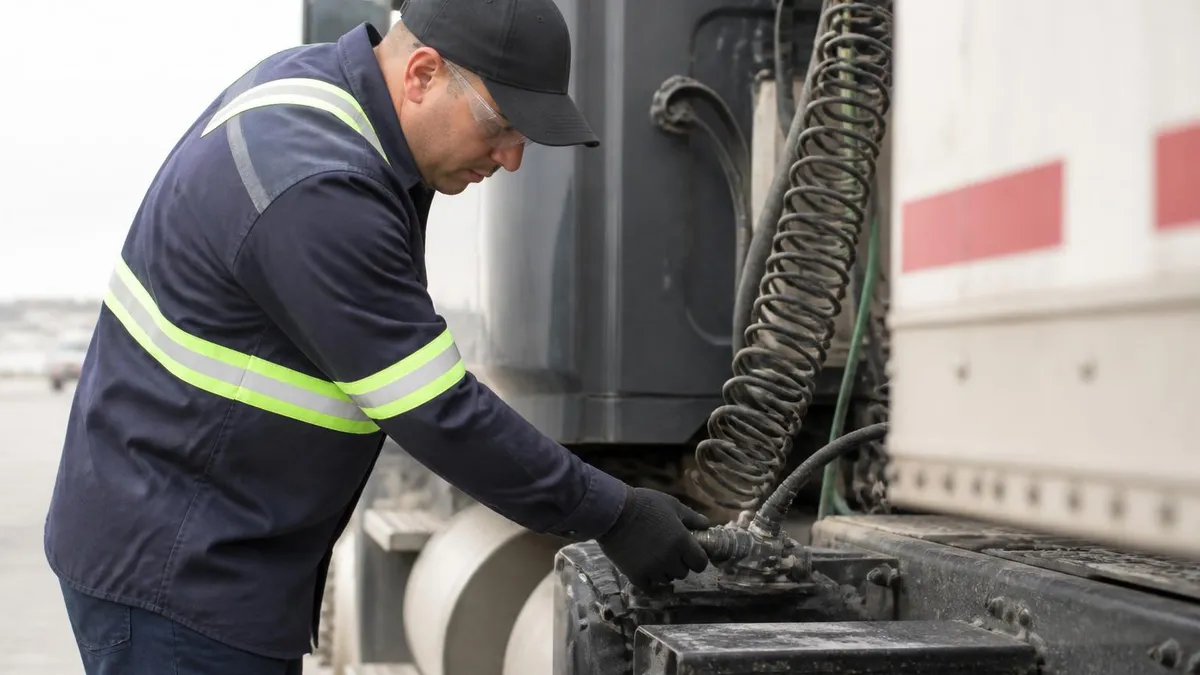
Air Brake System Troubleshooting: Diagnose Leaks, Pressure Drops, and Valve Failures
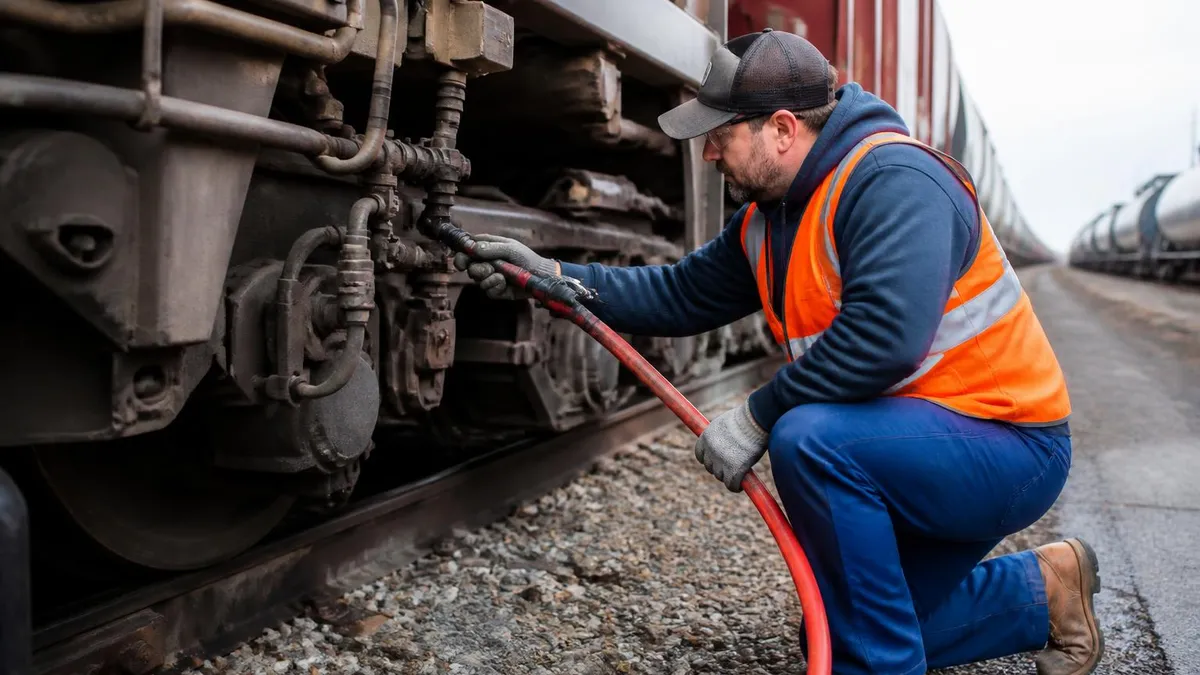
Air Brake Valve: Complete Guide for CDL Drivers and the Air Brake Test

DOT Air Brake Repair Certification Online: Complete Training Guide and Requirements

Air Brake Adjustment: Complete Guide for CDL Drivers
About the Author

Educational Psychologist & Academic Test Preparation Expert
Columbia University Teachers CollegeDr. Lisa Patel holds a Doctorate in Education from Columbia University Teachers College and has spent 17 years researching standardized test design and academic assessment. She has developed preparation programs for SAT, ACT, GRE, LSAT, UCAT, and numerous professional licensing exams, helping students of all backgrounds achieve their target scores.