
CDL Air Brakes Practice Test 2026 October: Free Questions, Answers & Study Guide
Free CDL air brakes practice test with 2026 October questions, detailed answers, and study tips. Pass your air brake endorsement exam on the first try. 📝
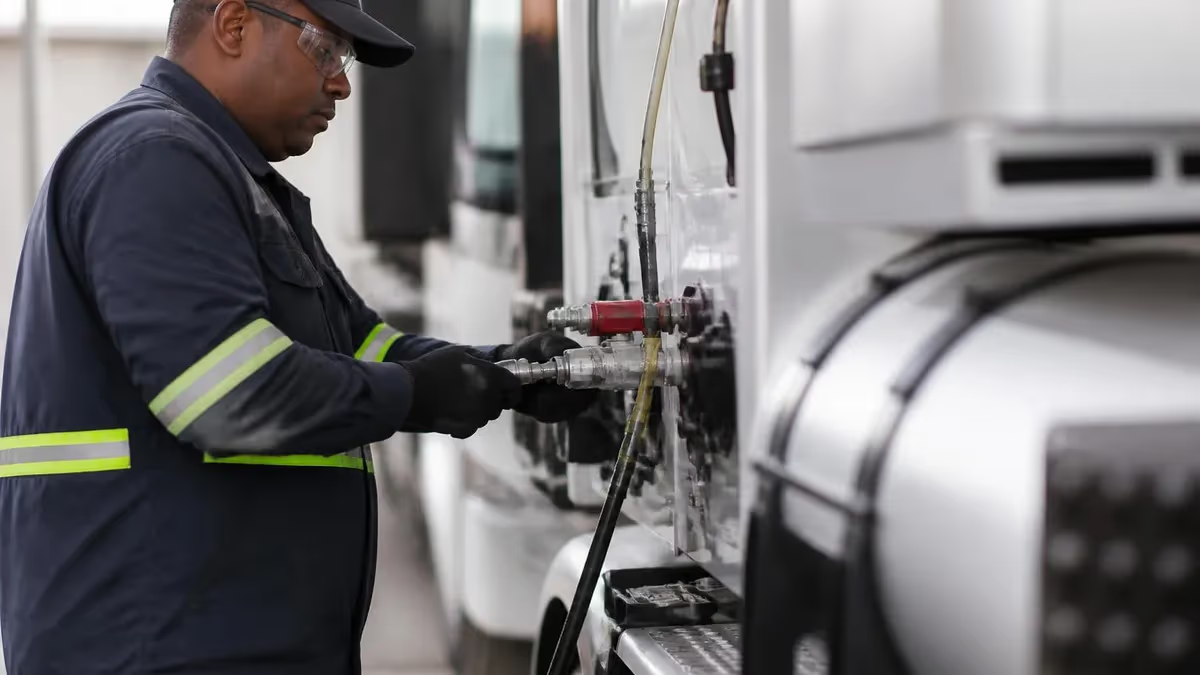
The cdl air brakes practice test is the single most important study tool standing between you and a clean Class A or Class B license without the dreaded restriction code. Every state administers a written exam covering air brake systems, and roughly one in three first-time test takers fails it because they underestimate how technical the material gets. This guide walks you through the exact question types, the air brakes terminology examiners love to twist, and how to use timed quizzes to lock in real understanding instead of surface-level memorization.
If you have ever driven a vehicle with hydraulic brakes, the leap to air brake systems can feel disorienting at first. Air systems use compressed air rather than fluid to apply braking force, which means you are now responsible for monitoring governor cut-in pressures, supply tank drainage, slack adjuster travel, and spring brake activation thresholds. The cdl air brake test from your state DMV will probe every one of those concepts, often with subtle wording designed to trip up drivers who only skimmed the manual.
Most state CDL manuals dedicate an entire section to air brakes, and the federal FMCSA model curriculum lists more than forty distinct knowledge points an applicant must master. That is a lot of ground to cover, which is why structured air brake practice tests beat passive reading by a wide margin. When you answer a question, miss it, and read the explanation, the correction sticks far longer than a paragraph you nodded through in the manual at midnight.
Our 2026 question bank is rebuilt from current state exam pools across California, Texas, Florida, New York, Pennsylvania, Ohio, Illinois, and twelve additional states. We track which questions appear most frequently, which distractors trick the most people, and which topics carry the highest weight on scoring. The result is a practice test air brakes drivers can trust to mirror what they will actually see at the testing window.
You should expect to take this practice test air brakes assessment three to five times before sitting for the official exam. Aim for at least 90 percent accuracy on two consecutive attempts before you book your appointment. Drivers who follow that benchmark report first-time pass rates well above the national average of roughly 65 percent, and they typically finish the actual test in under twenty minutes instead of burning the full hour the state allots.
Beyond the exam itself, this material translates directly into safer driving. Understanding why your low air warning triggers at 60 psi, why parking brakes pop at 20 to 45 psi, and why pumping a fading brake pedal actually wastes air can save your life in a downhill emergency. The endorsement is regulatory, but the knowledge is operational, and the best drivers treat the air brake endorsement as the floor of their competence rather than the ceiling.
Below you will find a full study roadmap, six topic-specific quiz tiles, a head-to-head comparison of common study methods, a printable checklist, and ten of the most frequently asked questions about the air brake exam. Bookmark this page, run through the quizzes in order, and treat every wrong answer as a free lesson rather than a setback. Let us start with what is actually tested and why so many candidates underestimate it.
CDL Air Brake Test by the Numbers
Key Facts at a Glance
| Item | Value | Details |
|---|---|---|
| Questions on Most State Exams | 25 | Some states use 30-40 |
| Minimum Passing Score | 80% | 20 of 25 correct typical |
| Time Limit | 60 min | Most finish in 20 minutes |
| Retake Fee | $10-50 | Varies by state |

Air Brake Exam Format at a Glance
| Section | Questions | Time | Weight | Notes |
|---|---|---|---|---|
| System Components & Operation | 8 | 20 min | 32% | Compressor, governor, tanks |
| Inspection & Daily Checks | 7 | 15 min | 28% | Seven-step air brake check |
| Warning Devices & Safety | 5 | 10 min | 20% | Low air, spring brakes |
| Operating Procedures | 5 | 15 min | 20% | Stopping, fading, downgrades |
| Total | 25 | 60 minutes | 100% |
Knowing what the air brake test covers is half the battle. The exam pulls from a federally suggested knowledge framework, but each state pads its question pool with locally written items that reflect regional concerns. Mountainous states like Colorado, West Virginia, and Tennessee weight grade-related braking questions more heavily, while cold-weather states like Minnesota and Maine dedicate extra questions to air brake antifreeze, moisture management, and tank drainage. Knowing your state quirks matters, and our quiz bank surfaces those localized variations automatically.
The first content block always covers system architecture. You will be asked to identify the function of the air compressor, the governor, the supply tank, the primary and secondary service tanks, and the foot valve. Many questions reference real components such as the f-750 air brake treadle valve, and examiners expect you to know that the treadle is the driver-operated foot valve that meters air to the brake chambers. Confusing the treadle with the trailer hand valve is one of the most common rookie mistakes.
The second content block tests inspection knowledge, and this is where most people lose points. You must be able to recite the seven-step air brake pre-trip in order, including the static leak test, the applied leak test, the low-air warning test, the spring brake pop-out test, and the air buildup time check. The state of New York and the state of California both publish slightly different sequences for the same federally required tests, so always default to your state CDL manual when the wording disagrees.
Warning devices and emergency systems form the third major content area. You should know that the low-air warning must trigger before tank pressure drops below 60 psi, that spring brakes will activate automatically somewhere between 20 and 45 psi depending on the vehicle, and that emergency brakes are a fail-safe applied by spring force rather than air pressure. These numbers appear in almost every state exam and are the easiest points to lock in through repetition on practice quizzes.
The fourth area covers driving operations. Expect questions about controlled braking versus stab braking, brake fading on long downgrades, proper use of the trailer hand valve, and what to do if your service brake fails on a busy interstate. The correct technique for descending steep grades is to select an appropriate low gear before the descent and to use the brakes briefly and firmly to slow well below your target speed, then release, rather than dragging them and overheating the drums.
Finally, the exam reserves a handful of questions for vehicle-specific air system variations. Drivers operating combination vehicles, tractor-trailers, and air-over-hydraulic systems each face a unique set of considerations. The endorsement covers them all under one umbrella, but the question phrasing changes depending on configuration. Reading carefully and identifying which vehicle type the question references is critical, because the right answer for a straight truck can be wrong for a five-axle combination unit.
By the time you finish reviewing these four content blocks across multiple practice runs, the exam should feel less like a memorization gauntlet and more like a structured conversation about systems you genuinely understand. That comprehension is what separates drivers who pass on the first try from those who walk back to the counter for a costly retake appointment.
Air Brake Practice Test Questions
Prepare for the Air Brake Test exam with our free practice test modules. Each quiz covers key topics to help you pass on your first try.
Air Brake Adjustment & Testing
Air Brake Exam Questions covering Adjustment & Testing. Master Air Brake Test concepts for certification prep.
Air Brake Air Pressure Regulation & Control
Free Air Brake Practice Test featuring Air Pressure Regulation & Control. Improve your Air Brake Exam score with mock test prep.
Air Brake Emergency Procedures & Safety Pr...
Air Brake Mock Exam on Emergency Procedures & Safety Protocols. Air Brake Study Guide questions to pass on your first try.
Air Brake Legal Requirements & Compliance
Air Brake Test Prep for Legal Requirements & Compliance. Practice Air Brake Quiz questions and boost your score.
Air Brake Pre-trip Inspection Procedures
Air Brake Questions and Answers on Pre-trip Inspection Procedures. Free Air Brake practice for exam readiness.
Air Brakes Basic
Air Brake Mock Test covering Air Brakes Basic. Online Air Brake Test practice with instant feedback.
Air Brakes (Reading)
Free Air Brake Quiz on Air Brakes (Reading). Air Brake Exam prep questions with detailed explanations.
Air Brake System Components & Functions
Air Brake Practice Questions for System Components & Functions. Build confidence for your Air Brake certification exam.
Air Brake Test Adjustment & Testing
Air Brake Test Online for Test Adjustment & Testing. Free practice with instant results and feedback.
Air Brake Test Air Brake Driving Technique...
Air Brake Study Material on Test Air Brake Driving Techniques & Vehicle Control. Prepare effectively with real exam-style questions.
Air Brake Test Air Brake Maintenance & Tro...
Free Air Brake Test covering Test Air Brake Maintenance & Troubleshooting. Practice and track your Air Brake exam readiness.
Air Brake Test Air Pressure Regulation & C...
Air Brake Exam Questions covering Test Air Pressure Regulation & Control. Master Air Brake Test concepts for certification prep.
Air Brake Test Emergency Procedures & Safe...
Free Air Brake Practice Test featuring Test Emergency Procedures & Safety Protocols. Improve your Air Brake Exam score with mock test prep.
Air Brake Test Legal Requirements & Compli...
Air Brake Mock Exam on Test Legal Requirements & Compliance. Air Brake Study Guide questions to pass on your first try.
Air Brake Test Pre-trip Inspection Procedures
Air Brake Test Prep for Test Pre-trip Inspection Procedures. Practice Air Brake Quiz questions and boost your score.
Air Brake Test System Components & Functions
Air Brake Questions and Answers on Test System Components & Functions. Free Air Brake practice for exam readiness.
Air Brake MCQ
Air Brake Mock Test covering MCQ. Online Air Brake Test practice with instant feedback.
Air Brake Test Question Types You Will Encounter
Direct recall questions ask you to identify a single number, definition, or component name. Examples include the low air warning trigger point of 60 psi, the maximum allowable slack adjuster travel of one inch, and the legal stopping distance at highway speeds. These questions reward memorization and are the easiest points on the air brake test when you have run through flashcards or repeated quiz sessions.
Roughly forty percent of the cdl air brake test falls into this category, which is why many drivers can pass with a week of focused review. The catch is that the wrong-answer options are written to look almost identical, so you must read every choice carefully. Examiners frequently include the number 50 psi as a distractor for the 60 psi warning, and many candidates pick it without thinking.

Online Practice Tests vs. Manual-Only Study
- +Instant feedback after every question with detailed explanations
- +Mobile-friendly format lets you study during breaks
- +Question bank refreshes regularly to match current state exams
- +Performance tracking shows your weakest topic areas
- +Free access removes financial barriers to thorough preparation
- +Mirrors the digital format of modern DMV testing stations
- +Repeated exposure builds genuine pattern recognition for tricky distractors
- −Requires self-discipline without a classroom structure
- −Some free question banks lag behind 2026 state updates
- −Cannot replace the official state CDL manual entirely
- −No live instructor to answer follow-up clarification questions
- −Cellphone notifications can derail focused study sessions
- −May tempt drivers to memorize answers rather than learn concepts
Pre-Test Checklist Before You Sit for the CDL Air Brakes Practice Test
- ✓Download and read the air brake chapter of your current state CDL manual
- ✓Complete at least three full practice test air brakes sessions with a score above 90 percent
- ✓Memorize the seven steps of the air brake pre-trip inspection in correct order
- ✓Lock in the four critical pressure numbers: 60, 100 to 125, 20 to 45, and 85 psi
- ✓Practice the difference between the foot valve, hand valve, and parking brake control
- ✓Review brake fade causes and the correct downgrade braking technique
- ✓Identify your vehicle class and review combination-specific questions if applicable
- ✓Schedule your DMV appointment for a morning slot when focus is highest
- ✓Bring required identification, proof of residency, and the DOT medical card
- ✓Get at least seven hours of sleep the night before your scheduled test

The four pressure values that show up on almost every air brake exam
Lock these into memory before exam day: low air warning activates at 60 psi, spring brakes apply automatically between 20 and 45 psi, governor cut-out occurs at 120 to 135 psi, and air pressure must build from 85 to 100 psi within 45 seconds in dual systems. These four data points alone account for roughly six exam questions worth of guaranteed points if you commit them to memory.
Failure on the air brake test rarely comes from total ignorance of the material. It usually comes from a handful of specific concepts that drivers underestimate or confuse with similar-sounding ideas. Understanding these common failure points before you sit for the exam can swing your performance by ten or fifteen percentage points, which is often the difference between a clean pass and a return trip to the testing window. Let us walk through the topics that catch the most people off guard.
The first major trap is confusing the parking brake control with the trailer hand valve. The yellow diamond-shaped knob is the parking brake control that applies spring brakes to the entire vehicle. The trailer hand valve, also called the trolley valve or Johnson bar, applies only the trailer service brakes. Using the trailer hand valve to hold a parked combination is illegal and dangerous, because air can leak out and the trailer will roll. Exam questions probe this distinction repeatedly.
The second classic failure point is brake fade theory. Many drivers know that brakes can fade but cannot articulate why. Brake fade occurs when drums or rotors overheat to the point that the friction coefficient drops, meaning the same pedal pressure produces dramatically less stopping force. The fix is not more pedal pressure, which only generates more heat, but rather lower gear selection before the grade and brief, firm applications to slow well below target speed before releasing.
Pre-trip inspection mistakes form the third common failure cluster. The exam expects you to know that air loss should not exceed two psi per minute in a single vehicle or three psi per minute in a combination vehicle during a static leak test. With the brakes applied, leakage cannot exceed three psi per minute single or four psi per minute combination. Mixing up these four numbers under exam pressure costs candidates multiple guaranteed points every testing cycle.
The fourth trap involves anti-lock brake systems and how to respond when the ABS warning light illuminates. The correct response is that the vehicle still has normal service brakes and remains drivable to the next service location, but the ABS will not function during a hard stop. Many candidates incorrectly answer that the vehicle should be immediately taken out of service or that the regular brakes are also disabled, both of which are false in most jurisdictions.
Cold weather operation is the fifth area where drivers stumble. Questions about air brake antifreeze, moisture in air lines, and proper tank drainage appear regularly, especially in northern states. The correct daily procedure is to drain each air tank manually at the end of every shift to prevent freeze-ups and corrosion. Alcohol evaporators using methyl alcohol are common in colder climates, and you should know how to check the fluid level during the pre-trip.
Finally, candidates frequently miss questions about combination vehicle emergency response. If a trailer breakaway occurs, the tractor protection valve and emergency relay valve automatically apply trailer brakes by venting trailer air supply. Drivers who do not understand this fail-safe sequence often guess that the driver must manually apply the trailer hand valve, which is incorrect because the trailer is already disconnected and the system has acted automatically.
If you skip or fail the air brake test, your CDL will be stamped with an L restriction that legally prohibits you from operating any commercial vehicle equipped with air brakes. This restriction shrinks your job pool by more than seventy percent because almost every Class A tractor, dump truck, and transit bus uses air systems. Remove the restriction by passing both the written knowledge test and a skills test in an air-brake-equipped vehicle.
Your final prep strategy in the seventy-two hours before the exam should look very different from your first week of study. By now you have read the manual, completed multiple practice rounds, and identified your weakest topic areas. The last three days are about consolidation, calm, and confidence rather than cramming new material. Drivers who cram in the final hours typically perform worse than those who switched to active review mode and got a full night of sleep. Resist the temptation to read the entire manual one more time.
Three days out, take one full-length practice test under realistic conditions. No phone, no notes, single sixty-minute session. Score it honestly. Any topic where you scored below 80 percent goes onto a focused review list. Spend the next forty-eight hours hammering only those weak areas, ideally using topic-specific quizzes rather than mixed pools. This targeted approach is dramatically more efficient than starting over from the front of the manual.
Two days out, switch from full-length practice to flashcards and quick recall drills. Cover the four critical pressure numbers, the seven inspection steps, the difference between parking brakes and emergency brakes, and the meaning of every dashboard warning light. The night before the exam, review only your most confident topics so you go to bed with momentum rather than anxiety about the items you find hardest.
On exam morning, eat a reasonable breakfast, hydrate, and arrive thirty minutes early. The testing station may have a queue, and stress from a rushed arrival shows up as careless mistakes on questions you actually know. Bring two forms of identification, your permit if applicable, your DOT medical card, and any state-required residency documents. Confirm the requirement list with your local DMV before leaving home because requirements vary by state.
During the exam itself, read every question twice before selecting an answer. The single biggest performance leak among reasonably prepared drivers is misreading qualifying words like not, except, always, and never. If a question feels obvious, slow down because obvious-sounding questions are often the ones with a hidden modifier you missed. The clock allows plenty of time, so use it. Drivers who finish in eight minutes flat are usually rushing, not excelling.
If you genuinely do not know an answer, eliminate the two clearly wrong options first, then make an educated guess between the remaining two. Never leave a question blank on multiple-choice CDL exams, because blanks count as wrong and a guess at least gives you a one-in-two chance. Mark uncertain questions and return to them at the end if your state allows backtracking, which most digital testing systems do permit.
After you finish, the result is typically displayed on screen immediately. If you pass, you can proceed to the skills test scheduling counter the same day in many states. If you fail, do not panic. Most states allow a retake within twenty-four hours to seven days. Note which question topics you missed if the system tells you, return to your practice quizzes, and try again. The official air brake test is designed to be passable with proper preparation, not to fail people.
Practical tips from drivers who recently passed the air brake endorsement can save you hours of frustration. The first universal recommendation is to spend more time in the truck than in the book once you have the basics down. Walk the air system with a working tractor while a mentor names each component, traces each air line, and demonstrates each test in real time. Tactile familiarity locks in concepts that twenty manual readings cannot, and it transforms abstract diagrams into recognizable parts.
The second tip is to record yourself reciting the seven-step pre-trip inspection out loud, then play it back during commutes. This builds verbal fluency, which matters for the skills portion of the test where you must narrate the inspection live to an examiner. Many drivers can recognize the steps in a multiple-choice format but freeze when asked to perform them sequentially without prompts. Recording closes that gap before exam day.
The third tip is to pair up with another candidate or a working driver for quiz drills. Reading aloud, debating wrong-answer choices, and explaining concepts to someone else are among the most effective forms of active recall available. Studies of CDL pass rates consistently show that drivers who study with at least one partner outperform solo studiers by ten to fifteen percentage points on first attempts.
The fourth tip is to use varied practice sources rather than running the same fifty questions repeatedly. Your brain memorizes question order and answer position rather than concept depth if you repeat the same bank too often. Rotate among at least three different practice test sources during the final week of prep. The cdl practice test air brakes question banks linked throughout this page cover different angles deliberately, which is why we built the topic-specific quizzes.
The fifth tip concerns physical readiness. The air brake exam may only be a written test, but mental sharpness depends on physical state. Avoid heavy meals before testing, limit caffeine to one cup, and stay hydrated. Skip alcohol for at least forty-eight hours before the exam because even moderate drinking the night before measurably reduces working memory the following morning. Treat exam day as you would a physical performance event.
The sixth tip is to study the air brake antifreeze and moisture management material carefully even if you live in a warm state. The federal question bank includes these items regardless of climate, and they are easy points if you understand that water vapor compresses into air tanks and must be drained daily. Drivers in Florida and Arizona occasionally lose points here simply because they assumed the topic would not apply to their region.
The seventh and most important tip is to view the air brake endorsement not as a barrier but as a foundation for a career. The drivers who pass on the first try and continue developing this knowledge become the ones trusted with the highest-paying loads, the longest hauls, and the most demanding equipment. Treat your study sessions as professional development and the test result will follow naturally. Now run through the remaining quiz tiles and the frequently asked questions below to finish your preparation.
Sample Air Brake Practice Questions
Try these questions from our free Air Brake practice tests. The correct answer and an explanation follow each question.
What kind of gradient should you park on in order to check the manual slack adjusters of the S-CAM brakes for free play?
- A. Park on level ground, chock the wheels and release the parking brakes
- B. Level ground and apply the parking brake
- C. Park on a slight grade, release the parking brakes and apply the service brake watching your vehicle movement
- D. Park on level ground, drain off the air pressure before checking the adjustment
Answer: A. Park on level ground, chock the wheels and release the parking brakes
To accurately check manual slack adjusters for free play, the vehicle must be on level ground, and the wheels must be chocked to prevent movement. Crucially, the parking brakes must be released to ensure the service brakes are free to move, allowing for a proper measurement of slack adjuster travel.
How should you test the service brakes during a pre-trip air brake check?
- A. Roll forward slowly and apply the brake pedal firmly
- B. Pump the pedal 20 times while parked
- C. Rev the engine to build pressure
- D. Disconnect the trailer line
Answer: A. Roll forward slowly and apply the brake pedal firmly
Move forward at low speed and apply the brakes to confirm they stop the vehicle and do not pull.
What is the correct procedure to test the spring brakes during a pre-trip inspection?
- A. Charge the system, chock wheels, release service brakes, pull the parking brake knob, and attempt to move the vehicle
- B. Apply service brakes at full pressure and measure stopping distance
- C. Release all air from the system and verify the vehicle does not roll
- D. Start the engine and check that the spring brake light extinguishes within 30 seconds
Answer: A. Charge the system, chock wheels, release service brakes, pull the parking brake knob, and attempt to move the vehicle
With wheels chocked, fully charged system, and service brakes released, pulling the parking brake control should firmly prevent any vehicle movement — confirming the spring brakes are functioning.
Why do air brakes have a slight time lag compared to hydraulic brakes?
- A. Air must travel through the lines before brakes apply
- B. The pedal is heavier
- C. The driver must pump twice
- D. The compressor must restart each time
Answer: A. Air must travel through the lines before brakes apply
It takes a brief moment for air to move through the lines and apply the brakes.
Air Brake Questions and Answers


About the Author

Educational Psychologist & Academic Test Preparation Expert
Columbia University Teachers CollegeDr. Lisa Patel holds a Doctorate in Education from Columbia University Teachers College and has spent 17 years researching standardized test design and academic assessment. She has developed preparation programs for SAT, ACT, GRE, LSAT, UCAT, and numerous professional licensing exams, helping students of all backgrounds achieve their target scores.