
How Do Air Brakes Work? Complete CDL Guide to Air Brake Systems 2026 October
How do air brakes work? Complete CDL guide to air brake systems, 🧠 components, pre-trip inspection steps, and the air brake endorsement test.
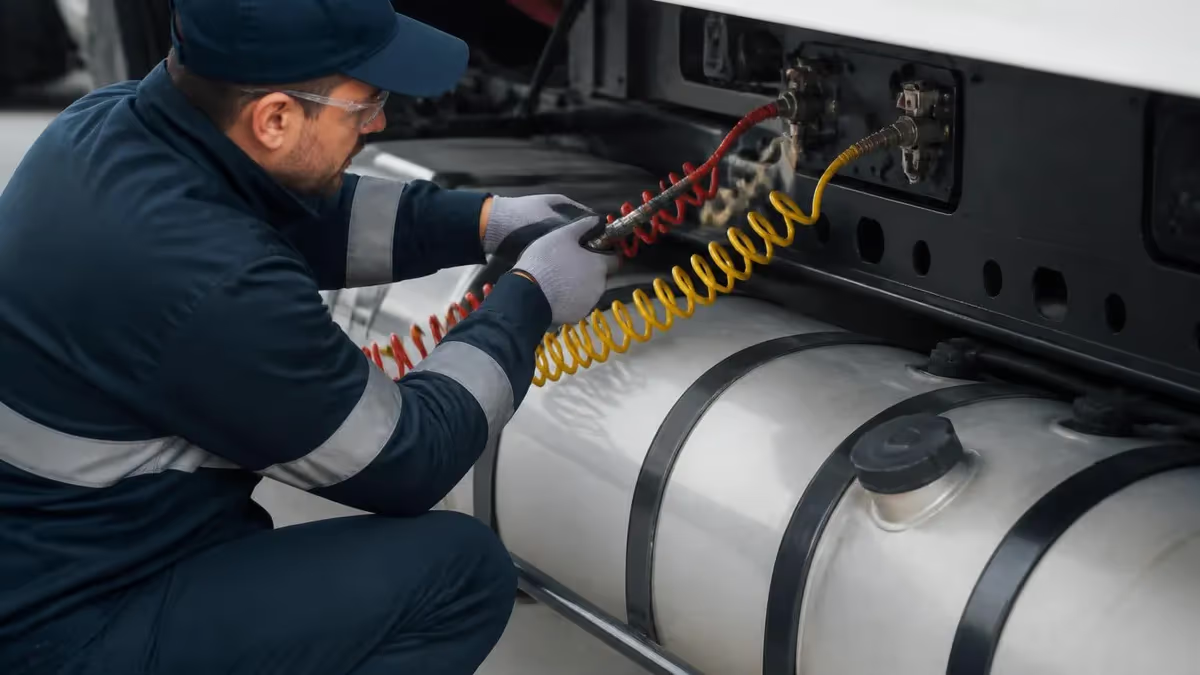
How Do Air Brakes Work? The Complete CDL Driver's Guide
If you are studying for your commercial license, the single biggest question on the knowledge exam is simple to ask and harder to answer: how do air brakes work? Cars use hydraulic brake fluid to push a piston against a rotor. But a loaded semi-truck weighing 80,000 pounds needs a much stronger, much safer system. That system is compressed air. Once you understand the basic flow you will pass the air brake practice test with confidence.
The Core Principle: Compressed Air Replaces Brake Fluid
Air brakes use stored compressed air to apply mechanical braking force at each wheel. A small engine-driven compressor pumps outside air into storage tanks until pressure reaches 120 to 125 psi. When the driver pushes the brake pedal, that stored air is released through valves to brake chambers at each wheel.
The air pressure pushes a diaphragm, which rotates a metal arm called a slack adjuster. The slack adjuster twists an S-shaped cam, which presses two brake shoes against the inside of a spinning brake drum. Friction between the shoes and drum is what actually stops the truck. That is the whole chain in one paragraph, and every CDL written test question on air brakes is asking about some link in that chain.
Hydraulic systems cannot scale this big because brake fluid can leak, boil, or fail under the heat of repeated stops at heavy weight. Compressed air is unlimited (the compressor just makes more), heat-tolerant, and most importantly, fail-safe by design. If a hydraulic line breaks, your car loses brakes entirely. If an air brake line breaks, the truck does the opposite — strong springs at every wheel slam the brakes on automatically.
Why Heavy Vehicles Need Air, Not Hydraulics
A loaded 18-wheeler can carry 35 tons. The kinetic energy at 60 mph is roughly 30 times what a passenger car produces. No reasonable hydraulic master cylinder can generate the force needed to stop that mass repeatedly without overheating the fluid.
Compressed air solves three problems at once. It provides limitless braking force. It cannot vapor-lock under heat. And it powers the spring brake fail-safe that gives the system its safety reputation. That is why every Class A vehicle, most Class B vehicles, and many buses use air. Studying with the air brake practice test 2026 drills these system fundamentals into memory.
A second important point: air is free. The compressor pulls regular atmospheric air through an intake filter and compresses it into the storage tanks. There is no fluid reservoir to refill, no special chemistry, no compatibility worries. That cost-free supply is part of why air systems can run continuously on coast-to-coast hauls with zero supply maintenance. The only consumable in the air loop is the desiccant cartridge that dries the air, and even that lasts a year.
Air brakes use compressed air (not fluid) to push diaphragms in brake chambers, which rotate S-cams that press brake shoes against drums. The compressor builds air to ~120 psi. Pressing the pedal releases air to the chambers. Loss of air pressure triggers spring brakes to apply automatically — that is the fail-safe. CDL drivers need an air brake endorsement to operate any vehicle with this system.
Key Air Brake System Components
- Function: Pumps outside air into storage tanks
- Driven by: Engine via belt or gears
- Output: 100 to 125 psi
- Function: Regulates compressor cut-in and cut-out
- Cut-in: Around 100 psi
- Cut-out: Around 125 psi
- Wet tank: Traps water and oil
- Service tanks: Supply primary and secondary circuits
- Drain: Daily, to prevent freezing
- Function: Driver-controlled air release
- Modulation: More pedal = more air = more force
- Type: Dual-circuit treadle valve
- Function: Convert air pressure into mechanical push
- Part inside: Diaphragm and pushrod
- Sizes: Type 20, 24, 30 commonly used
- Slack adjuster: Lever that takes wear slack out of shoes
- S-cam: Rotates to push shoes outward
- Final force: Shoes press into drum, friction stops wheel

Step-By-Step: What Happens When You Press the Pedal
Understanding the sequence inside the system is the difference between memorizing facts and actually knowing the material. Here is what happens the moment your foot hits the treadle valve in a truck moving down the highway. Five stages, every one of them mechanical, every one of them testable on the CDL exam.
First, the foot valve opens. Stored air rushes from the service tanks through brake lines toward each wheel. The amount of air released depends on how hard you press — light pressure releases a little, full pressure releases a lot. This is why air brakes are modulated rather than on-off. Skilled drivers feather the pedal the same way they feather a gas pedal.
Second, the air arrives at the brake chamber on each wheel. Inside the chamber, a rubber diaphragm flexes outward under the pressure. The diaphragm pushes a metal pushrod out the back of the chamber. The harder you press the pedal, the further the pushrod extends. The entire response happens in under half a second on a properly maintained system, which is slightly slower than hydraulic but plenty fast for highway use.
Third, the pushrod rotates the slack adjuster. The slack adjuster is essentially a lever arm with one end on the pushrod and the other end on the brake camshaft. As the pushrod extends, the slack adjuster swings, rotating the camshaft. Slack adjusters wear over time as the brake shoes wear, so they have an adjustment mechanism to keep travel within spec — usually under one inch.
Fourth, the camshaft turns the S-cam. The S-cam is a shaft with an S-shaped lobe sitting between the two brake shoes inside the drum. As the cam rotates, its widening profile forces the two shoes outward, pressing them into the inside surface of the brake drum spinning with the wheel. The S-cam shape is what makes the force progressive rather than abrupt.
Fifth, friction does the rest. The shoes have a friction lining that grabs the drum. The drum cannot keep spinning freely against the shoes, so it slows, and because the drum is bolted to the wheel hub, the wheel slows with it. The kinetic energy of the moving truck converts to heat in the drum, which is why brake drums get extremely hot and why downhill grade braking requires careful pacing.
On long descents, experienced drivers use engine retarders and lower gears to spare the drums rather than dragging the service brakes the entire grade. Practice the sequence with a focused cdl air brakes practice test before exam day.
The Three Air Brake Subsystems
The brakes you use every day. When you press the foot valve during normal driving, air flows from the service tanks through the brake lines to each chamber. Service brakes are modulated — light pressure for slowing down, heavy pressure for hard stops. They are the primary system for all routine braking and account for nearly all your stopping during a normal route.
Air Brake System Numbers Every CDL Driver Must Know

CDL Pre-Trip Air Brake Inspection: 7 Required Steps
Step 1: Build Air to Governor Cut-Out
Step 2: Test the Low-Air Warning
Step 3: Spring Brakes Auto-Apply
Step 4: Air Leakage Rate Test
Step 5: Parking Brake Test
Step 6: Service Brake Test
Step 7: Drum and Slack Adjuster Visual
Spring Brakes: The Fail-Safe That Makes Air Brakes Trustworthy
The spring brake is the single most important safety feature in any commercial air brake system. Picture a heavy steel coil spring strong enough to apply the brakes on its own. In normal driving, air pressure (around 100 psi) compresses that spring inside the rear brake chambers, holding the brakes off. When you set the parking brake or the system loses pressure, air bleeds out and the spring snaps back, jamming the brakes on.
This is why air brake systems are described as fail-safe rather than fail-open. A hydraulic system can lose pressure and leave the driver with no brakes. An air system can lose pressure and the worst-case result is locked wheels. That is not a comfortable stop, but it stops the truck. The yellow diamond-shaped knob on the dash is your manual control. Pull it, and air exhausts from the spring chambers, applying the parking brakes. Push it in, and air refills the chambers, releasing them.
The Dual Air Brake System and Why It Exists
Modern trucks use two completely separate air circuits — primary and secondary. The primary circuit normally controls the rear axles, while the secondary handles the steer axle. Configuration varies by manufacturer. Each circuit has its own air storage tank, its own gauge, and its own warning. If one circuit fails, the other still provides braking on roughly half the wheels. This redundancy is mandated by federal regulation.
That mandate exists because a single point of failure in a critical safety system is unacceptable on a vehicle carrying 80,000 pounds. Reading the cdl air brakes section of your state CDL manual will reinforce these federal requirements with local details. Watch for state-specific quirks too — some states test heavily on dual circuit gauge reading, others focus on warning lights.
Air Brake Endorsement: Written, Skills, and the Restriction
To drive a commercial vehicle equipped with air brakes you need the air brake endorsement added to your CDL. There are two parts. The written knowledge test covers component identification, pressure thresholds, and the inspection steps. The skills test happens at the road test, where the examiner watches you perform the seven-step pre-trip and demonstrate spring brake apply and release.
If you take your road test in a vehicle without air brakes, the state stamps an air brake restriction (L restriction) on your license. That restriction means you legally cannot drive an air-equipped truck until you retake the skills test in one. The smartest move is to take the test in an air-equipped vehicle from the start so the restriction never appears. Walk through the system one more time with the air brake practice test pdf printable so you can mark up your own notes.
Drum Brakes vs Air Disc Brakes: The Modern Shift
The vast majority of commercial trucks still use drum brakes activated by S-cams and air chambers. They are durable, repairable, and inexpensive. The downside is that drum brakes fade more under heavy heat and they take longer to stop than disc brakes. Newer Class 8 trucks are increasingly equipped with air disc brakes — same air supply, same chambers, but the air pushes a caliper that squeezes pads against a rotor. Air disc brakes stop roughly 20 to 30 percent shorter, recover faster from heat, and require less adjustment.
Common Problems and How to Spot Them
Air brake systems fail predictably, and a trained driver can spot trouble before a roadside inspector does. The most common issue is moisture in the lines — water from the air gets compressed along with air, then condenses inside the storage tanks. In cold weather it freezes, blocking air flow. Drivers prevent this by draining the wet tank daily and using an air dryer with a desiccant cartridge. Run a final timed cdl air brake test the night before your exam to lock in pre-trip terminology.
Air Brakes vs Hydraulic Brakes
- +Limitless braking force — compressor never runs out of air
- +Fail-safe design — air loss triggers automatic spring brake apply
- +No heat-related fluid boiling like hydraulic systems
- +Dual circuit redundancy mandated by federal rule
- +Capable of stopping 80,000-pound loads repeatedly
- +Easy to integrate trailer braking on combination vehicles
- −Slower response time (about 0.4 seconds vs 0.25 for hydraulic)
- −Moisture in air system causes freezing in winter
- −Requires daily tank draining and inspection
- −More expensive components and more frequent maintenance
- −Air compressor steals engine power continuously
- −Slack adjusters require regular checks for wear
Pros and Cons at a Glance
| Pros | Cons |
|---|---|
| Limitless braking force — compressor never runs out of air | Moisture in air system causes freezing in winter |
| Fail-safe design — air loss triggers automatic spring brake apply | Requires daily tank draining and inspection |
| No heat-related fluid boiling like hydraulic systems | More expensive components and more frequent maintenance |
| Dual circuit redundancy mandated by federal rule | Air compressor steals engine power continuously |
| Easy to integrate trailer braking on combination vehicles | Slack adjusters require regular checks for wear |

Air Brake Pre-Trip Daily Checklist
- ✓Drain wet tank and service tanks until air runs dry
- ✓Build air pressure to governor cut-out (around 125 psi)
- ✓Confirm low-air warning activates above 60 psi
- ✓Verify spring brakes auto-apply between 20 and 40 psi
- ✓Test air leakage rate (under 2 psi/min released, 3 psi/min applied)
- ✓Inspect each brake chamber for cracks, leaks, or missing clamps
- ✓Check pushrod travel on every slack adjuster (under 1 inch)
- ✓Visually inspect drums for cracks, glazing, and contamination
- ✓Test parking brake holds against gentle forward gear
- ✓Test service brake with rolling stop — no pulling, no noise
Class A, Class B, and When Air Brakes Are Required
Air brakes appear across all commercial vehicle classes but they show up differently depending on what you drive. Class A combination vehicles almost always have air brakes on both the tractor and the trailer. Glad-hand connectors join the two air systems so the trailer brakes receive air from the tractor compressor. Class B straight trucks and buses over 26,001 pounds typically have air brakes if they are heavy-duty workhorses like dump trucks or transit buses.
Class C vehicles may or may not have air brakes depending on configuration. Some shuttle buses use hydraulic, but anything heavy enough to need them will. The CDL air brake endorsement covers all three classes — once you pass it, you are legally cleared for any air-equipped vehicle in your weight class.
How the Air Brake Endorsement Fits Into Your CDL Path
Most CDL candidates take the air brake knowledge test the same day they take their general knowledge test. The written exam typically has 25 multiple-choice questions, and you need 80 percent to pass on most state versions. Topics: component identification, pressure thresholds (especially 60 psi and 20-40 psi), inspection steps, dual circuit basics, spring brake operation.
The skills exam is hands-on: the examiner watches you perform the seven-step inspection out loud, naming each component and verifying each pressure point. Memorize the script, point to each part as you name it, and call out every pressure value as the gauges hit them.
Maintenance, Adjustment, and Long-Term Care
Air brake systems reward consistent maintenance more than almost any other truck system. The desiccant cartridge in the air dryer should be replaced annually. Storage tanks should be drained daily — the wet tank first, then the service tanks. Skipping this is the number one preventable failure in cold climates.
Slack adjusters on most newer trucks are automatic but should still be visually inspected weekly. Brake chambers have a finite lifespan because the rubber diaphragm degrades; expect to replace them every 3 to 5 years. The compressor runs whenever the engine runs, so it accumulates hours fast. Most fleets schedule a full air system service every 100,000 miles.
Drivers who treat the daily walk-around as a real inspection catch most problems in time to avoid roadside violations and emergency repairs. DOT inspectors check the same things every time: pushrod travel, drum cracks, leaking fittings, contaminated air, missing safety wires on chamber clamps. If you check them first, you almost never get cited.
The Bottom Line: Why This System Has Lasted 150 Years
George Westinghouse patented the modern air brake in 1869 because the railroads needed a way to stop heavy trains. The same logic applies to modern heavy trucks. Compressed air is unlimited, reliable, heat-tolerant, and fundamentally fail-safe. The system is also dead simple to diagnose — most problems show up clearly on the air gauge or in the pushrod travel measurement. A trained driver with a flashlight can identify nearly every common issue in five minutes.
Master the seven-step pre-trip, memorize the four critical pressure numbers (125 cut-out, 60 warning, 20-40 spring apply, 85-100 build in 45 seconds), understand the spring brake fail-safe, and you have the knowledge base every CDL examiner expects. Combine that with daily practice on a realistic question bank and the air brake endorsement becomes one of the easier CDL milestones — finite, logical, and repeatable.
Every truck on the road uses the same physics. Whether you drive a dump truck in town or a long-haul tractor pulling double trailers, the compressor builds the same air to the same psi, the pedal opens the same valves, the spring brakes apply on the same trigger. Learn the system once and it carries through your entire driving career. For a full practice run before exam day, work through the timed air brakes question set and you should comfortably clear the 80 percent passing mark on the written portion.
Air Brake Questions and Answers





About the Author

Educational Psychologist & Academic Test Preparation Expert
Columbia University Teachers CollegeDr. Lisa Patel holds a Doctorate in Education from Columbia University Teachers College and has spent 17 years researching standardized test design and academic assessment. She has developed preparation programs for SAT, ACT, GRE, LSAT, UCAT, and numerous professional licensing exams, helping students of all backgrounds achieve their target scores.